
A fire pump is not an ordinary standby load. When an installation uses automatic transfer between a normal power source and an alternate source, the transfer equipment must be reviewed as part of the complete fire-pump power system—not selected only from the ampere rating printed on a standard ATS.
This guide helps fire-pump controller manufacturers, panel builders, electrical contractors, consultants and project procurement teams determine what must be verified before specifying an automatic transfer switch for a fire pump.
Table of Contents
Quick Answer: Can a Normal ATS Be Used for a Fire Pump?
Do not assume that it can. NFPA 20:2025 Section 10.8.3 contains specific requirements for fire-pump power transfer switches, including fire-pump-service listing, short-circuit suitability, electrically operated and mechanically held construction, and motor-current capability. [1]
A standard compact ATS for general standby loads should therefore not be treated as fire-pump transfer equipment merely because its voltage, pole count and nominal current appear suitable.
Important LEEYEE Product Boundary
LEEYEE supplies compact low-voltage automatic transfer switches for general standby power applications, primarily using open-transition transfer.
A standard LEEYEE compact ATS must not be described as fire-pump-listed transfer equipment unless the exact model, certification scope and project requirements have been independently verified.
Why Is Fire-Pump Transfer Equipment Different From a Normal ATS?
Normal ATS selection usually begins with system voltage, rated current, number of poles and the type of alternate source. These parameters still matter in a fire-pump project, but they are only part of the decision.
Fire-pump transfer equipment forms part of a life-safety power arrangement. Motor starting duty, locked-rotor current, available short-circuit current, controller configuration, source sensing and required listing can all affect whether the equipment is acceptable. [1]
| Selection Item | General Standby ATS | Fire-Pump Project |
|---|---|---|
| Rated current | Selected for defined load duty | Motor full-load and locked-rotor duty also matter |
| Listing / approval | Depends on application | Fire-pump-service listing can be mandatory |
| Short-circuit suitability | Checked against fault level | Explicitly addressed by NFPA 20 Section 10.8.3.2 |
| Operating mechanism | Product dependent | NFPA 20 Section 10.8.3.3 specifies electrically operated and mechanically held equipment |
| Controller coordination | General load coordination | Must fit the fire-pump controller arrangement |
Buyer meaning: matching voltage and nominal amperes does not make a general compact ATS equivalent to dedicated fire-pump transfer equipment.
NFPA 20:2025 Requirements Buyers Should Recognize
For projects governed by NFPA 20:2025, the following clauses are especially relevant when reviewing automatic transfer equipment for a fire pump. [1]
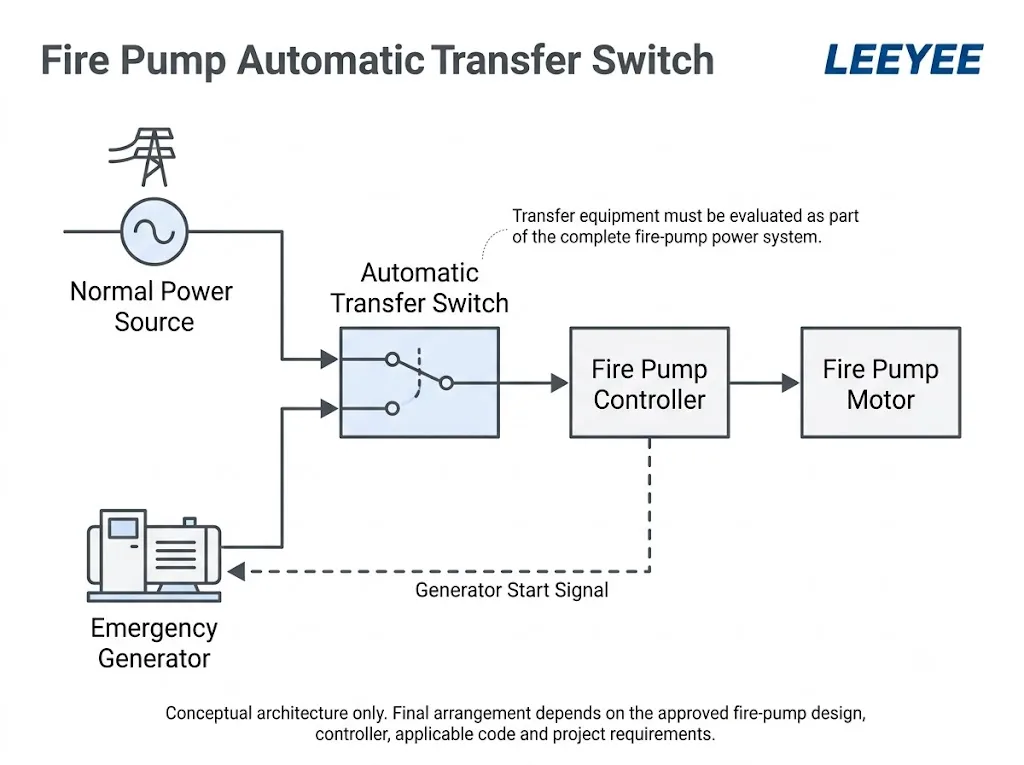
Where Does the ATS Sit in the Fire-Pump Power System?
A fire-pump installation can receive power from a normal source and, where the approved design requires it, an alternate source such as an emergency generator.
The transfer equipment selects the applicable source supplying the fire-pump controller. The controller then manages the fire-pump motor. Dedicated fire-pump systems can integrate or closely coordinate the automatic transfer function with the controller. [1][4]
How Should Fire-Pump ATS Current Rating Be Evaluated?
NFPA 20:2025 Section 10.8.3.4 requires the transfer switch ampere rating to be not less than 115% of motor full-load current and also requires suitability for switching motor locked-rotor current. [1]
A buyer therefore should not compare only the pump's normal operating current with the catalogue current of an ATS.
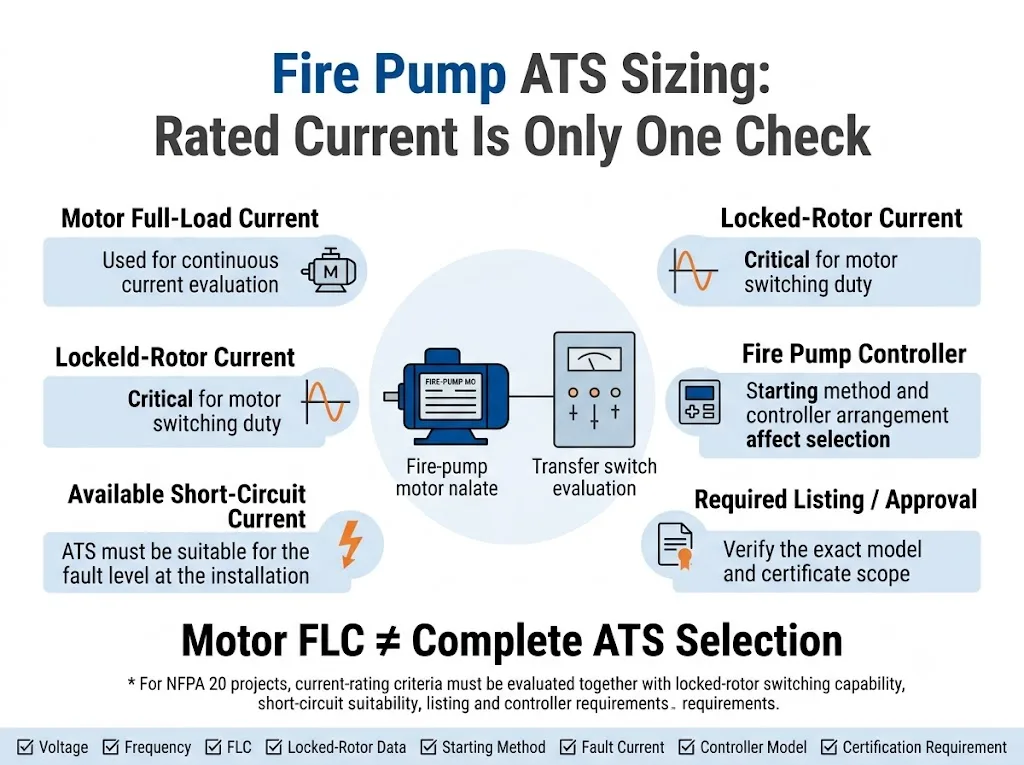
| Required Data | Why It Matters | Typical Source |
|---|---|---|
| Motor voltage | Confirms voltage compatibility | Motor nameplate / datasheet |
| Motor full-load current | Continuous ampere-rating evaluation | Motor / controller data |
| Locked-rotor current | Motor switching duty | Motor technical data |
| Starting method | Affects system behaviour | Controller specification |
| Available fault current | Short-circuit suitability | Electrical study |
Is This Type of LEEYEE Compact ATS Suitable for a Fire Pump?
The LEEYEE product shown below is the compact automatic transfer switch type that LEEYEE actually supplies for general low-voltage standby source transfer.
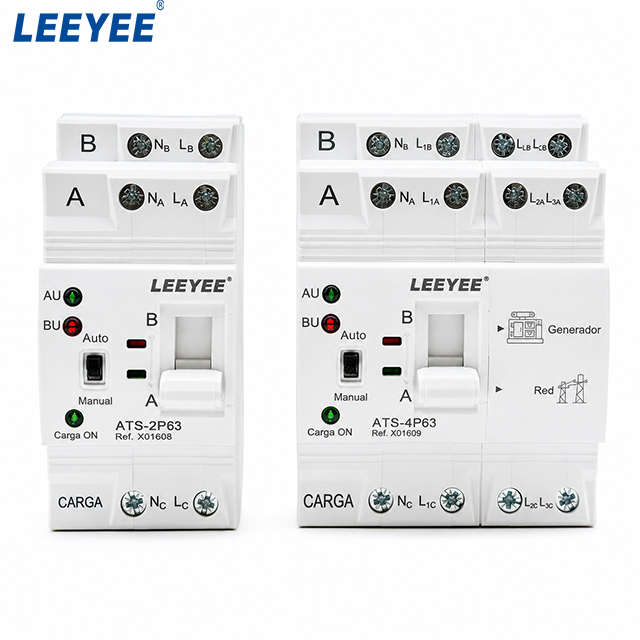
A product of this type can be suitable for ordinary standby-power applications when its verified voltage, current, pole configuration and transfer characteristics match the electrical system.
However, automatic operation, manual operation and dual-source transfer capability do not by themselves establish suitability for a fire-pump installation. These functions should not be confused with a fire-pump-service listing.
What This Means for LEEYEE Buyers
LEEYEE's standard compact ATS should be considered for general standby power projects within its verified product specifications.
If the project specification requires a transfer switch specifically listed for fire-pump service, UL 1008 fire-pump equipment, FM approval or another mandatory fire-protection approval, dedicated certified equipment must be selected instead.
Integrated ATS or Separate Fire-Pump Transfer Equipment?
Fire-pump systems can use transfer equipment integrated with or closely associated with the fire-pump controller, depending on the listed arrangement and project requirements.
Tornatech, for example, publishes electric fire-pump controller configurations with automatic transfer switches associated with the controller. Its GPx information references NFPA 20, UL 218 and UL 1008 for defined product configurations. [4]
The procurement lesson is simple: dedicated fire-pump transfer equipment is normally evaluated together with its controller application rather than treated as an ordinary upstream ATS.
Should a Fire Pump ATS Be 3-Pole or 4-Pole?
There is no universal answer that every fire-pump ATS should be 3-pole or every installation should use 4-pole equipment.
A 4-pole ATS switches the neutral together with the phase conductors. A 3-pole ATS normally leaves the neutral unswitched. The correct choice depends on the grounding and neutral design of the complete system.
What Changes When the Alternate Source Is a Generator?
When an emergency generator is the alternate source, the system has to do more than mechanically switch between two sets of terminals.
Fire-pump transfer systems can involve source sensing, generator-start signalling, alternate-source verification and controlled transfer/retransfer functions. The exact sequence must follow the listed equipment documentation and the requirements adopted for the project. [1][4]
Do not copy timing values or source thresholds from a general compact ATS into a fire-pump specification unless the listed controller and transfer equipment documentation supports them.
Does Every Fire Pump Need an ATS?
No single answer applies to every installation. The need for an alternate source and automatic transfer depends on the governing fire code, reliability of the normal source, facility classification and approved fire-protection design.
Where transfer equipment is required under NFPA 20:2025, Section 10.8.2.3 requires each fire pump to have its own dedicated transfer switch or switches. [1]
Does Every Fire Pump ATS Require Bypass Isolation?
No. Bypass isolation should not be presented as a universal requirement worldwide.
California healthcare projects show why local requirements matter. HCAI PIN 78, effective February 6, 2025, discusses fire-pump ATS listing and bypass-isolation requirements for the applicable OSHPD healthcare applications. [2]
What Does UL 1008 Mean for Fire-Pump ATS Procurement?
UL 1008 is an important transfer-switch standard, but a generic “UL 1008” statement does not by itself prove that a particular model is approved for the exact fire-pump application being specified.
Buyers should verify the exact manufacturer, model, certification category and application scope instead of relying only on a logo or marketing claim.
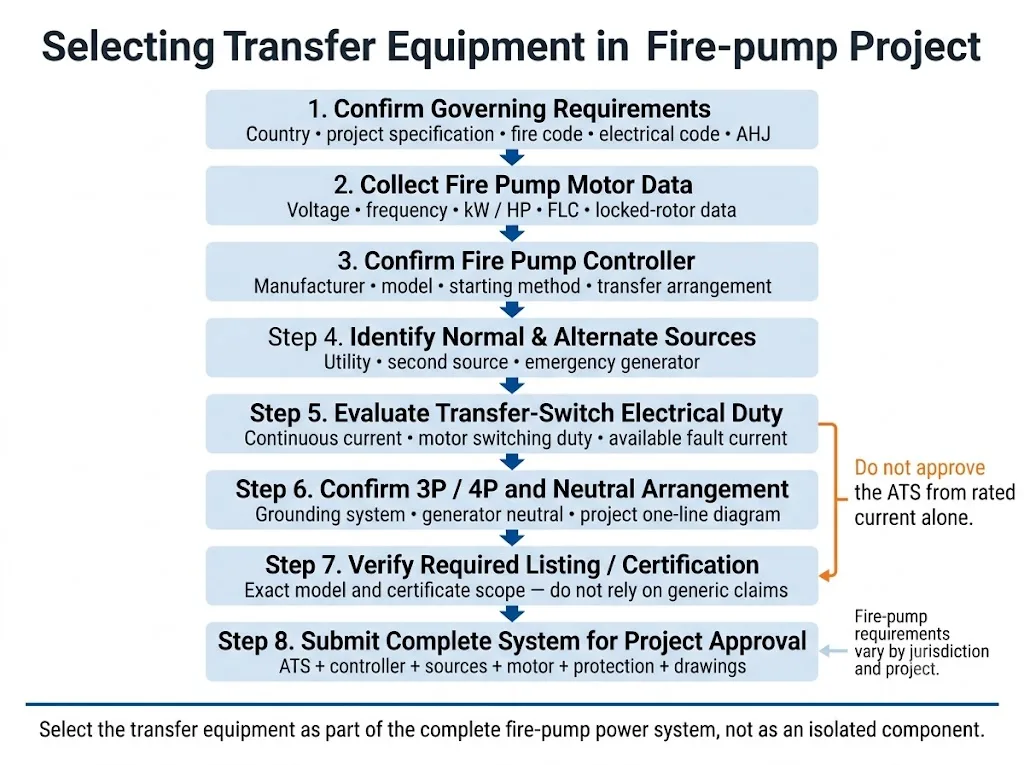
How to Select Fire-Pump Transfer Equipment
Common Fire Pump ATS Selection Mistakes
| Mistake | Why It Creates Risk | Better Action |
|---|---|---|
| Selecting only by amperes | Ignores motor and project conditions | Review full motor and controller data |
| Assuming any automatic ATS is suitable | General ATS and fire-pump ATS are not automatically equivalent | Verify listing and application scope |
| Using a compact ATS because it fits physically | Physical size does not prove compliance | Check listing, motor duty and fault rating |
| Choosing 3P or 4P by habit | Neutral treatment depends on grounding design | Follow the approved one-line diagram |
| Ignoring fault current | Equipment may not be suitable for the installation | Obtain project short-circuit data |
What Should a Buyer Send Before Requesting an ATS Review?
Project Review Checklist
- Project country and facility type
- Applicable fire and electrical code
- Required listing or certification
- Motor kW / HP
- Motor voltage and frequency
- Motor full-load current
- Locked-rotor current or starting data
- Starting method
- Fire-pump controller manufacturer and model
- Normal power source
- Generator or alternate source
- Available short-circuit current
- Grounding and neutral arrangement
- Required pole configuration
- Single-line diagram
Need to Review an ATS Configuration Before Ordering?
Send the motor data, system voltage, normal and alternate source information, controller details, pole requirements and project certification requirements. LEEYEE can help determine whether the electrical requirements fit a standard compact ATS application or whether dedicated fire-pump transfer equipment is required.
Frequently Asked Questions
Can I use a normal ATS for a fire pump?
Do not assume so. For projects governed by NFPA 20:2025, Section 10.8.3.1 requires the power transfer switch to be specifically listed for fire-pump service. [1]
Is a compact LEEYEE ATS a fire-pump ATS?
LEEYEE's standard compact ATS products are intended for general low-voltage standby power transfer. They should not be represented as fire-pump-listed equipment unless the exact model and required certification scope have been verified.
How do I size a fire pump automatic transfer switch?
For NFPA 20:2025 projects, Section 10.8.3.4 requires at least 115% of motor full-load current and suitability for switching locked-rotor current. Other listing, short-circuit and controller requirements must also be checked. [1]
Should a fire pump ATS be 3-pole or 4-pole?
The answer depends on system grounding and neutral treatment. Confirm the generator neutral, electrical code, controller requirements and approved one-line diagram before deciding.
Can one ATS serve several fire pumps?
For projects governed by NFPA 20:2025, Section 10.8.2.3 requires each fire pump to have its own dedicated transfer switch where transfer equipment is required. [1]
Does every fire pump ATS require bypass isolation?
No global rule should be assumed. Some jurisdictions and facility types impose additional requirements. HCAI PIN 78 is one specific California healthcare example. [2]
How can I verify a UL certification claim?
Check the exact manufacturer, model, file number or product category in UL Product iQ rather than relying only on a UL logo or a general UL 1008 statement. [3]
References
- National Fire Protection Association (NFPA), NFPA 20: Standard for the Installation of Stationary Pumps for Fire Protection, 2025 Edition. See Section 10.8.2.3 and Sections 10.8.3.1–10.8.3.4. Verify the edition legally adopted for the project. NFPA publication information.
- California Department of Health Care Access and Information (HCAI), PIN 78 — Fire Pump Automatic Transfer Switches, effective February 6, 2025. HCAI PIN 78.
- UL Solutions, Product iQ certification-information resources. UL Product iQ guidance.
- Tornatech, GPx Series — Electric Fire Pump Controllers. Published information describes defined fire-pump controller and automatic transfer configurations referencing NFPA 20, UL 218 and UL 1008. Tornatech GPx Series.
