
Choosing between a 2P, 3P and 4P automatic transfer switch starts with one practical question: which current-carrying conductors must transfer when the ATS changes from one source to the other? Phase configuration matters, but so do the Neutral path, generator grounding, source bonding, protection design and the exact ATS terminal arrangement.
Table of Contents
Quick Answer: 2P vs 3P vs 4P ATS
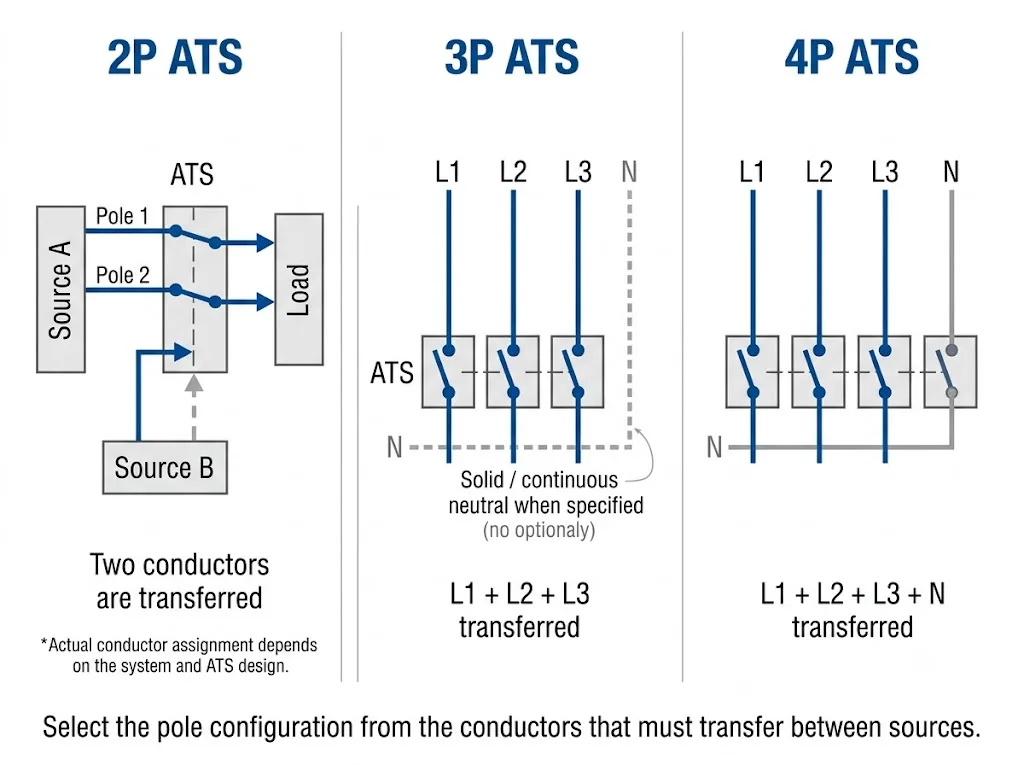
A 2P ATS provides two switched current-carrying paths. It is commonly considered for single-phase applications, but the two poles do not universally represent the same conductors in every electrical system.
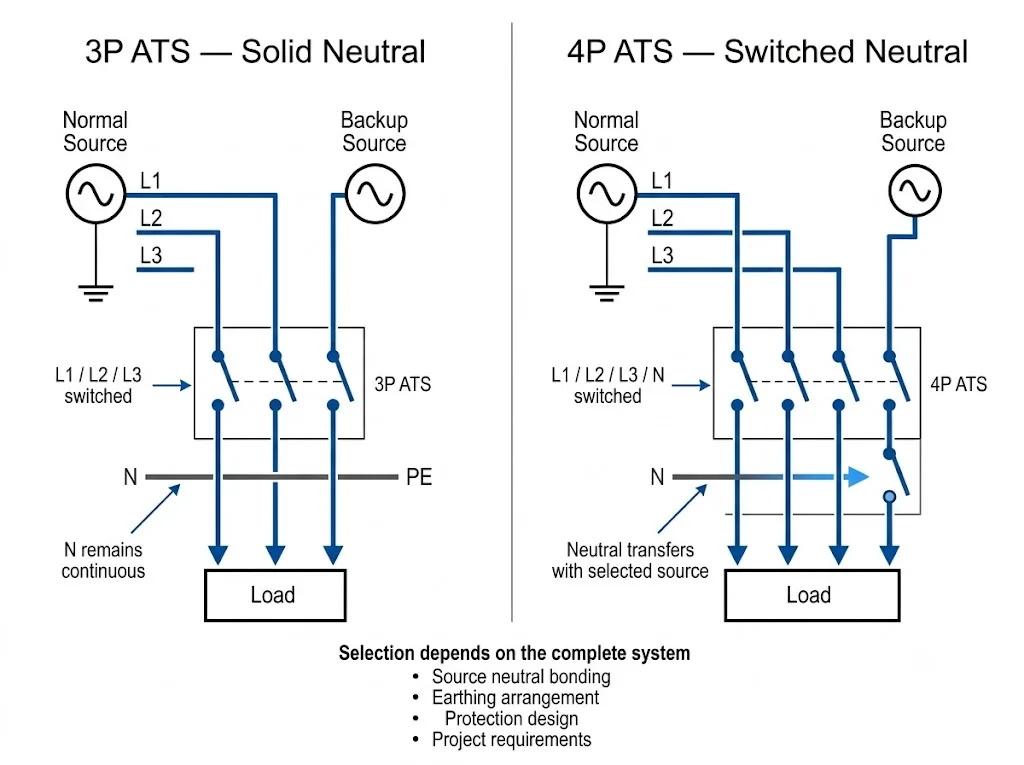
A 3P ATS normally transfers L1, L2 and L3. In a three-phase four-wire system, Neutral may remain continuous outside the three switching poles when that arrangement is compatible with the approved grounding and protection design.
A 4P ATS transfers L1, L2, L3 and Neutral. Eaton describes the use of a fully rated fourth pole where a three-phase application requires the Neutral conductor to be switched.[2]
Use this matrix as a first screening tool. It does not replace the project single-line diagram or the exact ATS datasheet.
| System Arrangement | Conductors Transferred | Starting Point | Verify Before Order |
|---|---|---|---|
| Single-phase application requiring two switched paths | Two conductors | 2P candidate | Actual conductor assignment and Neutral requirement |
| Three-phase, three-wire load | L1 + L2 + L3 | 3P engineering configuration | Product availability, voltage, current and terminal arrangement |
| Three-phase, four-wire with continuous Neutral | L1 + L2 + L3 | 3P engineering configuration | Product availability, Neutral path, source bonding and protection design |
| Three-phase with Neutral transfer required | L1 + L2 + L3 + N | 4P candidate | Neutral switching, grounding and protection requirements |
Procurement conclusion: do not select an ATS only from the words “single-phase,” “three-phase,” “generator,” “TN-S” or “TT.” First confirm which conductors must transfer and what must happen to Neutral.
What Does “Pole” Mean in ATS Selection?
For a buyer, a pole can be understood as one switching path that transfers a current-carrying conductor between the available sources. Pole count therefore describes the number of switched paths inside the ATS.
That is different from phase count, number of sources and switch position. A 4P ATS does not mean four phases, and 2P does not tell you everything about how the two conductors are assigned.
The current IEC product standard is IEC 60947-6-1:2026. It applies to transfer switching equipment used to transfer a load between power supply sources at rated voltages not exceeding 1,000 V AC or 1,500 V DC.[1]
What 2P, 3P or 4P Does Not Tell You
Pole count is important, but it is only one part of the ATS specification. Two products with the same pole count can still differ in ways that matter to a panel builder, distributor or project buyer.
Rated Current
Pole count does not tell you whether the ATS is rated for the required load current or application duty.
Short-Circuit Capability
2P, 3P or 4P does not define the required short-circuit withstand or coordination arrangement.
Neutral Contact Sequence
“4P” confirms a switched fourth path, but does not by itself define whether Neutral is break-before-make, overlapping or uses another manufacturer-specific arrangement.
Controller Functions
Auto/Manual control, source monitoring, indication, transfer delays and generator-start functions are separate from pole count.
PC or CB Class
Pole number does not define the switching architecture or whether the project requires PC Class or CB Class equipment.
Certificate Scope
A certificate or test report must be checked against the exact model, rating and configuration being ordered.
Why This Matters for the LEEYEE Product Shown Above
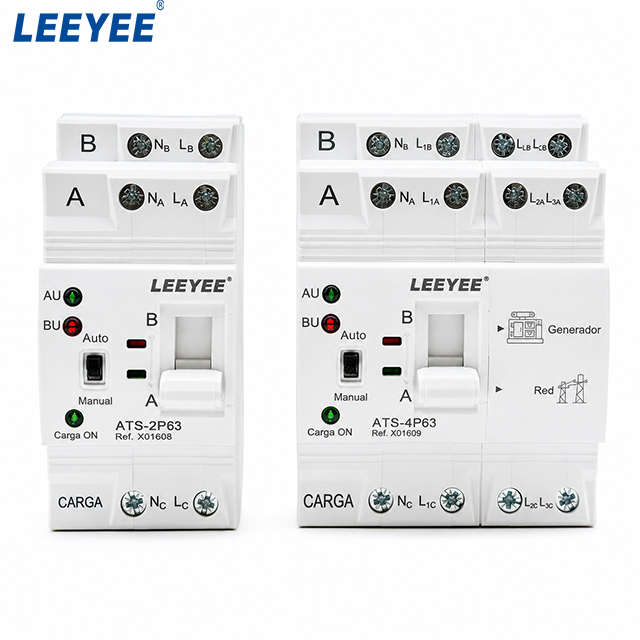
The real LEEYEE 2P and 4P units both include visible Auto/Manual operation and status indication. These are control features. They do not make the 4P version “more advanced” than the 2P version. Pole count answers a different question: how many current-carrying paths must transfer.
How to Choose 2P, 3P or 4P Step by Step
A useful B2B selection process follows the electrical system from the load back toward the sources.
Identify single-phase or three-phase operation
This establishes the first selection boundary. A single-phase application commonly leads toward a 2P configuration, while a three-phase application requires further checking of phase and Neutral switching.
Identify every current-carrying conductor used by the load
A three-phase three-wire load and a three-phase four-wire load do not create the same Neutral question. Confirm whether the load actually uses N.
Decide whether Neutral remains continuous or transfers
Schneider Electric / ASCO distinguishes solid-Neutral and switched-Neutral arrangements. In a switched-Neutral ATS, an additional pole connects the load Neutral to the selected source Neutral.[3]
Check generator grounding and Neutral bonding
Cummins documents generator applications where a switched-Neutral transfer arrangement is used with a separately derived generator system. Grounding and Neutral configuration can also affect the intended ground-fault current path.[5]
Verify the exact LEEYEE or project ATS model
Confirm terminal arrangement, Neutral function, rated voltage, rated current, controller supply, transfer operation, short-circuit characteristics and required documentation before approval.
When Should You Consider a 2P ATS?
A 2P ATS is a common starting point when two current-carrying conductors must transfer between sources. In many line-to-neutral single-phase applications, those paths can correspond to Line and Neutral.
The real LEEYEE product shown on this page includes an ATS-2P63 example. Its two-pole construction provides two switched current-carrying paths. The actual conductor arrangement must still match the application and wiring diagram.
However, 2P should not automatically be translated as “L + N” in every market. The correct conductor assignment depends on the electrical system and the product design.
Important Split-Phase Boundary
In a 120/240 V single-phase three-wire system, a two-pole transfer switch can be used to switch the two ungrounded conductors. This is one reason a buyer should not infer conductor assignment from “2P” alone.[6]
When Is a 3P ATS Configuration Used?
A 3P ATS configuration is used where L1, L2 and L3 must transfer between sources without a switched fourth Neutral pole.
Three-phase, three-wire system
Where the load uses only the three phase conductors, the three switching poles can correspond directly to L1, L2 and L3.
Three-phase, four-wire system with continuous Neutral
A 3P transfer arrangement can also be used in an engineered four-wire system where the project intentionally keeps Neutral continuously connected rather than switching it through the power poles.
Schneider Electric / ASCO describes a solid-Neutral arrangement in which the source Neutrals remain connected through a solid Neutral assembly rather than through a switching pole.[3]
LEEYEE Product Availability Boundary
This 3P section is included because buyers searching “2P vs 3P vs 4P ATS” need to understand the complete engineering decision. The compact LEEYEE ATS product evidence shown on this page demonstrates 2P and 4P versions. Confirm separately whether a specific project has an available 3P LEEYEE model before ordering.
When Should You Consider a 4P ATS?
A 4P ATS is considered when the project requires L1, L2, L3 and Neutral to transfer between the two sources.
The real compact LEEYEE product shown above includes an ATS-4P63 example. Its four-pole construction provides four switched current-carrying paths for applications requiring this configuration.
Eaton states that three-phase transfer switches requiring Neutral switching can use a fully rated fourth pole that performs in the same manner as the individual phase power poles.[2]
Cummins also documents switched-Neutral transfer arrangements for separately derived generator systems and explains their relationship with generator grounding and ground-fault sensing.[5]
4P Is Not Automatically Better Than 2P or 3P
A fourth pole is not a quality grade or premium safety upgrade. It changes how many current-carrying conductors transfer. The correct product is the configuration that matches the approved electrical system.
Does Every 4P ATS Switch Neutral in the Same Way?
No. “4P” tells you that a fourth switched path exists, but it does not fully describe the Neutral contact sequence.
Schneider Electric / ASCO distinguishes solid, switched and overlapping Neutral arrangements. A switched Neutral is commonly described as break-before-make, while an overlapping Neutral uses a make-before-break sequence for the Neutral contacts.[4]
Buyers should therefore verify the exact ATS documentation rather than assuming that every 4P product has the same Neutral-transfer behaviour.
Current IEC Scope Boundary
IEC 60947-6-1:2026 lists overlapping-Neutral transfer switching equipment among types that remain under consideration and are not covered by the current edition.[1] If a project specifically requires overlapping Neutral operation, verify the applicable product documentation, test basis and project requirements separately.
Do TN-S, TN-C-S or TT Systems Automatically Decide 3P or 4P?
No. The earthing-system designation is an important input, but it does not independently determine the ATS pole count.
The project still needs to establish:
- how the Normal source Neutral is grounded and bonded;
- how the Emergency source or generator Neutral is grounded and bonded;
- whether the two source Neutrals remain interconnected;
- whether the generator is treated as a separately derived source;
- how residual-current or ground-fault protection is intended to operate;
- and what local project requirements specify.
Project Confirmation Required
Do not create a universal rule such as “TN-S = 3P” or “TT = 4P.” Final selection should follow the approved single-line diagram, source documentation, protection design, applicable electrical rules and the exact ATS datasheet.
Three Practical ATS Pole Selection Examples
These examples illustrate selection logic. They are not substitutes for a project electrical design.
Example 1: 230 V L-N Load
A single-phase project requires two current-carrying paths to transfer. A 2P ATS is a reasonable starting candidate. Confirm that the selected product and wiring diagram match the required Line and Neutral arrangement.
Example 2: Three-Phase Three-Wire Load
The load uses L1, L2 and L3 with no distributed Neutral. A 3P transfer configuration is a logical engineering starting point. Product availability must still be confirmed before purchase.
Example 3: Three-Phase Four-Wire System
The approved design requires L1, L2, L3 and Neutral to transfer between sources. A 4P ATS becomes the starting candidate, subject to confirmation of Neutral switching, grounding and protection requirements.
What Happens If the Wrong Pole Configuration Is Ordered?
Neutral Path Mismatch
The project may require a transferred Neutral while the purchased ATS keeps it continuous, or the reverse.
Protection Problems
An incorrect grounding or Neutral arrangement can affect the intended ground-fault current path and associated sensing.[5]
Panel Redesign
A different pole configuration can change terminal planning, conductor routing, installation space and the exact ATS model.
Procurement Rework
If the mismatch is discovered after production or cabinet assembly, the correction may require another ATS rather than a simple wiring change.
What Panel Builders and Distributors Should Verify Before Fixing the SKU
A distributor should not manage ATS inventory only as “63 A” or by another current rating. Pole configuration and electrical arrangement should be part of the SKU logic.
The key procurement question is not only “What have we already decided?” but also “What can still change the final model?”
| Already Decided | Still Verify | Why It Matters |
|---|---|---|
| 2P / 3P / 4P candidate | Available model, terminal arrangement and Neutral function | Engineering configuration and actual supplier product range are not always identical |
| Rated current | Application duty and short-circuit requirements | These can change the required ATS model or coordination |
| System voltage | Controller and source-sensing voltage | Power poles and control electronics are separate selection items |
| 4P required | Neutral contact sequence | 4P alone does not define the Neutral switching sequence |
| Project standard | Exact certificate or report model scope | A certificate should not be assumed to cover every configuration |
| Cabinet concept | Dimensions, terminals and installation space | Different pole configurations can affect panel layout |
Rated current + 2P/3P/4P requirement + system voltage + frequency + source type + Neutral arrangement + controller requirement + required standard/certificate + quantity + OEM requirement.
Before Ordering a 2P or 4P LEEYEE ATS
Prepare these project details before final model confirmation:
- Source 1: utility, generator or other supply
- Source 2: utility, generator or other supply
- Phase arrangement: single-phase or three-phase
- Rated voltage and frequency
- Required load current
- Required pole arrangement: confirm whether the project needs two or four switched paths
- Neutral arrangement: continuous or switched
- Generator Neutral and grounding information, when applicable
- Earthing arrangement and protection scheme
- Short-circuit or coordination requirement
- Controller and sensing requirements
- Required standard, certificate or project approval document
- Quantity, label and OEM packaging requirements
Need to Confirm a 2P or 4P ATS Configuration?
Share your system voltage, phase arrangement, load current, source type, Neutral requirement and generator grounding information. LEEYEE can review these details against the available compact ATS configuration before model confirmation.
ATS Pole Selection FAQ
Is a 2P ATS always L + N?
No. 2P means two switched poles. In many line-to-neutral systems those may be Line and Neutral, but another electrical system can assign the two switched poles differently.
Does LEEYEE offer the compact ATS shown here in 2P and 4P?
The real product example shown on this page includes ATS-2P63 and ATS-4P63 configurations. Final current, voltage, control and project requirements should still be confirmed before ordering.
Does this page confirm a LEEYEE 3P model?
No. The 3P section explains the engineering configuration because 3P is part of the wider 2P-versus-3P-versus-4P selection question. Confirm actual LEEYEE model availability separately.
Can a 3P ATS configuration be used in a three-phase four-wire system?
It can be used in an engineered arrangement where L1, L2 and L3 transfer while Neutral intentionally remains continuous. Grounding, bonding and protection design must support that arrangement.[3]
When should I choose a 4P ATS?
A 4P ATS is considered when L1, L2, L3 and Neutral must all transfer between the two sources. Final selection should still be checked against the project grounding and Neutral-bonding design.[2]
Does a generator always require a 4P ATS?
No. Generator systems can use different grounding and Neutral arrangements. The choice depends on the approved generator grounding, Neutral bonding and protection design.[5]
Is a 4P ATS more advanced than a 2P ATS?
No. Pole count describes the number of switched current-carrying paths. Auto/Manual operation, status indication and controller functions are separate features.
Does TT, TN-S or TN-C-S automatically determine the ATS pole number?
No. The earthing arrangement is one input. Source Neutral bonding, generator grounding, protection design and local project requirements must also be checked.
Does every 4P ATS use the same Neutral switching sequence?
No. A 4P label does not fully define the Neutral contact sequence. Manufacturer documentation should be checked for the exact switching behaviour.[4]
References
- IEC. IEC 60947-6-1:2026, Low-voltage switchgear and controlgear — Part 6-1: Multiple function equipment — Transfer switching equipment. Official IEC publication page.
- Eaton. Fundamentals of Automatic Transfer Switches (ATS), including fully rated fourth-pole and switched-Neutral application guidance. Eaton technical guidance.
- Schneider Electric / ASCO. Neutral Configurations in Transfer Switches, Data Bulletin ASC-DB-NCTS. Schneider Electric / ASCO data bulletin.
- Schneider Electric / ASCO. What neutral configurations are available for ASCO Transfer Switches? Description of solid, switched and overlapping Neutral arrangements. Schneider Electric technical FAQ.
- Cummins Power Generation. Application Manual — Transfer Switches, grounding methods and switched-Neutral transfer-switch application considerations. Cummins application manual.
- Eaton. Residential Transfer Switches Catalogue, examples of 120/240 V single-phase two-pole transfer-switch configurations. Eaton catalogue.