
Choosing between a contactor type ATS and a switch type ATS is not simply a question of which design is faster, carries more current, or costs less. Both architectures are used in low-voltage source-transfer systems, but they are built differently. For panel builders, generator integrators and OEM buyers, the correct decision depends on switching duty, utilization category, short-circuit conditions, upstream protection, operating endurance, isolation requirements and the design of the complete transfer switching equipment.
A contactor-based ATS can be attractive where high operating endurance, relatively fast electromagnetic operation and flexible panel-built control are important. A purpose-built switch-type ATS can be attractive where an integrated change-over mechanism, stable mechanical positions, compact assembly and an isolation function where specifically declared are priorities.
Neither construction is automatically better for generator backup, industrial panels or high-current systems. Define the electrical requirements first, then select the switching architecture.[1][2]
Inhaltsübersicht
Contactor Type ATS vs Switch Type ATS at a Glance
For procurement, the most useful comparison is not a simple list of advantages and disadvantages. It is a comparison of the factors that change panel design, operating duty, short-circuit coordination, maintenance and project approval.
| Decision factor | Contactor-type ATS | Switch-type ATS |
|---|---|---|
| Switching architecture | Two interlocked power contactors or a purpose-designed contactor switching assembly | Dedicated change-over switching mechanism |
| Typical IEC relationship | Often used in Class CC configurations; verify the complete TSE classification | Often used in Class PC configurations; verify the complete TSE classification |
| Operating speed | Electromagnetic actuation can be relatively fast | Depends on the motor, solenoid or other mechanism used |
| Operating endurance | High operation counts can be a design advantage | Check mechanical and electrical endurance for the exact product |
| Source interlocking | Mechanical and electrical interlocking are commonly required | Source separation is normally built into the change-over mechanism |
| Short-circuit interruption | Do not assume the contactors interrupt fault current | Class PC equipment is not selected as a short-circuit protective breaker |
| Isolierung | Must be confirmed from the complete design | Some devices provide an isolation function when specifically declared |
| Panel integration | Flexible but may require more separately assembled control components | Integrated ATS construction can simplify panel assembly |
| Grundlage der Auswahl | Duty, endurance, utilization category, control logic and coordination | Duty, integration, isolation requirements, utilization category and coordination |
Buyer conclusion: neither “contactor type” nor “switch type” describes the complete electrical capability of an ATS. Check the complete product ratings and the required protective-device arrangement.
How Do the Two ATS Architectures Actually Differ?
In a conventional contactor-based arrangement, one contactor connects the load to the normal source and another connects it to the alternate source. For open-transition operation, the design must prevent the two source contactors from closing at the same time. ABB's contactor-based ATS application guidance specifically requires electromechanical interlocking between the power contactors in its example systems.[3]
A switch-type ATS uses a dedicated change-over mechanism to move the load connection from one source to the other. A typical switch-derived Class PC product is built as complete transfer switching equipment rather than simply two independently assembled contactors.[4]
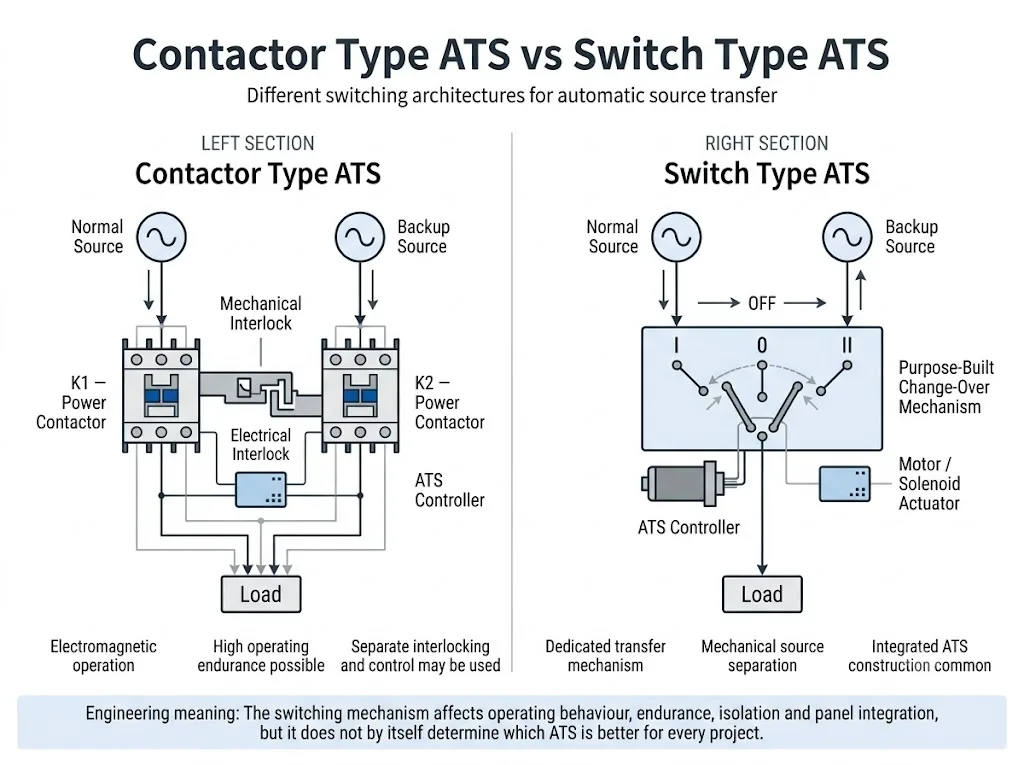
Do not approve an ATS from a controller photo or from the words “automatic transfer” alone. Ask how the power contacts are switched, how unintended source overlap is prevented, what the complete transfer equipment is rated for and what test documentation covers the selected configuration.
Where Does the LEEYEE Compact ATS Fit?
LEEYEE's standard ATS range uses a compact integrated change-over construction with automatic/manual operation and source/status indication in one unit. It is not the traditional panel-built arrangement made from two separate power contactors.
In the context of this comparison, the LEEYEE product architecture is therefore closer to the purpose-built switch/change-over side of the comparison. The contactor-type architecture is included in this guide to help engineers and buyers understand an important alternative used in the wider ATS market; it does not imply that LEEYEE's standard range includes a traditional two-contactor ATS.
Wichtig: physical appearance alone must not be used to assign IEC Class PC, utilization category, Icw, conditional short-circuit rating or certification scope. Those values must be confirmed from the datasheet, test report or certificate for the exact LEEYEE model being offered.
When Should You Choose a Contactor Type or Switch Type ATS?
There is no universal winner. The following conditions provide a useful starting point for a contactor-based ATS vs switch-based ATS comparison, but project-specific electrical requirements remain decisive.
Contactor Type May Be Attractive When
- the application expects comparatively frequent source transfers;
- high operating endurance is a major requirement;
- fast electromagnetic actuation is valuable to the transfer sequence;
- the panel builder wants flexible control using separate contactors, relays and controller logic;
- the complete assembly's utilization category and short-circuit coordination have been verified.
Switch Type May Be Attractive When
- a purpose-built change-over mechanism is preferred;
- compact integration is important;
- stable mechanical switching positions are useful;
- an isolation function is required and is specifically declared by the selected product;
- the ATS ratings and upstream protective-device coordination match the project.
Rules such as “generator = contactor,” “industrial = switch,” or “high current = switch type” are too simplistic. The correct choice depends on load duty, fault level, switching frequency, utilization category, upstream protection and the complete ATS documentation.
“Contactor Type” and “Switch Type” Are Not the Whole IEC Specification
The current international product standard is IEC 60947-6-1:2026, Ausgabe 4.0. It applies to transfer switching equipment used to transfer a load between power sources within its specified voltage scope. The 2026 edition also contains specific requirements for bypass/isolation TSE, closed-transition ATSE and stand-alone ATS controllers.[1]
One point is particularly important for panel builders: IEC 60947-6-1:2026 does not cover TSE configurations that are not fully manufacturer type-tested or marked according to the document as a complete transfer switch.[1]
Two contactors plus an ATS controller should not automatically be described as an IEC 60947-6-1 compliant complete ATSE. The complete assembly, interlocking, controller, switching devices, ratings, marking and conformity evidence must be verified.
ABB's IEC-market guidance describes Class CC solutions in relation to contactor technology and Class PC solutions in relation to switching equipment capable of making and withstanding specified short-circuit current without being intended to break short-circuit current as a protective circuit breaker does.[2]
These relationships help explain the technologies, but buyers should use the classification declared for the complete product instead of assigning a class from its external appearance.
Which ATS Type Switches Faster?
A contactor mechanism can operate quickly because the contactor is electromagnetically actuated. ABB identifies relatively high switching speed as one advantage of contactor-based ATS solutions when compared with traditional motor-and-gearbox switch mechanisms.[3]
That does nicht mean every contactor ATS is faster than every switch-type ATS. The actual result depends on the actuator, mechanism and controller used by the selected product.
Compare total transfer time, not only the movement time of the switching mechanism. Source-failure detection, controller delays, generator starting and source stabilization can all affect the interruption experienced by the load.
Why generator backup is a good example
In a utility-to-generator system, the ATS normally does not transfer the load simply because its mechanical part can move quickly. The generator first needs to start and reach acceptable electrical conditions before the controller commands transfer.
This means a small difference in mechanism speed may be much less important than generator starting time, programmed delays and source qualification.
Which Type Has Longer Mechanical and Electrical Life?
High operating endurance is a recognized advantage of contactor-based transfer solutions. ABB notes that contactors can support a high number of electrical operations, making them relevant in applications with frequent source transfers.[3]
However, that does not justify a universal statement that every contactor ATS has a longer service life than every switch-type ATS.
For project approval, check:
- mechanical endurance of the complete switching mechanism;
- electrical endurance at the required operational current;
- applicable utilization category;
- expected number of transfers during the project life;
- motor, inductive or mixed-load characteristics;
- manufacturer conditions attached to the published endurance data.
A headline mechanical-life number does not tell the whole story. For an OEM panel or project approval, electrical endurance at the required switching duty is usually the more useful comparison.
Mechanical and Electrical Interlocking Matter
For a conventional open-transition contactor ATS, the two source contactors must not close simultaneously. A mechanical interlock physically restricts simultaneous closure, while electrical control logic can provide another layer of command interlocking. ABB specifically requires electromechanical interlocking in its example contactor ATS systems.[3]
In a purpose-built switch-type ATS, the source-change mechanism is normally designed as one mechanically coordinated switching system rather than two independently operated power contactors.
Do not confuse ordinary open-transition ATS with closed-transition ATS. LEEYEE's standard compact range is focused on ordinary open-transition transfer. Closed-transition, bypass/isolation or other advanced schemes require project-specific engineering and should not be presented as standard stock functionality unless the exact supplied configuration has been confirmed.
Short-Circuit Capability Is More Important Than the Mechanism Name
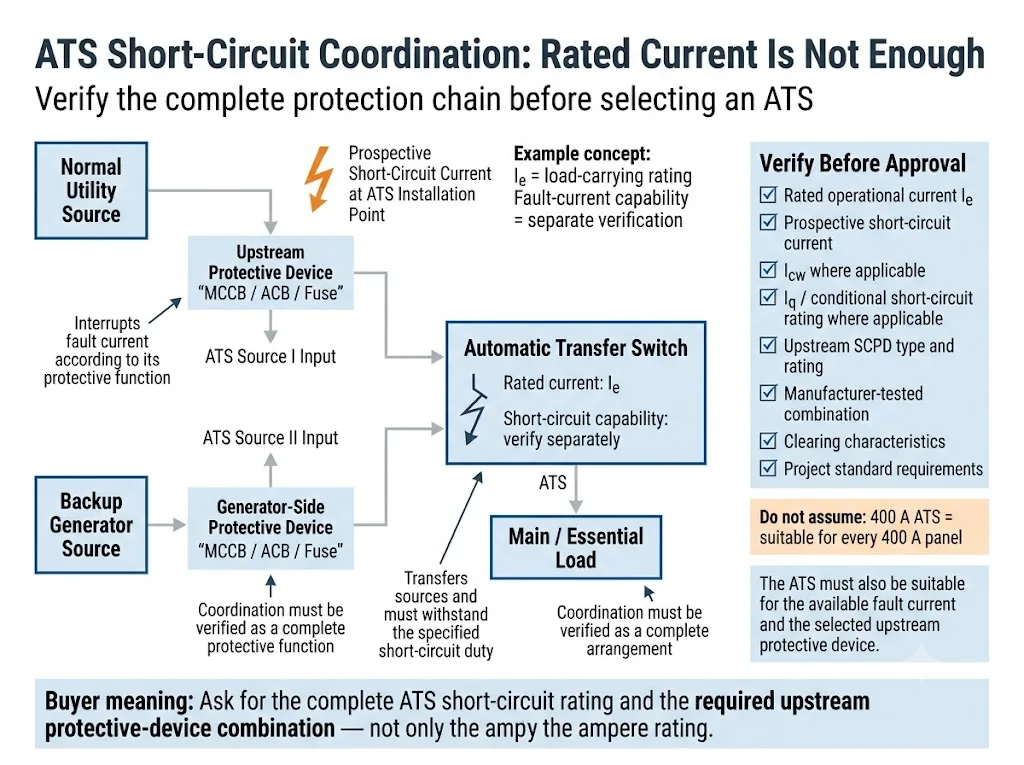
This is one of the most important checks for a main distribution board, generator panel or industrial installation. The ATS rated operational current is not the same thing as its short-circuit capability.
A 400 A transfer switch, for example, may be able to carry the required operational current, but the “400 A” rating alone does not establish whether it is suitable for the prospective fault current at its installation point.
ABB's IEC-market guidance explains that Class PC and Class CC solutions are not intended to break short-circuit current in the way Class CB equipment with overcurrent releases is intended to do. Their application therefore depends on correct coordination with the relevant upstream short-circuit protective device.[2]
Depending on the product and project, the buyer may need to verify short-time withstand current Icw, conditional short-circuit capability, making capability and the exact upstream fuse, MCCB or ACB arrangement.
What should an OEM buyer or panel builder confirm?
- prospective short-circuit current at the ATS installation point;
- the complete ATS short-circuit rating for the selected model;
- Icw where applicable;
- conditional short-circuit data where applicable;
- the exact upstream protective device required for the declared rating;
- confirmation that the data applies to the required voltage and pole configuration.
Is Switch Type ATS Better for High-Current LV Panels?
No general rule supports choosing the architecture from current alone. Both contactor-based and switch-based transfer equipment are available at substantial current ratings.
Eaton currently publishes contactor-type automatic transfer switches with continuous-current ratings up to 3000 A.[5] Socomec likewise publishes switch-derived Class PC transfer equipment across substantial current ranges.[4]
These examples show why “small current = contactor” and “large current = switch type” are unreliable selection rules.
For a high-current LV board, ask instead:
- What is the prospective fault current?
- What short-circuit performance is required?
- What utilization category applies?
- What upstream protective device will be used?
- Is an isolation function required?
- Is the system 3P or 4P?
- How often will the ATS transfer?
- What maintenance strategy applies?
Which Type Is Better for Generator Backup?
Either architecture can be technically suitable for a utility-to-generator standby system when the complete ATS is correctly selected. Generator backup does not automatically require a contactor-based architecture.
For LEEYEE's standard compact ATS range, the relevant question is therefore not “Should I order the contactor version?” but rather:
- Does the compact open-transition ATS match the required operational current?
- Does the required 2P, 3P or 4P configuration match the system?
- Is the normal/backup source arrangement suitable?
- Does the generator control interface match the project?
- Are the short-circuit conditions and upstream protection acceptable?
- Are the required certificates and model-specific documents available?
| Projektverhältnis | What should drive the selection? |
|---|---|
| Normal utility + standby generator | Source monitoring, generator interface, transfer sequence and protection coordination |
| Unstable source with frequent transfer | Electrical endurance and transfer frequency become more important |
| Main board with high fault level | Short-circuit capability and upstream SCPD coordination become critical |
| Kompaktes OEM-Schaltfeld | Footprint, integrated control and simplified wiring can become important |
| Maintenance-sensitive project | Manual operation, isolation and service procedure require confirmation |
| Critical process | Acceptable interruption time and transition method require project-specific confirmation |
Commercial Building vs Industrial Application
Application labels alone do not determine the correct ATS architecture. The connected load, fault environment, transfer frequency and maintenance requirements matter more.
Commercial building distribution
A commercial project may prioritize standby-generator operation, predictable transfer logic, compact panel integration, straightforward manual operation and the required project documentation.
A compact integrated ATS can be a practical solution where its operational current, pole configuration, transfer method and protection coordination match the design.
Industrial panel or equipment system
An industrial application may add motors, high inrush, more frequent switching, process restart requirements, remote signals, higher fault levels or more demanding maintenance conditions.
In these projects, the buyer should confirm the utilization category and complete electrical duty rather than choosing only from the nominal ampere rating.
Cost: Compare the Complete Installed System
Comparing only the price of the power switching element can give the wrong result.
A panel-built contactor ATS can require two contactors, mechanical interlocking, controller or voltage-monitoring relays, auxiliary components, wiring and enclosure space. ABB's application guidance illustrates this type of multi-component architecture.[3]
A compact integrated change-over ATS can reduce separately assembled transfer components. For an OEM panel builder, that may affect assembly time, wiring complexity, enclosure layout and commissioning effort.
Compare the complete installed cost, including:
- power switching device;
- controller and monitoring functions;
- mechanical and electrical interlocking;
- auxiliary relays and wiring;
- upstream protective devices;
- panel and busbar space;
- assembly and commissioning time;
- spare parts;
- maintenance requirements.
How to Choose Between Contactor Type and Switch Type ATS
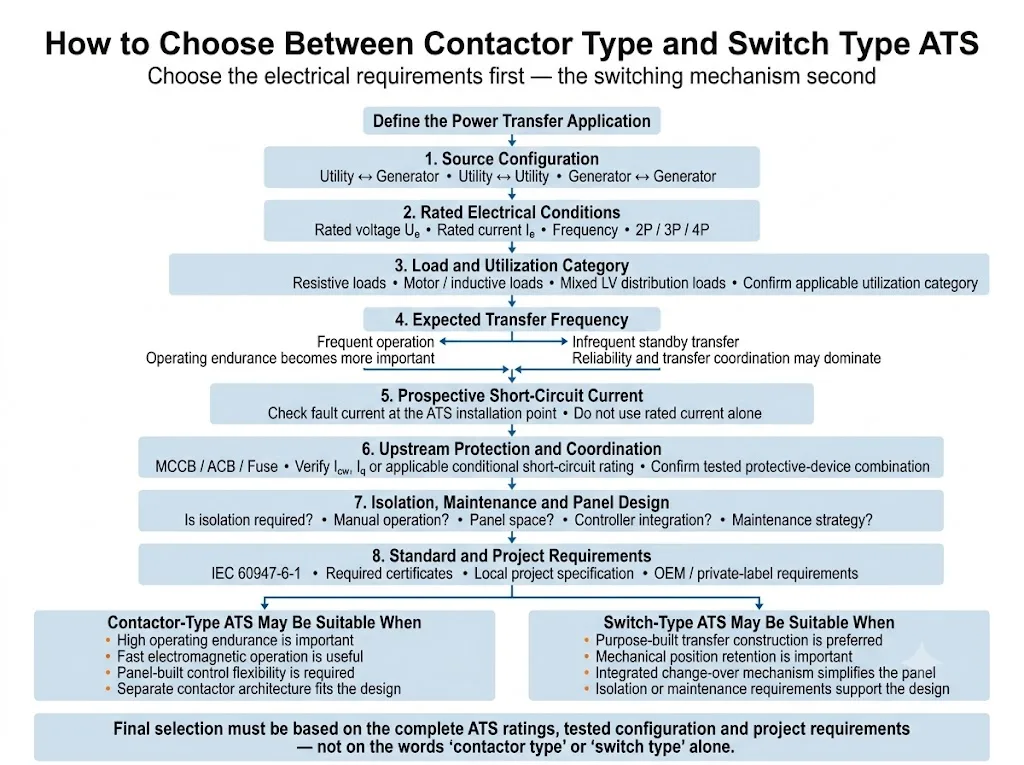
The most reliable selection process starts with the electrical system and reaches the switching architecture only after the important requirements are known.
- Define the source arrangement. Confirm whether the application is utility–generator, utility–utility or another supported two-source arrangement.
- Confirm voltage, current, frequency and poles. Define Ue, Ie, system frequency and the required 2P, 3P or 4P configuration.
- Identify the load duty. Determine whether the ATS supplies resistive loads, motors, mixed distribution loads or other demanding equipment.
- Confirm the utilization category. The required switching duty should match the complete ATS documentation.
- Estimate transfer frequency. Frequent transfer increases the importance of mechanical and electrical endurance.
- Establish the fault level. Ermitteln Sie den möglichen Kurzschlussstrom am Installationspunkt.
- Coordinate upstream protection. Confirm the fuse, MCCB or ACB arrangement required for the ATS short-circuit rating.
- Check project compliance. Confirm the applicable IEC requirements, certificates, model data and any OEM documentation required by the customer.
Häufige Auswahlfehler
“Contactor ATS is only for small current.”
This is not a reliable rule. Eaton currently publishes contactor-type ATS equipment with continuous-current ratings up to 3000 A.[5]
“Switch type is always slower.”
Traditional motor-driven change-over mechanisms can be slower than solenoid contactors, but mechanism technology varies. Compare the actual product's transfer performance instead of assuming from the architecture name alone.
“The higher the ATS ampere rating, the higher its fault capability.”
Rated operational current and short-circuit capability are different parameters. Verify both independently.
“Two mechanically interlocked contactors automatically make a compliant ATSE.”
Do not make this assumption. IEC 60947-6-1:2026 requires the complete TSE configuration to fall within the applicable manufacturer testing and marking scope.[1]
“LEEYEE supplies both architectures shown in this comparison.”
This guide compares two ATS technologies used in the market. LEEYEE's standard commercial range is the compact integrated change-over type described earlier, not a traditional panel-built two-contactor ATS.
Before Ordering a LEEYEE Compact ATS
A useful ATS recommendation requires more than a nominal current. Prepare the following information before confirming a model or OEM configuration:
Need to Confirm a Compact ATS Model?
Send LEEYEE your system voltage, current, pole configuration, normal and backup source arrangement, load type, prospective fault current and upstream protection. We can use these project details to confirm whether the standard compact ATS range matches your application.
FAQ
Is a contactor type ATS faster than a switch type ATS?
A solenoid-operated contactor can operate quickly, particularly compared with a traditional motor-and-gearbox change-over mechanism. This is not a universal rule for all products. Compare the complete transfer time of the exact ATS and controller sequence.[3]
Which ATS type has a longer operating life?
Contactor-based solutions can provide high operating endurance and may be attractive for frequent transfer applications. However, the correct comparison is the mechanical and electrical endurance declared for the specific products at the required switching duty.[3]
Can a contactor ATS be used for high-current systems?
Yes. High-current contactor-type transfer equipment exists. Eaton, for example, currently publishes contactor-type ATS products up to 3000 A. Current rating alone therefore does not determine the architecture.[5]
What is the difference between Class CC and Class PC ATS?
ABB's IEC-market guidance associates Class CC with contactor-based transfer technology and Class PC with switching equipment capable of making and withstanding specified short-circuit current without being intended to interrupt that fault as a protective breaker. Always confirm the classification declared for the complete product.[2]
Is the LEEYEE compact ATS a traditional contactor type ATS?
No. LEEYEE's standard product is a compact integrated change-over ATS rather than a panel-built arrangement using two separate power contactors. This article discusses contactor-based ATS technology for comparison so buyers can understand the structural and application differences.
Can I identify the IEC class of a LEEYEE ATS from its appearance?
No. External construction can help explain the switching architecture, but IEC class, utilization category, Icw, conditional short-circuit capability and certification scope must be verified from the documentation for the exact model.
Is the LEEYEE standard ATS suitable for generator backup?
The compact ATS range is intended for two-source transfer applications including normal-source and backup-source systems, but suitability for a specific generator project still depends on voltage, current, poles, generator control logic, protection coordination and model-specific ratings.
Do I need a 3-pole or 4-pole ATS for a generator?
Generator use alone does not determine the answer. Neutral switching depends on the earthing arrangement, generator bonding, system design, protection strategy and applicable project requirements. Confirm the neutral treatment before ordering the pole configuration.
Referenzen
- Internationale Elektrotechnische Kommission (IEC). IEC 60947-6-1:2026 – Niederspannungs-Schalt- und Steueranlagen – Teil 6-1: Mehrzweckgeräte – Umschaltgeräte, Ausgabe 4.0, veröffentlicht am 2. April 2026. Offizielle Veröffentlichungsseite der IEC.
- ABB. How to Select an Automatic Transfer Switch Class — A Guide for IEC Markets. Technical guidance on Class PC, Class CB and Class CC architectures, short-circuit performance and operating considerations. Technisches Whitepaper von ABB.
- ABB. Contactor-Based Automatic Transfer Switch Solutions — Implementation Tips for IEC Markets. Application note covering contactor operation, switching speed, electrical operations, interlocking and ATS implementation. ABB application note.
- Socomec. ATyS p Automatic Transfer Switching Equipment. Manufacturer documentation describing switch-type derived Class PC ATSE and IEC 60947-6-1 conformity. Socomec ATyS p.
- Eaton. Contactor Type Automatic Transfer Switches. Current manufacturer information listing continuous-current ratings up to 3000 A and describing an interlocked contactor-type transfer switching mechanism. Eaton contactor-type ATS.