
When an elevator or building system has both normal utility power and a standby source such as a generator, an automatic transfer switch can transfer the upstream feeder between those sources. The difficult part is not simply choosing an ATS with a large enough ampere rating. Elevator projects can also require coordination with the elevator controller, generator, neutral arrangement, transfer sequence and emergency operating strategy.
Inhaltsübersicht
Quick Answer: Can an ATS Be Used for Elevator Backup Power?
Yes. An ATS can transfer an elevator feeder between a normal source and an available standby source. A typical ATS monitors the power sources and transfers the connected load when the preferred source becomes unavailable and the alternate source is acceptable. [1]
However, the ATS is only one part of the elevator emergency-power system. It does not replace the elevator controller, drive, braking system, rescue functions or other elevator safety controls. Elevator operation under emergency power must be coordinated with the elevator equipment requirements and project design. [2]
For procurement: confirm the real feeder load, acceptable transfer type, pole configuration, generator capacity, controller signals and applicable project requirements before fixing the ATS model.
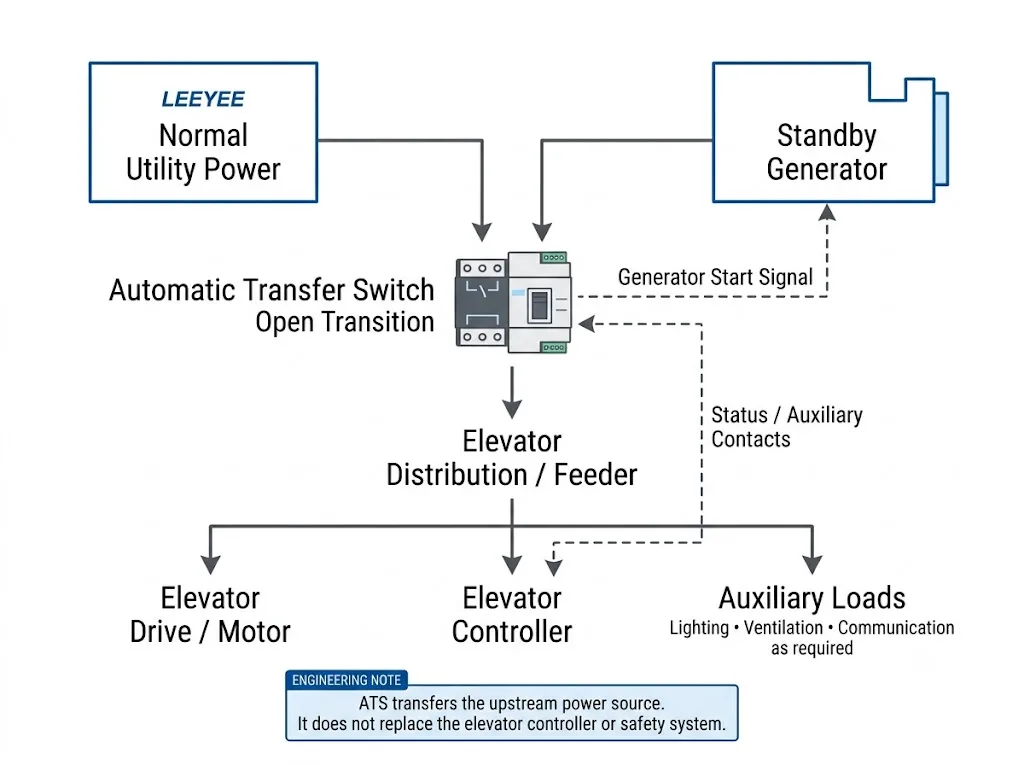
What Does the ATS Actually Do in an Elevator Power System?
An automatic transfer switch connects a load to one of two power sources. In a common utility-and-generator arrangement, the ATS monitors source conditions and transfers the load when the normal source is unavailable and the alternate source reaches acceptable conditions. [1]
The elevator controller performs a different job. It manages elevator operation. On projects where emergency-power operation needs coordination, control wiring or status contacts may be required between the ATS and elevator controller. [2][3]
Seven Things to Confirm Before Selecting an Elevator ATS
Confirm the Actual Load, Not Only the Motor kW
ATS selection should start from the feeder and the loads that must operate from standby power. The elevator motor rating alone does not describe the complete emergency-power requirement.
Confirm Whether Open-Transition Transfer Is Acceptable
Open-transition transfer is a break-before-make process: the ATS disconnects the load from one source before connecting it to the other source. This creates an interruption during transfer. [1]
Whether that interruption is acceptable for a particular elevator controller and drive must be checked against the elevator manufacturer's requirements and electrical design.
Confirm the Pole and Neutral Arrangement
The decision between a 3-pole and 4-pole ATS depends on the electrical system, source grounding, neutral arrangement, generator connection and project design.
3-Pole Concept
The three phase conductors are switched while neutral remains continuous.
4-Pole Concept
The three phase conductors and neutral are switched when required by the system design.
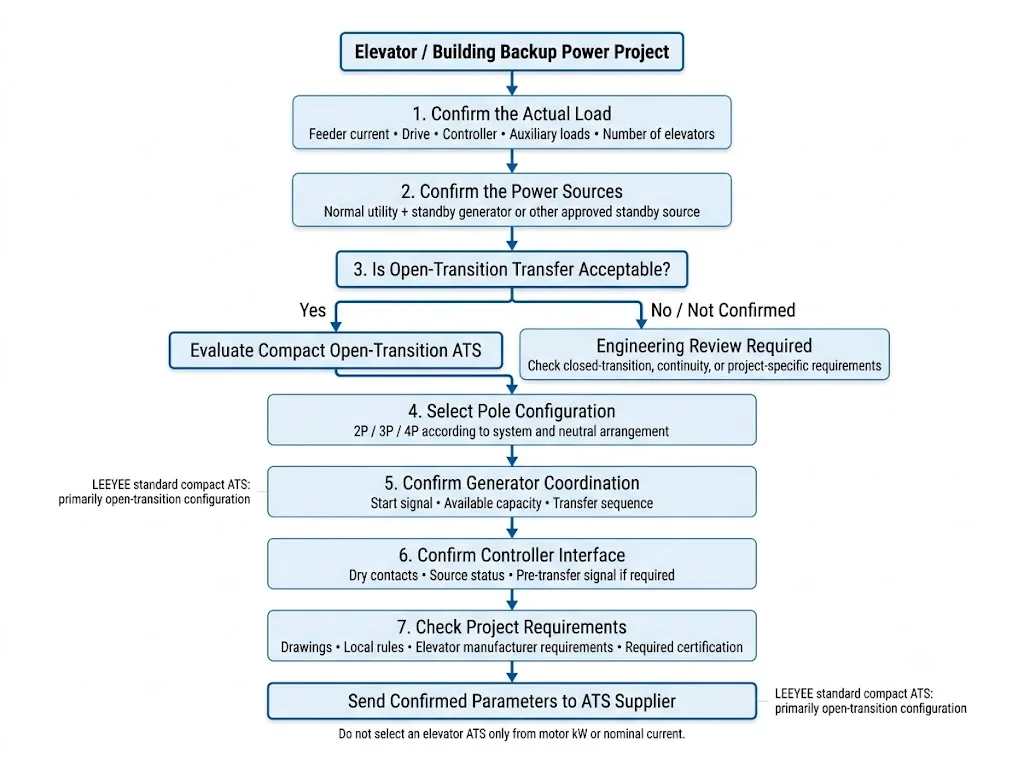
Confirm the Generator Start Sequence
A common sequence is: normal source becomes unavailable, the standby generator starts, the alternate source reaches acceptable conditions, and the ATS transfers the load. Exact thresholds and timing must be verified for the project. [1]
Confirm Whether the Controller Needs ATS Status Signals
Some elevator systems require ATS status, auxiliary contacts, source availability signals or pre-transfer coordination. These functions are project-dependent and should be confirmed with the elevator-controller documentation. [3]
Confirm Generator Capacity
Generator selection can be affected by elevator load data, drive characteristics, simultaneous operation and other standby loads. A universal percentage should not be assumed.
Confirm Auxiliary Loads
Depending on the project, standby power may also need to support controller equipment, cab lighting, ventilation, communication or other elevator-related auxiliary systems.
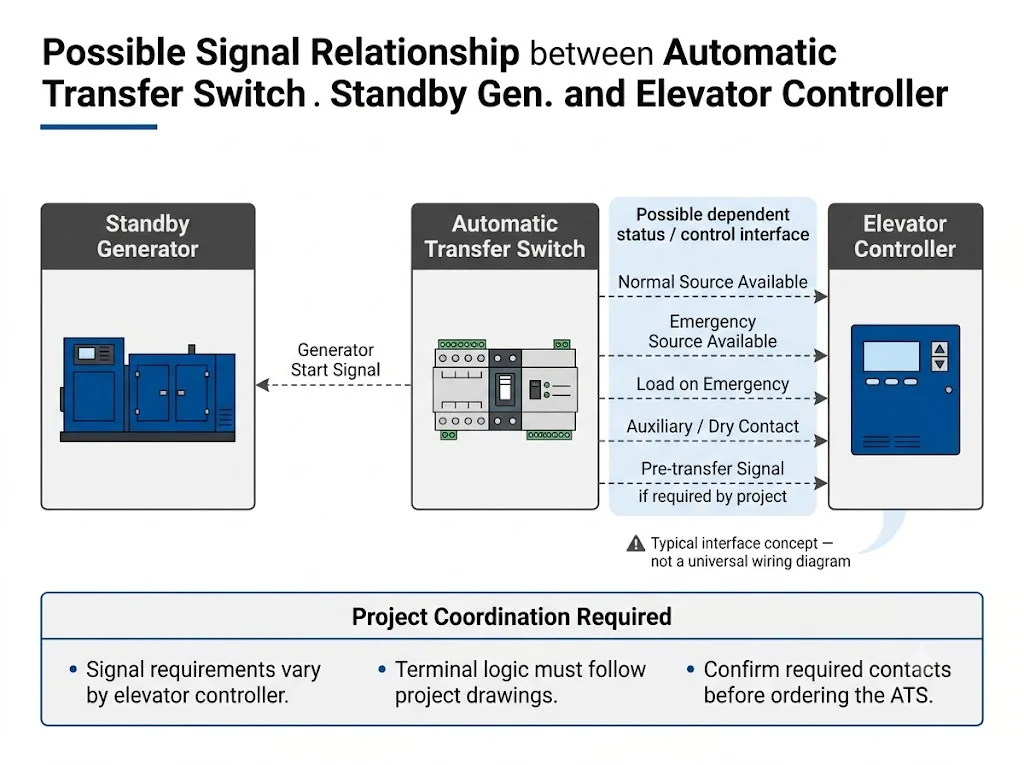
How Can the ATS and Elevator Controller Coordinate?
The ATS power circuit handles source transfer. Separately, auxiliary contacts or other approved interfaces may tell the elevator controller that emergency power is available, that the ATS has transferred or that a transfer sequence is about to occur.
Published engineering specifications include examples of elevator ATS systems using emergency-position contacts and pre-transfer signals. These examples demonstrate the need for coordination, but they should not be copied as universal wiring requirements. [3]
What Does a Typical Utility-to-Generator Transfer Sequence Look Like?
What Changes When One ATS Serves Multiple Elevators?
A multiple-elevator system raises an important question: how many elevators are required or permitted to operate simultaneously while the building is on standby power?
This affects generator loading, group-control logic and the coordination between the power system and elevator controls. DoD and GSA design documents provide examples where simultaneous elevator operation and group control must be considered. [2][5]
Elevator ATS Selection Table
| Auswahlfrage | Was zu überprüfen ist | Warum es wichtig ist |
|---|---|---|
| What load is transferred? | Elevator feeder and required auxiliary loads | Defines the load the ATS must carry. |
| Which sources? | Utility and generator or other approved standby source | Defines the transfer arrangement. |
| Open transition acceptable? | Controller and project requirements | Open transition includes an interruption. |
| 3P or 4P? | Neutral- und Erdungsanordnung | Determines whether neutral is switched. |
| Controller interface? | Dry contacts and required signals | Some projects require ATS-controller coordination. |
Wo lässt sich ein kompakter LEEYEE ATS unterbringen?
LEEYEE Produktumfang
LEEYEE supplies compact integrated automatic transfer switches for straightforward normal-to-standby power transfer. These products are intended to act as upstream source-transfer devices rather than elevator control or safety equipment.
For an elevator or building project, suitability must still be confirmed against the required current, pole configuration, system voltage, transition method, controller interface and project documentation.
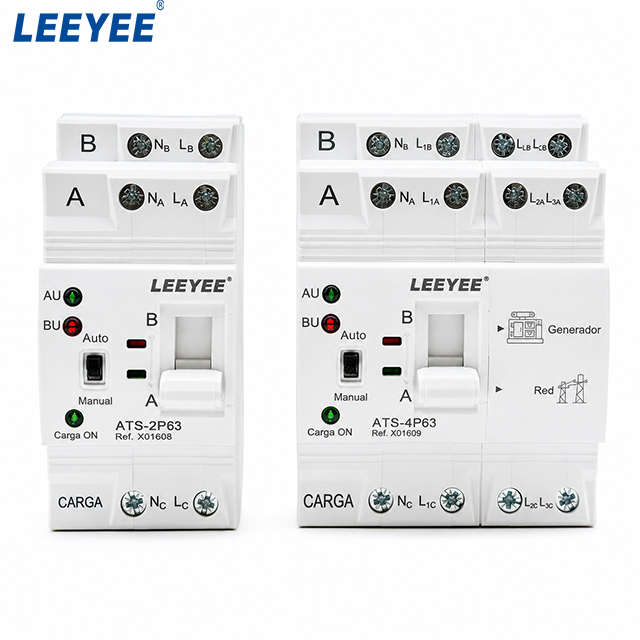
This compact form factor can be appropriate for panel builders, electrical contractors and OEM projects that need conventional automatic source transfer and where open-transition operation is acceptable.
When Does the Project Need More Than a Standard Compact ATS?
Requires Extra Review
- Closed-transition requirement
- Bypass-isolation architecture
- Special continuity requirements
- Complex multi-elevator sequencing
- Project-specific load shedding
Gehen Sie nicht von etwas aus
- A larger current rating solves control issues
- 4P is automatically better than 3P
- Every elevator accepts open transition
- Every controller uses the same dry contacts
- One generator-sizing rule fits every project
Before Ordering: Send These Project Details
- Systemspannung und Frequenz
- Einphasige oder dreiphasige Versorgung
- Normaler Quelltyp
- Standby source and generator information
- Elevator feeder rated current
- Required 2P, 3P or 4P configuration
- Neutral- und Erdungsanordnung
- Number of elevators
- Required simultaneous or sequential operation
- Elevator-controller interface requirements
- Required dry contacts or status signals
- Single-line diagram, project specification and required certification
Need to Confirm an Elevator ATS Configuration?
Send the system voltage, feeder current, pole requirement, generator information, elevator-controller requirements and project drawing. LEEYEE can review the ATS-side selection scope and identify which items still require project confirmation.
FAQ for Elevator ATS Projects
Can a compact automatic transfer switch be used for an elevator?
It can be used as the upstream source-transfer device when the electrical rating, transfer method and project requirements are compatible. It does not replace elevator control or safety equipment.
Can an open-transition ATS be used for an elevator?
It may be suitable when the elevator controller, drive and project design permit an interruption during source transfer. This must be confirmed rather than assumed.
Should an elevator ATS be 3P or 4P?
The correct choice depends on the neutral arrangement, grounding system, generator connection and electrical design.
Can one ATS supply multiple elevators?
Yes, as part of an engineered system, but the required simultaneous operation, generator capacity and group-control strategy must be confirmed. [2][5]
Is a LEEYEE compact ATS an elevator-specific controller?
No. It is an automatic source-transfer device. In an elevator project it should be treated as part of the upstream power-distribution system, while elevator operating and safety functions remain with the elevator equipment.
Referenzen
- Eaton. Fundamentals of Automatic Transfer Switches (ATS). Official Eaton source.
- U.S. Department of Defense / Whole Building Design Guide. UFC 3-490-06, Elevators. Official WBDG source.
- University of Houston. Master Specification 26 36 23 — Automatic Transfer Switches. University of Houston source.
- ASME. ASME A17.1 / CSA B44 — Safety Code for Elevators and Escalators. Official ASME source.
- U.S. General Services Administration. 2024 P100 — Facilities Standards for the Public Buildings Service. Official GSA source.
