
An automatic transfer switch can be used in an irrigation pump system to transfer the incoming supply of a pump control panel between utility power and a standby generator. The key engineering point is that the ATS manages source transfer; it does not replace the pump controller, motor starter, VFD, overload protection or circuit protection.
Inhaltsübersicht
Schnelle Antwort
For a typical low-voltage irrigation project, the practical arrangement is utility + generator → ATS → pump control panel → motor-control equipment → pump motor. When the normal source becomes unacceptable, an automatic transfer switch can transfer the connected load to an available alternate source according to its control logic. Open-transition transfer is break-before-make, so the downstream pump system experiences an interruption during transfer. [1][2]
- Select the ATS from the complete electrical load and project design, not from pump kW alone.
- Confirm the motor starting method because generator transient performance may become a limiting factor.
- Do not determine pole configuration only from the fact that the pump motor is three-phase.
- Keep ATS source-transfer functions separate from motor starting, pump sequencing and motor protection.
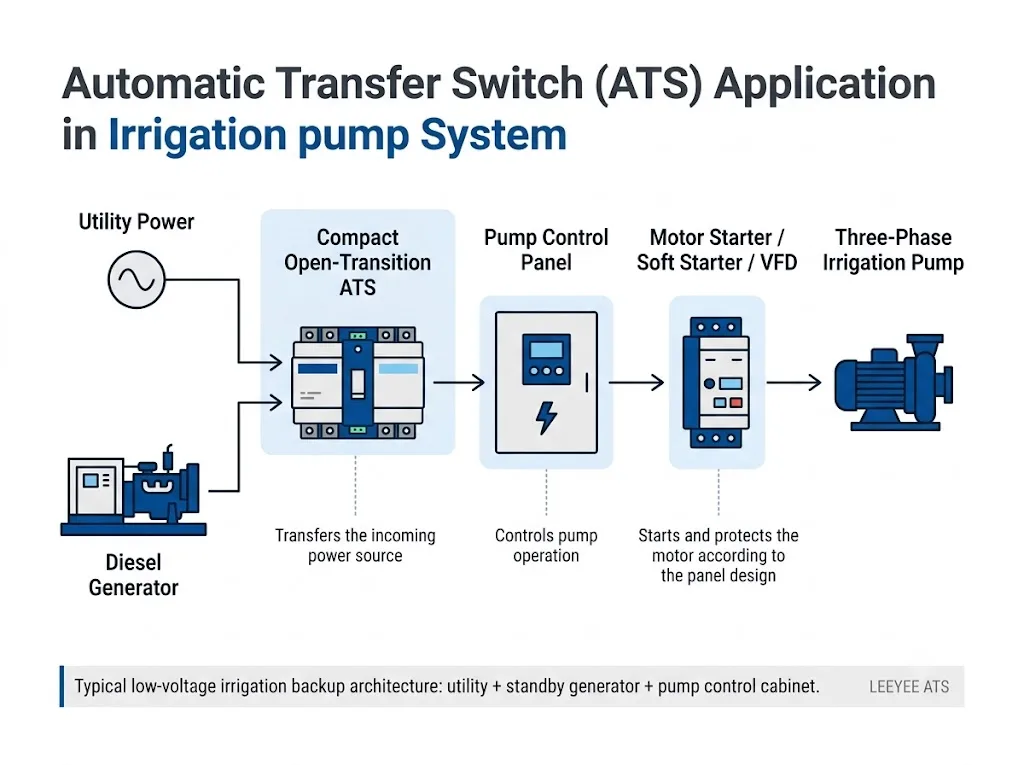
Where Does the ATS Sit in an Irrigation Pump System?
In a conventional irrigation pump installation, the ATS is normally positioned on the incoming power side of the pump control cabinet. One source may be the utility supply and the second source may be a diesel generator. The ATS monitors source conditions and transfers the connected load when its configured conditions are satisfied. [2]
Downstream of the ATS, the pump control system may contain an MCCB or other protective devices, contactors, overload protection, a soft starter, a variable-frequency drive, pump sequencing controls or other project-specific equipment.
The ATS belongs to the power-source architecture. The pump control panel remains responsible for pump operating logic. Protection, starter and control arrangements must be confirmed from the actual motor data, panel design and project requirements.
Was passiert, wenn der Strom ausfällt?
A typical utility-generator ATS sequence begins when the controller detects unacceptable normal-source conditions. Where the system is designed for generator-start control, the standby generator is started. After the alternate source reaches conditions accepted by the ATS controller, the connected load can be transferred. When normal utility power later returns and satisfies the configured retransfer conditions, the load can return to the normal source. [2]
- Normal operation: utility power supplies the pump control panel through the ATS.
- Source failure: the ATS detects that the normal source is outside acceptable conditions.
- Generator start: where the selected ATS and generator controller support the required interface, a generator-start command is initiated.
- Alternate source available: the generator reaches conditions accepted by the transfer controller.
- Transfer: the ATS transfers the pump control panel to the alternate source.
- Pump restart: the pump controller, starter, soft starter or VFD determines the motor-start sequence.
- Utility restoration: after the normal source meets the configured return conditions, the system can transfer back.
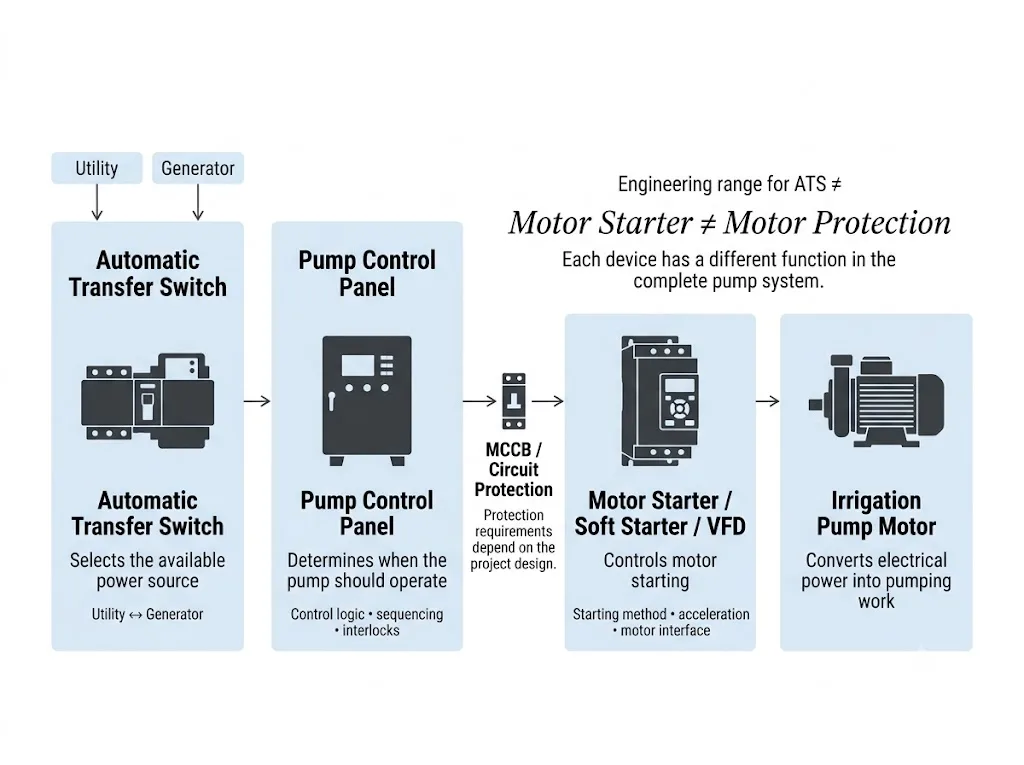
The ATS supplies an available source to the downstream control system. Motor starting, pump sequencing and motor protection remain functions of the pump-control design.
ATS, Pump Controller and Motor Starter Have Different Jobs
The “Project Confirmation” column shows what the panel builder or buyer still needs to verify before ordering.
| Equipment | Hauptfunktion | Projektbestätigung |
|---|---|---|
| ATS | Transfers the load between available power sources | Voltage, current, poles, transfer type and source arrangement |
| MCCB / protection | Circuit protection and isolation as required by the design | Fault level, rating and coordination |
| Motor starter | Starts and stops the motor | Motor data and starting method |
| Soft starter / VFD | Controls motor acceleration or speed | Input requirements, motor compatibility and settings |
| Pump controller | Controls pump sequence or process logic | Pressure, level, timing, duty/standby and restart logic |
| Generator | Provides the alternate electrical source | Running load, motor-starting demand and transient performance |
IEC 60947-4-1 covers electromechanical contactors and motor starters within its scope, while IEC 60947-6-1 covers transfer switching equipment. Keeping these functions separate is important when specifying a pump control panel. [1][3]
Do Not Select the ATS Only From Pump kW
A request such as “I have a 30 kW irrigation pump; which ATS should I buy?” does not contain enough information for a reliable project selection.
Pump power is useful, but the transfer switch sees the electrical load presented by the complete downstream system. Two installations with the same motor kW can differ in voltage, rated current, starting method, number of pumps, auxiliary loads and operating sequence.
Ask the ATS supplier to review the actual electrical data. Do not rely on a universal “pump kW = ATS amperage” table.
Why Motor Starting Method Matters
Motor starting can impose a much higher transient demand on a generator than steady-state operation. Generator application guidance explains that motor starting can create high inrush current and generator voltage dip, so starting demand and voltage recovery should be considered when evaluating a generator for motor loads. [4]
IEC 60034-12 addresses starting-performance characteristics for specified single-speed three-phase cage induction motors. The practical procurement lesson is that starting behaviour should be verified from real motor and starter data rather than guessed from pump power alone. [5]
| Starting Method | What Changes | Der Käufer sollte bestätigen |
|---|---|---|
| DOL | Motor is connected directly to the supply during starting | Starting current, torque and generator transient capability |
| Star-delta | Starting characteristics differ from direct-on-line operation | Motor suitability, transition logic and starter design |
| Soft starter | Starting voltage/current profile can be controlled | Settings, motor load and generator compatibility |
| VFD | Acceleration and speed are electronically controlled | Drive input requirements and generator compatibility |
ATS Rating and Generator Size Are Different Decisions
An ATS current rating does not directly determine generator kVA. The ATS must be suitable for the required load current, switching duty and protection arrangement, while the generator must also support the running load and the transient demand created when motors start. [1][4]
For multi-pump systems, starting sequence can be especially important. Starting one motor and allowing it to accelerate before starting another can create a very different generator duty from starting several motors simultaneously.
Generator sizing should be confirmed from the actual motor load schedule, starting method, permitted voltage and frequency disturbance, and other loads connected to the generator.
Should a Three-Phase Irrigation Pump Use a 3P or 4P ATS?
A three-phase pump does nicht automatically determine the required ATS pole configuration.
In general engineering terms, a three-pole transfer arrangement switches the three phase conductors, while a four-pole arrangement also switches the neutral. Whether the neutral should be switched depends on the complete source arrangement, generator neutral configuration, earthing system, protection concept and project requirements. [2]
Confirm the L1 / L2 / L3 / N / PE arrangement and the neutral-switching requirement from the project single-line diagram.
The LEEYEE product image below shows compact 2P and 4P configurations. Product availability for a specific quotation, including the required pole configuration, should always be confirmed against the current LEEYEE datasheet and order specification rather than inferred from an application article.
Why Open Transition Fits Many Ordinary Pump Backup Systems
Open transition is a break-before-make transfer method. The ATS disconnects the load from one source before connecting it to the other. This prevents intentional overlap between the two sources during a normal transfer, but it also means that the downstream pump-control system experiences an interruption. [2]
For ordinary low-voltage irrigation backup systems that can tolerate this interruption and a controlled motor restart, a compact open-transition ATS can be a practical solution. Suitability still depends on the actual pump-control logic and electrical design.
LEEYEE's standard product direction for this type of application is a compact integrated open-transition ATS. Projects requiring closed-transition operation, source paralleling, bypass-isolation arrangements or uninterrupted transfer should be treated as separate engineered solutions.
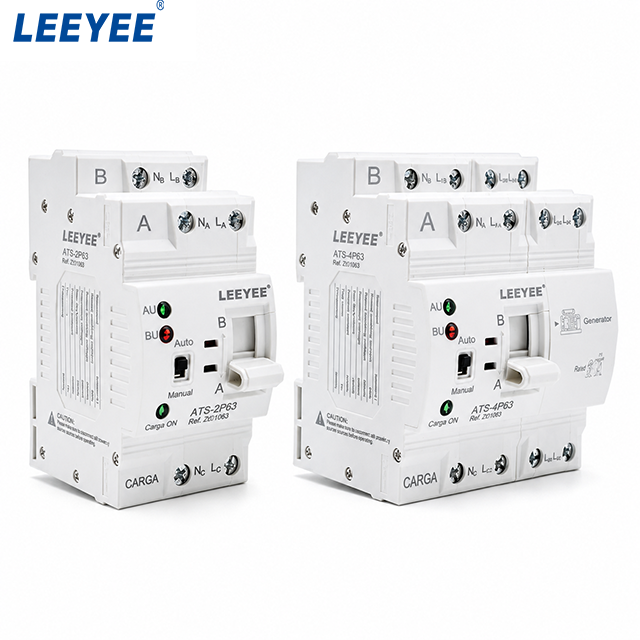
LEEYEE supplies a compact integrated ATS format suitable for panel-level normal/standby source transfer. The image should not be interpreted as proof that every current rating, pole option or control requirement is available for every project; those details must be confirmed before ordering.
What If Several Irrigation Pumps Share One ATS?
A pumping station may contain a duty pump, standby pump, booster pump or several irrigation pumps supplied by one control cabinet. In this case, ATS selection should consider the complete downstream load arrangement, not the nameplate of one motor.
The control strategy also matters. If several motors can restart after transfer to generator power, the system designer may need a defined restart sequence so the generator is not exposed to unnecessary simultaneous starting demand.
The exact sequence should be confirmed by the panel designer, pump-control specialist and generator supplier according to the actual project.
Outdoor Irrigation Projects Need a Suitable Enclosure
Irrigation installations are often located in pump rooms, agricultural buildings or outdoor electrical cabinets. That does not mean the ATS device itself should automatically be described as weatherproof.
The complete enclosure must be selected for the installation environment. Relevant factors can include dust, moisture, condensation, ambient temperature, ventilation, cable entry, corrosion exposure, maintenance access and the required enclosure protection level.
When requesting an ATS for an outdoor pump project, provide the cabinet location and environmental conditions. Enclosure suitability and ATS electrical selection are separate engineering questions.
A Practical ATS Selection Flow for Irrigation Pump Systems
A useful quotation request follows the electrical decision path instead of jumping directly from pump power to an ATS model.
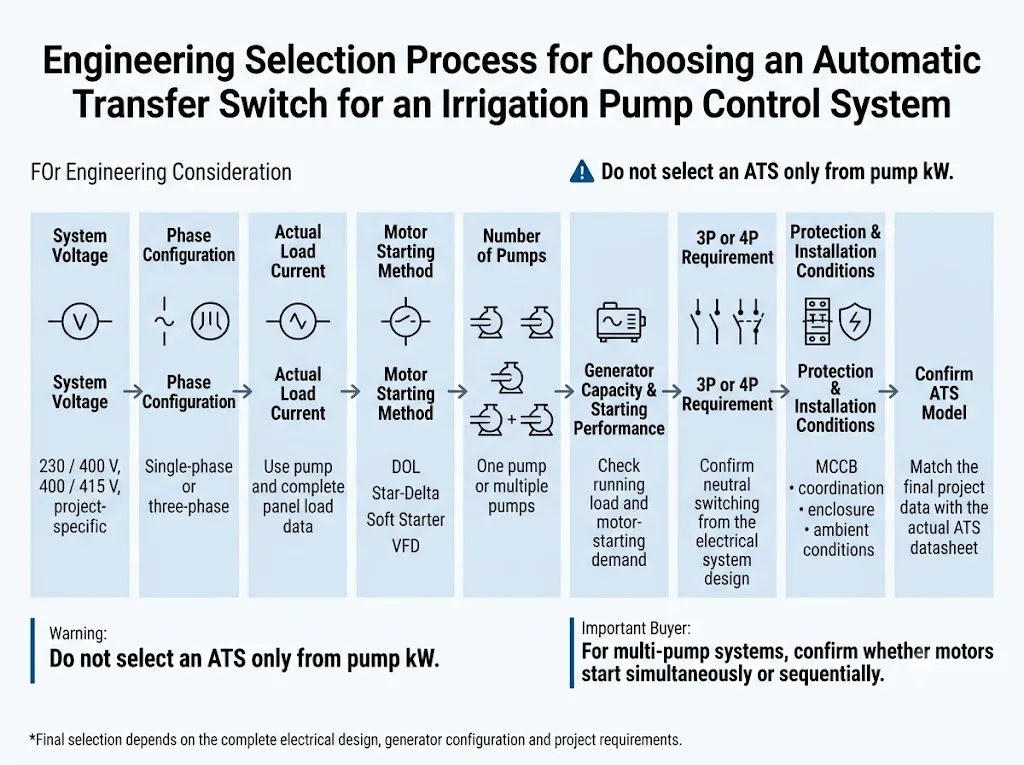
- Confirm system voltage and frequency.
- Confirm single-phase or three-phase architecture.
- Identify the actual downstream load current.
- Record each pump motor's starting method.
- Confirm how many pumps and auxiliary loads are supplied through the ATS.
- Check generator running and motor-starting capability.
- Confirm the required pole arrangement from the electrical design.
- Check upstream and downstream protection plus available fault data.
- Confirm indoor or outdoor cabinet conditions and mounting space.
- Match the final project data against the current LEEYEE ATS datasheet and wiring information.
Typical B2B Irrigation Pump Backup Scenario
Consider a three-phase agricultural pumping station supplied from the utility during normal operation and supported by a standby diesel generator during an outage.
The compact ATS is installed on the incoming side of the pump control cabinet. Under normal conditions, the cabinet receives utility power. When the normal source becomes unavailable and the generator source satisfies the transfer controller's conditions, the ATS transfers the cabinet to the alternate source.
The pump-control system then determines whether the motor should restart immediately, after a delay or in sequence with other pumps. The ATS does not determine irrigation scheduling, pump duty rotation or the motor acceleration profile unless those functions are provided by a separate engineered control system.
Before Ordering: Information to Send LEEYEE
- Systemspannung
- Systemfrequenz
- Einphasig oder dreiphasig
- Pump motor rated power
- Pump motor rated current
- Number of pumps
- Direktanlauf (DOL), Stern-Dreieck-Anlauf, Sanftstarter oder Frequenzumrichter (VFD)
- Normal power source
- Generator voltage and rated output
- Available motor-starting data
- Erforderliche Polkonfiguration
- Neutralleiter- und Erdungsanordnung
- Upstream/downstream protective devices
- Einleitungsdiagramm, falls vorhanden
- Indoor or outdoor installation
- Einbauraum für Schalttafel
- Required quantity
- OEM or private-label requirement
Need Help Confirming an ATS for a Pump Control Panel?
Send the system voltage, pump rated current, starting method, generator information and single-line diagram. LEEYEE can review whether the standard compact open-transition ATS range matches the proposed low-voltage irrigation backup architecture. Final model selection remains subject to the actual LEEYEE datasheet and project requirements.
FAQ for Irrigation Pump ATS Selection
Can an automatic transfer switch be used for an irrigation pump?
Yes. An ATS can transfer a suitable pump control panel between two power sources, such as utility power and a standby generator. Motor-control and motor-protection functions remain separate and must be designed for the actual pump system. [1][2]
Does the ATS directly start the irrigation pump after a power failure?
Not by itself. The ATS transfers the electrical source. The pump controller, motor starter, soft starter or VFD determines how the motor starts or restarts.
Can I choose an ATS only from the pump's kW rating?
No. Pump kW does not describe the complete electrical requirement. Voltage, rated current, number of pumps, starting method, auxiliary loads, generator performance, pole configuration and protection arrangement also affect selection.
Why is motor starting important for a generator-backed irrigation pump?
Motor starting can create a substantial transient electrical demand and generator voltage dip. Generator evaluation therefore needs to consider starting performance as well as steady-state running load. [4]
Is a 3P ATS always correct for a three-phase irrigation pump?
No. A three-phase motor does not by itself determine whether the neutral should be switched. The source arrangement, generator neutral configuration, earthing system and project design must be checked before the pole configuration is confirmed. [2]
Which pole versions are shown in the LEEYEE product image?
The real product image on this page shows compact LEEYEE 2P and 4P ATS units. The required pole configuration for a specific project should still be confirmed against the current product datasheet and electrical drawing.
Can several irrigation pumps share one ATS?
Potentially yes, if the complete load, ATS rating, protection, generator capacity and control sequence are engineered accordingly. For multiple motors, confirm whether they can start simultaneously or are intentionally sequenced.
Does an ATS replace the MCCB or motor protection device?
No. Transfer switching, circuit protection and motor-control functions are separate. IEC 60947-6-1 addresses transfer switching equipment, while IEC 60947-4-1 addresses contactors and motor starters within its scope. [1][3]
Can a compact ATS be installed in an outdoor irrigation cabinet?
It may be installed inside a suitable electrical enclosure when the actual ATS model, cabinet and environmental requirements allow it. Enclosure protection, temperature conditions, ventilation, condensation control and maintenance access must be confirmed for the project.
Is an open-transition ATS suitable for every irrigation project?
No. Open transition introduces a supply interruption because it is break-before-make. It can suit ordinary backup systems that tolerate this interruption and controlled restart, but applications requiring source paralleling, closed transition or uninterrupted transfer need a different engineered solution. [2]
Referenzen
- Internationale Elektrotechnische Kommission (IEC). IEC 60947-6-1:2026 – Niederspannungsschalt- und Steuergeräte – Teil 6-1: Mehrfunktionsgeräte – Umschaltgeräte. Offizielle Veröffentlichungsseite der IEC.
- Eaton. Fundamentals of Automatic Transfer Switches. Eaton technical resource.
- Internationale Elektrotechnische Kommission (IEC). IEC 60947-4-1:2023 — Low-voltage switchgear and controlgear — Part 4-1: Contactors and motor-starters. Offizielle Veröffentlichungsseite der IEC.
- Cummins Power Generation. Application Manual — Generator Set Sizing and Motor Starting. Cummins technical manual.
- Internationale Elektrotechnische Kommission (IEC). IEC 60034-12:2024 — Rotating electrical machines — Part 12: Starting performance of single-speed three-phase cage induction motors. Offizielle Veröffentlichungsseite der IEC.
