
A hybrid inverter system does not automatically need an external ATS. An automatic transfer switch can be useful when two AC sources—most commonly the utility grid and a generator—must be selected before feeding an approved inverter AC input or backup AC bus. However, some hybrid inverters already provide a dedicated generator input, generator-control function or internal transfer architecture. The correct design depends on the exact inverter model, generator interface and manufacturer-approved system diagram. [1][2][3]
Start with the inverter manual, not with the ATS.
If grid and generator must share one approved AC connection, an external ATS may be used to select the source. If the inverter already provides a dedicated generator port or manages the required source transfer internally, another ATS may not be necessary.
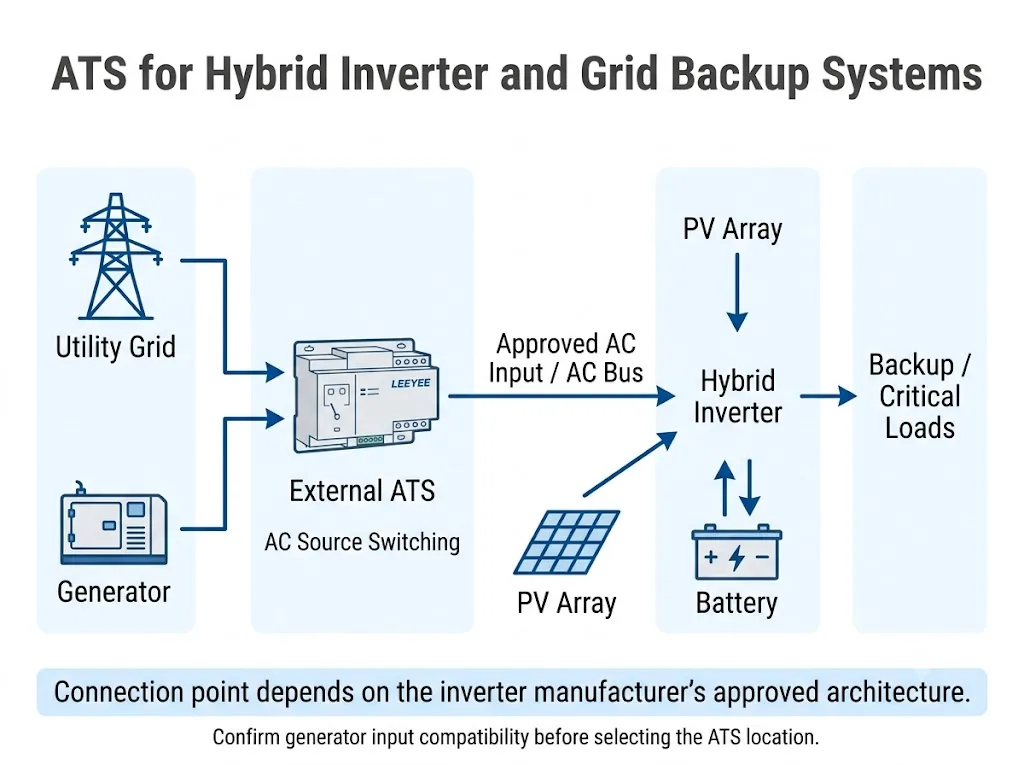
Inhaltsübersicht
Does a Hybrid Inverter Need an External ATS?
There is no universal yes-or-no answer based only on the words hybrid inverter. Different inverter families manage grid, generator and backup power in different ways.
SolaX, for example, documents grid-connected generator modes in which an external ATS is required between the generator and grid, while some pure off-grid generator modes do not require that external ATS. [1]
Solis documents a different arrangement for its specified S6 hybrid inverter family: in an on-grid generator application, a third-party ATS switches between grid and generator, while a separate source-status signal tells the inverter when generator power is feeding its grid-side connection. [2]
Other inverter platforms provide dedicated generator ports. Deye publishes hybrid inverter manuals with a configurable GEN input and generator-start control functions on applicable models. [3]
| Systemarchitektur | External ATS? | Was zu überprüfen ist |
|---|---|---|
| Grid + inverter + battery only | Often not required for source selection | Internal grid / backup transfer function |
| Grid and generator share one approved AC input | Often used | Manufacturer-approved generator connection |
| Separate Grid and GEN ports | May not be required | Dedicated generator-port instructions |
| External bypass or alternate AC bus | Projektabhängig | Backfeed prevention, transfer sequence and system design |
Procurement conclusion: the inverter manual—not the word “hybrid”—determines whether an external ATS is required.
Three Common Hybrid Inverter Architectures
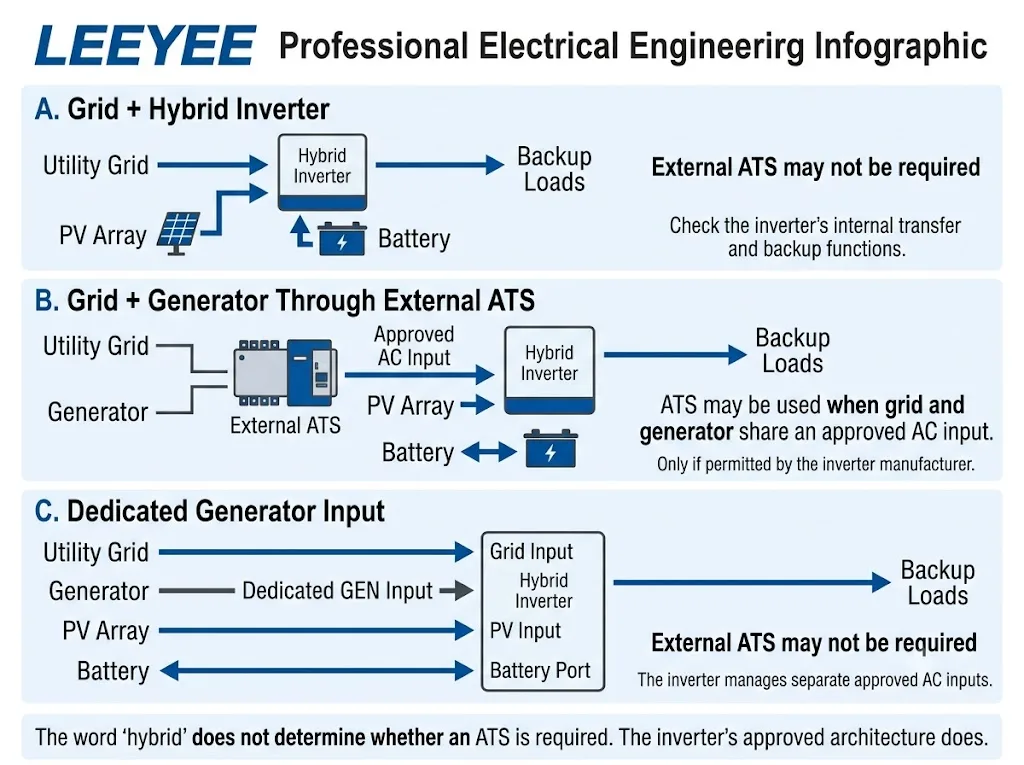
Architecture A: Grid feeds the hybrid inverter directly
A grid-connected hybrid inverter may already contain the transfer functions required to separate the grid from its backup or EPS output during an outage. In this case, adding an external ATS simply because the project includes backup power may not add a useful function.
Architecture B: Grid and generator share one approved AC input
This is a common situation in which an external ATS has a clear role. The ATS selects utility or generator, and the selected source feeds the AC connection that the inverter manufacturer has approved.
Technische Abgrenzung: This architecture does not mean every inverter can accept generator power at its normal grid terminal. The manufacturer documentation for the exact model must explicitly support the proposed connection.
Architecture C: The inverter has a dedicated generator input
Some hybrid inverters provide a separate GEN port. The generator can then connect according to the inverter manufacturer's own generator-control architecture, so an external grid/generator ATS may not be needed for that particular function.
External ATS vs. the Inverter's Internal Transfer Function
| Funktion | External ATS | Hybrid inverter |
|---|---|---|
| Select between two external AC sources | Hauptfunktion | Model-dependent |
| PV conversion / MPPT control | Nein | Ja |
| Battery charging / discharging | Nein | Yes, with supported battery system |
| Battery SOC-based energy control | Nein | Model / EMS dependent |
| Generator start command | Configuration-dependent | Available on some models |
| Replace EMS or BMS | Nein | Nein |
A compact ATS should therefore be treated as an AC source-transfer device. It should not be described as the controller responsible for PV dispatch, battery SOC, charging strategy or overall energy management.
Dry Contact and Generator Start Must Be Confirmed Separately
A dry contact is a control interface, not the generator's main power connection. Some hybrid inverter systems use dry contacts for generator start, source status or other low-power control signals, but those functions are model-specific.
The LEEYEE compact ATS shown on this page should therefore not be assumed to include every possible dry-contact, generator-start or source-status function. If the inverter requires these signals, confirm whether the selected ATS configuration or an external controller provides the required interface before ordering.
- Power path: Grid / generator → ATS → approved AC destination.
- Control path: Inverter, ATS controller or generator controller → start, stop, source-status or permissive signal.
Can the Inverter and Load Accept Open-Transition Switching?
LEEYEE's standard compact ATS range is primarily intended for conventional open-transition switching. Open transition follows a break-before-make sequence: one source is disconnected before the other source is connected.
This means the downstream circuit can experience a transfer interruption. A standard compact ATS should therefore not be presented as a UPS, a seamless-transfer device or a closed-transition system.
Project check: Confirm whether the inverter, control equipment and connected loads can tolerate the transfer interruption. If the project requires closed transition, synchronized source overlap or verified no-break performance, that requirement needs different equipment and separate engineering approval.
How Should the ATS Current Be Selected?
Do not choose the ATS only from the inverter's headline kW rating. The relevant current is the maximum current that can actually pass through the ATS at its installation point.
| ATS position | System data to check | ATS item to verify |
|---|---|---|
| Before inverter AC input | Maximum AC input / pass-through current | Nennbetriebsstrom |
| Grid-generator source selection | Source voltage, frequency and transferred current | Rated voltage and current |
| Backup / bypass bus | Maximum bus or transferred-load current | Continuous current and load characteristics |
| Signal-integrated arrangement | Source sense / auxiliary signal | Required control interface |
2P, 3P or 4P: Confirm the Actual System Requirement
The pole count should not be chosen from the words “hybrid inverter” alone. The required arrangement depends on the inverter topology, generator neutral arrangement, earthing system, required source separation and project rules.
The actual LEEYEE product image below shows compact 2P and 4P ATS configurations. Project availability and suitability must still be confirmed against the required voltage, current, neutral treatment and system design.
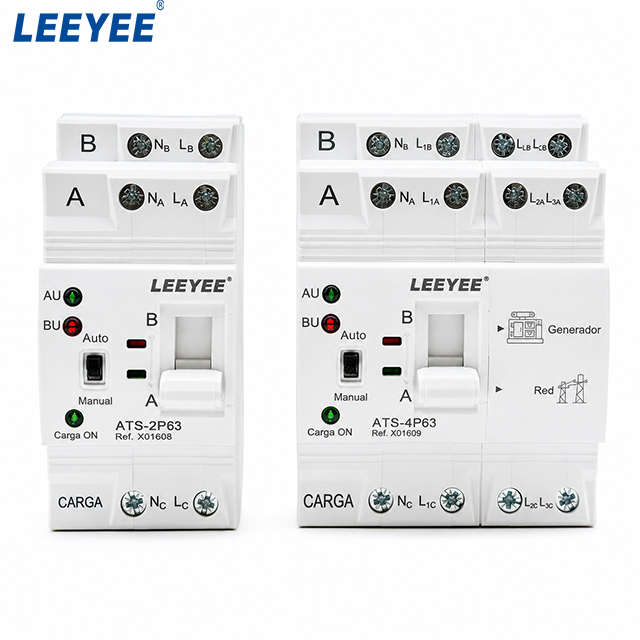
Wichtige Produktgrenze: The LEEYEE compact ATS is used for AC source transfer. It should not be described as a hybrid inverter, EMS, BMS, battery controller, generator synchronizer or closed-transition controller.
What Else Should a B2B Buyer Verify on the ATS?
For IEC-based low-voltage projects, IEC 60947-6-1 is the key transfer-switch standard family to review for transfer switching equipment. The exact applicable edition, product certificate scope and project requirement must be confirmed against the selected model and destination market.
| Artikel | Warum es wichtig ist | What to request |
|---|---|---|
| Nennbetriebsspannung | Must suit the actual AC system | Modellspezifikation |
| Nennbetriebsstrom | Must carry the current at the ATS position | Current rating and limits |
| Pole / neutral arrangement | Affects source and neutral separation | Available configuration and project requirement |
| Transition method | Determines interruption behavior | Open-transition documentation |
| Short-circuit coordination | Must suit upstream protection and fault conditions | Applicable manufacturer coordination data |
| Steuerschnittstelle | May be required by the inverter or generator controller | Model-specific I/O documentation |
| Zertifizierungsumfang | Market and project requirements differ | Model-specific certificate or test documentation |
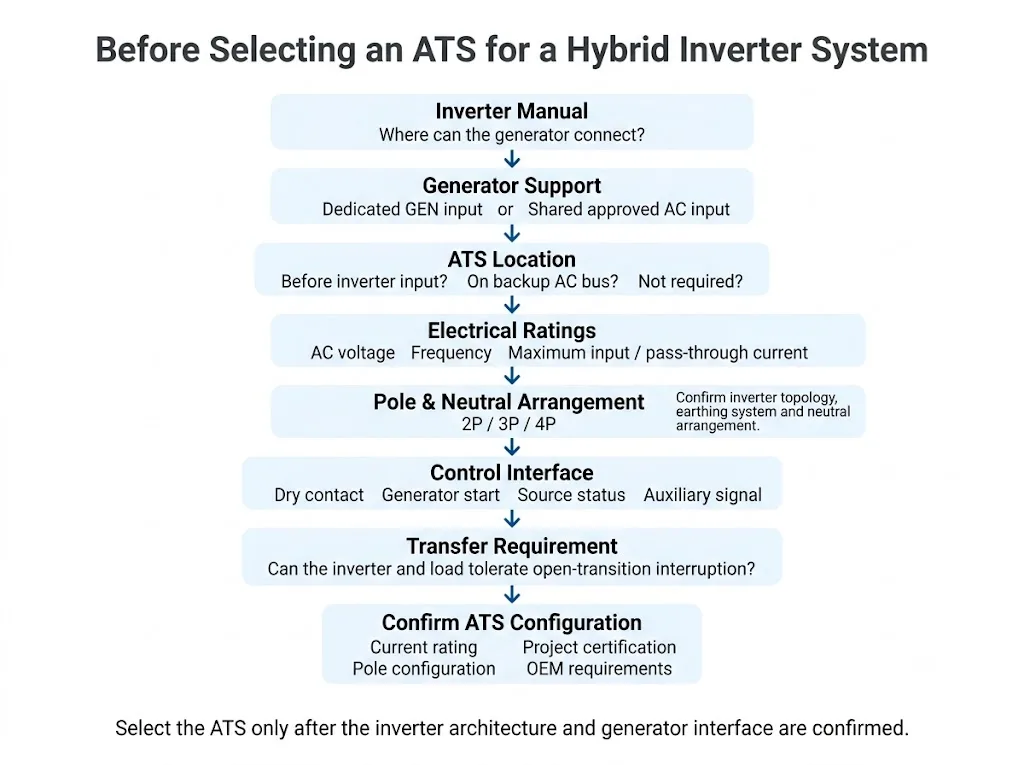
Hybrid Inverter ATS Selection: A Practical Decision Flow
Common Integration Mistakes
Assuming every hybrid inverter needs an external ATS
Some inverter architectures already provide a dedicated generator input or the required source-management function.
Assuming every generator can feed an inverter grid input
This arrangement should be used only when the inverter manufacturer supports it.
Assuming this ATS automatically provides generator-start dry contacts
Control interfaces vary by model and configuration. Confirm the exact ATS terminal and controller functions before promising generator-start or source-status integration.
Assuming an ATS creates seamless backup
A standard open-transition ATS introduces a source-transfer interval. Critical-load continuity must be checked separately.
Choosing current from inverter kW only
ATS sizing should use the maximum current that can pass through the actual switching point.
Before Ordering an ATS for a Hybrid Inverter System
Send the inverter and generator details before fixing the ATS model
Provide the inverter model, manufacturer connection diagram, system voltage, maximum current, generator information, required pole configuration, intended ATS position and any control-signal requirement. LEEYEE can then review whether the compact ATS configuration matches the stated AC source-switching application.
FAQ
Does every hybrid inverter need an ATS?
No. Some systems use an external ATS for grid/generator selection, while other hybrid inverters provide their own generator input or source-transfer architecture.
Can this LEEYEE ATS be used between grid and generator?
Yes, when the application is compatible with the ATS electrical ratings and the inverter manufacturer permits the selected grid/generator AC architecture.
Does this ATS replace the hybrid inverter's EMS or BMS?
No. The ATS performs AC source transfer. It does not control PV production, battery SOC, charging strategy, EMS logic or battery management.
Does this ATS provide generator-start dry contacts?
Do not assume so from the application alone. Generator-start, source-status and auxiliary-contact functions must be confirmed for the exact ATS controller and configuration before ordering.
Can I use 2P or 4P?
The product image shows LEEYEE compact 2P and 4P configurations. The correct choice depends on the actual phase, neutral, earthing and inverter architecture.
Can this ATS provide zero-interruption backup?
No such assumption should be made. LEEYEE's standard compact ATS is intended for conventional open-transition source switching, so the downstream system must tolerate the transfer interval.
Referenzen
- SolaX Power, Generator Function on Hybrid Inverter. Official manufacturer guidance covering generator modes and ATS-dependent architectures for supported inverter families. Official SolaX source.
- Solis North America, Integrating a Generator with Solis HV Hybrid. Official guidance describing an external ATS and source-status signal for a specified S6 hybrid inverter family. Official Solis source.
- Ningbo Deye Inverter Technology Co., Ltd., hybrid inverter technical documentation covering multifunction GEN input and generator-control functions on applicable models. Official Deye source.
- Internationale elektrotechnische Kommission, IEC 60947-6-1 — Low-voltage switchgear and controlgear — Part 6-1: Multiple function equipment — Transfer switching equipment. Official IEC Webstore.
The manufacturer examples above illustrate why hybrid-inverter ATS integration is model-specific. They do not imply endorsement of LEEYEE by the referenced inverter manufacturers. Final wiring, neutral treatment, source compatibility, protection, control logic, transfer performance and certification scope must be confirmed against the exact ATS and inverter documentation and the project electrical design.
