
Inhaltsübersicht
Quick Answer
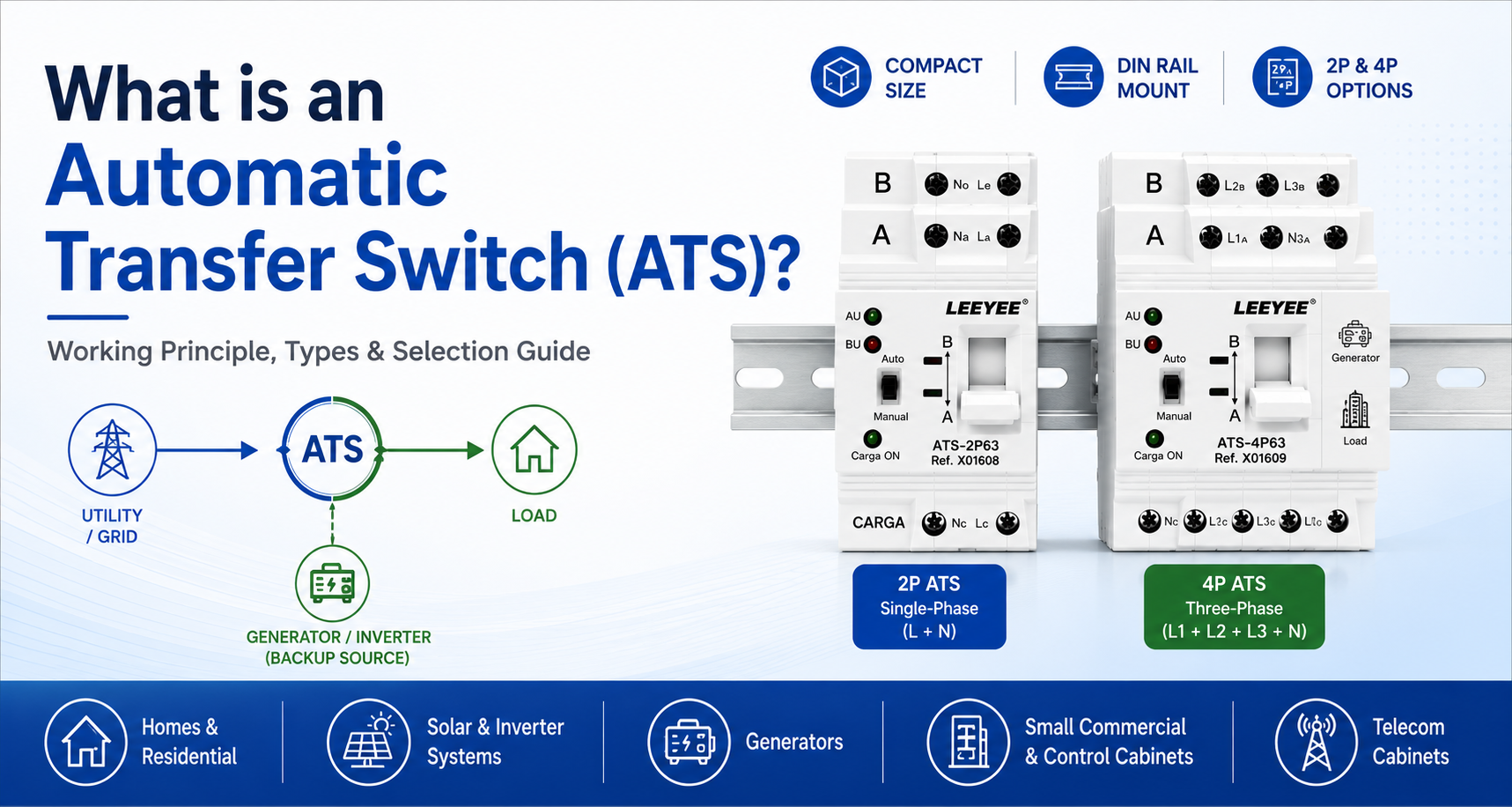
An automatic transfer switch, or ATS, automatically transfers a load between two power sources. When the normal source fails, the ATS switches the load to a backup source, such as a generator, inverter, or secondary AC supply. When the normal source returns and becomes stable, the ATS switches the load back.
For compact backup power systems, the most important selection factors are phase type, current rating, voltage, pole configuration, backup source type, wiring method, and transfer switching time.
For LEEYEE ATS-63 Series, the transfer switching time is less than 50 ms. This refers to the ATS switching action itself; total backup recovery time may also depend on the generator, inverter, or backup source response.
In many residential, solar backup, generator backup, and small commercial systems, a 2P ATS is used for single-phase power, while a 4P ATS is used for three-phase systems that require L1, L2, L3, and neutral switching.
Key Takeaways
- An ATS automatically transfers a load between a normal source and a backup source.
- A 2P ATS is commonly used for single-phase L + N systems.
- A 4P ATS is commonly used for three-phase L1 + L2 + L3 + N systems.
- The ATS current rating must be equal to or higher than the actual load current.
- Transfer switching time matters. LEEYEE ATS-63 Series switches in less than 50 ms.
- An ATS is not a UPS. It does not store energy or provide battery backup.
- An ATS does not replace circuit breakers, fuses, SPDs, or other protection devices.
- LEEYEE ATS-63 Series is available in 2P and 4P versions with rated current options from 6A to 63A.
What Is an Automatic Transfer Switch?
An automatic transfer switch is a power switching device used to move an electrical load from one power source to another. In most backup power systems, one source is the normal supply, such as utility grid power. The other source is a backup supply, such as a generator, inverter, solar backup system, or another AC source.
The ATS monitors the available power sources. If the normal source fails, drops voltage, or becomes unstable, the ATS transfers the load to the backup source when that source is ready. Once the normal source returns and stabilizes, the ATS transfers the load back.
This makes the ATS an important part of backup power systems for homes, small shops, offices, control cabinets, telecom cabinets, generator systems, and solar inverter backup systems.
The key point is simple: an ATS is not just an on/off switch. It is a source-transfer device. To work safely, it must match the system voltage, current, phase type, pole configuration, backup source, wiring design, and transfer requirement.
What Does an Automatic Transfer Switch Do?
An ATS performs one main job: it keeps the load connected to the right available power source.
In a basic utility-to-backup system, the ATS:
- Monitors the normal power source.
- Detects when the normal source fails or becomes unstable.
- Checks whether the backup source is available.
- Transfers the load to backup power when conditions are acceptable.
- Transfers the load back when normal power returns and stabilizes.
This process reduces manual switching and helps maintain power availability during an outage.
How Does an Automatic Transfer Switch Work?
An ATS works by monitoring two power sources and selecting which source supplies the load.
In a compact ATS system, the two sources are often:
- Normal source: utility grid power
- Backup source: generator, inverter, solar backup system, or another AC source
The ATS monitors source availability and electrical conditions such as voltage and frequency. When the normal source fails, the ATS checks the backup source. If the backup source is within the required range, the ATS transfers the load.
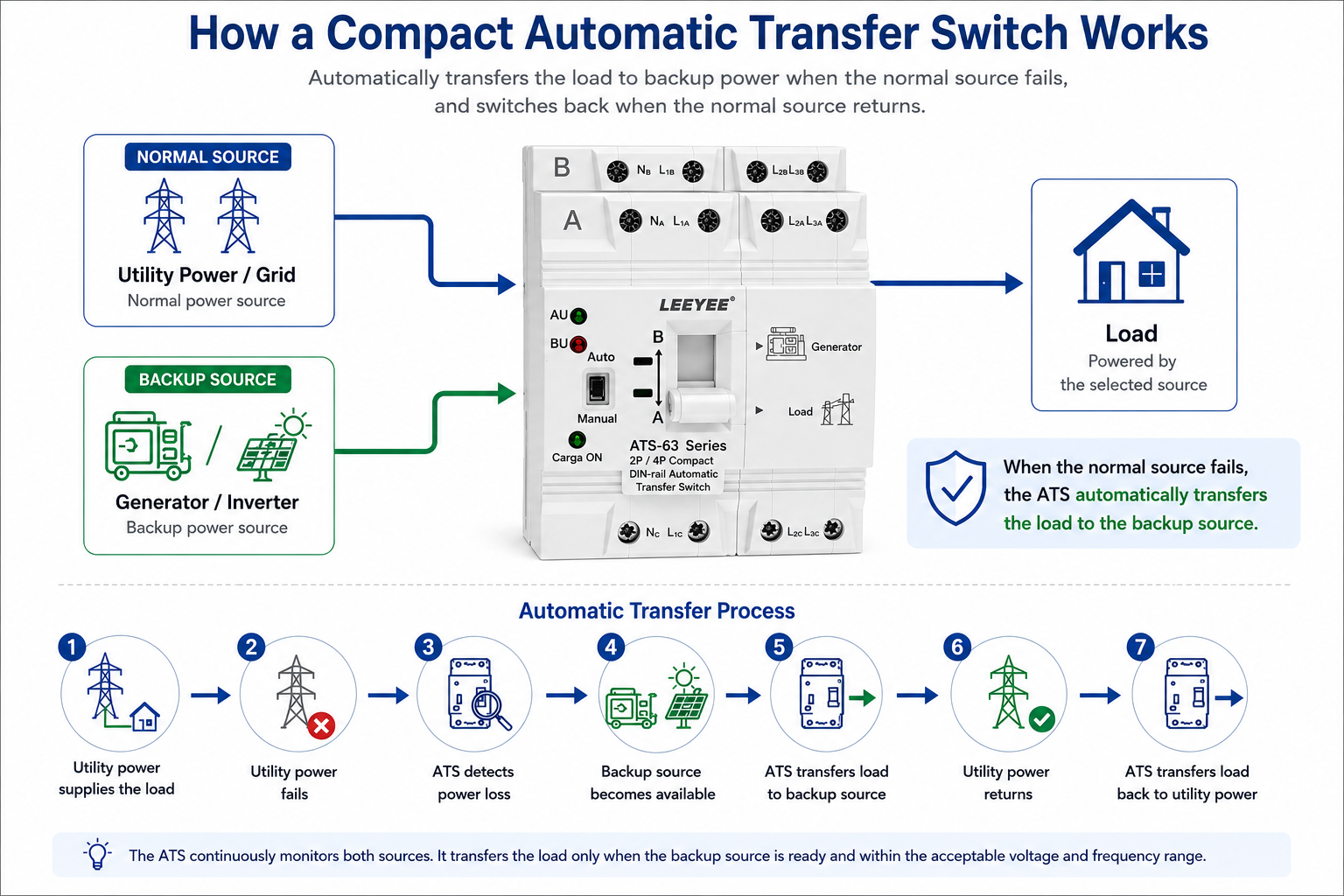
A typical automatic transfer process looks like this:
- Utility power supplies the load.
- Utility power fails or becomes unstable.
- The ATS detects the power loss.
- The backup source becomes available.
- The ATS transfers the load to the backup source.
- Utility power returns.
- The ATS transfers the load back to utility power.
 View larger
For LEEYEE ATS-63 Series, the transfer switching time is less than 50 ms according to the product manual. This value refers to the ATS switching action itself. In generator backup systems, the total time before backup power is available may also include generator start-up and voltage stabilization time.
This process is automatic, but it is not the same as uninterrupted power. Standard ATS switching may still create a short interruption. If the load cannot tolerate any interruption, a UPS or a different power architecture may be required.
Automatic Transfer Switch Example
A simple example is a small building with utility power and a backup generator.
Under normal conditions, the building runs on utility power. The ATS keeps the load connected to the utility source.
When utility power fails, the backup source becomes available. Once the backup source reaches a usable voltage and frequency, the ATS transfers the load to backup power.
When utility power returns, the ATS verifies that the normal source is stable, then transfers the load back.
The same basic idea can apply to solar inverter backup systems, small distribution boards, pump control cabinets, and other compact AC backup systems.
Manual Transfer Switch vs Automatic Transfer Switch
A manual transfer switch requires a person to operate the switch. When power fails, someone must physically switch the load from one source to another.
An automatic transfer switch does this automatically based on source status.
| Typ | How It Works | Typical Use |
|---|---|---|
| Manual transfer switch | Switched by hand | Simple systems where manual operation is acceptable |
| Non-automatic transfer switch | Electrically operated but manually controlled | Systems that need powered operation but not full automation |
| Automatic transfer switch | Transfers automatically based on source status | Backup systems that need automatic source transfer |
For homes, small offices, generator backup systems, solar inverter backup systems, and control cabinets, an ATS is often more practical than manual switching.
Main Types of Automatic Transfer Switch Applications
ATS products can be used in different source arrangements. The right choice depends on the power system design.
Utility to Generator
This is one of the most common ATS applications.
The normal source is utility power. The backup source is a generator. When utility power fails, the ATS transfers the load to generator power. When utility power returns, it transfers the load back.
This setup is common in homes, shops, small commercial buildings, pump systems, and backup power cabinets.
Utility to Utility
In this arrangement, both sources are utility supplies. If one utility source fails, the ATS transfers the load to the second utility source.
This is more common in commercial or industrial facilities with access to two independent feeds.
Utility to Inverter or Solar Backup
In some solar and battery backup systems, an ATS can switch between grid power and inverter output.
This application requires careful system design. Before using an ATS with an inverter, confirm the inverter output voltage, frequency, grounding method, neutral arrangement, and local electrical code requirements.
Not every inverter system should be wired the same way. Always follow the inverter manufacturer’s instructions and the project wiring design.
Open Transition vs Closed Transition ATS
Transfer switches are often described as open transition or closed transition.
Open Transition ATS
Open transition means break-before-make. The ATS disconnects from one source before connecting to the other source.
This is widely used in general backup power applications. It is suitable for many homes, shops, generator backup systems, solar inverter backup systems, control cabinets, pumps, lighting circuits, and other non-critical loads.
A short interruption may occur during transfer.
Closed Transition ATS
Closed transition means make-before-break. The ATS briefly connects two synchronized power sources before disconnecting from the first source.
This type of system is more complex. It requires source synchronization and is usually used in larger engineered power systems where transfer interruption must be minimized.
Important Note for Compact ATS Products
Do not assume every ATS supports closed transition.
Compact DIN-rail ATS products, including LEEYEE ATS-63 Series, are mainly used for general backup source switching in small and medium AC systems. For these applications, buyers should focus first on phase type, current rating, voltage, pole configuration, backup source type, wiring method, transfer switching time, and installation conditions.
If a project requires closed transition, synchronization, or zero-interruption transfer, it needs a different level of system design.
2P vs 4P Automatic Transfer Switch
Pole configuration is one of the most important ATS selection points.
Many buyers start by asking for a current rating, such as 32A or 63A. That is not enough. The ATS must also match the phase type and wiring method.
What Is a 2P ATS?
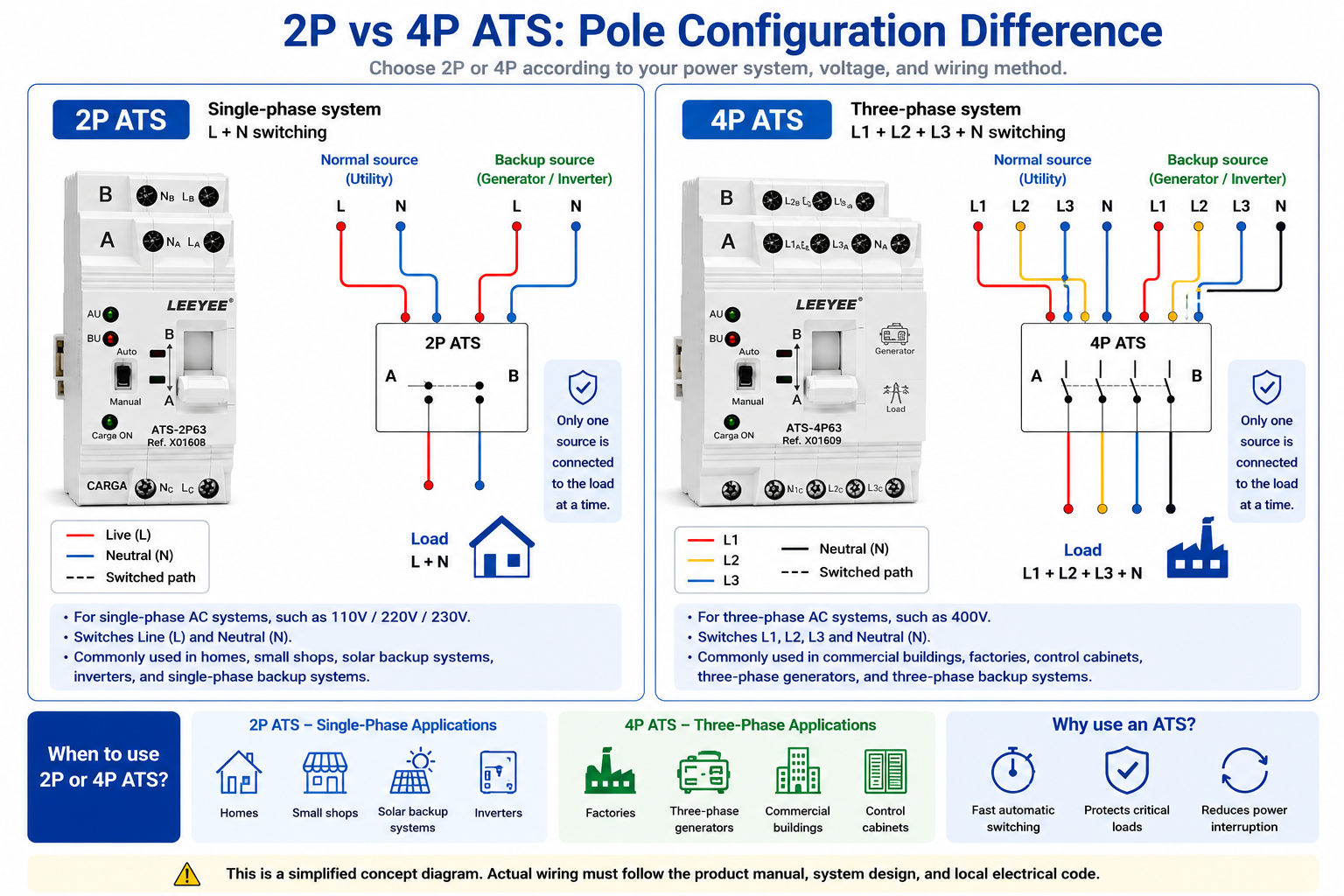
A 2P ATS has two switching poles. It is commonly used in single-phase systems where Line and Neutral need to be switched.
Typical 2P ATS applications include:
- Home backup systems
- Small shops
- Small offices
- Single-phase generator backup systems
- Single-phase inverter backup systems
- Verteilerschränke für Wohngebäude
What Is a 4P ATS?
A 4P ATS has four switching poles. It is commonly used in three-phase systems where L1, L2, L3, and Neutral need to be switched.
Typical 4P ATS applications include:
- Three-phase commercial systems
- Small factories
- Steuerschränke
- Three-phase generator backup systems
- Pump control panels
- Distribution boards that require neutral switching
2P vs 4P ATS Selection Table
| System Typ | Common ATS Choice | Notes |
|---|---|---|
| Single-phase AC system | 2P ATS | Common for homes, shops, and small offices |
| Single-phase generator backup | 2P ATS | Used for L + N switching |
| Three-phase AC system | 4P ATS | Used for L1 + L2 + L3 + N switching |
| Three-phase generator backup | 4P ATS | Common in control cabinets and distribution systems |
| Inverter backup system | 2P or 4P | Depends on inverter output and wiring design |
| System requiring neutral switching | 2P or 4P | Depends on phase type and local requirements |
 View larger
The simplest rule is: use 2P for many single-phase systems and 4P for many three-phase systems. Final selection should always follow the actual wiring design.
How to Choose the Right Automatic Transfer Switch
Choosing an ATS is not just a matter of choosing the highest current rating. A good selection starts with the power system.
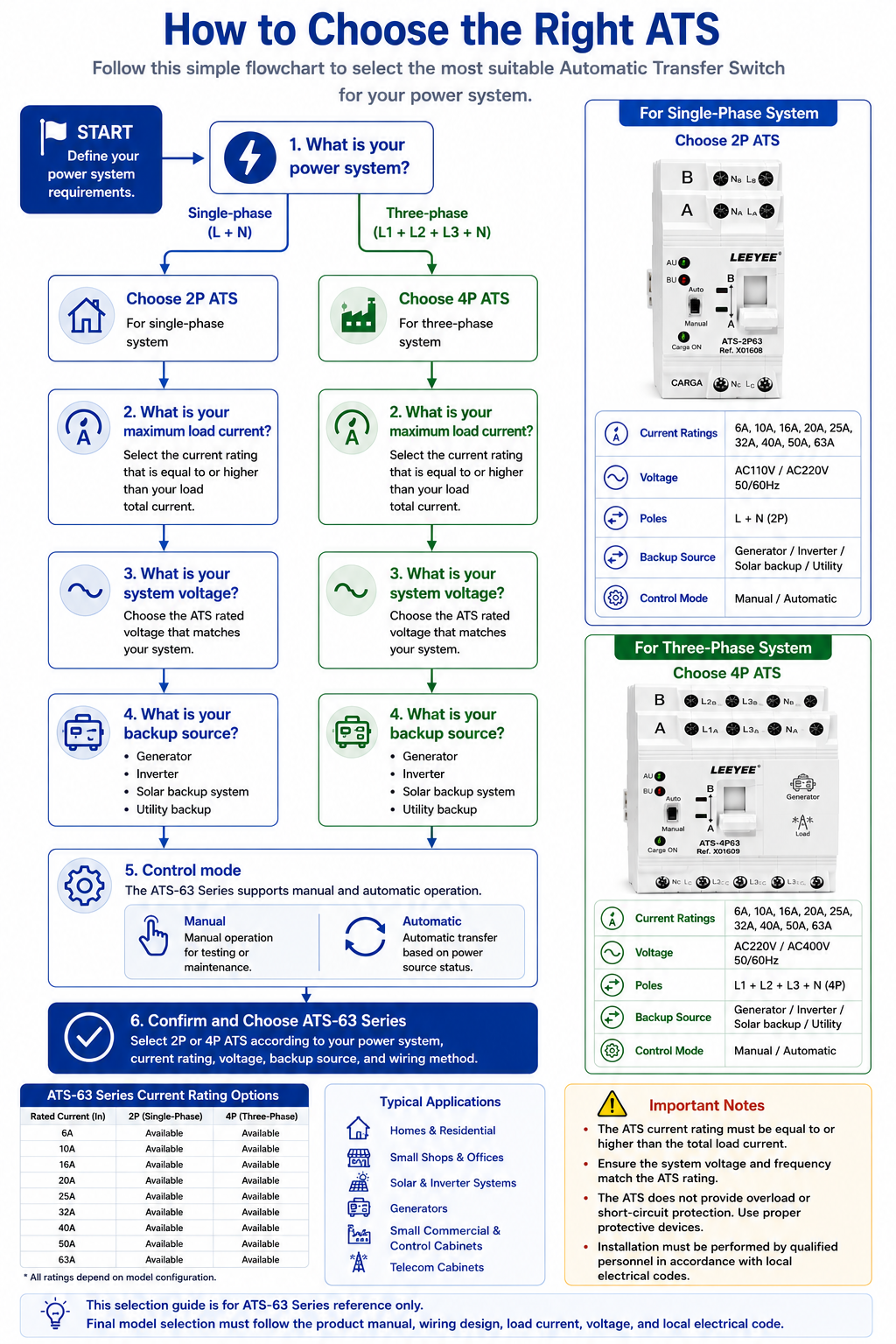
1. Confirm the Phase Type
First, identify whether the system is single-phase or three-phase.
For many single-phase systems, a 2P ATS is used. For many three-phase systems, a 4P ATS is used.
2. Confirm the Load Current
The ATS current rating must be equal to or higher than the load current.
For LEEYEE ATS-63 Series, available current ratings include 6A, 10A, 16A, 20A, 25A, 32A, 40A, 50A, and 63A.
For pumps, motors, compressors, and other inductive loads, starting current should also be considered.
3. Confirm the System Voltage
The ATS rated voltage must match the power system.
LEEYEE ATS-63 Series supports configurations for AC110V, AC220V, AC400V, and 50/60Hz.
Using the wrong voltage rating can cause unsafe operation or switching failure.
4. Confirm the Backup Source
Common backup sources include generator, inverter, solar backup system, utility backup, or another AC backup source.
Generator backup systems may require a complete control design. Inverter and solar backup systems require extra attention to neutral, grounding, waveform, and local code requirements.
5. Confirm the Transfer Switching Time
Transfer switching time tells you how quickly the ATS changes from one source to another after the switching condition is met.
For LEEYEE ATS-63 Series, the transfer switching time is less than 50 ms. This makes it suitable for many compact backup power applications, including generator backup, solar inverter backup, control cabinets, and small distribution systems.
However, transfer switching time is not the same as total backup power recovery time. If the backup source is a generator, the total recovery time may also include generator start-up and voltage stabilization. If the load cannot tolerate even a short interruption, a UPS or a different power design may be required.
6. Confirm Manual and Automatic Operation
Many compact ATS products support both manual and automatic operation.
Manual operation is useful for testing and maintenance. Automatic operation allows the ATS to transfer based on source status.
7. Confirm Installation Conditions
Compact ATS products are often installed in distribution boards or control cabinets.
Check DIN-rail space, wiring space, terminal capacity, cabinet layout, heat dissipation, product dimensions, and installation environment.
 View larger
Key Specifications to Check Before Buying an ATS
| Spezifikation | What to Confirm |
|---|---|
| Nennspannung | Must match the system voltage |
| Nennstrom | Must match or exceed the load current |
| Pole configuration | 2P or 4P depending on phase type and wiring method |
| Frequency | 50Hz or 60Hz |
| Transfer switching time | Check whether the ATS switching time is suitable for the load. LEEYEE ATS-63 transfer switching time is <50 ms. |
| Backup source | Generator, inverter, solar backup, utility backup, or other AC source |
| Operation mode | Manual, automatic, or other stated functions |
| Einbauverfahren | DIN rail, panel, or cabinet installation |
| Protection design | Circuit breakers, fuses, SPDs, and grounding as required |
| Zertifizierung | Depends on target market and project requirements |
| Wiring diagram | Must match the actual system design |
A reliable supplier should be able to provide technical data, dimensions, wiring diagrams, and application guidance.
Standards and Compliance
For compact ATS products used in residential, commercial, solar backup, generator backup, and control cabinet applications, buyers often ask for CE and RoHS documentation.
CE indicates that the product is designed for applicable European conformity requirements within its declared product category. RoHS addresses restrictions on certain hazardous substances in electrical and electronic equipment.
LEEYEE automatic transfer switches can be supplied with CE and RoHS documentation for buyers who need support for export, distribution, panel assembly, or project procurement.
Certification needs can vary by country and project. For public buildings, critical systems, large generator projects, or regulated installations, buyers should confirm whether additional local standards, test reports, or approvals are required.
ATS vs MTS vs UPS
ATS, MTS, and UPS devices are often mentioned together, but they do different jobs.
| Device | Full Name | Main Function |
|---|---|---|
| ATS | Automatic Transfer Switch | Automatically switches the load between two power sources |
| MTS | Manual Transfer Switch | Switches the load manually between two power sources |
| UPS | Uninterruptible Power Supply | Provides temporary battery power during an interruption |
An ATS does not store energy. It transfers the load to another available source.
A UPS stores energy in batteries and can support sensitive equipment during short interruptions. In some systems, an ATS and UPS are used together.
Does an ATS Provide Overload or Short-Circuit Protection?
No. An ATS does not replace circuit protection devices.
An ATS transfers the load between power sources. It does not provide overload protection or short-circuit protection by itself.
A complete power system should include suitable protection devices, such as circuit breakers, fuses, surge protective devices, residual current protection where required, proper grounding and bonding, and correct cable sizing.
Common Automatic Transfer Switch Applications
Home Backup Power
In residential systems, an ATS can switch selected circuits from utility power to a generator or inverter backup source.
Typical loads include lighting, refrigerators, routers, water pumps, security systems, and basic household circuits.
Small Shops and Offices
Small commercial users may need backup power for lighting, cash registers, communication devices, refrigeration, security systems, or ventilation equipment.
A compact ATS can make the transfer process automatic instead of manual.
Generator Backup Systems
Generator backup is one of the most common ATS applications.
The ATS transfers the load to generator power when utility power fails and transfers it back when utility power returns.
Solar and Inverter Backup Systems
In some solar or battery backup systems, an ATS can switch between grid power and inverter output.
This requires careful design. Always confirm inverter output voltage, frequency, grounding method, neutral arrangement, load type, and local code requirements.
Pump Control Systems
Water pumps, irrigation systems, drainage systems, and control cabinets may require backup power.
For pump applications, current rating and motor starting current are especially important.
Telecom Cabinets
Compact ATS products can be used in telecom cabinets or remote equipment rooms where power source transfer is required.
Compact size, reliable switching, and stable voltage monitoring are important in this type of application.
Control Cabinets and Distribution Boards
In control cabinets and distribution boards, an ATS can support auxiliary circuits, monitoring systems, fans, small motors, and backup circuits.
The ATS must match the cabinet layout, load current, voltage, and wiring method.
LEEYEE ATS-63 Automatic Transfer Switch
For residential backup power, generator backup, solar inverter backup, small distribution systems, and control cabinet applications, LEEYEE provides the ATS-63 automatic transfer switch series.
ATS-63 is a compact DIN-rail automatic transfer switch designed for switching between common power A and backup power B in AC power systems. It is available in 2P and 4P versions for single-phase and three-phase applications.
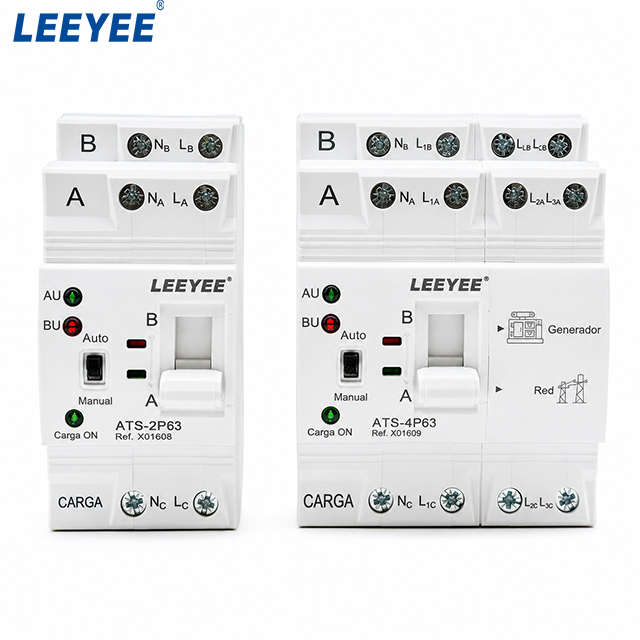
For full technical specifications, wiring details, and dimensions, please view the ATS-63 product page or contact LEEYEE for selection support.
When ATS-63 Is a Good Fit
ATS-63 is a good fit for compact AC backup power systems where automatic source transfer is needed.
Typical applications include home backup power systems, generator backup systems, solar inverter backup systems, small shops and offices, light commercial distribution, control panels, distribution boards, telecom cabinets, and compact power cabinets requiring 2P or 4P switching.
It is best suited for systems within its rated current, voltage, wiring range, and transfer switching requirements.
When ATS-63 May Not Be the Right Fit
ATS-63 is not designed to replace large power transfer systems or critical power architectures.
It may not be the right fit for systems above 63A, large industrial transfer systems, data center redundant power systems, hospital-grade critical power systems, applications requiring zero power interruption, systems requiring closed transition synchronization, or applications where overload or short-circuit protection is expected from the ATS itself.
For these applications, a larger engineered transfer solution may be required.
Common Mistakes When Choosing an ATS
Choosing Only by Current Rating
A request like “I need a 63A ATS” is not enough. Voltage, phase type, pole configuration, backup source, wiring method, transfer switching time, and installation conditions also matter.
Using 2P ATS in a Three-Phase System
A 2P ATS is not suitable for a standard three-phase system that requires four-pole switching. Many three-phase systems require a 4P ATS.
Ignoring Neutral Switching
Neutral switching depends on the grounding system, generator design, inverter wiring, and local code. Do not assume every system should handle neutral the same way.
Undersizing the ATS
The ATS should not operate above its rated current. For motors and pumps, starting current must also be considered.
Treating ATS as a UPS
An ATS does not provide battery backup. If the load cannot tolerate even a short interruption, a UPS may be required.
Forgetting Protection Devices
An ATS does not replace circuit breakers, fuses, or surge protection. The complete system must include proper protection.
Ignoring Installation Space
Compact ATS products still need adequate wiring space, terminal access, ventilation, and safe cabinet layout.
When Should You Use an Automatic Transfer Switch?
Use an ATS when a load needs to switch automatically from one power source to another after the main supply fails.
An ATS is suitable when two AC power sources are available, manual switching is too slow or inconvenient, a generator or inverter source is available, and the application needs automatic backup source transfer.
An ATS may not be enough when the load requires zero interruption, the backup source is unstable, the wiring system is unclear, the load exceeds the ATS rating, or local regulations require a different transfer system.
For sensitive electronics, an ATS may need to work together with a UPS.
Frequently Asked Questions About Automatic Transfer Switches
What is the purpose of an automatic transfer switch?
The purpose of an automatic transfer switch is to move the load from the normal power source to a backup source when the normal source fails or becomes unstable.
What is an automatic transfer switch used for?
It is used for backup power switching in homes, small commercial buildings, generator systems, solar inverter backup systems, control panels, distribution boards, and telecom cabinets.
How does an automatic transfer switch work?
It monitors the normal source and backup source. When the normal source fails and the backup source is ready, the ATS transfers the load to the backup source.
What happens when utility power comes back?
The ATS transfers the load back to utility power after the normal source returns and becomes stable.
Can an ATS work without a generator?
Yes. An ATS can also switch between utility and inverter power, utility and solar backup power, two utility sources, or other AC backup sources.
Is an ATS required for a generator?
Not always. However, an ATS is recommended when automatic generator backup transfer is needed. Without an ATS, switching may need to be done manually.
Can an ATS switch between grid and solar inverter?
Yes, in some systems. The design must confirm inverter output, voltage, frequency, neutral arrangement, grounding method, load type, and local code requirements.
How fast does an ATS switch?
Switching time depends on the ATS design, source condition, and system settings. For LEEYEE ATS-63 Series, the transfer switching time is less than 50 ms. In generator backup systems, the total backup time may also include generator start-up and stabilization time.
What is the transfer switching time of LEEYEE ATS-63?
LEEYEE ATS-63 Series has a transfer switching time of less than 50 ms according to the product manual. This refers to the ATS switching action itself. In generator backup systems, the total backup time may also include generator start-up and stabilization time.
What is the difference between ATS and UPS?
An ATS transfers the load between two power sources. A UPS provides temporary battery power. An ATS does not store energy.
What is the difference between 2P and 4P ATS?
A 2P ATS is commonly used for single-phase systems. A 4P ATS is commonly used for three-phase systems that require L1, L2, L3, and neutral switching.
Can a 2P ATS be used for a three-phase system?
No. A 2P ATS is not suitable for standard three-phase systems requiring three-phase or four-pole switching.
What size automatic transfer switch do I need?
Choose the ATS according to load current, system voltage, pole configuration, source type, wiring method, and transfer switching requirement. LEEYEE ATS-63 is available in 6A, 10A, 16A, 20A, 25A, 32A, 40A, 50A, and 63A options.
Can ATS-63 be used for home backup power?
Yes, when the voltage, current, pole configuration, and wiring method match the home backup system.
Can ATS-63 be used for generator backup?
Yes. It can be used in compact generator backup systems when the electrical parameters and wiring design match the application.
Can ATS-63 be used for solar backup systems?
Yes, in some solar or inverter backup systems. Buyers should confirm the inverter output, system voltage, frequency, neutral switching requirement, and wiring method before selection.
What certifications are available for LEEYEE ATS?
LEEYEE automatic transfer switches can be supplied with CE and RoHS documentation. Project requirements should be confirmed before ordering.
Does an ATS provide surge protection?
No. An ATS switches between power sources. Surge protection requires a separate surge protective device.
Does an ATS provide overload or short-circuit protection?
No. Use suitable circuit breakers, fuses, or other protection devices as part of the complete system design.
What should I confirm before buying an ATS?
Confirm voltage, current rating, pole configuration, frequency, source type, wiring method, transfer switching time, installation space, certification needs, and application conditions.
Need Help Choosing an ATS?
Tell us your voltage, current, phase type, backup source, transfer requirement, and wiring details. LEEYEE can help you select a suitable ATS-63 option for generator backup, solar inverter backup, distribution boards, and compact control cabinets.
Schlussfolgerung
An automatic transfer switch automatically transfers a load between a normal power source and a backup source. It is commonly used in generator backup, solar inverter backup, residential distribution, small commercial systems, telecom cabinets, and control panels.
The right ATS must match the real power system. Before selecting a model, confirm voltage, current, phase type, pole configuration, backup source, wiring method, transfer switching time, and installation conditions.
For compact backup power systems, LEEYEE ATS-63 provides 2P and 4P DIN-rail options from 6A to 63A, with transfer switching time less than 50 ms. It is a practical choice for many small and medium AC backup applications when the system requirements match the product rating.
A well-selected ATS makes backup power switching easier, safer, and more reliable.