
A battery energy storage system may require automatic source transfer, but the ATS must be used at the correct point in the system. LEEYEE compact automatic transfer switches are intended for suitable low-voltage AC-side transfer applications, not for direct switching of a high-voltage battery DC bus.
Table des matières
Réponse rapide
A compact LEEYEE ATS can be considered where a BESS project needs to transfer a low-voltage AC load between two defined AC sources, such as utility and generator power, or another project-approved AC source arrangement.
It does not replace the PCS, BMS, EMS, battery contactor, DC disconnect or battery-side protection equipment. Any transfer involving PCS output or microgrid operation must be confirmed against the actual system design.
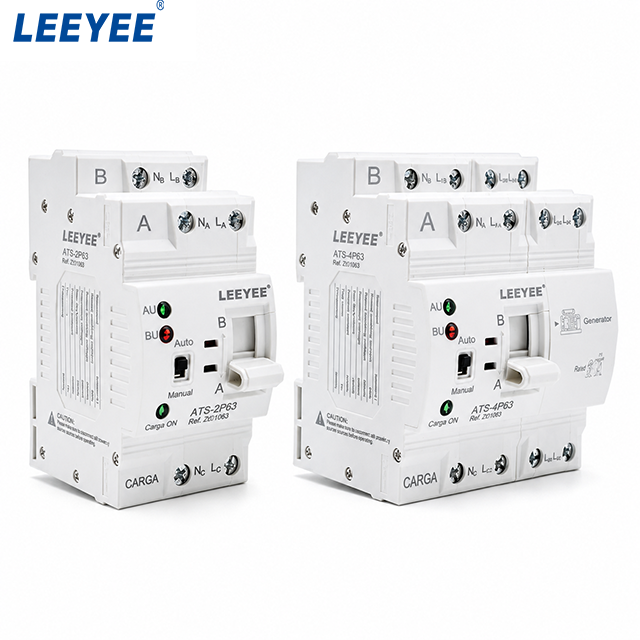
Where Can This Compact ATS Fit in a BESS Project?
The product shown above is a compact integrated ATS intended for ordinary low-voltage AC source transfer. In a BESS project, it may be suitable for panel-level or auxiliary AC circuits where two AC sources must be selected automatically.
| Application Position | Suitability | Signification technique |
|---|---|---|
| Battery DC bus | Not suitable | This compact ATS should not be used for direct high-voltage battery DC switching. |
| Utility ↔ Generator | Suitable in many LV applications | A typical low-voltage AC dual-source transfer application, subject to current, voltage and project requirements. |
| AC auxiliary load supply | Potentially suitable | Useful where auxiliary loads can tolerate normal open-transition transfer interruption. |
| PCS AC output ↔ another AC source | En fonction du projet | PCS behaviour, source compatibility, interlocking and control logic must be confirmed first. |
| Large BESS main power switching | Requires separate evaluation | Do not assume a compact ATS is suitable for high-current main-bus transfer simply because the project is a BESS application. |
Why the ATS Belongs on the AC Side
A BESS typically contains a battery system, PCS, BMS and higher-level control logic. The battery stores energy on the DC side, while the PCS handles power conversion between the battery and the AC system.
A compact ATS performs a much narrower function: it transfers a suitable AC load between two predefined sources. It does not manage battery SOC, charging and discharging strategy, cell protection or inverter power conversion.
What Type of BESS Load Is a Better Match for This Product?
This compact ATS is a better fit when the transfer point is a relatively conventional low-voltage AC circuit rather than a large utility-scale storage main bus.
Better-matched applications
- Low-voltage auxiliary distribution
- Utility-to-generator backup circuits
- Small or medium panel-level transfer circuits
- Critical AC loads that accept open-transition interruption
- OEM control or distribution cabinets within the ATS rated range
Applications requiring another solution
- High-voltage battery DC switching
- Large BESS main-bus transfer beyond the product rating
- Closed-transition or no-break transfer
- Synchronized parallel source transfer
- Complex multi-source microgrid control
2P or 4P: Which Configuration Should Be Used?
The product shown is available in compact 2-pole and 4-pole configurations. The correct choice depends on the AC system rather than on the term “BESS” itself.
| Configuration | Utilisation typique | Ce qui doit être confirmé |
|---|---|---|
| 2P | Single-phase low-voltage AC source transfer | System voltage, neutral arrangement, source configuration and actual load current. |
| 4P | Three-phase applications where all required conductors, including neutral where specified, are switched | Grounding system, neutral switching requirement, source arrangement and project single-line diagram. |
Pole selection should therefore be based on the actual single-line diagram. A buyer should not choose 2P or 4P only because the project is described as an energy storage system.
Open Transition Is an Important Limitation
LEEYEE's standard compact ATS is primarily intended for ordinary open-transition transfer. The connected source is disconnected before the alternative source is connected.
This is acceptable for many conventional backup circuits, but not for every BESS load. If the downstream equipment cannot tolerate the interruption, the system designer must select another continuity strategy.
Can It Be Used Between Utility and Generator?
Yes, utility-to-generator transfer is one of the more natural applications for this compact ATS when the system voltage, current rating, pole configuration and control requirements fall within the selected model's capabilities.
In such a project, the ATS may supervise the two AC sources and transfer the load according to the system configuration. Generator start logic, dry contacts or other control functions should be confirmed against the actual ATS model and generator controller.
Can It Be Used with a PCS?
Possibly, but this is not a universal application. A PCS is not simply another generic AC source. Its operating mode may depend on synchronization, grid-following or grid-forming behaviour, anti-islanding logic, EMS commands and internal protection.
Therefore, if one transfer source is the PCS AC output, the system integrator should confirm:
- whether the PCS is allowed to energize the proposed AC bus,
- whether it may be disconnected and reconnected by an external ATS,
- whether any synchronization is required,
- how source interlocking is implemented,
- which controller has authority over the transfer sequence.
Do Not Select ATS Current from the BESS kWh Rating
Battery energy capacity and ATS current rating describe different things. A 100 kWh, 500 kWh or 1 MWh battery capacity does not directly determine the ATS ampere rating.
ATS selection must instead be based on the actual AC transfer circuit: system voltage, load current, pole configuration, source arrangement, switching duty and protection design.
Check these parameters
- AC voltage
- Courant de charge
- Source A and Source B
- 2P or 4P requirement
- Neutral switching
- Transfer interruption tolerance
Do not use these as shortcuts
- BESS kWh alone
- Battery voltage alone
- “Energy storage” as the only project description
- Assuming every PCS output behaves like utility power
- Assuming all critical loads accept open transition
What to Send Before Asking for a BESS ATS Recommendation
For a useful model review, provide:
- Schéma unifilaire
- ATS installation position
- Source A type
- Source B type
- Nominal AC voltage
- System frequency
- Courant de charge
- Système monophasé ou triphasé
- 2P or 4P requirement
- Neutral arrangement
- Schéma de mise à la terre
- PCS AC parameters, if involved
- Generator information, if involved
- Required transfer logic
- Acceptable interruption time
- Required control or status signals
Need to Confirm Whether This Compact ATS Fits Your BESS AC Circuit?
Send your single-line diagram, AC voltage, load current, source arrangement and 2P / 4P requirement. LEEYEE can help review whether this compact open-transition ATS is suitable for the proposed low-voltage AC transfer point.
FAQ
Can this LEEYEE ATS switch a battery DC circuit?
No. The compact ATS shown on this page is intended for suitable low-voltage AC source transfer. It should not be specified as a high-voltage battery-side DC switching device.
Is this product suitable for every BESS main power circuit?
No. Suitability depends on the actual AC current, voltage, switching duty and architecture. Large-current BESS main-bus transfer may require a different transfer solution.
Can I use the 2P version for a single-phase BESS auxiliary circuit?
It may be suitable where the actual voltage, current, neutral arrangement and transfer logic match the selected model. The project single-line diagram should be checked before selection.
When would the 4P version be considered?
A 4P configuration may be used in suitable three-phase applications where the project requires the relevant conductors, including neutral where specified, to be switched. The grounding and neutral scheme must be confirmed first.
Does this ATS provide seamless transfer?
No. The standard compact ATS is intended for open-transition operation, so the active source is disconnected before the alternative source is connected.
Can it work with a generator in a BESS project?
Yes, generator backup is a natural low-voltage AC transfer application when the electrical rating and control requirements match the selected ATS.
References and Engineering Notes
- IEC 60947-6-1, Low-voltage switchgear and controlgear — transfer switching equipment.
- Final BESS topology, PCS behaviour, grounding, neutral treatment, protection coordination and source-control sequence must be verified against the project's actual single-line diagram and equipment documentation.
