
A good automatic transfer switch sample does not automatically mean a supplier is ready for a bulk order. For an importer, distributor, generator-set integrator or private-label buyer, the real question is whether the supplier can reproduce the approved ATS consistently across future production batches.
A useful ATS supplier audit therefore goes beyond price, catalogue claims and a certificate PDF. It checks the exact product configuration, technical documents, applicable conformity evidence, sample-to-production control, factory inspection, OEM artwork, change management, batch traceability and after-sales support.
Table des matières
Quick Answer: How Should You Audit an ATS Supplier?
Use a controlled approval sequence: define the ATS requirement → confirm the exact model → review datasheets and wiring → verify required certificate scope → evaluate a representative sample → freeze the approved configuration → confirm production inspection and OEM controls → verify traceability → release the bulk order.
The most important question is not simply whether a supplier can manufacture an ATS. It is whether the supplier can repeatedly deliver the same approved ATS configuration with controlled documents and traceable production records.

Use Approval Gates, Not a Vague Supplier Score
Some supplier-audit items are commercial preferences. Others should stop an order until the issue is resolved.
Focus first on the Critical rows. A competitive price cannot compensate for an unidentified product, conflicting documents or missing conformity evidence required by the project.
| Approval Gate | Priority | Buyer Must Confirm | Typical Evidence |
|---|---|---|---|
| Product definition | Critical | Exact current, voltage, poles and architecture | Model matrix + datasheet |
| Document match | Critical | Documents correspond to the offered model | Datasheet + wiring + manual |
| Certification requise | Critical* | Applicable evidence covers the actual model | Certificate + report scope |
| Approbation d'échantillon | Critical | Physical sample meets the agreed specification | Approved sample record |
| Change control | Critical | Material changes cannot occur without control | Revision / change procedure |
| Production inspection | Haut | Outgoing checks are defined | Inspection plan / records |
| OEM control | Haut | Labels, manuals and packaging are revision controlled | Approved artwork |
| Traceability | Haut | A complaint can be linked to a production batch | Lot / date / record system |
| Delivery management | Haut | Lead time reflects the actual order conditions | Production plan |
| Assistance après-vente | Haut | Technical complaints and replacements have a process | Complaint workflow |
*Certification becomes a critical gate when required by the destination market, customer specification, contract or project approval process.
Do not release a bulk order if the supplier cannot clearly identify the product being supplied, if key technical documents conflict with the approved sample, or if conformity evidence required by the project cannot be connected to the ordered model.
1. Verify the ATS Product Line Before Comparing Prices
Supplier evaluation should begin with product fit. A capable factory is still the wrong supplier if its ATS platform does not match the buyer's electrical system or project requirements.
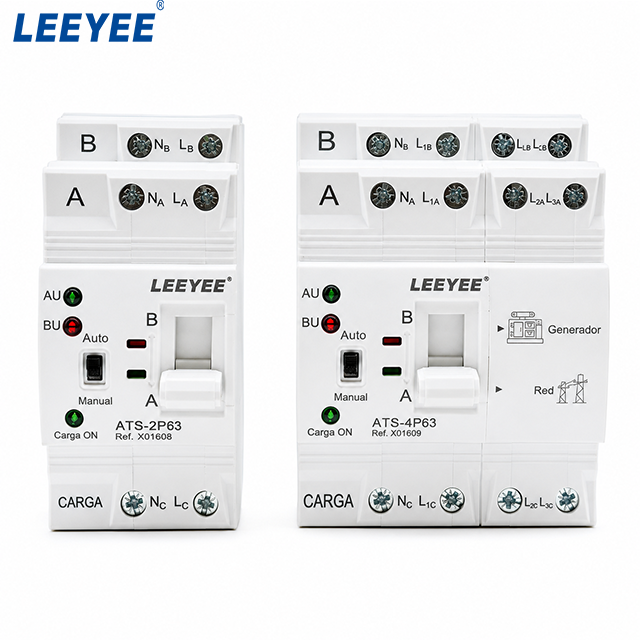
Product Capability Checklist
Confirm whether the required rated-current range belongs to the supplier's regular product line.
Confirm the actual available 2P, 3P and 4P configurations instead of assuming every current rating has every pole option.
Confirm which configurations are intended for single-phase and three-phase systems.
Verify the rated operational voltage and frequency for the proposed model.
Confirm the transfer architecture and product classification relevant to the intended application.
Identify which models are regular production items and which require project-specific confirmation.
Check whether model naming remains stable enough for repeat orders, ERP records, catalogues and after-sales identification.
A catalogue containing many current ratings does not prove that every rating is available with every pole configuration, controller function or certificate scope. Audit the exact model proposed for your order.
2. Can the Supplier Define the Exact ATS You Are Buying?
“100 A, 4P ATS” is not a complete bulk-purchase specification.
The approved product should be identifiable through a controlled combination of model number, electrical rating, pole configuration, mechanical version and control functions.
The most important column below is Recommended Evidence. It turns a verbal sales claim into something purchasing and quality teams can verify.
| Article | Pourquoi c'est important | Recommended Evidence |
|---|---|---|
| Model number | Prevents wrong-product ordering | Model coding table |
| Courant nominal | Defines the ordered rating | Datasheet + nameplate |
| Rated voltage / frequency | Must suit the intended system | Datasheet + nameplate |
| 2P / 3P / 4P | Affects switched conductors and installation | Model code + wiring diagram |
| Transfer architecture | Different architectures are not interchangeable | Technical specification |
| Controller functions | Affects source detection and transfer behaviour | Operating manual |
| Auxiliary interfaces | Affects generator or monitoring integration | Terminal information |
| Mechanical dimensions | Affects panel integration | Dimension drawing |
Procurement conclusion: the quotation, datasheet, wiring diagram, manual and physical sample should all point to the same identifiable configuration.
IEC 60947-6-1:2026 applies to transfer switching equipment within its defined scope for systems whose rated voltage does not exceed 1,000 V AC or 1,500 V DC. It covers ATSE and includes specific provisions for configurations such as bypass/isolation transfer switching equipment and ATSE with closed-transition capability. [1]
Do not treat a compact open-transition ATS as equivalent to a closed-transition, bypass/isolation or other specialized transfer system simply because current and voltage ratings appear similar. The required architecture and applicable project conditions must be confirmed separately.
3. Audit the Technical Documents as One Controlled Set
Documentation quality is an important supplier-audit signal because bulk purchasing depends on more than a working physical sample.
The quotation, datasheet, wiring diagram, installation manual, dimensions and nameplate information should be checked together.
Fiche technique
Does it identify the same model, rating and configuration as the quotation?
Schéma de câblage
Does the diagram correspond to the actual pole configuration, terminals and control functions?
Installation / Operating Manual
Can the buyer identify which ATS version the manual applies to?
Dessin dimensionnel
Can a panel builder use it to confirm mounting and enclosure space?
Nameplate
Does the physical marking match the approved model and ratings?
If one generic datasheet or wiring diagram is used for several materially different ATS configurations, request model-specific information before approval.
4. Verify Certificate Scope, Not Just a Certificate Cover
The supplier's answer to “Do you have certification?” is only the starting point.
The audit should establish whether the document is relevant to the required market and whether its model and rating scope actually includes the ATS being purchased.
Certificate and Report Verification Checklist
Certificate holder or manufacturer identified in the document.
Product category stated in the document.
Referenced standard and edition.
Exact model or model family covered.
Electrical ratings included in the scope.
Relevant annexes, continuation pages or report references.
Issuing certification body or laboratory.
Document number and current validity where applicable.
UL Solutions identifies UL 1008 as the standard used for transfer switch equipment within applicable certification categories. Buyers requiring UL certification should verify the actual product and certification record rather than assuming a general supplier claim covers every ATS variant. [2]
ISO guidance explains that conformity to ISO 9001 demonstrates a systematic quality-management approach but should not be treated as a substitute for product conformity. [3] A factory quality-system certificate therefore does not by itself prove that a particular ATS model meets a required product standard.
5. Evaluate a Representative Sample Before Bulk Production
Sample evaluation should establish a physical reference for the product the buyer intends to receive later in quantity.
Do not evaluate only whether the ATS transfers once. Record the complete approved configuration and compare it against the quotation, datasheet, wiring information, markings and OEM requirements.
Record the items below during sample evaluation so that later production can be compared against a defined reference.
| Sample Item | What to Record | Why It Matters Later |
|---|---|---|
| Boîtier | Structure, colour, markings | Visual batch comparison |
| Front interface | Controls and indicators | Interface consistency |
| Nameplate | Model and electrical ratings | Shipment verification |
| Terminaux | Power and auxiliary layout | Wiring consistency |
| Dimensions | Overall and mounting dimensions | Panel compatibility |
| Operating behaviour | Applicable Auto / Manual and transfer functions | Functional reference |
| Accessoires | Manual, packaging and supplied items | Complete-order consistency |
Procurement conclusion: approve a defined configuration, not just a product appearance.
Create a Golden Sample or Equivalent Approved Reference
After a representative sample passes evaluation, record it as the approved physical reference. The buyer may call this a golden sample, approved sample or another controlled reference.
The important point is that the purchase order, technical specification, OEM artwork and production inspection can all refer back to the same approved version.
A controlled sample reference makes later disagreements easier to prevent: instead of asking whether a production unit “looks different,” both parties can compare it against an agreed configuration and revision.
6. Ask How Product Changes Are Controlled
Sample approval has limited value if the supplier can later change components, terminals, housing or control design without a defined review process.
This does not mean a product can never change. It means important changes should be identified, assessed and communicated according to the commercial and technical agreement.
Questions Worth Asking
- What specification is released to production after sample approval?
- How are different current and pole variants separated during production?
- Who can authorize a component or structural substitution?
- Which changes require buyer notification or renewed sample approval?
- How are drawing, manual and artwork revisions identified?
- Can an older production version be distinguished from a revised version?
Ask the supplier: “If a terminal, controller, housing or other important part changes before our next order, how will that change be identified and communicated?”
7. Audit What the Factory Actually Checks Before Shipment
“Every ATS is tested” is not enough information for a supplier audit.
Ask which characteristics are inspected, how acceptance is defined, whether records are retained, and how nonconforming units are handled.
Factory QC Questions
Is the ATS model, current rating and pole configuration checked before functional inspection?
Are product markings checked against the production order?
Is automatic transfer operation checked where applicable to the ordered ATS?
Is manual operation checked where the model provides that function?
Are source-status indications checked where provided?
Are load-position indications checked where provided?
Are Auto / Manual control functions checked where applicable?
Is fault indication checked when that function is included?
Are generator-start, dry-contact or other auxiliary functions checked when they are part of the ordered configuration?
Are terminals, assembly condition, labels and external appearance inspected?
Is there a defined process for isolating, correcting and re-inspecting nonconforming units?
Can inspection information be linked to the relevant production batch?
Standards-based product evaluation and routine outgoing inspection serve different purposes. IECEE publishes a Test Report Form for IEC 60947-6-1:2026 used with IEC 60947-1:2020, illustrating the structured scope of conformity testing. [4] Do not assume that a supplier's production-line functional check is equivalent to certification or type testing.
8. Audit OEM Capability Through Revision Control
“OEM supported” can mean anything from adding a logo sticker to managing a complete private-label product package.
For a serious OEM order, the supplier should be able to control the relationship between the physical ATS, its model code, technical label, packaging and manual.
OEM capability should be judged by how accurately revisions are controlled, not simply by whether the supplier can print a customer's logo.
| OEM Item | Ce qu'il faut confirmer | Approval Evidence |
|---|---|---|
| Logo | Position, size and appearance | Artwork proof |
| Nameplate | Model and technical information | Approved label file |
| Code de modèle | Buyer code vs factory reference | Cross-reference list |
| Emballage | Box, carton, barcode, quantity | Maquette d'emballage |
| Manuel | Language and model applicability | Version-controlled PDF |
Procurement conclusion: every OEM item should point back to the same approved ATS specification.
A Practical Artwork Approval Flow
- Buyer sends branding, model and packaging requirements.
- Supplier prepares proposed artwork.
- Buyer checks both appearance and technical information.
- The approved file receives a controlled revision.
- Production uses the approved revision.
- Pre-shipment inspection compares production against the approved file.
Do not add a certification mark, standard reference or electrical rating to OEM artwork merely because it appears on another product. Markings and claims must correspond to the actual ATS and applicable approval scope.
9. Require Batch Traceability Before You Need It
Traceability may appear unimportant when the first sample works. Its value becomes clear when hundreds of units have entered distribution channels.
If a buyer later reports an abnormal unit, the supplier should have a practical way to identify which product version and production batch are involved.
Useful Traceability Fields
Exact product model or configuration.
Batch, lot or other production identifier.
Production date or traceable date code.
Applicable OEM artwork revision.
Inspection or outgoing-test record reference.
Purchase order or shipment reference.
The factory does not have to use one universal traceability format. What matters is whether a field complaint can be connected to meaningful production information.
10. Test Technical Communication Before Visiting the Factory
One of the simplest supplier audits can be performed during the RFQ stage.
Send a realistic system requirement and observe whether the supplier asks enough technical questions before recommending a model.
A Technical ATS Enquiry May Need to Clarify
Tension et fréquence du système.
Système monophasé ou triphasé.
Required rated current or load information.
Required 2P, 3P or 4P configuration.
Normal and alternative power-source type.
Required transfer architecture.
Automatic and manual operating requirements.
Generator-start interface where required.
Dry contacts or remote status requirements where applicable.
Installation dimensions or available panel space.
Destination market and required conformity documents.
Quantity and OEM requirements.
If a supplier recommends a final ATS model after receiving only a current rating and pole count, further technical confirmation is justified. The exact information required depends on the application.
11. Audit Lead-Time Management, Not Just the Promised Number
A single lead-time statement has limited value unless it is connected to the actual model mix, quantity, material availability and OEM work involved.
Ask for practical answers to these questions
- Which ATS configurations are produced regularly?
- Which variants normally require production to order?
- At what point is the production schedule confirmed?
- When must OEM artwork and manuals be frozen?
- How is a mixed-current or mixed-pole order scheduled?
- How are material shortages or production delays communicated?
- Can the supplier provide meaningful production milestones for a large order?
A credible delivery commitment should reflect the specific order. Buyers should avoid assuming that a lead time quoted for one standard model automatically applies to a mixed-model or customized OEM order.
12. Audit After-Sales Support Before the First Complaint
Bulk-order after-sales support is more than fast messaging. It is the ability to identify the product, obtain useful failure information and connect a complaint to the correct technical and production records.
| Situation | Supplier Should Be Able To |
|---|---|
| One unit is abnormal | Identify the model and request relevant diagnostic information |
| Several units show a similar issue | Check whether they share a batch or product revision |
| Buyer needs old technical files | Recover the correct manual, drawing or wiring information |
| Replacement is required | Confirm the correct current configuration before shipment |
| The product has been revised | Explain relevant differences from the earlier approved version |
Procurement conclusion: after-sales capability becomes more valuable as repeat orders and installed quantities increase.
13. When Is a Pilot Order Useful?
A representative sample verifies one or a few units. A pilot order can test whether the supplier can reproduce the approval through its real purchasing, assembly, inspection, packaging and shipping process.
A pilot order can be especially useful when the supplier is new, the private-label package is complex, several ATS variants are mixed in one order, or the buyer's internal approval process requires production-level verification.
A pilot order can help evaluate
- Whether production units match the approved sample.
- Whether the correct labels are applied to the correct ATS variants.
- Whether manuals and packaging stay consistent.
- Whether mixed models are separated correctly.
- Whether inspection records are available as agreed.
- Whether production and shipment communication is reliable.
A pilot order is a procurement risk-control option, not a universal standard requirement. Whether it is necessary depends on order value, product complexity, project risk and the buyer's quality procedure.
14. Use a Pass / Hold / Fail Decision for Critical Items
A supplier with one serious technical gap should not receive a high approval score simply because many less-important administrative items passed.
| Audit Area | Pass | Retenir | Fail |
|---|---|---|---|
| Exact product definition | PASS Clear configuration |
HOLD Minor clarification needed |
FAIL Product cannot be identified |
| Technical documents | PASS Documents match product |
HOLD Revision pending |
FAIL Documents conflict with sample |
| Certification requise | PASS Scope verified |
HOLD Evidence incomplete |
FAIL Required model not covered |
| Sample control | PASS Reference frozen |
HOLD Corrections pending |
FAIL Approved configuration not reproducible |
| Change control | PASS Controlled revisions |
HOLD Process unclear |
FAIL Important changes can occur uncontrolled |
| Traceability | PASS Batch identifiable |
HOLD Partial records |
FAIL No practical batch identification |
Procurement conclusion: unresolved critical failures should normally be closed before bulk-order release.
15. Common ATS Supplier Audit Red Flags
- The supplier cannot explain its ATS model coding.
- Materially different products use one generic datasheet.
- The wiring diagram does not match the sample terminals.
- A certificate is shown but its applicable model scope is unclear.
- The supplier claims one certificate automatically covers every rating and pole configuration without showing supporting scope.
- The sample nameplate conflicts with the quotation or datasheet.
- No controlled sample or equivalent approved product reference is retained.
- Important product changes can occur without a defined review process.
- OEM artwork is approved only through informal screenshots with no revision control.
- The supplier cannot explain what outgoing checks are actually performed.
- Complaints cannot be connected to meaningful production information.
- The supplier pushes for a large first order before the buyer has adequately evaluated the proposed configuration.
16. What Should You Prepare Before Requesting a Bulk ATS Quote?
Supplier quality is easier to judge when the buyer sends a technically useful RFQ. A vague enquiry can produce a vague quotation even from a capable supplier.
Bulk ATS RFQ Checklist
Tension et fréquence du système.
Système monophasé ou triphasé.
Required rated current or load information.
Required 2P, 3P or 4P configuration.
Normal and alternative source type.
Required transfer architecture.
Generator-start requirements where applicable.
Dry-contact or remote-monitoring requirements where applicable.
Installation method and dimensional limitations.
Required product standard, certificate or project documentation.
Destination market.
Sample quantity and expected bulk quantity.
OEM logo, label, packaging and manual requirements.
Need to Review an ATS Configuration Before Sample Approval?
Send the required current, voltage, poles, source configuration, target market, quantity and OEM requirements. LEEYEE can provide the relevant product information for technical confirmation before quotation or sample evaluation.
17. How Should Buyers Audit LEEYEE?
Apply the same audit logic to LEEYEE that you would apply to another ATS supplier.
Before approving an order, confirm the proposed model, rated current, poles, voltage, control functions, drawings, wiring information and any conformity documents required by the destination market or project.
LEEYEE's standard ATS supply is based on a compact integrated automatic transfer switch format primarily intended for ordinary open-transition transfer applications. Single-phase / three-phase, current and 2P / 3P / 4P availability must be confirmed against the exact model proposed for the order.
Closed-transition systems, bypass/isolation arrangements, maintenance-bypass systems or other advanced architectures should not be assumed to be standard versions of the compact ATS. They require separate engineering and supply confirmation.
OEM logo, technical label, packaging, manuals, auxiliary functions and conformity-document requirements should also be confirmed before mass production.
Requirement confirmation → model and document review → certificate-scope verification where required → sample evaluation → approved reference → OEM artwork freeze → production / inspection confirmation → shipment → batch-record retention.
ATS Supplier Audit FAQ
What is the most important thing to check when auditing an ATS supplier?
Confirm whether the supplier can consistently reproduce the exact ATS configuration approved during sample evaluation. This links product specification, document control, production consistency, OEM management and traceability.
Is an ISO 9001 certificate enough to approve an ATS supplier?
No. ISO guidance distinguishes quality-management-system conformity from product conformity. [3] A QMS certificate can support supplier evaluation, but the ATS itself still needs the product-specific technical and conformity evidence required by the project or market.
How should a buyer verify an ATS certificate?
Check the certificate holder, standard, model designation, ratings, annexes and associated report information. When an official certification database is available, use it to verify the relevant record. Do not assume one document covers every product in a supplier's catalogue.
Should I request an ATS sample before a bulk order?
For a new supplier, new ATS configuration or private-label project, representative sample evaluation is a strong procurement risk-control step. The sample should be checked against the agreed technical specification and later used as a controlled production reference where practical.
What is a golden sample in ATS procurement?
It is an approved physical reference used to define what later production should reproduce. The term itself is a procurement practice rather than an ATS standard requirement. Buyers may use another controlled approval method if it provides equivalent traceability.
Can one ATS certificate cover every current rating and pole configuration?
Do not assume so. The actual certificate, report and model scope must be checked because covered ratings and configurations depend on the specific conformity documentation.
What should an ATS supplier provide before bulk-order approval?
At minimum, the buyer should be able to identify the proposed ATS through appropriate technical information such as its model, electrical ratings, pole configuration, relevant wiring and installation documents, and any conformity evidence required by the project. The exact document package should be agreed for the order.
Why is batch traceability important for ATS distributors?
Traceability helps determine whether a field issue is isolated or potentially connected to a particular product revision, production period or shipment. It also supports more efficient replacement and root-cause communication.
Planning a Private-Label or Bulk ATS Order?
Prepare your voltage, current, poles, source configuration, required functions, destination market, quantity and OEM requirements first. Technical confirmation before production is easier than correcting a model, label or documentation problem after shipment.
Références
- IEC — IEC 60947-6-1:2026, Appareillage de commutation et de commande à basse tension – Partie 6-1 : Équipements multifonctions – Équipements de commutation de transfert, Edition 4.0. Publication officielle de la CEI.
- UL Solutions — Services de certification et d'évaluation des commutateurs, including applicable transfer switch equipment evaluated under UL 1008. Solutions UL.
- International Organization for Standardization (ISO) — ISO 9001 – What does it mean in the supply chain? ISO supplier-selection guidance.
- IECEE / IEC — IECEE TRF 60947-6-1E:2026, Test Report Form applicable to IEC 60947-6-1:2026 for use in conjunction with IEC 60947-1:2020. Official IEC / IECEE Test Report Form.