
ATS vs AMF panel is often explained too simply. An ATS is not just a switch that waits for two already-running power sources, and an AMF panel is not simply a “more advanced ATS.” They solve different parts of a generator backup system, although some controller functions can overlap.
For generator buyers, genset integrators, panel builders and electrical contractors, the useful question is: who detects the mains problem, who requests generator start, who manages the genset, and which device physically transfers the load?
Table des matières
ATS vs AMF Panel: Quick Answer
Un ATS (Automatic Transfer Switch) is fundamentally responsible for transferring a load between power supply sources. IEC 60947-6-1:2026 applies to transfer switching equipment and includes automatic transfer switching equipment with its controller as well as stand-alone ATS controllers.[1]
Un AMF (Automatic Mains Failure) controller or panel is centred on the generator response to a mains failure. A dedicated AMF controller can monitor mains and generator conditions, provide start and fuel outputs, and support generator monitoring and protection functions depending on the controller design.[2]
A generator project therefore does not automatically require a separate complete AMF panel. If the genset already has a suitable controller, the remaining requirement may mainly be source transfer plus a compatible control interface. The actual start-command architecture must be confirmed for the selected equipment and project.
Product names differ between suppliers. For procurement, focus first on the responsibility assigned to each device.
| Equipment | Main Responsibility | Buyer Must Confirm |
|---|---|---|
| ATS / ATSE | Transfer the load between the normal and alternative power sources | Current, poles, voltage, source arrangement, transfer method and controller functions |
| Contrôleur ATS | Monitor sources and execute transfer logic; suitable controllers may also provide generator-start outputs | Source sensing, timers, available I/O and terminal logic |
| Genset controller | Manage generator starting, stopping, monitoring, alarms and protection | Remote-start input, engine supervision, monitoring and available I/O |
| AMF controller / panel | Coordinate generator response to mains failure and, depending on design, command switching equipment | Control scope, switching hardware, protection, monitoring and approved drawings |
Signification de l'acheteur : do not decide from the words “ATS” or “AMF” alone. Ask who monitors the normal source, who sends the generator-start request, who manages the generator, and which device physically transfers the load.
What Is the Real Difference Between ATS and AMF?
The clearest distinction is system responsibility.
IEC 60947-6-1:2026 applies to transfer switching equipment used to transfer a load between power supply sources. Its scope includes automatic transfer switching equipment with its controller and stand-alone ATS controllers.[1]
This makes load transfer the central ATS function. Depending on its design, an ATS controller may additionally perform source sensing, timing, status signalling and generator-start control.
AMF means Automatic Mains Failure. The Deep Sea Electronics DSE4520 MKII, for example, is identified as an Auto Mains (Utility) Failure Control Module and provides mains/generator sensing, monitoring, start and fuel outputs and protection functions.[2]
ATS and AMF functions can therefore work together closely without being identical equipment.
Can an ATS Start a Generator?
Saying that an ATS “cannot start a generator” is too absolute.
Automatic transfer switches can include engine-start contacts. Schneider Electric / ASCO technical guidance confirms that suitable transfer switches can use engine-start contacts to send a start signal to a generator when the preferred source is lost.[3]
The important distinction is what happens after that signal. A start contact requests generator operation; it does not mean the ATS replaces the generator controller's wider engine-management, monitoring and protection functions.
Important LEEYEE product boundary: the fact that some ATS controllers support generator-start contacts does not mean every LEEYEE compact ATS model includes that output. Generator-start I/O must be confirmed for the selected model and project.
ATS Body, ATS Panel and AMF Panel Are Different Procurement Scopes
ATS body
The ATS body is the transfer switching device itself. It carries the load current and changes the connection between the normal and alternative power sources.
ATS panel
An ATS panel is a wider assembly built around the transfer function. Depending on the project, it may also contain protection, terminals, control power, indication, metering and other components.
AMF panel
An AMF panel is normally centred more strongly on automatic generator operation following mains failure. Its exact contents depend on the project architecture.
Signification technique : “ATS vs AMF” is mainly a system-function question. “ATS body vs ATS panel” is mainly an equipment-scope question.
When Can ATS + Genset Controller Be Enough?
Many generator sets already include a controller that handles generator starting, stopping, monitoring and protection.
If those functions already exist, the remaining requirement may mainly be automatic source transfer. The project then needs to define how the generator-start request and any required status feedback are handled.
Conclusion de l'acquisition : if the generator already includes an appropriate controller, first determine whether the missing equipment is simply the source-transfer device.
When Is an Independent AMF or Wider Generator-Control System More Appropriate?
More extensive control equipment becomes relevant when a project extends beyond a simple one-utility / one-generator automatic-transfer arrangement.
- additional generator-engine protection or monitoring;
- complex start, stop or alarm logic;
- centralised generator fault management;
- multiple generators;
- generator synchronising or paralleling;
- load sharing;
- complex load sequencing;
- advanced remote monitoring or communications;
- project-specific interlocking and control sequences.
Dedicated synchronising and load-sharing generator controllers exist for these more complex architectures.[4][5] These functions should not be treated as normal compact-ATS functionality.
Which One Should a Generator Buyer Purchase?
| Your Existing System | Likely Direction | Confirmer avant de commander |
|---|---|---|
| Genset already has a capable controller | Evaluate whether the missing requirement is an ATS | Transfer logic, source sensing and generator-start architecture |
| Generator has only basic local control | Additional AMF / genset control may be required | Start/stop, protection, alarms and switching logic |
| Simple utility + one standby generator | Compact ATS + genset controller may be suitable | Operating sequence and control interfaces |
| Complex generator-control specification | Independent AMF or engineered control system | Protection, alarms, communications and drawings |
| Synchronising or multiple generators | Purpose-designed generator-control system | A standard compact ATS is not the complete solution |
Generator Start Signal: What Must Be Checked?
The phrase generator start does not by itself prove that two products can be connected directly.
- which controller generates the start request;
- the actual output and input terminals;
- NO, NC or configurable logic;
- volt-free contact or powered output;
- contact electrical rating;
- genset remote-start input requirement;
- required status or fault feedback;
- the approved control schematic.
Important for LEEYEE ATS selection: do not assume that a dedicated generator-start dry contact is included merely because an ATS is used in a generator-backup application. Confirm the selected model and required control arrangement before ordering.
Où utiliser le LEEYEE Compact ATS ?
LEEYEE's product discussed here is a commutateur de transfert automatique intégré et compact intended to provide the source-transfer portion of suitable low-voltage backup-power systems.
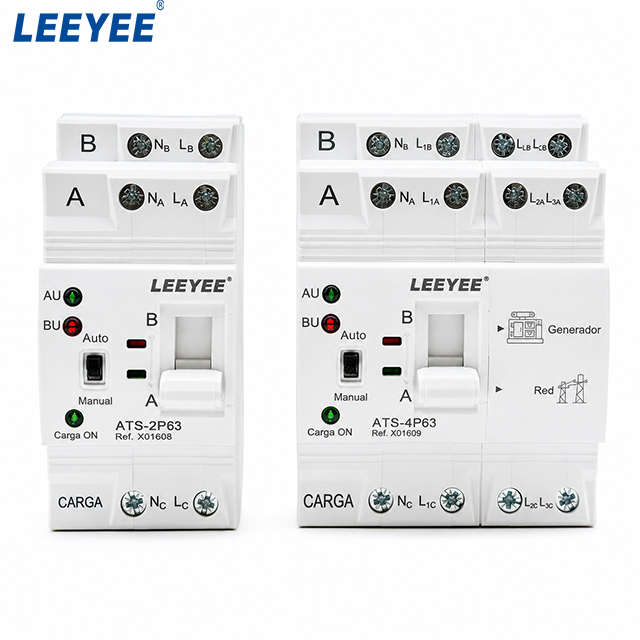
LEEYEE supply boundary: this article does not present LEEYEE as a supplier of a complete large AMF generator-control cabinet, synchronising panel, generator-paralleling panel or multi-generator load-sharing system. The standard product scope discussed here is the compact integrated ATS.
Do You Need an ATS Body or a Complete ATS Panel?
This is a separate decision from ATS vs AMF.
A panel builder or generator integrator may use a compact ATS as the transfer component and integrate it with the required enclosure, protective devices, terminals and project controls.
A complete ATS panel has a wider scope and may additionally include enclosure requirements, protection, terminals, indication, metering, control power, communication interfaces and documentation.
Common ATS vs AMF Procurement Mistakes
Assuming every ATS lacks a generator-start function
Some ATS controllers provide engine-start contacts.[3] The actual feature must be confirmed for the selected controller.
Assuming every generator-backup ATS includes a start dry contact
Generator-backup suitability and generator-start I/O are separate specifications.
Assuming a start output equals complete AMF functionality
A generator-start request does not provide all generator monitoring, engine protection and fault-management functions of a dedicated genset controller.[2]
Ordering another complete controller without checking the genset
If the genset already provides the required control functions, the project may mainly need the missing transfer function.
Buying only an ATS when the specification requires a complete panel
The transfer device alone does not automatically include enclosure, protection, terminals, wiring, metering or project documentation.
Before Ordering: ATS and Generator Interface Checklist
Send these details for technical confirmation
- normal power source type;
- backup power source type;
- single-phase or three-phase system;
- system voltage and frequency;
- continuous load current;
- required ATS pole configuration;
- neutral switching requirement;
- generator manufacturer;
- generator controller manufacturer and model;
- generator remote-start information;
- required generator-start architecture;
- required source and transfer logic;
- required status or alarm contacts;
- upstream protection information;
- single-line diagram;
- control schematic or sequence of operation;
- required standard or project specification;
- whether the requirement is ATS only or a wider panel assembly.
Need to Confirm Whether This LEEYEE ATS Fits Your Generator System?
Send the generator controller model, system voltage, load current, required poles and available control drawing. LEEYEE can help review the ATS selection and identify which generator-control interfaces still require project confirmation.
ATS vs AMF Panel FAQ
What is the main difference between an ATS and an AMF panel?
An ATS primarily transfers a load between power sources. An AMF controller or panel is centred on coordinating generator operation after mains failure.
Can an ATS automatically start a generator?
Some ATS controllers provide engine-start contacts.[3] Whether a particular ATS includes this function must be confirmed from its documentation.
Does the LEEYEE compact ATS shown here definitely include a generator-start dry contact?
This article does not make that claim. Generator-start I/O must be confirmed for the selected LEEYEE model and project control architecture.
Do I need an AMF panel if the generator already has a controller?
Not automatically. If the genset controller already provides the required generator-control functions, the missing requirement may mainly be source transfer.
Can an ATS replace a genset controller?
Normally no. A start request does not provide all engine-management, generator-monitoring and fault-protection functions of a dedicated genset controller.[2]
Does LEEYEE supply a complete large AMF generator-control cabinet?
This article does not present LEEYEE as a supplier of complete large AMF generator-control cabinets. The standard product scope discussed here is the compact integrated ATS.
Final Selection Rule
Do not choose between ATS and AMF from the product name alone.
First identify who monitors the normal source, who generates the generator-start request, who manages the genset, and who physically transfers the load.
If the generator already provides the required control functions, a suitable LEEYEE compact ATS may provide the missing source-transfer function, subject to confirmation of voltage, current, poles, source arrangement and the required control interface.
Références
- International Electrotechnical Commission (IEC). IEC 60947-6-1:2026 — Low-voltage switchgear and controlgear — Part 6-1: Multiple function equipment — Transfer switching equipment. Page des publications officielles de la CEI.
- Deep Sea Electronics. DSE4520 MKII — Auto Mains (Utility) Failure Control Module. DSE4520 MKII official product page.
- Schneider Electric / ASCO Power Technologies. Can two or more ASCO transfer switches be connected to and able to start a common generator? Schneider Electric official FAQ.
- Deep Sea Electronics. DSE8710 Synchronising & Load Sharing Control Module. DSE8710 official documentation.
- Deep Sea Electronics. DSE8610 Synchronising & Load Sharing Control Module. DSE8610 official documentation.
