
Compact DIN-rail ATS buyer guide
When buying a compact automatic transfer switch, checking only “63A” or “2P / 4P” is not enough. A B2B buyer should confirm what the ATS actually does, which two sources it transfers between, how automatic and manual operation work, whether the voltage and pole configuration match the system, and whether the short-circuit and installation conditions have been coordinated correctly.
This guide focuses on the functions and selection points that apply to the LEEYEE ATS-63 compact DIN-rail automatic transfer switch. It is intended for panel builders, electrical contractors, distributors, OEM buyers and project procurement teams evaluating this type of integrated ATS.
Table des matières
Quick Answer: What Does This Automatic Transfer Switch Do?
LEEYEE ATS-63 is an integrated automatic transfer switch that transfers a load between common power A et backup power B. The switching device and basic automatic control function are built into the same compact DIN-rail unit.[1]
- Two-source transfer: switches the load between power source A and power source B.
- Automatic / manual operation: supports automatic transfer and local manual operation.
- 2P / 4P options: available for different wiring and pole requirements.
- 6A–63A range: multiple rated-current options within the ATS-63 series.
- AC110V / 220V / 400V: available rated working-voltage options.
- DIN-rail mounting: compact construction for distribution boards and control cabinets.
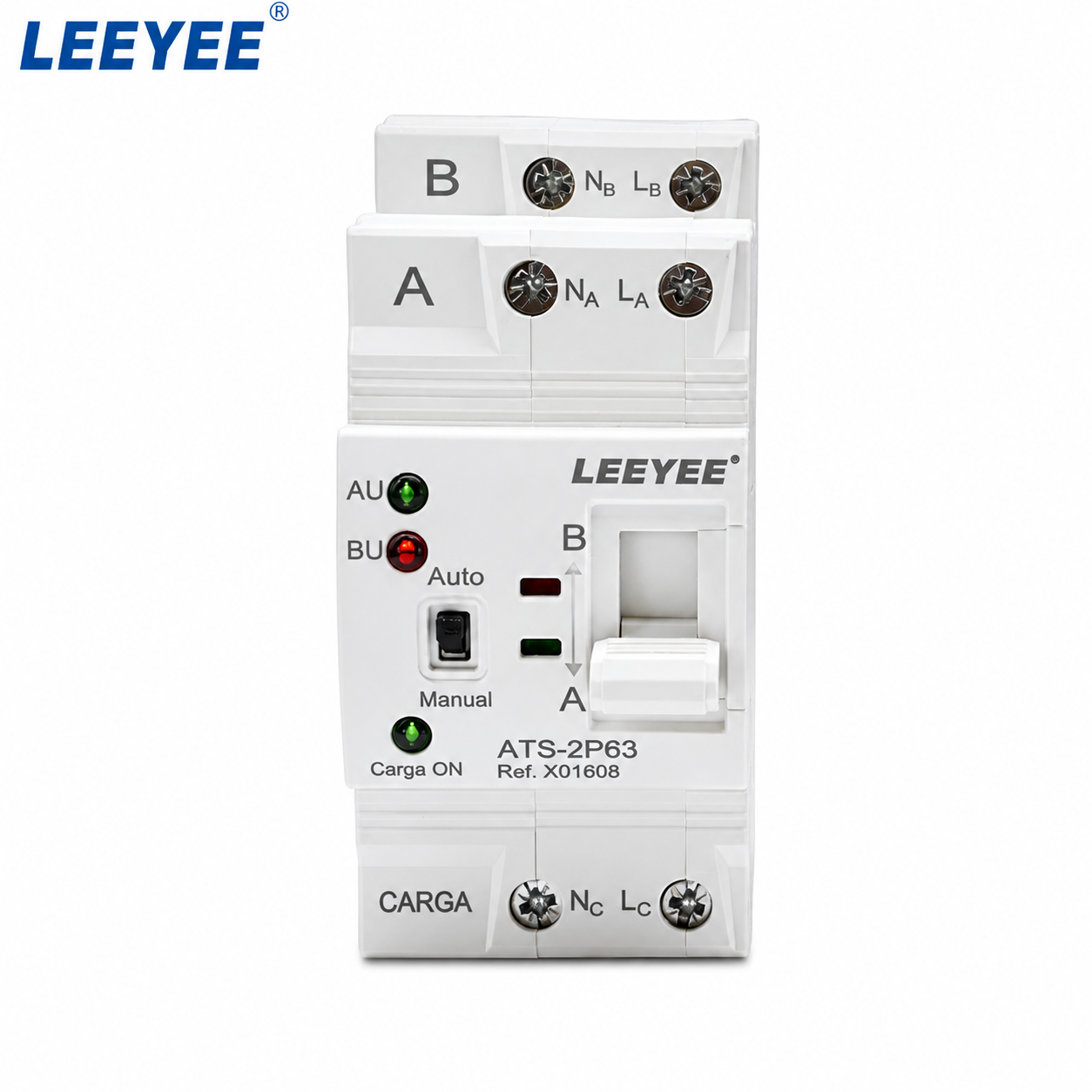
The supplied ATS-63 technical information does pas list RS485 / Modbus, programmable communication I/O, a dedicated generator-start controller output, closed-transition synchronization or a separate external ATS controller. These functions should therefore not be specified or promised for this product unless a separate model-specific document confirms them.[1]
1. The Core Function: Transfer Between Power A and Power B
The main job of this ATS is straightforward: connect the load to one of two available AC sources and transfer between them according to the product's automatic-control logic.
The front of the 2P unit identifies A et B as the two source sides, with the load connection marked separately at the output. This makes the product suitable for compact backup-power arrangements where two AC sources need to feed one downstream load circuit.[1]
This is an integrated compact ATS, not a stand-alone ATS controller. The buyer normally selects the complete device by voltage, current, pole configuration, source arrangement, wiring method and installation conditions.
2. What Happens in Automatic Mode?
In automatic operation, the ATS monitors the source condition and performs source transfer according to its built-in control logic. The ATS-63 product data also specifies voltage-protection reference values for the AC220V and AC110V control configurations.[1]
These are product-specific reference values from the current ATS-63 technical data, not universal ATS settings.
| Control Configuration | Voltage Reference | Signification pour l'Acheteur |
|---|---|---|
| AC220V | Undervoltage 175V; recovery 190V; overvoltage 270V; recovery 250V ±5V | Confirm that the selected 220V configuration and system conditions match the project |
| AC110V | Undervoltage 85V; recovery 90V; overvoltage 140V; recovery 135V ±5V | Do not reuse 220V assumptions for a 110V system |
The ATS-63 product range includes an AC400V rated-working-voltage option, while the current product page separately lists AC220V and AC110V control-circuit reference values. For an AC400V / 4P project, confirm the exact sensing and control wiring of the selected unit before order approval rather than inferring it from the 220V table.[1]
3. Why Manual Mode Still Matters
The product includes a local Auto / Manual selector. Manual operation is useful during commissioning, inspection or maintenance when the technician needs local control instead of normal automatic transfer.
For procurement, the important point is not simply that the word “Manual” appears on the product. The project team should understand how manual operation is used in the actual panel and ensure that operating instructions are available to the installer or end user.
If the project requires remote manual commands, programmable transfer delays, BMS control or remote communication, do not assume those functions are included. The current ATS-63 technical data confirms local Auto / Manual operation but does not list those advanced controller functions.
4. 2P vs 4P: Choose by the Actual Wiring System
ATS-63 is available in 2P and 4P versions.[1] Pole selection must follow the electrical system and neutral-switching requirement, not only the load current.
| Option | Typical Selection Direction | Ce qui doit être confirmé |
|---|---|---|
| ATS 2P | Commonly used where a single-phase system requires switching of line and neutral | System wiring, neutral arrangement, rated voltage and load current |
| ATS 4P | Commonly used where three phases and neutral need to be switched | Three-phase wiring, neutral requirements, system voltage and project design |
Do not select 2P or 4P from a generic rule alone. Neutral switching can depend on the earthing arrangement, source design and local electrical requirements.
5. Rated Current: 6A to 63A Is a Series Range, Not One Universal Setting
LEEYEE ATS-63 is available in rated operating current options of 6A, 10A, 16A, 20A, 25A, 32A, 40A, 50A and 63A.[1]
The required rating should be selected from the actual circuit and load conditions. “63A ATS” should not become the default choice simply because it is the maximum rating in the series.
Loads with significant starting or inrush current can impose different switching duties from ordinary steady loads. The ATS-63 technical data declares usage category AC-31B. If the project includes motors, pumps, compressors or other high-inrush loads, confirm whether the declared utilization category and switching duty are suitable before ordering.
6. Voltage and Frequency Must Match the Ordered Configuration
The ATS-63 technical data lists rated working voltage options of AC110V, AC220V and AC400V, with a rated frequency of 50/60Hz.[1]
These values are model-selection data. They do not mean one physical ATS should automatically be assumed to work on every listed voltage without the correct configuration.
State the actual system voltage, frequency, phase arrangement and both source voltages. This is especially important when the normal source and backup source come from different equipment such as utility power and an inverter or generator.
7. Transfer Switching Time: Understand What “<50 ms” Means
The current LEEYEE ATS-63 technical data specifies a transfer switching time of less than 50 ms.[1]
This value describes the ATS switching action. It does pas mean every backup-power system restores power in less than 50 ms.
If the backup source is already energized and acceptable, the ATS can perform its switching operation according to the product design. If the backup source is a generator that is not already running, the generator itself still needs time to start and stabilize before it can supply the load.
Do not sell or specify this compact ATS as a UPS or closed-transition system. Applications that cannot tolerate an interruption require a different power architecture.
8. Class PC: The ATS Is Not the Short-Circuit Protective Device
The ATS-63 product specification declares the device as Classe PC.[1]
Under IEC transfer-switch terminology, Class PC transfer switching equipment is capable of making and withstanding specified short-circuit current conditions but is not intended to break short-circuit current itself.[2][3]
The ATS-63 technical data states a rated short-circuit current Iq of 5kA and lists RT16-00-63A as the recommended fuse.[1]
The upstream protective device and available fault current must be considered as part of the complete design. Do not treat the ATS itself as a replacement for the required fuse, circuit breaker or short-circuit protection strategy.
9. What Do PC Class and AC-31B Tell a Buyer?
These markings answer different questions.
| Marquage | What It Describes | Action de l'Acheteur |
|---|---|---|
| Classe PC | Short-circuit capability classification of the transfer switching equipment | Confirm upstream protection and short-circuit coordination |
| AC-31B | Declared utilization category of the ATS-63 product | Confirm the intended load and switching duty match the declared category |
Neither marking should be treated as a marketing label. Both affect whether the product is appropriate for the real circuit.
10. Technical Specifications Buyers Should Check Before Ordering
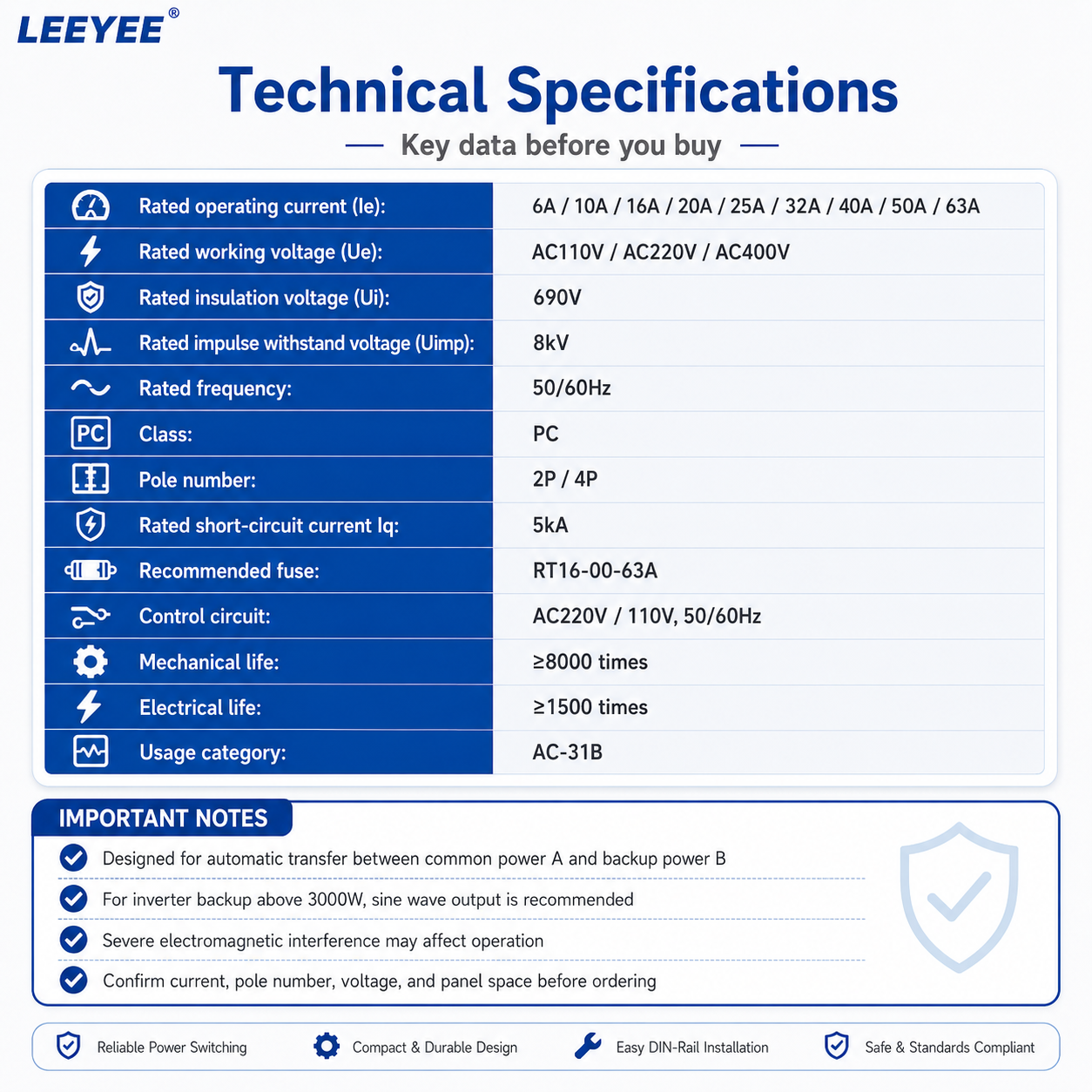
These are the principal values currently published for the ATS-63 series.
| Spécifications | ATS-63 Data | Buyer Check |
|---|---|---|
| Rated current Ie | 6 / 10 / 16 / 20 / 25 / 32 / 40 / 50 / 63A | Match the actual circuit and load duty |
| Tension de travail nominale Ue | AC110V / AC220V / AC400V | Specify the required voltage configuration |
| Insulation voltage Ui | 690V | Verify against project insulation requirements |
| Impulse withstand Uimp | 8kV | Include in technical approval where required |
| Fréquence | 50/60Hz | Confirm both power sources |
| Classe | PC | Coordinate upstream short-circuit protection |
| Pôles | 2P / 4P | Match phase and neutral switching requirements |
| Courant de court-circuit nominal Iq | 5kA | Compare with the project fault-current conditions |
| Fusible recommandé | RT16-00-63A | Confirm final upstream protection and coordination |
| Durée de vie mécanique | ≥8000 opérations | Review expected switching frequency |
| Durée de vie électrique | ≥1500 opérations | Review switching duty and maintenance plan |
| Catégorie d'utilisation | AC-31B | Confirm suitability for the actual load |
11. Panel Space and DIN-Rail Installation
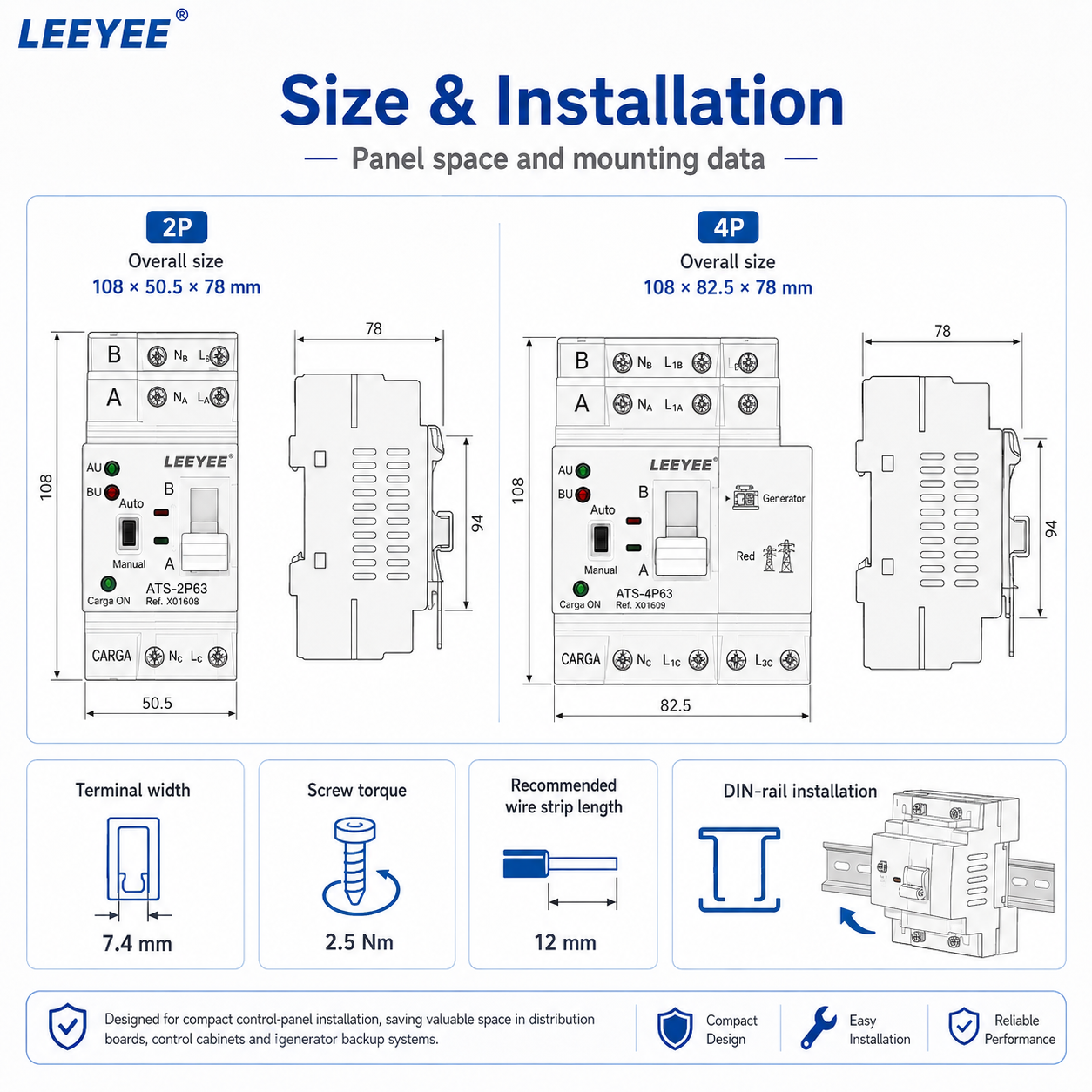
For panel builders and OEM buyers, mechanical fit is part of model selection. ATS-63 is designed for Installation sur rail DIN, but the 2P and 4P versions require different panel widths.[1]
| Installation Item | Published Data | Pourquoi c'est important |
|---|---|---|
| 2P overall size | 108 × 50.5 × 78 mm | Check available DIN-rail and wiring space |
| 4P overall size | 108 × 82.5 × 78 mm | Requires more panel width than the 2P model |
| Largeur de la borne | 7,4 mm | Affects conductor and terminal planning |
| Couple de serrage | 2,5 Nm | Use the specified installation torque |
| Wire strip length | 12 mm | Supports consistent terminal preparation |
12. Where This Compact ATS Is a Good Fit
The ATS-63 is intended for compact backup-power arrangements that need automatic source transfer within its published electrical and environmental limits.[1]
- Distribution boards: compact circuits requiring transfer between two AC sources.
- Control cabinets: auxiliary or small-power circuits where DIN-rail space matters.
- Generator backup systems: when the generator-side source and system architecture are compatible with the ATS.
- Inverter backup systems: when output voltage, frequency, waveform, neutral arrangement and wiring meet the product requirements.
- Light commercial backup: circuits within the ATS-63 current, voltage and switching-duty limits.
- OEM panels: where a repeatable 2P or 4P DIN-rail transfer solution is required.
13. When This ATS Is Not the Right Product
A technically correct product page should also tell buyers when another solution is required.
- Rated current above 63A.
- Closed-transition or make-before-break transfer.
- Zero-interruption power comparable with a UPS.
- Integrated generator engine-start management that is not documented for this ATS.
- RS485 / Modbus, BMS integration or programmable communication I/O not listed in the product documentation.
- A different utilization category or switching duty required by the actual load.
- Short-circuit conditions that cannot be coordinated with the published ATS-63 ratings and upstream protection.
14. Common Purchasing Mistakes
- Ordering “63A ATS” without giving the voltage or pole number. Current alone does not identify the correct configuration.
- Assuming 2P and 4P differ only in physical width. Pole configuration must match the electrical system and neutral-switching requirement.
- Assuming all listed voltages are one universal model. Specify the actual required voltage configuration.
- Treating Class PC as built-in short-circuit protection. The upstream protection and fault-current conditions still require engineering coordination.
- Ignoring AC-31B when the load has significant inrush. Confirm the utilization category against the real switching duty.
- Assuming <50 ms means zero interruption. ATS switching time and total backup-source recovery time are different.
- Requesting Modbus, dry contacts or generator-start control without checking the model documentation. These functions are not listed in the current ATS-63 technical data.
- Ignoring panel dimensions. The 4P model is wider than the 2P model and requires different cabinet space.
15. Before Ordering: ATS-63 Buyer Checklist
- Required rated current: 6A to 63A
- System voltage: AC110V, AC220V or AC400V
- Frequency: 50Hz or 60Hz
- Système monophasé ou triphasé
- Required pole configuration: 2P or 4P
- Normal source type and voltage
- Backup source type and voltage
- Whether neutral must be switched
- Load type and any significant starting or inrush current
- Available short-circuit current and upstream protective device
- Required transfer-time expectations
- Available DIN-rail and cabinet space
- Installation environment and project requirements
- Quantity, labeling or OEM documentation requirements
Send your voltage, current, phase type, 2P / 4P requirement, normal source, backup source, load type and panel-space information. LEEYEE can use those details to confirm which ATS-63 configuration should be reviewed for your project.
Frequently Asked Questions About Automatic Transfer Switch Functions
What is the main function of the LEEYEE ATS-63?
ATS-63 transfers a load between common power A and backup power B. The product integrates the transfer mechanism and basic automatic-control function into a compact DIN-rail unit.[1]
Does the ATS-63 support automatic and manual operation?
Yes. The product has Auto / Manual operation. Manual mode is useful for local commissioning and maintenance, while automatic mode performs normal source-transfer operation.
Quelles sont les classifications de courant disponibles ?
The published ATS-63 series includes 6A, 10A, 16A, 20A, 25A, 32A, 40A, 50A and 63A options. Select the rating from the actual load and switching-duty requirements rather than automatically choosing the highest value.[1]
What is the difference between the 2P and 4P ATS-63?
The two versions have different pole configurations and physical widths. A 2P unit is commonly used where a single-phase circuit switches line and neutral, while a 4P unit is commonly used where three phases and neutral must be switched. Final selection must follow the actual wiring and earthing arrangement.
Does ATS-63 provide overload or short-circuit protection?
Does the ATS-63 have RS485 or Modbus?
The current ATS-63 technical information used for this guide does not list RS485, Modbus or BMS communication. Do not assume those functions are available unless a model-specific document confirms them.
Can the ATS-63 start a generator automatically?
The current product documentation confirms automatic transfer between two AC sources but does not list a dedicated programmable generator-start controller output. If the project requires the ATS to issue a generator engine-start command, confirm the complete generator-control architecture before specifying this product.
Is the ATS-63 a zero-interruption transfer switch?
No such assumption should be made. The published ATS switching time is less than 50 ms, which is not the same as zero interruption. A UPS or another engineered power design may be required for loads that cannot tolerate a supply break.[1]
Quelles informations devrais-je envoyer avant de commander ?
Send the rated current, voltage, frequency, phase type, 2P / 4P requirement, normal and backup source details, load type, wiring arrangement, protective-device information and available panel space. This allows the proposed ATS configuration to be checked against the real project.
The values in this guide describe the currently published LEEYEE ATS-63 series. Final selection still depends on the specific electrical system, wiring arrangement, load duty, fault-current conditions, upstream protection and local project requirements. Where a condition is not covered by the model documentation, obtain project-specific confirmation before approval.
Références
- LEEYEE. ATS-63 Automatic Transfer Switch — Product Data and Technical Parameters. Rated current, voltage, frequency, 2P / 4P options, transfer switching time, Class PC, Iq, recommended fuse, AC-31B, environmental data and dimensions. Page produit officielle LEEYEE.
- IEC. IEC 60947-6-1:2026 — Low-voltage switchgear and controlgear — Part 6-1: Multiple function equipment — Transfer switching equipment. IEC states that the standard applies to transfer switching equipment used to transfer a load between power supply sources. Page de publication officielle de l'IEC.
- ABB. How to Select an Automatic Transfer Switch Class. Technical guidance explaining IEC 60947-6-1 Class PC transfer switching equipment as capable of making and withstanding, but not intended for breaking, short-circuit currents. Official ABB technical paper.