
A gas generator can work with an automatic transfer switch, but selecting the ATS is not simply a matter of choosing a “generator ATS.” For generator-set integrators, panel builders, contractors and project buyers, the critical issue is whether the electrical ratings, pole configuration and generator-control interface all match the backup system.
Table des matières
Quick Answer: What ATS Is Suitable for a Gas Generator?
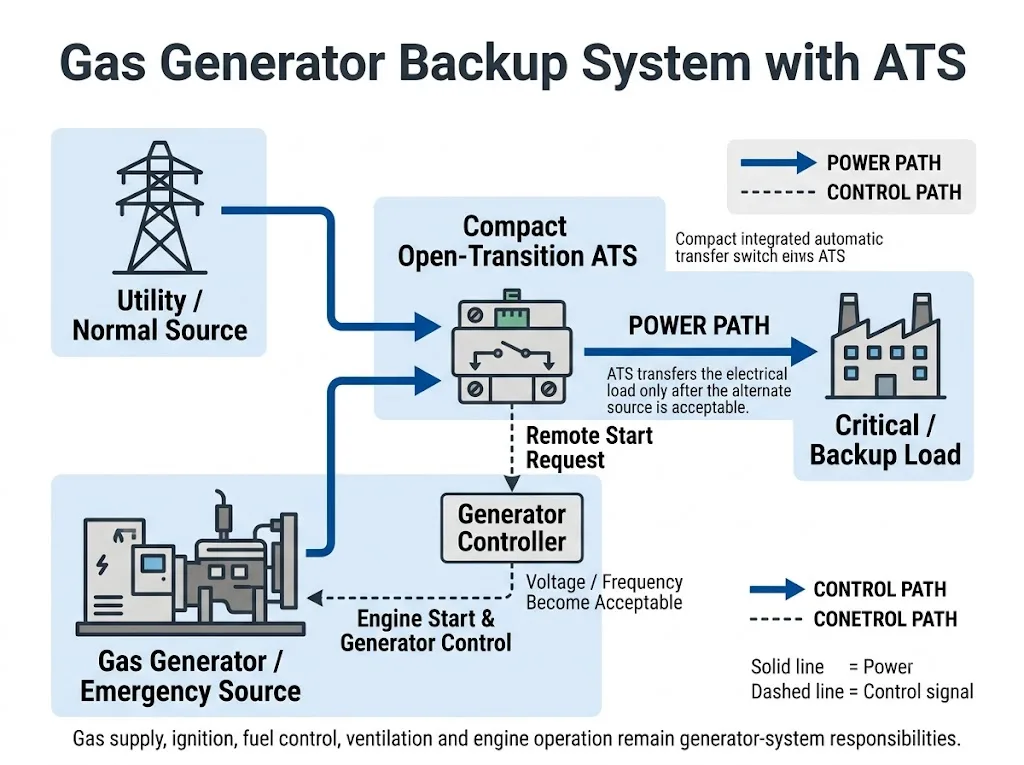
A natural-gas or other gas-fuelled standby generator can be paired with an ATS when the utility source, generator output, load current, phase configuration and transfer requirements are compatible.
In a typical utility-to-generator system, the ATS monitors source conditions and transfers the load between the normal and backup electrical sources. If automatic generator starting is required, the start interface must also be compatible with the actual generator controller and must be confirmed from the model-specific wiring documentation. [2]
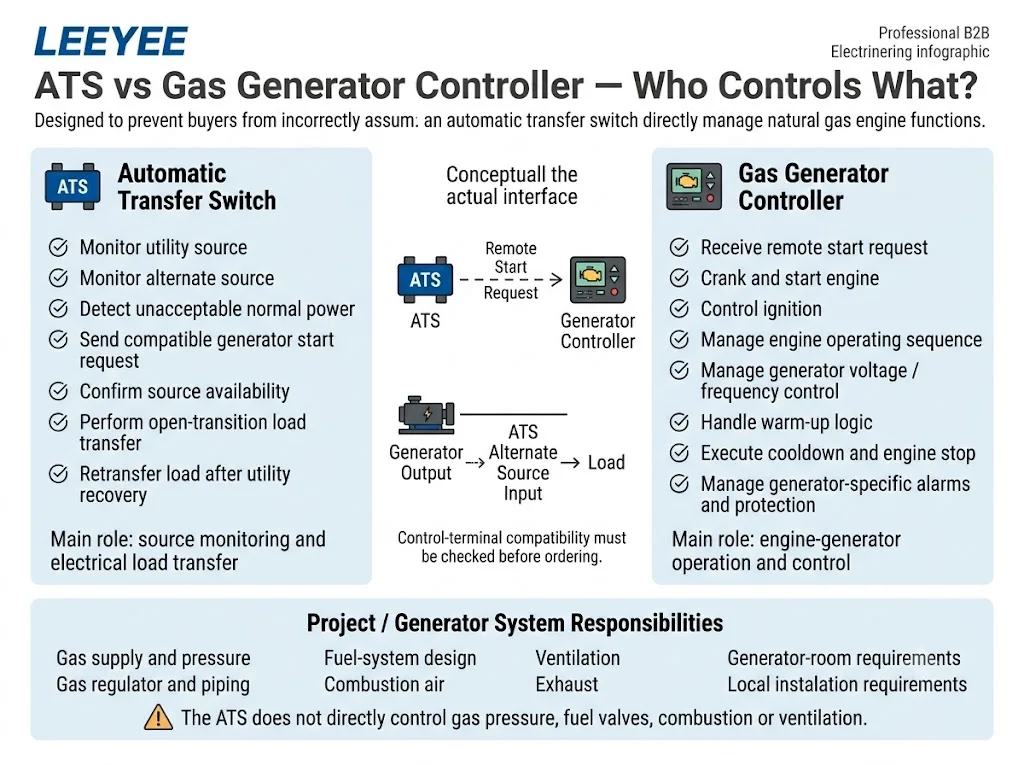
The ATS does pas replace the generator controller. It does not directly manage gas pressure, fuel piping, ignition, combustion air or ventilation. Those functions remain part of the generator and project engineering scope.
For procurement, confirm six items first: voltage, phase, load current, poles, transition method and generator-controller interface.
What Must Match Between the Gas Generator and the ATS?
This is the main engineering question for a gas generator ATS project. Fuel type matters to the generator installation, but the transfer switch itself must first match the electrical system and the required control arrangement.
| Élément à confirmer | Pourquoi c'est important | What the Buyer Should Provide |
|---|---|---|
| Tension du système | Utility, generator and ATS ratings must be compatible. | Normal-source and generator-output voltage |
| Phase | Determines the basic source and load configuration. | Monophasé ou triphasé |
| Courant de charge | Determines the required ATS current rating. | Design current and important load characteristics |
| Configuration des pôles | Neutral treatment can affect whether 2P, 3P or 4P switching is appropriate. | Single-line diagram and neutral / earthing arrangement |
| Transition method | LEEYEE standard compact ATS applications are based on open-transition transfer. | Confirm whether a short break is acceptable |
| Contrôleur de générateur | Any automatic-start interface must match the controller actually used in the genset. | Controller model and wiring diagram |
Procurement conclusion: “natural gas generator” alone is not enough information to select an ATS.
LEEYEE Compact ATS for Utility-to-Backup-Source Switching
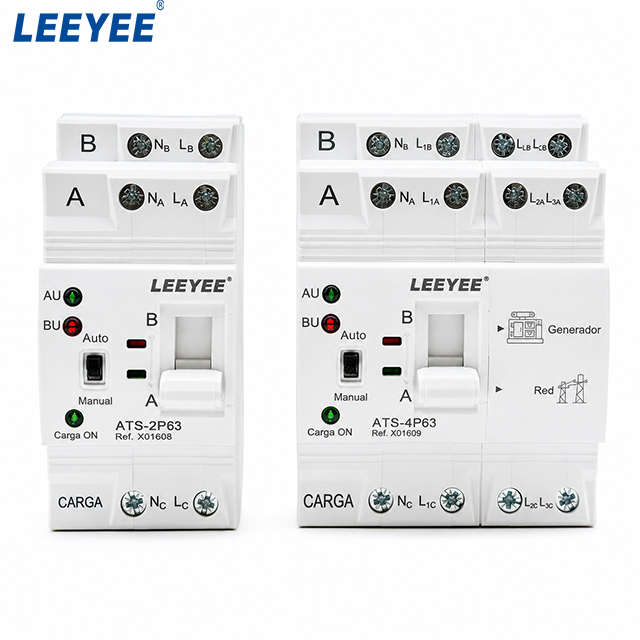
LEEYEE supplies compact integrated automatic transfer switches for switching between two low-voltage power sources. The actual product shown below is available in compact pole configurations such as 2P and 4P, making it suitable for many single-phase and three-phase backup-power panel designs when the electrical ratings and project conditions match.
Can Any ATS Work with Any Gas Generator?
Non. An ATS and gas generator should not be considered compatible only because both support automatic operation.
In generator-backed systems, source transfer and generator starting are separate functions. Many transfer-control systems can coordinate or provide a generator-start request, but the exact interface depends on the ATS design and generator controller. Cummins transfer-switch guidance describes systems in which the transfer control detects unacceptable normal power, completes the relevant start delay, signals the generator set to start, monitors generator voltage build-up and then proceeds with transfer logic. [2]
Check the Generator Control Interface Before Ordering
Generator controllers are not universally wired the same way. If the project requires the ATS to coordinate automatic generator starting, confirm the actual controller documentation before an OEM panel is built.
- Generator controller manufacturer and model
- Remote-start input type, if required
- Required NO / NC contact logic where applicable
- Whether a dry contact or another interface is required
- Permitted control voltage and contact rating
- Terminal identification
- Start and stop logic
- Any auxiliary alarm or status signals required by the project
ATS and Gas Generator Controller: Who Controls What?
The most important system boundary is between source transfer et engine-generator operation. IEC 60947-6-1 applies to transfer switching equipment used to transfer a load between power supply sources. [1]
| Fonction | ATS / Transfer Control | Generator Controller / Project System |
|---|---|---|
| Monitor normal source | Yes, according to ATS functions | Not the main transfer function |
| Evaluate alternate electrical source | According to selected ATS/control functions | Produces and regulates generator output |
| Request generator start | Only if the selected model/control arrangement provides a compatible interface | Receives and processes the start request |
| Crank and start engine | Non | Generator-controller function |
| Ignition and engine operation | Non | Generator-system function |
| Transfer electrical load | Oui | Non |
| Gas pressure, regulator and piping | Non | Generator / project engineering |
| Ventilation and combustion air | Non | Generator / project engineering |
How Does the Automatic Transfer Sequence Work?
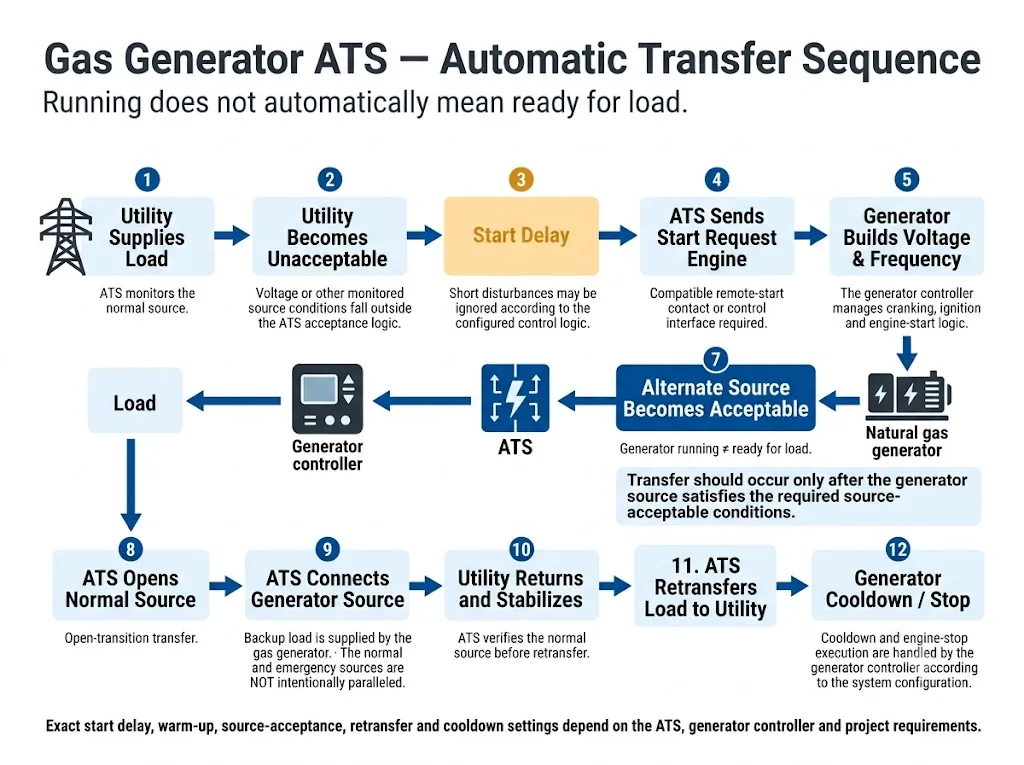
This page focuses on gas-generator compatibility and selection rather than repeating the complete ATS operating-principle guide. A typical generator-backed transfer sequence can be reduced to five engineering stages:
Cummins describes this general relationship in generator transfer applications: normal-source monitoring, generator-start coordination, generator voltage build-up, transfer delay and later retransfer are separate stages of operation. [2]
Does the Generator Need to Warm Up Before the ATS Transfers?
The important requirement is not simply “wait a fixed number of seconds.” The alternate source must satisfy the transfer logic required by the selected system.
Generator starting and generator readiness are separate conditions. Cummins guidance describes generator voltage build-up and transfer-related time delays intended to ensure the generator source is suitable before load transfer. [2]
Manufacturer-specific ATS products can use different delay values. A delay documented for one ATS or generator therefore must not be copied as a universal setting for every gas-generator project. [3]
Is a Gas Generator ATS Different from a Diesel Generator ATS?
From the transfer-switch side, the basic electrical task is usually similar: transfer the load between the normal source and the generator source. The generator fuel does not by itself determine the ATS current rating, pole count or voltage rating.
| Point de sélection | Gas Generator | Diesel Generator |
|---|---|---|
| Basic ATS role | Transfer between utility and generator source | Transfer between utility and generator source |
| ATS voltage / current | Based on electrical system and load | Based on electrical system and load |
| Start interface | Must be verified if automatic-start coordination is required | Must be verified if automatic-start coordination is required |
| Fuel-side engineering | Gas pressure, regulator, piping and supply conditions | Diesel storage and fuel-delivery system |
| Engine operating sequence | Generator-specific | Generator-specific |
Buyer meaning: select the ATS from electrical and control requirements, not from the fuel label alone.
How to Select a LEEYEE ATS for a Gas Generator Project
LEEYEE's compact 2P and 4P ATS products are suitable as the electrical source-transfer element in compatible utility-to-backup-source systems. Final selection must still be based on the project electrical design.
1. Confirm Voltage
Utility voltage, generator output and ATS rated voltage must match the intended system.
2. Phase de confirmation
Identify whether the system is single-phase or three-phase before choosing pole configuration.
3. Confirm Load Current
Use the real design load and applicable engineering margin rather than generator fuel type.
4. Confirm Pole Configuration
Neutral and earthing arrangements can affect whether 2P, 3P or 4P switching is required.
5. Confirm Transition Method
LEEYEE standard compact ATS applications are based on open-transition switching.
6. Confirm Control Requirements
If generator-start coordination is required, verify the exact ATS model and generator-controller wiring documents.
Generator kVA Is Not the Same as ATS Current
Generator sets are often specified in kVA while an ATS is selected by current rating. For a simple three-phase apparent-power calculation:
This only converts apparent power to approximate line current. It does not by itself decide the correct ATS rating. The final selection should also consider the actual connected load, motor or compressor starting conditions, upstream protection, conductor sizing and project requirements.
Should a Three-Phase Gas Generator Use a 3P or 4P ATS?
There is no safe universal answer without the system drawing.
Whether the neutral should be switched depends on the earthing arrangement, generator neutral treatment, bonding method, protective-device design and applicable project rules. These conditions should be confirmed by the responsible electrical designer before the ATS pole configuration is fixed.
For an OEM panel order, send the single-line diagram and neutral arrangement rather than asking the ATS supplier to guess from “three-phase generator” alone.
What Gas-Generator Conditions Are Outside the ATS Scope?
A gas generator backup project includes fuel, engine and installation requirements that should not be described as ATS functions.
- Fuel gas type
- Required gas pressure and flow
- Regulator selection
- Gas piping design
- Combustion-air requirements
- Ventilation
- Exhaust arrangement
- Generator enclosure or room design
- Applicable fire-safety requirements
- Local gas and electrical regulations
These conditions affect whether the complete standby generator system can operate safely and reliably, but they are not functions performed by the compact ATS.
Common Gas Generator ATS Specification Mistakes
Choosing by Fuel Type Instead of Electrical Ratings
“Gas generator” does not tell the ATS supplier the voltage, current, phase, pole arrangement or controller interface.
Assuming Every ATS Has the Same Generator Start Output
Do not assume a remote-start terminal or dry contact exists from the product category alone. Check the exact LEEYEE ATS model documentation and the generator-controller requirements.
Assuming Generator Running Means Ready for Load
Engine start and alternate-source acceptance are separate stages. The transfer logic should confirm the generator source meets the required electrical conditions before connecting the load. [2]
Using a Fixed Warm-Up Time from Another Project
Delay settings vary by equipment and application. A value documented for one ATS or generator should not be treated as universal. [3]
Ignoring Neutral and Earthing Details
Selecting 3P or 4P from phase count alone can be incorrect. Neutral treatment needs project-level confirmation.
Treating the ATS as a Gas-Engine Controller
The ATS transfers electrical sources. Gas supply, engine starting, combustion and generator-specific protection belong to the generator system.
Before Ordering: Gas Generator ATS Confirmation Checklist
For a useful ATS recommendation, prepare the following information:
- Utility nominal voltage
- Generator output voltage
- Système monophasé ou triphasé
- System frequency
- Generator rated kVA or kW
- Actual or design load current
- Important load types, such as motors, pumps or compressors
- Required 2P, 3P or 4P configuration
- Dispositif de neutre et de mise à la terre
- Generator controller manufacturer and model
- Required automatic-start interface, if applicable
- Utility-generator-load single-line diagram
- Norme ou certification requise
- Quantité de commande
- OEM label or private-label requirements where applicable
Need to Confirm a Gas Generator ATS Configuration?
Send the voltage, phase, load current, pole requirement, generator-controller model and project diagram. LEEYEE can review whether a compact open-transition ATS configuration matches the electrical transfer requirements of the project.
Questions fréquemment posées
Can a LEEYEE ATS automatically start a natural gas generator?
Automatic generator-start coordination depends on the exact ATS model and generator controller. Do not assume every compact ATS has the same remote-start interface. Confirm the model-specific wiring diagram before approval.
Can any ATS work with any gas generator?
No. Electrical ratings and any required generator-control interface must be compatible. Confirm voltage, phase, current, poles, transition method and controller wiring before approval.
Does the ATS control the gas valve or gas pressure?
No. Those are generator and fuel-system functions. The ATS is the electrical source-transfer device.
How does an ATS know when the generator source is acceptable?
Transfer-control systems use source-sensing logic according to their design. Exact voltage, frequency, timing and other acceptance functions depend on the selected equipment and should be confirmed from the relevant documentation. [2]
Does a gas generator always need the same warm-up delay?
No. There is no universal warm-up time based only on fuel type. Delay settings should follow the generator, ATS/controller and project requirements. [2][3]
Can the same type of ATS be used for gas and diesel generators?
It may be possible when the voltage, phase, load current, pole arrangement, transition requirements and control arrangement are compatible. Fuel type alone does not establish compatibility.
What size ATS do I need for a gas generator?
Start with the actual electrical load, system voltage and phase rather than generator fuel. Also check motor starting, upstream protection and project requirements before finalizing the rating.
Should I choose 3P or 4P for a three-phase gas generator?
Confirm whether the neutral must be switched. Earthing arrangement, generator neutral treatment, bonding and protection design can affect the decision.
Is the LEEYEE compact ATS open transition?
LEEYEE standard compact ATS applications are based on open-transition switching. Projects requiring closed transition, bypass isolation or other advanced transfer architectures need a different engineered solution.
Engineering Takeaway
The correct question is not simply “Does this ATS work with a gas generator?” The useful engineering question is: Do the electrical ratings, neutral arrangement, transfer method and any required generator-control interface match the complete backup-power design?
For LEEYEE compact 2P and 4P open-transition ATS applications, confirm the system voltage, phase, current, poles, generator controller and project drawing before ordering. Gas supply, engine operation, ventilation and fuel-system engineering remain separate generator-project responsibilities.
Références
- Commission électrotechnique internationale (CEI), IEC 60947-6-1:2026 — Appareillage de commutation et de commande à basse tension — Partie 6-1 : Équipements multifonctions — Équipements de commutation de transfert. Page des publications officielles de la CEI.
- Cummins Inc., Application Manual — Transfer Switches, Transfer Equipment Controls. The manual describes normal-source monitoring, generator-start coordination, generator voltage build-up, transfer delays and retransfer logic in generator-backed transfer systems. Cummins transfer-switch application manual.
- Schneider Electric / ASCO, Generator test with load transfer for a 165 Series ATS. This manufacturer-specific example illustrates why transfer and warm-up timing must be confirmed for the actual equipment rather than copied as a universal setting. Schneider Electric technical FAQ.
