
Lorsque les acheteurs comparent des parafoudres, la valeur Up est souvent mal comprise. Une valeur Up plus faible indique généralement une meilleure limitation de tension, mais cela ne signifie pas automatiquement que le parafoudre est le choix idéal pour chaque tableau, système ou équipement protégé.
Up, ou niveau de protection en tension, est la tension résiduelle maximale mesurée aux bornes du parafoudre lors d'un test de surtension spécifié. Une valeur Up plus faible indique généralement une meilleure limitation de tension, mais les acheteurs doivent effectuer la comparaison en tenant compte du type de parafoudre, de la norme, de la tension nominale, du courant de décharge, du mode de protection et des conditions d'installation.
Ce guide explique ce que le niveau de protection en tension Up du parafoudre signifie, comment il se rapporte à la tension résiduelle et à la tension de tenue aux chocs des équipements, et ce que les acheteurs doivent vérifier avant de valider un modèle pour des tableaux de distribution, des panneaux OEM, des armoires industrielles et des équipements sensibles.
Table des matières
Réponse rapide : que doivent savoir les acheteurs sur le Up d'un parafoudre ?
Up correspond au niveau de protection en tension d'un parafoudre. On le désigne également couramment sous le terme de tension résiduelle ou tension passante lors d'un essai de choc.
Généralement oui pour la limitation de tension. Toutefois, Up doit être évalué en tenant compte de Uc, In, Imax, Iimp, du type de parafoudre et de la longueur des câbles d'installation.
La tension atteignant les équipements en aval doit rester inférieure au niveau de tenue aux chocs de ces derniers, avec une marge de sécurité raisonnable.
La valeur Up indiquée sur la fiche technique est mesurée aux bornes du parafoudre. La longueur des câbles de raccordement et les protections de secours peuvent accroître la tension réelle subie par les équipements protégés.
Besoin d'aide pour vérifier si la valeur de Up est appropriée ?
Transmettez-nous la tension de votre système, le type de mise à la terre, le type de parafoudre, les équipements protégés et la configuration de votre armoire. LEEYEE peut vous aider à sélectionner le modèle de parafoudre adapté pour vos tableaux de distribution, panneaux OEM et projets d'approvisionnement.
Que signifie Up sur la fiche technique d'un parafoudre ?
Haut de la page signifie niveau de protection en tension. Dans le langage courant des achats, cela indique le niveau de tension résiduelle pouvant subsister lorsque le parafoudre évacue un courant de choc dans des conditions d'essai spécifiées.
Un parafoudre ne fait pas disparaître la surtension. Il dévie le courant de choc et limite la tension à un niveau inférieur. C'est cette tension limitée que les acheteurs utilisent pour comprendre la valeur Up.
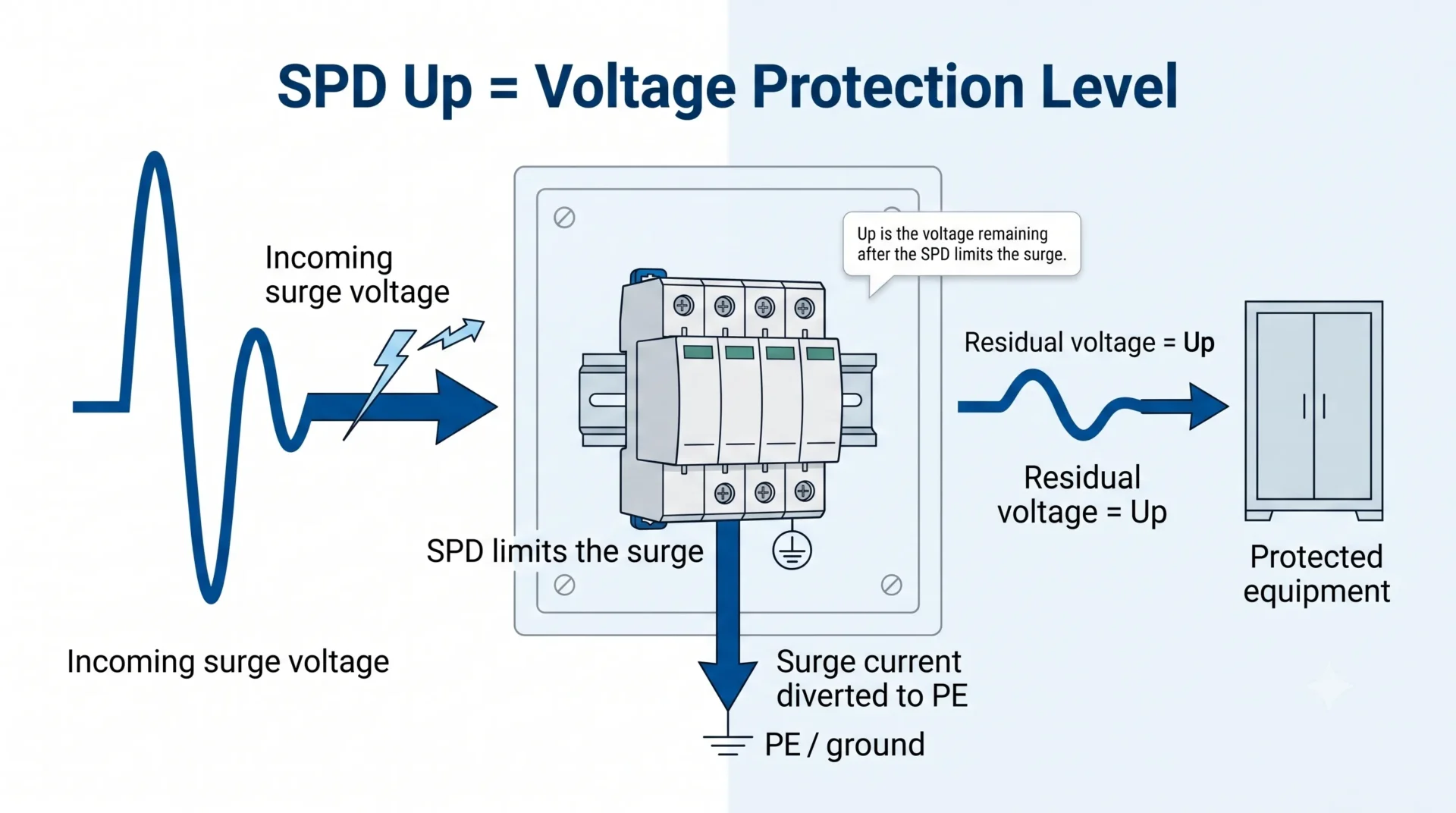
C'est pourquoi Up est crucial pour les équipements sensibles. Si la tension résiduelle dépasse la capacité de tenue de l'équipement, celui-ci peut subir des dommages malgré la présence d'un parafoudre.
Up n'est pas identique à Uc
Les acheteurs comparent souvent Uc et Up, car ces deux valeurs de tension figurent sur les fiches techniques des parafoudres. Cependant, elles répondent à des besoins différents.
| Paramètres | Nom complet | Ce qu'elle indique | Signification pour l'Acheteur |
|---|---|---|---|
| Uc | Tension de fonctionnement maximale continue | La tension maximale que le parafoudre peut supporter en continu sans dysfonctionnement. | Utilisez cette valeur pour vérifier si le parafoudre est adapté à la tension réelle du système. |
| Haut de la page | Niveau de protection de la tension | Le niveau de tension résiduelle aux bornes du parafoudre lors d'un test de surtension spécifié. | Utilisez cette valeur pour vérifier si l'équipement en aval est protégé contre les surtensions excessives. |
En termes simples : Uc indique si le parafoudre est compatible avec le système. Up indique la tension susceptible d'atteindre l'équipement lors d'une surtension.
Si vous êtes encore en train de confirmer la valeur Uc pour des systèmes CA, consultez notre Guide de sélection SPD Uc avant de comparer les valeurs Up.
Up vs tension résiduelle vs tension d'écrêtage vs tension de la varistance (MOV)
Les acheteurs peuvent rencontrer des termes différents dans les fiches techniques, les échanges avec les fournisseurs ou les articles sur la protection contre la foudre. Bien que liés, ces termes ne doivent pas toujours être considérés comme équivalents.
| Terme | Signification pratique | Utilisation par l'acheteur | Risque courant |
|---|---|---|---|
| Haut de la page | Niveau de protection en tension déclaré du parafoudre dans des conditions d'essai spécifiées. | Utilisez-le pour la coordination de la protection parafoudre et l'évaluation de la protection des équipements. | Comparer le niveau de protection (Up) sans vérifier le type de parafoudre, les conditions d'essai ou le mode de protection. |
| Tension résiduelle | Tension subsistant aux bornes du parafoudre pendant le passage du courant de décharge. | Une méthode pratique pour comprendre la signification de l'Up lors de la limitation des surtensions. | Supposer que la tension résiduelle aux bornes du parafoudre est toujours identique à celle aux bornes de l'équipement. |
| Tension de serrage | Un terme général courant pour désigner le comportement de limitation de tension. | Peut aider à expliquer le concept, mais les acheteurs doivent confirmer si le fournisseur fait référence à l'Up du parafoudre ou aux données des composants. | Mélanger le langage marketing avec les paramètres techniques normalisés. |
| Tension de la varistance (MOV) | Un paramètre au niveau du composant de la varistance à oxyde métallique présente dans de nombreux parafoudres. | Utile pour l'ingénierie des composants, mais insuffisant pour la sélection d'un parafoudre fini. | Utiliser les données du composant MOV au lieu de la valeur indiquée sur la fiche technique du parafoudre fini. |
Up et tension de tenue aux chocs de l'équipement
L'objectif réel de la vérification du niveau de protection (Up) n'est pas de sélectionner la valeur la plus attrayante sur une étiquette. Il s'agit de coordonner le parafoudre avec l'équipement à protéger.
La tension atteignant l'équipement en aval doit être inférieure à sa tension de tenue aux chocs. Pour les équipements sensibles, les concepteurs peuvent avoir besoin d'un niveau de protection effectif plus bas ou d'étages de parafoudres coordonnés supplémentaires.
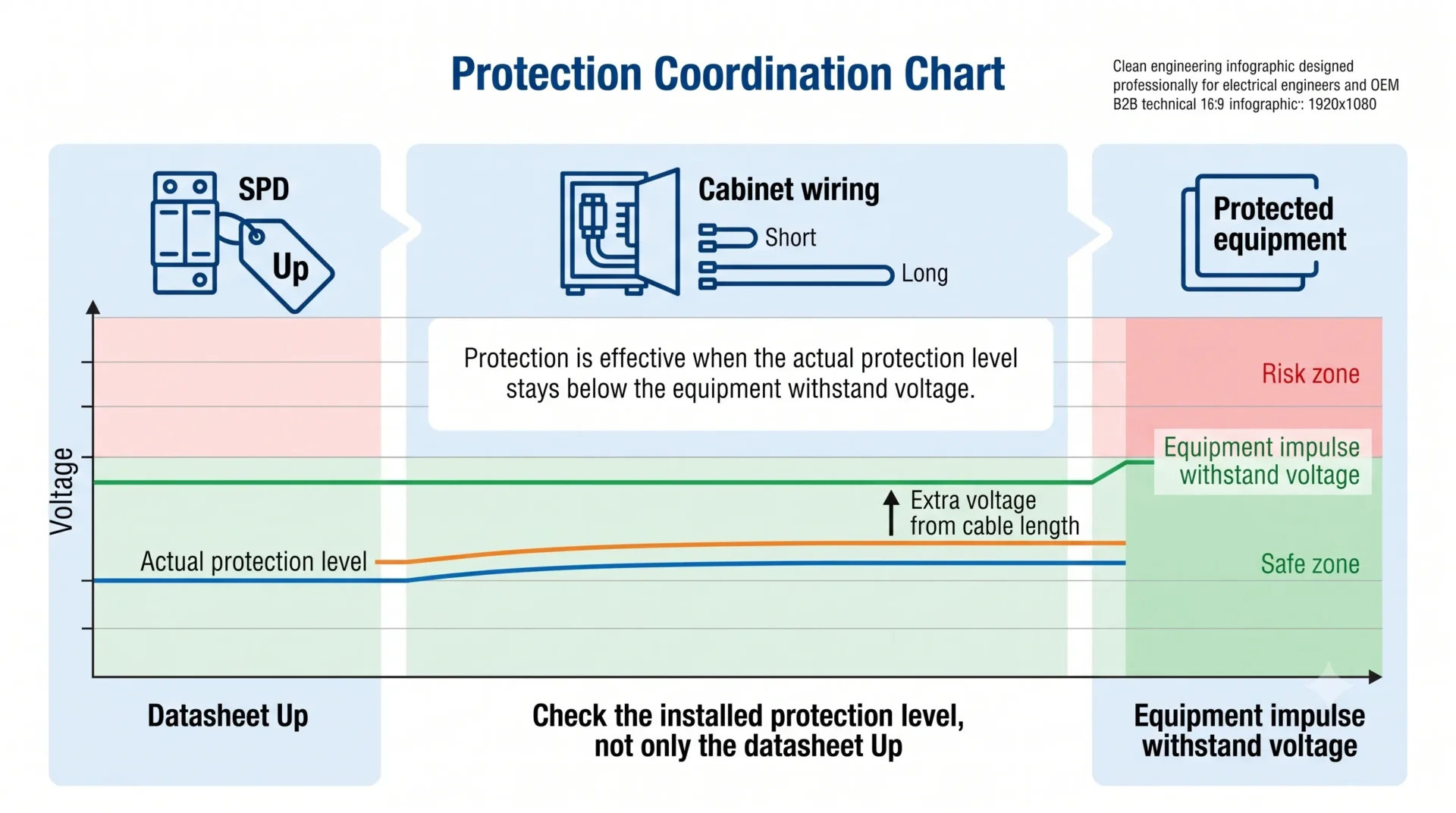
Logique de coordination de la protection
Le niveau de protection installé est nettement inférieur au niveau de résistance de l'équipement.
Le niveau de protection installé est proche ou supérieur au niveau de résistance de l'équipement.
| Équipements protégés | Préoccupations de l'acheteur | Comment se documenter |
|---|---|---|
| Tableau de distribution principal | Protection des appareillages de commutation et des circuits en aval | Vérifier les éléments suivants : type SPD, Iimp / In, position de montage et capacité de résistance aux impulsions de l'équipement. |
| Tableau de sous-distribution | Une protection plus proche des charges | Le SPD de type 2 « Up » prend davantage d'importance, car il est situé plus près des équipements en aval. |
| Automate programmable (PLC) ou armoire de commande | Composants électroniques sensibles et modules de commande | Un niveau de protection effectif moindre peut s’avérer nécessaire, souvent associé à une protection coordonnée en amont et en aval. |
| Panneau électrique OEM | Sélection de modèles reproductible pour les commandes groupées | La tension d'alimentation doit être adaptée à l'application du panneau, au marché cible, à la tension du système et à la certification requise. |
| Côté courant alternatif de l'onduleur solaire | Protection de l'entrée de l'onduleur et de l'électronique de commande | Vérifiez avec Uc les exigences de type 2 ou de type 1+2, le système de mise à la terre et la longueur des câbles. |
Le niveau de protection effectif est supérieur au Up indiqué sur la fiche technique
La valeur « Up » indiquée sur la fiche technique du SPD est mesurée au niveau des bornes du SPD. Dans une armoire réelle, l'équipement protégé peut être soumis à une tension plus élevée, car l'installation génère une surtension supplémentaire.
Cela ne signifie pas que la valeur Up de la fiche technique est inutile. Cela implique que les acheteurs doivent l'utiliser comme point de départ, puis vérifier comment le parafoudre sera installé dans le tableau réel.
| Facteur | En quoi cela peut-il renforcer le niveau de protection effectif ? | Action de l'acheteur / du constructeur de panneaux |
|---|---|---|
| Longueur du câble de raccordement | Les conducteurs longs génèrent une tension supplémentaire lors du passage d'un courant de surtension. | Veillez à ce que les conducteurs L, N et PE soient courts, directs et dépourvus de boucles inutiles. |
| Parcours d'éducation physique | Un parcours de protection électrique long ou indirect peut réduire l'efficacité réelle de la protection. | Utilisez une connexion PE courte et directe à la barre de mise à la terre. |
| Protection de secours | Les fusibles ou disjoncteurs utilisés pour la protection d'appoint des dispositifs de protection contre les surtensions (SPD) peuvent entraîner une augmentation de la tension en cas de surtension. | Respectez les recommandations du fabricant du SPD concernant la protection de secours et la méthode d'installation. |
| Distance par rapport à l'équipement | Si l'équipement protégé se trouve loin du dispositif de protection contre les surtensions (SPD), il peut tout de même être soumis à une tension de surtension plus élevée. | Envisagez de mettre en place une protection coordonnée en aval de type 2 ou de type 3 pour les charges sensibles. |
Ne vous fiez pas uniquement à l’étiquette pour évaluer le niveau de protection
Un bon dispositif de protection contre les surtensions (SPD) mal installé peut s'avérer peu efficace en termes de protection réelle. Pour les panneaux d'origine (OEM) et les tableaux de distribution, il convient de vérifier le dispositif de protection contre les surtensions (SPD) ainsi que le tracé du câblage, la longueur des câbles, la protection de secours et l'emplacement des équipements protégés.
Une valeur de Up plus faible est-elle toujours préférable ?
Une valeur « Up » plus faible signifie généralement que le SPD limite la tension de surtension à un niveau résiduel plus bas. Cela permet de mieux protéger les équipements en aval.
Cependant, les acheteurs ne doivent pas choisir un SPD uniquement en fonction de la valeur « Up ». Une valeur « Up » très faible n'est d'aucune utilité si le SPD n'est pas adapté à la tension du système, au courant de décharge requis, à la position d'installation ou au type de SPD.
Avertissement important à l'attention des acheteurs
Ne vous contentez pas de demander : « Quel SPD présente l'Up le plus faible ? » Il vaut mieux se poser la question suivante : « Quel SPD offre un niveau de protection adapté à mon équipement, tout en étant compatible avec les valeurs Uc, In, Imax, Iimp, la tension du système, le type de mise à la terre, le mode de protection et la configuration de l'installation ? »
| Erreur de sélection | Pourquoi c'est risqué | Une meilleure implication des acheteurs |
|---|---|---|
| Choisir la valeur Up la plus faible sans vérifier Uc | Il se peut que le SPD ne soit pas adapté à la tension de fonctionnement continue réelle. | Vérifiez d'abord la tension du réseau, les variations de tension, le système de mise à la terre et la tension Uc. |
| Comparaison des types 1, 2 et 3 uniquement par ordre croissant | Les différents types de SPD ont des rôles et des fonctions de contrôle distincts. | Comparez les caractéristiques du modèle SPD et la position de montage appropriées. |
| Comparaison d'Up selon différents modes de protection | Les valeurs L-PE, L-N, N-PE et L-L ne sont pas nécessairement interchangeables. | Vérifiez que le mode de protection est le même lorsque vous comparez les fiches techniques des fournisseurs. |
| Ignorer In, Imax ou Iimp | Le SPD dispose peut-être d’une bonne tension de charge, mais sa capacité de décharge est insuffisante au regard du niveau de risque. | Vérifiez les valeurs nominales du courant de décharge en collaboration avec Up. |
| Ne pas tenir compte de la longueur du câble de raccordement | Le niveau de protection réel de l'équipement peut être supérieur à celui indiqué dans la fiche technique. | Veillez à ce que les conducteurs de connexion SPD soient courts et directs. |
| Utilisation d'un SPD de type 3 comme protection principale | Les SPD de type 3 sont généralement destinés à assurer une protection de précision à proximité des équipements terminaux, et non à faire face aux courants de surtension importants au niveau de l'entrée principale. | Utilisez une protection coordonnée de type 1 / type 2 / type 3 lorsque cela est nécessaire. |
Comment les différents types de parafoudres influencent la sélection du Up
Le terme « Up » doit être compris en lien avec le type de SPD. Un SPD de type 1, un SPD de type 2, un SPD de type 1+2 et un SPD de type 3 ne remplissent pas le même rôle au sein du système de protection.
| Type de DOCUP | Position d'installation typique | Axe principal de sélection | Comment comprendre « Up » |
|---|---|---|---|
| DOCUP de type 1 | Tableau électrique principal, point d'entrée de la zone de protection contre la foudre | Courant de défaut, comportement en régime permanent, mise à la terre du système, coordination des protections principales | Le type est important, mais le type 1 est principalement choisi pour sa capacité à évacuer les courants de foudre. |
| Type 1+2 SPD | Tableau de distribution principal nécessitant une protection combinée | Équilibre entre la capacité de conduction du courant de foudre et la limitation de tension | Souvent utilisé pour réduire les niveaux de protection lorsque le produit est correctement coordonné. |
| DOCUP de type 2 | Tableau de distribution, tableau divisionnaire, coffret OEM | Uc, In, Imax, Up, configuration des pôles, certification | Le raccordement « Up » est très important, car les SPD de type 2 sont couramment utilisés pour protéger les équipements électriques en aval. |
| DOCUP de type 3 | Proche de l'équipement terminal | Protection précise et coordination avec les parafoudres de type 1 et de type 2 en amont | La tension « Up » est généralement plus faible, mais le type 3 ne doit pas être considéré comme un substitut à la protection contre les surtensions en amont. |
Pour en savoir plus sur le choix général d'un modèle SPD au-delà d'Up, vous pouvez également consulter notre Guide de sélection SPD.
Pourquoi la longueur du câble d'installation modifie le niveau de protection réel
La valeur « Up » indiquée dans la fiche technique est mesurée au niveau des bornes du dispositif de protection contre les surtensions (SPD). Dans un tableau de distribution réel, l'équipement protégé peut être soumis à une tension plus élevée, car les câbles de raccordement du SPD ajoutent une tension supplémentaire lors du passage d'un courant de surtension.
C'est pourquoi l'installation ne se résume pas à un simple détail de câblage. Elle a une incidence directe sur l'efficacité réelle de la protection.
Ce que les acheteurs devraient demander aux installateurs ou aux fabricants de panneaux de confirmer
- À quel endroit le SPD sera-t-il installé à l'intérieur de l'armoire ?
- Quelle est la longueur des conducteurs reliant la barre omnibus ou la borne au parafoudre ?
- Quelle est la longueur du chemin de raccordement PE ?
- Le chemin PE est-il direct ou fait-il le tour d'autres composants ?
- L'équipement protégé est-il éloigné du SPD ?
- Le système nécessite-t-il une protection supplémentaire en aval de type 2 ou de type 3 ?
Up doit être vérifié conjointement avec Uc, In, Imax et Iimp
La valeur « Up » correspond à un indice de performance en matière de protection. Mais elle ne reflète pas à elle seule l'ensemble des critères à prendre en compte pour choisir une SPD.
| Paramètres | Ce que cela signifie | Pourquoi c'est important lors d'un contrôle |
|---|---|---|
| Uc | Tension de fonctionnement maximale continue | Si l'Uc n'est pas adapté, le SPD risque de vieillir prématurément ou de tomber en panne dans les conditions réelles du réseau. |
| Haut de la page | Niveau de protection contre les tensions / tension résiduelle | Indique la tension pouvant subsister lors d'un essai de surtension. |
| En | Courant de décharge nominal | Fait preuve d'une capacité de décharge de surtension normale et d'une bonne durabilité face à des contraintes répétées liées aux surtensions. |
| Imax | Courant de décharge maximal pour un parafoudre de type 2 | Il présente une excellente résistance aux pics de tension lors de l'essai avec la forme d'onde de type 2. |
| Iimp | Courant d'impulsion pour ESD de Type 1 | Indique la capacité de décharge de courant de foudre pour les applications de type 1. |
Guides connexes : Sélection du courant nominal d’entrée du SPD, Sélection SPD Imaxet IEC 61643-11 vs IEC 61643-31.
Plages de valeurs Up courantes sur les fiches techniques
Les différents types de SPD et les différentes conceptions de produits peuvent présenter des valeurs « Up » différentes. Ne comparez pas ces chiffres sans avoir vérifié l'application concernée.
| Exemple de niveau supérieur | Comment les acheteurs pourraient percevoir la situation | Rappel important |
|---|---|---|
| ≤ 1,0 kV ou moins | Souvent associées à une protection de précision, à des applications à basse tension ou à une protection à proximité des équipements terminaux. | Vérifiez le type de dispositif de protection (SPD), l'intensité nominale de décharge, la tension du réseau et s'il est adapté pour servir de protection principale. |
| ≤ 1.2 kV / ≤ 1.5 kV | On le retrouve couramment dans de nombreuses fiches techniques de parafoudres à rail DIN basse tension. | Ces modèles sont souvent intéressants pour les tableaux de distribution, mais il convient tout de même de vérifier les valeurs Uc, In, Imax, le mode de protection et la longueur du câblage. |
| ≤ 2.0 kV / ≤ 2.5 kV | Peut apparaître sur des dispositifs de protection à haute énergie ou en amont. | Ce n'est pas forcément une mauvaise chose. Cela peut s'inscrire dans le cadre d'une stratégie coordonnée de protection en amont. |
| Valeurs « Higher Up » | Peut apparaître en fonction du type de SPD, des conditions d'essai, de la tension nominale ou du mode de protection. | Vérifiez si un SPD supplémentaire en aval est nécessaire pour les équipements sensibles. |
Ces recommandations ne sont pas universelles. Les valeurs Up réelles dépendent du type de SPD, de la tension du système, du mode de protection, de la forme d'onde d'essai, des conditions de courant de décharge et de la fiche technique du fabricant. Vérifiez toujours la valeur exacte dans la fiche technique du produit et la norme applicable.
Comment comparer la valeur Up entre différents fournisseurs
Lorsque vous comparez les devis de différents fournisseurs de SPD, ne vous fiez pas uniquement à un seul chiffre. Demandez à connaître l'ensemble des paramètres.
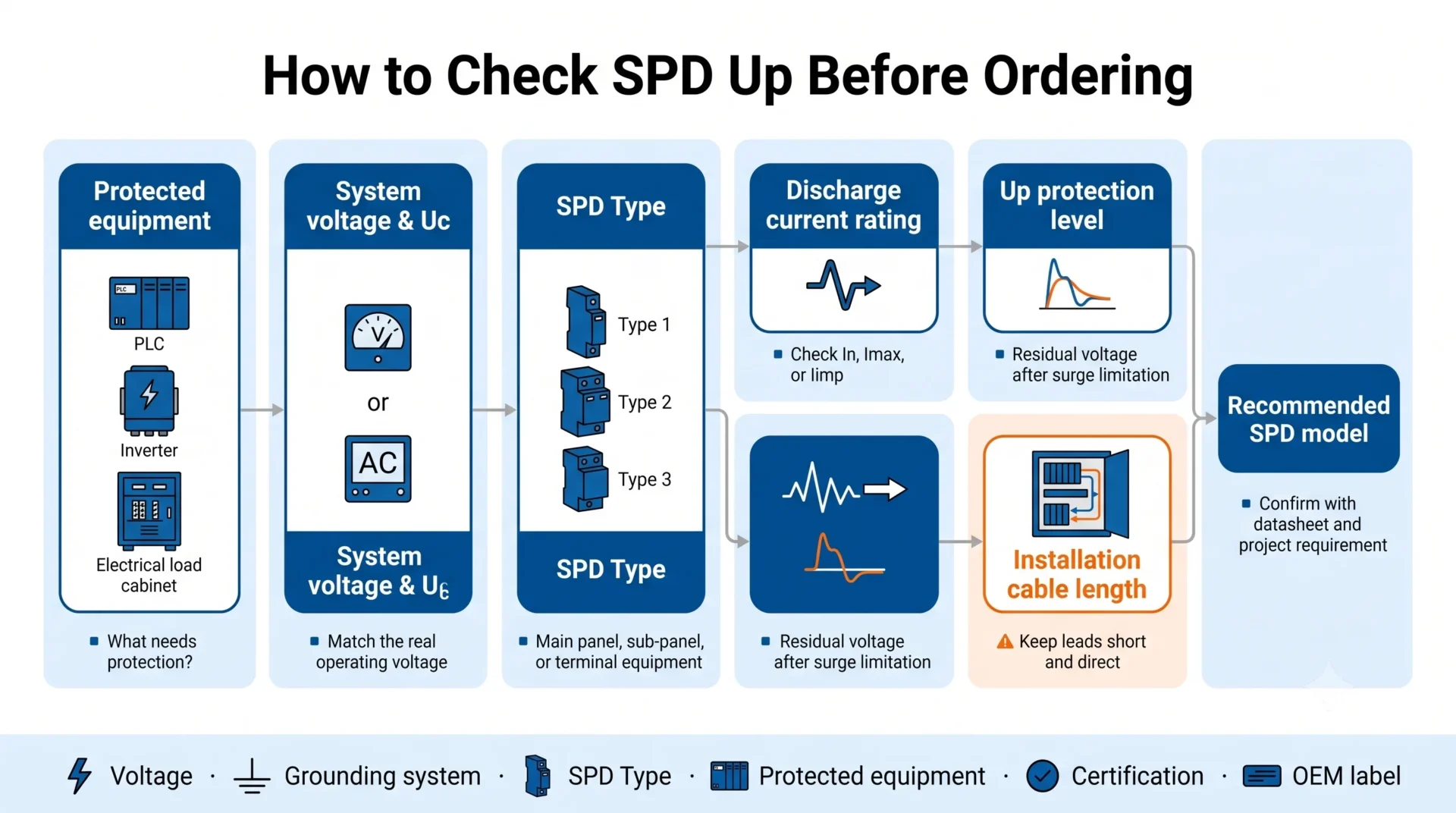
Avant de comparer les valeurs Up, assurez-vous que :
- Type de SPD : Type 1, Type 1+2, Type 2 ou Type 3
- Tension du système et Uc requise
- Mode de protection : L-PE, L-N, N-PE, L-L
- Courant de décharge nominal In
- Courant de décharge maximal Imax
- Courant de impulsion Iimp pour un SPD de type 1
- Forme d'onde d'essai et norme
- Nombre de pôles et système de câblage
- Certification : CE, TÜV, CB ou exigences spécifiques au projet
- Position d'installation et longueur de câble prévue
Pour les commandes des équipementiers et des distributeurs, la valeur « Up » doit s'inscrire dans le cadre d'un processus complet de validation des paramètres. Elle ne doit pas être considérée comme une « valeur optimale » isolée.
Exemples pour les acheteurs : comment interpréter Up dans des projets réels
| Situation du projet | Questions que l'acheteur pourrait poser | Une meilleure réponse technique |
|---|---|---|
| Tableau de distribution 230/400 V | Puis-je choisir le SPD présentant la valeur « Up » la plus faible ? | Commencez par vérifier la valeur Uc, les exigences de type 2, les valeurs In et Imax, le système de mise à la terre, le mode de protection et la longueur des câbles d'installation. Comparez ensuite la valeur Up. |
| Tableau électrique principal avec protection externe contre la foudre | Un SPD de type 2 à faible Up est-il suffisant ? | Vérifiez si une protection de type 1 ou de type 1+2 est nécessaire. Le courant Iimp peut être plus important du côté de l'entrée. |
| Armoire de commande à automate programmable ou panneau de commande sensible | Pourquoi ai-je encore besoin d'une protection en aval ? | Si l'équipement est sensible ou situé loin du SPD en amont, une protection coordonnée de type 2 ou de type 3 peut s'avérer nécessaire. |
| Panneau OEM destiné à l'exportation | Quelle valeur « Up » devons-nous indiquer dans les spécifications du modèle ? | Définissez le marché cible, la tension du système, le type de SPD, la certification, le niveau de résistance des équipements protégés et la disposition de l'armoire avant de finaliser le modèle. |
Envoyez vos besoins en matière de tableaux électriques avant de choisir selon Up
Pour les commandes en série, les panneaux OEM et les projets de tableaux de distribution, LEEYEE peut vous aider à vérifier les paramètres Uc, In, Imax, Iimp, le système de mise à la terre, le mode de protection, la protection de secours et la disposition d'installation de l'armoire.
Avant de commander : informations à transmettre au fournisseur
Si vous souhaitez qu'un fournisseur vous recommande le SPD adapté plutôt que de se contenter de vous envoyer une liste de prix, veuillez lui fournir les informations suivantes.
- Tension nominale du système
- Variation maximale de tension, si elle est connue
- Système de mise à la terre : TN-S, TN-C-S, TT ou IT
- Type de SPD requis : Type 1, Type 1+2, Type 2 ou Type 3
- Emplacement d'installation : tableau principal, tableau secondaire, armoire ou équipement terminal
- Type d'équipement protégé
- Tension de tenue aux impulsions de l'équipement, si disponible
- Uc obligatoire
- Obligatoire dans / Imax / Iimp
- Niveau de protection requis ou niveau maximal acceptable
- Mode de protection : L-PE, L-N, N-PE ou L-L
- Exigence en matière de protection par sauvegarde
- Schéma de câblage de l'armoire ou photo
- Exigence en matière de certification ou de norme
- Exigences relatives à la marque OEM, à l'emballage ou à la marque de distributeur
FAQ sur le niveau de protection en tension Up des parafoudres
Que signifie 'Up' sur un SPD ?
Up signifie le niveau de protection contre les surtensions. Il décrit la tension résiduelle qui peut apparaître aux bornes du SPD lorsque le SPD décharge un courant de surtension dans des conditions d'essai spécifiées.
Est-ce que la tension de montée est la même que la tension résiduelle ?
Dans le langage des acheteurs, 'Up' est souvent compris comme le niveau de protection de tension déclaré lié à la tension résiduelle ou à la tension de passage. Cela aide les acheteurs à comprendre combien de tension peut encore atteindre les équipements en aval lors d'un événement de surtension.
Est-ce que la tension SPD Up est la même que la tension de limitation ?
Pas toujours. La tension de clamp est souvent utilisée comme un terme général pour la limitation de tension, mais la sélection finale du disjoncteur de surtension (SPD) doit utiliser la valeur Up déclarée dans la fiche technique du SPD. Les acheteurs ne doivent pas confondre la valeur Up du SPD avec la tension du composant MOV.
Un SPD Up inférieur est-il toujours meilleur ?
Une limitation inférieure est généralement meilleure pour la limitation de tension, mais ce n'est pas le seul facteur de sélection. Les acheteurs doivent également vérifier Uc, In, Imax, Iimp, le type de SPD, le mode de protection, le système de mise à la terre et la longueur du câble d'installation.
Puis-je choisir SPD uniquement par Up ?
Non. Up vous indique le niveau de protection, mais il ne vous dit pas si le SPD peut fonctionner en toute sécurité sur la tension de votre système ou décharger le courant de surtension requis. Cela doit être vérifié dans le cadre d'une sélection complète du SPD.
Pourquoi le niveau de protection réel est-il supérieur à celui du dossier technique ?
La fiche technique est mesurée aux bornes SPD. Dans une armoire réelle, les fils de connexion, le chemin de mise à la terre (PE), les dispositifs de protection de secours et la disposition de l'installation peuvent ajouter une tension supplémentaire, de sorte que l'équipement peut voir un niveau de protection effectif plus élevé.
Pourquoi la longueur du câble affecte-t-elle la protection SPD ?
Lors de la circulation d'un courant de choc, les conducteurs longs ou en boucle ajoutent une tension supplémentaire. Cela peut rendre la tension réelle au niveau de l'équipement protégé supérieure à la valeur Up indiquée sur la fiche technique du parafoudre.
Quelle valeur de Up est adaptée à un tableau de distribution ?
Cela dépend de la tension du système, du type de parafoudre (SPD), de l'équipement protégé, du niveau de tenue aux chocs de l'équipement, du mode de protection et de la configuration de l'installation. Pour les tableaux de distribution standard, le Up du parafoudre de Type 2 est généralement vérifié conjointement avec Uc, In et Imax.
Le parafoudre de Type 3 a-t-il un Up inférieur à celui d'un Type 2 ?
Le parafoudre de Type 3 est normalement utilisé à proximité de l'équipement terminal et peut présenter un niveau de protection inférieur. Cependant, il doit être coordonné avec un parafoudre de Type 1 ou de Type 2 en amont et ne doit pas être utilisé comme seule protection principale là où une décharge de courant de foudre élevée est requise.
Que doivent confirmer les acheteurs OEM avant de commander un parafoudre par valeur de Up ?
Les acheteurs OEM doivent confirmer la tension du système, Uc, le type de parafoudre, la configuration des pôles, In, Imax ou Iimp, le mode de protection, la norme requise, l'équipement protégé, la position d'installation, la protection de secours ainsi que les exigences en matière d'étiquetage ou d'emballage.