
PV Combiner Box Protection and BOM Guide
A PV combiner box fuse holder and a surge protective device may sit next to each other inside the same enclosure, but they protect against different electrical events. Treating them as substitutes can leave the PV strings without the required overcurrent protection or leave the inverter exposed to transient overvoltage.
This guide explains how PV fuse holders, gPV fuse links, DC SPDs, DC isolators and circuit breakers fit into a combiner box BOM. It is written for combiner box manufacturers, solar EPC contractors, PV distributors, project procurement teams and OEM buyers.
Daftar Isi
Quick Answer: Can a Fuse Holder Replace an SPD?
Tidak. A PV fuse link provides overcurrent protection by opening a series circuit when its specified current-time operating conditions are reached. A PV DC SPD is connected in parallel and limits transient overvoltage by diverting surge current through a controlled protection path.[1][2]
The fuse holder mainly mounts and connects the replaceable fuse link. It is not the calibrated protective element by itself. A DC isolator provides switching and isolation, while a correctly selected DC circuit breaker provides automatic overcurrent interruption within its declared ratings.[6][7]
Fuse link: overcurrent protection. DC SPD: transient overvoltage protection. Isolator: manual switching and isolation. Breaker: automatic overcurrent interruption.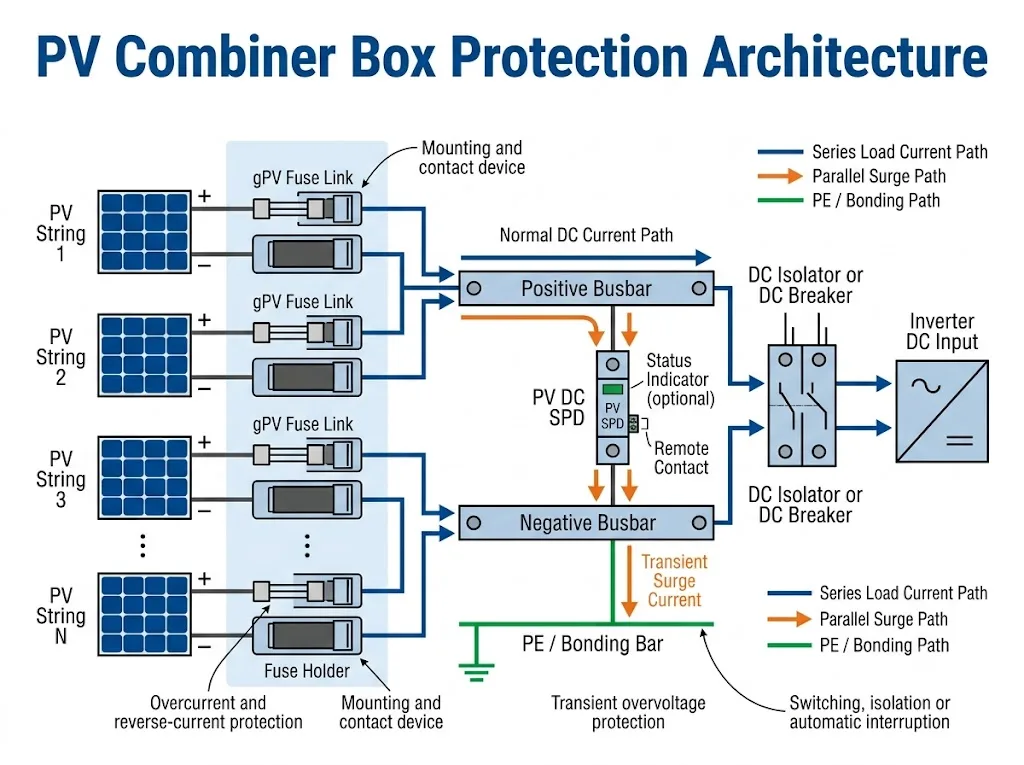
PV Fuse Holder vs SPD: The Main Procurement Differences
Focus first on the protected risk and circuit position. These two fields explain why the devices cannot replace each other.
| Titik perbandingan | PV fuse holder and fuse link | SPD DC PV |
|---|---|---|
| Risiko utama | Specified overcurrent, reverse-current and short-circuit exposure | Lightning-related or switching transient overvoltage |
| Circuit position | Connected in series with the protected PV string or conductor | Connected in parallel across the required DC protection modes |
| Arus normal | The PV operating current passes through the installed fuse link | The full PV load current does not normally pass through the SPD as a series device |
| Prinsip kerja | The fuse element opens the circuit according to its current-time characteristic | The SPD limits voltage and diverts surge current during a transient event |
| After operation | An operated fuse link is replaced after the fault is investigated | The SPD is inspected according to its status indication and manufacturer maintenance criteria |
| Main order data | DC voltage, gPV current, breaking capacity, fuse size, holder rating and temperature conditions | Ucpv, Up, SPD type, In, Imax, Iimp when applicable, Iscpv, modes and backup protection |
| Primary IEC context | IEC 60269 series, including IEC 60269-6 for photovoltaic fuse links | IEC 61643-31 product requirements and IEC 61643-32 selection principles |
Procurement conclusion: a quotation containing fuse holders does not automatically include surge protection. A quotation containing an SPD does not automatically include PV string overcurrent protection.
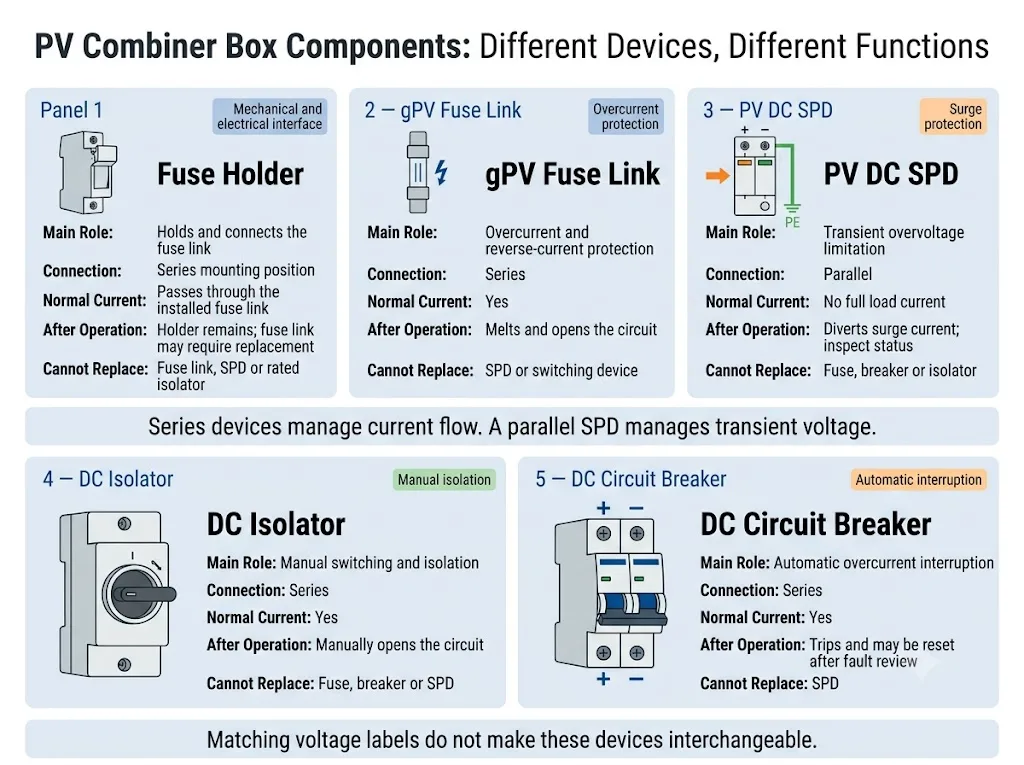
Fuse Holder and Fuse Link Are Separate BOM Items
Many RFQs use the term “PV fuse” for both the holder and the replaceable fuse link. This wording is not precise enough for an OEM quotation.
PV Fuse Holder
The fuse holder provides mounting, insulation, terminals and electrical contact for the fuse link. It must be compatible with the fuse-link dimensions, DC voltage, current, terminal conductor, enclosure temperature and installation method.
gPV Fuse Link
The fuse link contains the calibrated element that interrupts the specified overcurrent. IEC 60269-6 gives supplementary requirements for fuse links used to protect PV strings and arrays in circuits with nominal voltages up to 1,500 V DC.[1]
Common quotation error
A line such as “10 × 38 fuse holder, 32 A” does not confirm whether the gPV fuse link is included. The quotation should list the holder model, fuse-link model, rated current, voltage and quantity separately.
Commercial product documentation also shows why this distinction matters. PV fuse manufacturers commonly publish separate fuse-link and fuse-holder ranges, while some combiner box suppliers state that fuse holders are fitted but fuse links are not included in the scope of supply.[8][9]
Do not use an ordinary fuse holder as a load-break switch
Do not open a fuse holder while load current is flowing unless the complete device is explicitly rated and approved for that switching duty. A dedicated DC switch-disconnector or another approved switching arrangement should be selected where load switching and isolation are required.[6]
Where the Fuse, SPD, Isolator and Breaker Fit
A PV combiner box collects several string inputs and sends the combined DC output toward the inverter. The internal components should be selected as one coordinated protection system, not as unrelated catalogue items.
The table describes the usual functional relationship. The final connection order must follow the approved project diagram and product instructions.
| Perangkat | Typical circuit relationship | Tujuan utama | Does not replace |
|---|---|---|---|
| String fuse link | Series connection at a string input when overcurrent protection is required | Limits harmful reverse-current or fault-current exposure at string level | SPD, output isolation or complete feeder protection |
| SPD DC PV | Parallel connection across the required DC protection modes | Limits transient overvoltage before it reaches the inverter or monitoring equipment | Fuse link, breaker or isolation device |
| DC isolator | Normally installed in the combined output path or another approved isolation point | Provides manual switching and isolation for inspection or maintenance | Overcurrent protection or surge protection |
| DC circuit breaker | String circuit, combined output or downstream feeder according to the design | Provides automatic overcurrent interruption and any additional declared switching function | SPD or an unverified string-fuse requirement |
The SPD is normally the only one of these devices connected as a parallel surge path. Fuse links, breakers and isolators form part of a series current path.
One-sided or two-sided string fusing cannot be selected from a generic combiner box photograph. The decision depends on the PV topology, grounding arrangement, conductor protection requirements and applicable project rules. Commercial combiner box ranges include both one-sided and two-sided fuse configurations, which confirms that the arrangement is application-dependent.[9]
Does Every PV String Need a Fuse?
Not automatically. The need for string overcurrent protection depends on the current that can feed a faulted string from the other parallel strings and whether that exposure can exceed the permitted limits of the PV module or string conductor.
The responsible designer should compare the maximum possible reverse-current contribution with:
- The module manufacturer’s maximum series fuse rating
- The module short-circuit current and applicable correction factors
- The string cable current-carrying capacity
- The number of parallel strings connected to the same input
- The inverter MPPT and input protection architecture
- The required protection of positive and negative conductors
- The applicable installation standard and national requirements
IEC 62548-1 addresses PV array design, including DC wiring, electrical protection devices, switching and earthing provisions. IEC 60364-7-712 addresses the selection and application of equipment within PV electrical installations.[4][5]
Arti rekayasa
Do not use a universal rule such as “every combiner box needs string fuses” or “two strings never need fuses.” The answer must be confirmed from the actual array design, module data, conductor ratings and applicable project documents.
The fuse-holder current is not the fuse-selection answer
A holder marked 32 A does not mean the project should use a 32 A fuse link. The holder rating defines an equipment limit. The fuse-link rating must be coordinated with the module, conductor, fault-current exposure and design standard.
String Fuse, Output Fuse and SPD Backup Fuse
A combiner box may contain more than one fuse function. A BOM that lists only “DC fuse” makes technical review and replacement planning difficult.
| Fuse role | Protected circuit | Selection basis | Kesalahan umum |
|---|---|---|---|
| String fuse | Individual PV string | Module limit, string current, reverse-current exposure and conductor capacity | Selecting only from the holder’s maximum current |
| Output or feeder fuse | Combined output conductor or downstream DC feeder | Combined current, conductor capacity, fault level and downstream coordination | Using the same rating as a single string fuse |
| SPD backup fuse | SPD branch and its fault-disconnection path | SPD manufacturer instructions, declared short-circuit behaviour and available fault current | Assuming an existing string fuse provides approved SPD backup protection |
Internal SPD disconnection is not always external backup protection
Many SPDs contain an internal disconnection mechanism. An external fuse or breaker may still be required under the manufacturer’s declared coordination conditions. Verify the maximum permitted backup device, available short-circuit current and actual branch arrangement from the model-specific documentation.[2][3]
How to Confirm the PV DC SPD for the BOM
A supplier should not select the SPD from only the words “600 V,” “1,000 V” or “1,500 V combiner box.” The complete selection must consider voltage stress, protection level, surge environment, short-circuit behaviour and circuit topology.
Calculate the maximum cold-condition string voltage
PV module open-circuit voltage increases as module temperature falls. Use the module Voc, number of modules in series, voltage temperature coefficient and lowest design temperature to establish the maximum string voltage.[4]
Confirm Ucpv for each protection mode
Ucpv is the maximum continuous operating voltage declared for a PV SPD. It must be suitable for the maximum continuous voltage that can appear across the relevant SPD terminals.[3]
Compare the voltage protection level
A higher Ucpv gives more continuous-voltage margin, but it does not automatically provide better protection. Compare the SPD voltage protection level, Up, with the withstand capability of the equipment being protected.
Confirm Type 2 or Type 1+2 requirements
Type 2 is commonly used for induced and switching surges. A Type 1 or Type 1+2 solution may be required where lightning-current discharge is expected at the installation point. The project lightning protection concept must confirm the requirement.[3]
Check discharge and short-circuit ratings
Confirm In, Imax and Iimp where applicable. Also verify Iscpv, the available PV short-circuit current and any external backup protection required by the SPD manufacturer.
Confirm the DC topology and protection modes
The SPD configuration must match the actual PV system. Do not select a two-pole or three-pole arrangement only from a product photograph. Confirm whether the array is floating, functionally grounded or arranged according to another approved topology.
Keep the surge-current path short and direct
Connection routing affects the residual voltage appearing at the protected equipment. Locate the SPD and bonding connection according to the manufacturer instructions and approved enclosure design.[3]
Continue the engineering review
This page explains how fuse holders, fuse links and SPDs fit into the combiner box BOM. For a detailed voltage calculation, use the DC SPD Ucpv Selection Guide. For a complete surge-protection review, use the PV Combiner Box SPD Guide.
DC Isolator vs Circuit Breaker in the BOM
An isolator and a breaker can both appear in the combined output circuit, but their primary functions are different.
DC switch-disconnector
A switch-disconnector provides a defined method of switching and isolation. IEC 60947-3 applies to switches, disconnectors, switch-disconnectors and fuse-combination units for rated voltages up to 1,500 V DC.[6]
Confirm the rated operational voltage, current, pole arrangement, utilization category, load-switching duty, isolation function and handle arrangement. Do not substitute an AC isolator merely because its current rating appears sufficient.
DC circuit breaker
A circuit breaker provides automatic interruption under its declared overcurrent and short-circuit conditions. IEC 60947-2 covers circuit breakers with rated voltages up to 1,500 V DC for applications within its scope.[7]
Confirm the DC voltage, rated current, breaking capacity, trip characteristics, pole connection, polarity requirements and suitability for isolation where that function is required.
A breaker does not provide surge protection
The breaker operates according to its overcurrent and breaking characteristics. It does not provide the fast voltage-limiting and surge-current diversion function of a PV DC SPD.
Typical PV Combiner Box Protection Patterns
There is no single BOM that is correct for every array. The configuration should show which protection functions are present and which functions are already provided elsewhere.
| Typical pattern | Main components | When it may be considered | What still needs confirmation |
|---|---|---|---|
| String fuses + SPD + isolator | gPV fuse links and holders, PV DC SPD and combined-output switch-disconnector | Multi-string arrays requiring string protection and local manual isolation | Output feeder protection, SPD backup protection and inverter input protection |
| String fuses + SPD + output breaker | String fuses, PV DC SPD and DC breaker at the combined output | Projects requiring string protection and automatic output interruption | Whether the breaker also provides the required isolation and switching functions |
| SPD + isolator without string fuses | PV DC SPD and switch-disconnector | Only where engineering review confirms that individual string fuses are not required | Reverse-current exposure, module limit, cable protection and inverter architecture |
| Integrated fuse-combination assembly | Fused switch or another tested combination device plus PV DC SPD | Compact OEM assemblies with documented switching and protection functions | Exact functions, utilization category, replacement method and certificate scope |
The correct question is not “Which component can be removed?” It is “Which protection or isolation function would be missing if that component were removed?”
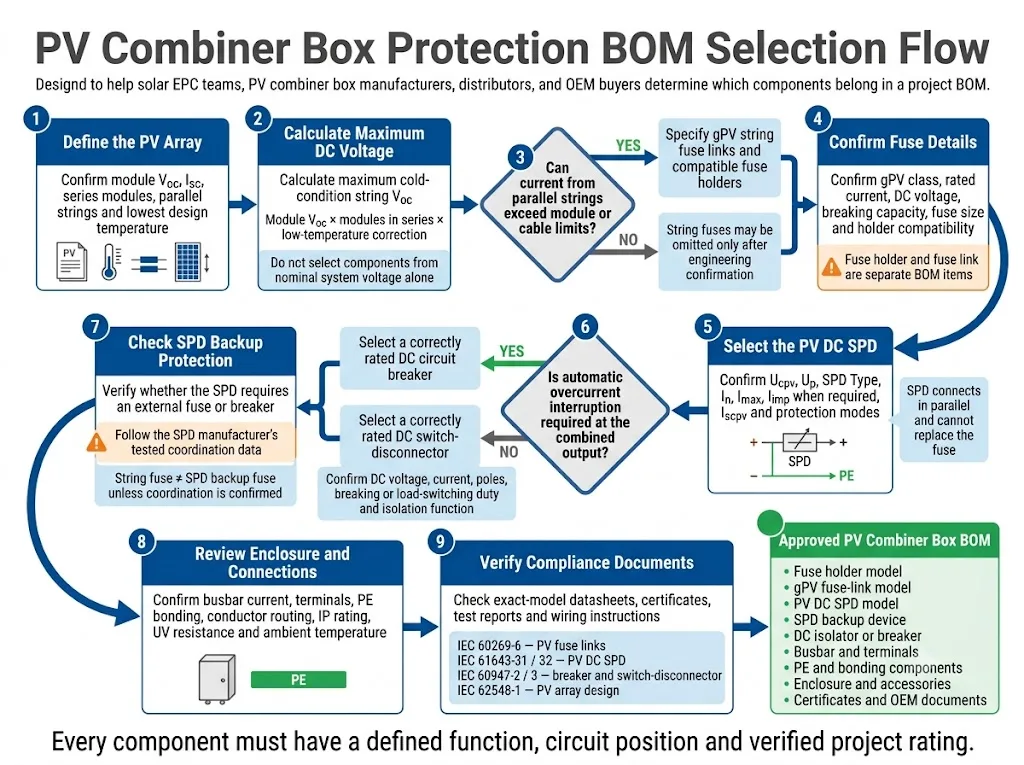
How to Prepare a Complete Combiner Box BOM
A useful BOM identifies the electrical function, circuit position, exact model and rating of every component. Product names and quantities alone are not enough.
Use the following fields as a quotation framework. Final values must come from the approved design and model-specific documents.
| BOM item | Parameter untuk dikonfirmasi | Common purchasing risk |
|---|---|---|
| gPV fuse link | DC voltage, rated current, gPV classification, breaking capacity, dimensions and module coordination | Using a general-purpose fuse with a similar ampere rating |
| PV fuse holder | Compatible fuse size, DC voltage, current, terminals, mounting, touch protection and temperature data | Assuming the fuse link is included or ignoring enclosure temperature |
| SPD DC PV | Ucpv, Up, SPD type, In, Imax, Iimp, Iscpv, modes, indicator and remote contact | Selecting only from nominal voltage or the largest current number |
| SPD backup protection | Whether external protection is required, approved device type and maximum rating | Using the string fuse rating without checking SPD coordination data |
| DC switch-disconnector | Operational voltage, current, poles, utilization category, load-break duty and isolation function | Using an AC isolator or a fuse holder as the normal switching device |
| DC circuit breaker | DC voltage, current, breaking capacity, trip characteristic, poles, polarity and isolation suitability | Assuming every DIN-rail breaker marked DC is suitable for the array |
| Busbars and terminals | Combined current, conductor size, temperature rise, clearances, material and terminal torque | Correctly rating the protective devices but undersizing the connection system |
| PE and bonding parts | PE bar, enclosure bonding, conductor arrangement and terminal capacity | Installing an SPD without a defined low-impedance surge-current path |
| Enclosure and cable entries | IP or NEMA rating, UV resistance, ambient temperature, condensation control and cable glands | Using indoor components or layouts in exposed outdoor environments |
| Monitoring and remote signals | String current monitoring, SPD remote contact, switch status, communication and power supply | Confirming the power circuit but omitting required SCADA or alarm interfaces |
A good BOM connects every component to one defined function, one circuit position and one verified set of project parameters.
Which Standards and Documents Should Buyers Check?
Do not approve a combiner box only from a product label or general catalogue. Request documentation for the exact voltage, current, pole arrangement and model being quoted.
| Component or design area | Relevant IEC context | Document to request |
|---|---|---|
| PV fuse link | IEC 60269-6:2010+AMD1:2021 | Exact-model datasheet, certificate or test report showing voltage, current, class and breaking capacity |
| PV fuse holder | Applicable fuse-system requirements and manufacturer documentation | Holder datasheet, compatible fuse list, terminal data, temperature information and certificate scope |
| SPD DC PV | IEC 61643-31:2018 and its corrigendum | Exact-model certificate, report, datasheet, protection modes and backup-device instructions |
| SPD application | IEC 61643-32:2017 and its corrigendum | Installation diagram, voltage-selection data and coordination information |
| Switch-disconnector | IEC 60947-3:2020+AMD1:2025 | DC ratings, utilization category, pole diagram, isolation and load-switching evidence |
| Circuit breaker | IEC 60947-2:2024 or another project-approved breaker standard | DC breaking capacity, pole connection, trip data and isolation suitability |
| PV array design | IEC 62548-1:2023+AMD1:2025 | Approved array calculation, conductor schedule and protection design |
| PV installation | IEC 60364-7-712:2025 | Approved single-line diagram, installation requirements and project compliance records |
Certificate scope must match the exact model
A certificate for one fuse-holder size, one SPD Ucpv, one breaker pole arrangement or one isolator rating should not be assumed to cover every product in the same catalogue family. Verify the model list and rating scope before project approval.
Common Combiner Box Purchasing Mistakes
Ordering a holder without confirming the fuse link
The delivered box may contain empty holders or a fuse-link rating different from the approved design.
Selecting every component from nominal system voltage
The maximum cold-condition string voltage can be higher than the nominal system label. Every DC component must be checked against the actual voltage condition.
Assuming the breaker includes surge protection
A breaker interrupts overcurrent within its ratings. It does not clamp transient voltage like an SPD.
Using the string fuse as SPD backup without verification
The two fuse functions may protect different branches and require different ratings and coordination evidence.
Using the fuse holder as the maintenance isolator
Unless specifically rated for load switching, opening a holder under load can create a dangerous DC arc.
Ignoring enclosure heat and terminal resistance
Fuse holders, terminals, breakers and SPDs can operate in a hot outdoor enclosure. Spacing, conductor preparation, torque and temperature derating affect reliability.
Approving a certificate without checking its model scope
The certificate may cover a different voltage, current, pole configuration or product variant from the item being supplied.
Information to Send with a Combiner Box RFQ
- Maximum PV system DC voltage
- Module manufacturer and model
- Module Voc and Isc
- Voltage temperature coefficient
- Lowest design temperature
- Modules connected in series
- Number of parallel strings
- Module maximum series fuse rating
- String cable size and rating
- Combined output current
- One-sided or two-sided fusing
- Required gPV fuse-link size
- Required SPD type
- Required SPD Ucpv and Up
- SPD remote contact requirement
- Isolator or breaker preference
- PV grounding or DC topology
- Enclosure IP or NEMA rating
- Required IEC, EN or UL documents
- Approved single-line diagram
- Quantity and delivery schedule
- OEM label and packaging requirements
Need to Confirm a PV Combiner Box Protection BOM?
Send the module data, string configuration, maximum DC voltage, current, single-line diagram and required certification. LEEYEE can help review the PV DC SPD configuration and coordinate the relevant fuse holder, fuse link, isolator and breaker requirements before an OEM or project quotation is finalized.
LEEYEE is a specialized surge protection and low-voltage protection supplier. CNSPD is LEEYEE’s surge protection-focused platform for global technical buyers.
Engineering and Project Approval Boundaries
This guide provides a procurement and BOM-review framework. It does not replace the approved electrical design, module and inverter instructions, local regulations or verification by the responsible engineer.
Requirements can differ by country, utility, project owner, insurer and certification route. IEC, EN and UL documents should not be treated as interchangeable without checking the target market and contract requirements.
A component supplier can compare ratings and prepare a quotation, but the final selection of string fusing, conductor protection, SPD type, protection modes, switching arrangement and short-circuit coordination must be confirmed for the specific project.
Pertanyaan yang Sering Diajukan
Can a fuse holder protect a PV string without a fuse link?
No. The holder provides mounting, insulation and electrical contacts. The replaceable fuse link contains the calibrated element that opens the circuit under the specified overcurrent condition.
Can a PV fuse protect an inverter from lightning surges?
Not by itself. A transient overvoltage can damage inverter insulation or electronics without producing the sustained current-time condition required to operate the fuse. A correctly selected PV DC SPD is used to limit the transient voltage.
Can a PV DC SPD replace a string fuse?
No. The SPD limits transient overvoltage. It does not provide selective series overcurrent protection for a faulted PV string.
Does every combiner box need string fuses?
Not always. The requirement depends on parallel-string reverse current, module maximum series fuse rating, conductor capacity, inverter architecture and applicable project rules.
Can a DC breaker replace the string fuses?
Not automatically. A breaker at the combined output may protect the outgoing conductor, while string fuses address fault exposure at individual string level. Substitution requires verification of the device location, ratings, operating characteristics and project requirements.
Can a fuse holder be used as a DC isolator?
Do not assume so. A normal fuse holder may not be rated to interrupt load current. Use a device explicitly approved for the required DC switching and isolation duty.
Can a string fuse also serve as the SPD backup fuse?
Only when the actual circuit arrangement and the SPD manufacturer’s coordination documentation confirm it. String protection and SPD backup protection should not be treated as identical by default.
Should every 1,000 V combiner box use a 1,000 V Ucpv SPD?
Do not select from the nominal label alone. Calculate the maximum cold-condition string voltage, confirm the voltage stress in each SPD protection mode and compare Ucpv, Up and the protected equipment requirements.
Is a higher Ucpv always safer?
No. A higher Ucpv gives more continuous-voltage tolerance, but the SPD voltage protection level and coordination with the protected equipment must also be considered. The best selection balances voltage withstand and protective performance.
What is the most common error in a combiner box RFQ?
The most common error is requesting “fuse, SPD and breaker” without providing module data, string quantity, voltage, current, wiring arrangement and certification requirements. The supplier then has to guess the protection logic.
Referensi
These references identify the main standards and official technical examples used to establish the device-function boundaries in this guide. The complete standards and project-specific requirements should be reviewed for final design and approval.
- International Electrotechnical Commission, IEC 60269-6:2010+AMD1:2021 CSV — Low-voltage fuses, Part 6: Supplementary requirements for fuse-links for the protection of solar photovoltaic energy systems. Halaman publikasi resmi IEC.
- International Electrotechnical Commission, IEC 61643-31:2018 and IEC 61643-31:2018/COR1:2022 — Low-voltage surge protective devices, Part 31: Requirements and test methods for SPDs for photovoltaic installations. Base publication; Corrigendum 1.
- International Electrotechnical Commission, IEC 61643-32:2017 and IEC 61643-32:2017/COR1:2019 — Surge protective devices connected to the DC side of photovoltaic installations, selection and application principles. Base publication; Corrigendum 1.
- International Electrotechnical Commission, IEC 62548-1:2023+AMD1:2025 CSV — Photovoltaic arrays, Part 1: Design requirements. Halaman publikasi resmi IEC.
- International Electrotechnical Commission, IEC 60364-7-712:2025 — Low-voltage electrical installations, Part 7-712: Solar photovoltaic power supply installations. Halaman publikasi resmi IEC.
- International Electrotechnical Commission, IEC 60947-3:2020+AMD1:2025 CSV — Low-voltage switchgear and controlgear, Part 3: Switches, disconnectors, switch-disconnectors and fuse-combination units. Halaman publikasi resmi IEC.
- International Electrotechnical Commission, IEC 60947-2:2024 — Low-voltage switchgear and controlgear, Part 2: Circuit-breakers. Halaman publikasi resmi IEC.
- Mersen, HelioProtection PV Fuses and Fuse Holders, official product-family information showing separate photovoltaic fuse-link and fuse-holder ranges. Official manufacturer page.
- Phoenix Contact, official string combiner box product information showing fuse holders, DC isolators and surge protection as separate functions, including models where fuse links are not included with the fitted holders. Combiner box example; Fuse-holder scope example.