
Sebuah automatic transfer switch (ATS) and a generator automatic voltage regulator (AVR) solve two different problems in a backup power system. The ATS determines which source feeds the load. By contrast, the AVR controls alternator excitation to help maintain generator output voltage. Therefore, one cannot replace the other. [1][2][3]
For generator integrators, panel builders and project buyers, this distinction affects both equipment selection and troubleshooting. If generator voltage becomes unstable, changing the ATS will not regulate that voltage. Instead, the ATS monitors the source and decides whether it is suitable for transfer, while the generator or alternator control system manages voltage regulation. [2][3]
Daftar Isi
Quick Answer: ATS vs AVR — Do You Need Both?
Many generator backup systems use both ATS and AVR functions, but this does not always mean buying two separate external devices. The generator alternator may already include an AVR. In that case, the buyer selects the ATS separately to monitor the normal and emergency sources and transfer the load according to the configured control logic. [2][3]
If the generator cannot produce acceptable voltage, investigate the generator, alternator, excitation system, AVR configuration and loading. In other words, do not treat the ATS as a voltage stabilizer.
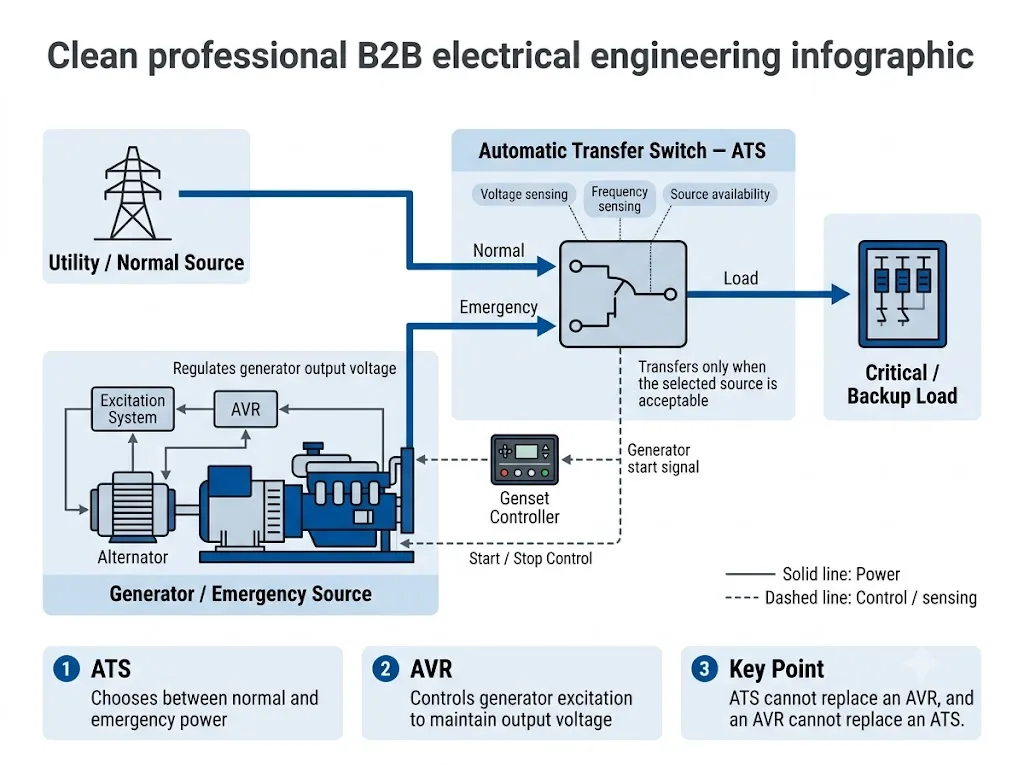
ATS vs AVR: What Is the Actual Difference?
For procurement, focus on the last column: what each device changes in the project.
| Perangkat | Primary job | What it monitors or controls | Project meaning |
|---|---|---|---|
| ATS | Mengalihkan beban di antara sumber daya yang tersedia | Source availability and, depending on the controller, voltage, frequency and transfer timing | Determines when the load changes between utility and generator |
| Generator AVR | Regulates alternator output voltage | Alternator voltage feedback and excitation | Helps the generator maintain required output voltage under operating conditions |
What the ATS Controls
IEC 60947-6-1:2026 defines transfer switching equipment around transferring a load between power supply sources. The current edition covers automatic transfer switching equipment and stand-alone ATS controllers. [1]
What the AVR Controls
By comparison, STAMFORD describes an AVR as part of a brushless alternator excitation system. Its closed-loop control senses alternator output voltage and adjusts excitation to regulate the output. [3]
Do I Need ATS, AVR, or Both?
Use this as an initial decision guide only. Final equipment selection still depends on the actual genset and project control design.
| Situasi proyek | What to investigate or specify |
|---|---|
| Need automatic utility-to-generator switching | ATS or equivalent automatic transfer equipment |
| Generator already includes its designed AVR | ATS may be selected separately; confirm genset documentation |
| Generator voltage is unstable or outside requirement | Investigate generator, alternator, AVR/excitation system and loading; do not expect the ATS to regulate voltage |
| Load cannot tolerate generator start and open-transition interruption | ATS plus a suitable UPS or other continuity strategy may be required |
What Happens During a Utility-to-Generator Transfer?
A generator backup transfer involves more than detecting that utility power disappeared. First, the ATS identifies that the normal source has failed or moved outside its configured acceptance conditions. Next, the control system starts the generator. Finally, the ATS waits until the alternate source becomes suitable before it transfers the load. Eaton describes transfer after the alternate source reaches acceptable voltage and frequency conditions. [2]
However, no single timing sequence applies to every project. The ATS controller, generator controller and project specification determine the generator-start signal, sensing thresholds, transfer delays and retransfer sequence. Therefore, buyers should confirm these values from the selected equipment documentation rather than copy them from a generic diagram.
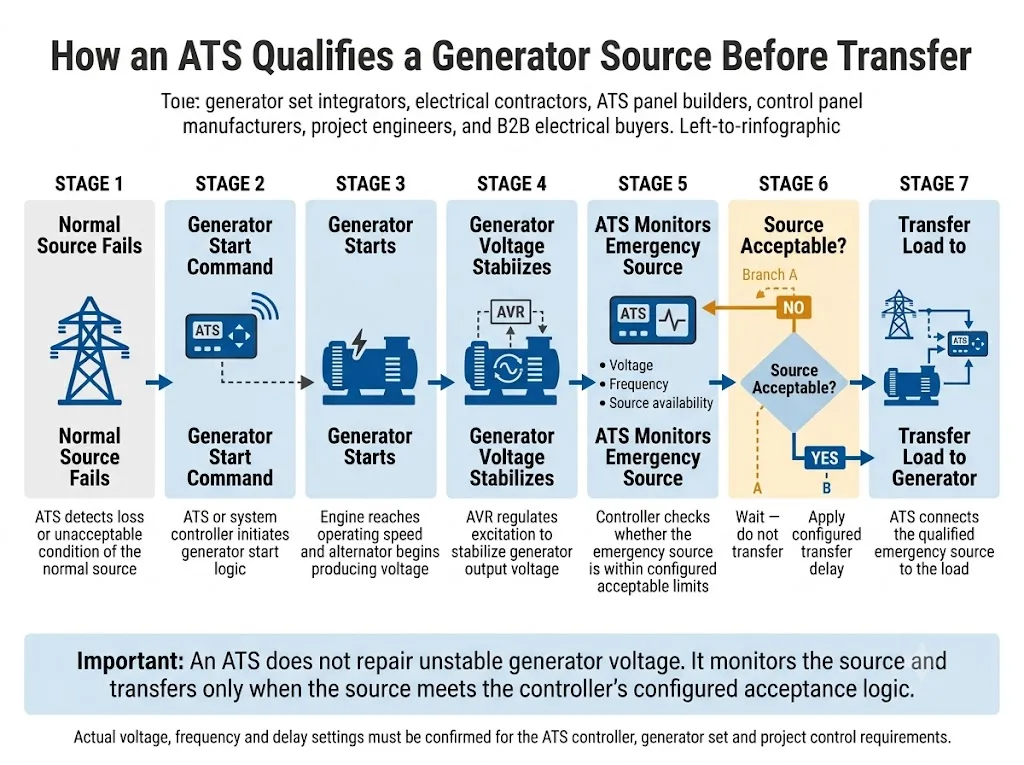
1. The Normal Source Becomes Unacceptable
The transfer controller monitors the normal source according to its available sensing functions and programmed settings. For example, some controllers can evaluate undervoltage, overvoltage, underfrequency, overfrequency and other source conditions. [2][4]
2. The ATS Requests Generator Start
In a utility-generator system, the ATS or wider control system can send a remote generator-start request. The genset controller then manages engine starting, generator monitoring, alarms and stop logic. For example, Deep Sea Electronics documents controllers that monitor mains and generator supplies and manage automatic generator start/stop and load-transfer control functions. [5]
3. Generator Voltage and Frequency Establish
After the engine starts, the alternator begins producing electrical power. The AVR controls excitation to regulate generator voltage. By contrast, generator frequency closely follows rotational speed and therefore depends on the engine governor and genset speed-control system. Cummins technical documentation separates engine speed/frequency control from alternator voltage control. [3][7]
Do not confuse voltage regulation with frequency regulation. An AVR primarily controls alternator voltage through excitation. Therefore, if generator frequency is unstable, review engine speed, governing behaviour, loading and the complete genset system instead of assuming the AVR alone caused the problem.
4. The ATS Qualifies the Emergency Source
The ATS should not transfer simply because voltage appears at the generator terminals. Instead, the controller applies its configured source-acceptance logic. Once the alternate source satisfies the required conditions for the specified period, the ATS can complete the transfer. [2][4]
5. The ATS Transfers the Load
After qualification and any programmed transfer delay, an open-transition ATS disconnects the load from one source before connecting it to the other. LEEYEE’s standard compact ATS offering primarily supports ordinary open-transition source transfer. Therefore, buyers should not treat it as a UPS or zero-break transfer system.
Why Should an ATS Wait for a Stable Generator Source?
The Generator Needs Time to Become Ready
A generator needs time to start and establish suitable electrical output. If the system connects the load too early, the project may experience an unsuccessful transfer, abnormal load operation, repeated control actions or generator loading before the source becomes ready.
The ATS Uses Source Acceptance Logic
Therefore, transfer systems use source sensing and configurable delays. Eaton ATS documentation describes controller functions that can include undervoltage, overvoltage, underfrequency, overfrequency and programmable transfer intervals. However, the actual values depend on the application and controller. [4]
Makna rekayasa: “generator voltage is unstable” does not provide enough information to select or reject an ATS.
Instead, confirm generator rated voltage, measured voltage behaviour, frequency, load condition, AVR/excitation configuration, engine/governor behaviour and the ATS controller’s allowable sensing settings. Then let the genset integrator or project engineer determine the final control sequence.
ATS, AVR, UPS and Genset Controller: Different Jobs in One System
Generator backup projects often combine several devices. Although they work together, they do not perform the same job. Therefore, a reliable design starts by assigning one clear responsibility to each device.
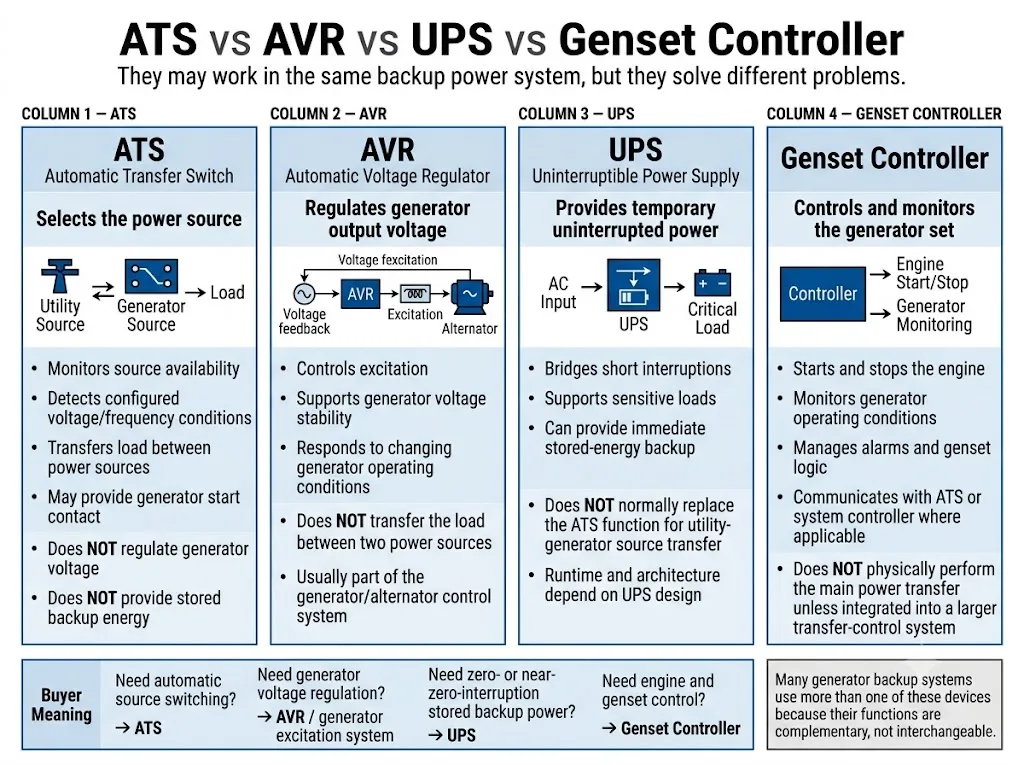
| Peralatan | Main responsibility | What it does not replace |
|---|---|---|
| ATS | Automatic source monitoring and load transfer | Generator AVR, UPS ride-through function or genset engine control |
| AVR | Alternator excitation and voltage regulation | Automatic transfer between utility and generator |
| UPS | Provides ride-through or uninterrupted power according to UPS topology | General ATS utility-generator transfer function or alternator AVR |
| Genset controller | Engine start/stop, generator monitoring, alarms and control logic | The physical ATS power-transfer mechanism unless integrated into a complete transfer system |
Where a UPS Fits
A UPS is especially different from a conventional open-transition ATS. Eaton describes UPS equipment as providing emergency or ride-through power when input power fails, with the exact behaviour depending on UPS topology. [6]
Therefore, if a load cannot tolerate the interruption associated with generator starting and open-transition transfer, the project may require a UPS or another continuity solution in addition to the ATS.
When Does a Generator System Need an AVR?
First Check the Generator Design
The correct question is usually not “Should I install an AVR after the ATS?” Instead, first determine how the generator alternator regulates its output voltage.
Generator alternators commonly incorporate an AVR as part of the excitation system. For example, STAMFORD documentation describes both self-excited and PMG-excited AVR arrangements and treats the AVR as part of alternator voltage control. [3]
Then Check the Actual Operating Problem
- If the alternator already includes the correct AVR: the project may not require a separately purchased external AVR. Therefore, confirm the generator and alternator documentation first.
- If generator voltage cannot remain within the required range: investigate the generator, alternator, excitation/AVR system and load response instead of expecting the ATS to fix the voltage.
- If large motor, transformer or difficult nonlinear loads are involved: confirm generator and alternator performance for the actual load characteristics. In addition, do not select the system from ATS rated current alone.
- If the problem is unstable frequency: investigate engine speed, governor/control behaviour and loading conditions as well as ATS source sensing. [7]
When Can You Buy an ATS Without Buying a Separate AVR?
When the Generator Already Includes Voltage Regulation
A project can require an ATS even when the buyer does not need to purchase a separate standalone AVR. For example, the generator set may already use an alternator with a manufacturer-designed AVR or another appropriate voltage-regulation arrangement.
How the Procurement Scope May Be Split
In that case, a typical procurement split may include:
- Generator set with engine, alternator, voltage regulation and genset control.
- ATS for utility-generator source monitoring and transfer.
- UPS only where the load needs additional ride-through or uninterrupted continuity.
- Distribution and protective devices selected for the complete electrical design.
However, this architecture is not universal. Some systems integrate several control functions into one panel, while others use separate ATS and generator controllers. Therefore, confirm the single-line diagram, generator interface and sequence of operation before ordering.
What Should You Check Before Selecting a Generator ATS?
Do Not Select by Current Alone
ATS selection should not be based only on generator kVA or one current value. Instead, the transfer switch must match the electrical system, switching arrangement, control interface and load requirements.
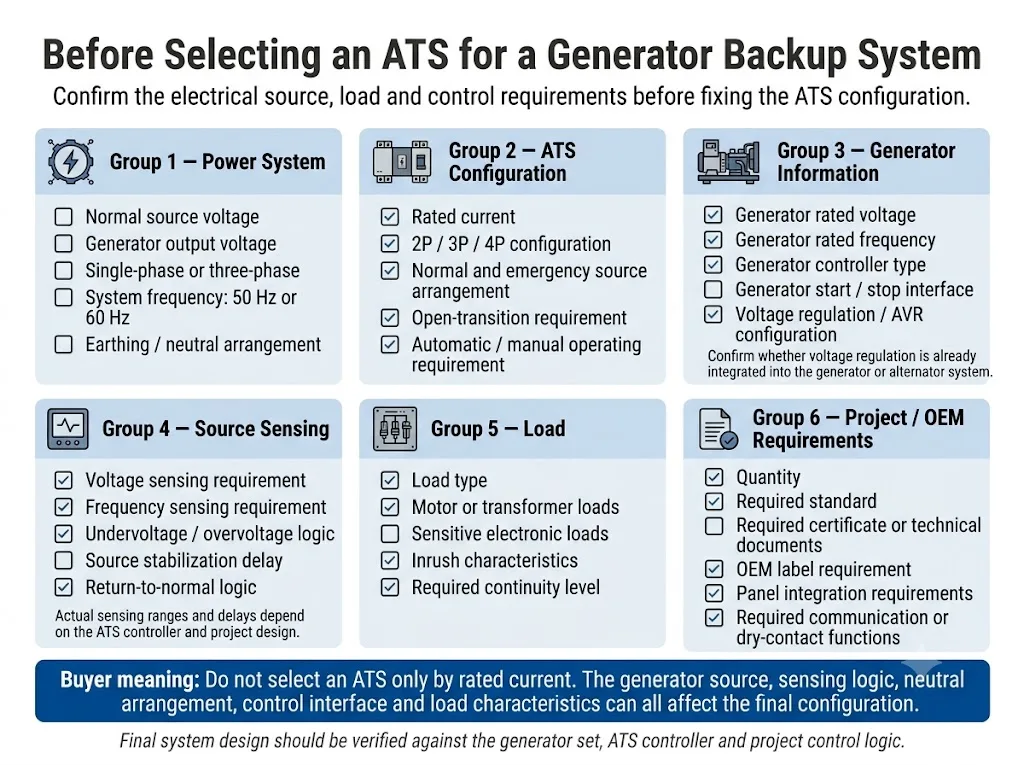
Generator ATS Project Confirmation Checklist
Before requesting a model recommendation, prepare these details:
Three Common ATS and AVR Specification Mistakes
Mistake 1: “The Generator Has AVR, So I Do Not Need ATS.”
An AVR does not transfer the load between utility and generator. Therefore, a generator may have correctly regulated output voltage and still require an ATS wherever the project needs automatic source changeover.
Mistake 2: “The ATS Will Stabilize Bad Generator Voltage.”
The ATS can monitor source conditions and delay or prevent transfer when the generator does not satisfy its configured acceptance logic. However, it does not regulate alternator excitation or repair unstable generator voltage. [2][3][4]
Mistake 3: “AVR Controls Generator Frequency Too.”
AVR and frequency control are different functions. The AVR regulates alternator voltage through excitation. By contrast, generator frequency is linked to rotational speed and therefore involves engine speed, governor behaviour and genset control performance. [7]
Where LEEYEE Fits Into a Generator Backup System
The LEEYEE Product in This Application
LEEYEE supplies the compact integrated automatic transfer switch itself for this type of application. The ATS switches the load between two power sources according to its controller logic. Therefore, it should not be confused with an AVR, UPS, complete generator controller or complete backup-power cabinet.
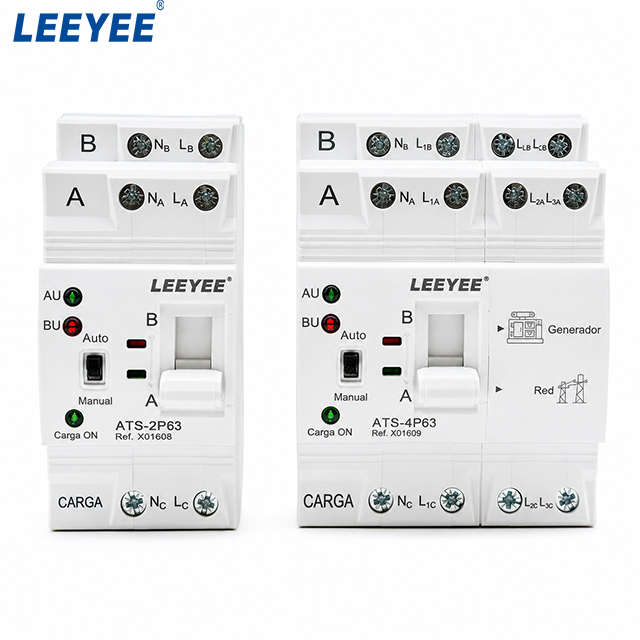
LEEYEE supplies compact integrated automatic transfer switches for low-voltage source-transfer applications, including utility-generator backup arrangements where the selected ATS configuration matches the project requirements.
Depending on the actual product specification and electrical system, project selection can involve single-phase or three-phase systems and 2P, 3P or 4P configurations. In addition, the standard LEEYEE ATS offering primarily focuses on ordinary transfer transisi terbuka.
LEEYEE does not present this ATS as an AVR, UPS, complete generator set, complete generator control cabinet, bypass-isolation ATS or complete backup-power system.
What Still Requires Project Confirmation
For a generator project, confirm the ATS together with generator characteristics and the required sequence of operation. In particular, verify the selected model’s sensing capability, controller settings, generator-start interface, pole configuration, rated current and communication functions against the applicable LEEYEE product documentation before project approval.
Batasan proyek: the diagrams in this guide explain system relationships. They are not project wiring drawings. Therefore, determine final wiring, protection, neutral treatment, source sensing, generator start/stop logic and commissioning values from the actual equipment documentation, applicable standards and approved project design.
Need to Confirm an ATS for Your Generator System?
Share the normal-source voltage, generator voltage, frequency, phase arrangement, rated current, pole requirement, load type and generator start interface. LEEYEE can then help confirm whether a compact ATS configuration fits your source-transfer requirement.
Pertanyaan yang Sering Diajukan
Is ATS the same as AVR on a generator?
No. An ATS transfers a load between available power sources. By contrast, a generator AVR regulates alternator output voltage through the excitation system. Therefore, the two devices solve different problems. [1][3]
Can an ATS work with a generator that already has an AVR?
Yes, provided the generator and ATS are electrically and functionally compatible with the project. The AVR regulates generator voltage, while the ATS manages source transfer. Therefore, confirm voltage, frequency, phase arrangement, start interface and controller settings before commissioning.
Does every generator backup system need a separate external AVR?
No. Many alternators already incorporate an AVR as part of the excitation system. Therefore, whether another regulator is required depends on the generator and alternator design. Check the genset documentation instead of assuming an additional external AVR is necessary. [3]
What happens if generator voltage is too low when the ATS wants to transfer?
If the ATS controller supports and uses voltage qualification, an unacceptable emergency-source voltage can prevent or delay transfer. However, the actual threshold and timing depend on the selected controller and project settings. The generator-side low-voltage condition still requires investigation. [2][4]
Can AVR fix unstable generator frequency?
Not as its primary function. The AVR regulates alternator voltage through excitation. By contrast, frequency follows generator rotational speed. Therefore, unstable frequency requires review of engine speed, governor/control behaviour, load conditions and the complete genset configuration. [7]
Can an ATS replace a UPS?
Not when the load requires stored-energy ride-through or uninterrupted power during generator starting and open-transition transfer. The ATS changes the load between sources. A UPS, by contrast, can support the load during an input interruption according to its topology and energy-storage design. [6]
Does the ATS controller start the generator?
In many utility-generator systems, the ATS or associated transfer controller can issue a generator-start request. The genset controller then manages engine and generator control functions. However, the exact interface depends on the selected ATS and genset controller. [2][5]
What information should I provide when ordering a generator ATS?
Provide normal-source voltage, generator voltage, frequency, phase arrangement, rated current, pole configuration, neutral arrangement, generator-start interface and load type. In addition, specify required sensing, delay, dry-contact, communication, standards and OEM requirements where applicable.
Referensi
- [1] Komisi Elektroteknika Internasional (IEC). IEC 60947-6-1:2026, Low-voltage switchgear and controlgear – Part 6-1: Multiple function equipment – Transfer switching equipment. Halaman publikasi resmi IEC.
- [2] Eaton. Fundamentals of Automatic Transfer Switches (ATS). Sumber daya teknis Eaton.
- [3] STAMFORD | AvK, Cummins Generator Technologies. Automatic Voltage Regulator Technical Documentation. Official AVR manuals.
- [4] Eaton. Automatic Transfer Switch, Type ATS-PWR. Eaton ATS technical document.
- [5] Deep Sea Electronics. DSE7320 MKII Auto Mains (Utility) Failure Control Module. Deep Sea Electronics documentation.
- [6] Eaton. Uninterruptible Power Supply (UPS) FAQs. Eaton UPS technical resource.
- [7] Cummins Power Generation. Gas Power Plant Application Manual. Buku Panduan Teknis Cummins.
Standards, product capabilities and controller settings can vary by edition, model and market. Therefore, confirm current equipment datasheets, approved project documents and applicable local requirements before final design or commissioning.
