
Bandingkan perangkat pelindung lonjakan Tipe 1, Tipe 2, dan Tipe 3 berdasarkan posisi instalasi, gelombang uji, rating arus, dan peran perlindungan.
Daftar Isi
Temukan Informasi yang Anda Butuhkan
Perbandingan Cepat SPD Tipe 1, Tipe 2, dan Tipe 3
Cara termudah untuk memahami tiga jenis SPD adalah menghubungkan setiap jenis dengan posisi normalnya dalam instalasi listrik.
| Tipe SPD | Posisi khas | Peran perlindungan utama | Tugas pengujian utama | Penilaian kunci umum |
|---|---|---|---|---|
| Tipe 1 | Asal atau papan masuk utama | Mengalirkan arus petir parsial energi tinggi | Arus lonjakan 10/350 μs | Iimp |
| Tipe 2 | Papan distribusi utama atau sub | Membatasi lonjakan petir dan lonjakan switching | Arus pelepasan 8/20 μs | Dalam dan Imax |
| Tipe 3 | Dekat dengan peralatan terminal yang sensitif | Membatasi sisa tegangan lebih yang tersisa | Uji gelombang kombinasi | Uoc dan Up |
Apa Itu Perangkat Pelindung Lonjakan Tipe 1?
SPD Tipe 1 dirancang untuk pemasangan di mana arus petir parsial mungkin memasuki sistem listrik tegangan rendah.
Ini umumnya dianggap pada titik awal instalasi, terutama di mana bangunan memiliki sistem perlindungan petir eksternal atau di mana pengaturan suplai masuk menciptakan paparan arus petir yang signifikan.
Apa yang dilakukan SPD Tipe 1?
SPD Tipe 1 mengalihkan arus impuls energi tinggi ke sistem pengikatan dan pembumian yang setara. Peran utamanya adalah untuk mencegah arus petir mengalir tidak terkontrol melalui instalasi listrik internal.
Gelombang uji Tipe 1
SPD Tipe 1 diuji menggunakan 10/350 μs impuls arus..Peringkat utama yang terkait dengan uji ini adalah Iimp, atau arus pelepasan impuls.
Iimp tidak boleh dibandingkan langsung dengan nilai Imax SPD Tipe 2 karena kedua peringkat menggunakan bentuk gelombang yang berbeda dan mewakili tugas uji yang berbeda.
Di mana SPD Tipe 1 dipasang?
- Pintu masuk layanan;
- Papan distribusi tegangan rendah utama;
- Titik asal instalasi listrik;
- Transisi zona perlindungan petir di mana arus petir parsial diharapkan.
Kapan Tipe 1 harus dipertimbangkan?
- Bangunan memiliki sistem perlindungan petir eksternal;
- Pengaturan pasokan masuk terbuka terhadap masuknya arus petir;
- Penilaian risiko proyek mengidentifikasi arus petir parsial;
- Aturan instalasi nasional menentukan perlindungan Tipe 1;
- Instalasi ini adalah infrastruktur kritis dengan konsep perlindungan petir yang terdefinisi.
Apa Itu Perangkat Pelindung Lonjakan Tipe 2?
SPD Tipe 2 adalah perangkat pelindung lonjakan tingkat distribusi yang paling umum dalam instalasi listrik tegangan rendah.
Ini membatasi lonjakan tegangan transien yang disebabkan oleh efek petir tidak langsung, operasi switching dan energi lonjakan residual dari tahap perlindungan hulu.
Sumber lonjakan apa yang ditangani Tipe 2?
- Efek petir tidak langsung;
- Operasi switching;
- Motor dan transformer;
- Gangguan jaringan utilitas;
- Energi lonjakan residual setelah SPD hulu.
Gelombang uji Tipe 2
SPD Tipe 2 diuji menggunakan gelombang arus 8/20 μs..Peringkat penting termasuk In, Imax, Naik dan Uc.
Di mana SPD Tipe 2 dipasang?
- Papan distribusi utama;
- Papan sub-distribusi;
- Kabinet kontrol mesin;
- Panel industri;
- Panel listrik komersial;
- Panel distribusi AC inverter surya.
Kapan Tipe 2 dapat dianggap cukup?
SPD Tipe 2 mungkin cukup pada sumber beberapa instalasi di mana sistem tidak diharapkan mengalirkan arus petir sebagian.
Ini mungkin termasuk instalasi tertentu dengan:
- Sumber masuk bawah tanah;
- Tidak ada sistem perlindungan petir eksternal;
- Pajanan arus petir yang dinilai lebih rendah;
- Tidak ada persyaratan beban Tipe 1 di sisi hulu.
Apa Itu Perangkat Pelindung Lonjakan Tipe 3?
SPD Tipe 3 menyediakan proteksi titik penggunaan (point-of-use) untuk peralatan terminal sensitif. SPD ini membatasi sisa tegangan lonjakan yang tersisa setelah proteksi hulu atau yang berkembang di sepanjang konduktor hilir.
Di mana Tipe 3 dipasang?
Tipe 3 dipasang di dekat peralatan yang dilindungi, termasuk:
- PLC;
- Server;
- Sistem kontrol;
- Peralatan komunikasi;
- Peralatan medis;
- Catu daya sensitif;
- Peralatan rumah tangga elektronik.
Proteksi Tipe 3 dapat dibangun ke dalam soket stopkontak, kabel daya, modul proteksi peralatan, perangkat panel kontrol, atau unit proteksi terminal.
Metode pengujian Tipe 3
Perangkat Tipe 3 umumnya dievaluasi dengan generator gelombang kombinasi yang menghasilkan bentuk gelombang tegangan sirkuit terbuka 1.2/50 μs dan bentuk gelombang arus hubung singkat 8/20 μs. Peringkat yang relevan dapat mencakup Uoc dan Naik.
Dapatkah Tipe 3 digunakan sendiri?
Tipe 3 biasanya tidak diharapkan untuk membuang energi surja tinggi yang ada pada titik masuk layanan atau tingkat distribusi utama.
Perbandingan Teknikal: Tipe 1 vs Tipe 2 vs Tipe 3
| Item perbandingan | Tipe 1 SPD | Tipe 2 SPD | Tipe 3 SPD |
|---|---|---|---|
| Peran utama | Pembuangan arus petir | Pembatasan surja tingkat distribusi | Perlindungan peralatan akhir |
| Posisi khas | Asal atau papan masuk utama | Papan distribusi utama atau sub | Dekat dengan peralatan terminal |
| Kelas uji | Kelas I | Kelas II | Kelas III |
| Bentuk gelombang utama | 10/350 μs | 8/20 μs | Gelombang kombinasi |
| Peringkat penting | Iimp | Dalam dan Imax | Uoc |
| Evaluasi juga | Uc, Up, dan perilaku gangguan | Uc, Up, dan peringkat hubung singkat | Up dan kompatibilitas beban |
| Lingkungan surja tipikal | Arus petir parsial | Petir induksi dan transien pensaklaran | Tegangan surja sisa |
| Dapatkah ini melindungi seluruh instalasi sendirian? | Belum tentu | Belum tentu | Tidak |
| Teknologi umum | Spark gap, MOV, atau teknologi gabungan | Teknologi berbasis MOV atau gabungan | Perlindungan berbasis MOV ringkas, GDT, atau filter |
10/350 μs vs 8/20 μs: Mengapa Gelombang Uji Penting
Nilai arus yang ditampilkan dalam kiloampere hanya bermakna jika bentuk gelombang dan definisi peringkat yang terkait juga diketahui.
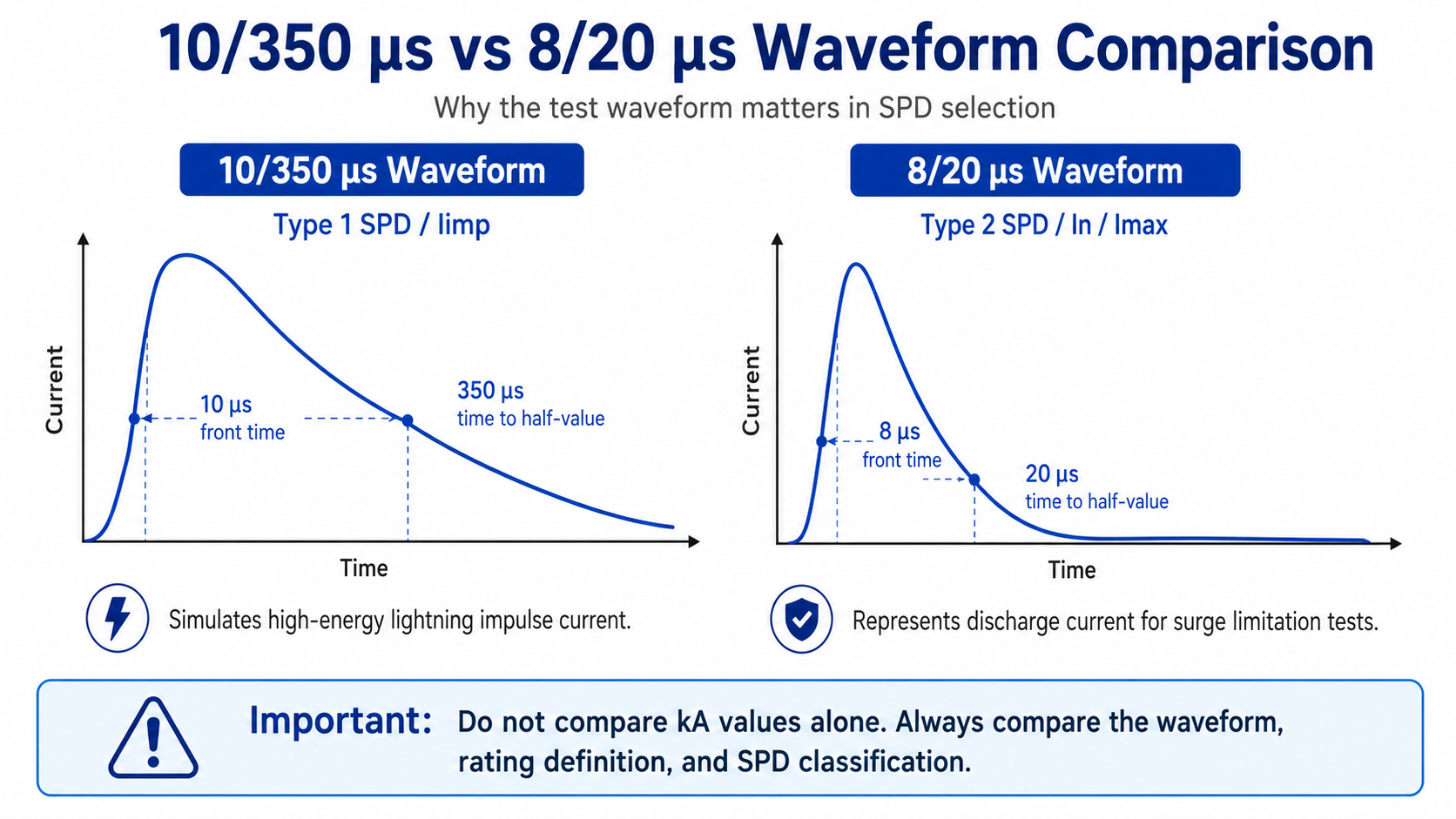
Iimp vs In vs Imax vs Uoc
Nilai-nilai ini mendeskripsikan pengujian yang berbeda dan tidak boleh dianggap sebagai versi yang dapat dipertukarkan dari peringkat arus yang sama.
Nilai penting lainnya termasuk Uc, Up, peringkat arus hubung singkat, dan persyaratan perlindungan cadangan.
Bagaimana Tipe 1, Tipe 2, dan Tipe 3 SPD Bekerja Bersama
Perlindungan surja yang efektif didasarkan pada tahapan perlindungan yang terkoordinasi, bukan sekadar memasang SPD dengan peringkat arus terbesar.
Konsep tipikal dapat menggunakan:
- Tipe 1 di titik asal untuk membuang arus petir parsial;
- Tipe 2 di papan distribusi hilir untuk membatasi tegangan lebih yang tersisa;
- Tipe 3 di dekat peralatan sensitif untuk mengurangi tegangan surja sisa akhir.
Ini tidak berarti setiap bangunan harus menggunakan tiga SPD terpisah. Alternatif yang memungkinkan termasuk SPD gabungan Tipe 1+2, SPD gabungan Tipe 2+3, atau perlindungan Tipe 2 di titik asal di mana tugas Tipe 1 tidak diperlukan.
Tidak ada aturan jarak kabel tunggal yang harus diterapkan pada setiap kombinasi SPD. Koordinasi yang diperlukan bergantung pada teknologi SPD, koordinasi yang diuji oleh produsen, susunan konduktor, tingkat perlindungan, dan peralatan yang dilindungi.
Apa Itu SPD Gabungan Tipe 1+2?
SPD Tipe 1+2 diuji untuk tugas Tipe 1/Kelas I dan Tipe 2/Kelas II. Ini menggabungkan pembuangan arus impuls petir dan pembatasan tegangan surja tingkat distribusi.
SPD Tipe 1+2 mungkin berguna di mana:
- Kedua tugas perlindungan diperlukan di satu titik instalasi;
- Ruang papan utama terbatas;
- Koordinasi SPD terpisah akan sulit dilakukan;
- Solusi terkoordinasi secara internal yang ringkas lebih diutamakan.
Untuk panduan pemilihan Tipe 1+2 yang lengkap, lihat panduan SPD Tipe 1+2.
Tipe SPD Apa yang Anda Butuhkan?
Tabel berikut memberikan arah awal. Pemilihan akhir harus tetap mengikuti desain sistem yang sebenarnya dan persyaratan yang berlaku.
| Situasi proyek | Arah pemilihan awal |
|---|---|
| Bangunan memiliki sistem proteksi petir eksternal | Pertimbangkan Tipe 1 atau Tipe 1+2 |
| Arus petir sebagian dapat masuk ke dalam instalasi | Tugas Tipe 1 diperlukan |
| Perlindungan panel utama umum tanpa tugas Tipe 1 | Tipe 2 |
| Sub-distribusi atau panel kontrol mesin | Tipe 2 |
| Peralatan terminal sensitif | Tipe 3 di dekat peralatan |
| Tugas Tipe 1 dan Tipe 2 diperlukan dalam satu papan utama | Tipe 1+2 |
| Peralatan jauh dari SPD utama | Pertimbangkan Tipe 2 atau Tipe 3 tambahan |
| Perlindungan lonjakan arus diperlukan pada sirkuit DC PV surya | Gunakan SPD DC khusus PV |
Cara Memilih Tipe SPD yang Benar
- Identifikasi posisi pemasangan. Apakah SPD dipasang di titik awal, papan distribusi, panel mesin, atau peralatan terminal?
- Nilai paparan petir. Periksa sistem proteksi petir eksternal, pasokan masuk, dan zona proteksi petir.
- Konfirmasikan aplikasi AC atau DC. Jangan gunakan SPD AC biasa pada sisi DC sistem fotovoltaik.
- Konfirmasi sistem penyaluran. Identifikasi TN-S, TN-C, TT, IT, atau pengaturan pentanahan DC yang relevan.
- Periksa set peringkat lengkap. Tinjau Uc, Up, Iimp, In, Imax, Uoc, peringkat hubung singkat, dan perlindungan cadangan.
- Verifikasi koordinasi. Periksa hubungan antara perlindungan hulu, SPD hilir, dan peralatan yang dilindungi.
Kesalahan Umum dalam Pemilihan SPD
- Memilih hanya berdasarkan nilai kA terbesar. Angka arus yang lebih besar tidak mengoreksi bentuk gelombang, peringkat tegangan, atau konfigurasi sirkuit yang salah.
- Membandingkan Iimp secara langsung dengan Imax. Nilai-nilai ini mewakili tugas uji yang berbeda dan bentuk gelombang yang berbeda.
- Menggunakan Tipe 3 sebagai SPD bangunan utama. Tipe 3 ditujukan untuk perlindungan peralatan akhir, bukan arus lonjakan masuk berenergi tinggi.
- Mengasumsikan Tipe 1 melindungi setiap beban. Tegangan sisa dan efek konduktor hilir mungkin masih memerlukan perlindungan tambahan.
- Menggunakan aturan 10 meter tetap. Koordinasi harus mengikuti teknologi SPD yang dipilih dan dokumentasi produsen.
- Mengabaikan Uc dan Up. Kapasitas arus saja tidak menentukan kompatibilitas tegangan atau perlindungan peralatan.
- Menggunakan SPD AC pada DC PV. Sirkuit DC fotovoltaik memerlukan tegangan spesifik aplikasi dan karakteristik pemutusan.
- Mengabaikan koordinasi hubung singkat. SPD, sekering cadangan, dan arus hubung singkat prospektif harus kompatibel.
Tipe SPD IEC dan UL Tidak Sama Definisinya
Sistem IEC dan UL keduanya menggunakan terminologi Tipe 1, Tipe 2, dan Tipe 3, tetapi klasifikasi tersebut tidak boleh dianggap sepenuhnya dapat dipertukarkan.
Di bawah kerangka kerja IEC, tipe-tipe tersebut berkaitan erat dengan kelas uji, bentuk gelombang, dan tugas perlindungan. Di bawah UL 1449, tipe SPD sangat terkait dengan lokasi koneksi yang diizinkan dan pemasangan relatif terhadap peralatan servis serta perlindungan arus berlebih.
Untuk proyek di Amerika Utara, konfirmasikan:
- Pencatatan UL;
- Tipe SPD;
- Arus pelepasan nominal;
- Peringkat perlindungan tegangan;
- Peringkat arus hubung singkat;
- Lokasi sambungan yang diizinkan.
FAQ SPD Tipe 1 vs Tipe 2 vs Tipe 3
Apa perbedaan utama antara SPD Type 1, Type 2, dan Type 3?
Tipe 1 mengelola tugas arus petir di titik asal, Tipe 2 memberikan perlindungan lonjakan pada tingkat distribusi, dan Tipe 3 membatasi tegangan lonjakan residual yang mendekati peralatan sensitif.
Apakah Tipe 1 lebih baik daripada Tipe 2?
Tidak. Mereka menjalankan peran yang berbeda. Tipe 1 menangani tugas arus petir, sementara Tipe 2 membatasi overvoltage transien dalam sistem distribusi listrik.
Apakah Tipe 2 dapat dipasang di panel distribusi utama?
Ya. Tipe 2 umumnya dipasang di papan distribusi utama dan sub di mana tugas arus petir Tipe 1 tidak diperlukan atau di mana tahap Tipe 1 hulu sudah ada.
Apakah setiap instalasi memerlukan SPD Tipe 1?
Tidak. Kebutuhan untuk Tipe 1 tergantung pada paparan arus petir, perlindungan petir eksternal, susunan pasokan yang masuk, dan persyaratan proyek yang berlaku.
Bisakah SPD Tipe 3 digunakan tanpa Tipe 1 atau Tipe 2?
Tipe 3 seharusnya tidak bergantung sebagai satu-satunya perlindungan di mana lonjakan energi tinggi dapat masuk ke instalasi. Ini terutama dimaksudkan sebagai perlindungan terminal yang terkoordinasi.
Apakah Tipe 1+2 sama dengan Tipe 1 dan Tipe 2?
SPD Tipe 1+2 diuji untuk kedua tugas Tipe 1 dan Tipe 2 dalam satu produk. Perangkat Tipe 1 dan Tipe 2 yang terpisah dapat memberikan tahap yang sama, tetapi koordinasi mereka harus diverifikasi.
Apa perbedaan antara Iimp dan Imax?
Iimp dikaitkan dengan uji arus impuls Tipe 1 10/350 μs. Imax dikaitkan dengan uji arus pelepasan maksimum Tipe 2 8/20 μs.
Dapatkah LEEYEE membantu memilih jenis SPD yang benar?
Ya. Berikan tegangan sistem, aplikasi AC atau DC, pengaturan pembumian, posisi pemasangan, jumlah kutub, peringkat yang diperlukan, dan jumlah proyek.
Panduan Perlindungan Lonjakan Terkait
Butuh Bantuan Memilih Tipe SPD yang Tepat?
Kirimkan aplikasi AC atau DC, tegangan sistem, pengaturan pembumian, posisi pemasangan, kutub yang diperlukan, peringkat arus, dan jumlah proyek. LEEYEE akan membantu mengidentifikasi konfigurasi perlindungan lonjakan arus yang sesuai.