
A telecom base station can contain utility power, a standby generator, AC distribution, rectifiers, batteries and a -48 V DC power system. The key ATS selection question is therefore not simply whether a telecom site needs an automatic transfer switch. The first question is where the source transfer occurs and whether that switching point is AC or DC.
This guide explains where a compact AC automatic transfer switch can fit in a telecom base station, how utility-to-generator transfer relates to the -48 V DC power system, and what telecom contractors, cabinet manufacturers, generator integrators and project buyers should confirm before ordering.
Daftar Isi
Quick Answer: Where Does an ATS Fit in a Telecom Base Station?
In a conventional grid-and-generator telecom power architecture, an AC automatic transfer switch can be installed on the AC supply side to transfer the downstream AC load between the utility source and the standby generator. The rectifier then converts AC power into the DC supply required by telecom equipment. [1] [2]
Telecom ICT equipment commonly uses a nominal -48 V DC interface. ETSI EN 300 132-2 addresses the -48 V DC power interface between a power supply system and ICT equipment, including systems supplied through AC rectifiers and battery backup. [1]
A standard AC ATS should therefore not automatically be treated as a switch for the -48 V DC bus. If the required switching point is on the DC side, the DC voltage, current, polarity, protection and switching duty must be confirmed separately.
Key Points for Telecom ATS Selection
- First identify whether the required transfer point is AC or DC.
- Utility-to-generator source transfer is a typical AC ATS application.
- The -48 V telecom DC interface is a different part of the power architecture.
- ATS contact transfer time is not the same as total generator recovery time.
- 2P or 4P selection depends on the actual phase, neutral and grounding arrangement.
- The LEEYEE ATS-63 is available in compact 2P and 4P configurations for compatible AC source-transfer applications.
- Generator-start outputs and communication functions must be confirmed separately for the selected controller and model.
How Is an Automatic Transfer Switch Connected in a Telecom Base Station?
For procurement purposes, it is useful to separate the telecom power system into two layers: the AC source-transfer layer dan DC telecom power layer.
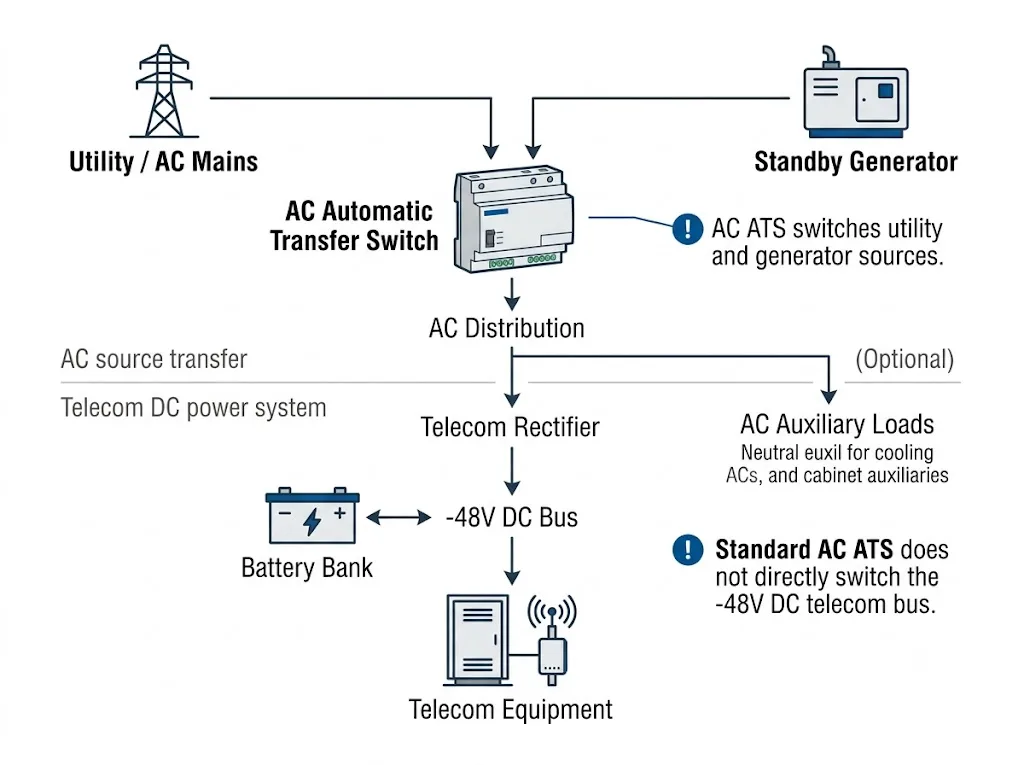
ETSI EN 300 132-2 defines requirements for the -48 V DC interface used by ICT equipment and describes DC power systems that can be based on AC rectifiers with battery backup. [1]
AC ATS vs -48 V DC Telecom Power: What Is the Difference?
A telecom base station can use an automatic transfer switch and a -48 V battery-backed DC power system at the same site. They solve different power-supply problems and should not be treated as the same function.
| System Position | Fungsi Utama | Standard AC ATS? | Buyer Check |
|---|---|---|---|
| Utility / generator input | Select between two AC sources | Aplikasi tipikal | Voltage, current, poles and transfer logic |
| AC distribution | Feeds rectifiers and permitted AC loads | May be downstream of ATS | Load current and protection coordination |
| Rectifier system | Converts AC to telecom DC | Tidak | Rectifier and DC-system design |
| Battery system | Supports the DC power system | Tidak | Battery voltage, autonomy and protection |
| -48 V DC interface | Supplies compatible ICT loads | Not automatically | Use equipment specifically suitable for DC duty |
Telecom power architectures vary by operator, rectifier design, battery system, site load and generator strategy. The project single-line diagram remains the controlling reference.
Important Application Boundary
Do not select an AC ATS merely because it is installed inside the same cabinet as -48 V DC telecom equipment.
If the project specification refers to “48 V DC transfer,” “battery switching” or “DC bus transfer,” the required DC switching equipment must be confirmed separately. A standard AC ATS is not a universal DC transfer solution.
How Does Utility-to-Generator Transfer Work at a Telecom Site?
A telecom ATS connected to a standby generator operates as part of a sequence. The ATS cannot supply generator power before the generator has started and reached acceptable electrical conditions.
- Kondisi normal: the utility or preferred source supplies the downstream AC load.
- Source failure: the controller detects that the normal source is unacceptable.
- Generator start request: where the controller and system design provide this function, the generator receives a start signal.
- Generator starting: the generator starts and builds voltage and frequency.
- Source acceptance: the control system confirms that the alternate source is suitable for transfer.
- Load transfer: the ATS transfers the AC load to the emergency source.
- Utility recovery: the controller detects restoration of the preferred source.
- Retransfer: after the configured return conditions are satisfied, the load returns to the normal source.
Cummins transfer-switch application guidance describes this general operating sequence: normal-source failure is detected, a generator start signal can be initiated, the system waits until the generator is ready for load, and transfer then occurs according to the configured control logic. [3]
How Does the LEEYEE Compact ATS Match This Application?
The LEEYEE ATS-63 shown below is a compact integrated automatic transfer switch available in 2P and 4P configurations. This makes it relevant to compatible telecom AC-input applications where two AC sources must be transferred within the electrical ratings of the selected model.
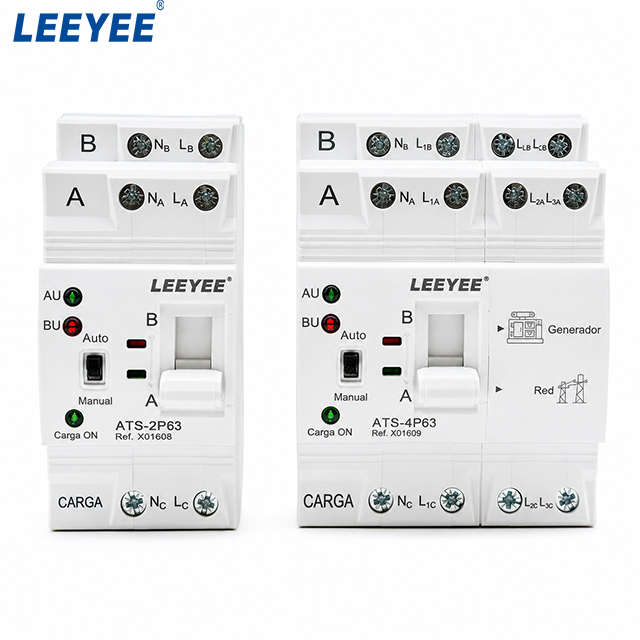
What This Product Image Confirms
- Compact integrated ATS construction
- 2P and 4P product configurations
- LEEYEE ATS-63 product family
- Compact form suitable for integration into compatible low-voltage cabinets
Functions That Must Be Confirmed Separately
The product image alone does not confirm generator-start dry contacts, remote status outputs, RS485, Modbus, communication interfaces or other controller functions. These requirements must be checked against the exact selected model and technical documentation before they are specified for a telecom project.
Current LEEYEE product information for the ATS-63 range lists 2P and 4P configurations, rated-current options from 6 A to 63 A, AC110 V / AC220 V / AC400 V options, 50/60 Hz operation, PC-class construction and DIN-rail installation. [6]
This product can therefore be considered for some compact telecom AC-input cabinets and utility/generator backup applications where the actual electrical requirements remain within the selected model's ratings.
It should not be presented as a complete telecom power solution, a -48 V DC transfer switch, a rack ATS PDU or a large bypass-isolation ATS system.
Refer to the Halaman produk LEEYEE ATS-63 for model-specific technical data and confirm the final configuration before ordering. [6]
Should a Telecom Base Station Use a 2P or 4P ATS?
Pole selection should follow the actual electrical system. The words “telecom base station” do not by themselves determine whether 2P or 4P is correct.
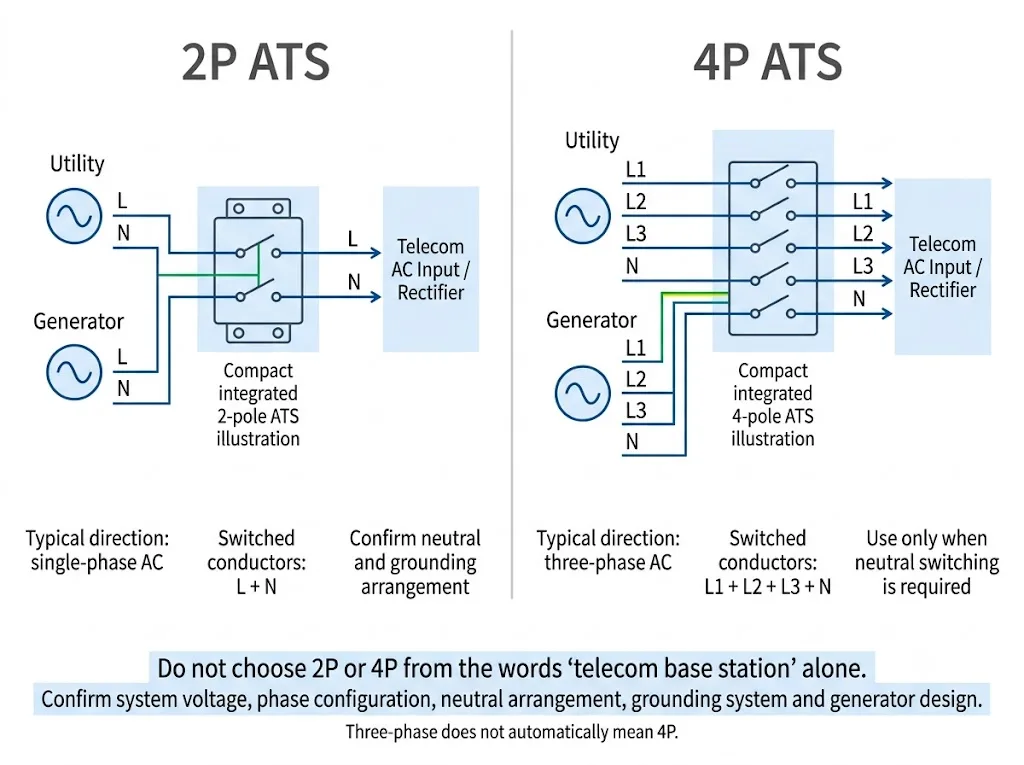
| Konfigurasi | Arah Bersama | Apa yang Harus Dikonfirmasi |
|---|---|---|
| 2P | Single-phase systems where line and neutral are switched | Voltage, neutral treatment, grounding and project wiring |
| 4P | Three-phase systems where L1, L2, L3 and neutral are switched | Whether switched neutral is required by the actual source and grounding arrangement |
Schneider Electric / ASCO technical guidance distinguishes solid-neutral and switched-neutral transfer-switch arrangements and explains that the choice is related to the electrical distribution and alternative-source grounding arrangement. [4]
How Should ATS Current Be Selected for a Telecom Base Station?
Select the ATS from the AC load that actually passes through the switch, not simply from the words “base station” and not from generator kVA alone.
Depending on the site design, the transferred AC load can include the rectifier input and other approved AC auxiliary circuits. The designer should confirm which circuits are actually downstream of the ATS.
Before fixing the current rating, confirm:
- Maximum continuous AC load current
- Rectifier input demand
- Other AC auxiliary loads transferred through the same switch
- Starting or inrush characteristics where applicable
- Upstream and downstream protective devices
- Available short-circuit conditions at the installation point
- Project-specific design margin
Does a Telecom ATS Automatically Start the Generator?
Not necessarily. Generator-backed systems often require a start request after normal-source failure, but the availability and electrical characteristics of that signal depend on the selected ATS controller and project design.
Cummins transfer-switch documentation describes ATS sequences that can include generator-start signalling before the alternate source becomes ready for load. [3]
For a LEEYEE telecom application, confirm the exact selected model and controller before specifying any of the following:
- Generator-start dry contact
- Contact electrical rating
- Source-failure delay
- Generator source-acceptance delay
- Retransfer timing
- Generator cooldown or stop coordination
What Remote Status Should an Unmanned Telecom Site Consider?
Remote visibility can be useful for unmanned telecom sites. However, the required signals and communication interface depend on the selected ATS controller and the project's monitoring architecture.
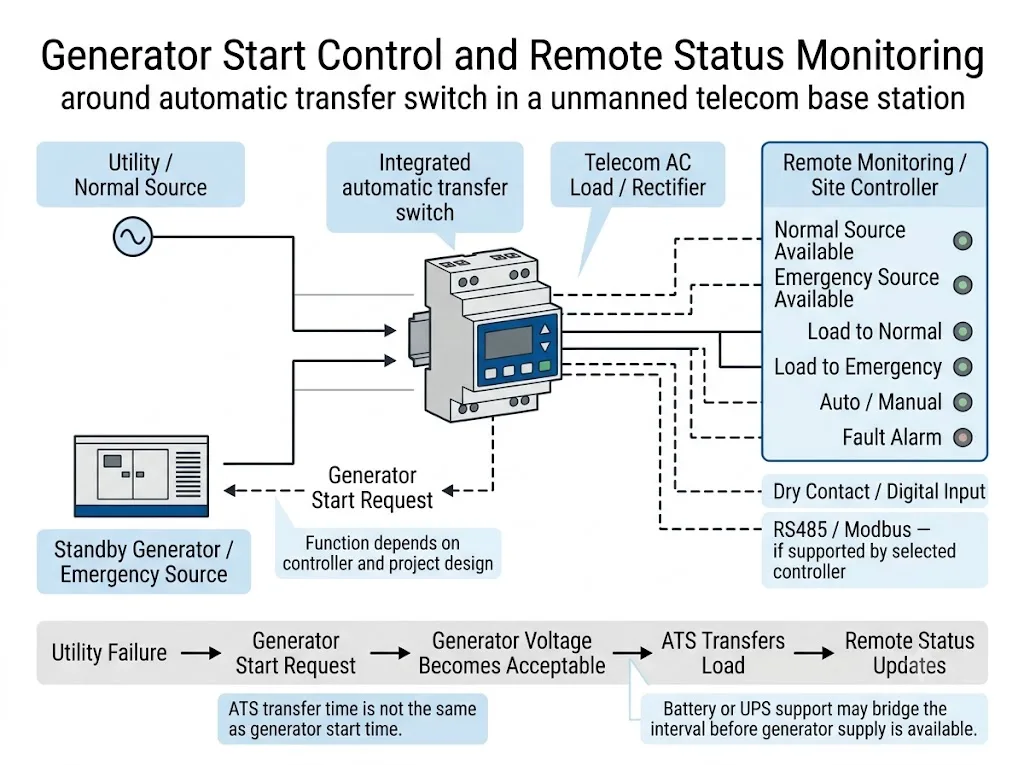
Possible project monitoring points may include:
- Normal Source Available
- Emergency Source Available
- Load to Normal
- Load to Emergency
- Auto / Manual
- Fault Alarm
Remote Communication Must Be Verified by Model
Dry contacts, RS485, Modbus, BMS integration and remote alarm functions cannot be confirmed from the product image alone. They must be verified from the exact selected model, controller configuration and technical documentation.
What Changes in an Outdoor Telecom Cabinet?
ETSI's -48 V ICT power-interface scope includes telecom equipment installed in buildings, shelters, street cabinets and outdoor locations. [1] This does not mean every internal component is independently suitable for direct outdoor exposure.
For an ATS installed inside an outdoor telecom enclosure, confirm:
- Ambient operating temperature
- Humidity and condensation conditions
- Dust and contamination
- Coastal or corrosive atmosphere where relevant
- Solar heating of the cabinet
- Available DIN-rail and cable-routing space
- Terminal access for installation and service
- Cabinet ventilation or thermal management
- Ingress-protection requirement of the complete enclosure
Standar mana yang harus diperiksa?
The current IEC publication for transfer switching equipment is IEC 60947-6-1:2026, Low-voltage switchgear and controlgear – Part 6-1: Multiple function equipment – Transfer switching equipment. [5]
IEC states that this edition applies to transfer switching equipment used to transfer a load between power sources and covers manually operated, remotely operated and automatic transfer switching equipment. [5]
Common Telecom ATS Selection Mistakes
1. Treating the -48 V DC System as an Ordinary AC ATS Load
The AC source-transfer function and the -48 V ICT power interface are different parts of the power system.
2. Assuming Every Telecom ATS Has Remote Communication
Do not assume that RS485, Modbus, remote alarm outputs or dry-contact feedback are included unless the exact model documentation confirms them.
3. Assuming a Generator Application Means Generator-Start Output Is Included
An ATS can be used between utility and generator sources while generator-start control remains a separate controller or project function.
4. Selecting 4P Only Because the Site Is Three-Phase
Neutral switching depends on the actual source and grounding arrangement. [4]
5. Comparing Only Switching Speed
Generator starting, source stabilization and programmed delays occur before generator power is available to the ATS. [3]
6. Treating a Compact ATS as a Complete Telecom Power Solution
The ATS handles AC source transfer. The rectifier, battery system, DC distribution and telecom monitoring architecture remain separate parts of the project.
Before Ordering an ATS for a Telecom Base Station
- AC or DC switching point
- Utility and generator arrangement
- Satu fase atau tiga fase
- Tegangan sistem yang terukur
- Maximum AC load current
- 2P or 4P requirement
- Neutral switching requirement
- Pengaturan pembumian
- Generator-start signal requirement
- Required status feedback
- RS485 / Modbus requirement, if any
- Ruang rel DIN dan pengkabelan
- Indoor or outdoor cabinet location
- Ambient environmental conditions
- Required standard or certification documents
- Jumlah pesanan
- OEM or private-label requirements
Need to Confirm a Telecom ATS Configuration?
Send the AC voltage, maximum load current, phase type, utility/generator arrangement, required poles, neutral arrangement and any generator-start or remote-monitoring requirements. LEEYEE can review whether the compact 2P or 4P ATS configuration matches the stated project conditions before quotation.
Pertanyaan yang Sering Diajukan
Is the LEEYEE ATS-63 suitable for a telecom base station?
It can be considered for compatible AC utility / generator source-transfer applications where the project matches the selected model's voltage, current, pole configuration and installation requirements. It is not a -48 V DC telecom transfer switch.
Can the LEEYEE ATS-63 be used between utility and generator sources?
It can be considered for compatible dual-AC-source applications when the system voltage, current, pole arrangement and transfer requirements fall within the selected model's documented ratings. Generator-control functions must be confirmed separately.
Does the ATS support Modbus or RS485?
This cannot be confirmed from the product image alone. Communication interfaces, remote contacts and monitoring functions must be verified from the selected model and controller documentation.
Can this ATS switch the -48 V telecom battery bus?
Do not assume so. This article treats the LEEYEE ATS-63 as an AC source-transfer device. DC-side switching requires equipment specifically rated and designed for the actual DC application.
Should I choose 2P or 4P?
Both 2P and 4P configurations are shown in the LEEYEE ATS-63 range. Final selection depends on system phase arrangement, neutral switching requirements, grounding design and generator configuration.
What should I send for a telecom ATS quotation?
Provide the AC/DC switching point, voltage, phase type, maximum current, utility/generator arrangement, required poles, neutral and grounding information, generator-control needs, remote-monitoring needs, cabinet environment and OEM requirements.
Kesimpulan
The LEEYEE ATS-63 is relevant to the article's intended application: compact AC utility / generator source transfer for compatible telecom base-station power inputs.
Its compact integrated 2P and 4P construction makes it suitable for evaluation in compatible low-voltage telecom cabinets where electrical ratings, neutral arrangement and installation conditions match the selected model.
At the same time, the product should not be presented as a -48 V DC transfer switch, complete telecom power system, rack ATS PDU or large bypass-isolation ATS. Generator-start outputs, remote contacts and communication functions must be confirmed from the exact selected model.
Send Your Telecom Power Requirements for Review
For a useful technical review, provide the single-line diagram where available, AC voltage, load current, phase type, generator information, 2P or 4P requirement, neutral arrangement and any generator-start or remote-monitoring functions required by the project.
Referensi
- ETSI — EN 300 132-2, Environmental Engineering (EE); Power supply interface at the input of Information and Communication Technology (ICT) equipment; Part 2: -48 V Direct Current (DC). ETSI EN 300 132-2 work item.
- Vertiv — NetSure 211 DC Power System. Telecom DC power-system documentation covering -48 V DC applications, AC input, rectification, DC distribution and battery-related functions. Vertiv NetSure 211.
- Cummins Power Generation — Panduan Penggunaan Sakelar Transfer. Technical guidance covering source failure detection, generator start signalling, source acceptance, transfer, retransfer and generator cooldown sequences. Panduan Penggunaan Sakelar Transfer Cummins.
- Schneider Electric / ASCO — Neutral Configurations in Transfer Switches. Technical guidance covering solid-neutral and switched-neutral arrangements. ASCO Neutral Configurations Data Bulletin.
- International Electrotechnical Commission — IEC 60947-6-1:2026, Low-voltage switchgear and controlgear – Part 6-1: Multiple function equipment – Transfer switching equipment, Edisi 4.0. IEC 60947-6-1:2026.
- LEEYEE — ATS-63 Automatic Transfer Switch product information: 6 A–63 A, 2P / 4P, AC110 V / AC220 V / AC400 V, 50/60 Hz, PC Class and DIN-rail installation. LEEYEE ATS-63 Product Page.
