
An automatic transfer switch can be part of an airport backup-power system, but airport auxiliary power and aviation-critical power are not the same application. A compact open-transition ATS may be evaluated for suitable low-voltage auxiliary circuits, while airfield lighting and other aviation-critical systems can have much stricter requirements for transfer time, redundancy, control logic, equipment construction and project approval.
For airport electrical contractors, switchboard manufacturers, generator integrators and project procurement teams, the first question should therefore not be simply “Which airport ATS should I buy?” It should be: what load is being transferred, how long may that load lose power, and what does the approved project specification require?
Indice dei contenuti
Quick Answer: Can a Standard ATS Be Used in an Airport?
Yes, for some circuits—but never by assumption. A conventional open-transition automatic transfer switch may be considered for airport auxiliary loads when the load can tolerate the transfer interruption and the exact ATS satisfies the electrical ratings, source arrangement, short-circuit coordination, control requirements and project specification.
Airfield visual aids, CAT II/CAT III-related systems, navigation-related equipment and other aviation-critical loads require application-specific engineering confirmation. FAA guidance, for example, establishes particular secondary-power performance for defined airport visual-aid applications; those requirements should not be generalized to every electrical circuit in an airport.[1]
A standard ATS may enter the selection process after electrical and project review.
Verify the complete approved power architecture before selecting the transfer equipment.
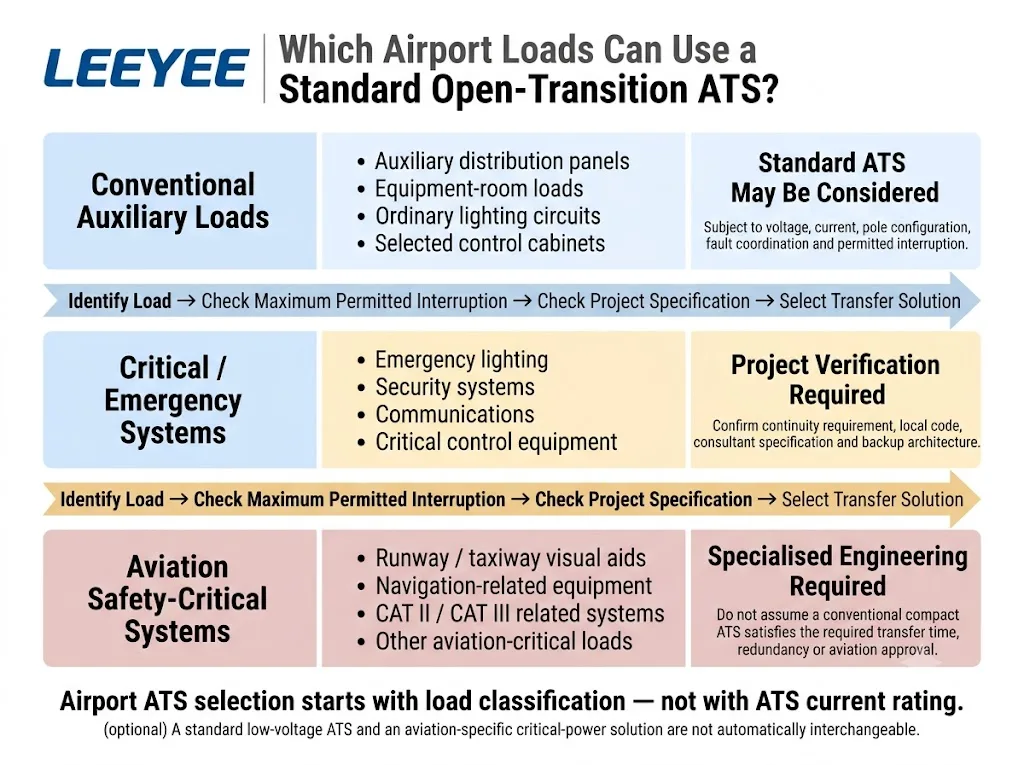
Where Can an Automatic Transfer Switch Fit in an Airport?
Airports contain many types of electrical loads. A terminal auxiliary distribution board, a control cabinet and an airfield visual-aid system have different consequences when power is interrupted, so they should not be treated as one generic “airport critical power” application.
Focus first on the “Selection Position” column. It indicates whether a conventional ATS can reasonably enter the project evaluation.
| Airport Circuit | Typical Decision | Selection Position | Cosa deve essere confermato |
|---|---|---|---|
| Auxiliary distribution | Automatic backup may be required | Standard ATS may be evaluated | Load, poles, fault level and interruption tolerance |
| Equipment-room loads | Depends on equipment function | Standard ATS may be evaluated | Load type and acceptable outage duration |
| Monitoring or control cabinets | Continuity requirement may vary | ATS or another solution may be needed | ATS versus UPS requirement and control interface |
| Emergency or safety-related systems | Specifico per il progetto | Engineering approval required | Local rules, consultant design and continuity requirement |
| Airfield visual aids | Special secondary-power requirements may apply | Do not assume a compact ATS is suitable | Aviation guidance, transfer time and approved architecture |
| Navigation or aviation-critical equipment | System-specific | Specialist design required | Applicable rules, redundancy and equipment approval |
Procurement conclusion: “airport application” is not enough information for ATS selection. The actual circuit function and permitted interruption must be identified first.
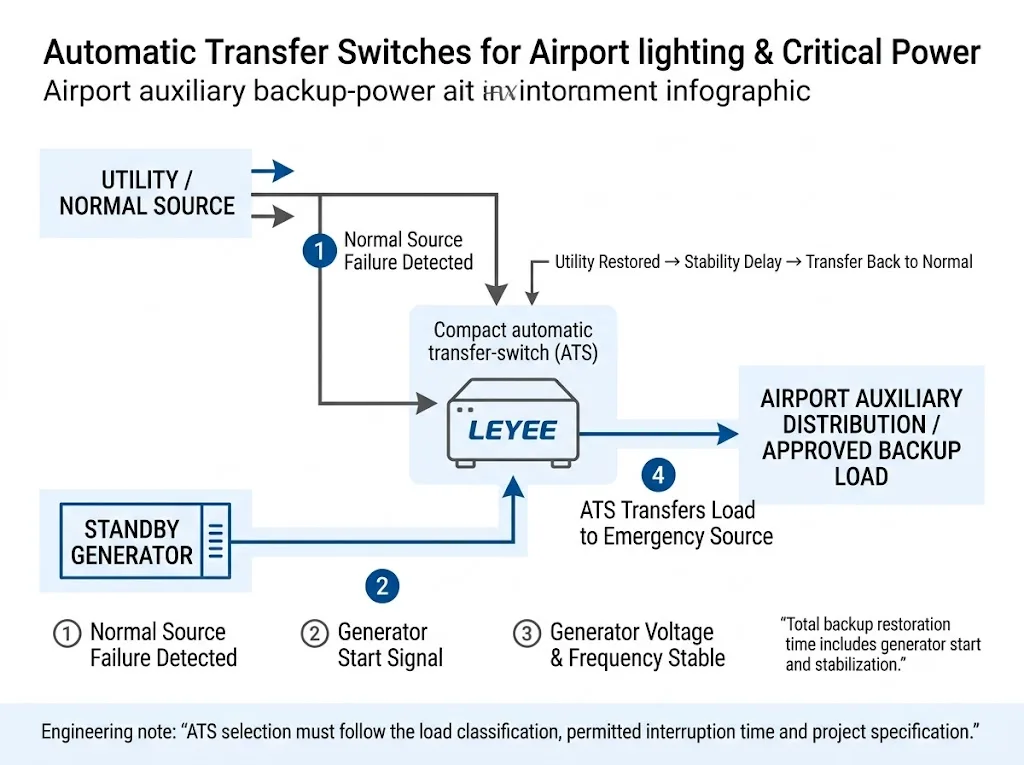
How Does an ATS Work With an Airport Standby Generator?
In a generator-backed system, the ATS does not create emergency power. Its role is to evaluate source conditions and transfer the connected load between acceptable power sources according to the approved control sequence.
When normal power returns, retransfer may also include source-stability and timing logic. Exact thresholds, delays, generator controls and retransfer behaviour must be confirmed from the selected ATS/controller and project control philosophy rather than assumed from a generic sequence.
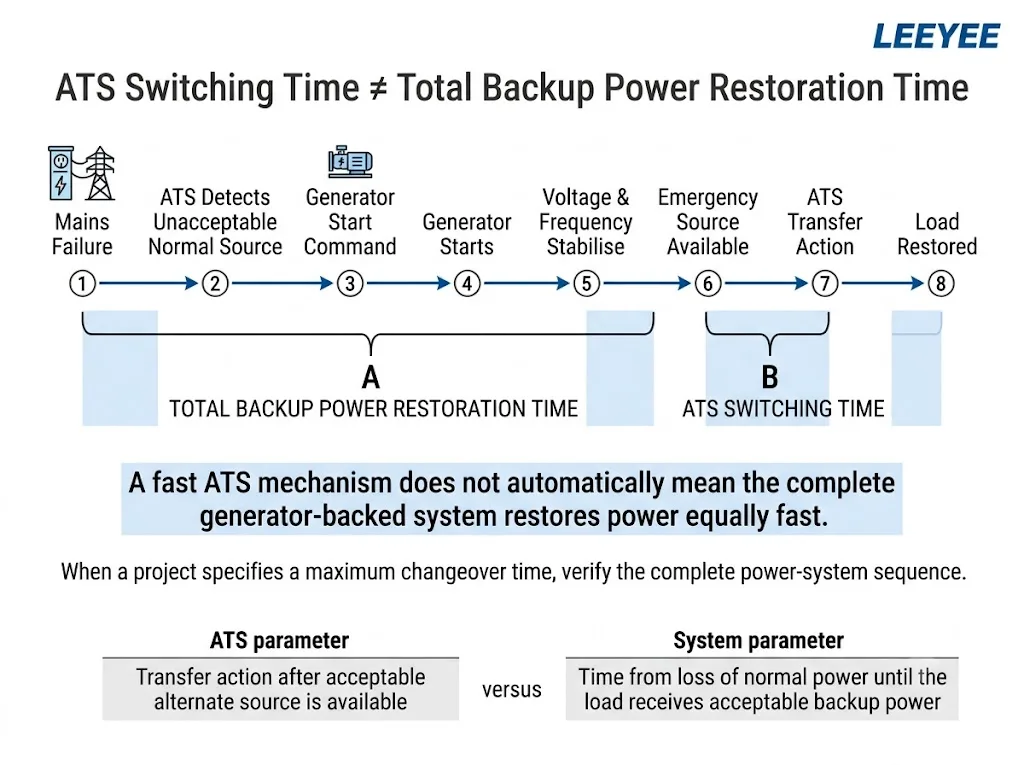
ATS Switching Time Is Not the Same as Total Backup-Power Restoration Time
This distinction is especially important in airport projects. ATS switching time describes the transfer action under defined source conditions. Total restoration time can also include source-failure detection, generator starting, generator acceleration, voltage and frequency stabilization, programmed delays and then the transfer operation.
Why Airfield Lighting Requires a Different Level of Review
FAA Advisory Circular AC 150/5340-30J is currently listed by the FAA as active guidance for the design and installation of airport visual aids.[1]
For the two-source arrangements addressed by that guidance, the FAA states that the second source should generally be available within 15 seconds after interruption of the prime source. For essential visual aids associated with Category II operations, the guidance establishes a one-second changeover requirement. [1]
These figures demonstrate why an airport lighting automatic transfer switch cannot be selected only from a conventional ATS datasheet. Source availability, generator operating strategy, control logic and the complete airfield-lighting architecture can determine whether the required system performance is achieved.
Singapore Changi Airport provides a real published example. The Singapore AIP states that automatic standby generator power is available for airfield lighting and identifies a one-second switch-over time during Category II low-visibility operations.[2]
That is an airport-specific published operating condition. It should not be interpreted as a universal requirement for every airport, every lighting circuit or every jurisdiction.
Why an Airport Lighting Tender ATS May Be Very Different From a Compact ATS
Another important procurement distinction appears in real airport tender specifications. A tender that uses the words “automatic transfer switch” may actually describe an integrated power panel or powerhouse system, not a small stand-alone transfer device.
A published Airfield Ground Lighting technical specification for Clark International Airport, for example, contains a dedicated section for a Dual Automatic Transfer Switch and describes an integrated system involving generator-source priority, automatic generator control, transfer and retransfer timing, voltage monitoring, indication, metering and associated panel functions.[5]
For procurement teams, this means an airfield-lighting tender should be compared line by line with the proposed equipment. A compact automatic transfer switch should not be presented as a direct substitute for a dedicated airfield-lighting transfer panel simply because both documents use the term “ATS.”
What Does Open Transition Mean for Airport ATS Selection?
Open transition is a break-before-make transfer method: the connected load is disconnected from one source before it is connected to the other source. The load therefore experiences an interruption during transfer.[4]
Whether this interruption is acceptable depends on the load and the approved power-system design. A conventional auxiliary circuit may accept open transition, while a more interruption-sensitive system may require another continuity strategy.
Which Transfer-Switch Standard Should the Buyer Check?
IEC 60947-6-1:2026 is the current IEC international standard for transfer switching equipment within its defined scope. It applies to transfer switching equipment used to transfer a load between power sources where rated voltage does not exceed 1,000 V AC or 1,500 V DC.[3]
The 2026 edition covers automatic transfer switching equipment and also contains specific provisions for bypass/isolation transfer equipment, ATSE with closed-transition capability and stand-alone ATS controllers. [3]
What Should Be Confirmed Before Selecting an Airport ATS?
Before sending an ATS enquiry, prepare these project details:
- Exact load function: identify what the circuit actually supplies.
- Load classification: conventional auxiliary, project-critical or aviation-critical.
- System voltage and frequency: use the actual project values.
- Phase and pole requirement: including whether the neutral needs to be switched.
- Continuous design current: together with relevant load characteristics.
- Normal source: utility, transformer or another approved source.
- Alternate source: generator, second utility source or another approved supply.
- Maximum permitted interruption: state the required system performance.
- Available fault current and upstream protection: needed for coordination review.
- Generator interface: start command, source-available feedback and required control logic.
- Transfer / retransfer logic: provide any project-defined timers or source priorities.
- Remote status requirements: define the required dry contacts or communication points.
- Applicable standards and approvals: provide consultant, airport or local project requirements.
- Single-line diagram and control schematic: these are often more useful than the phrase “airport ATS.”
Remote Status and Alarm Signals Should Be Defined Early
Airport projects may require transfer equipment to exchange status information with a generator controller, PLC, BMS or another supervisory system. The required interface must be defined by the project rather than assumed.
Typical project enquiries may request signals such as Normal Available, Emergency Available, Load to Normal, Load to Emergency, Auto/Manual status and Fault Alarm. Whether those signals are available, how they are wired and whether additional communication functions are required must be confirmed against the exact ATS/controller configuration.
Where Does the Standard LEEYEE ATS Fit?
The product below shows the actual compact ATS form supplied by LEEYEE. This matters because many airport tender documents use the term “ATS” for much larger integrated transfer panels. Those are not automatically the same product category.
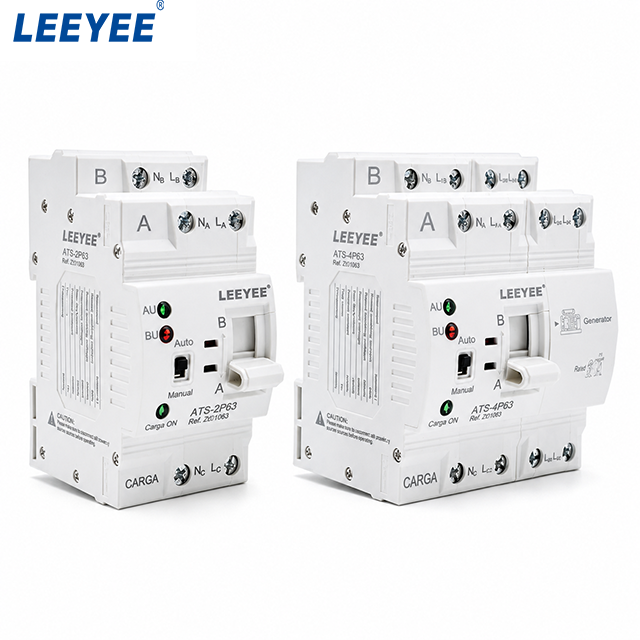
LEEYEE standard supply is positioned for conventional low-voltage open-transition applications.
For an airport project, the standard compact LEEYEE ATS should be evaluated only where the circuit's electrical ratings, pole configuration, transfer method, permitted interruption, generator interface, control requirements and project approval conditions match the actual product configuration.
The standard product should non be presented as a dedicated runway-lighting, navigation-system, CAT II/CAT III, airfield-lighting powerhouse or other specialised aviation-safety transfer solution without model-specific and project-specific verification.
Where a tender requires a larger integrated panel, dual-generator logic, bypass/isolation equipment, closed-transition operation, specialised redundancy or aviation-specific approvals, that requirement should be treated as a separate engineered system rather than extending the claimed capability of the standard compact ATS.
A Practical Four-Step Airport ATS Decision
-
Identify the exact load.
“Airport lighting” is too broad. State whether the circuit serves auxiliary lighting, equipment rooms, emergency systems, airfield visual aids or another defined load. -
Define the maximum acceptable interruption.
Determine the required system-level continuity before choosing the transfer method. -
Check whether open transition is acceptable.
If the load cannot tolerate the interruption, a conventional open-transition ATS may not be the correct architecture. -
Verify the proposed equipment against the full project specification.
Confirm ratings, poles, short-circuit coordination, generator logic, controls, monitoring, documentation, standards and approval requirements before the equipment is approved.
Need to Check Whether a Standard LEEYEE ATS Fits Your Airport Auxiliary Circuit?
Send the single-line diagram, load description, system voltage, current, pole requirement, normal and alternate sources, permitted interruption, generator control requirements, required status signals and applicable project specification. LEEYEE can use those details to determine whether the requirement is suitable for evaluation within the standard compact open-transition ATS scope or should be treated as a specialised project solution.
Domande frequenti
Can a normal automatic transfer switch be used for airport runway lighting?
It should not be assumed. FAA guidance demonstrates that defined airfield visual-aid systems can have specific secondary-power and changeover requirements.[1] The applicable airport specification, aviation requirements and complete power architecture must be reviewed first.
Does a fast ATS automatically meet a one-second airport requirement?
No. A project may define performance for the complete secondary-power system rather than only the ATS mechanism. Generator availability, source validation, programmed delays and transfer logic can all affect the total result.[1]
Is one second required for every airport ATS?
No. The one-second FAA provisions discussed here relate to defined Category II visual-aid applications, and the Changi one-second figure is an airport-specific published condition during Category II low-visibility operations.[1][2] Other airport systems and jurisdictions may use different requirements.
Is an airfield-lighting ATS the same as a compact ATS?
Not necessarily. Public airport technical specifications can describe complete ATS panels with generator priority, timers, monitoring, metering and additional control functions.[5] A compact ATS should therefore be compared with the complete tender requirement rather than treated as a direct equivalent.
Can the LEEYEE compact ATS be considered for airport auxiliary power?
It may be considered where the actual low-voltage auxiliary circuit matches the ATS electrical ratings, open-transition operating method, pole arrangement, control requirements and permitted interruption. Final selection must still be confirmed from the project drawings and exact product documentation.
Can an ATS replace a UPS for an airport control load?
Not automatically. Open-transition transfer disconnects one source before connecting the other, so an interruption occurs during transfer.[4] If the equipment cannot tolerate that interruption, the approved design may require another continuity solution.
Should an airport ATS use 3 poles or 4 poles?
Pole selection should not be based on the word “airport” or phase count alone. Neutral treatment, earthing arrangement, generator configuration, protective scheme and the project single-line diagram must be reviewed.
Is IEC 60947-6-1 compliance enough for an airport project?
No. IEC 60947-6-1:2026 is the current IEC product standard for transfer switching equipment within its scope, but project acceptance may also depend on aviation requirements, local electrical rules, consultant specifications and model-specific documentation.[3]
What should I send when requesting an airport ATS quotation?
Send the circuit function, single-line diagram, voltage, frequency, phase and pole requirement, continuous current, source arrangement, maximum permitted interruption, fault or upstream protection information, generator-control requirements, remote signals, quantity and applicable approval documents.
Riferimenti
- [1] Federal Aviation Administration (FAA). AC 150/5340-30J — Design and Installation Details for Airport Visual Aids . Active FAA advisory circular covering airport visual-aid installation, including secondary-power and Category II changeover considerations for defined visual-aid systems.
- [2] Civil Aviation Authority of Singapore (CAAS). Singapore AIP — WSSS AD 2.15, Other Lighting, Secondary Power Supply . Published Changi Airport information listing automatic standby generator power for airfield lighting and a one-second switch-over during Category II low-visibility operations.
- [3] International Electrotechnical Commission (IEC). IEC 60947-6-1:2026 — Apparecchiature di commutazione e controllo a bassa tensione — Parte 6-1: Apparecchiature multifunzionali — Apparecchiature di commutazione di trasferimento . Edition 4.0, published 2 April 2026.
- [4] Eaton. Automatic Transfer Switches (ATS) Fundamentals . Technical overview explaining open-transition transfer as a break-before-make sequence.
- [5] Clark International Airport Corporation. Technical Specifications — Airfield Ground Lighting System Upgrade . Public project specification containing a dedicated Dual Automatic Transfer Switch section and associated generator, control, monitoring and panel requirements. This project example illustrates the need to verify the complete airport tender specification rather than assuming one generic ATS configuration.
