
Questa guida si concentra su automatic transfer switches for mineral mining operations, including selected low-voltage auxiliary circuits in open-pit mines, underground mine support areas, dewatering stations, workshops and mineral-processing facilities. It does not refer to cryptocurrency mining, and it does not present a standard compact ATS as explosion-protected mining equipment.
A mining automatic transfer switch transfers selected low-voltage loads between a normal power source and an alternative source, typically a standby generator, when the normal source becomes unavailable.
The compact LEEYEE ATS shown on this page is a 2P / 4P compact integrated transfer switch intended for ordinary low-voltage two-source transfer applications. In a mining project, it may be evaluated for suitable auxiliary circuits only after current, load type, generator behaviour, protection, enclosure and installation conditions have been confirmed.
Do not assume that a standard compact ATS is suitable for a classified hazardous mining area. IEC 60947-6-1:2026 covers transfer switching equipment but excludes transfer switches used in explosive atmospheres and refers to the IEC 60079 series for those applications.[1]
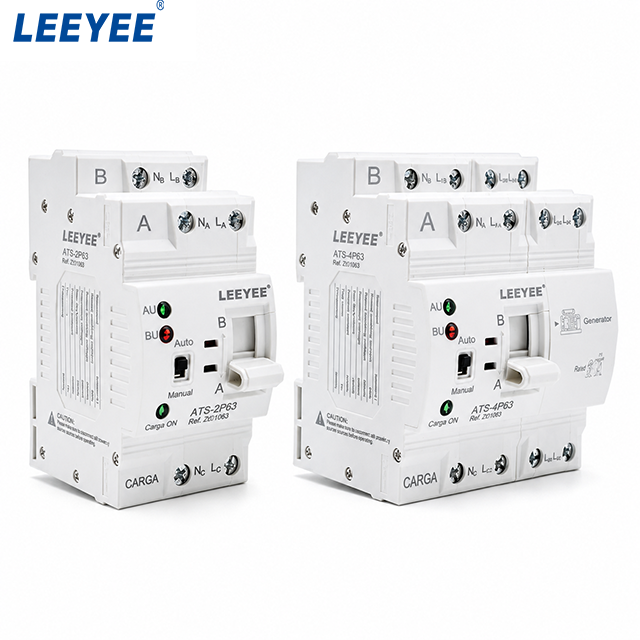
Ambito del prodotto: the product shown here is a compact low-voltage ATS, not a large mining switchboard, bypass-isolation ATS, closed-transition system or explosion-protected mining device.
Indice dei contenuti
Where Can a Compact Automatic Transfer Switch Fit in Mining?
A mine may contain many different electrical systems. The correct starting point is therefore not “How large should the mining ATS be?” but “Which low-voltage auxiliary circuits actually require an alternative source?”
Depending on the project, selected drainage, auxiliary ventilation, lighting, workshop or control circuits may require backup power. However, each application must be checked against the actual load and the selected ATS model rather than assuming that every mining load can be switched by a compact ATS.
| Possible Auxiliary Circuit | Why Backup May Be Required | Main Engineering Check |
|---|---|---|
| Small or selected dewatering pump circuit | Maintain designated drainage functions | Motor starting, ATS utilization duty and generator capability |
| Selected auxiliary ventilation circuit | Maintain designated support ventilation | Motor duty, controls, interlocks and mine-safety requirements |
| Lighting circuit | Maintain selected essential lighting | Total load and distribution arrangement |
| Control panel | Maintain selected monitoring or control functions | Voltage, pole configuration and transfer sequence |
| Workshop or surface auxiliary circuit | Maintain selected support loads | Mixed-load current and feeder capacity |
These examples do not mean that the ATS shown here is automatically suitable for every pump, fan or mining load. Motor-switching capability, current rating, utilization category and project requirements must be verified from the selected model documentation before approval.
Significato dell'acquirente: define the essential circuit first, then confirm whether the actual 2P or 4P LEEYEE ATS model can satisfy that circuit. Do not select the switch only because the application is described as “mining.”
How Does the Generator and ATS Work Together?
The ATS does not generate backup power. Its job is to transfer a designated load between two available sources.
In a common standby arrangement, the normal supply is the preferred source and a diesel generator is the alternative source. A compatible transfer-control system can also provide a generator start signal when normal power fails, depending on the ATS controller and generator controller used.[4]
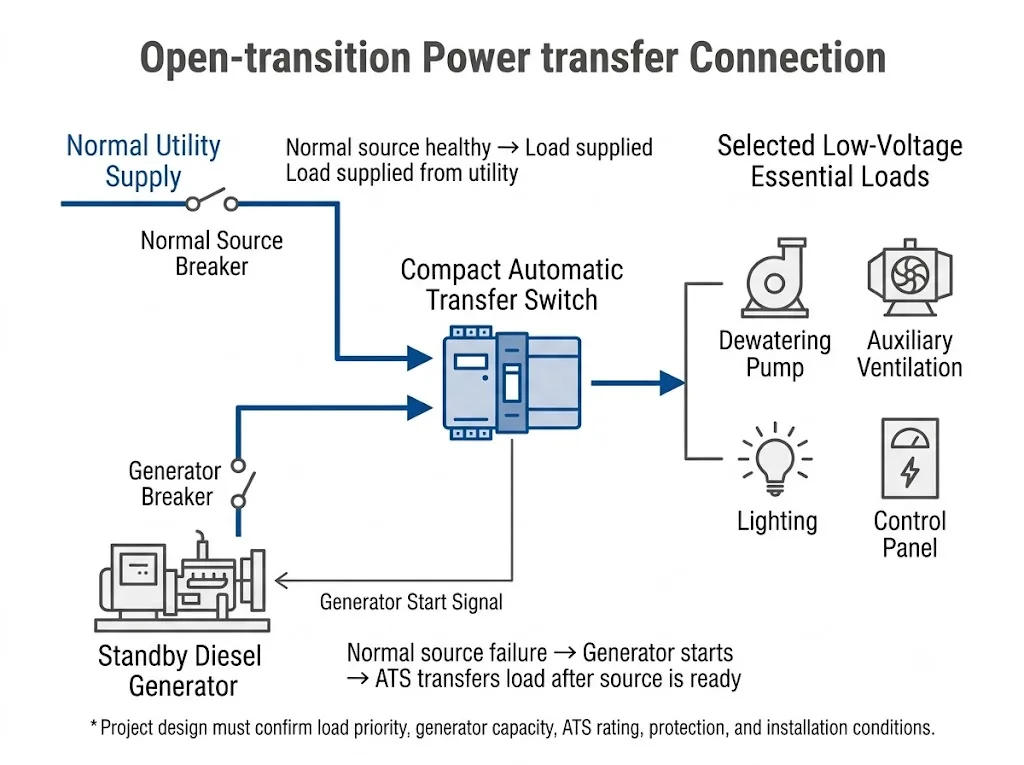
Typical open-transition operating sequence
- The normal source supplies the selected load.
- The ATS controller detects that the normal source no longer satisfies its configured source conditions.
- Where automatic generator starting is used, a start request is sent to the generator controller.
- The system waits until the alternative source meets the configured transfer conditions.
- The load is disconnected from the normal source before connection to the alternative source.
- After normal power returns and the configured retransfer conditions are satisfied, the load can return to the normal source.
Source thresholds, time delays, generator warm-up or cool-down periods, start-contact logic and retransfer timing are project-specific. They must be confirmed against the actual ATS controller, generator controller and approved electrical design.
Do Not Select This ATS by Running Current Alone
This is especially important if the mining auxiliary circuit includes a pump, fan or other motor.
A motor can demand substantially more from the power source during starting than during normal operation. Generator sizing guidance therefore evaluates motor starting characteristics, starting method and load sequencing rather than relying only on continuous current.[3]
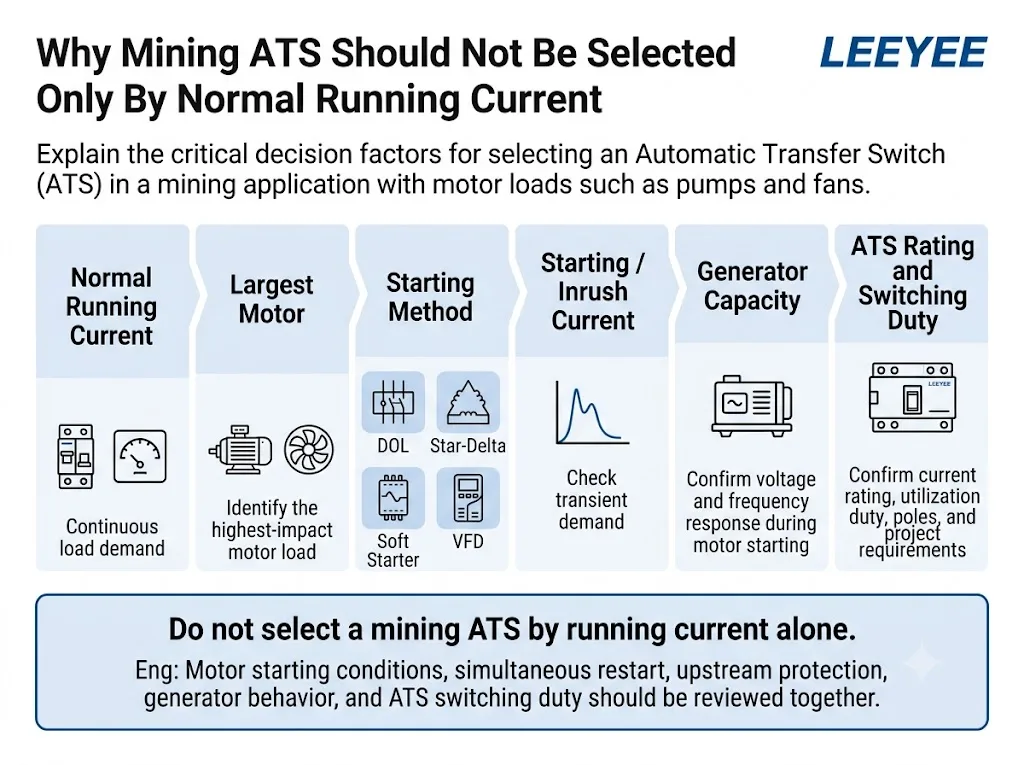
| Articolo da confermare | Perché è importante |
|---|---|
| Normal running current | Defines continuous load demand. |
| Largest motor | Can create the most significant individual starting event. |
| Starting method | DOL, star-delta, soft starter and VFD operation can create different source demands. |
| Restart sequence | Several motors restarting together can create a different transient condition from sequential starting. |
| Generator capability | The generator must support the intended load application sequence. |
| ATS utilization and switching duty | The actual selected model must be suitable for the connected load type and declared operating conditions. |
Do not interpret a 63 A ATS marking as proof that the device can directly switch any 63 A mining motor load. Motor application suitability depends on more than continuous current. The selected model's utilization category, switching performance and manufacturer data must be checked together with the motor and generator requirements.
Generator Capacity and ATS Rating Are Different Decisions
ATS question
Can the selected compact ATS carry and switch the specified circuit under its declared electrical and utilization conditions?
Generator question
Can the generator accept the intended transferred load and starting sequence while remaining within the project's required operating limits?
A larger ATS does not increase generator motor-starting capability. Likewise, a larger generator does not prove that a particular ATS is suitable for the load's switching duty.
For mining circuits containing pumps, fans or other motors, the ATS supplier and generator integrator should review the same load schedule.
2P or 4P: Match the Actual System
The real LEEYEE product image on this page shows ATS-2P63 e ATS-4P63 configurations. These are the product configurations represented on this page.
| Configurazione | Typical Design Question | Cosa deve essere confermato |
|---|---|---|
| 2P | Is this a suitable single-phase two-wire transfer arrangement? | System voltage, conductor arrangement and project design |
| 4P | Does the three-phase system require neutral switching? | Earthing arrangement, generator neutral treatment and project requirements |
Do not choose 4P simply because the system is used in mining, and do not assume a 3P version from this page. Pole selection must follow the actual single-line diagram and neutral/earthing arrangement.
Which Electrical Parameters Should Be Confirmed?
| Parametro | Domanda di progetto | Procurement Impact |
|---|---|---|
| Tensione di sistema | What are the actual normal and generator voltages? | Must match the selected ATS and controller configuration. |
| Frequenza | 50 Hz or 60 Hz? | Must be compatible with the complete transfer system. |
| Phase | Monofase o trifase? | Helps determine whether the available 2P or 4P configuration is appropriate. |
| Pali | 2P or 4P? | Depends on system architecture and neutral treatment. |
| Attuale | What continuous load current applies? | Must be reviewed together with real switching duty. |
| Tipo di carico | Motor, lighting, control or mixed? | Can materially change switching requirements. |
| Source arrangement | Utility-generator or another two-source arrangement? | Affects control, sensing and generator-start requirements. |
| Transition mode | Is ordinary open transition acceptable? | Must match the process and load requirement. |
Check Short-Circuit Conditions and Upstream Protection
The ATS current marking alone does not establish short-circuit suitability.
The project should determine the prospective short-circuit current at the installation point and verify the selected ATS together with its specified upstream protective device and model-specific technical documentation.
Transfer-switch manufacturers commonly publish short-circuit withstand or closing information together with specific protective-device conditions. Those combinations are product-specific and must not be copied from another manufacturer's ATS or from another LEEYEE model without verification.[6]
Protection information to confirm
Mining Environment: Evaluate the ATS Inside the Complete Panel
The compact ATS shown on this page is intended to be considered as a component inside a low-voltage electrical system. Its suitability cannot be judged from the word “mining” alone.
A protected indoor switchboard, an outdoor pump panel and equipment near a dusty processing area can experience very different environmental conditions.
IEC 60529 defines the IP Code for degrees of protection provided by enclosures against access, solid foreign objects and water.[5] The enclosure requirement should therefore be reviewed separately from the ATS electrical selection.
Environmental information to confirm
Significato ingegneristico: ask where the ATS will be installed, what enclosure will contain it and what conditions the complete panel will experience.
Standard Compact ATS Does Not Mean Explosion-Protected ATS
This is the most important product boundary for a mining application.
IEC 60947-6-1:2026 covers transfer switching equipment but excludes transfer switches used in explosive atmospheres, referring instead to the IEC 60079 series for such environments.[1]
IECEx documentation also distinguishes Group I equipment for mines susceptible to firedamp and provides a separate conformity framework for equipment used in explosive atmospheres.[2]
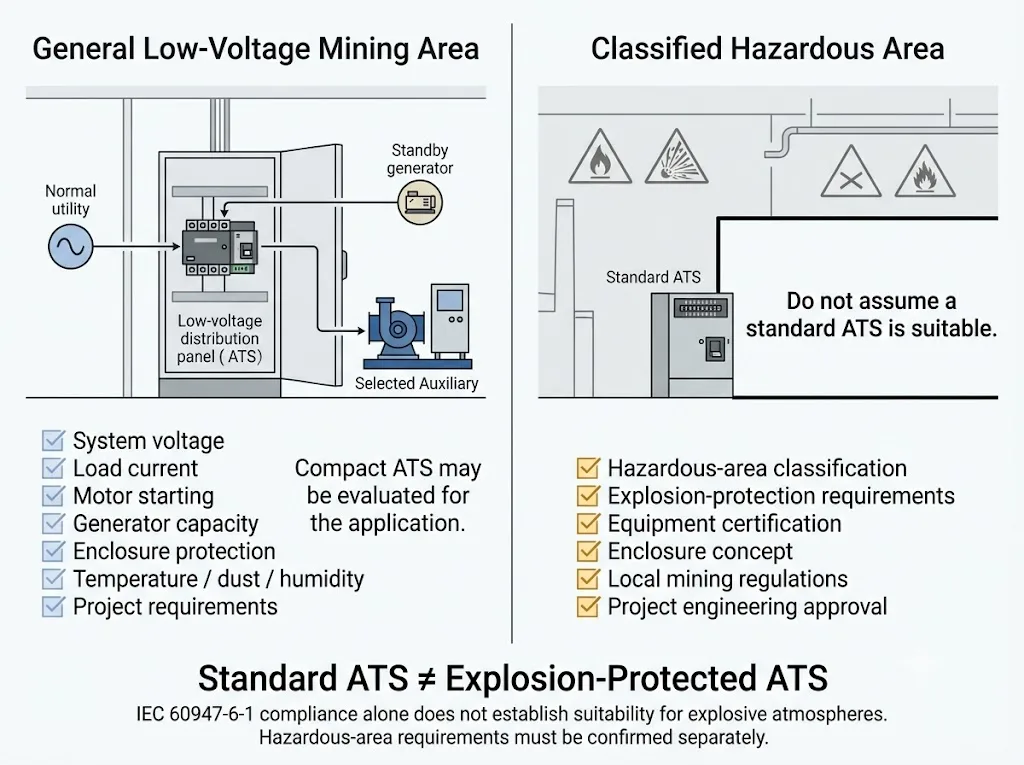
The LEEYEE ATS-2P63 and ATS-4P63 shown on this page must not be presented as explosion-protected mining ATS devices.
If the proposed location is classified as hazardous, confirm the area classification, required protection concept, equipment group, enclosure arrangement, certificate scope, local mine-safety requirements and project approval before equipment selection.
Installing a standard ATS inside a cabinet does not automatically make the final assembly suitable for an explosive atmosphere. The complete protection concept requires separate project-specific verification.
Where This LEEYEE Compact ATS Fits — and Where It Does Not
Reasonable evaluation scope
The real product shown on this page is a compact 2P / 4P low-voltage automatic transfer switch for ordinary two-source switching. In mining projects, it can be evaluated for suitable low-voltage auxiliary circuits when the electrical ratings, open-transition operation, switching duty, protection, enclosure and installation conditions are confirmed.
Do not position this product as
- A large mine main incoming ATS system.
- A high-power mine ventilation main transfer system without specific engineering verification.
- A large mine dewatering main-transfer system without specific motor and switching verification.
- An explosion-protected or mine-certified ATS.
- A closed-transition ATS.
- A bypass-isolation ATS.
- A complete mining power-distribution solution supplied as one engineered package.
Professional product selection depends on knowing where a compact ATS is appropriate as much as knowing where a different engineered solution is required.
A Practical Selection Process for This Compact ATS
- Define the auxiliary circuit. Identify exactly which load requires standby power.
- Confirm system phase and poles. Determine whether the available 2P or 4P configuration fits the approved electrical design.
- Record the continuous current. Compare it with the selected model's actual rating.
- Identify the load type. Motor, lighting, control and mixed loads must not automatically be treated the same.
- For motor loads, check starting conditions. Confirm motor rating, starting method and restart sequence.
- Confirm generator capability. Review voltage, frequency, rated output and transient performance with the generator supplier.
- Check ATS switching suitability. Verify utilization category and model-specific switching data.
- Review short-circuit protection. Confirm prospective fault current and upstream protective-device requirements.
- Review environmental conditions. Confirm enclosure, dust, moisture, temperature and vibration requirements.
- Check hazardous-area classification. If the location is classified, do not treat this compact standard ATS as an explosion-protected solution.
Information to Send Before Ordering
A request such as “I need a 63 A ATS for a mine” is not enough for reliable selection. The application information below allows a more meaningful review.
Mining ATS project checklist
Need to confirm whether this compact ATS fits your mining auxiliary circuit?
Send the system voltage, required 2P or 4P configuration, load current, load type, generator information, motor data where applicable, protection information, installation conditions and single-line diagram. LEEYEE can review the requested ATS configuration against the information provided.
Domande frequenti
Can this compact LEEYEE ATS be used in a mining project?
It may be evaluated for suitable low-voltage auxiliary circuits, but the application must match the selected ATS rating, switching duty, protection, 2P or 4P configuration, enclosure and installation conditions.
Can this ATS switch a mining dewatering pump?
It should not be assumed from the 63 A current marking alone. The motor rating, starting method, ATS utilization category, switching capability, generator performance, protection and restart sequence must be checked before approval.
Can this ATS be used for a mine ventilation motor?
Only after the actual motor and project requirements are reviewed. Main ventilation or safety-critical ventilation systems can involve additional operational, redundancy, interlock and regulatory requirements that should not be inferred from a standard compact ATS product image.
Should I choose the 2P or 4P version?
The choice depends on the actual system architecture. The 2P and 4P versions shown on this page should be matched to the single-line diagram, phase arrangement, neutral treatment and earthing requirements. Do not assume 4P solely because the project is in mining.
Does the ATS automatically start the generator?
A compatible automatic transfer system can provide a generator start signal, but the actual contact logic and controller compatibility must be confirmed for the ATS and generator controllers used in the project.[4]
Does a 63 A rating mean the ATS can switch any 63 A load?
No. Continuous current rating does not by itself define suitability for every motor or switching duty. Load type, utilization category, short-circuit conditions and manufacturer-declared performance must also be checked.
Is this ATS explosion-proof?
This page does not claim that the shown LEEYEE ATS-2P63 or ATS-4P63 is explosion-protected. Classified hazardous areas require separate equipment selection and certification review under the applicable explosion-protection requirements.[1][2]
Can all mining loads be transferred through one compact ATS?
Not automatically. Different loads can have different current, starting, protection, criticality and allowable-interruption requirements. The system designer should determine load grouping from the actual project.
Riferimenti
- International Electrotechnical Commission (IEC). IEC 60947-6-1:2026 — Low-voltage switchgear and controlgear — Part 6-1: Multiple function equipment — Transfer switching equipment. Pagina delle pubblicazioni ufficiali dell’IEC.
- IECEx. IECEx OD 504 — Specification for Units of Competence Assessment Outcomes. IECEx documentation covering hazardous-area competence and equipment groups, including Group I for mines susceptible to firedamp. IECEx official document.
- Generac Industrial Power. Sizing Considerations for Commercial and Industrial Generators. Technical guidance addressing load analysis, motor starting, starting kVA and load sequencing. Generac technical paper.
- Caterpillar Inc. Cat EMCP 4 Start Signal Monitoring. Technical guidance describing utility monitoring, transfer-device operation and generator start signalling. Caterpillar technical article.
- International Electrotechnical Commission (IEC). IEC 60529:1989+A1:1999+A2:2013 — Degrees of protection provided by enclosures (IP Code). Pagina delle pubblicazioni ufficiali dell’IEC.
- Eaton. Automatic Transfer Switches Product Guide. Manufacturer documentation illustrating why transfer-switch short-circuit performance must be evaluated with the specified upstream protective device. Eaton values are product-specific and are not presented as LEEYEE ratings. Eaton ATS product guide.
