
A portable generator can supply a commercial load through suitable transfer equipment, but the correct transfer method depends on how the generator is deployed, started and connected to the electrical system. For many supervised commercial or temporary-power applications, manual transfer is a practical solution. Automatic transfer is possible only when the exact generator and control architecture support the required automatic operating sequence.
Commercial-buyer scope: this guide is intended for electrical contractors, panel builders, distributors, temporary-power suppliers, equipment integrators and small commercial projects. It is not a household wiring tutorial. Final source isolation, conductor sizing, protection, grounding, bonding, neutral treatment and installation method must be confirmed from the generator documentation, transfer-device documentation, project design and applicable local rules.
Indice dei contenuti
Quick Answer: Can a Portable Generator Use a Transfer Switch?
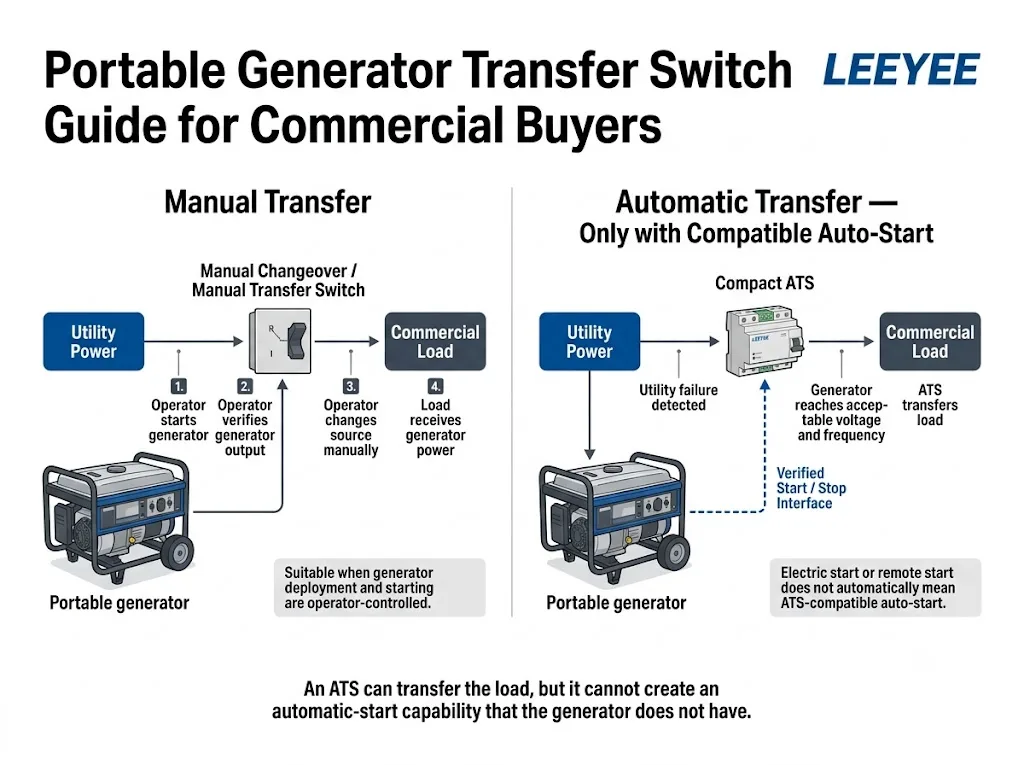
Sì. Portable generators can be used with suitable transfer equipment. When an operator must position, connect or start the generator, manual transfer is commonly used because the operator is already part of the backup-power procedure. Portable-generator manufacturers offer manual transfer equipment for this type of application. [1]
Automatic transfer can also be technically possible, but only when the exact generator provides a documented control interface compatible with the required automatic-start system. Some portable generators provide such interfaces; many do not. The generator model must therefore be checked before an ATS solution is specified. [2]
Portable Generator vs Standby Generator: What Actually Changes?
For transfer selection, the most useful distinction is not simply whether a generator is portable or permanently installed. The important question is how the alternate source becomes available after the normal source is lost.
Use this table only as an initial screening tool. The exact generator model and system design take priority.
| Decision Point | Portable Generator | Standby Generator |
|---|---|---|
| Typical deployment | Often deployed or prepared when backup power is required | Normally forms part of a permanently installed backup system |
| Starting | Often operator-controlled; selected models provide external auto-start capability | Commonly designed for automatic generator-control integration |
| Typical transfer approach | Manual transfer is common where operation is supervised | ATS integration is common |
| Automatic operation | Possible only where the exact generator and controller support it | Normally designed around an automatic operating sequence, subject to model compatibility |
Procurement conclusion: do not select the transfer method from the label “portable” or “standby” alone. Verify the exact source-control capability.
A key switch, push button or wireless remote only confirms that the generator supports that starting method. It does not prove that an external controller or ATS can issue the required automatic start and stop commands.
Why Manual Transfer Is Common for Portable Commercial Generators
Manual transfer is a recognised transfer method, not simply a less advanced form of automatic transfer. IEC 60947-6-1:2026 covers manually operated transfer switching equipment (MTSE), remotely operated transfer switching equipment (RTSE) and automatic transfer switching equipment (ATSE), among other transfer-switching equipment within its scope. [3]
On a construction site, temporary facility or supervised commercial installation, personnel may already be required to deploy, fuel, connect and start a portable generator. In that operating model, manual transfer can be an appropriate engineering choice.
Generac, for example, provides manual transfer-switch products specifically for portable-generator use. This is evidence of a common application approach, not a rule that every portable generator must use manual transfer. [1]
When Can Automatic Transfer Be Used?
Automatic transfer should be considered only after the generator-control capability has been verified.
Some current portable-generator models provide a documented wired interface for integration with compatible automatic systems. Champion's StartLINK-equipped portable-generator documentation is one example. The existence of such products does not imply compatibility for another generator model. [2]
Detect the condition of the normal source
In an automatic system, the ATS or associated controller monitors the source according to its designed sensing logic. Exact voltage, frequency and timing criteria are equipment-specific and must be confirmed from the applicable documentation.
Issue a compatible generator-start command
The generator must provide a documented interface compatible with the controller used in the project. An ATS should not be assumed to start a generator unless this interface has been verified.
Allow the alternate source to become acceptable
The generator must start and satisfy the source-acceptance conditions defined by the ATS or controller and project design.
Transfer the load
In an automatic system, transfer should occur only when the alternate source meets the transfer conditions defined by the ATS/controller and the approved system design.
Retransfer and stop the generator
Return-to-normal, cooldown and stop behaviour are controller- and generator-specific. Do not assume generic delay values; verify the actual equipment documentation.
Automatic backup is a coordinated system function. Generator starting, source qualification, transfer, retransfer and shutdown can involve separate devices or controller functions. Their compatibility must be verified for the project.
Should a Small Commercial Project Use Manual Transfer or ATS?
Start with the required operating response. If personnel are present and the permissible outage duration allows supervised generator deployment and switching, manual transfer can be appropriate. If the load requires unattended source recovery, an automatic architecture becomes more relevant.
However, unattended recovery is only possible when the generator itself can be made available automatically and the full generator-control-transfer sequence is compatible.
| Commercial Scenario | Manual Transfer May Fit When | Automatic Transfer May Fit When |
|---|---|---|
| Supervised construction site | Generator deployment and operation already require personnel | A permanently available compatible source and unattended recovery are required |
| Temporary commercial facility | Source changes are supervised | Backup operation must occur without an operator |
| Small retail or service location | A managed interruption is acceptable | Defined essential loads require automatic restoration |
| Pump, refrigeration or process-support load | The permitted interruption allows operator response | Delayed restoration creates unacceptable operational consequences |
Buyer meaning: define the required recovery behaviour first. Then verify whether the generator and transfer system can actually deliver it.
Backfeed Prevention and Source Isolation Are Critical
A generator connected to a building or structure must not unintentionally energise the normal utility supply. Proper transfer equipment provides the required source-transfer and isolation function within the approved installation design.
U.S. OSHA guidance for portable generators warns against directly connecting a generator to the electrical system of a structure without a properly installed transfer switch because improper connection can expose utility workers and others to electrical hazards. [4]
OSHA guidance applies in its U.S. regulatory context. Projects in other countries must follow the applicable national or local electrical rules, the generator manufacturer's instructions and project requirements. Do not treat one country's installation guidance as a universal global requirement.
2P or 4P? Start with the Conductors That Must Transfer
Pole selection should not be reduced to “single-phase equals 2P” or “three-phase equals 4P.” The first engineering question is: which current-carrying conductors must change from Source A to Source B?
Phase configuration is part of the answer, but neutral treatment, source bonding, earthing arrangement, protection design and the exact ATS terminal arrangement can also affect the final choice.
2P is a two-switched-path configuration
A 2P ATS provides two switched current-carrying paths. It is commonly considered in certain single-phase applications, but the actual conductor assignment must be confirmed from the system diagram and ATS datasheet.
4P provides four switched paths
In a three-phase application where the design requires L1, L2, L3 and Neutral to transfer between sources, a 4P arrangement is a typical candidate. That does not mean every three-phase system requires a switched neutral.
The number of phases alone does not determine pole count. Confirm which conductors must transfer, especially the Neutral path, before selecting 2P or 4P equipment.
Neutral Switching Depends on the Grounding and Bonding Architecture
The neutral decision requires more than identifying the generator as portable. Generator neutral-to-frame bonding, the normal-source bonding arrangement, the earthing system, the transfer-switch design and applicable electrical rules all need to be considered.
OSHA's portable-generator fact sheet explicitly distinguishes grounding from bonding and notes that bonding of the neutral conductor to the generator frame is an important safety consideration. It also states, in the U.S. construction context, that generators supplying a structure through a transfer switch require the applicable grounding arrangement and that the transfer switch must be approved for the use and installed according to manufacturer instructions by a qualified electrician. [5]
For that reason, this guide does not prescribe a universal “switch the neutral” or “do not switch the neutral” rule. The correct arrangement must be determined from the complete system architecture and local requirements.
Any modification to grounding or bonding must follow the generator manufacturer's instructions and the approved project design.
Size the Backup System from the Generator and the Real Load
Transfer-switch current rating and generator output are different constraints. A transfer switch with a higher current rating does not increase the power available from the generator.
Confirm the generator's rated output and the actual backup-load requirement. Loads such as motors, compressors, refrigeration equipment and pumps may create starting conditions that must be considered using the relevant equipment data.
For a small commercial or temporary-power project, selecting defined essential loads can be more practical than attempting to supply every circuit from the portable generator.
Dove si inserisce il LEEYEE Compact ATS
The actual LEEYEE product shown below is a compact integrated automatic transfer switch available in 2P and 4P configurations. The visible product features include Auto / Manual selection and A / B source positions.
These visible features support its role as a compact source-transfer device. They do non provide evidence that the product itself includes a universal portable-generator start controller, dry-contact generator-start output or any specific generator communication protocol.
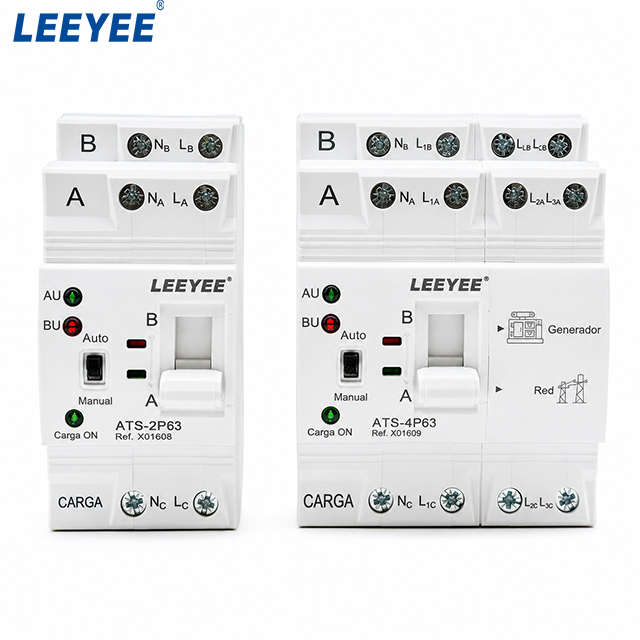
Do not interpret the Auto position as proof that this ATS can automatically start any portable generator. The generator's start/stop interface and any required external controller must be confirmed separately.
In a project where the portable generator must be started manually, the generator needs to be running and providing an acceptable alternate source before automatic source transfer can be considered. The exact behaviour of the LEEYEE ATS must follow the documentation for the selected model.
Commercial Selection Process
Identify the exact generator
Record the manufacturer and model. Do not specify automatic operation before reviewing its start/stop and electrical documentation.
Confirm how the generator can be started
Distinguish manual, electric-button, remote-control and documented external automatic-start capability.
Confirm electrical characteristics
Verify voltage, frequency, phase arrangement and generator rated output.
Define the required backup load
Identify essential loads and any operating or starting characteristics that affect generator sizing.
Determine the required switched conductors
Confirm phase conductors and Neutral rather than selecting 2P or 4P from phase count alone.
Verify grounding and bonding
Review the generator neutral configuration, system earthing arrangement and applicable installation rules.
Select manual or automatic transfer
Match the transfer method to the required operating procedure and verified generator-control capability.
Confirm the exact transfer-switch model
Verify electrical ratings, terminal arrangement, source-sensing functions, product standard, certification and environmental suitability from model-specific documentation.
Which Standards Should Commercial Buyers Check?
For IEC-oriented transfer switching equipment, the current edition is IEC 60947-6-1:2026, Edition 4.0, published in April 2026. Its scope includes MTSE, RTSE and ATSE, along with other transfer-switching equipment categories defined by the standard. [3]
For North American projects, UL Solutions identifies UL 1008 for categories including automatic transfer switches used in emergency or optional standby systems and nonautomatic transfer switches. [6]
Mentioning IEC 60947-6-1 or UL 1008 explains the standards landscape only. It does not mean that the LEEYEE product shown on this page is certified to every referenced standard. Certification must be verified for the exact model and destination market.
Before Requesting a Transfer Switch Recommendation
- Generator manufacturer and exact model
- Generator starting method
- Whether a documented external automatic-start interface exists
- Output voltage and frequency
- Single-phase or three-phase system arrangement
- Generator rated continuous output or rated current
- Essential backup loads
- Motor, pump, compressor or refrigeration starting requirements where relevant
- Required operating method: supervised manual or automatic
- Conductors that must transfer between sources
- Neutral arrangement and generator bonding information
- Earthing / grounding system
- Ambiente di installazione
- Required product standard or certification
- Mercato di destinazione
- Quantity and OEM / private-label requirements
Need to Confirm Whether Your Portable Generator Should Use Manual Transfer or ATS?
Send the generator model, voltage, phase arrangement, rated output, start method, load information and Neutral / grounding details. LEEYEE can help review whether a compact ATS should be evaluated for the project before the model is fixed.
Domande frequenti
Can a portable generator use a transfer switch?
Yes. A portable generator can supply a structure or commercial load through properly selected transfer equipment. The correct transfer method depends on the generator, load, system architecture and installation requirements.
Does a portable generator always need a manual transfer switch?
No. Manual transfer is common where the generator requires operator deployment or starting, but selected portable generators provide interfaces that can support automatic integration. Verify the exact generator model before deciding.
Does electric start mean the generator can work automatically with an ATS?
No. Electric start only describes a method for cranking and starting the engine. Automatic integration requires a documented external control interface compatible with the system controller.
Can the LEEYEE ATS automatically start any portable generator?
This should not be assumed. The compact LEEYEE product shown here is a source-transfer device. Generator-start functionality and signal compatibility must be confirmed separately from the documentation for the generator and the selected ATS/control system.
Does a single-phase system always require a 2P ATS?
No. A 2P device provides two switched current-carrying paths, but the correct conductor arrangement depends on the system design. Confirm which conductors—including Neutral where applicable—must transfer.
Does a three-phase system always require a 4P ATS?
No. A 4P arrangement is typically considered when L1, L2, L3 and Neutral all need to transfer. A three-phase system does not automatically require a switched Neutral.
Should Neutral be switched between utility and generator?
There is no universal answer. The decision depends on the generator bonding arrangement, earthing system, normal-source architecture, protection design, transfer equipment and applicable electrical requirements. It should be confirmed from the complete project design.
Does a 63A transfer switch mean a generator can supply 63A?
No. Transfer-switch rating and generator capacity are separate parameters. Generator capacity must be sufficient for the actual connected backup load and relevant starting conditions.
Riferimenti
- Generac Power Systems — Portable Generator Transfer Switches and manufacturer guidance for manual transfer using portable generators. Used here only as evidence that manual transfer is an established portable-generator application; product-specific Generac instructions do not define requirements for all projects. Generac portable generator transfer switches.
- Champion Power Equipment — manufacturer documentation for selected StartLINK-equipped portable generators that provide documented wired automatic start/stop integration. This capability is model-specific and must not be generalised to other portable generators. Champion generator documentation.
- International Electrotechnical Commission — IEC 60947-6-1:2026, Low-voltage switchgear and controlgear – Part 6-1: Multiple function equipment – Transfer switching equipment, Edition 4.0, published April 2, 2026. IEC 60947-6-1:2026 official page.
- U.S. Occupational Safety and Health Administration — portable-generator safety guidance addressing connection to structures, transfer switching and electrical hazards. Apply this guidance within its U.S. regulatory context. OSHA portable generator guidance.
- U.S. Occupational Safety and Health Administration — Grounding Requirements for Portable Generators. The fact sheet distinguishes grounding and bonding and addresses generators supplying structures through transfer switches. OSHA grounding and bonding fact sheet.
- UL Solutions — Servizi di certificazione e valutazione degli switch. UL identifies UL 1008 categories including automatic transfer switches for emergency and optional standby systems and nonautomatic transfer switches. UL Solutions transfer-switch information.
- LEEYEE — 2P vs 3P vs 4P ATS Selection Guide. LEEYEE technical guidance explaining that pole selection begins with the current-carrying conductors that must transfer and must also consider the Neutral path, generator grounding, source bonding and protection design. LEEYEE ATS pole selection guide.
