
Choosing an ATS for a diesel generator is not simply a matter of matching generator kVA to an ampere rating. A reliable utility-to-generator system must coordinate the actual load current, voltage and frequency, phase and neutral arrangement, generator-controller start interface, source monitoring, transfer sequence and protection requirements. [1][2]
For a typical diesel generator backup system, the ATS monitors utility power. If the normal source remains unacceptable, the system requests the generator to start. The load transfers only after the generator source satisfies the controller's acceptance conditions. When utility power returns and remains acceptable, the ATS retransfers the load and the generator can complete its cool-down period before stopping. [1][2]
- Match ATS current to the actual load, not generator kVA alone.
- Confirm voltage, frequency and phase arrangement.
- Verify the generator controller's remote-start interface.
- Choose 3P or 4P only after reviewing neutral and earthing design.
- Confirm source-acceptance and timing requirements.
- Check upstream protection and short-circuit coordination.
Índice
What Should You Confirm Before Choosing a Diesel Generator ATS?
ATS selection should start with the electrical system and the load. Transfer equipment must suit the required load current and voltage, while short-circuit capability and upstream protection also need to match the installation conditions. [2]
| Item de Seleção | O que Confirmar | Por que Isso Importa |
|---|---|---|
| Tensão do sistema | Utility and generator rated voltage | The ATS power circuit and sensing functions must suit the system. |
| Frequência | 50 Hz, 60 Hz or project requirement | Frequency can form part of source-acceptance logic. |
| Phase and poles | Single-phase or three-phase; neutral arrangement | This determines the required switching configuration. |
| Corrente de carga | Actual design or continuous load current | This is a primary input for ATS current selection. |
| Controlador do gerador | Brand, model and remote-start input | The start command must match the genset controller interface. |
| Neutral and earthing | Grounding arrangement and whether neutral must switch | This affects 3P versus 4P selection and protection behaviour. |
How Does an ATS Work With a Diesel Generator?
A diesel generator ATS performs a controlled sequence rather than one instant switching action. The controller monitors the power sources, requests generator start when required, evaluates source availability, transfers the load and later returns the load to normal power.
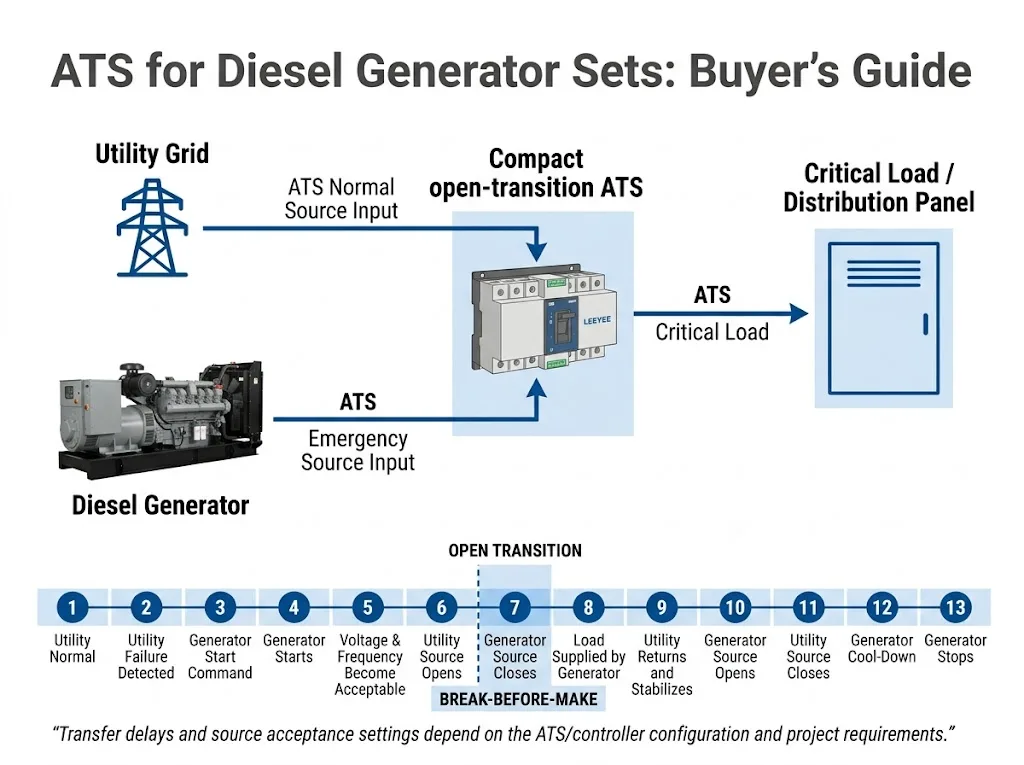
- Utility supplies the load. The ATS monitors the preferred source.
- Utility becomes unacceptable. The controller detects the configured abnormal-source condition.
- The generator receives a start request. The generator controller manages the engine-start sequence.
- The generator builds electrical output. Engine running does not automatically mean the source is ready for transfer.
- The alternate source is accepted. The generator voltage and applicable frequency conditions must satisfy the controller logic.
- The load transfers. In open transition, the first source is disconnected before the second source is connected.
- Utility is monitored for recovery. The normal source must satisfy the configured return conditions.
- The load retransfers to utility. A retransfer delay may be used before returning the load.
- The generator completes its cool-down or stop delay. It can then receive the stop command. [2]
How Does the ATS Start the Diesel Generator?
The ATS normally does not crank the engine directly. Its control system provides a start request to the genset controller, while the generator controller manages cranking, engine protection and generator output build-up. [2]
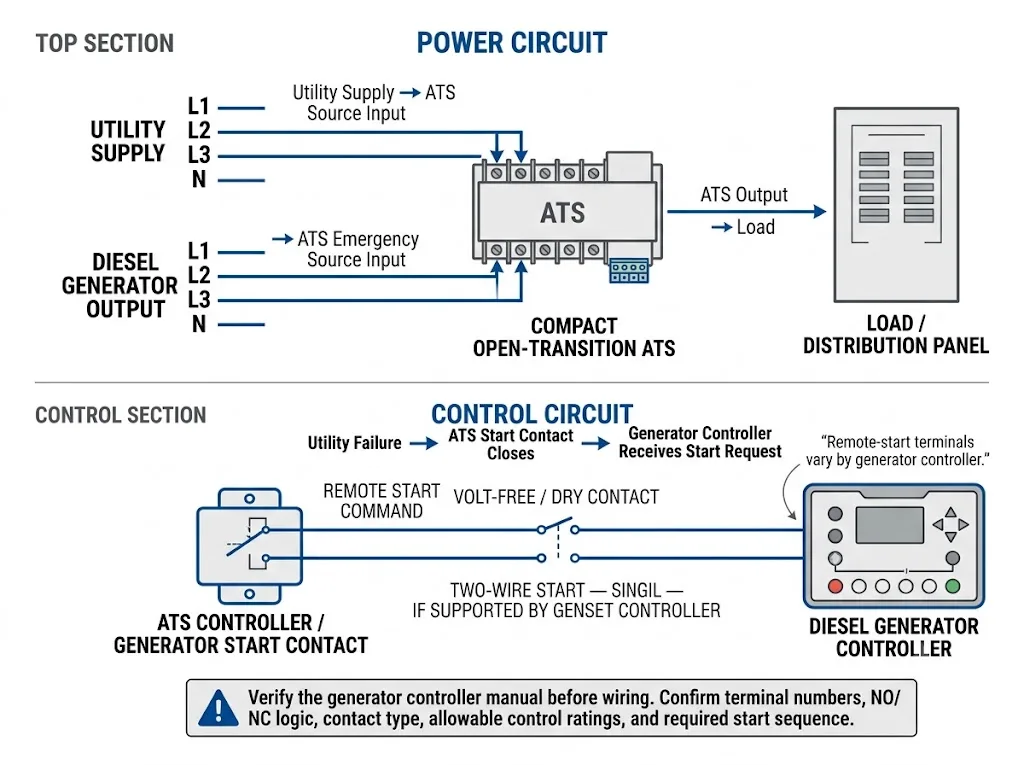
Is the generator start signal always a dry contact?
A volt-free or dry-contact two-wire start arrangement is common in generator integration, but it must not be treated as a universal terminal standard. Generator controllers can differ in terminal assignment, NO/NC logic, input type and permitted electrical characteristics.
When Is the Generator Ready for Load Transfer?
A diesel engine can already be running while its electrical output is still building or stabilising. The alternate source should satisfy the controller's acceptance conditions before the ATS transfers the load. [1]
Should You Use a 2P, 3P or 4P ATS?
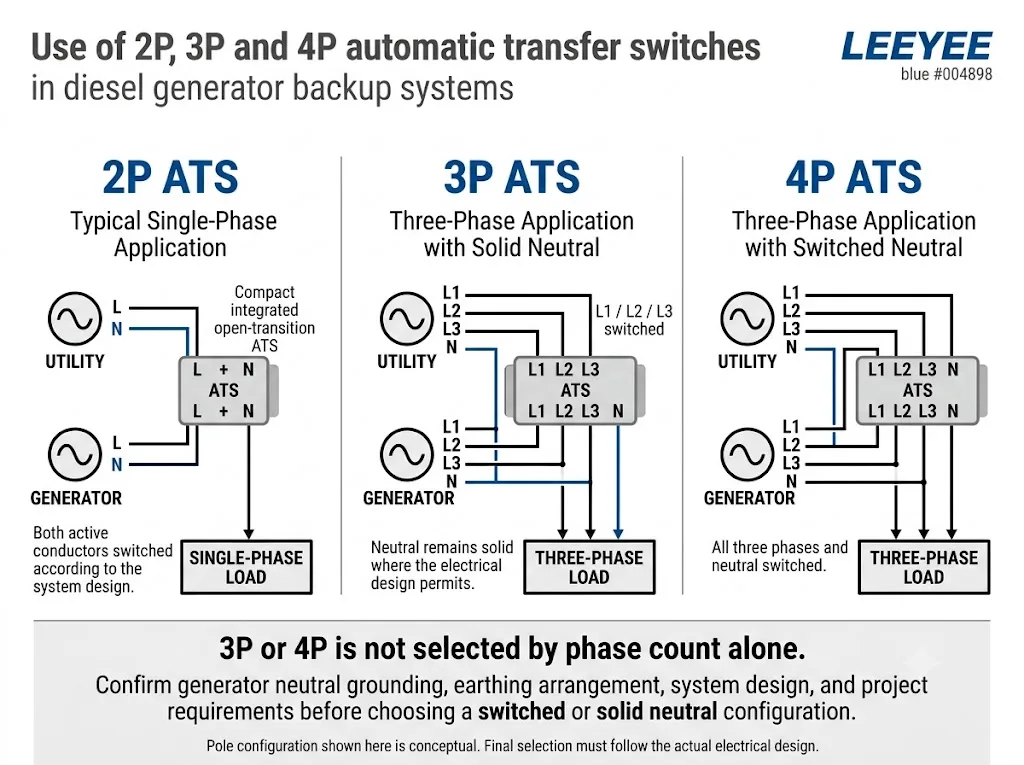
Pole selection starts with the phase arrangement, but phase count alone does not determine whether the neutral should switch. A three-phase diesel generator does not automatically require a 4P ATS.
| ATS | Typical Arrangement | Questão de projeto |
|---|---|---|
| 2P | Single-phase application with two switched conductors | Which conductors must switch in the actual design? |
| 3P | L1, L2 and L3 switched; neutral remains solid | Is a solid neutral suitable for the grounding and protection arrangement? |
| 4P | L1, L2, L3 and neutral switched | Does the system require neutral switching? |
How Do You Match ATS Current to Generator Capacity?
Generator ratings are commonly expressed in kVA, while an ATS is selected with a current rating and other electrical characteristics. Generator kVA can provide a reference full-load current, but it should not be the only selection criterion.
Example: 100 kVA, 400 V, three phase
100,000 ÷ (1.732 × 400) ≈ 144 A.
This is a reference generator full-load current. Final ATS selection still requires review of the actual load, voltage, load characteristics, protection and short-circuit conditions.
Why Is Open Transition Suitable for Standard Generator Backup?
Open transition is a break-before-make transfer. The first source is disconnected before the second source is connected, so the utility and generator are not intentionally paralleled during a standard transfer. [1]
This matches the standard product application discussed on this page: a compact automatic transfer switch used between normal utility power and a backup generator source.
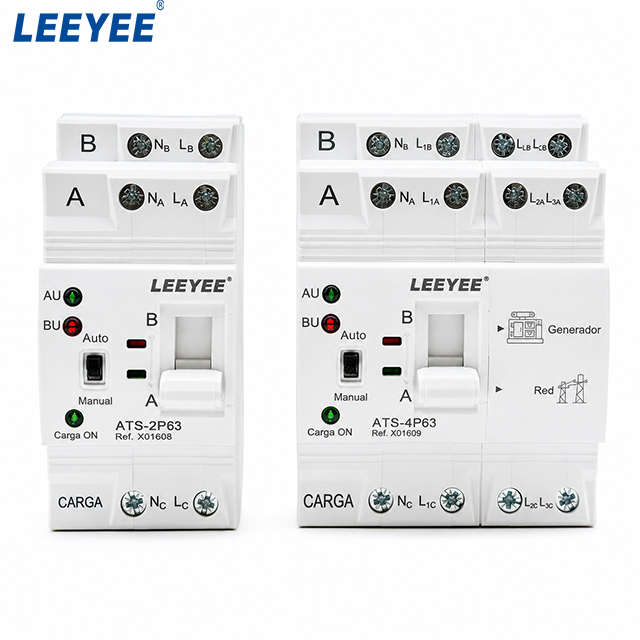
LEEYEE Compact ATS for Generator Backup Applications
The product image shows LEEYEE compact ATS models in 2P and 4P configurations, including Auto/Manual operation and utility/generator source identification. This form factor is intended for compact low-voltage backup-power switching rather than a large bypass-isolation ATS cabinet.
The pictured units provide real product evidence for the type of compact utility-to-generator ATS discussed in this guide. Final voltage, current rating, pole configuration and generator-controller interface still need to be confirmed for the specific project.
Can a Diesel Generator ATS Provide Zero-Interruption Backup?
A standard open-transition ATS does not provide zero-interruption power. Break-before-make transfer creates an interruption, and after a utility failure the diesel generator also requires time to start and reach an acceptable electrical condition.
If a load cannot tolerate this interruption, the project may require a UPS or another ride-through solution in addition to the generator and ATS.
Que informação você deve enviar antes de fazer o pedido?
- Utility rated voltage
- Generator rated voltage
- 50 Hz ou 60 Hz
- Monofásico ou trifásico
- Actual load current
- Generator rated kVA
- Configuração de polos necessária
- Disposição do neutro e da ligação à terra
- Generator controller brand and model
- Remote-start input information
- Upstream breaker or fuse information
- Available fault current where known
- Applicable standard requirement
- Quantidade e requisitos do fabricante original (OEM)
Need to Confirm a Diesel Generator ATS Configuration?
Send your generator controller model, system voltage and frequency, phase arrangement, load current and neutral requirement. LEEYEE can review the compact ATS configuration before quotation.
Perguntas mais frequentes
Does an ATS automatically start a diesel generator?
In a typical utility-to-generator system, the transfer-control system can send a start request after the normal source becomes unacceptable. The generator controller then manages engine starting. The exact interface must be confirmed for the selected genset controller.
Does the ATS transfer as soon as the engine starts?
Not necessarily. The generator can be running before its output satisfies the controller's source-acceptance conditions.
Can I use a 3P ATS with a three-phase diesel generator?
It can be appropriate where the neutral remains solid, but this decision must be based on the grounding, neutral and protection design rather than phase count alone.
When should a 4P ATS be considered?
A 4P ATS switches the neutral together with the three phase conductors. Whether this is required depends on the project grounding and neutral arrangement.
Is a dry contact enough to start every generator?
No universal assumption should be made. Remote-start terminals and electrical logic vary between generator controllers, so the exact controller documentation must be checked.
Can a standard ATS keep sensitive loads powered without interruption?
No. A standard compact open-transition ATS uses break-before-make transfer. Loads that require ride-through may also need a UPS or another suitable backup architecture.
Referências
- Eaton — Noções básicas sobre comutadores automáticos de transferência (ATS). Technical guidance covering source monitoring, generator applications, open transition and neutral-switching concepts. Fonte oficial
- Cummins Power Generation — T-011: Transfer Switch Application Manual, A048F226. Application guidance covering utility-to-generator operation, start signalling, transfer/retransfer logic, current rating and short-circuit application considerations. PDF oficial
- Eaton — 3-Pole and 4-Pole Transfer Switch Switching Characteristics. Technical guidance covering switched neutral, solid neutral, grounding and ground-fault considerations. PDF oficial
- International Electrotechnical Commission — IEC 60947-6-1:2026, Low-voltage switchgear and controlgear — Part 6-1: Multiple function equipment — Transfer switching equipment, Edição 4.0. IEC official source
