
A pump station automatic transfer switch should be selected as part of the complete utility-generator-pump control system, not from pump power alone. For suitable low-voltage pump-control applications, a compact ATS can transfer the control panel between normal and standby sources while the downstream starter, VFD, soft starter, motor protection device and pump controller continue to perform their own functions. IEC 60947-6-1:2026 covers transfer switching equipment used to transfer loads between power sources for continuity of supply.[1]
Índice
Quick Answer: Is a Compact ATS Suitable for a Pump Control Panel?
Yes, when the required pump-control load falls within the verified electrical and switching ratings of the selected ATS. For LEEYEE's compact 2P and 4P open-transition ATS format, suitability should be confirmed from system voltage, motor current, starting method, generator capability, pole configuration and protection design.
Larger pump stations, higher-current motor systems, specialized fire-pump installations, closed-transition systems and bypass-isolation architectures require separate engineering confirmation and should not be assumed to use the same compact ATS.
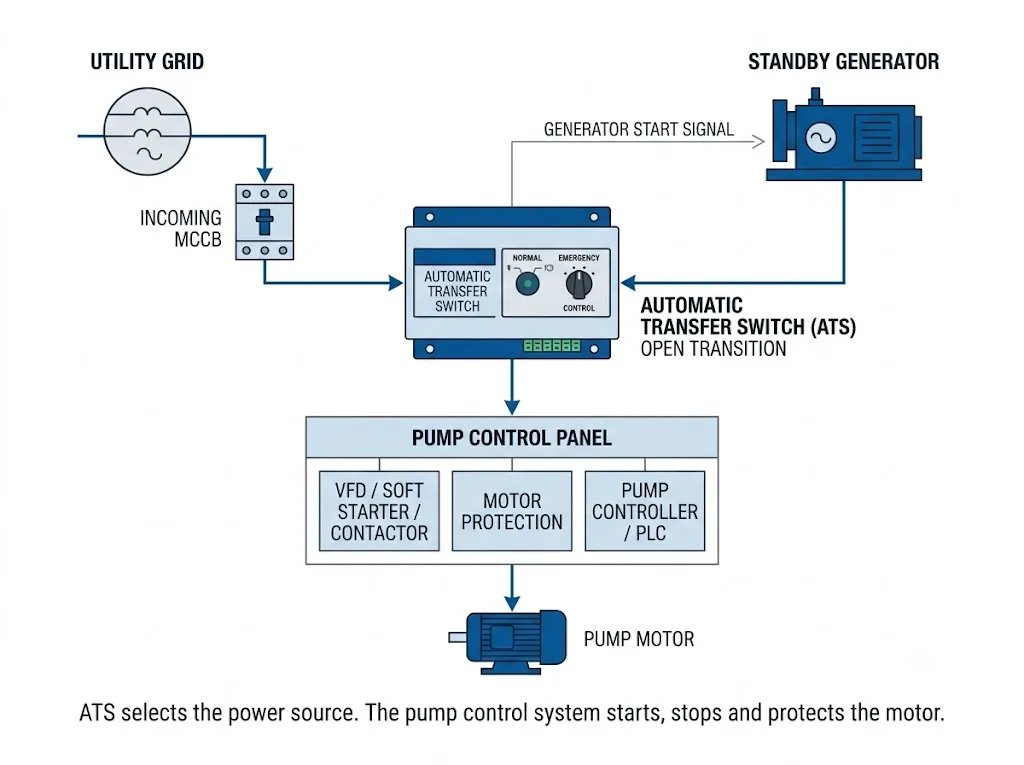
Where Does the ATS Sit in a Pump Control Panel?
In a typical compact pump-control application, the ATS is installed upstream of the pump control equipment. One input receives the normal utility supply and the other receives the standby source, such as a generator. The ATS output then supplies the pump control panel.
The ATS does not replace the motor starter or motor protection. IEC 60947-4-1:2023 separately covers electromechanical contactors, motor starters and motor protective switching devices.[2]
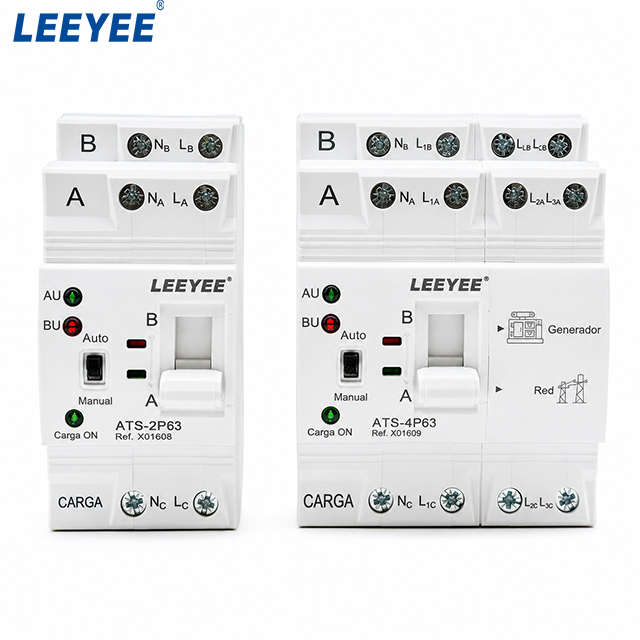
Compact 2P / 4P Open-Transition ATS
The product shown above represents the actual compact LEEYEE ATS format used for suitable low-voltage source-transfer applications. The integrated device combines source switching with front-panel operating and status functions in a compact form suitable for installation inside distribution and control panels.
For a pump-control application, the physical format alone does not prove suitability. The selected model still has to match the real system voltage, motor current, motor-starting duty, generator capability, protection arrangement and project requirements.
How to Select a Pump Station Automatic Transfer Switch
Start with the real pump-system duty rather than the pump kW alone. The first question is whether the required current and switching duty fall within the verified range of the compact ATS being considered.
- Verifique a tensão, a fase e a frequência. Check whether the electrical system matches the available ATS configuration.
- Read the motor nameplate. Record motor rated power and full-load current.
- Confirm the starting method. DOL, star-delta, soft starter and VFD systems create different starting conditions.
- Check simultaneous operation. Determine how many pumps can run or start together.
- Verify the standby generator. Confirm that it can support the required running load and motor-starting sequence.
- Confirm 2P or 4P configuration. Pole selection must match the actual conductor and neutral arrangement.
- Verify the ATS rating. Confirm the selected model against its verified electrical, thermal and short-circuit coordination conditions.
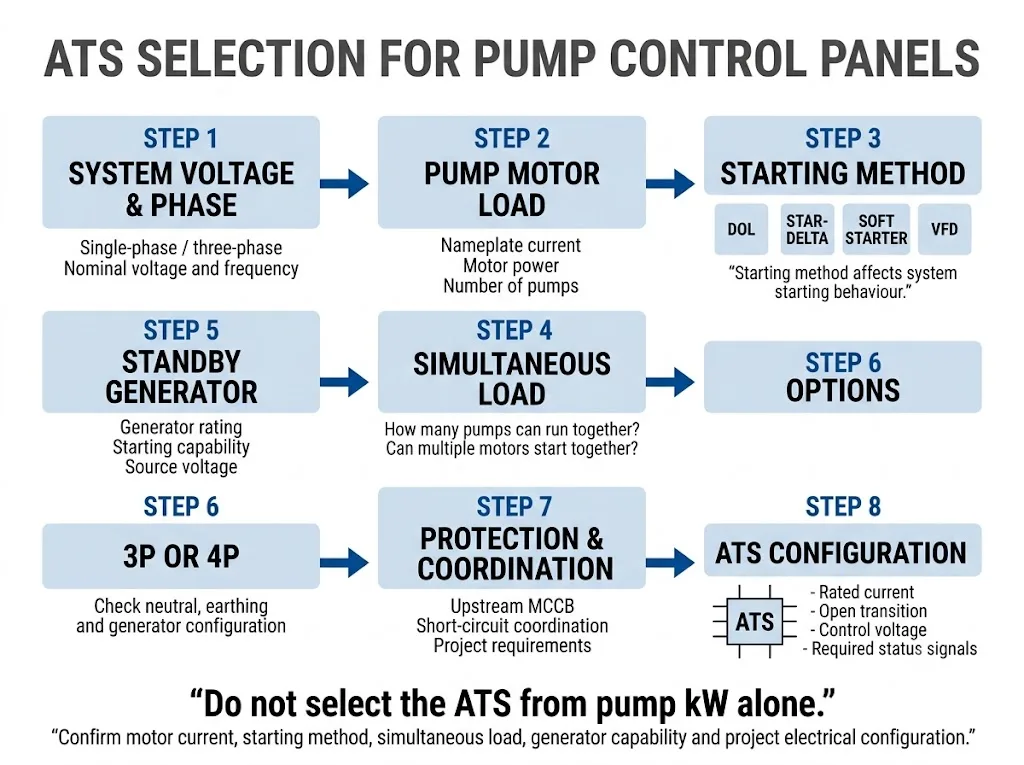
Do Not Size the ATS from Pump kW Alone
Pump power is useful, but it does not describe the complete electrical duty. Two pumps with the same kW rating can create different requirements because their voltage, motor current, starting method and operating sequence may be different.
Generator sizing also depends on more than running kW. Caterpillar's generator sizing guidance includes running demand, starting demand, motor starting method and load steps among the relevant project inputs.[4]
Why Pump Motor Starting Matters
Motor loads deserve additional attention during source transfer. A rotating motor can retain residual voltage after disconnection, and reconnecting it under unfavorable phase, voltage or frequency conditions can create transient current and mechanical stress. Schneider Electric's ASCO technical guidance discusses motor-load transfer and related inrush effects.[3]
| Starting Method | O que deve ser confirmado |
|---|---|
| DOL | Motor starting duty, source capability and applicability of the selected ATS. |
| Star-delta | Starter sequence, transition behaviour and generator response. |
| Soft starter | Configured current limit, acceleration profile and standby-source compatibility. |
| VFD | Drive input requirements, restart logic, harmonics and generator compatibility. |
Do not use one universal current multiplier for all pump motors.
One Pump and Multiple Pumps Are Different Loads
A compact ATS may be suitable for a small pump-control system while being unsuitable for a larger multi-pump station. The number of installed pumps alone does not determine the required transfer capacity; the operating sequence matters.
| Pump Arrangement | Key Question | Selection Impact |
|---|---|---|
| Single pump | What are the running and starting conditions? | Confirm that the required electrical duty remains within the verified system limits. |
| Duty / standby | Can only one pump operate at a time? | Installed motor count may be higher than simultaneous load. |
| Duty / assist | Can two pumps operate together? | Combined operating load may exceed the intended compact ATS application. |
| Large multi-pump station | Are multiple motors operated or started together? | Requires system-level verification and may need a higher-capacity transfer solution. |
Match the ATS with the Standby Generator
The ATS and generator form part of the same standby-power system but perform different functions. The ATS transfers the load; the generator has to provide acceptable emergency power while carrying the required pump load.
A generator that supports the steady running load may still require further checking for motor starting, voltage dip, frequency dip and load sequencing. Final generator sizing should follow the generator manufacturer's technical data or approved sizing tools.[4]
2P or 4P for a Pump Control Panel?
The LEEYEE product format shown on this page includes compact 2P and 4P versions. The pole configuration must match the electrical system rather than being selected from pump power.
| Configuração | General Application Logic | Confirme Antes de Pedir |
|---|---|---|
| 2P | Used where a suitable single-phase source requires two-pole transfer. | System voltage, conductor arrangement and project requirements. |
| 4P | Used where four-pole switching is required by the three-phase system design. | Phase/neutral arrangement, earthing, generator connection and protection scheme. |
Do not assume that every generator-backed system automatically requires 4P. The project electrical design must confirm the neutral and earthing arrangement.[5]
MCCB, ATS and Motor Protection Have Different Jobs
The compact ATS should not be presented as an all-in-one pump protection device. Transfer switching, feeder protection, motor starting and motor protection are separate functions.[1][2]
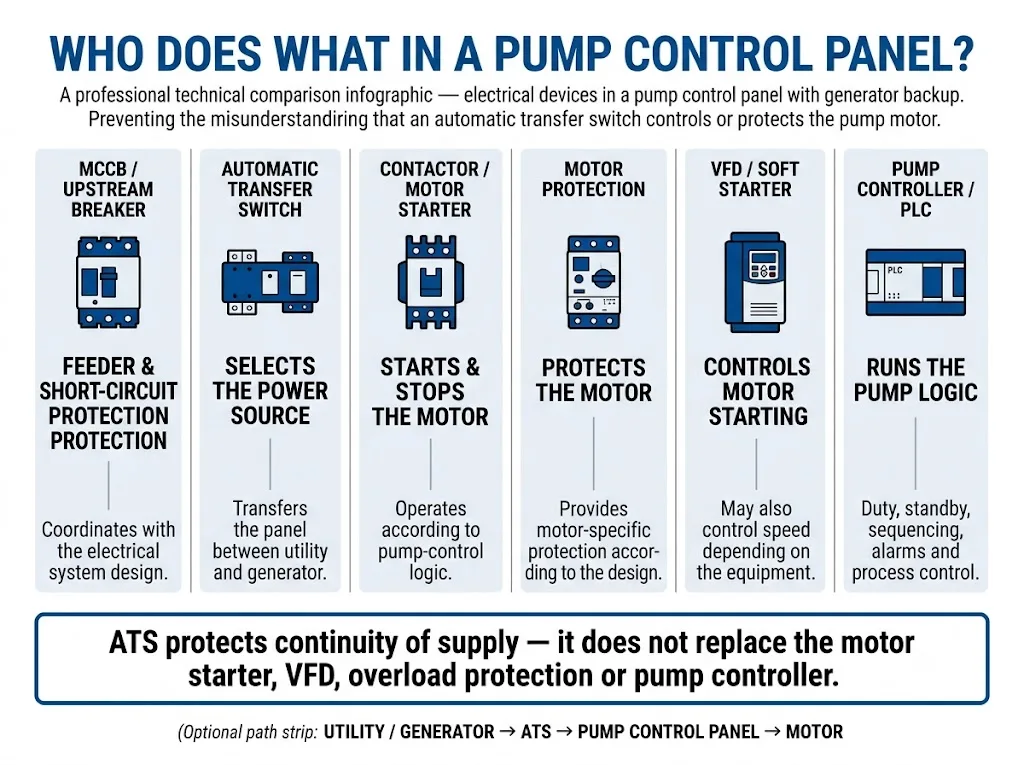
| Dispositivo | Função Principal |
|---|---|
| MCCB / upstream protection | Feeder and short-circuit protection according to the system design. |
| LEEYEE compact ATS | Transfers the pump-panel supply between the normal and standby sources. |
| Contactor / starter | Starts and stops the motor. |
| Motor protection device | Provides motor-specific protection functions defined by the panel design. |
| VFD / soft starter | Controls motor acceleration and, where applicable, operating speed. |
| Pump controller / PLC | Controls duty, standby, sequencing, level logic and alarms. |
Transfer Delays Are a System Function, Not an Assumed Product Feature
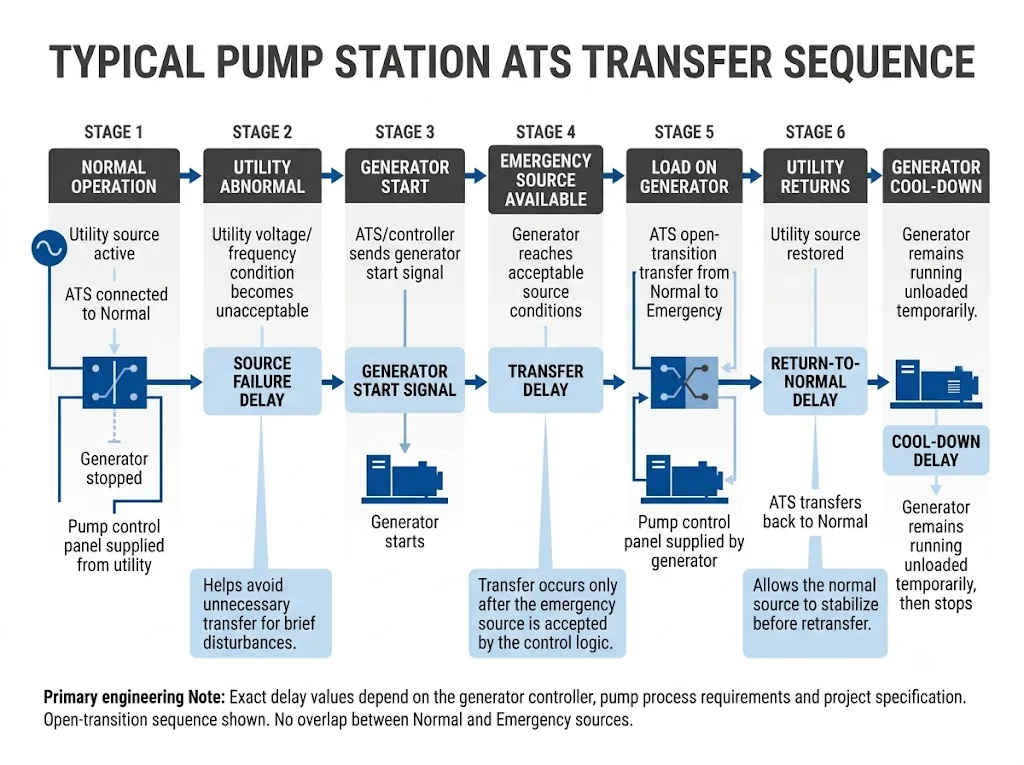
Pump-station systems may require source-failure delay, generator-start timing, retransfer delay or generator cool-down logic. Real pump-station specifications often include these functions.[6]
These functions must not automatically be attributed to the compact LEEYEE ATS unless the selected model documentation specifically confirms them. Depending on the project, timing logic may be implemented by the ATS controller, generator controller, PLC or another external control device.
Remote Monitoring Must Be Confirmed Model by Model
Some pump stations require PLC, BMS or SCADA feedback such as source availability, load position or alarm status. Pump-station design criteria can distinguish source availability from ATS switch position.[7]
The product image alone does not prove that a selected LEEYEE ATS provides dry contacts, Modbus, RS485 or another communication interface. If remote monitoring is required, confirm the actual terminal functions and communication capability from the selected model's verified technical documentation before panel design.
Outdoor Pump Stations Need a Suitable Completed Enclosure
The compact ATS shown here is an internal panel device. Using it in an outdoor pump station does not mean the ATS itself determines the final enclosure protection level.
The completed pump-control panel should be designed for the real installation environment, including:
- required enclosure protection;
- ambient temperature and humidity;
- condensation control;
- corrosion conditions;
- ventilation and thermal management;
- cable-entry sealing;
- device spacing and clearances.
Which Pump Applications Fit This Compact ATS Format?
| Aplicação | Fit with the Compact ATS Format |
|---|---|
| Small pump control panel with utility / generator backup | Potentially suitable after voltage, current and motor-duty verification. |
| Agricultural irrigation control panel | Potentially suitable where the verified load remains within the selected model's ratings. |
| Small water-treatment or drainage equipment panel | Potentially suitable with project-specific electrical confirmation. |
| Multi-pump high-current station | Do not assume suitability; calculate the real combined load and required transfer capacity. |
| Large municipal pump station | Requires separate engineering review and may need a higher-capacity transfer solution. |
| Fire pump controller | Requires dedicated standards and project confirmation; standard suitability must not be assumed. |
Engineering Note: Fire Pump Applications
Before Ordering: Pump Control Panel ATS Checklist
Envie estes detalhes do projeto
Need to Confirm Whether This Compact ATS Fits Your Pump Panel?
Send the system voltage, motor current, starting method, number of pumps and generator information. LEEYEE can check whether the compact 2P / 4P open-transition ATS format is suitable or whether the project requires another transfer solution.
Perguntas mais frequentes
Is this compact LEEYEE ATS suitable for every pump station?
No. It can be suitable for appropriate low-voltage pump-control applications, but the final decision depends on voltage, current, motor-starting duty, generator capability, protection requirements and the verified ATS ratings.
Can I select the ATS from pump kW alone?
No. Pump kW does not show the complete motor-starting condition or simultaneous load. Confirm the motor nameplate current, starting method and actual operating sequence.
Does the ATS control the pump motor?
No. The ATS transfers the incoming power source. The downstream pump controller, starter, contactor, VFD or soft starter controls motor operation.
Does this ATS include programmable transfer delays?
Do not assume so from the product appearance. Required timing functions must be confirmed from the selected ATS model documentation and the complete control-system design.
Can this ATS communicate with PLC, BMS or SCADA?
Only when the selected model provides the required output or communication interface. Confirm actual dry contacts, terminals and communication functions before panel design.
Can this compact ATS be used for a large municipal pump station?
Do not assume so. Large pump stations can require higher current, greater motor-starting capability, more complex control and different short-circuit performance. A separate engineering review is required.
Can this ATS be used for a fire pump controller?
Suitability must not be assumed. Fire-pump transfer applications can have dedicated standards, certifications and project requirements.[1]
Confirm the Application Before Ordering
Share the pump-panel load data and utility-generator configuration so the project can be checked against the actual LEEYEE ATS capability rather than selected from the application name alone.
Referências
- International Electrotechnical Commission (IEC). IEC 60947-6-1:2026 — Aparelhagem de baixa tensão — Parte 6-1: Equipamentos multifuncionais — Equipamentos de comutação de transferência. Página de publicação oficial da IEC.
- International Electrotechnical Commission (IEC). IEC 60947-4-1:2023 — Low-voltage switchgear and controlgear — Part 4-1: Contactors and motor-starters. Página de publicação oficial da IEC.
- Schneider Electric / ASCO. Motor Load Transfer Made Simple. Official technical bulletin.
- Caterpillar Electric Power. Generator Sizing Resources. Official sizing resource.
- Schneider Electric / ASCO. Configurações do neutro em comutadores de transferência. Official technical bulletin.
- Fulton County Public Works. Sewer Pump Station & Force Main Design Guidelines. Official guideline PDF.
- Fairfax County Department of Public Works and Environmental Services. Wastewater Pump Station Facility Design Criteria, Version 8.0. Official design criteria PDF.
