
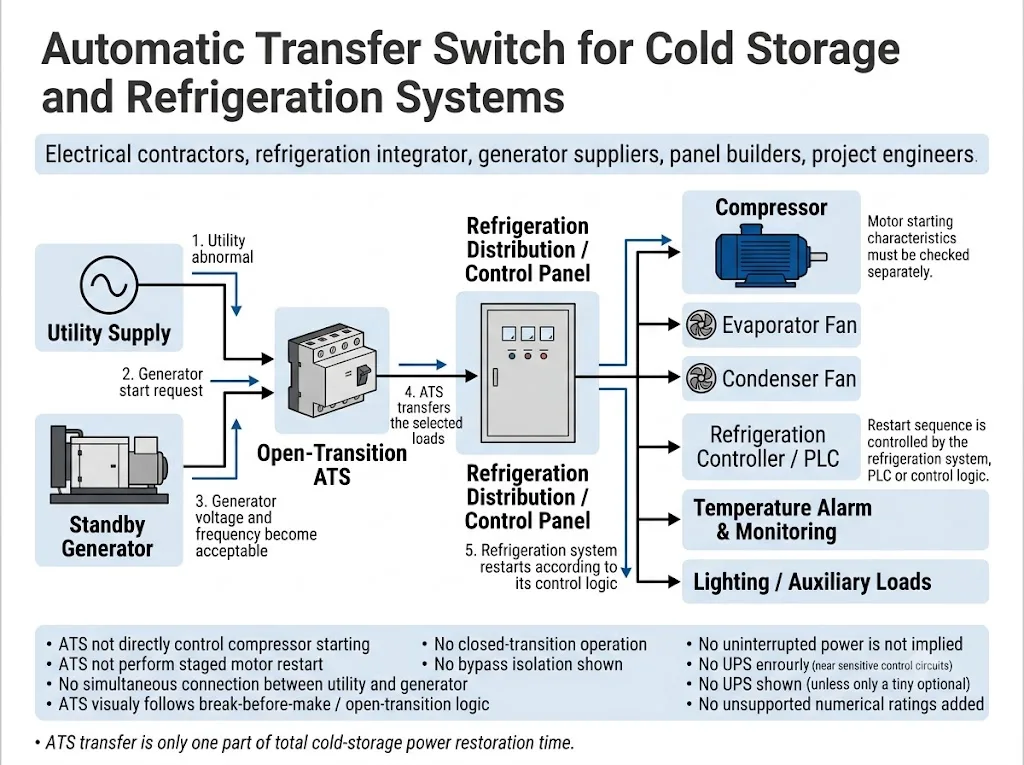
Selecting an automatic transfer switch for a cold-storage or refrigeration system is not simply a matter of matching an ATS ampere rating to the total refrigeration load. The correct selection depends on which circuits will transfer, whether compressor motors pass directly through the ATS, how the standby generator accepts those loads, the phase and neutral arrangement, and how much interruption the refrigeration system can tolerate.
A compact open-transition automatic transfer switch can be used in many cold-storage backup-power architectures, but the ATS should be selected from the electrical system and transferred-load characteristics, not from cold-room size or compressor kW alone.
Before fixing the ATS model, confirm the transferred load list, continuous current, compressor starting method, generator capacity, phase and pole configuration, neutral arrangement, acceptable interruption and refrigeration restart sequence.
Most important: if the ATS directly switches compressor or other motor circuits, do not assume suitability from the ampere rating alone. The marked utilization category, motor-switching duty and project requirements must also be confirmed.[1][5]
สารบัญ
What Actually Determines ATS Selection in a Cold-Storage Project?
The first question is not “How large is the cold room?” It is “What electrical load will the automatic transfer switch actually carry?”
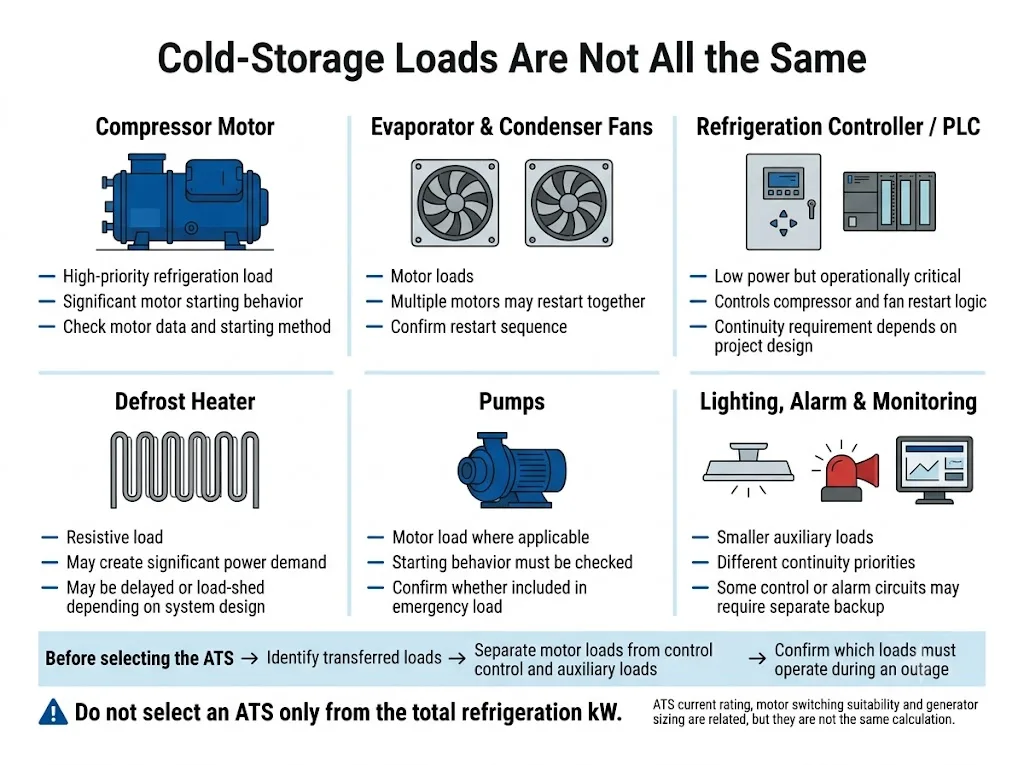
A cold-storage installation may include compressor motors, condenser and evaporator fans, pumps, defrost heaters, refrigeration controllers, PLCs, alarms, monitoring equipment and lighting. These loads do not behave in the same way when utility power fails or when standby power becomes available.
| รายการที่ต้องยืนยัน | เหตุผลที่สำคัญ | What the Buyer Should Provide |
|---|---|---|
| Transferred loads | Defines what the ATS must continuously carry | Load schedule or circuit list |
| Compressor motors | Motor starting and reconnection can create demanding electrical conditions | Motor current, power and starting method |
| เครื่องกำเนิดไฟฟ้า | Must support steady running load and transient starting demand | Generator kW/kVA, voltage and controller data |
| Phase and neutral | Affects pole selection and whether neutral switching needs evaluation | Single-line diagram and earthing arrangement |
| Interruption tolerance | Determines whether ordinary open-transition transfer is acceptable | Process and control-system requirements |
| Restart sequence | Prevents assuming every refrigeration load should reconnect simultaneously | Refrigeration controller or PLC logic |
ข้อสรุปด้านการจัดซื้อ: ATS selection should begin with the transferred-load architecture, not with a single compressor power figure.
Cold-Storage Loads Should Not Be Treated as One Identical Load
Compressor motors
Compressor motors are usually among the most important loads to evaluate. Motor-driven equipment can require substantially more power during starting than during normal running, and generator application guidance requires starting and transient demand to be considered separately from steady-state load.[4]
For engineering review, “15 kW compressor” alone is not enough. Useful information includes motor rated current, motor power, starting method, number of compressors and whether several motors can restart at the same time.
Evaporator and condenser fans
Fan motors may be smaller than the main compressor, but several fans can reconnect together. Their combined contribution should therefore appear in the load schedule and restart strategy.
Refrigeration controller, PLC and monitoring
Control and monitoring circuits may consume much less power than a compressor but can be operationally critical. If a controller, alarm or monitoring system cannot tolerate a short interruption, that continuity requirement must be addressed separately in the electrical design. An ordinary open-transition ATS is not an uninterruptible power supply.[2]
Defrost heaters and auxiliary loads
Defrost heaters are primarily resistive loads, while lighting and other auxiliary circuits may have different priorities. Depending on the project, non-critical loads may be delayed or excluded from emergency operation to reduce generator demand.
Do not size a cold-storage backup system from one total-kW figure. Generator application guidance distinguishes steady-state load from starting and transient requirements, and sequencing can reduce the amount of load applied at one time.[4]
Can an Automatic Transfer Switch Switch a Refrigeration Compressor Directly?
It can only be confirmed after reviewing the actual transfer-switch rating and circuit arrangement. An ATS that is suitable for distribution or lightly inductive duty should not automatically be assumed suitable for direct compressor motor switching simply because its rated current is higher than the compressor running current.
IEC 60947-6-1:2026 covers low-voltage transfer switching equipment and establishes requirements for transfer-switch performance and declared characteristics. Final application suitability must therefore be checked against the selected device documentation and the actual project duty.[1]
Transfer-switch application guidance also treats motor switching as a specific duty because switching motors imposes different making and breaking conditions from ordinary non-inductive or lightly inductive loads.[5]
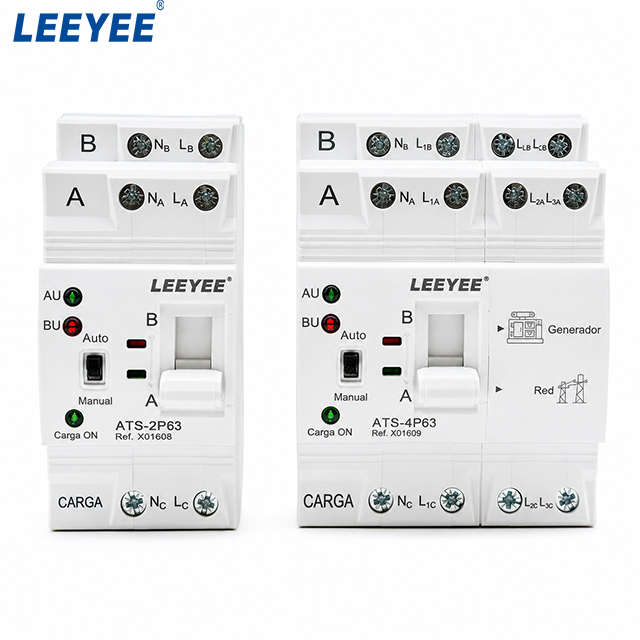
How this product fits a cold-storage project: the compact LEEYEE ATS shown above is best treated as a source-transfer device within the refrigeration distribution architecture. A typical arrangement is utility + generator → compact ATS → refrigeration distribution/control panel → compressors, fans, controllers and auxiliary loads.
Current public information for the compact ATS-63 lists 2P and 4P configurations, 6–63 A current options and utilization category AC-31B.[6] Therefore, do not conclude that a 63 A ATS-63 is suitable for directly switching a compressor merely because the compressor running current is below 63 A.
If compressor or other motor circuits pass directly through the ATS, the specific motor duty, utilization category, protection arrangement and project requirements must be confirmed before model approval.
ATS Sizing and Generator Sizing Are Related but Not Identical
The automatic transfer switch must carry the transferred load continuously and perform its declared transfer duty. The generator must supply the steady-state demand and also tolerate the transient demand created as motors and other major loads are started or reconnected.
Cummins generator application guidance explains that motor-driven loads may require considerably more power while starting than while running and that abrupt application of a large load can produce voltage and frequency disturbances if the generating set is not adequately selected.[4]
| ATS Selection Checks | Generator Selection Checks |
|---|---|
| Continuous transferred current | Total running load |
| Voltage and frequency | แรงดันและความถี่ของเครื่องกำเนิดไฟฟ้า |
| จำนวนขั้ว | Available kW and kVA |
| Utilization category and switching duty | Motor starting and transient capability |
| Open-transition suitability | Step-load acceptance and recovery |
| Short-circuit coordination | Generator protection and control strategy |
ความหมายเชิงวิศวกรรม: a generator may need additional capacity for motor starting even when the ATS continuous-current rating appears adequate.
จะเกิดอะไรขึ้นเมื่อระบบไฟฟ้าสาธารณะหยุดทำงาน?
A common misunderstanding is to treat ATS switching time as the entire cold-storage restoration time. It is not.
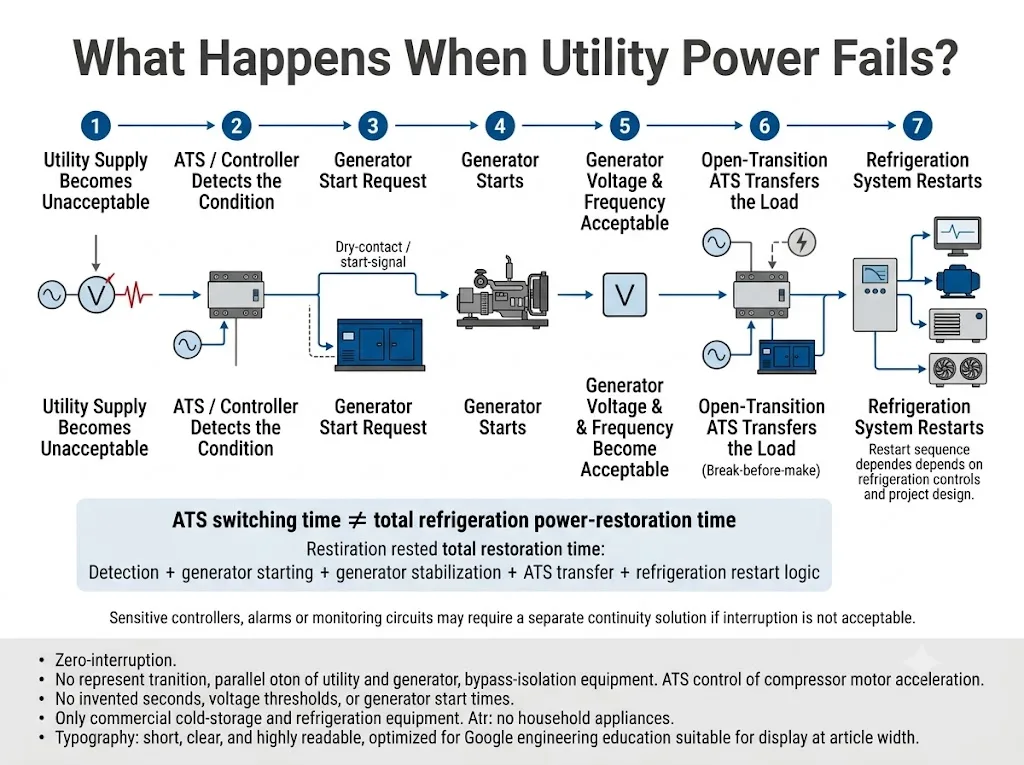
Utility power becomes unacceptable
The ATS or associated controller detects that the normal source is outside the configured acceptable conditions.
The generator receives a start request
The standby generator begins its start sequence. The actual start-signal interface depends on the ATS, generator controller and project wiring.
The generator becomes an acceptable source
The emergency source must become suitable for transfer before the load is connected. Generator starting and stabilization time is separate from the ATS contact-transfer interval.
The ATS transfers the selected load
In open transition, the first source is disconnected before the second source is connected. This is break-before-make operation, so an intentional interruption occurs during transfer.[2]
The refrigeration system executes its restart logic
Compressors, fans, pumps and auxiliary equipment should restart according to the refrigeration controller, PLC, motor starters and wider system design. The ATS should not be assumed to perform compressor sequencing by itself.
ATS switching time is not total refrigeration recovery time. Generator starting, source stabilization and compressor restart delays can make the complete restoration sequence much longer than the ATS contact-transfer interval.
Is Open-Transition ATS Suitable for Cold Storage?
Open transition can be suitable for cold-storage applications where the selected loads and controls are designed to tolerate a short interruption. During open-transition transfer, the normal source is disconnected before the emergency source is connected.[2]
That does not make open transition universally suitable. The engineer should confirm interruption tolerance for the refrigeration controller, compressor control logic, alarms, monitoring equipment and any other critical circuit.
If a controller or monitoring circuit requires uninterrupted power, the project may need a separate continuity solution for that circuit rather than assuming that the entire refrigeration system requires a different transfer architecture.
LEEYEE standard product scope for this article: the normal product direction is a compact open-transition ATS. Closed-transition and bypass-isolation systems should be treated as separate engineered solutions rather than standard compact ATS features.
Should All Refrigeration Compressors Restart at the Same Time?
They should not be assumed to do so.
When several motors are applied to a generator at the same time, the combined transient demand can be much more difficult for the generating set than the normal running load. Generator application guidance describes load-step sequencing as one method of reducing the amount of load applied at one time.[4]
In a cold-storage project, this sequencing may be handled by the refrigeration controller, PLC, motor starters, generator controls or a wider power-management design.
The ATS transfers the power source. It should not be credited with compressor sequencing, motor starting or load-management functions unless those functions are specifically documented for the selected system.
How to Select an ATS for a Cold-Storage System
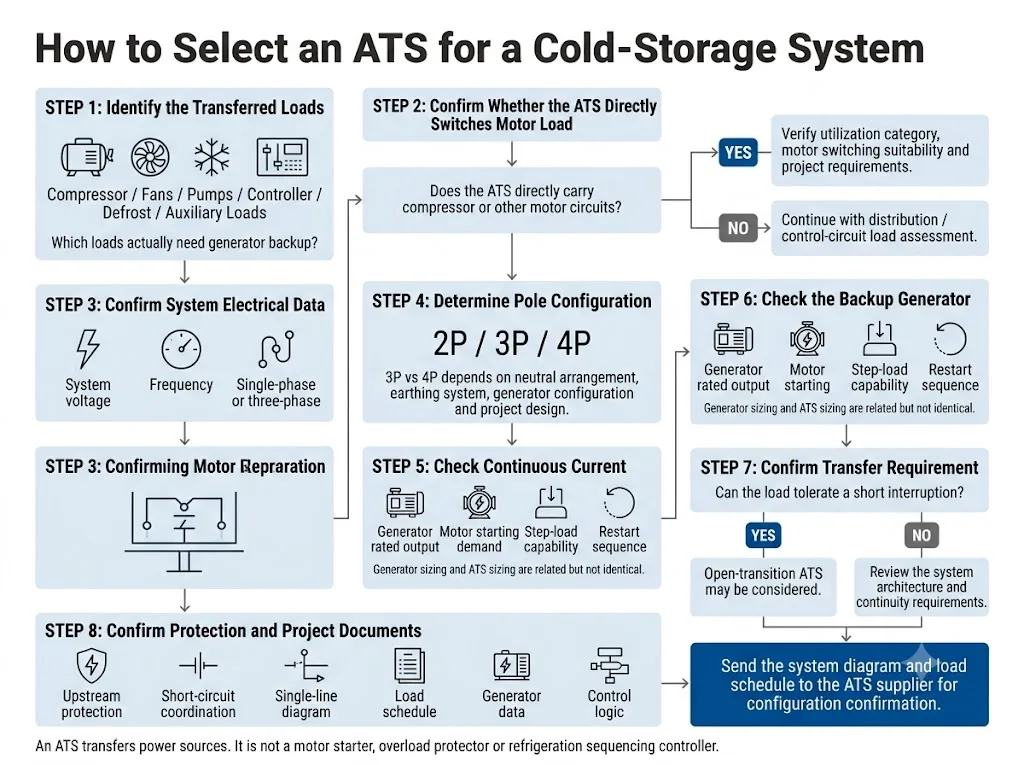
Identify the actual transferred loads
List every circuit that must operate during a utility outage. Separate essential refrigeration loads from circuits that can be delayed or excluded from generator operation.
Confirm whether compressor motors pass directly through the ATS
If the ATS directly switches motor circuits, verify its declared utilization category, motor-switching capability and project suitability. Do not infer this from ampere rating alone.[1][5]
Confirm system voltage, frequency and phase
Match the ATS to the actual system voltage and frequency. Confirm whether the project is single-phase or three-phase before choosing the pole configuration.
Determine the required pole configuration
Pole selection is not simply “single-phase equals 2P” or “three-phase equals 4P” in every project. Neutral treatment depends on source configuration, earthing arrangement and electrical design.
Schneider Electric distinguishes solid-neutral and switched-neutral transfer arrangements and explains that a switched-neutral design uses an additional pole to transfer the neutral between sources.[3]
Current public information for the LEEYEE ATS-63 lists 2P and 4P versions. Final pole selection must still match the project wiring and applicable electrical design.[6]
Calculate continuous transferred current
Use the real load schedule and applicable design requirements. Do not choose an ATS only from cold-room floor area, refrigeration capacity or one compressor nameplate value.
Check generator capacity separately
Confirm continuous generator capacity, motor-starting demand, voltage/frequency response and expected load steps. The generator must remain within acceptable operating limits while refrigeration equipment is restored.[4]
Confirm acceptable transfer interruption
If the selected refrigeration and control loads can tolerate break-before-make transfer, open transition may be appropriate. If not, the system architecture requires further engineering review rather than an assumption that the standard ATS can provide uninterrupted power.[2]
Review protection and short-circuit coordination
An ATS is not a substitute for circuit breakers, fuses, motor protection or overload protection. Available fault current, upstream/downstream protection and transfer-switch short-circuit ratings must be checked within the complete panel design.
Why Delay Settings Matter in Refrigeration Backup Power
Delay functions can help prevent the system from reacting to every brief utility disturbance and can allow the standby source to become stable before transfer. Separate restart delays may also be used by refrigeration controls to avoid reconnecting several motors at the same instant.
There is no single delay value that is correct for every cold room. Utility quality, generator characteristics, compressor controls, process requirements and equipment documentation all affect the appropriate setting.
จำเป็นต้องมีการยืนยันโครงการ: do not apply a universal 5-second, 10-second or other fixed ATS delay unless that value is supported by the selected ATS, generator, refrigeration controller and project specification.
Common Cold-Storage ATS Selection Mistakes
Choosing the ATS from compressor running current only
Running current is important, but it does not prove that a transfer switch is suitable for the required motor-switching duty.
Assuming a larger ampere rating solves every problem
A higher ATS current rating does not automatically solve utilization-category, neutral, fault-current, motor-transfer or generator-starting issues.
Assuming the ATS controls compressor sequencing
Compressor sequencing normally belongs to the refrigeration controller, PLC, starter logic, generator control system or wider power-management design.
Ignoring neutral configuration
Whether the neutral remains solidly connected or is switched is a system-design question and should be checked against source configuration, earthing arrangement and project requirements.[3]
Treating open transition as uninterrupted power
Open-transition transfer intentionally disconnects one source before connecting the other. The load therefore experiences an interruption during the transfer process.[2]
Information to Prepare Before Ordering
Cold-storage ATS project checklist
ระบบไฟฟ้า
- แรงดันระบบพิกัด
- ความถี่
- ระบบไฟฟ้าเฟสเดียวหรือสามเฟส
- การจัดวางแบบกลาง
- ระบบต่อดิน
- แผนภาพเส้นเดี่ยว
Refrigeration load
- Total transferred running current
- Compressor quantity
- Individual motor ratings and rated current
- Motor starting method: DOL, star-delta, soft starter, VFD or other
- Evaporator and condenser fan loads
- Pumps and defrost heaters
- Control, alarm and monitoring circuits
- Critical and non-critical load classification
Standby source
- Generator rated kW / kVA
- แรงดันและความถี่ของเครื่องกำเนิดไฟฟ้า
- Generator controller model or relevant technical data
- Remote-start interface requirements
- Expected load-restoration sequence
ATS and panel requirements
- Required rated current
- การกำหนดค่าขั้วที่ต้องการ
- Whether the ATS directly carries motor circuits
- Acceptable interruption during transfer
- Available short-circuit current and protective-device arrangement
- Installation method and available panel space
- Required standard, certification or project documentation
- Quantity and OEM / private-label requirements
Need to confirm an ATS configuration for a cold-storage project?
Send the single-line diagram, transferred-load schedule, compressor motor data and generator specifications. LEEYEE can review the electrical configuration and help confirm whether a compact ATS fits the intended transfer duty.
คำถามที่พบบ่อย
Can an automatic transfer switch power a cold-storage compressor?
An ATS can form part of the supply path to a refrigeration compressor, but direct motor-switching suitability must be verified from the actual ATS ratings, utilization category, product documentation and circuit arrangement. Ampere rating alone is not enough.[1][5]
Should ATS size be based on compressor starting current?
ATS continuous-current selection and generator motor-starting calculations are related but not identical. The ATS must meet its declared load-switching duty and continuous-current requirements, while the generator must also handle transient power demanded when motors start or reconnect.[4][5]
Is a 4-pole ATS always required for a three-phase cold room?
No universal rule should be applied without reviewing the system. The decision depends on whether the neutral must be switched, the earthing arrangement, generator configuration and project requirements. Switched-neutral ATS arrangements use an additional pole for the neutral.[3]
How long will a cold-storage system lose power during generator transfer?
Total restoration time includes utility-failure detection, generator starting, generator stabilization, ATS transfer and refrigeration restart logic. The ATS contact-transfer interval is only one part of the complete process.
Is open-transition ATS suitable for refrigeration systems?
It can be suitable when the selected refrigeration and control loads tolerate a short interruption. Open transition is break-before-make, so the load is intentionally disconnected between sources. Circuits requiring greater continuity need separate engineering review.[2]
Should compressors restart automatically after ATS transfer?
Restart behavior should be determined by the refrigeration equipment, PLC, motor starters and project control logic. The ATS transfers the power source; it should not automatically be assumed to control compressor restart sequencing.
เอกสารอ้างอิง
- IEC — IEC 60947-6-1:2026, Low-voltage switchgear and controlgear — Part 6-1: Multiple function equipment — Transfer switching equipment. หน้าการเผยแพร่อย่างเป็นทางการของ IEC.
- Schneider Electric / ASCO — What are the different ASCO ATS transition modes? Open transition is described as break-before-make operation. Schneider Electric technical FAQ.
- Schneider Electric / ASCO — What neutral configurations are available for ASCO Transfer Switches? Technical explanation of solid and switched-neutral transfer arrangements. Schneider Electric technical FAQ.
- Cummins Power Generation — Application Manual: Liquid Cooled Generator Sets. Guidance covering running load, motor starting requirements and load-step sequencing. คู่มือการใช้งาน Cummins.
- Cummins Power Generation — คู่มือการใช้งานสวิตช์เปลี่ยนแหล่งจ่ายไฟ. Guidance covering transfer-switch application and motor-load switching considerations. Cummins transfer-switch application manual.
- LEEYEE — ATS-63 Automatic Transfer Switch 2P / 4P 6A–63A for Backup Power Systems. Public product data lists current options, 2P/4P configurations and utilization category AC-31B. หน้าผลิตภัณฑ์ LEEYEE ATS-63.
