
A marine automatic transfer switch can be considered when a low-voltage load needs to transfer automatically between two AC sources such as shore power and a generator. For a vessel, port-equipment panel or marine auxiliary system, however, choosing the ATS by ampere rating alone is not enough. Voltage, frequency, poles, neutral arrangement, transfer method, protection coordination, environmental conditions and any required marine approval must all be confirmed.
A compact automatic transfer switch may be suitable for selected marine auxiliary and port-equipment low-voltage systems, but a standard ATS should not automatically be described as a marine-certified transfer switch.
IEC 60947-6-1:2026 covers transfer switching equipment used to transfer a load between power sources, while the IEC 60092 series addresses electrical installations and low-voltage assemblies used in ships.[1][2][3] The ATS device, the complete panel and any vessel or classification approval therefore need to be evaluated separately.
สารบัญ
Marine ATS Selection at a Glance
Start with the actual source arrangement and load. A buyer searching for a marine automatic transfer switch normally needs to answer one system question first: which two sources are being transferred, and what must remain connected to the load?
| การจัดวางระบบ | ตรวจสอบก่อนเป็นอันดับแรก | ความหมายของผู้ซื้อ |
|---|---|---|
| Shore power + generator | Voltage, frequency, source priority and interlocking | Confirm how the generator becomes available and how unintended source overlap is prevented. |
| Shore power + another AC source | Source compatibility and neutral arrangement | The ATS cannot make electrically incompatible sources equivalent. |
| Single-phase auxiliary circuit | Current and conductor switching | Confirm whether line and neutral must both be transferred. |
| Three-phase auxiliary circuit | การจัดวางแบบ 3P หรือ 4P | Neutral switching must follow the actual electrical design. |
| Classed vessel or specified project | Required approval and documentation | Electrical ratings alone do not establish classification acceptance. |
ข้อสรุปด้านการจัดซื้อ: “I need a 63A marine ATS” is not enough information. A useful technical enquiry should describe the two sources, voltage, frequency, phase, neutral arrangement, load and project approval requirements.
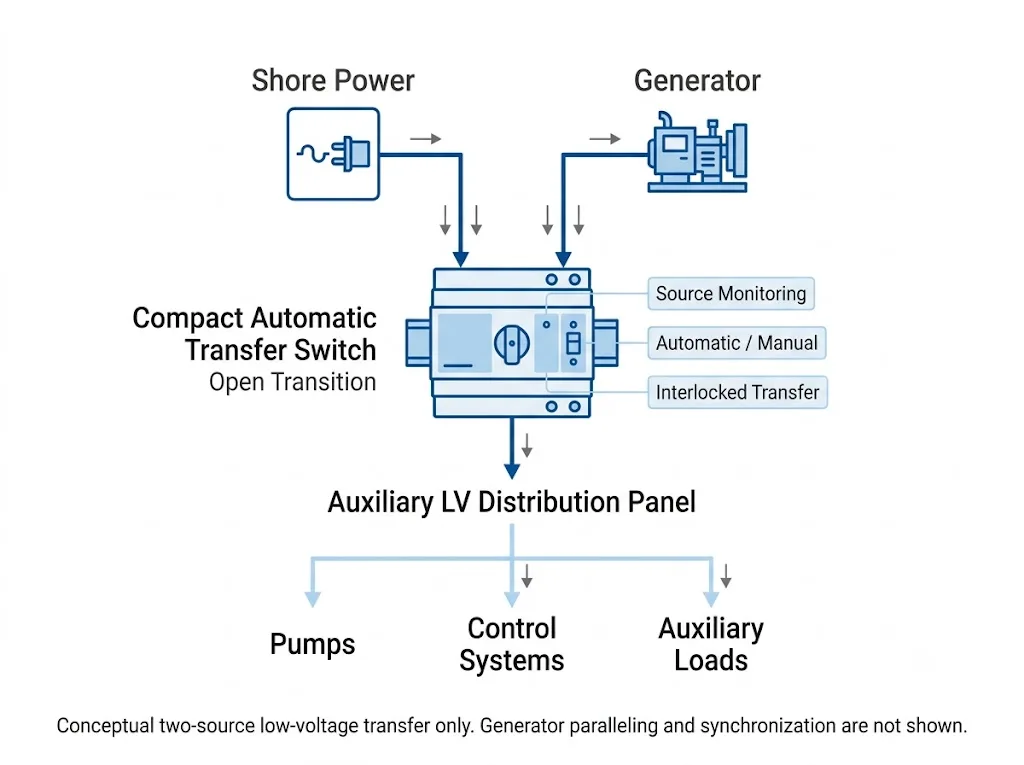
Where Does the ATS Sit Between Shore Power, Generator and the Load?
The compact ATS discussed on this page is a transfer device between two low-voltage sources and one load circuit. IEC 60947-6-1:2026 applies to transfer switching equipment used to transfer a load between power supply sources within the standard's scope.[1]
A transfer device is not the same thing as a complete marine electrical assembly. IEC 60092-302-2:2025 addresses low-voltage marine power switchgear and controlgear assemblies and distinguishes complete assemblies from the individual devices installed inside them.[2]
This page concerns compact two-source low-voltage transfer. Generator paralleling, bus-tie control, synchronization, load sharing, power-management systems and complete marine main-switchboard design are separate engineering subjects.
How Does Shore-Power-to-Generator Transfer Work?
For the standard compact ATS configuration discussed here, the relevant concept is primarily open transition. Open transition is break-before-make: the connected source is disconnected before the alternative source is connected.
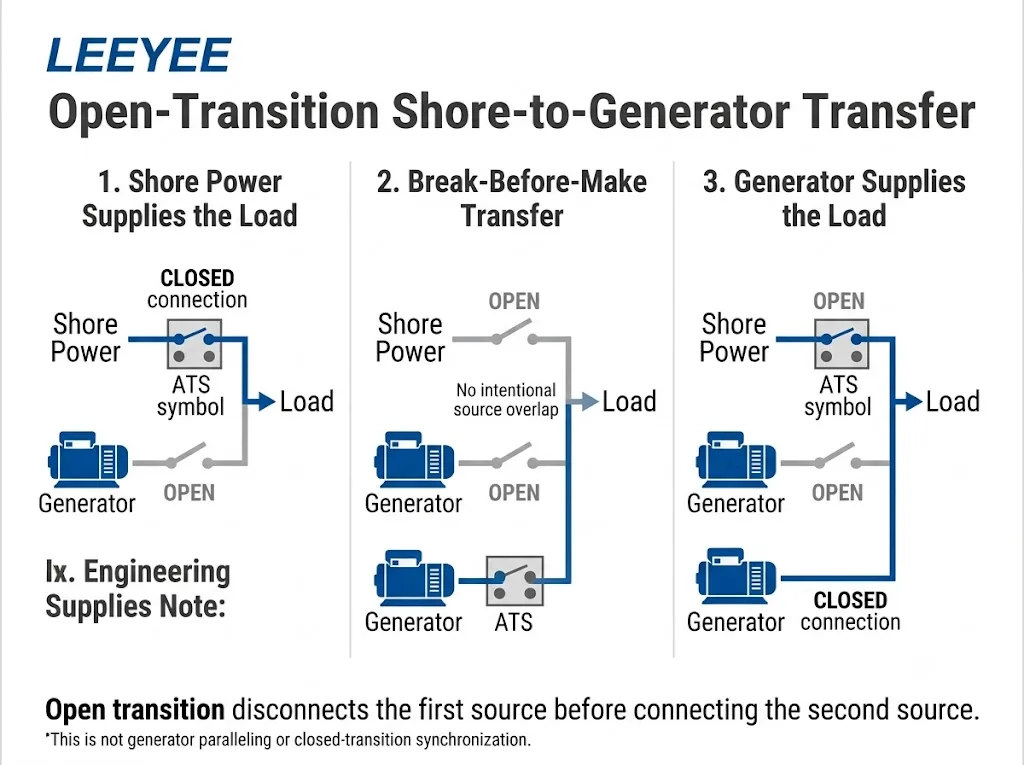
IEC 60947-6-1:2026 treats ATSE with closed-transition capability as a specific equipment function with dedicated requirements.[1] A normal compact open-transition ATS should therefore not be presented as a closed-transition or source-synchronization solution.
When the alternate source is a generator, generator start time is separate from the actual switching action. The generator may need time to start and reach acceptable electrical conditions before the controller permits transfer.
If a project requires shore power and generator power to overlap, synchronize or operate in parallel, a standard compact open-transition ATS is not enough. The project requires equipment and control architecture specifically designed for those functions.
Why Source Interlocking Matters
A shore-power and generator arrangement normally needs a defined method of preventing unintended connection of sources that are not intended to operate in parallel. The exact interlocking method depends on the complete system and applicable project rules.
Classification requirements can include source-control and interlocking provisions, but they must be checked against the actual vessel type, rule edition and electrical architecture. The ATS alone should never be used as evidence that the complete shore-connection system has obtained vessel or classification approval.[4]
Does a Marine ATS Need 2P, 3P or 4P?
Marine does not automatically mean 4P. Pole selection depends on the phase arrangement, neutral arrangement, earthing design, power-source configuration and project requirements. IEC 60092-201:2019 addresses ship electrical-system design topics including distribution systems, system earthing and sources of electrical power.[3]
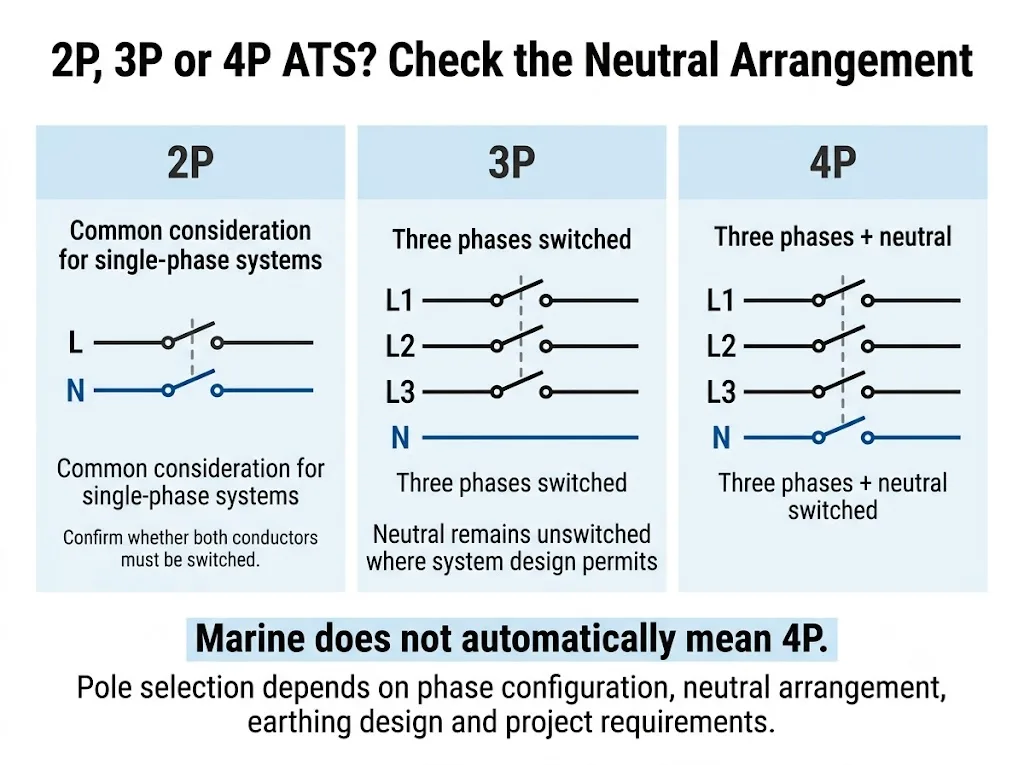
ATS แบบ 2P
A 2P ATS may be considered for a single-phase system where the design requires two conductors to be transferred. Whether the neutral must be switched depends on the actual source and earthing arrangement.
3P ATS
A 3P ATS transfers three phase conductors while the neutral remains outside the switching poles. This configuration is appropriate only when the complete electrical design permits an unswitched neutral.
ATS แบบ 4P
A 4P ATS transfers L1, L2, L3 and neutral. It may be required where switched neutral is part of the electrical design, but should not be specified merely because the application is marine.
Protective earth should not be treated as an ordinary switched pole. Neutral switching, bonding and protective-earth continuity are separate design questions and should be confirmed by the responsible electrical designer.
How Should the ATS Current Rating Be Selected?
Rated current is important, but it is only one selection parameter. The ATS must also match the real voltage, frequency, pole configuration, source arrangement and utilization conditions.
Motor, pump or compressor loads may introduce starting-current considerations. The system designer should also review upstream protective devices and the available short-circuit conditions at the installation point. The transfer switch does not replace circuit breakers, fuses or the wider protection design.
- Define both sources: shore supply, generator or another AC source.
- Define the load: continuous current and important starting characteristics.
- Confirm voltage and frequency: use actual project values.
- Confirm phase and poles: select the ATS from the real conductor arrangement.
- Review protection coordination: check upstream protection and fault conditions.
- Review environment and approval: verify marine conditions separately.
50 Hz or 60 Hz? The Two Sources Must Be Compatible
An ATS changes which source supplies the load. It does not convert voltage or frequency and does not make incompatible sources suitable for the same equipment.
Shore power, generator output, the ATS control circuit and the connected loads therefore need to be checked together. In three-phase applications, the complete project may also need to consider phase sequence and the requirements of downstream equipment.[3]
Do not assume an available shore supply can feed the vessel simply because it can be physically connected. Confirm voltage, frequency, phase arrangement, neutral/earthing design and connected-load requirements.
Marine Environments Add Requirements Beyond Electrical Ratings
Marine and port environments can introduce humidity, condensation, salt exposure, vibration and temperature conditions that are not proven by an ordinary voltage or current rating.
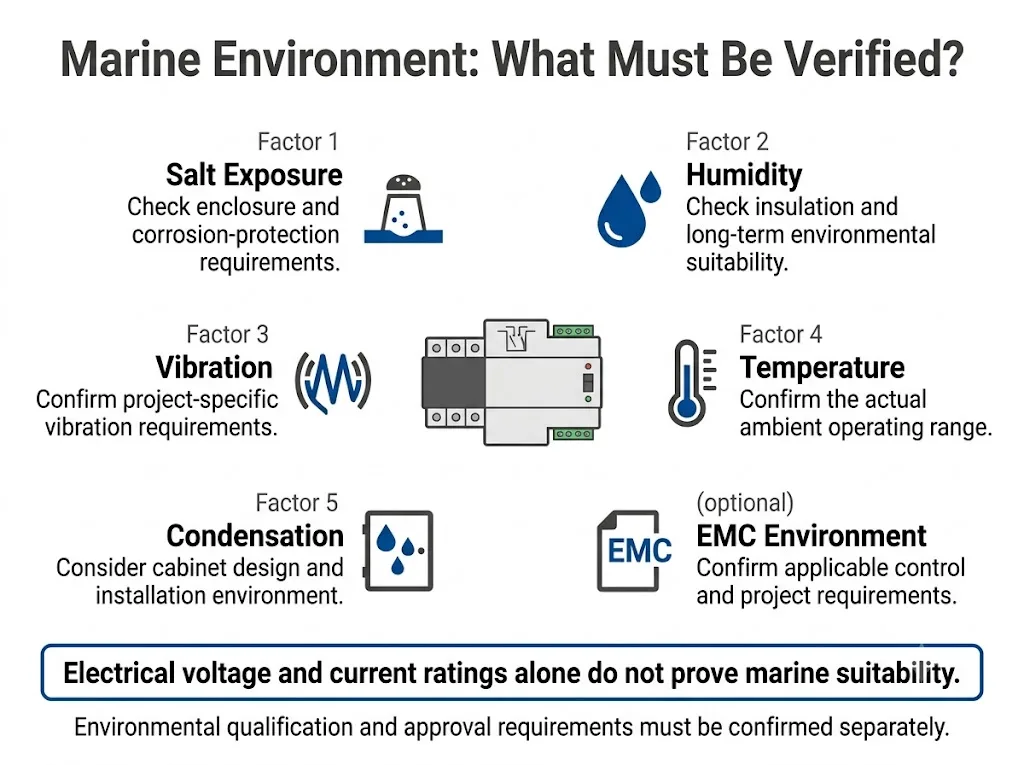
| สภาพ | เหตุใดจึงสำคัญ | สิ่งที่ต้องยืนยัน |
|---|---|---|
| Humidity / condensation | Can affect insulation and long-term reliability | Installation location, enclosure and qualification requirement |
| Salt exposure | Can increase corrosion risk | Cabinet, terminals, material protection and project requirements |
| Vibration | Can affect mechanical and electrical connections | Installation position and required test level |
| อุณหภูมิ | Affects permissible operating conditions | Actual minimum and maximum ambient conditions |
| EMC environment | May affect monitoring and electronic control | Applicable product and project requirements |
This table does not claim that a standard LEEYEE compact ATS has passed every marine environmental test. Required limits, test evidence and approval scope must be confirmed for the exact project.
IEC 60947-6-1 and IEC 60092 Do Different Jobs
A common procurement mistake is to treat compliance with an ATS product standard as proof that the entire marine installation is approved. These are different questions.
IEC 60947-6-1:2026 is the IEC product standard covering transfer switching equipment used for transferring a load between power sources.[1]
IEC 60092-201:2019 covers general system-design features for ship electrical installations, including distribution, earthing and sources of electrical power.[3]
IEC 60092-302-2:2025 covers low-voltage marine power switchgear and controlgear assemblies and addresses additional considerations associated with marine applications.[2]
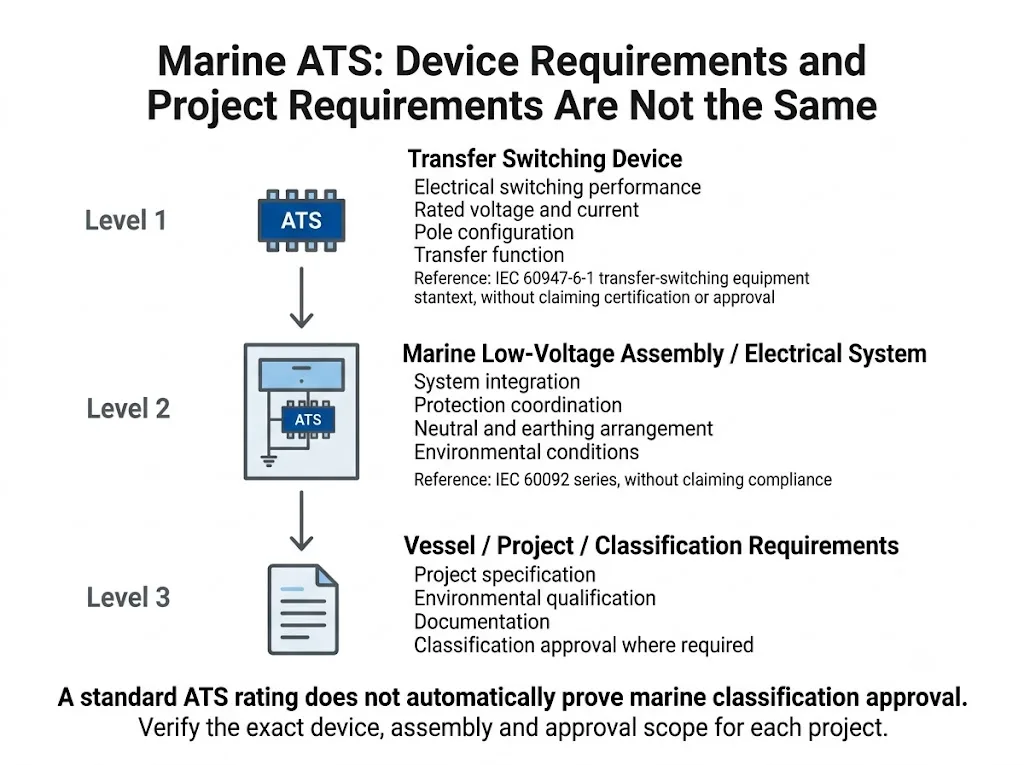
Referencing IEC 60947-6-1 or the IEC 60092 series does not mean that every standard LEEYEE ATS is approved by ABS, DNV, Lloyd's Register, Bureau Veritas, CCS or another classification society. Where marine classification is required, confirm the exact product, assembly, documentation and approval scope before specification.
Is a Normal Automatic Transfer Switch Suitable for Marine Use?
ไม่เสมอไป. A standard compact ATS can be evaluated for selected marine auxiliary low-voltage circuits if its voltage, frequency, current, pole configuration, transfer method and protection conditions match the system. Marine installations can introduce additional environmental and approval requirements that are not demonstrated by an ATS nameplate rating alone.[1][2][3]
For a panel builder or marine electrical integrator, the better question is: does this exact compact ATS configuration meet the electrical requirements of the circuit, and what additional marine project verification is still required?
Where the LEEYEE Compact ATS Fits
LEEYEE supplies compact automatic transfer switches for low-voltage dual-source, solar backup, generator and grid switching systems. In a marine project, the ATS should first be checked against the circuit's electrical requirements, while marine environmental and classification requirements remain separate engineering checks.
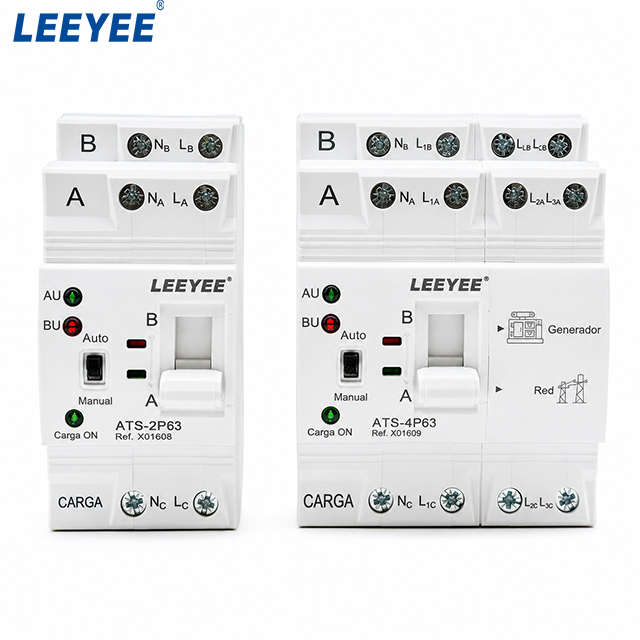
This LEEYEE product is a compact low-voltage automatic transfer switch. Using it in a marine project does not by itself establish marine environmental qualification or classification approval. Humidity, salt exposure, vibration, enclosure conditions and any required vessel approval must still be confirmed separately.
What a Compact ATS Does Not Replace
- A complete marine main switchboard.
- A generator paralleling controller.
- A load-sharing system.
- A synchronization system.
- A closed-transition system unless the exact equipment provides that function.
- A complete shore-power connection system.
- A vessel power-management system.
- Marine classification approval.
IEC 60947-6-1 separately addresses specialized transfer-switching functions such as closed-transition operation.[1] These functions should not be assumed to exist in an ordinary compact ATS.
Before Ordering: Marine ATS Engineering Checklist
Send the following information before fixing an ATS configuration. This lets the supplier, panel builder and system integrator evaluate the actual application instead of selecting only by current rating.
แหล่งจ่ายไฟ
- Normal source type
- Backup source type
- แรงดันไฟฟ้าที่กำหนด
- 50Hz or 60Hz
- ระบบไฟฟ้าเฟสเดียวหรือสามเฟส
- Preferred source
Load & Protection
- กระแสโหลดต่อเนื่อง
- Motor or pump starting characteristics
- อุปกรณ์ป้องกันต้นทาง
- Available fault information
- Critical-load requirements
Transfer Configuration
- Required 2P / 3P / 4P arrangement
- การจัดวางแบบกลาง
- รูปแบบการต่อลงดิน
- Automatic / manual requirement
- Generator start interface
- Transfer and return-delay requirements
- Required status / dry contacts
Marine Conditions
- Vessel or port-equipment application
- สถานที่ติดตั้ง
- Temperature range
- Humidity / condensation
- Salt exposure
- Vibration requirement
- Enclosure requirement
- Required standards / class documents
Need to review a marine low-voltage ATS configuration?
Send the two power sources, voltage, frequency, load current, required poles, neutral arrangement, environmental conditions and approval requirements. LEEYEE can review whether the compact ATS configuration is appropriate for further project evaluation.
Related ATS Engineering Guides
คำถามที่พบบ่อย
Can an ATS automatically switch from shore power to generator power?
Yes, when the transfer system is suitable for both sources and the generator-control sequence is correctly coordinated. Generator starting and stabilization are separate from the ATS switching action.
Does a marine ATS always require four poles?
No. Pole count depends on the phase configuration, neutral arrangement, earthing design and project requirements. Marine application alone does not determine whether 3P or 4P is required.[3]
Can this LEEYEE compact ATS be evaluated for a marine project?
Yes. It can be evaluated for selected low-voltage dual-source applications when the product's electrical configuration matches the circuit. Marine environmental conditions and any required classification approval must still be checked separately.
Can an IEC 60947-6-1 ATS automatically be called marine certified?
No. IEC 60947-6-1 is a product standard for transfer switching equipment.[1] Marine system design, assembly requirements and classification approval are separate matters.
Is open-transition ATS operation the same as synchronization?
No. Open transition is break-before-make and separates the two sources during transfer. Synchronization and closed-transition operation require different equipment capability and system engineering.[1]
Do humidity, salt and vibration matter if the ATS is inside a cabinet?
They can. The enclosure changes the exposure conditions, but the complete cabinet, location and required environmental qualification still need to be evaluated.[2]
What information should a buyer provide for a marine ATS quotation?
Provide both power sources, voltage, frequency, phase, continuous load current, poles, neutral and earthing arrangement, generator-control requirements, installation environment and required standards or classification documents.
เอกสารอ้างอิง
- [1] International Electrotechnical Commission (IEC). IEC 60947-6-1:2026, อุปกรณ์สวิตช์และควบคุมแรงดันต่ำ – ส่วน 6-1: อุปกรณ์หลายฟังก์ชัน – อุปกรณ์สวิตช์ถ่ายโอน.
- [2] International Electrotechnical Commission (IEC). IEC 60092-302-2:2025, Electrical installations in ships – Part 302-2: Low voltage switchgear and controlgear assemblies – Marine power.
- [3] International Electrotechnical Commission (IEC). IEC 60092-201:2019, Electrical installations in ships – Part 201: System design – General.
- [4] American Bureau of Shipping (ABS). Rules for Building and Classing Marine Vessels. Applicable requirements depend on vessel type, electrical architecture and current rule edition.
การยืนยันโครงการ: This guide supports B2B engineering discussion and preliminary ATS selection. Final acceptance must follow the actual vessel electrical design, load characteristics, protection scheme, environmental conditions, applicable standards, flag requirements and classification rules. Do not use this article as a substitute for approved project drawings, model-specific documentation or classification review.
