
Not sure whether a surge protective device should use 5kA, 10kA or 20kA In? This guide explains what In means, how it differs from Imax, and what buyers should confirm before ordering Type 2 SPDs for distribution boards, control cabinets, PV boxes and OEM panels.
Important: SPD selection is not based on In alone. For the complete selection path, including AC/DC type, Uc, Iimp, Imax, Up, poles, earthing system and backup protection, see our complete SPD Selection Guide.
For many standard Type 2 SPD applications, 10kA In is a common practical choice. For higher-exposure distribution boards, industrial panels, PV combiner boxes, or OEM products expected to handle more repeated surge stress, buyers often consider 20kA In.
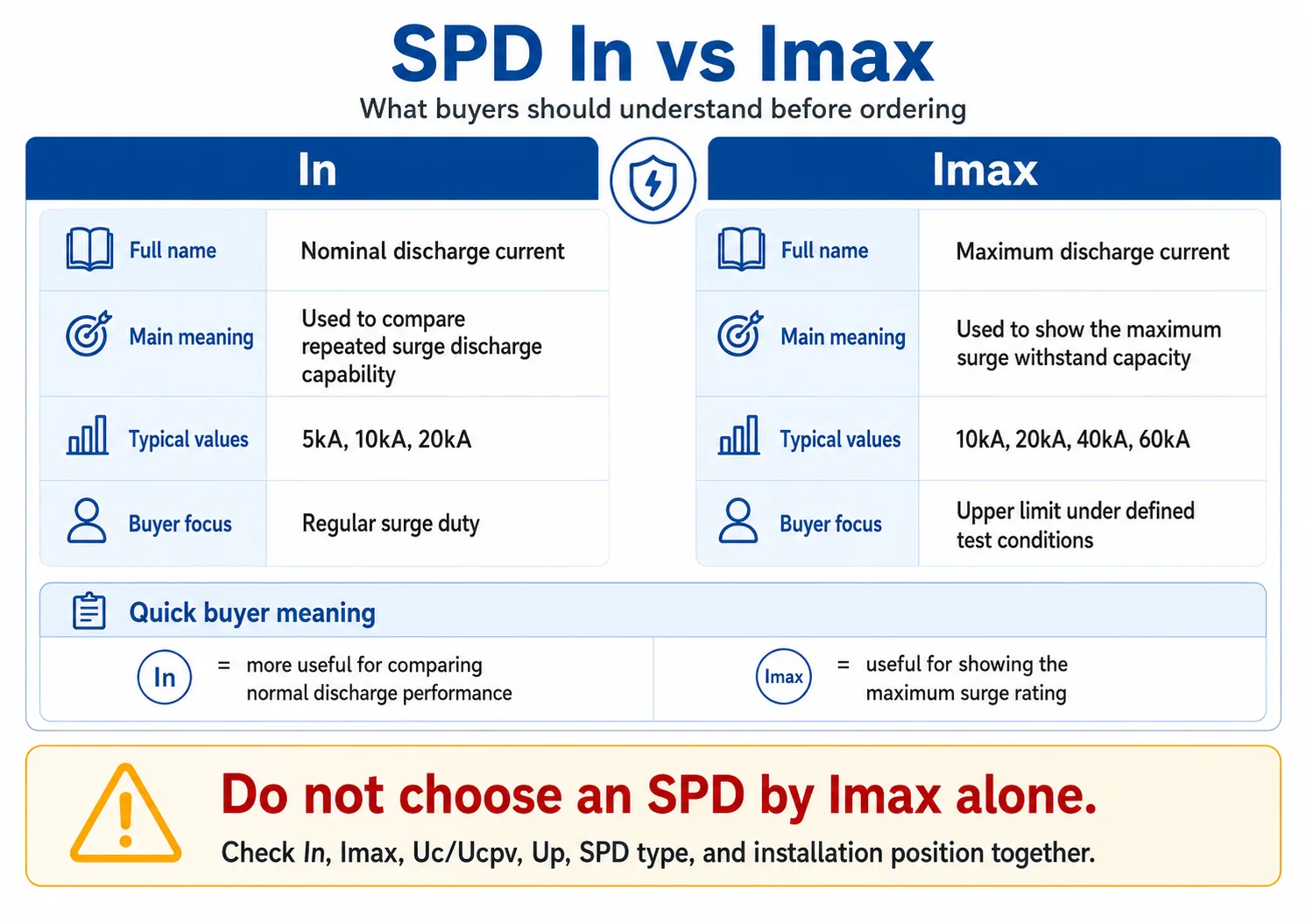
In shows the SPD’s nominal discharge current under defined 8/20 μs surge test conditions. It is useful for comparing repeated surge discharge capability. Imax shows a higher maximum discharge current, but it should not be used alone to judge the SPD.
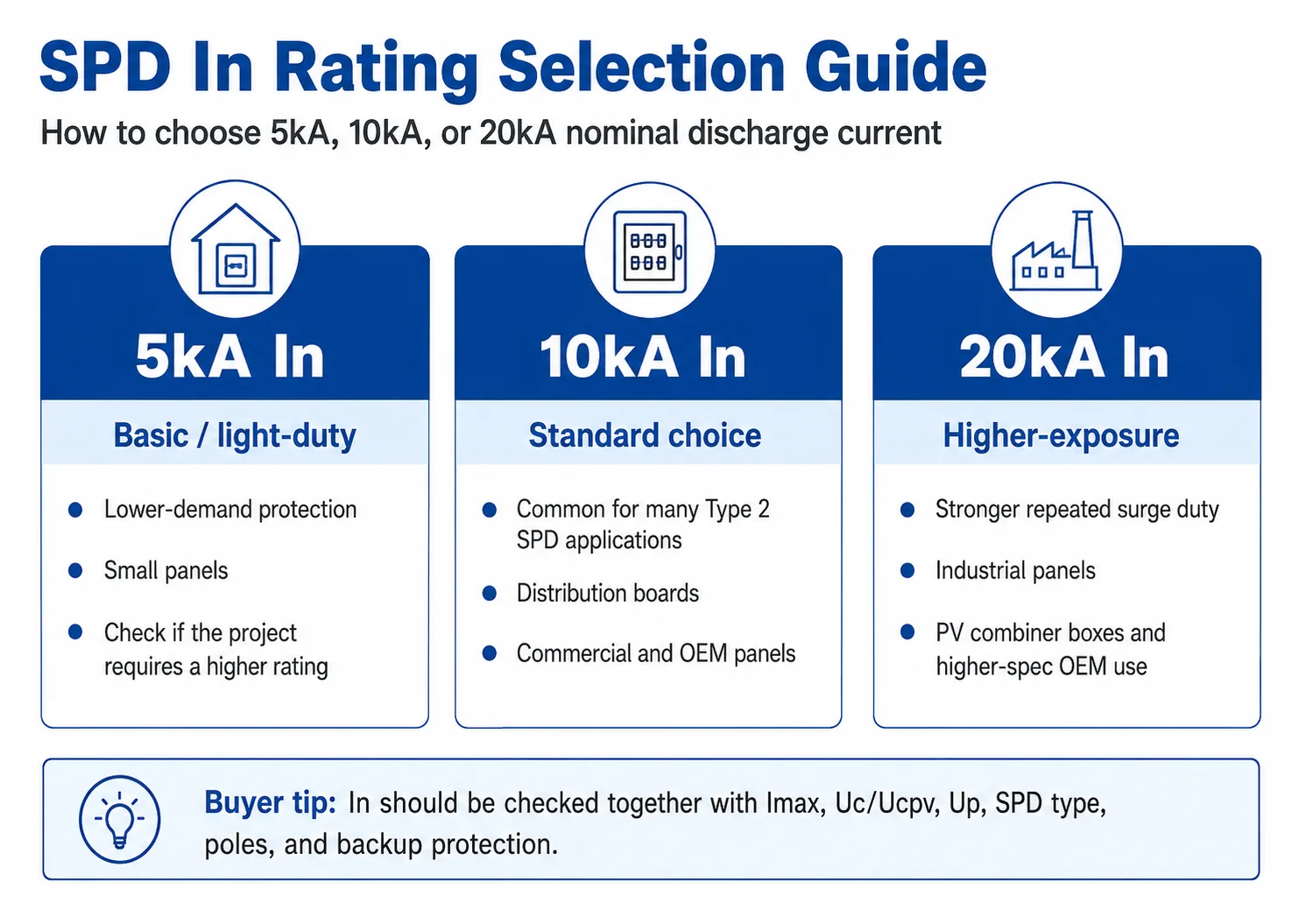
Table of Contents
Quick selection table for SPD In rating
Use this table as a first screening tool. Final selection should follow the project specification, local electrical rules, installation position and the manufacturer’s datasheet.
| In rating | Typical buyer meaning | Common application direction | What to confirm before ordering |
|---|---|---|---|
| 5kA | Basic nominal discharge capacity for lower-demand protection. | Small panels, light-duty applications, or projects where the specification accepts a lower In value. | Check whether the project requires 10kA or 20kA In instead. Do not use only price to decide. |
| 10kA | Common practical level for many Type 2 SPD applications. | Distribution boards, commercial panels, OEM electrical cabinets and many standard AC SPD applications. | Check Imax, Uc, Up, pole configuration, backup protection and standard compliance together. |
| 20kA | Higher nominal discharge capacity for stronger repeated surge duty. | Industrial panels, exposed sites, PV combiner boxes, main sub-distribution boards, and higher-spec OEM orders. | Confirm whether the system also needs Type 1 or Type 1+2 SPD, especially for high lightning exposure. |
What does In mean on an SPD?
In means nominal discharge current. It is usually shown in kA, such as 5kA, 10kA or 20kA.
For buyers, In tells you how the SPD is rated under defined repeated surge discharge conditions. It is especially important for Type 2 SPDs, because Type 2 devices are commonly used in distribution boards, sub-panels, machine control cabinets and OEM electrical assemblies.
Buyer meaning: In is not just another kA number on the label. It helps you compare the SPD’s regular discharge duty. A product with a higher In rating is usually positioned for stronger repeated surge capability, but it still must match voltage, type, Up, installation and backup protection.
In vs Imax: what is the difference?
Many buyers see a product marked as 10kA / 20kA or 20kA / 40kA and only focus on the larger number. That is a common mistake.
In and Imax describe different parts of SPD performance. They should be checked together.
| Parameter | Full name | Buyer meaning | Common misunderstanding |
|---|---|---|---|
| In | Nominal discharge current | Shows the SPD’s repeated discharge capability under defined 8/20 μs test conditions. | It is not the maximum discharge rating, but it is very important for comparing regular surge duty. |
| Imax | Maximum discharge current | Shows the maximum 8/20 μs surge current the SPD can withstand under defined conditions. | A higher Imax alone does not mean the SPD is always the better choice. |
A 20kA / 40kA SPD and a 10kA / 40kA SPD should not be judged only by the 40kA value. Buyers should check the full datasheet and confirm whether the In rating, Up value, Uc, SPD type and backup protection match the project.
How to choose In rating for Type 2 SPD
The easiest way is to start from the installation position and expected surge exposure. Do not start from the biggest kA number.
Choose 5kA In only when the requirement is clearly light-duty
A 5kA In SPD may be acceptable in some lower-demand applications. However, it is not the first choice for many B2B buyers who need stronger product positioning, distributor stock, or OEM panel supply.
Choose 10kA In for many standard distribution board applications
10kA In is commonly used for Type 2 SPD applications in sub-distribution boards, commercial panels and standard electrical cabinets. It gives buyers a practical balance between rating, cost and common market acceptance.
Choose 20kA In for higher-exposure or higher-spec projects
20kA In is more suitable when the SPD is expected to handle stronger repeated surge duty. It is often considered for industrial panels, exposed installations, PV combiner boxes, and OEM products where a stronger rating is requested.
Common In rating choices by application
The table below is not a replacement for a datasheet. It gives buyers a practical direction before requesting a quotation.
| Application | Common In direction | Reason | Related parameter to check |
|---|---|---|---|
| Small AC panel | 5kA or 10kA | Lower surge exposure or basic panel protection, depending on project requirement. | Uc, Up, pole number, backup fuse or MCB. |
| Distribution board | 10kA | Common Type 2 SPD direction for many commercial and industrial sub-panels. | Imax, Uc, Up, 1P/2P/3P/4P, remote signal. |
| Industrial control cabinet | 10kA or 20kA | Industrial environments may face switching surges and higher exposure. | Panel voltage, grounding, remote signal, backup protection. |
| PV combiner box | 20kA often preferred | PV systems are often exposed outdoors and may require stronger surge protection. | Ucpv, DC SPD standard, Imax, Type 2 or Type 1+2 requirement. |
| OEM electrical panel | 10kA or 20kA | Depends on target market, price level, customer specification and label positioning. | Brand label, certification, module width, replacement cartridge, packaging. |
What happens if the In rating is too low?
If the In rating is too low for the real application, the SPD may not have enough repeated surge discharge margin for that project. This can increase maintenance pressure, replacement frequency and customer complaints.
Shorter service margin
The SPD may have less room for repeated surge events in demanding conditions.
Earlier replacement
Panels in exposed areas may need module replacement sooner if the rating is not suitable.
Wrong product positioning
A low In value may not match the expectation of distributors, OEM buyers or project engineers.
Do not overcorrect either. Higher In can be useful, but it does not replace correct Uc, suitable Up, proper installation, grounding, short connection leads and coordinated backup protection.
What buyers should confirm before ordering
Before confirming an SPD order, send the supplier more than just “I need 40kA SPD”. A better request includes the real electrical and panel information.
- Application: distribution board, control cabinet, PV combiner box, inverter side, or OEM panel.
- Circuit type: AC distribution, PV DC, battery DC, signal, or equipment-side protection.
- System voltage: for example 230/400V AC, 480V AC, 1000V DC, or 1500V DC.
- SPD type: Type 1, Type 2, Type 1+2, or Type 3.
- Required In rating: 5kA, 10kA, 20kA, or project-specified value.
- Imax rating: such as 20kA, 40kA, 60kA or other requirement.
- Uc or Ucpv: must match the real system voltage and application.
- Up value: should be suitable for the protected equipment.
- Poles and wiring: 1P, 2P, 3P, 4P, 3P+N, or PV DC configuration.
- Earthing system: TT, TN-S, TN-C-S, IT, or project-specific design.
- Backup protection: fuse or MCB according to the SPD datasheet.
- Certification and standard requirement: IEC, EN, CE, TUV, CB, UL or project approval.
- OEM details: private label, packaging, model name, replacement cartridge and quantity.
Common mistakes when comparing In rating
Only comparing the largest kA number
Some buyers compare only Imax because it looks bigger on the label. This can hide important differences in In, Up, Uc, SPD type and standard.
Using the same In requirement for every application
A small indoor panel, a PV combiner box and an exposed industrial cabinet do not have the same surge environment. The In rating should match the application.
Ignoring Type 1 or Type 1+2 requirements
If the installation is at the service entrance or in a high lightning exposure area, Type 2 SPD with only In and Imax may not be enough. The project may need Type 1 or Type 1+2 protection with Iimp rating.
Forgetting the voltage and protection level
In rating does not tell you whether the SPD voltage is correct. Always check Uc or Ucpv, and also confirm Up for the protected equipment.
A simple answer sales teams can send to buyers
If a customer asks “Should I choose 10kA or 20kA In?”, you can answer like this:
For many standard Type 2 SPD applications, 10kA In is a common choice. For higher-exposure panels, industrial systems, PV combiner boxes, or stronger OEM specifications, 20kA In may be more suitable. Please also confirm Imax, Uc or Ucpv, Up, SPD type, poles, earthing system and backup protection before final selection.
SPD In rating FAQ
What is In rating in an SPD?
In is the nominal discharge current of a surge protective device. It is usually expressed in kA and is used to show the SPD’s discharge capability under defined 8/20 μs surge test conditions.
Is 10kA In enough for a Type 2 SPD?
10kA In is commonly used for many Type 2 SPD applications in distribution boards and standard electrical panels. However, final selection depends on surge exposure, installation position, project specification and datasheet requirements.
When should I choose 20kA In?
20kA In is often considered for higher-exposure applications, industrial panels, PV combiner boxes, exposed sites and OEM orders where stronger repeated surge capability is requested.
What is the difference between In and Imax?
In is the nominal discharge current used to compare regular repeated surge discharge duty. Imax is the maximum discharge current under defined 8/20 μs conditions. Buyers should check both values, not only the larger Imax number.
Does higher In always mean better protection?
Not always. Higher In can provide stronger discharge margin, but correct SPD selection also depends on voltage rating, Up, SPD type, pole configuration, earthing system, backup protection and installation quality.
Can I choose SPD only by In rating?
No. In is important, but SPD selection should also include AC/DC system type, Uc or Ucpv, Imax, Iimp if required, Up, poles, grounding system, backup fuse or MCB, and applicable standards.
Need help checking SPD In rating?
Send us your system voltage, application, SPD type, pole configuration, target In/Imax rating and required certification. LEEYEE can help recommend a suitable SPD direction for distribution boards, PV combiner boxes, industrial cabinets and OEM orders.
Request SPD Model Recommendation