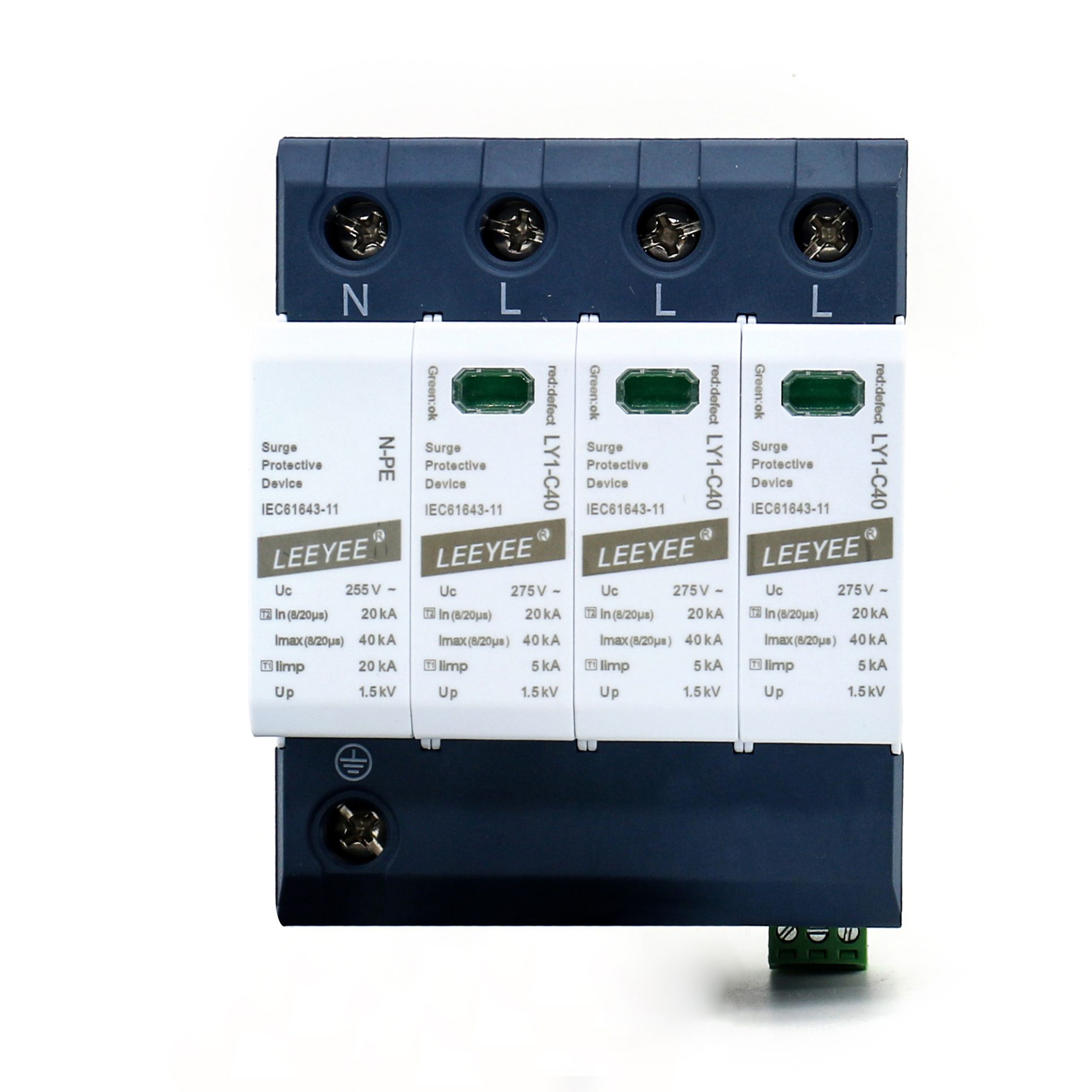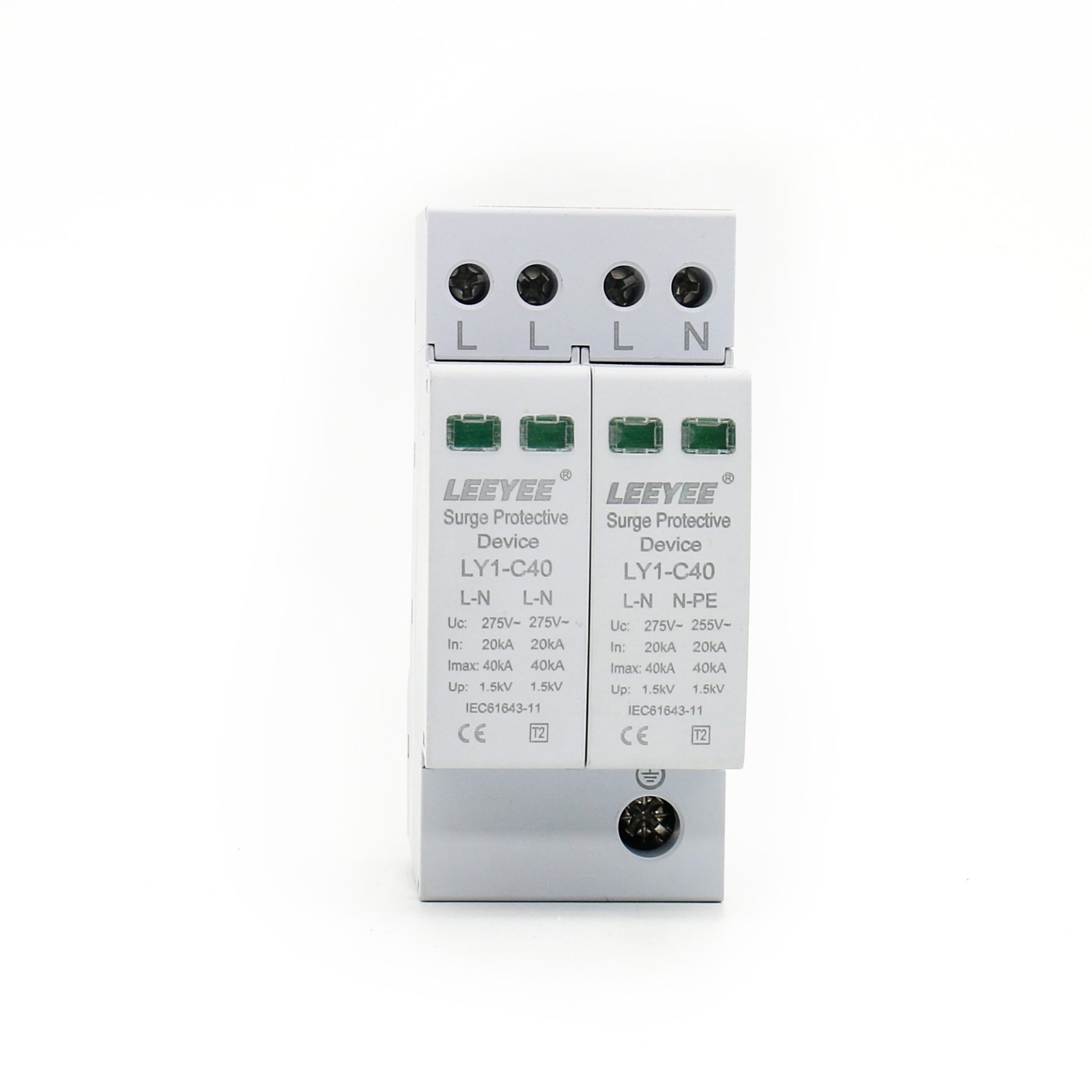
Ein 3-Phasen-Schutzschalter wird verwendet, um industrielle und kommerzielle dreiphasige Stromsysteme vor transienten Überspannungen zu schützen.
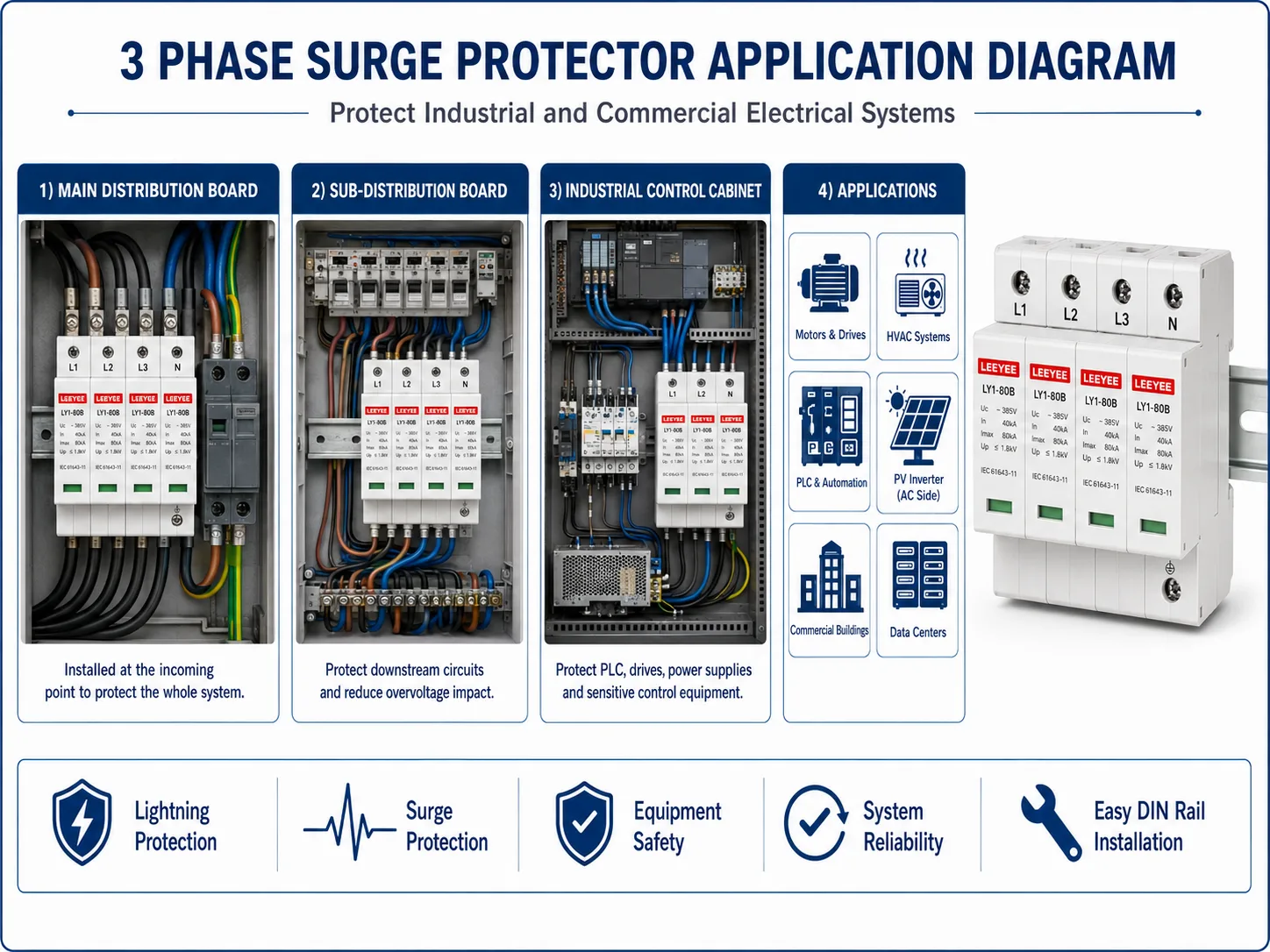
Er wird häufig in Hauptverteilern, Unterverteilerschränken, Steuerungsschränken, Maschinenpulten, HVAC-Systemen, PV-Wechselrichter-AC-Panels und OEM-Elektroschränken installiert.
Der wichtige Punkt ist einfach: Ein 3-Phasen-Schutzschalter sollte nicht nur nach Spannung oder Polanzahl ausgewählt werden. Der richtige SPD hängt vom gesamten elektrischen System ab.
Inhaltsübersicht
Schnelle Antwort: Wie wählt man einen 3-Phasen-Schutzschalter aus?
Für einen standardmäßigen dreiphasigen Verteiler bestätigen Sie zunächst die Systemspannung und Erdungssystem. Wählen Sie dann den Typ und die Polkonfiguration des SPD aus.
Haupt-Eingangsverteilungen benötigen möglicherweise Schutz vom Typ 1 oder Typ 1+2. Standard-Unterverteilungsanlagen verwenden häufig den Schutz vom Typ 2. TN-S, TN-C-S, TT, IT und drei-phasige 3-Draht-Systeme können unterschiedliche SPD-Konfigurationen erfordern.
| Anmeldung | Häufige SPD-Wahl | Hinweis für Käufer |
|---|---|---|
| Haupt-Eingangsverteilung mit hoher Blitzeinschlagsgefahr | Typ 1 oder Typ 1+2 SPD | Prüfen Sie Iimp und den Rückschutz. |
| Standard-Unterverteilungstafel | Typ 2 SPD | Häufig für industrielle und kommerzielle Verteiler. |
| TN-S drei-phasiges 4-Draht-System | 4P oder geeigneter 4-poliger SPD | Schützt L1, L2, L3, N und PE gemäß Design. |
| TT drei-phasiges 4-Draht-System | 3P+N / 3+1 SPD | Der Schutzweg N-PE muss berücksichtigt werden. |
| Drei-phasiges 3-Draht-System | 3P-SPD | Wird verwendet, wenn der Neutralleiter nicht verfügbar ist. |
| OEM-Elektroschrank | Hängt von der Projektskizze ab. | Bestätigen Sie Spannung, Erdung, Polanzahl und Zertifizierung. |
Eine höhere kA-Bewertung bedeutet nicht automatisch, dass der SPD für jedes Panel besser ist. Ein korrekter SPD ist einer, der zum realen elektrischen System, zur Installationsposition und zu den Schutzanforderungen passt.
Was ist ein 3-Phasen-Schutzschalter?
Ein drei-phasiger Überspannungsschutz, auch als drei-phasiges Überspannungsschutzgerät oder 3-phasiger SPD bezeichnet, ist dafür ausgelegt, transiente Überspannungen in drei-phasigen Stromsystemen zu begrenzen.
Ein Überspannung kann durch Blitzaktivität, Umschalten des Versorgungsnetzes, Motorstart und -stopp, Transformatorumschaltung, Kondensatorbankumschaltung, VFD-Betrieb, nahegelegene Fehler oder industrielle Lastumschaltung entstehen.
Der SPD bietet einen kontrollierten Entladepfad für den Überspannungsstrom. Wenn eine transiente Überspannung auftritt, begrenzt der SPD die Spannung auf ein sicheres Niveau und hilft, Überspannungsenergie in die Erde abzuleiten.
Dies hilft, nachgelagerte Geräte wie SPS, Antriebe, Netzteile, Sensoren, Steuerkarten, Kommunikationsgeräte und industrielle Maschinen zu schützen.
Warum benötigen dreiphasige Systeme eine unterschiedliche Auswahl von SPD?
Ein dreiphasiges System ist komplexer als ein einphasiger Stromkreis. Überspannungen können zwischen verschiedenen Leitern auftreten.
- Leitung zu Erde: L-PE
- Leitung zu Neutralleiter: L-N
- Neutralleiter zu Erde: N-PE
- Leitung zu Leitung: L-L
Deshalb muss die Auswahl des dreiphasigen SPDs die Systemstruktur berücksichtigen. Das Wort “drei Phasen” reicht nicht aus, um den SPD auszuwählen.
Wo werden 3-Phasen-Schutzschalter eingesetzt?
Dreiphasige SPDs werden häufig in B2B-Elektroanlagen verwendet, darunter:
- Industrielle Verteilerschränke
- Verteilungstafeln für gewerbliche Gebäude
- Fabrik Stromverteilungssysteme
- Maschinensteuerungsschränke
- HVAC-Steuerungspaneele
- Motorsteuerungszentren
- PLC- und Automatisierungsschränke
- Stromverteilungs paneele für Rechenzentren
- EV-Ladungsverteilungssysteme
- PV-Wechselrichter AC-Ausgabepaneele
- OEM-Elektroschränke
- Projekte für die Elektroanlagenbauer
Für OEM-Käufer, Importeure und Schaltschrankbauer muss das SPD sowohl den technischen Anforderungen als auch dem endgültigen Produktdesign entsprechen.
Dies umfasst den Verdrahtungsraum, die DIN-Schienen-Montage, modulare Steckerart, Fernsignalkontakte, Zertifizierung, Etikettendesign und langfristige Liefersicherheit.
Typ 1, Typ 2 und Typ 1+2 dreiphasige SPD
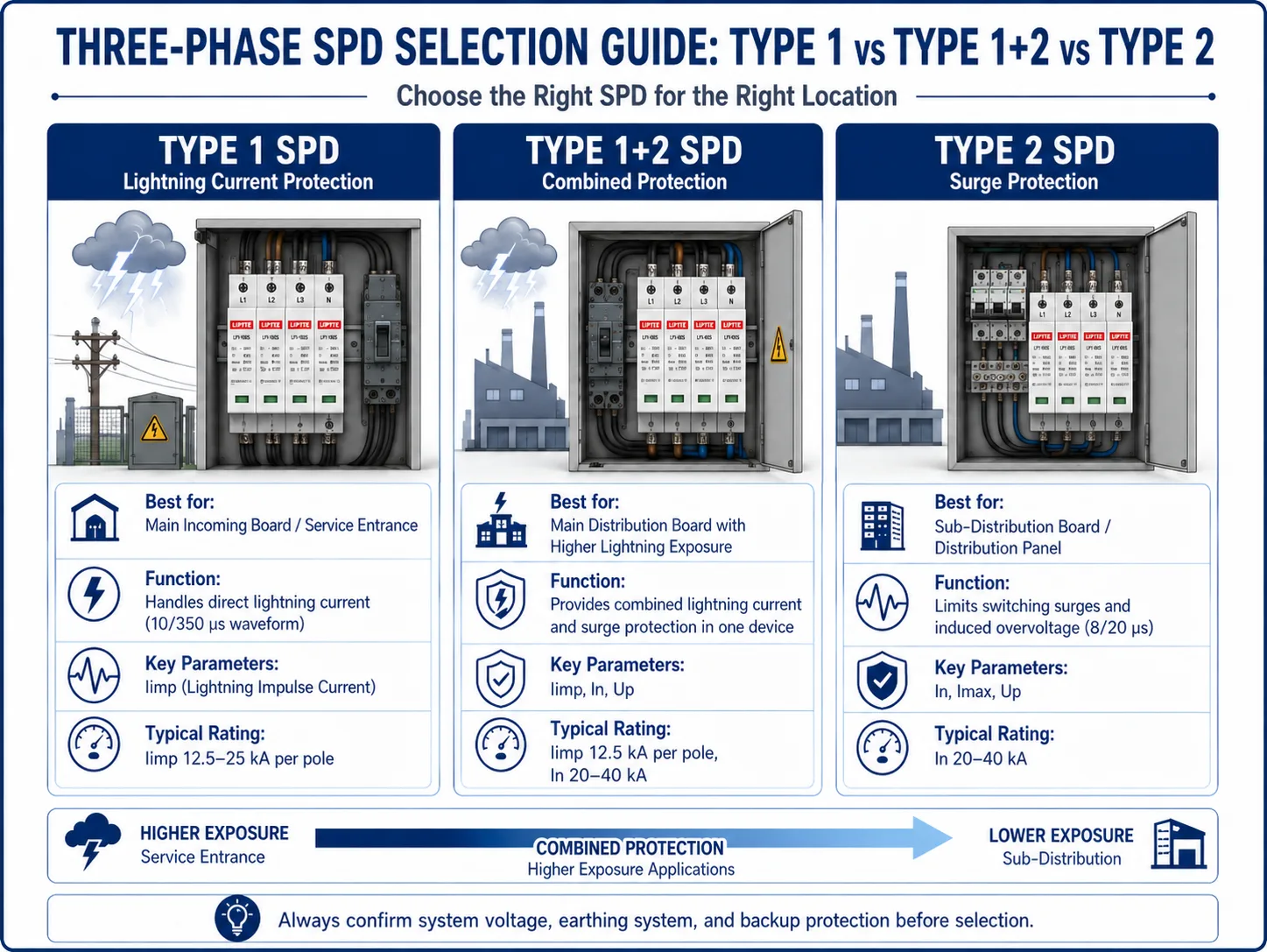
Der SPD-Typ sollte mit der Installationsposition und dem Überspannungsrisiko übereinstimmen. Ein Typ 2 SPD sollte nicht blind verwendet werden, wo Typ 1 Schutz erforderlich ist. Aber Typ 1 ist auch nicht automatisch in jedem Schrank erforderlich.
| SPD-Typ | Gewöhnliche Installationsposition | Hauptfunktion | Hinweis für Käufer |
|---|---|---|---|
| Typ 1 SPD | Hauptanschlussfeld, Serviceeingang | Behandelt partielle Blitzströme | Überprüfen Sie den Iimp-Wert. |
| Typ 1+2 SPD | Hauptverteilungstafel mit höherer Exposition | Blitzstrom- und Überspannungsschutz | Nützlich, wo kompakter kombinierter Schutz benötigt wird. |
| Typ 2 SPD | Unterverteilungstafel, Steuerungstafel | Begrenzen von Schaltüberspannungen und induzierten Überspannungen | Gemeinsam für industrielle Paneele. |
| Typ 3 SPD | In der Nähe empfindlicher Endgeräte | Feiner Schutz in der Nähe von Geräten | Wird normalerweise nach Typ-2-Koordinierung verwendet. |
Die richtige Wahl hängt von der Blitzbelastung, dem Schutz upstream, dem lokalen elektrotechnischen Design, der Installationsposition und den Projektanforderungen ab.
3P, 4P und 3P+N: Was ist der Unterschied?
Viele Käufer wählen einen dreiphasigen SPD nach Polanzahl. Dies kann zu Fehlern führen.
Die Polkonfiguration sollte mit der Systemverkabelung und der Erdungsanordnung übereinstimmen.
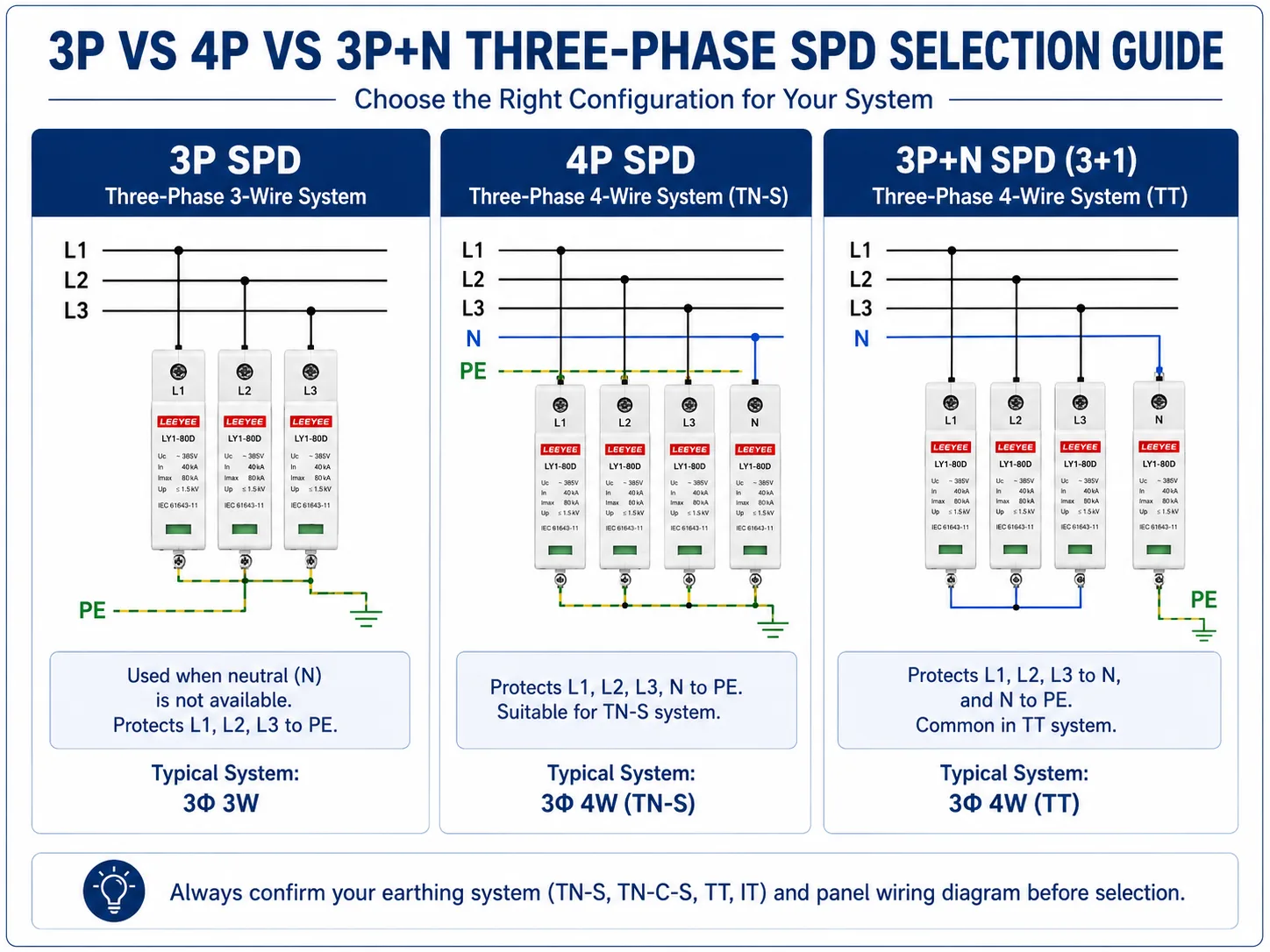
| SPD-Konfiguration | Allgemeine Verwendung | Was es bedeutet | Wichtiger Hinweis |
|---|---|---|---|
| 3P-SPD | Dreiphasige 3-Draht-Systeme | L1, L2, L3 Schutz | Verwendet, wenn kein Neutralleiter vorhanden ist. |
| 4P SPD | Dreiphasige 4-Draht-Systeme | L1, L2, L3, N Schutz | Die Verkabelungslogik hängt vom Systemdesign ab. |
| 3P+N SPD | Wird häufig in 3+1-Schutzdesigns verwendet | L1/L2/L3 zu N, N zu PE | Häufig in TT-bezogenen Schutzdesigns. |
| 4+0-Konfiguration | Wird häufig in TN-S-Systemen verwendet | L1, L2, L3, N geschützt gegen PE | Überprüfen Sie das Produktdesign und die Verkabelungsdiagramme. |
| 3+1-Konfiguration | Häufig in TT-Systemen verwendet | L1/L2/L3 zu N, N zu PE | Der N-PE-Pfad ist entscheidend. |
Ein 4P SPD und ein 3P+N SPD sollten in jedem Projekt nicht als dasselbe behandelt werden. Ein 3P SPD ist nicht automatisch für alle dreiphasigen Systeme geeignet. Ein 3P+N SPD ist nicht automatisch für jedes System mit Neutralleiter erforderlich.
Bestätigen Sie vor der Bestellung die Projektzeichnung, das Erdungssystem und das SPD-Schaltbild. Für detaillierte Schaltbilder siehe unser Dreiphasiges SPD-Schaltplan-Handbuch.
Wie Erdungssysteme die Auswahl von 3-Phasen-SPD beeinflussen
Das Erdungssystem ist einer der wichtigsten Faktoren bei der Auswahl von SPD. Unterschiedliche Erdungssysteme können unterschiedliche Schutzarten erfordern.
TN-S-Systeme
In einem TN-S-System sind Neutral- und Schutzleiter separate Leiter. Ein typisches dreiphasiges TN-S-Panel hat L1, L2, L3, N und PE.
In vielen TN-S-Verteilerkästen wird ein 4P SPD oder ein geeignetes 4-poliges Schutzgerät verwendet. Der genaue Anschluss hängt vom SPD-Design und der Verkabelung des Panels ab.
TN-C-S-Systeme
In einem TN-C-S-System wird der PEN-Leiter an einem bestimmten Punkt in N und PE getrennt. Die Auswahl des SPD hängt davon ab, wo das SPD installiert ist.
Für TN-C-S-Systeme wählen Sie den SPD nicht nur anhand der Anzahl der Drähte aus. Bestätigen Sie zunächst die Zeichnung des Panels.
TT-Systeme
In einem TT-System hat die Installation ihre eigene lokale Erd-Elektrode. Die Beziehung zwischen Neutral- und Erdpotential ist anders als bei TN-S-Systemen.
TT-Systeme verwenden oft eine 3P+N oder 3+1 Schutzlogik. Der N-PE-Schutzweg muss sorgfältig berücksichtigt werden.
IT-Systeme
IT-Systeme erfordern besondere Aufmerksamkeit. Sie können einen isolierten oder impedanzgeerdeten Neutralleiter haben.
Die Auswahl des SPD für IT-Systeme sollte dem elektrischen Entwurf des Projekts, den Anforderungen an die Isolationsüberwachung und dem lokalen Vorschriften folgen. Verwenden Sie keine standardmäßige TN- oder TT-SPD-Empfehlung, ohne das Systemdesign zu überprüfen.
Wichtige Parameter für einen 3-Phasen-Schutzschalter
Uc / MCOV
Uc, auch als MCOV bezeichnet, ist die maximale dauerhafte Betriebsspannung. Sie muss höher sein als die normale Systemspannung, sollte jedoch nicht blind zu hoch gewählt werden.
Wenn Uc zu niedrig ist, kann der SPD schneller altern oder früher ausfallen. Wenn Uc zu hoch ist, könnte das Schutzniveau weniger empfindlich werden.
Unter
In ist der Nennentladestrom. Er zeigt die Fähigkeit des SPD, wiederholte Stoßströme zu bewältigen, normalerweise mit einer 8/20 μs-Wellenform.
Imax
Imax ist der maximale Entladestrom. Er zeigt die maximale Einzelstoßentladefähigkeit des SPD unter festgelegten Prüfbedingungen.
Iimp
Iimp ist der Blitzstoßstrom. Er ist wichtig für Typ 1 SPDs und Typ 1+2 SPDs.
Nach oben
Up ist das Spannungsschutzniveau. Ein niedrigerer Up bedeutet im Allgemeinen eine bessere Spannungsbegrenzungsleistung.
Sicherung oder MCB
Ein 3-phasiger SPD benötigt in der Regel einen geeigneten Überstromschutz. Dies kann ein MCB, MCCB oder eine Sicherung sein. Die Nennleistung sollte dem SPD-Datenblatt folgen.
Auswahltabelle für 3-Phasen-Schutzschalter
Verwenden Sie diese Tabelle als schnellen Ausgangspunkt, bevor Sie eine Anfrage senden.
| System oder Anwendung | Empfohlene Auswahlrichtung | Was zu bestätigen ist |
|---|---|---|
| 230/400V TN-S Verteiler | Typ 2, 4P oder geeigneter 4-poliger SPD | Uc, In, Imax, Sicherungsschutz. |
| 400/415V Industrietafel | Typ 2 oder Typ 1+2 abhängig von der Position | Systemspannung und Expositionsniveau. |
| Hauptanschlussfeld | Typ 1 oder Typ 1+2 kann erforderlich sein | Iimp, Schutzvorrichtung stromaufwärts, Installationscode. |
| Unterverteilertafel | Typ 2 SPD | In, Imax, Up, Ersatzsicherung. |
| TT-System | 3P+N / 3+1 kann erforderlich sein | N-PE-Pfad und Produkttauglichkeit. |
| Drei-phasiges 3-Draht-System | 3P-SPD | Kein Neutralleiter, Systemspannung, Erdung. |
| OEM-Gehäuse | Projektbezogene SPD | Etikett, Zertifizierung, Verdrahtungsraum, Fernsignal. |
| Fernüberwachungs-Panel | SPD mit Fernsignal-Kontakt | Alarmkontakt-Typ und Verdrahtung. |
Diese Tabelle ist kein Ersatz für die Projektzeichnung. Sie ist ein schnelles Auswahlwerkzeug für Käufer, Händler und Schaltanlagenbauer.
Installationsposition: Hauptverteiler vs. Unterverteilung
Ein 3-phasiger Überspannungsschutz sollte entsprechend der Schutzzone und der Funktion des Panels installiert werden.
- Hauptanschlussverteilertafel
- Unterverteilertafel
- Maschinensteuerungsschrank
- PLC-Gehäuse
- PV-Wechselrichter AC-Ausgangspanel
- HVAC-Steuerpanel
- Stromverteilungseinheit des Rechenzentrums
Am Hauptanschlusspunkt kann je nach Blitzexposition und Gebäudeschutzdesign Typ 1 oder Typ 1+2 erforderlich sein. An Unterverteilungen wird häufig Typ 2 verwendet, um nachgeschaltete Stromkreise zu schützen.
Verdrahtung und Kabel-längen sind wichtig
Ein guter Überspannungsschutz kann schlecht funktionieren, wenn er schlecht verkabelt ist. Während eines Überschlags steigt der Strom sehr schnell an. Lange Drähte erhöhen die Induktivität und können die Spannung erhöhen, die von nachgeschalteten Geräten wahrgenommen wird.
Ausführliche Verdrahtungsdiagramme für TN-S, TN-C-S, TT, 3P, 4P und 3P+N finden Sie in den Dreiphasiges SPD-Schaltplan-Handbuch.
Häufige Fehler bei der Auswahl eines 3-Phasen-SPD
1. Auswahl nur nach Polzahl
Einige Käufer fragen nur nach “3P” oder “4P”, ohne das Erdungssystem zu bestätigen. Das kann zum falschen Produkt führen.
2. Das Erdungssystem ignorieren
TN-S-, TN-C-S-, TT- und IT-Systeme können unterschiedliche Verdrahtungslogik für SPD erfordern. Behandeln Sie nicht alle Drehstromfelder gleich.
3. Typ 2 verwenden, wenn Typ 1 oder Typ 1+2 erforderlich ist
Ein SPD Typ 2 ist für Verteilungsfelder üblich. Befindet sich das Feld jedoch am Haupteinspeisepunkt mit hoher Blitzbelastung, kann Typ 1 oder Typ 1+2 erforderlich sein.
4. Uc zu niedrig auswählen
Wenn Uc zu niedrig für die tatsächliche Betriebsspannung ist, kann der SPD schneller altern oder früher ausfallen. Prüfen Sie stets Nennspannung und Spannungsschwankungen.
5. Nur auf Imax achten
Imax ist wichtig, aber nicht die ganze Geschichte. Prüfen Sie In, Iimp, Up, Uc, Vorsicherung und Zertifizierung.
6. Den Backup-Schutz überspringen
Der SPD sollte gemäß seinem Datenblatt geschützt werden. Der Backup-Leitungsschutzschalter oder die Sicherung unterstützt die sichere Trennung am Ende der Lebensdauer oder bei Fehlerbedingungen.
7. Die Anforderung an das Fernmeldesignal ignorieren
Für Instandhaltungsteams in der Industrie kann ein Fernmeldeschaltkontakt helfen, den Status des SPD zu überwachen. Wenn das Feld einen Alarmausgang benötigt, bestätigen Sie dies vor der Bestellung.
Welche Informationen sollten Sie vor der Bestellung senden?
Bevor Sie eine Angebotsanfrage stellen, bereiten Sie diese Angaben vor. So kann der Lieferant den passenden Überspannungsschutz für 3-Phasen-Systeme schneller empfehlen.
| Information | Warum es wichtig ist |
|---|---|
| Nennsystemspannung | Legt die Auswahl von Uc / MCOV fest. |
| Erdungssystem | TN-S, TN-C-S, TT, IT oder 3-phasig 3-Draht. |
| Installationsposition | Hauptverteilung, Unterverteilung, Maschinensteuerung, OEM-Schaltschrank. |
| SPD-Typ | Typ 1, Typ 2, Typ 1+2 oder Typ 3. |
| Polkonfiguration | 3P, 4P oder 3P+N. |
| In / Imax / Iimp-Anforderung | Bestimmt die Entladekapazität. |
| Backup-Sicherung oder MCB | Erforderlich für sichere Koordination. |
| Fernsignalsignal-Anforderung | Erforderlich für Alarm- oder Wartungsüberwachung. |
| Zertifizierungsanforderung | CE, TUV, CB oder projektspezifische Dokumente. |
| OEM-Label-Anforderung | Wichtig für Distributoren und Eigenmarkenkäufer. |
| Verdrahtungsplan des Schaltschranks | Hilft, die korrekte SPD-Konfiguration zu bestätigen. |
Brauchen Sie Hilfe bei der Auswahl eines 3-Phasen-Schutzschalters?
Senden Sie uns Ihre Systemspannung, Erdungsart, Einbauposition, den Verdrahtungsplan des Schaltschranks, die Anforderung an die Vorsicherung und die Zertifizierungsanforderung. Unser Team kann ein geeignetes SPD-Modell für Ihre Verteilung, Ihren Schaltschrank oder Ihr OEM-Elektrogehäuse empfehlen.
Empfohlene 3-Phasen-SPD-Produkte für B2B-Käufer
LEEYEE liefert auf DIN-Schiene montierte Überspannungsschutzgeräte für industrielle und gewerbliche dreiphasige elektrische Systeme. Für dreiphasige Verteilungen, Schaltschränke und OEM-Elektrogehäuse können Ihnen die folgenden Produktseiten helfen, geeignete SPD-Optionen zu vergleichen.
FAQ
Was ist ein 3-Phasen-Überspannungsschutz?
Ein Überspannungsschutz für 3-Phasen-Systeme ist ein SPD, das dreiphasige elektrische Systeme vor transienten Überspannungen schützt. Er wird häufig in Industrieschaltschränken, gewerblichen Verteilungen, Maschinenschränken und OEM-elektrischen Systemen eingesetzt.
Wie wähle ich einen 3-Phasen-Überspannungsschutz (SPD) aus?
Bestätigen Sie Systemspannung, Erdungssystem, Einbauposition, SPD-Typ, Polkonfiguration, Bemessungsstoßstrom, Vorsicherung und Zertifizierungsanforderung. Wählen Sie nicht nur nach Polzahl oder Imax-Nennwert aus.
Was ist der Unterschied zwischen 3P und 4P SPD?
Ein 3P-SPD wird üblicherweise in dreiphasigen 3-Leiter-Systemen ohne Neutralleiter verwendet. Ein 4P-SPD wird in dreiphasigen 4-Leiter-Systemen eingesetzt, bei denen L1, L2, L3 und N gemäß dem Systemdesign geschützt werden müssen.
Was ist der Unterschied zwischen 4P und 3P+N SPD?
Ein 4P-SPD und ein 3P+N-SPD sind nicht immer dasselbe. Ein 3P+N-SPD bezieht sich häufig auf eine 3+1-Schutzlogik, bei der die drei Phasen gegen den Neutralleiter geschützt sind und der Neutralleiter gegen PE geschützt ist. Die richtige Auswahl hängt vom Erdungssystem ab.
Welche SPD wird für ein dreiphasiges TN-S-System verwendet?
Viele TN-S-Dreiphasen-Verteiler verwenden 4P- oder geeigneten 4-poligen SPD-Schutz. Die genaue Anschlussart hängt vom Schaltschrankdesign, dem SPD-Typ und den Projektanforderungen ab.
Welcher SPD wird für ein dreiphasiges TT-System verwendet?
TT-Systeme verwenden oft 3P+N- oder 3+1-Schutzlogik. Der N-PE-Schutzpfad muss sorgfältig berücksichtigt werden. Bestätigen Sie vor der Auswahl stets das Produktdatenblatt und die Projektzeichnung.
Benötige ich einen Typ 1 oder Typ 2 SPD für ein 3-Phasen-Panel?
Am Hauptzuführungspunkt kann bei Blitzgefährdung ein Typ 1 oder Typ 1+2 erforderlich sein. Typ 2 wird üblicherweise in Unterverteilern und Schaltschränken eingesetzt. Die richtige Auswahl hängt von der Einbauposition und dem Expositionsgrad ab.
Braucht ein dreiphasiger Überspannungsschutz eine Sicherung oder einen MCB zur Sicherung?
In den meisten Installationen ja. Die Vorsicherung oder der MCB hilft, den SPD sicher zu trennen, wenn er das Ende seiner Lebensdauer erreicht oder unter Fehlerbedingungen ausfällt. Die Bemessung sollte dem Datenblatt des SPD entsprechen.
Kann ich drei einphasige SPDs anstelle eines dreiphasigen SPDs verwenden?
Es kann technisch in einigen Ausführungen möglich sein, aber für eine abgestimmte Installation, einfachere Überwachung und eine sauberere Schaltschrankausführung wird in der Regel ein dedizierter dreiphasiger SPD bevorzugt. Befolgen Sie die Projektdokumentation und die Empfehlung des Lieferanten.
Welche Informationen sollte ich senden, um eine korrekte SPD-Empfehlung zu erhalten?
Geben Sie die Systemspannung, das Erdungssystem, die Installationsposition, die Polanforderung, den Typ der Überspannungsableiter, das Verdrahtungsdiagramm des Panels, die Anforderungen an die Rückfusionssicherung, die Zertifizierungsanforderung und an, ob ein Kontakt für das Fernsignal benötigt wird, an.