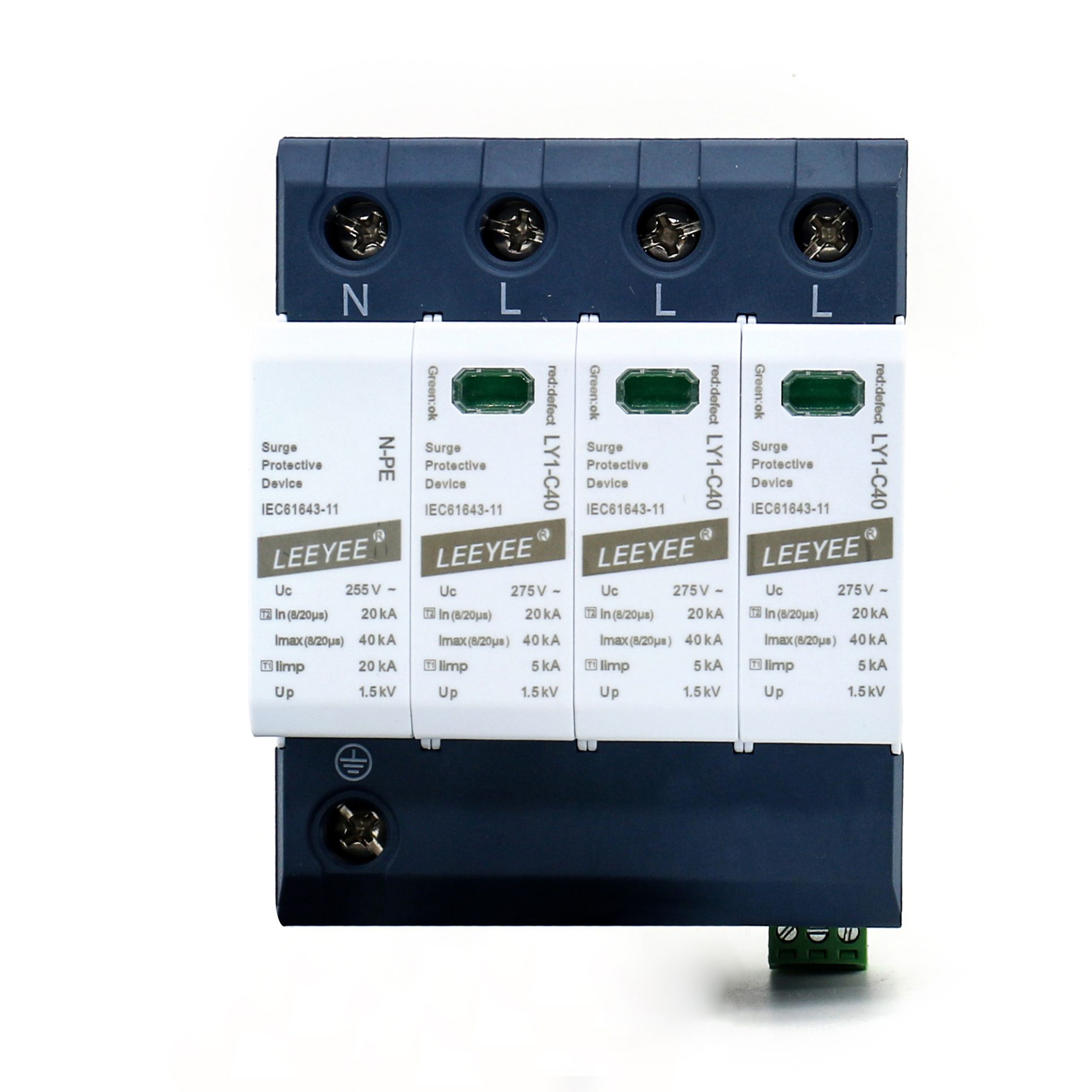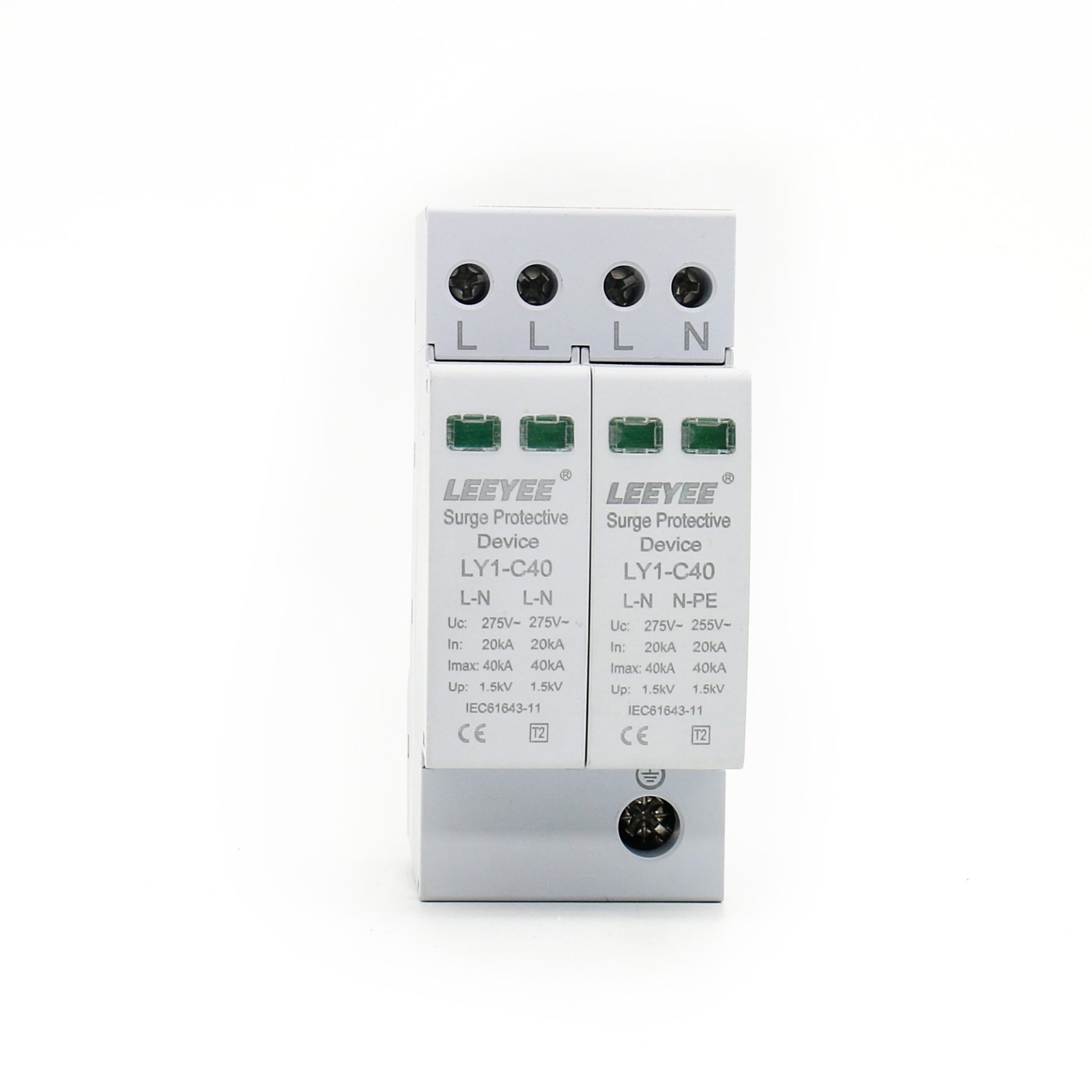
A 3 phase surge protector is used to protect industrial and commercial three-phase power systems from transient overvoltage.
It is commonly installed in main distribution boards, sub-distribution panels, control cabinets, machine panels, HVAC systems, PV inverter AC panels, and OEM electrical cabinets.
The important point is simple: a 3 phase surge protector should not be selected only by voltage or pole count. The correct SPD depends on the complete electrical system.
Table of Contents
Quick Answer: How Do You Choose a 3 Phase Surge Protector?
For a standard three-phase distribution board, first confirm the system voltage and earthing system. Then choose the SPD type and pole configuration.
Main incoming panels may need Type 1 or Type 1+2 protection. Standard sub-distribution boards commonly use Type 2 protection. TN-S, TN-C-S, TT, IT and three-phase 3-wire systems may require different SPD configurations.
| Application | Common SPD Choice | Buyer Note |
|---|---|---|
| Main incoming panel with high lightning exposure | Type 1 or Type 1+2 SPD | Check Iimp and backup protection. |
| Standard sub-distribution board | Type 2 SPD | Common for industrial and commercial panels. |
| TN-S three-phase 4-wire system | 4P or suitable 4-pole SPD | Protects L1, L2, L3, N and PE according to design. |
| TT three-phase 4-wire system | 3P+N / 3+1 SPD | N-PE protection path must be considered. |
| Three-phase 3-wire system | 3P SPD | Used when neutral is not available. |
| OEM electrical cabinet | Depends on project drawing | Confirm voltage, grounding, pole count and certification. |
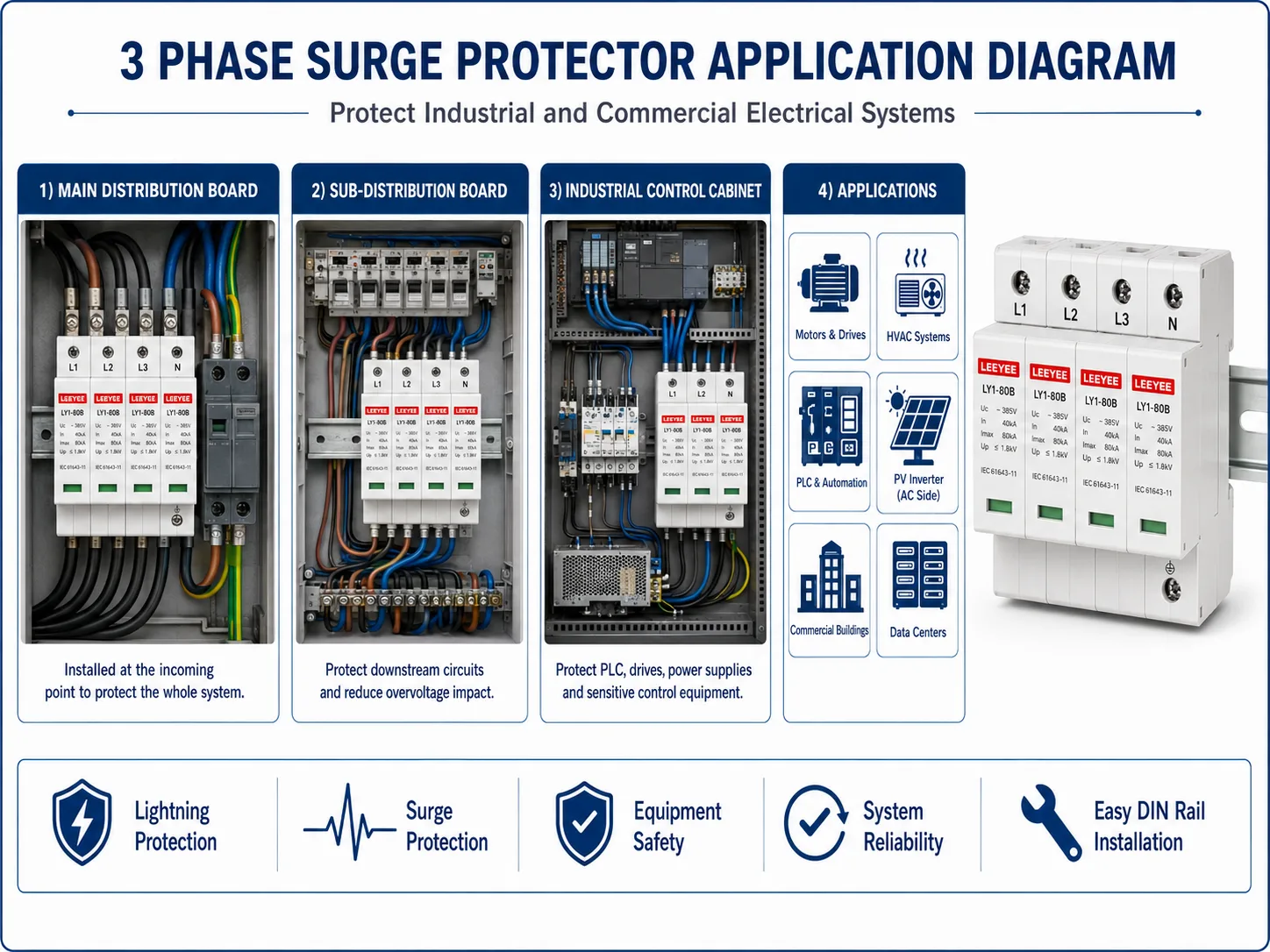
A higher kA rating does not automatically mean the SPD is better for every panel. A correct SPD is one that matches the real electrical system, installation position, and protection requirement.
What Is a 3 Phase Surge Protector?
A 3 phase surge protector, also called a three-phase surge protective device or 3 phase SPD, is designed to limit transient overvoltage in three-phase power systems.
A surge can come from lightning activity, utility grid switching, motor starting and stopping, transformer switching, capacitor bank switching, VFD operation, nearby faults, or industrial load switching.
The SPD provides a controlled discharge path for surge current. When a transient overvoltage appears, the SPD limits the voltage to a safer level and helps discharge surge energy to earth.
This helps protect downstream equipment such as PLCs, drives, power supplies, sensors, control boards, communication equipment, and industrial machines.
Why Three-Phase Systems Need Different SPD Selection
A three-phase system is more complex than a single-phase circuit. Surges may appear between different conductors.
- Line to earth: L-PE
- Line to neutral: L-N
- Neutral to earth: N-PE
- Line to line: L-L
This is why three-phase SPD selection must consider the system structure. The word “three phase” is not enough to select the SPD.
Where Are 3 Phase Surge Protectors Used?
3 phase SPDs are commonly used in B2B electrical systems, including:
- Industrial distribution boards
- Commercial building panels
- Factory power distribution systems
- Machine control cabinets
- HVAC control panels
- Motor control centers
- PLC and automation cabinets
- Data center power panels
- EV charging distribution systems
- PV inverter AC output panels
- OEM electrical cabinets
- Electrical panel builder projects
For OEM buyers, importers, and panel builders, the SPD must fit both the technical requirement and the final product design.
This includes wiring space, DIN rail mounting, pluggable module type, remote signal contact, certification, label design, and long-term supply stability.
Type 1, Type 2, and Type 1+2 Three-Phase SPD
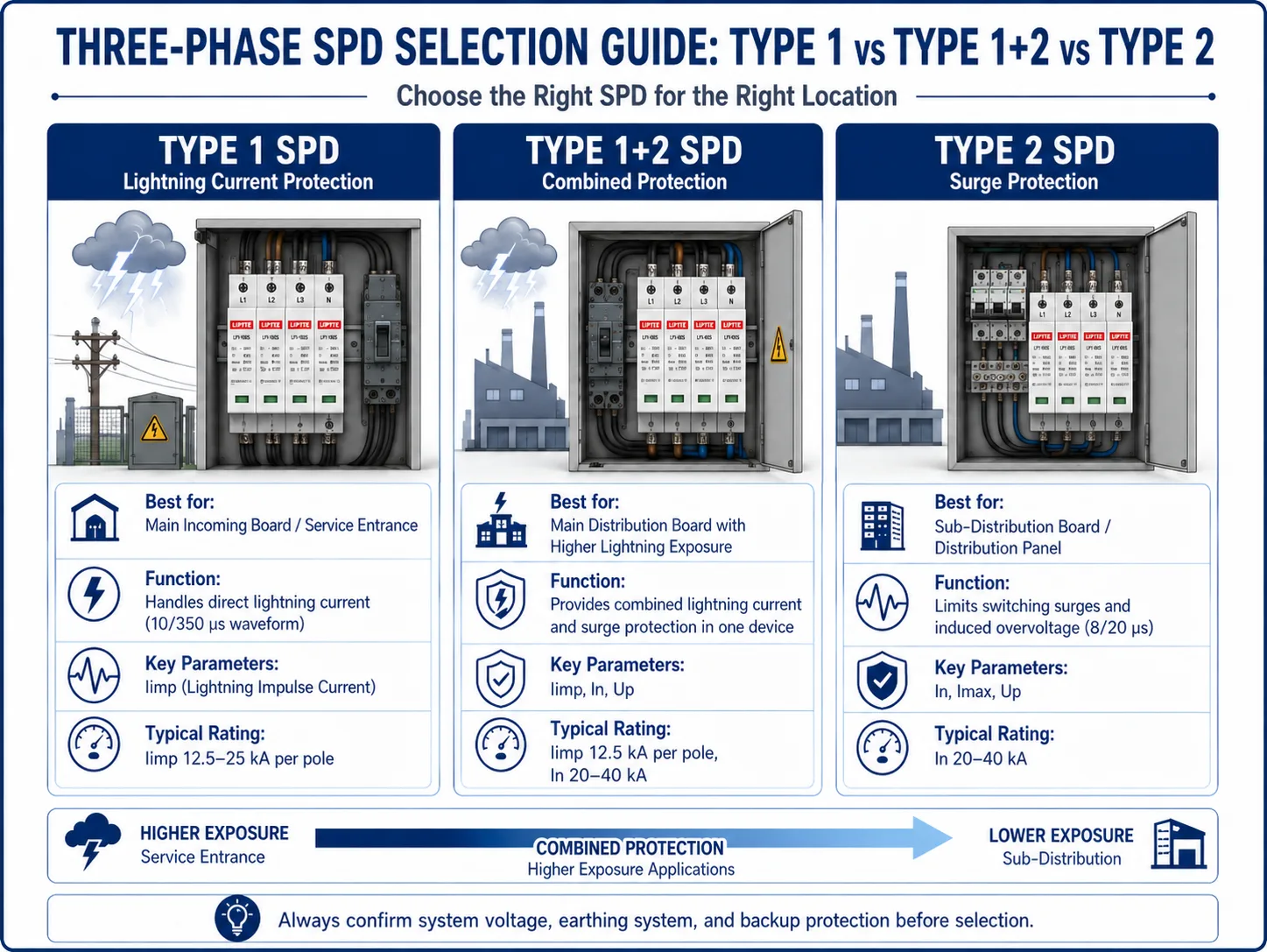
The SPD type should match the installation position and surge exposure level. A Type 2 SPD should not be used blindly where Type 1 protection is required. But Type 1 is also not automatically required in every panel.
| SPD Type | Common Installation Position | Main Function | Buyer Note |
|---|---|---|---|
| Type 1 SPD | Main incoming panel, service entrance | Handles partial lightning current | Check Iimp value. |
| Type 1+2 SPD | Main distribution board with higher exposure | Lightning current and surge protection | Useful where compact combined protection is needed. |
| Type 2 SPD | Sub-distribution board, control panel | Limits switching surges and induced surges | Common for industrial panels. |
| Type 3 SPD | Near sensitive terminal equipment | Fine protection near equipment | Usually used after Type 2 coordination. |
The correct choice depends on lightning exposure, upstream protection, local electrical design, installation position, and project requirements.
3P, 4P, and 3P+N: What Is the Difference?
Many buyers choose a three-phase SPD by pole count. This can lead to mistakes.
The pole configuration should match the system wiring and earthing arrangement.
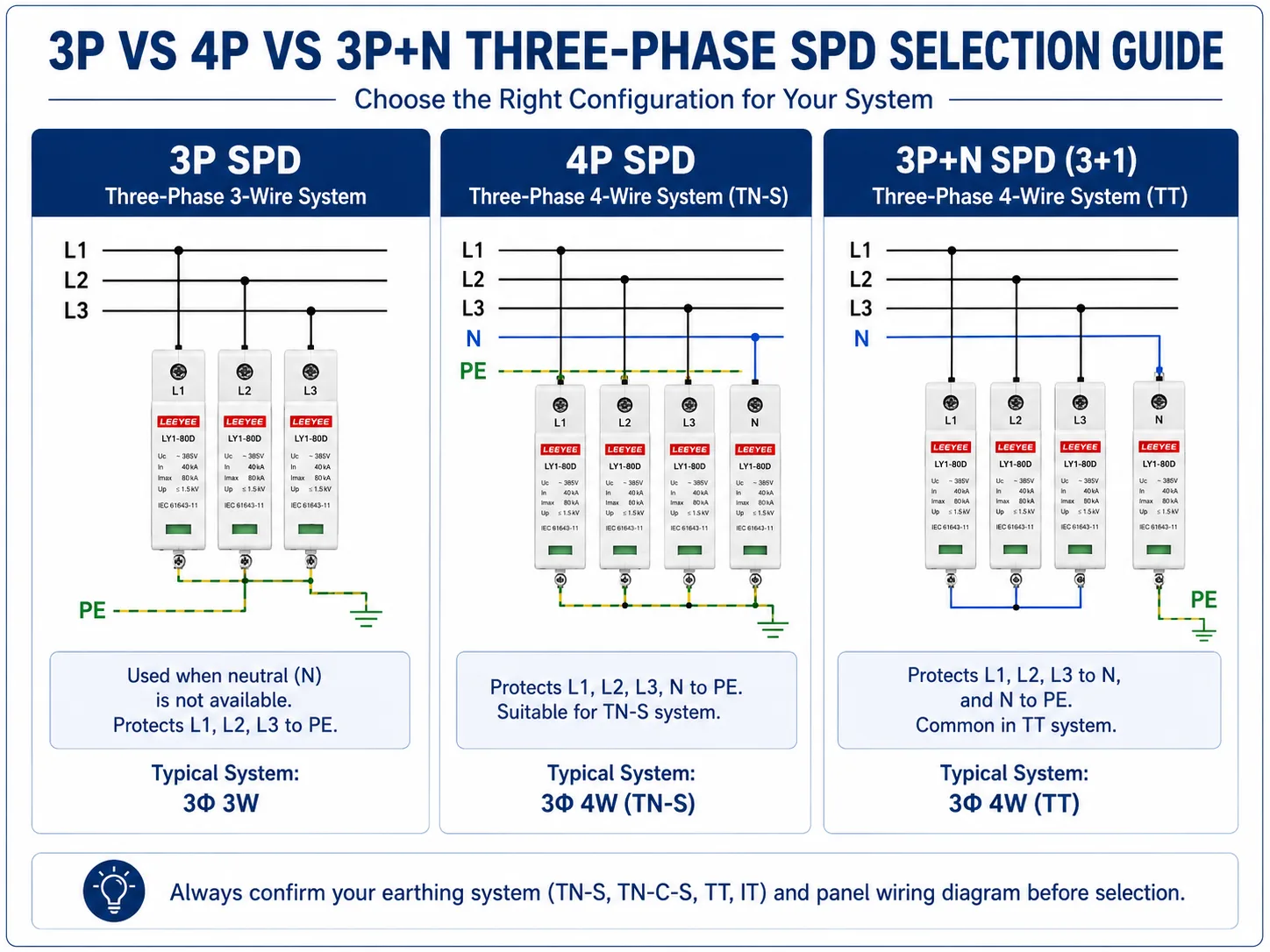
| SPD Configuration | Common Use | What It Means | Important Note |
|---|---|---|---|
| 3P SPD | Three-phase 3-wire systems | L1, L2, L3 protection | Used when neutral is not present. |
| 4P SPD | Three-phase 4-wire systems | L1, L2, L3, N protection | Wiring logic depends on system design. |
| 3P+N SPD | Often used in 3+1 protection design | L1/L2/L3 to N, N to PE | Common in TT-related protection design. |
| 4+0 configuration | Often used in TN-S systems | L1, L2, L3, N protected to PE | Check product design and wiring diagram. |
| 3+1 configuration | Often used in TT systems | L1/L2/L3 to N, N to PE | N-PE path is critical. |
A 4P SPD and a 3P+N SPD should not be treated as the same thing in every project. A 3P SPD is not automatically suitable for all three-phase systems. A 3P+N SPD is not automatically required for every system with neutral.
Before ordering, confirm the project drawing, earthing system, and SPD wiring diagram. For detailed wiring diagrams, see our Three-Phase SPD Wiring Diagram Guide.
How Earthing Systems Affect 3 Phase SPD Selection
The earthing system is one of the most important factors in SPD selection. Different earthing systems may require different protection modes.
TN-S Systems
In a TN-S system, neutral and protective earth are separate conductors. A typical three-phase TN-S panel has L1, L2, L3, N and PE.
In many TN-S distribution boards, a 4P SPD or suitable 4-pole protection is used. The exact connection depends on the SPD design and panel wiring.
TN-C-S Systems
In a TN-C-S system, the PEN conductor is separated into N and PE at a certain point. The SPD selection depends on where the SPD is installed.
For TN-C-S systems, do not select the SPD by looking only at the number of wires. Confirm the panel drawing first.
TT Systems
In a TT system, the installation has its own local earth electrode. The neutral-to-earth relationship is different from TN-S systems.
TT systems often use 3P+N or 3+1 protection logic. The N-PE protection path must be considered carefully.
IT Systems
IT systems require special attention. They may have an isolated or impedance-earthed neutral.
SPD selection for IT systems should follow the project electrical design, insulation monitoring requirement, and local code. Do not use a standard TN or TT SPD recommendation without checking the system design.
Key Parameters for a 3 Phase Surge Protector
Uc / MCOV
Uc, also called MCOV, is the maximum continuous operating voltage. It must be higher than the normal system voltage but not selected blindly too high.
If Uc is too low, the SPD may age faster or fail earlier. If Uc is too high, the protection level may become less sensitive.
In
In is the nominal discharge current. It shows the SPD’s ability to handle repeated surge currents, usually with an 8/20 μs waveform.
Imax
Imax is the maximum discharge current. It shows the SPD’s maximum single surge discharge capability under specified test conditions.
Iimp
Iimp is the lightning impulse current. It is important for Type 1 SPDs and Type 1+2 SPDs.
Up
Up is the voltage protection level. A lower Up generally means better voltage limiting performance.
Backup Fuse or MCB
A 3 phase SPD usually needs suitable backup overcurrent protection. This may be an MCB, MCCB, or fuse. The rating should follow the SPD datasheet.
3 Phase Surge Protector Selection Table
Use this table as a quick starting point before sending an inquiry.
| System or Application | Recommended Selection Direction | What to Confirm |
|---|---|---|
| 230/400V TN-S distribution board | Type 2, 4P or suitable 4-pole SPD | Uc, In, Imax, backup protection. |
| 400/415V industrial panel | Type 2 or Type 1+2 depending on position | System voltage and exposure level. |
| Main incoming board | Type 1 or Type 1+2 may be required | Iimp, upstream protection, installation code. |
| Sub-distribution board | Type 2 SPD | In, Imax, Up, backup fuse. |
| TT system | 3P+N / 3+1 may be required | N-PE path and product suitability. |
| Three-phase 3-wire system | 3P SPD | No neutral, system voltage, grounding. |
| OEM cabinet | Project-specific SPD | Label, certification, wiring space, remote signal. |
| Remote monitoring panel | SPD with remote signal contact | Alarm contact type and wiring. |
This table is not a replacement for the project drawing. It is a quick selection tool for buyers, distributors, and panel builders.
Installation Position: Main Board vs Sub-Distribution Board
A 3 phase surge protector should be installed according to the protection zone and panel function.
- Main incoming distribution board
- Sub-distribution board
- Machine control cabinet
- PLC cabinet
- PV inverter AC output panel
- HVAC control panel
- Data center power panel
At the main incoming point, Type 1 or Type 1+2 may be required depending on lightning exposure and building protection design. At sub-distribution boards, Type 2 is commonly used to protect downstream circuits.
Wiring and Lead Length Matter
A good SPD can perform poorly if it is wired badly. During a surge, current rises very fast. Long wires add inductance and can increase the voltage seen by downstream equipment.
For detailed TN-S, TN-C-S, TT, 3P, 4P and 3P+N wiring diagrams, see the Three-Phase SPD Wiring Diagram Guide.
Common Mistakes When Choosing a 3 Phase SPD
1. Choosing only by pole count
Some buyers ask only for “3P” or “4P” without confirming the earthing system. This can lead to the wrong product.
2. Ignoring the earthing system
TN-S, TN-C-S, TT and IT systems can require different SPD wiring logic. Do not treat all three-phase panels the same.
3. Using Type 2 where Type 1 or Type 1+2 is required
Type 2 SPD is common for distribution boards. But if the panel is at the main incoming point with high lightning exposure, Type 1 or Type 1+2 may be required.
4. Selecting Uc too low
If Uc is too low for the real operating voltage, the SPD may age faster or fail earlier. Always check nominal voltage and voltage fluctuation.
5. Looking only at Imax
Imax is important, but it is not the whole story. Check In, Iimp, Up, Uc, backup fuse, and certification.
6. Skipping backup protection
The SPD should be protected according to its datasheet. The backup MCB or fuse helps safe disconnection at end of life or under fault conditions.
7. Ignoring remote signal requirement
For industrial maintenance teams, remote signal contact can help monitor SPD status. If the panel needs alarm output, confirm this before ordering.
What Information Should You Send Before Ordering?
Before asking for a quotation, prepare these details. This helps the supplier recommend the correct 3 phase surge protector faster.
| Information | Why It Matters |
|---|---|
| Nominal system voltage | Determines Uc / MCOV selection. |
| Earthing system | TN-S, TN-C-S, TT, IT, or 3-phase 3-wire. |
| Installation position | Main incomer, sub-board, machine panel, OEM cabinet. |
| SPD type | Type 1, Type 2, Type 1+2, or Type 3. |
| Pole configuration | 3P, 4P, or 3P+N. |
| In / Imax / Iimp requirement | Determines discharge capacity. |
| Backup fuse or MCB | Required for safe coordination. |
| Remote signal requirement | Needed for alarm or maintenance monitoring. |
| Certification requirement | CE, TUV, CB or project-specific documents. |
| OEM label requirement | Important for distributors and private label buyers. |
| Panel wiring diagram | Helps confirm correct SPD configuration. |
Need Help Choosing a 3 Phase Surge Protector?
Send us your system voltage, earthing type, installation position, panel wiring diagram, backup fuse requirement, and certification requirement. Our team can recommend a suitable SPD model for your distribution board, control panel, or OEM electrical cabinet.
Recommended 3 Phase SPD Products for B2B Buyers
LEEYEE supplies DIN rail mounted surge protective devices for industrial and commercial three-phase electrical systems. For three-phase distribution boards, control panels, and OEM electrical cabinets, the following product pages can help you compare suitable SPD options.
FAQ
What is a 3 phase surge protector?
A 3 phase surge protector is an SPD used to protect three-phase electrical systems from transient overvoltage. It is commonly used in industrial panels, commercial distribution boards, machine cabinets, and OEM electrical systems.
How do I choose a 3 phase SPD?
Confirm the system voltage, earthing system, installation position, SPD type, pole configuration, surge current rating, backup protection, and certification requirement. Do not select only by pole count or Imax rating.
What is the difference between 3P and 4P SPD?
A 3P SPD is commonly used for three-phase 3-wire systems without neutral. A 4P SPD is used for three-phase 4-wire systems where L1, L2, L3 and N need protection according to the system design.
What is the difference between 4P and 3P+N SPD?
A 4P SPD and a 3P+N SPD are not always the same. A 3P+N SPD often refers to 3+1 protection logic, where the three phases are protected to neutral and neutral is protected to PE. The correct choice depends on the earthing system.
Which SPD is used for a three-phase TN-S system?
Many TN-S three-phase distribution boards use 4P or suitable 4-pole SPD protection. The exact connection depends on the panel design, SPD type, and project requirements.
Which SPD is used for a three-phase TT system?
TT systems often use 3P+N or 3+1 protection logic. The N-PE protection path must be considered carefully. Always confirm the product datasheet and project drawing before selection.
Do I need Type 1 or Type 2 SPD for a 3 phase panel?
Type 1 or Type 1+2 may be required at the main incoming point with lightning exposure. Type 2 is commonly used in sub-distribution boards and control panels. The correct choice depends on installation position and exposure level.
Does a 3 phase surge protector need a backup fuse or MCB?
In most installations, yes. The backup fuse or MCB helps disconnect the SPD safely if it reaches end of life or fails under fault conditions. The rating should follow the SPD datasheet.
Can I use three single-phase SPDs instead of one 3 phase SPD?
It may be technically possible in some designs, but a dedicated three-phase SPD is usually preferred for coordinated installation, easier monitoring, and cleaner panel design. Follow the project drawing and supplier recommendation.
What information should I send to get a correct SPD recommendation?
Send the system voltage, earthing system, installation position, pole requirement, SPD type, panel wiring diagram, backup fuse requirement, certification requirement, and whether remote signal contact is needed.