
Sind Sie sich unsicher, ob Sie ein 600V, 1000V oder 1500V DC SPD für ein Solar-PV-System wählen sollen?
Ein Parameter sollte überprüft werden, bevor die Bestellung bestätigt wird: Ucpv.
Für Solar-PV-Systeme sollte das DC SPD Ucpv gemäß der realen maximalen DC-Spannung ausgewählt werden, die an den SPD-Anschlüssen auftreten kann, nicht nur gemäß der auf dem Wechselrichter oder der Kombinationsbox aufgedruckten Systembezeichnung.
Dieser Leitfaden erklärt, wie man das DC SPD Ucpv für 600V, 1000V und 1500V Solar-PV-Systeme auswählt, insbesondere für PV-Kombinationsboxen, DC-Eingänge von Wechselrichtern, EPC-Projekte, Händler und OEM-Paneelbestellungen.
Inhaltsübersicht
Schnelle Antwort: So wählen Sie DC SPD Ucpv aus
Für Solar-PV-Systeme wählen Sie ein DC SPD mit Ucpv gleich oder höher als die maximale DC-Spannung, die an den SPD-Anschlüssen auftreten kann.
In der Praxis sollten Sie die PV-Systemspannung, Voc der PV-Strings, die niedrigste Betriebstemperatur, die maximale DC-Eingangsspannung des Wechselrichters, die Nennspannung der Kombinationsbox und den erforderlichen SPD-Typ überprüfen.
| PV-System | Häufige DC SPD Ucpv | Typische Verwendung | Hauptprüfung vor der Bestellung |
|---|---|---|---|
| 600V DC-System | 600V DC | Kleine PV-Systeme, netzunabhängige Solar, Niederspannungsstränge | Bestätigen Sie, dass die korrigierte Strangspannung unter 600V liegt. |
| 1000V DC-System | 1000V DC | Kommerzielle PV-Systeme, Dach-PV, Standard-Kombinationskästen | Überprüfen Sie die korrigierte Voc und die maximale DC-Spannung des Wechselrichters. |
| 1500V DC-System | 1500V Gleichstrom | Versorgungsnetzgroße Solaranlagen, große EPC-Projekte | Bestätigen Sie, dass jede DC-Komponente für 1500V ausgelegt ist. |
Diese Tabelle gibt eine schnelle Richtung vor, ist jedoch keine endgültige Ingenieursentscheidung. Bestätigen Sie vor der Auftragserteilung stets die korrigierte PV-String-Leerlaufspannung und die Nennspannung des gesamten DC-Stromkreises.
Brauchen Sie eine schnelle Modellempfehlung?
Übermitteln Sie die Spannung Ihres PV-Systems, das Modul Voc, die String-Konfiguration und die Anforderungen an den Kombinierkasten. Unser Team kann Ihnen helfen zu überprüfen, ob ein 600V, 1000V oder 1500V DC SPD für Ihr Projekt geeignet ist.
Was bedeutet Ucpv bei einem DC SPD?
Ucpv bedeutet maximale Dauerbetriebsspannung für Photovoltaiksysteme.
Einfach ausgedrückt ist es die maximale DC-Spannung, die der SPD kontinuierlich unter normalem PV-Betrieb standhalten kann.
Das unterscheidet sich von den Überspannungsstromwerten.
| Parameter | Was es bedeutet | Warum es wichtig ist |
|---|---|---|
| Ucpv | Maximale Dauerbetriebsspannung für PV-Systeme | Zeigt an, ob der SPD sicher an den DC-Stromkreis angeschlossen bleiben kann. |
| Unter | Nennentladestrom | Zeigt die normale Überspannungsableitungskapazität unter einem definierten Testwellenform. |
| Imax | Maximaler Entladestrom | Zeigt die maximale Überspannungsstromfähigkeit unter einer definierten Testwellenform. |
| Nach oben | Spannungsschutzniveau | Zeigt die Restspannung während eines Überspannungsereignisses. |
Für Solar-PV-Systeme ist Ucpv besonders wichtig, da PV-Strings auch bei geringem oder keinem Laststrom hohe DC-Spannungen erzeugen können.
Die höchste Spannung tritt oft bei kaltem Wetter und unter Freileitungsbedingungen auf. Deshalb sollte ein DC SPD nicht nur anhand des nominalen PV-Systemetiketts ausgewählt werden.
Warum die Auswahl von Ucpv in Solar-PV-Systemen wichtig ist
Ein Solar-PV-System ist nicht dasselbe wie ein normales AC-Verteilerfeld.
Auf der DC-Seite gibt es keinen natürlichen Nulldurchgang wie in AC-Schaltungen. DC-Spannung kann kontinuierlich vorhanden bleiben. Wenn der SPD nicht korrekt für das PV-DC-System bewertet ist, kann er während des normalen Betriebs Stress ausgesetzt werden.
Für einen PV-Kombinierkasten oder Wechselrichter-Schrank kann eine falsche Ucpv-Auswahl echte Projektprobleme verursachen:
- SPD-Anzeige wird zu früh rot.
- MOV-Modul altern schneller.
- Thermischer Trennschalter funktioniert.
- Das Wartungsteam benötigt wiederholte Ersatzteile.
- Die Genehmigung des Kombinierkastens verzögert sich.
- Der OEM-Käufer lehnt die Stückliste ab.
- Der Distributor erhält Qualitätsbeschwerden aus dem Feld.
Bei B2B-Bestellungen ist Ucpv nicht nur eine Datenblattnummer.
Es beeinflusst die Produktzuverlässigkeit, die Projektakzeptanz und die Kosten nach dem Verkauf. Für Hersteller von Kombinierkästen, EPC-Käufer, Distributoren und OEM-Projekte sollte dies bestätigt werden, bevor das Angebot finalisiert wird.
Wählen Sie DC SPD nicht nur nach “600V, 1000V oder 1500V”
Viele Käufer fragen:
“Wir haben ein 1000V-Solarsystem. Können wir Ihr 1000V DC SPD verwenden?”
In der Regel ja. Aber bevor das Modell bestätigt wird, sollte ein professioneller Anbieter eine weitere Frage stellen:
Wie hoch ist die korrigierte maximale Leerlaufspannung der PV-Stränge?
Ein als 1000V gekennzeichnetes PV-System bedeutet in der Regel, dass das System so ausgelegt ist, dass es 1000V DC nicht überschreitet. Aber die tatsächliche Spannung des PV-Strangs hängt vom Modul Voc, der Anzahl der in Reihe geschalteten Module und der tiefsten lokalen Temperatur ab.
Wenn die korrigierte Strangspannung zu nahe an der Systemgrenze liegt, sollte das Systemdesign überprüft werden.
Verwenden Sie kein SPD mit höherer Spannung, um ein Problem im Strangdesign zu verbergen.
Ein 1500V SPD lässt einen 1000V-Wechselrichter, eine Sicherungshalterung, einen Trennschalter, ein Kabel oder einen Kombinierkasten nicht zu einem 1500V-geprüften Produkt werden.
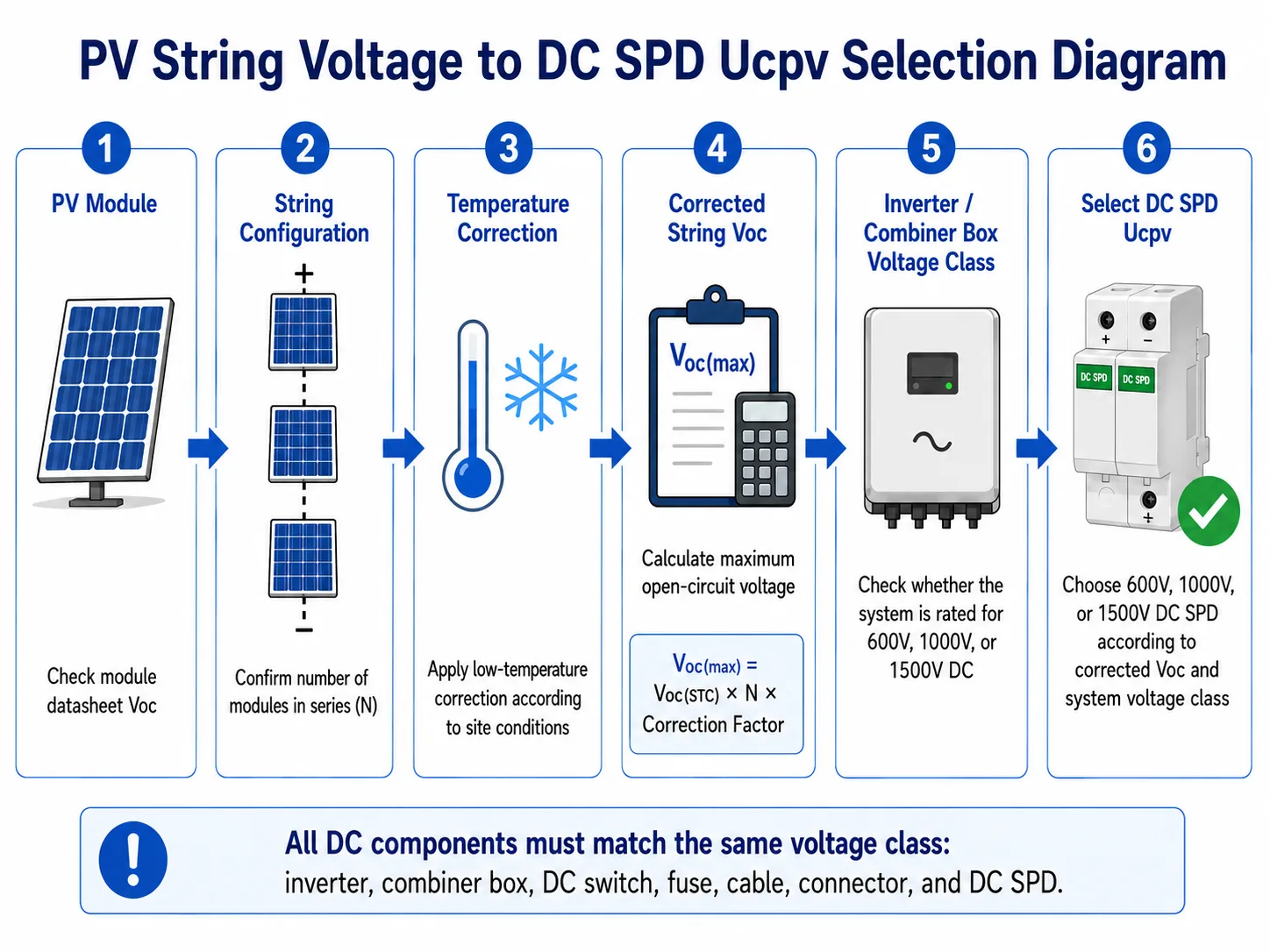
Die grundlegende Auswahllogik
Für die meisten Solar-PV-Projekte ist die Auswahllogik einfach:
- Bestätigen Sie die PV-Systemklasse: 600V, 1000V oder 1500V.
- Überprüfen Sie die Modul Voc aus dem Moduldatenblatt.
- Bestätigen Sie, wie viele Module in Reihe geschaltet sind.
- Wenden Sie die Korrektur bei niedrigen Temperaturen an.
- Vergleichen Sie die korrigierte Größe Voc mit der Systemspannungsgrenze.
- Wählen Sie eine DC SPD Ucpv-Bewertung, die für diese Spannungsgruppe geeignet ist.
- Bestätigen Sie den SPD-Typ, die Polkonfiguration und die Zertifizierung.
Die einfache Regel lautet:
DC SPD Ucpv sollte gleich oder höher sein als die maximale DC-Spannung, die an den SPD-Anschlüssen auftreten kann.
Aber diese Regel muss zusammen mit dem vollständigen Systemdesign verwendet werden. Der Wechselrichter, der Kombikasten, der DC-Schalter, der Sicherungshalter, das Kabel, der Stecker und der SPD sollten alle derselben Spannungsgruppe entsprechen.
Warum der PV String Voc wichtiger ist als die Betriebs- bzw. Arbeitsspannung
PV-Käufer betrachten manchmal nur die Betriebs- spannung.
Das ist nicht genug.
Der PV-String kann seine höchste Spannung erreichen, wenn der Kreis offen ist und die Temperatur niedrig ist. Dieser Wert wird als Leerlaufspannung oder Voc bezeichnet.
Wenn PV-Module in Reihe geschaltet werden, addieren sich ihre Voc-Werte.
| Artikel | Beispiel |
|---|---|
| Modul Voc | 49V |
| Module in Reihe | 18 |
| String Voc unter Standard-Testbedingungen | 882V |
Zunächst mag dies für ein 1000V-PV-System geeignet erscheinen. Aber bei kaltem Wetter kann die Modulspannung ansteigen. Nach Temperaturkorrektur kann die tatsächliche maximale Stringspannung höher sein.
Deshalb muss das korrigierte Voc überprüft werden, bevor der DC SPD ausgewählt wird.
600V DC SPD Auswahl
Ein 600V DC SPD wird normalerweise in Niedervolt-Solar-PV-Systemen eingesetzt.
Es könnte geeignet sein für:
- Kleine PV-Systeme
- Insel-Solarsysteme
- Niederspannungs-PV-Strings
- Kleine Kombinationsboxen
- Batteriebezogene DC-Schutzpaneele, wenn die Anwendung zur SPD-Bewertung passt
Vor der Auswahl eines 600V DC SPD bestätigen Sie, dass die korrigierte maximale PV-Stringspannung unter der SPD Ucpv-Bewertung liegt.
Bestätigen Sie auch, dass der Wechselrichter, der Isolator, der Sicherungshalter, das Kabel und der Anschluss für die gleiche DC-Spannungsklasse geeignet sind.
Ein 600V DC SPD sollte nicht in einem 1000V- oder 1500V-PV-System verwendet werden.
Wenn es in einem Hochspannungsstromkreis installiert ist, kann der SPD während des normalen Betriebs belastet werden. Dies kann vorzeitige Alterung, Überhitzung, roten Indikatorstatus oder thermische Trennung verursachen.
1000V DC SPD Auswahl
Ein 1000V DC SPD ist eine der häufigsten Optionen für kommerzielle PV-Systeme.
Es wird häufig verwendet in:
- Gewerbliche PV-Dachanlagen
- Standard-PV-Combiner-Boxen
- String-Wechselrichtersystemen
- Solarverteilungstafeln
- OEM PV-Schutzschränken
- Distributor-Lagerprogramme für gängige Solarprojekte
Für ein 1000V PV-System sollte der korrigierte PV-String Voc innerhalb des 1000V-Systemdesignlimits bleiben.
Wenn der korrigierte Voc sicher unter dem Limit liegt, ist ein 1000V DC SPD normalerweise die normale Auswahl.
Wenn der korrigierte Voc sehr nah an 1000V ist, überprüfen Sie das Stringdesign sorgfältig. In vielen Fällen ist die richtige Lösung, die Anzahl der in Reihe geschalteten Module zu reduzieren oder das Systemdesign zu überprüfen.
Ersetzen Sie nicht einfach ein 1000V SPD durch ein 1500V SPD.
Dies sollte nur in Betracht gezogen werden, wenn das gesamte DC-System für dieses Spannungsniveau entworfen und genehmigt ist.
1500V DC SPD Auswahl
Ein 1500V DC SPD wird für Hochspannungs-PV-Systeme verwendet.
Es ist häufig in:
- Solarkraftwerke im industriellen Maßstab
- Großen, auf dem Boden montierten PV-Projekten
- 1500V String-Wechselrichtersystemen
- Hochspannungs-PV-Combiner-Boxen
- EPC-Solarprojekten
- OEM PV-Schutzschränken für große Projekte
Ein 1500V PV-System ermöglicht eine höhere Stringspannung und einen niedrigeren Strom für dasselbe Leistungsniveau. Dies kann Kabelverluste und die Gesamtkosten des Systems bei großen Installationen reduzieren.
Es erfordert jedoch, dass jede DC-Komponente korrekt ausgelegt ist.
| Für 1500V-Projekte, Überprüfen | Warum es wichtig ist |
|---|---|
| Maximale DC-Eingangsspannung des Wechselrichters | Der Wechselrichter muss für die volle DC-Spannungsklasse ausgelegt sein. |
| Bewertungs-Spannung des Kombinationskastens | Das Panel-Etikett und die internen Komponenten müssen mit dem 1500V DC-Design übereinstimmen. |
| Bewertung des DC- isolators oder Schalters | DC-Schaltungen bei hoher Spannung erfordern geeignete DC-gekennzeichnete Komponenten. |
| Bewertung der DC-Sicherung und des Sicherungshalters | Die Fusionskoordination muss mit der PV-Schaltungsspannung übereinstimmen. |
| Spannungsbewertung von Kabel und Stecker | Der gesamte DC-Stromkreis muss koordiniert werden, nicht nur die SPD. |
| DC-SPD Ucpv | Die SPD muss für die DC-Spannungsklasse der PV ausgelegt sein. |
Eine 1500V DC SPD sollte als Teil eines vollständigen 1500V DC-Systems ausgewählt werden. Sie sollte nicht als Abkürzung zur Behebung von Überspannungen in einem 1000V-System verwendet werden.
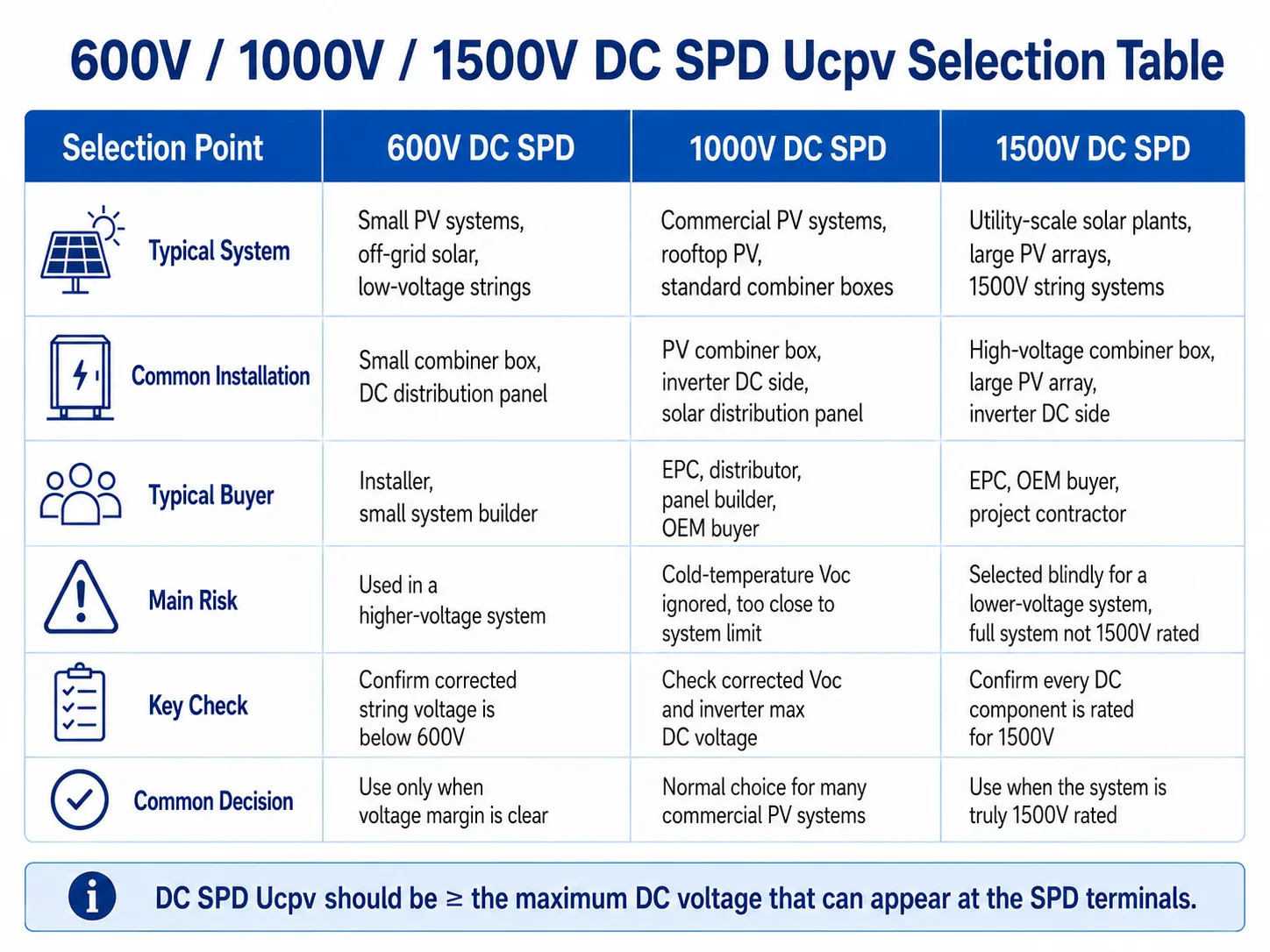
600V vs 1000V vs 1500V DC SPD Auswahl
| Auswahlpunkt | 600V DC SPD | 1000V DC SPD | 1500V DC SPD |
|---|---|---|---|
| Typisches Projekt | Kleine PV- oder netzunabhängige Solaranlage | Kommerzielle PV-Systeme | Solarkraftwerke im industriellen Maßstab |
| Häufige Installation | Kleine Kombinationsbox oder DC-Panel | PV-Kombinationsbox, Wechselrichter-Seite DC | Hochspannungs-Kombinationsbox, große PV-Anlage |
| Hauptkäufer | Installateur, kleiner Systembauer | EPC, Distributor, Modulbauer | EPC, OEM-Käufer, Projektauftragnehmer |
| Hauptschutzrisiko | Verwendet in einem Hochspannungssystem | Kälte-Temperatur Voc ignoriert | Blind ausgewählt für ein System mit niedrigerer Spannung |
| Schlüsselprüfung | Korrigierte Stringspannung | Maximale DC-Spannung des Wechselrichters und korrigiertes Voc | Vollständige 1500V-Systemkoordination |
Die beste Wahl ist nicht immer die höchste Spannungsbewertung. Die beste Wahl ist die Ucpv-Bewertung, die mit der tatsächlichen PV-Systemspannung mit einem angemessenen Sicherheitsabstand übereinstimmt.
Ist ein höheres Ucpv immer besser?
Nein.
Höhere Ucpv bedeutet nicht automatisch besseren Schutz.
Wenn Ucpv zu niedrig ist, kann das SPD frühzeitig ausfallen, da es übermäßig dauerhaftem Spannungen ausgesetzt ist.
Wenn Ucpv viel höher ist als benötigt, kann auch das Spannungsniveauschutz höher sein. Dies kann die Schutzkoordination für die Geräte hinter dem SPD verringern.
Wenn Ucpv zu niedrig ist
- Das SPD kann schneller altern.
- Die Anzeige könnte frühzeitig rot werden.
- Thermische Trennung kann auftreten.
- Die Wartungskosten für den Kombinationskasten können steigen.
Wenn Ucpv zu hoch ist
- Das Spannungsniveauschutz kann höher sein.
- Die Schutzkoordination kann schwächer sein.
- Die Produktkosten können steigen.
- Die OEM-Zulassung kann verwirrend werden.
Für Solar-PV-Projekte besteht das Ziel nicht darin, das SPD mit der höchsten Spannung zu kaufen. Das Ziel ist die Auswahl des richtigen SPDs für das tatsächliche DC-System.
Was passiert, wenn Ucpv zu niedrig ist?
Wenn die DC SPD Ucpv niedriger ist als die tatsächliche maximale PV-Spannung, kann der SPD während des normalen Betriebs belastet werden.
Mögliche Ergebnisse umfassen:
- Schnellerer MOV-Verschleiß
- Abnormale Erwärmung
- Rotes Indikatorfenster
- Thermische Trennung
- Früher Modulausfall
- Wiederholte Wartung des Kombinerkastens
- Höhere Austauschkosten
- Projektbeschwerde nach der Installation
Dieser Fehler tritt häufig auf, wenn eine 600V SPD in einem 1000V PV-System verwendet wird oder wenn eine 1000V SPD ausgewählt wird, ohne die korrigierte Kaltwetter Voc zu überprüfen.
Bei EPC-Projekten und OEM-Modulen kann dies zu einem Qualitätsproblem werden, nicht nur zu einem Komponentenproblem.
Was passiert, wenn Ucpv zu hoch ist?
Wenn der DC SPD Ucpv viel höher ist als erforderlich, kann die SPD die Systemspannung aushalten, bietet jedoch möglicherweise nicht die beste Schutzkoordination.
Mögliche Ergebnisse umfassen:
- Höherer Schutzpegel
- Weniger empfindliche Überspannungsklemmen
- Höhere Produktkosten
- Abweichung von den Projektspezifikationen
- Verwirrung während der Genehmigung von Modulen
- Unnötige Bestandskomplexität für Vertriebspartner
Deshalb sollte eine 1500V DC SPD nicht blind für jedes PV-Projekt ausgewählt werden. Bei einer 1000V Kombibox sollte zuerst überprüft werden, ob das gesamte DC-System für 1000V oder 1500V ausgelegt ist.
Kann ich einen 1500V DC SPD in einem 1000V PV-System verwenden?
Eine 1500V DC SPD hat eine höhere kontinuierliche Nennspannung als eine 1000V DC SPD.
Das bedeutet jedoch nicht, dass es immer der richtige Ersatz ist.
Für ein 1000V PV-System werden der Wechselrichter, die Kombibox, der Schalter, der Sicherungshalter, das Kabel und die Stecker normalerweise für ein 1000V DC-Design ausgewählt.
Wenn die korrigierte PV-String-Spannung die 1000V-Designgrenze überschreitet, sollte das Systemdesign überprüft werden.
Die Verwendung einer 1500V SPD aktualisiert das gesamte System nicht auf 1500V.
Eine 1500V SPD darf nur berücksichtigt werden, wenn der Projektingenieur bestätigt, dass die Systemspannungsbewertung, Schutzkoordination, Zertifizierungsanforderung und das Design des Moduls dies zulassen.
Bei OEM-Bestellungen sollte eine 1000V SPD nicht nur deshalb in eine 1500V SPD umgewandelt werden, weil das Modell mit höherer Spannung auf Lager ist.
Ucpv und Up: Verwechseln Sie diese beiden Parameter nicht
Ucpv und Up sind unterschiedlich.
Ucpv ist die maximale kontinuierliche Betriebsvoltage.
Nach oben ist der Spannungs Schutzpegel während einer Überspannung.
Ein DC SPD muss einen geeigneten Ucpv haben, damit er sicher mit dem PV-Kreis verbunden bleiben kann.
Es benötigt auch einen geeigneten Up-Wert, damit der Wechselrichter oder andere geschützte Geräte eine niedrigere Restsurge-Spannung erhalten.
Deshalb sollte Ucpv nicht isoliert geprüft werden. Eine gute DC SPD-Auswahl sollte Folgendes berücksichtigen:
- Ucpv
- Unter
- Imax
- Nach oben
- Iscpv, wenn erforderlich für die PV SPD-Spezifikation
- Typ 2 oder Typ 1+2
- Polkonfiguration
- Koordination des Backup-Schutzes
- Projektstandard und Zertifizierung
DC SPD Ucpv für Hersteller von Kombinationsboxen
Für Hersteller von Kombinationsboxen beeinflusst die Auswahl von Ucpv mehr als nur den SPD selbst.
Es beeinflusst:
- BOM-Zulassung
- Panel-Label
- Verdrahtungsdiagramm
- Produktdatenblatt
- Kundenakzeptanz
- Projektdokumentation
- Planung des Distributor-Lagerbestands
- After-Sales-Ersatz
| Information | Warum es wichtig ist |
|---|---|
| Nominal DC-Spannung der Kombinationsbox | Der SPD muss zur Spannungsgruppe des Panels passen. |
| PV-String-Spannung | Bestimmt den erforderlichen Ucpv. |
| Maximale DC-Spannung des Wechselrichters | Verhindert eine Fehlanpassung mit dem Inverterdesign. |
| Anzahl der Strings | Beeinflusst das Design der Module und das Schutzlayout. |
| SPD-Typ | Typ 2 oder Typ 1+2 hängt von den Projektanforderungen ab. |
| Polkonfiguration | Übliche PV-SPD-Optionen umfassen 2P- und 3P-Designs. |
| Zertifizierungsanforderung | Wichtig für die Genehmigung durch EPC und OEM. |
| Kennzeichnungsanforderung | Notwendig für Private Label- oder OEM-Bestellungen. |
Für standardmäßige kommerzielle PV-Datenboxen sind 1000V DC SPD üblich.
Für Utility-Scale PV Kombinationskästen ist ein 1500V DC SPD üblich.
Für kleinere oder netzferne Systeme kann ein 600V DC SPD ausreichend sein.
DC SPD Ucpv für Solar EPC-Projekte
Für Solar EPC-Projekte sollte die Auswahl von Ucpv dem Projektdesign folgen.
Das EPC-Team sollte bestätigen:
- Systemspannungsklasse
- Niedrigste Betriebstemperatur
- String-Konfiguration
- DC-Eingangsgrenze des Wechselrichters
- Blitzeinwirkung
- Anforderungen Typ 2 oder Typ 1+2
- Zertifizierung und Dokumentation
- Installationsort des SPD
- Anforderungen an Sicherungen oder Schutzschalter
Für EPC-Projekte besteht das Haupt Risiko nicht nur darin, die falsche SPD-Spannung zu wählen. Das größere Risiko besteht darin, dass unterschiedliche DC-Komponenten mit verschiedenen Spannungsannahmen ausgewählt werden.
Das SPD sollte mit dem gesamten DC-Systemdesign übereinstimmen.
DC SPD Ucpv für PV-Distribuoren
Für PV-Distributoren lautet die entscheidende Frage: Lagerplanung.
Ein Distributor benötigt möglicherweise unterschiedliche Ucpv-Optionen für verschiedene Kundengruppen:
| Kundentyp | Allgemeine Nachfrage |
|---|---|
| Kleine Solaranbieter | 600V oder 1000V DC SPD |
| Kommerzielle PV-Auftragnehmer | 1000V DC SPD |
| EPC-Projektkäufer | 1000V oder 1500V DC SPD |
| Kombinationsbox-Hersteller | 1000V- und 1500V-OEM-Optionen |
| Solarprojekte im Versorgungsmaßstab | 1500V DC SPD |
Für den Vertriebslagerbestand sind die Modelle 1000V und 1500V DC SPD oft die wichtigsten Optionen. Die lokale Marktnachfrage sollte jedoch vor der Abgabe von Großbestellungen überprüft werden.
DC SPD Ucpv für OEM-Käufer
Für OEM-Käufer muss die Ucpv-Auswahl stabil, wiederholbar und leicht genehmigbar sein.
Ein OEM-Käufer sollte bestätigen:
- Erforderliches Ucpv
- Typ 2 oder Typ 1+2
- Polkonfiguration
- Modulfarbe und Fensterindikator
- Anforderung für den Fernsignalschalter
- Anforderung für private Labeling
- Verpackungsanforderung
- Format des Datenblatts
- Anforderung an Zertifikat und Prüfbericht
- Verfügbarkeit von Ersatzmodulen
Für die OEM-Lieferung sollte die Spannungseinstufung des SPD nach Genehmigung des Designs nicht leichtfertig geändert werden. Auch wenn zwei Produkte ähnlich aussehen, können unterschiedliche Ucpv-Einstufungen das Datenblatt, das Etikett, die Verkabelung und die Projektdokumentation beeinflussen.
Typ 2 oder Typ 1+2: Ändert sich Ucpv?
Typ 2 und Typ 1+2 beschreiben die Überspannungsableitfähigkeit und die Prüfkategorie.
Sie ersetzen nicht die Ucpv-Auswahl.
In echten Bestellungen müssen beide bestätigt werden.
| Mögliche Anforderung | Typische Verwendung |
|---|---|
| Typ 2 DC SPD, Ucpv 1000V | Gängige kommerzielle PV-Systeme und Kombinationsboxen. |
| Typ 2 DC SPD, Ucpv 1500V | Hochspannungs-PV-Projekte im Versorgungsmaßstab. |
| Typ 1+2 DC SPD, Ucpv 1000V | 1000V PV-Systeme mit höherer Blitzexposition oder Projektanforderung. |
| Typ 1+2 DC SPD, Ucpv 1500V | 1500V PV-Systeme, bei denen die Fähigkeit zur Ableitung von Blitzströmen spezifiziert ist. |
Typ 2 DC SPD wird häufig zum Schutz vor induzierten Überspannungen durch nahegelegene Blitze oder Schaltereignisse verwendet.
Typ 1+2 DC SPD kann erforderlich sein, wenn das PV-System einer höheren Blitzbelastung ausgesetzt ist oder wenn die Projektspezifikation die Fähigkeit zur Ableitung von Blitzströmen erfordert.
Überprüfen Sie immer die Projektanforderungen, bevor Sie das Modell bestätigen.
Welche Informationen sollten Sie vor der Bestellung senden?
Wenn Sie sich nicht sicher sind, ob Sie 600V, 1000V oder 1500V DC SPD wählen sollen, senden Sie die folgenden Informationen an den Lieferanten, bevor Sie bestellen.
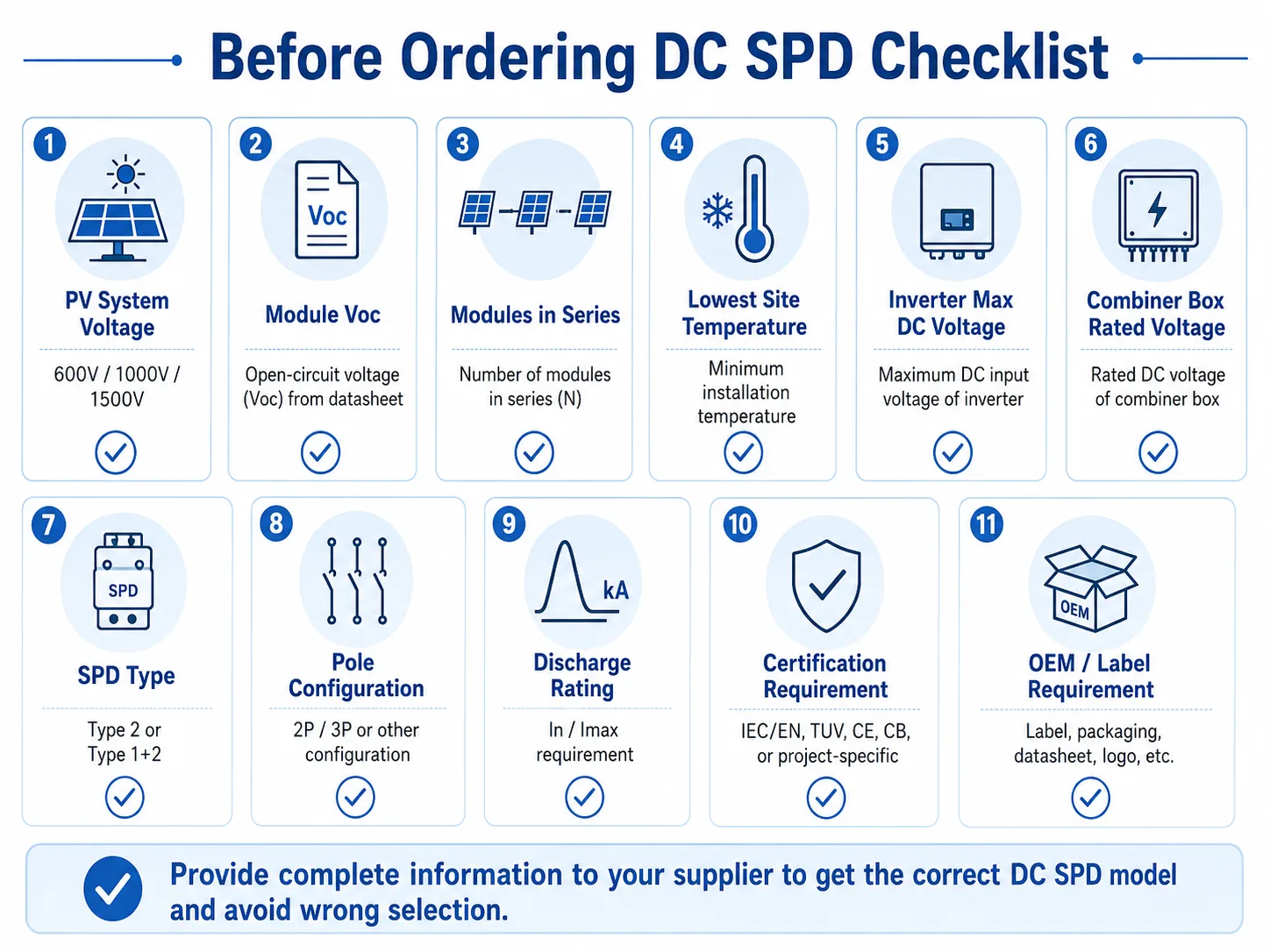
| Informationen zu senden | Beispiel |
|---|---|
| PV-Systemspannung | 600V / 1000V / 1500V |
| Modul Voc | 49V |
| Module in Reihe | 18 / 20 / 24 / 28 |
| Niedrigste Betriebstemperatur | -10°C / -20°C / -30°C |
| Maximale DC-Spannung des Wechselrichters | 1000V / 1500V |
| Bewertungs-Spannung des Kombinationskastens | 1000V DC / 1500V DC |
| SPD-Typ | Typ 2 / Typ 1+2 |
| Polkonfiguration | 2P / 3P |
| Benötigte Entladewertung | In / Imax-Anforderung |
| Zertifizierungsanforderung | IEC/EN, TUV, CB, CE oder projektspezifisch |
| OEM-Anforderung | Etikett, Verpackung, Datenblatt, Logo |
Diese Informationen helfen, falsche Modellauswahl zu vermeiden. Sie helfen auch dem Lieferanten, ein DC SPD zu empfehlen, das zu Ihrem Projekt passt, anstatt nur das günstigste verfügbare Produkt anzubieten.
Senden Sie Ihre PV-Systemanforderung
Wenn Sie DC SPDs für eine PV-Kombinationsbox, einen Wechselrichter-Schrank, ein Solar-Verteilungspanel oder ein OEM-Projekt auswählen, senden Sie uns Ihre Systemspannung und PV-String-Daten.
Unser Team kann ein geeignetes DC SPD-Modell für Ihre Solar-PV-Anwendung empfehlen.
Häufige Fehler, die vermieden werden sollten
Fehler 1: Nur nach Preis wählen
Ein SPDs mit niedrigerer Spannung kann günstiger sein, ist jedoch nicht für ein PV-System mit höherer Spannung geeignet.
Fehler 2: Verwendung von AC SPD auf der DC-Seite
AC SPD und PV DC SPD sind nicht dasselbe. Die DC-Seite eines Solar-PV-Systems benötigt ein für PV-Anwendungen ausgelegtes DC-rated SPD.
Fehler 3: Kaltwetter-Voc ignorieren
Die PV-Spannung kann bei niedrigen Temperaturen steigen. Dies ist einer der häufigsten Gründe, warum Ucpv nicht nur nach der nominalen Systemspannung ausgewählt werden sollte.
Fehler 4: Annehmen, dass 1500V immer besser sind
Ein 1500V SPD ist notwendig für ein 1500V PV-System, aber es ist nicht automatisch die beste Wahl für jedes 600V oder 1000V Projekt.
Fehler 5: Den gesamten DC-Stromkreis nicht überprüfen
Der SPD muss mit dem Wechselrichter, dem Kombi-Box, dem Trennschalter, dem Sicherungshalter, dem Kabel, dem Stecker und den Projektspezifikationen übereinstimmen.
Fehler 6: OEM-Modelle ohne Genehmigung ändern
Bei OEM-Panels und Kombi-Boxen kann die Änderung von SPD Ucpv nach Genehmigung die Kennzeichnung, das Datenblatt, das Schaltbild und die Kundenakzeptanz beeinträchtigen.
Empfohlener Auswahlfluss
- Bestätigen Sie, ob das Projekt 600V, 1000V oder 1500V beträgt.
- Überprüfen Sie die PV-Modul Voc.
- Bestätigen Sie die Anzahl der Module in Reihe.
- Anwenden der Korrektur für niedrige Temperaturen.
- Vergleichen Sie das korrigierte Voc mit der maximalen DC-Spannung des Wechselrichters.
- Bestätigen Sie die Nenn-DCS-Spannung der Kombi-Box.
- Wählen Sie das geeignete DC SPD Ucpv aus.
- Bestätigen Sie die Anforderungen für Typ 2 oder Typ 1+2.
- Bestätigen Sie die Polkonfiguration und Verdrahtung.
- Überprüfen Sie die Zertifizierung und Projektdokumentation.
- Senden Sie die finalen Daten an den Lieferanten zur Modellauswahl.
Beispiel: 1000V PV-Kombinationsbox
Ein Käufer baut eine 1000V PV-Zusammenführung.
Der Käufer fragt:
“Können wir einen 1000V DC SPD verwenden?”
Eine professionelle Antwort sollte nicht bei Ja stehen bleiben.
Der Lieferant sollte bestätigen:
- Was ist der Modul Voc?
- Wie viele Module sind in Reihe geschaltet?
- Was ist die niedrigste erwartete Temperatur?
- Was ist die korrigierte String Voc?
- Ist der Wechselrichter für 1000V DC ausgelegt?
- Ist die Kombibox für 1000V DC ausgelegt?
- Benötigt das Projekt Typ 2 oder Typ 1+2?
- Ist eine Zertifizierungsdokumentation erforderlich?
Wenn die korrigierte String Voc sicher innerhalb des 1000V Systemdesigns liegt, ist ein 1000V DC SPD normalerweise die richtige Wahl.
Wenn die korrigierte String Voc zu nah an der Grenze liegt, sollte das PV Stringdesign überprüft werden, bevor das SPD bestätigt wird.
Beispiel: 1500V PV-Projekt im Versorgungsmaßstab
Ein großangelegtes Solarprojekt verwendet eine 1500V DC-Architektur.
In diesem Fall sollte der Käufer bestätigen:
- 1500V Wechselrichter-Eingangsleistung
- 1500V Kombibox-Design
- 1500V DC-Separator-Leistung
- 1500V DC-Sicherung und Halterung
- 1500V Kabel- und Steckerverbindung
- 1500V DC SPD Ucpv
- Anforderungen Typ 2 oder Typ 1+2
- Projektzertifizierungsdokumente
Für diese Art von Projekt ist ein 1500V DC SPD nicht nur eine Hochvoltoption. Es ist Teil des vollständigen 1500V PV Systemdesigns.
Wie LEEYEE die Auswahl des DC SPD Ucpv unterstützt
LEEYEE liefert DC-Überspannungsschutzgeräte für Solar-PV-Anwendungen, einschließlich PV-Kombiboxen, Wechselrichter-DC-Schutz, Solardistributionspanels und OEM-Panelprojekten.
Bei der Auswahl von PV SPD bestätigen wir normalerweise mehr als nur das Spannungslabel.
Wir überprüfen:
- Systemspannung
- Korrigierte PV-Strangspannung
- SPD-Typ
- Polkonfiguration
- Anforderungen an den Entladestrom
- Zertifizierungsanforderung
- OEM-Label oder private Label-Anforderung
- Zielanwendung, wie Kombinationsbox oder Wechselrichterschrank
Dokumentationsunterstützung für EPC- und OEM-Bestellungen
Für PV SPD-Projekte benötigen Käufer häufig IEC/EN, TUV, CB, CE oder projektspezifische Dokumente, bevor sie EPC-, Distributor- oder OEM-Bestellungen bestätigen. Bitte bestätigen Sie die erforderliche Dokumentation vor der Modellgenehmigung.
CNSPD ist die auf Überspannungsschutz ausgerichtete Plattform von LEEYEE, die globalen Käufern hilft, zuverlässige SPDs und verwandte Produkte zum Schutz vor Niederspannung zu beziehen.
Wenn Sie Unterstützung bei der Auswahl von DC SPD für ein 600V-, 1000V- oder 1500V-Solar-PV-System benötigen, senden Sie Ihre PV-Systemdaten vor der Bestellung.
FAQ
Welches Ucpv sollte ich für ein 1000V Solarpv-System wählen?
Für die meisten 1000V Solar-PV-Systeme wird häufig ein 1000V DC SPD ausgewählt. Sie sollten jedoch die korrigierte offene PV-Strings-Spannung, die maximale DC-Spannung des Wechselrichters und die Bewertung des Kombinationskastens bestätigen, bevor Sie die Bestellung aufgeben.
Kann ich einen 1500V DC SPD anstelle eines 1000V DC SPD verwenden?
Ersetzen Sie ein 1000V DC SPD nicht blind durch ein 1500V DC SPD. Ein 1500V SPD hat eine höhere Spannungsprüfung, aber der Rest des PV-Systems könnte weiterhin für 1000V DC ausgelegt sein.
Ist Ucpv dasselbe wie die maximale Gleichstromspannung des Wechselrichters?
Nr. Ucpv ist die maximale dauerhafte Betriebs spannung des SPD. Die maximale DC-Spannung des Wechselrichters ist die höchste DC-Eingangsspannung, die der Wechselrichter erlaubt. Sie sollten koordiniert werden, sind jedoch nicht dasselbe Parameter.
Sollte DC SPD Ucpv gleich oder höher als der PV-Strings Voc sein?
Ja. Der DC SPD Ucpv sollte gleich oder höher sein als die maximale Spannung, die an den SPD-Anschlüssen auftreten kann. Für PV-Systeme ist die korrigierte Leerlaufspannung ein wichtiger Referenzwert.
Was passiert, wenn der DC SPD Ucpv zu niedrig ist?
Wenn Ucpv zu niedrig ist, könnte die SPD während des normalen PV-Betriebs unter Stress stehen. Dies kann zu schnellerem Verschleiß, abnormaler Erwärmung, rotem Anzeige-Status, thermischer Trennung oder vorzeitigem Ausfall führen.
Was passiert, wenn DC SPD Ucpv zu hoch ist?
Wenn Ucpv viel höher ist als erforderlich, bietet die SPD möglicherweise nicht die beste Schutzkoordination. Das Spannungs-Schutzniveau kann höher sein, und das Produkt kann mehr kosten als nötig.
Ist ein 1500V DC SPD besser als ein 1000V DC SPD?
Nicht immer. Ein 1500V DC SPD ist die richtige Wahl für ein 1500V PV-System. Für ein 1000V PV-System ist ein 1000V DC SPD normalerweise die übliche Wahl, wenn die korrigierte Stringspannung innerhalb der Systemgrenze liegt.
Was ist die Ucpv, die für PV-Combiner-Boxen üblich ist?
1000V DC SPD ist häufig für viele kommerzielle PV-Zusammenführungsboxen. 1500V DC SPD ist häufig für PV-Zusammenführungsboxen im Versorgungsmaßstab. 600V DC SPD kann für kleinere oder niederohmige PV-Systeme verwendet werden.
Benötige ich Typ 2 oder Typ 1+2 DC SPD?
Es hängt vom Projektdesign, der Blitzeinwirkung und der Spezifikation ab. Typ 2 ist für viele PV-Systeme verbreitet. Typ 1+2 kann erforderlich sein, wenn die Fähigkeit zum Blitzstromentladung festgelegt ist.
Welche Informationen sollte ich für die Auswahl des DC SPD-Modells senden?
Bitte senden Sie die PV-Systemspannung, die Modul-Voc, die in Reihe geschalteten Module, die niedrigste Standorttemperatur, die maximale DC-Spannung des Wechselrichters, die Nennspannung des Kombinationskastens, den SPD-Typ, die Pol-Konfiguration und die Zertifizierungsanforderung.
Brauchen Sie Hilfe bei der Auswahl des DC SPD Ucpv?
Wenn Sie DC SPDs für eine PV-Kombinationsbox, einen Wechselrichter-Schrank, ein Solar-Verteilungspanel oder ein OEM-Projekt auswählen, senden Sie uns Ihre Systemspannung und PV-String-Daten.
Bitte geben Sie die PV-Systemspannung, Modul Voc, Anzahl der in Serie geschalteten Module, niedrigste Installationstemperatur, maximale DC-Spannung des Wechselrichters, Nennspannung der Kombinationsbox, Anforderungen an Typ 2 oder Typ 1+2, Polkonfiguration sowie Anforderungen an Zertifizierung oder OEM-Label an.