
Não tem certeza se deve escolher um DC SPD de 600V, 1000V ou 1500V para um sistema PV solar?
Um parâmetro deve ser verificado antes que o pedido seja confirmado: Ucpv.
Para sistemas PV solares, o DC SPD Ucpv deve ser selecionado de acordo com a real tensão DC máxima que pode aparecer nos terminais do SPD, não apenas pelo nome do sistema impresso no inversor ou na caixa combinadora.
Este guia explica como escolher o DC SPD Ucpv para sistemas solares PV de 600V, 1000V e 1500V, especialmente para caixas combinadoras PV, entradas DC de inversores, projetos EPC, distribuidores e pedidos de painéis OEM.
Índice
Resposta Rápida: Como Escolher Ucpv de SPD DC
Para sistemas PV solares, escolha um DC SPD com Ucpv igual ou superior à tensão DC máxima que pode aparecer nos terminais do SPD.
Na prática, você deve verificar a tensão do sistema PV, Voc da string PV, a temperatura mais baixa do local, a tensão máxima de entrada DC do inversor, a tensão nominal da caixa combinadora e o tipo de SPD necessário.
| Sistema PV | DC SPD Ucpv Comuns | Uso Típico | Verificação principal antes de fazer o pedido |
|---|---|---|---|
| Sistema DC de 600V | 600V DC | Pequenos sistemas de PV, solar off-grid, strings de baixa tensão | Confirme que a tensão da string corrigida está abaixo de 600V. |
| Sistema DC de 1000V | 1000V DC | Sistemas comerciais de PV, PV em telhados, caixas combinadoras padrão | Verifique a Voc corrigida e a tensão máxima DC do inversor. |
| Sistema DC de 1500V | 1500V CC | Plantas solares em escala de utilidade, grandes projetos de EPC | Confirme que cada componente DC está classificado para 1500V. |
Esta tabela fornece uma direção rápida, mas não é uma decisão final de engenharia. Antes de fazer um pedido, sempre confirme a tensão em circuito aberto da string de PV corrigida e a tensão nominal de todo o circuito DC.
Precisa de uma Recomendações Rápida de Modelo?
Envie a voltagem do seu sistema fotovoltaico, módulo Voc, configuração da string e requisitos da caixa combinadora. Nossa equipe pode ajudar a verificar se um SPD DC de 600V, 1000V ou 1500V é adequado para o seu projeto.
O Que Significa Ucpv em um SPD DC?
Ucpv significa tensão máxima de operação contínua para sistemas fotovoltaicos.
Em palavras simples, é a máxima tensão DC que o SPD pode suportar continuamente sob operação normal de PV.
Isto é diferente das classificações de corrente de surto.
| Parâmetro | O que isso significa | Por que Isso Importa |
|---|---|---|
| Ucpv | Tensão máxima de operação contínua para sistemas fotovoltaicos | Mostra se o SPD pode permanecer conectado de forma segura ao circuito DC. |
| Em | Corrente de descarga nominal | Mostra a capacidade normal de descarga de surto sob uma forma de onda de teste definida. |
| Imax | Corrente máxima de descarga | Mostra a capacidade máxima de corrente de surto sob uma forma de onda de teste definida. |
| Para cima | Nível de proteção da tensão | Mostra a tensão residual durante um evento de surto. |
Para sistemas de energia solar fotovoltaica, Ucpv é especialmente importante porque strings de PV podem produzir alta tensão DC mesmo quando há pouca ou nenhuma corrente de carga.
A maior tensão frequentemente aparece em tempo frio e condições de circuito aberto. É por isso que um SPD DC não deve ser selecionado apenas olhando para o rótulo nominal do sistema fotovoltaico.
Por Que a Seleção de Ucpv é Importante em Sistemas Solares FV
Um sistema fotovoltaico não é o mesmo que um quadro de distribuição AC normal.
No lado DC, não há cruzamento natural de zero como em circuitos AC. A tensão DC pode permanecer presente continuamente. Se o SPD não estiver corretamente classificado para o sistema DC de PV, ele pode ser exposto a estresse durante a operação normal.
Para uma caixa combinadora de PV ou gabinete de inversor, uma seleção errada de Ucpv pode criar problemas reais no projeto:
- O indicador de SPD fica vermelho muito cedo.
- O módulo MOV envelhece mais rápido.
- O desconector térmico opera.
- A equipe de manutenção precisa de substituições repetidas.
- A aprovação da caixa combinadora está atrasada.
- O comprador de OEM rejeita a lista de materiais.
- O distribuidor recebe reclamações de qualidade do campo.
Em pedidos B2B, Ucpv não é apenas um número de ficha técnica.
Impacta a confiabilidade do produto, a aceitação do projeto e o custo pós-venda. Para fabricantes de caixas combinadoras, compradores de EPC, distribuidores e projetos de OEM, deve ser confirmado antes que a cotação seja finalizada.
Não Escolha SPD DC Apenas por “600V, 1000V ou 1500V”
Muitos compradores perguntam:
“Temos um sistema solar de 1000V. Podemos usar seu SPD CC de 1000V?”
Geralmente, sim. Mas antes de confirmar o modelo, um fornecedor profissional deve fazer uma pergunta a mais:
Qual é a tensão máxima na condição de circuito aberto corrigida do string PV?
Um sistema PV marcado como 1000V geralmente significa que o sistema foi projetado para não ultrapassar 1000V CC. Mas a tensão real do string PV depende do Voc do módulo, do número de módulos em série e da temperatura local mais baixa.
Se a tensão do string corrigida estiver muito próxima do limite do sistema, o design do sistema deve ser revisado.
Não use um SPD de alta tensão para esconder um problema de projeto do string.
Um SPD de 1500V não faz um inversor de 1000V, porta-fusível, isolador, cabo ou caixa combinadora se tornar classificado em 1500V.
A Lógica Básica de Seleção
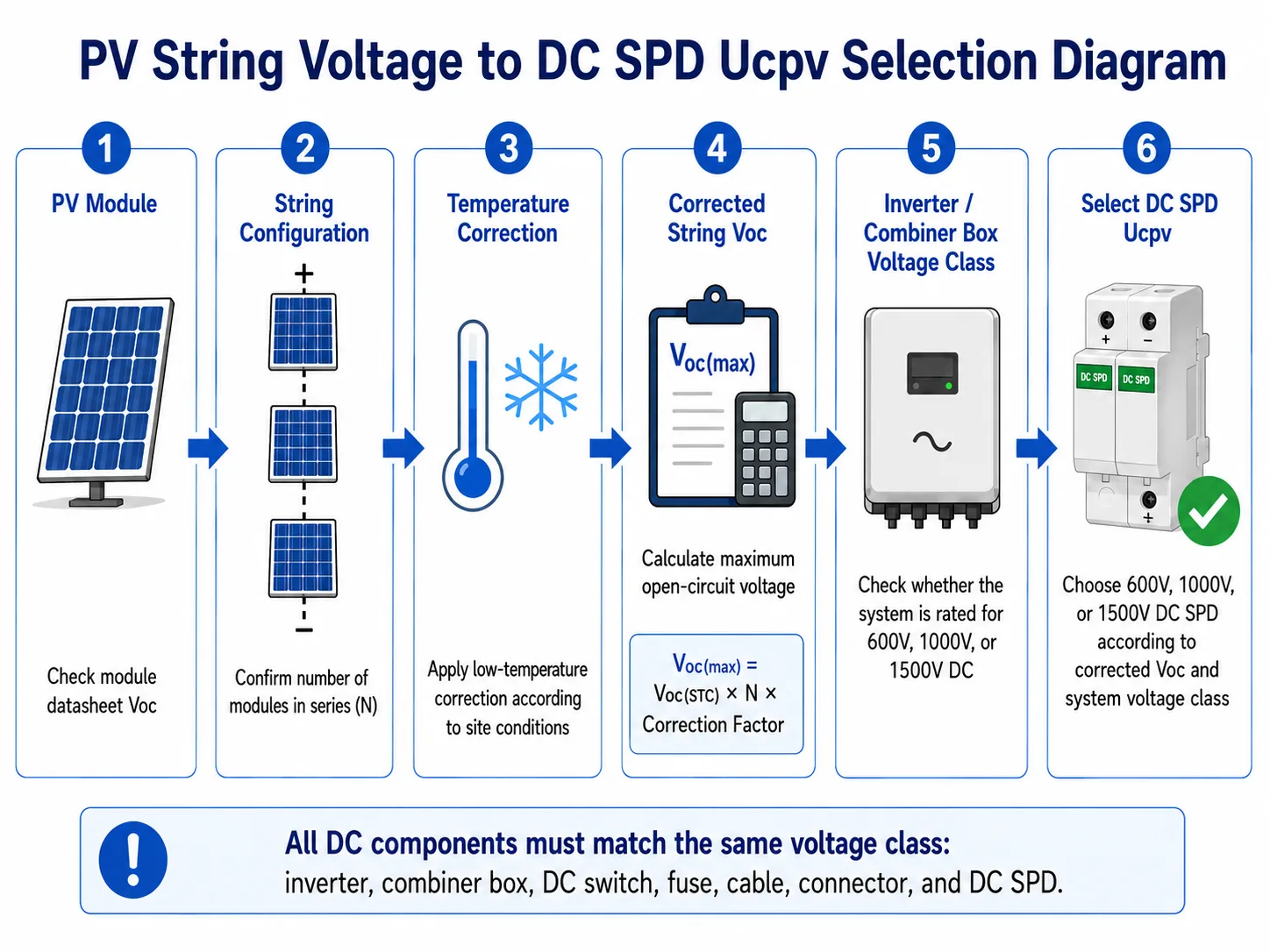
Para a maioria dos projetos de PV solar, a lógica de seleção é simples:
- Confirme a classe do sistema PV: 600V, 1000V ou 1500V.
- Verifique o Voc do módulo na ficha técnica do módulo.
- Confirme quantos módulos estão conectados em série.
- Aplique a correção de baixa temperatura.
- Compare a string corrigida Voc com o limite de tensão do sistema.
- Escolha uma classificação de Ucpv de SPD DC adequada para essa classe de tensão.
- Confirme o tipo de SPD, configuração de polos e certificação.
A regra simples é:
O SPD Ucpv DC deve ser igual ou superior à tensão DC máxima que pode aparecer nos terminais do SPD.
Mas essa regra deve ser utilizada juntamente com o projeto completo do sistema. O inversor, caixa combinadora, interruptor DC, suporte de fusível, cabo, conector e SPD devem todos corresponder à mesma classe de tensão.
Por Que o Voc da String FV é Mais Importante do Que a Tensão de Trabalho
Os compradores de PV às vezes olham apenas para a tensão de operação.
Isso não é suficiente.
A string PV pode alcançar sua maior tensão quando o circuito está aberto e a temperatura está baixa. Esse valor é chamado de tensão em circuito aberto, ou Voc.
Quando os módulos PV são conectados em série, seus valores de Voc se somam.
| Item | Exemplo |
|---|---|
| Voc do módulo | 49V |
| Módulos em série | 18 |
| String Voc em condição de teste padrão | 882V |
À primeira vista, isso pode parecer adequado para um sistema fotovoltaico de 1000V. Mas em clima frio, a voltagem do módulo pode aumentar. Após a correção de temperatura, a voltagem máxima real da string pode ser maior.
É por isso que o Voc corrigido deve ser verificado antes de selecionar o SPD CC.
Seleção de SPD DC de 600V
Um SPD DC de 600V é normalmente usado em sistemas solares fotovoltaicos de baixa tensão.
Pode ser adequado para:
- Pequenos sistemas fotovoltaicos
- Sistemas solares off-grid
- Strings PV de baixa tensão
- Caixas combinadoras pequenas
- Painéis de proteção CC relacionados a baterias, quando a aplicação corresponde à classificação do SPD
Antes de selecionar um SPD CC de 600V, confirme que a voltagem máxima corrigida da string PV está abaixo da classificação do Ucpv do SPD.
Confirme também que o inversor, isolador, suporte de fusível, cabo e conector são adequados para a mesma classe de voltagem CC.
Um SPD CC de 600V não deve ser usado em um sistema fotovoltaico de 1000V ou 1500V.
Se instalado em um circuito de alta tensão, o SPD pode ser sobrecarregado durante a operação normal. Isso pode causar envelhecimento precoce, superaquecimento, status de indicador vermelho ou desconexão térmica.
Seleção de SPD DC de 1000V
Um SPD DC de 1000V é uma das escolhas mais comuns para sistemas fotovoltaicos comerciais.
É frequentemente utilizado em:
- Sistemas fotovoltaicos para telhados comerciais
- Caixas de combinação PV padrão
- Sistemas de inversores de string
- Painéis de distribuição solar
- Gabinetes de proteção PV OEM
- Programas de estoque de distribuidores para projetos solares comuns
Para um sistema PV de 1000V, o Voc corrigido da string PV deve permanecer dentro do limite de projeto do sistema de 1000V.
Se o Voc corrigido estiver abaixo do limite de forma segura, um SPD DC de 1000V é geralmente a seleção normal.
Se o Voc corrigido estiver muito próximo de 1000V, verifique o design da string com cuidado. Em muitos casos, a solução correta é reduzir o número de módulos em série ou rever o design do sistema.
Não simplesmente substitua um SPD de 1000V por um SPD de 1500V.
Isso deve ser considerado apenas quando todo o sistema DC estiver projetado e aprovado para esse nível de tensão.
Seleção de SPD DC de 1500V
Um SPD DC de 1500V é utilizado para sistemas fotovoltaicos de alta tensão.
É comum em:
- Centrais solares à escala industrial
- Grandes projetos fotovoltaicos montados no solo
- Sistemas de inversores de string de 1500V
- Caixas de combinação PV de alta tensão
- Projetos solares EPC
- Gabinetes de proteção PV OEM para grandes projetos
Um sistema PV de 1500V permite uma tensão de string mais alta e uma corrente mais baixa para o mesmo nível de potência. Isso pode reduzir a perda de cabo e o custo de balanceamento do sistema em grandes instalações.
Mas também requer que cada componente CC esteja corretamente classificado.
| Para Projetos de 1500V, Verifique | Por que Isso Importa |
|---|---|
| Tensão máxima de entrada CC do inversor | O inversor deve ser classificado para a classe de tensão CC total. |
| Tensão nominal da caixa combinadora | O rótulo do painel e os componentes internos devem corresponder ao projeto de 1500V CC. |
| Classificação do isolador ou interruptor CC | A comutação CC em alta tensão necessita de componentes com classificação adequada para CC. |
| Classificação do fusível e suporte do fusível | A coordenação do fusível deve corresponder à tensão do circuito fotovoltaico. |
| Classificação de voltagem do cabo e conector | O circuito DC completo deve ser coordenado, não apenas o SPD. |
| DPS CC Ucpv | O SPD deve ser projetado para a classe de voltagem DC do PV. |
Um SPD DC de 1500V deve ser selecionado como parte de um sistema completo de 1500V DC. Não deve ser usado como um atalho para resolver sobrecarga de tensão em um sistema de 1000V.
Seleção entre 600V, 1000V e 1500V de SPD DC
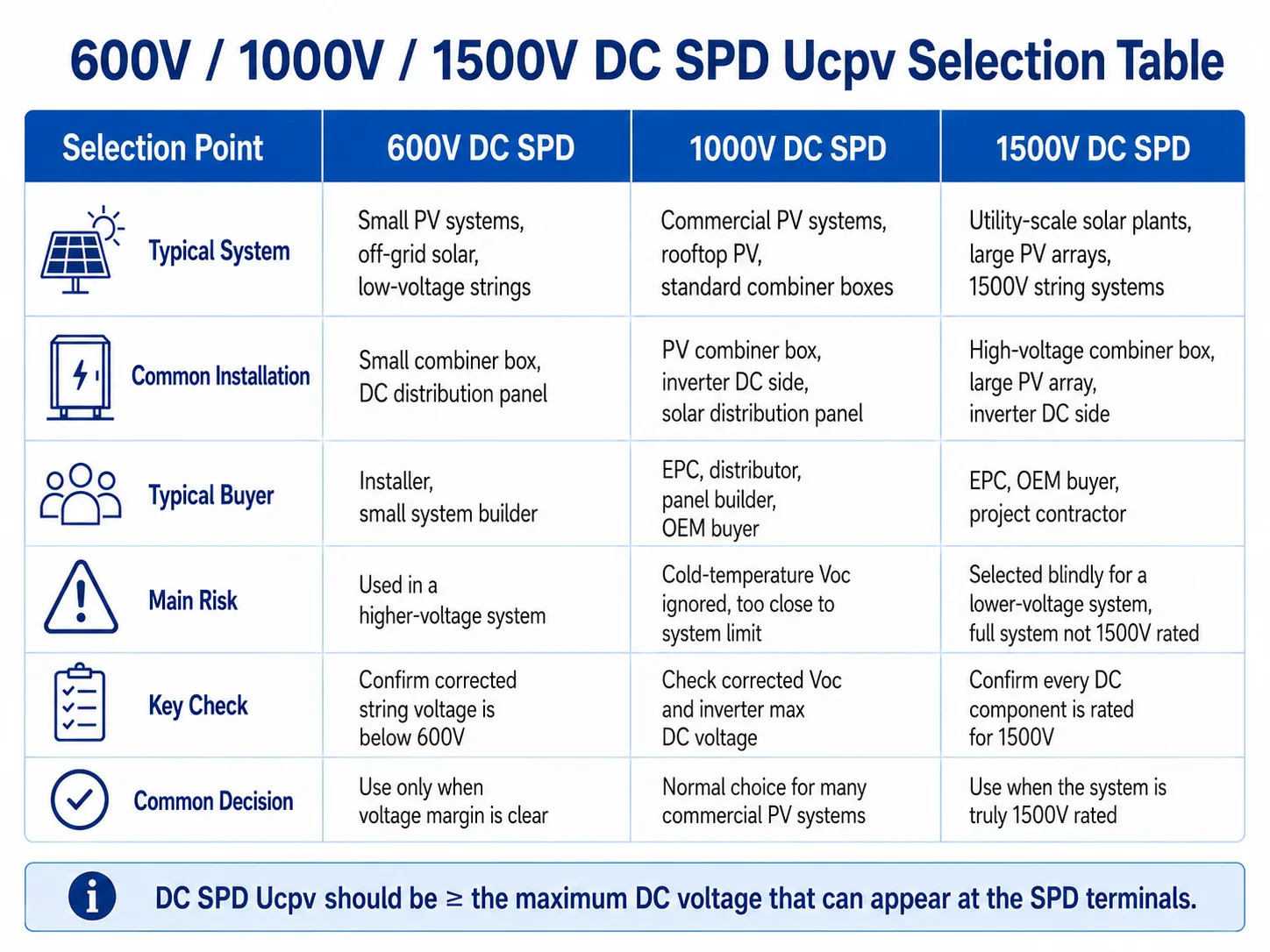
| Ponto de Seleção | SPD CC 600V | SPD CC 1000V | SPD CC 1500V |
|---|---|---|---|
| Tipo de projeto típico | Pequeno sistema fotovoltaico ou solar fora da rede | Sistemas fotovoltaicos comerciais | Centrais solares à escala industrial |
| Instalação comum | Pequena caixa combinadora ou painel DC | Caixa combinadora fotovoltaica, lado DC do inversor | Caixa combinadora de alta tensão, grande arranjo fotovoltaico |
| Principal comprador | Instalador, construtor de pequenos sistemas | EPC, distribuidor, construtor de painéis | EPC, comprador OEM, empreiteiro do projeto |
| Principal risco | Usado em um sistema de alta voltagem | Voc de baixa temperatura ignorado | Selecionado de forma cega para um sistema de baixa voltagem |
| Verificação de chave | String de tensão corrigida | Tensão máxima do inversor e Voc corrigido | Coordenação total do sistema de 1500V |
A melhor escolha não é sempre a classificação de tensão mais alta. A melhor escolha é a classificação Ucpv que corresponde à tensão real do sistema PV com uma margem de segurança adequada.
É Sempre Melhor Ter um Ucpv Mais Alto?
Não.
Ucpv mais alto não significa automaticamente melhor proteção.
Se Ucpv for muito baixo, o SPD pode falhar precocemente porque está exposto a tensão contínua excessiva.
Se Ucpv for muito maior do que o necessário, o nível de proteção contra tensões também pode ser mais alto. Isso pode reduzir a coordenação de proteção para o equipamento atrás do SPD.
Se Ucpv for muito baixo
- O SPD pode envelhecer mais rápido.
- O indicador pode ficar vermelho precocemente.
- Desconexão térmica pode ocorrer.
- O custo de manutenção da caixa combinadora pode aumentar.
Se Ucpv for muito alto
- O nível de proteção contra tensões pode ser mais alto.
- A coordenação de proteção pode ser mais fraca.
- O custo do produto pode aumentar.
- A aprovação do OEM pode se tornar confusa.
Para projetos de energia solar PV, o objetivo não é comprar o SPD de maior tensão. O objetivo é selecionar o SPD certo para o sistema DC real.
O Que Acontece Se o Ucpv For Muito Baixo?
Se o Ucpv do SPD DC for menor do que a tensão máxima real do PV, o SPD pode ser estressado durante a operação normal.
Os resultados possíveis incluem:
- Envelhecimento mais rápido do MOV
- Aquecimento anormal
- Janela indicadora vermelha
- Desconexão térmica
- Falha precoce do módulo
- Manutenção repetida da caixa combinadora
- Custo de substituição mais alto
- Reclamação do projeto após a instalação
Esse erro ocorre frequentemente quando um SPD de 600V é usado em um sistema fotovoltaico de 1000V, ou quando um SPD de 1000V é selecionado sem verificar o Voc corrigido em clima frio.
Para projetos EPC e painéis OEM, isso pode se tornar um problema de qualidade, não apenas um problema de componente.
O Que Acontece Se o Ucpv For Muito Alto?
Se o Ucpv do DC SPD for muito mais alto do que o requerido, o SPD pode suportar a tensão do sistema, mas pode não proporcionar a melhor coordenação de proteção.
Os resultados possíveis incluem:
- Nível de proteção de tensão mais alto
- Clampeamento de surto menos sensível
- Custo de produto mais alto
- Incompatibilidade com a especificação do projeto
- Confusão durante a aprovação do painel
- Complexidade desnecessária de estoque para distribuidores
É por isso que um SPD DC de 1500V não deve ser selecionado cegamente para todo projeto de PV. Para uma caixa combinadora de 1000V, primeiro verifique se todo o sistema DC foi projetado para 1000V ou 1500V.
Posso Usar um SPD DC de 1500V em um Sistema FV de 1000V?
Um SPD DC de 1500V tem uma classificação de tensão de operação contínua mais alta do que um SPD DC de 1000V.
Mas isso não significa que seja sempre a substituição correta.
Para um sistema PV de 1000V, o inversor, a caixa combinadora, o isolador, o suporte de fusível, o cabo e os conectores geralmente são selecionados em torno de um projeto de 1000V DC.
Se a tensão corrigida da string PV exceder o limite de design de 1000V, o design do sistema deve ser revisado.
Usar um SPD de 1500V não atualiza todo o sistema para 1500V.
Um SPD de 1500V pode ser considerado apenas quando o engenheiro do projeto confirmar que a classificação de tensão do sistema, a coordenação de proteção, o requisito de certificação e o design do painel permitem.
Para pedidos OEM, não altere SPD de 1000V para SPD de 1500V apenas porque o modelo de alta tensão está disponível em estoque.
Ucpv e Acima: Não Confunda Esses Dois Parâmetros
Ucpv e Up são diferentes.
Ucpv é a tensão máxima de operação contínua.
Para cima é o nível de proteção de tensão durante um surto.
Um SPD DC deve ter um Ucpv adequado para que possa permanecer conectado com segurança ao circuito PV.
Também precisa de um valor Up adequado para que o inversor ou outro equipamento protegido receba uma tensão residual de sobretensão mais baixa.
É por isso que Ucpv não deve ser verificado sozinho. Uma boa seleção de SPD DC deve considerar:
- Ucpv
- Em
- Imax
- Para cima
- Iscpv, quando necessário para a especificação do SPD PV
- Tipo 2 ou Tipo 1+2
- Configuração de polos
- Coordenação de proteção de backup
- Padrão e certificação do projeto
Ucpv de SPD DC para Fabricantes de Caixas de Combinação
Para fabricantes de caixas combinadoras, a seleção de Ucpv afeta mais do que o próprio SPD.
Afecta:
- Aprovação da lista de materiais
- Etiqueta do painel
- Diagrama de fiação
- Ficha técnica do produto
- Aceitação do cliente
- Documentação do projeto
- Planejamento de estoque do distribuidor
- Substituição pós-venda
| Informação | Por que Isso Importa |
|---|---|
| Tensão DC nominal da caixa combinadora | O SPD deve corresponder à classe de tensão do painel. |
| Tensão da string PV | Determina o Ucpv necessário. |
| Tensão máxima DC do inversor | Previne incompatibilidade com o design do inversor. |
| Número de strings | Afeta o design do painel e a disposição de proteção. |
| Tipo de SPD | Tipo 2 ou Tipo 1+2 depende dos requisitos do projeto. |
| Configuração de polos | As opções comuns de SPD PV incluem designs 2P e 3P. |
| Requisito de certificação | Importante para aprovação de EPC e OEM. |
| Requisito de etiqueta | Necessário para pedidos de marca privada ou OEM. |
Para caixas de combinação de PV comerciais padrão, o SPD de 1000V CC é comum.
Para caixas de combinação de PV em escala de utilidade, o SPD de 1500V CC é comum.
Para sistemas menores ou fora da rede, o SPD de 600V CC pode ser suficiente.
Ucpv de SPD DC para Projetos de EPC Solar
Para projetos EPC de solar, a seleção de Ucpv deve seguir o projeto.
A equipe EPC deve confirmar:
- Classe de tensão do sistema
- Menor temperatura do local
- Configuração de string
- Limite de entrada DC do inversor
- Exposição a raios
- Requisito de Tipo 2 ou Tipo 1+2
- Certificação e documentação
- Local de instalação do SPD
- Requisito de fusível ou disjuntor de backup
Para projetos EPC, o principal risco não é apenas escolher a tensão errada do SPD. O maior risco é que diferentes componentes CC sejam selecionados com diferentes suposições de tensão.
O SPD deve corresponder ao design completo do sistema CC.
Ucpv de SPD DC para Distribuidores de FV
Para distribuidores de PV, a pergunta chave é o planejamento de estoque.
Um distribuidor pode precisar de diferentes opções de Ucpv para diferentes grupos de clientes:
| Tipo de Cliente | Demanda Comum |
|---|---|
| Pequenos instaladores solares | SPD DC de 600V ou 1000V |
| Contratantes de PV comerciais | SPD CC 1000V |
| Compradores de projetos EPC | SPD CC de 1000V ou 1500V |
| Fabricantes de caixas combinadoras | Opções OEM de 1000V e 1500V |
| Projetos solares em grande escala | SPD CC 1500V |
Para estoque de distribuidores, os modelos de SPD DC de 1000V e 1500V costumam ser as opções mais importantes. Mas a demanda do mercado local deve ser verificada antes de fazer pedidos em grande escala.
Ucpv de SPD DC para Compradores OEM
Para compradores OEM, a seleção de Ucpv deve ser estável, repetível e fácil de aprovar.
Um comprador OEM deve confirmar:
- Ucpv necessário
- Tipo 2 ou Tipo 1+2
- Configuração de polos
- Cor do módulo e indicador de janela
- Requisito de contato de sinal remoto
- Requisito de marca privada
- Requisito de embalagem
- Formato da ficha técnica
- Requisito de certificado e relatório de teste
- Disponibilidade de módulo de reposição
Para fornecimento OEM, não altere casualmente a classificação de tensão do SPD após a aprovação do projeto. Mesmo que dois produtos pareçam semelhantes, diferentes classificações de Ucpv podem afetar a ficha técnica, o rótulo, a fiação e a documentação do projeto.
Tipo 2 ou Tipo 1+2: Isso muda o Ucpv?
Tipo 2 e Tipo 1+2 descrevem a capacidade de descarga de surto e a classe de teste.
Eles não substituem a seleção Ucpv.
Em pedidos reais, ambos devem ser confirmados.
| Requisito Possível | Uso Típico |
|---|---|
| Tipo 2 SPD CC, Ucpv 1000V | Sistemas fotovoltaicos comerciais comuns e caixas combinadoras. |
| Tipo 2 SPD CC, Ucpv 1500V | Projetos fotovoltaicos de grande escala em alta tensão. |
| Tipo 1+2 SPD CC, Ucpv 1000V | Sistemas fotovoltaicos de 1000V com maior exposição a raios ou requisito do projeto. |
| Tipo 1+2 SPD CC, Ucpv 1500V | Sistemas PV de 1500V onde a capacidade de descarga de corrente de relâmpago é especificada. |
O SPD DC Tipo 2 é comumente usado para proteção contra sobretensões induzidas por relâmpagos ou eventos de comutação próximos.
O SPD DC Tipo 1+2 pode ser necessário quando o sistema PV tiver maior exposição ao relâmpago ou quando a especificação do projeto exigir capacidade de descarga de corrente de relâmpago.
Sempre verifique os requisitos do projeto antes de confirmar o modelo.
Que informação você deve enviar antes de fazer o pedido?
Se você não tiver certeza se deve escolher SPD DC de 600V, 1000V ou 1500V, envie as seguintes informações ao fornecedor antes de fazer o pedido.
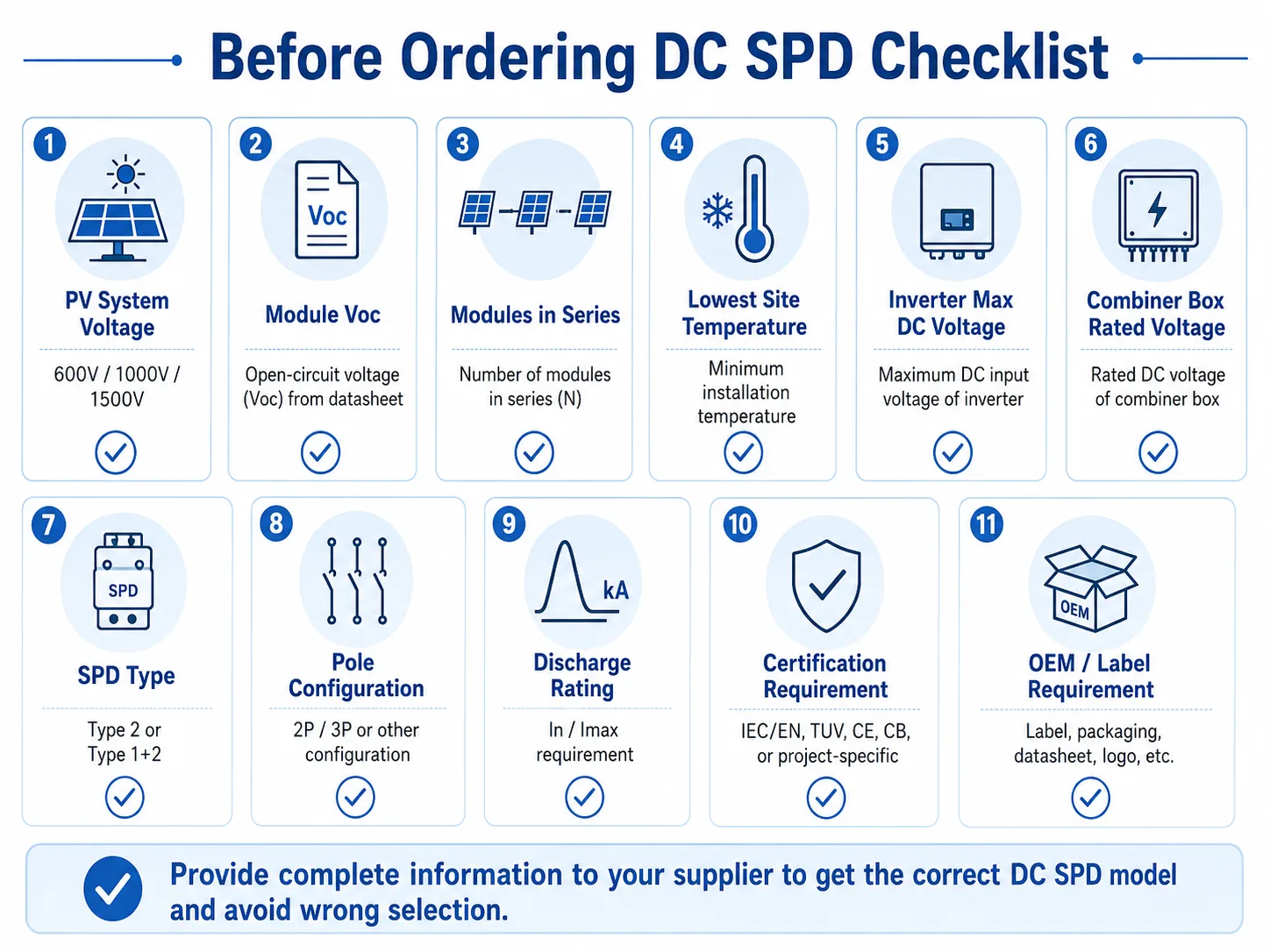
| Informações a Enviar | Exemplo |
|---|---|
| Tensão do sistema fotovoltaico | 600V / 1000V / 1500V |
| Voc do módulo | 49V |
| Módulos em série | 18 / 20 / 24 / 28 |
| Menor temperatura do local | -10°C / -20°C / -30°C |
| Tensão máxima DC do inversor | 1000V / 1500V |
| Tensão nominal da caixa combinadora | 1000V CC / 1500V CC |
| Tipo de SPD | Tipo 2 / Tipo 1+2 |
| Configuração de polos | 2P / 3P |
| Classificação de descarga requerida | Requisito de In / Imax |
| Requisito de certificação | IEC/EN, TUV, CB, CE ou específico do projeto |
| Requisito OEM | Rótulo, embalagem, ficha técnica, logotipo |
Essas informações ajudam a evitar a seleção de modelos errados. Elas também ajudam o fornecedor a recomendar um SPD DC que corresponda ao seu projeto, em vez de apenas cotar o produto mais barato disponível.
Envie sua exigência de sistema PV
Se você estiver selecionando SPDs DC para uma caixa combinadora PV, armário de inversor, painel de distribuição solar ou projeto OEM, nos envie a tensão do seu sistema e os dados da string PV.
Nossa equipe pode recomendar um modelo de SPD DC adequado para sua aplicação solar PV.
Erros comuns a evitar
Erro 1: Escolher apenas pelo preço
Um SPD de menor voltagem pode ser mais barato, mas não é adequado para um sistema PV de maior voltagem.
Erro 2: Usar SPD AC no lado DC
SPD AC e SPD DC para PV não são a mesma coisa. O lado DC de um sistema solar PV requer um SPD classificado para DC, projetado para aplicações de PV.
Erro 3: Ignorar o Voc em clima frio
A voltagem PV pode subir em condições de baixa temperatura. Esta é uma das razões mais comuns pelas quais o Ucpv não deve ser selecionado apenas pela voltagem nominal do sistema.
Erro 4: Supor que 1500V é sempre melhor
Um SPD de 1500V é necessário para um sistema PV de 1500V, mas não é automaticamente a melhor escolha para todo projeto de 600V ou 1000V.
Erro 5: Não verificar todo o circuito DC
O SPD deve corresponder ao inversor, caixa de combinador, isolador, porta-fusível, cabo, conector e especificação do projeto.
Erro 6: Mudar modelos OEM sem aprovação
Para painéis OEM e caixas de combinador, mudar o SPD Ucpv após a aprovação pode afetar o rótulo, a ficha técnica, o diagrama de fiação e a aceitação do cliente.
Fluxo de seleção recomendado
- Confirme se o projeto é 600V, 1000V ou 1500V.
- Verifique o Voc do módulo PV.
- Confirme o número de módulos em série.
- Aplique correção de baixa temperatura.
- Compare o Voc corrigido com a máxima voltagem DC do inversor.
- Confirme a voltagem DC nominal da caixa de combinador.
- Selecione o SPD DC Ucpv adequado.
- Confirme o requisito Tipo 2 ou Tipo 1+2.
- Confirme a configuração do pólo e a fiação.
- Verifique a certificação e a documentação do projeto.
- Envie os dados finais ao fornecedor para recomendação de modelo.
Exemplo: Caixa combinadora PV 1000V
Um comprador está construindo uma caixa combinadora PV de 1000V.
O comprador pergunta:
“Podemos usar um SPD DC de 1000V?”
Uma resposta profissional não deve parar em sim.
O fornecedor deve confirmar:
- Qual é o Voc do módulo?
- Quantos módulos estão conectados em série?
- Qual é a menor temperatura esperada?
- Qual é a tensão de circuito aberto corrigida?
- O inversor é classificado para 1000V CC?
- A caixa de combinação é classificada para 1000V CC?
- O projeto requer Tipo 2 ou Tipo 1+2?
- É necessária documentação de certificação?
Se a tensão de circuito aberto corrigida estiver dentro do projeto do sistema de 1000V, um SPD CC de 1000V é geralmente a escolha certa.
Se a tensão de circuito aberto corrigida estiver muito próxima do limite, o projeto da string fotovoltaica deve ser revisado antes de confirmar o SPD.
Exemplo: Projeto PV em escala utilitária 1500V
Um projeto solar em larga escala utiliza uma arquitetura de 1500V CC.
Neste caso, o comprador deve confirmar:
- classificação de entrada do inversor de 1500V
- projeto da caixa de combinação de 1500V
- classificação do isolador CC de 1500V
- classificação do fusível e suporte CC de 1500V
- classificação do cabo e conector de 1500V
- SPD CC Ucpv de 1500V
- Requisito de Tipo 2 ou Tipo 1+2
- documentos de certificação do projeto
Para este tipo de projeto, um SPD CC de 1500V não é apenas uma opção de maior tensão. Faz parte do design completo do sistema fotovoltaico de 1500V.
Como a LEEYEE suporta a seleção de DC SPD Ucpv
A LEEYEE fornece dispositivos de proteção contra surto CC para aplicações de energia solar fotovoltaica, incluindo caixas de combinação PV, proteção DC do inversor, painéis de distribuição solar e projetos de painéis OEM.
Para seleção de SPD PV, normalmente confirmamos mais do que o rótulo de tensão.
Verificamos:
- Tensão do sistema
- Tensão corrigida da string PV
- Tipo de SPD
- Configuração de polos
- Requisito de corrente de descarga
- Requisito de certificação
- Requisito de rótulo OEM ou rótulo privado
- Aplicação-alvo, como caixa combinadora ou gabinete de inversor
Suporte de documentação para pedidos EPC e OEM
Para projetos de SPD PV, os compradores geralmente precisam de documentos IEC/EN, TUV, CB, CE ou específicos do projeto antes de confirmar pedidos de EPC, distribuidores ou OEM. Por favor, confirme a documentação necessária antes da aprovação do modelo.
CNSPD é a plataforma focada em proteção contra surtos da LEEYEE, criada para ajudar compradores globais a encontrar SPDs confiáveis e produtos de proteção de baixa tensão relacionados.
Se você precisar de suporte para seleção de SPD DC para um sistema solar PV de 600V, 1000V ou 1500V, envie os dados do seu sistema PV antes de fazer o pedido.
FAQ
Qual Ucpv devo escolher para um sistema solar fotovoltaico de 1000V?
Para a maioria dos sistemas solares fotovoltaicos de 1000V, normalmente é selecionado um SPD DC de 1000V. No entanto, você deve confirmar a tensão de circuito aberto da string PV corrigida, a tensão DC máxima do inversor e a classificação da caixa combinadora antes de fazer o pedido.
Posso usar um SPD de 1500V DC em vez de um SPD de 1000V DC?
Não substitua um SPD de 1000V DC por um SPD de 1500V DC de forma cega. Um SPD de 1500V tem uma classificação de tensão mais alta, mas o restante do sistema fotovoltaico ainda pode estar projetado para 1000V DC.
É o Ucpv o mesmo que a tensão máxima de CC do inversor?
Não. Ucpv é a tensão máxima de operação contínua do SPD. A tensão máxima DC do inversor é a maior tensão de entrada DC permitida pelo inversor. Elas devem ser coordenadas, mas não são o mesmo parâmetro.
O DC SPD Ucpv deve ser igual ou maior que o Voc do string PV?
Sim. O SPD Ucpv da DC deve ser igual ou superior à tensão máxima que pode aparecer nos terminais do SPD. Para sistemas fotovoltaicos, a tensão em circuito aberto corrigida é uma referência importante.
O que acontece se o DC SPD Ucpv estiver muito baixo?
Se o Ucpv estiver muito baixo, o SPD pode ser estressado durante a operação normal do PV. Isso pode levar a um envelhecimento mais rápido, aquecimento anormal, status de indicador vermelho, desconexão térmica ou falha precoce.
O que acontece se o SPD Ucpv da DC estiver muito alto?
Se o Ucpv estiver muito acima do necessário, o SPD pode não fornecer a melhor coordenação de proteção. O nível de proteção de tensão pode ser mais alto e o produto pode custar mais do que o necessário.
É o SPD de 1500V CC melhor do que o SPD de 1000V CC?
Nem sempre. Um SPD de 1500V DC é a escolha certa para um sistema PV de 1500V. Para um sistema PV de 1000V, um SPD de 1000V DC é geralmente a seleção normal se a tensão corrigida da string estiver dentro do limite do sistema.
Qual Ucpv é comum para caixas combinadoras de PV?
O SPD de 1000V CC é comum para muitas caixas de combinação de PV comerciais. O SPD de 1500V CC é comum para caixas de combinação de PV em escala de utilidade. O SPD de 600V CC pode ser utilizado para sistemas de PV menores ou de baixa tensão.
Preciso de SPD DC Tipo 2 ou Tipo 1+2?
Depende do projeto, da exposição ao relâmpago e da especificação. O Tipo 2 é comum para muitos sistemas fotovoltaicos. O Tipo 1+2 pode ser exigido quando a capacidade de descarga de corrente de relâmpago é especificada.
Que informações devo enviar para a seleção do modelo DC SPD?
Envie a voltagem do sistema FV, Voc do módulo, módulos em série, a temperatura mais baixa do local, a voltagem máxima de CC do inversor, a voltagem nominal da caixa combinadora, o tipo de SPD, a configuração de polos e o requisito de certificação.
Precisa de ajuda para escolher o DC SPD Ucpv?
Se você estiver selecionando SPDs DC para uma caixa combinadora PV, armário de inversor, painel de distribuição solar ou projeto OEM, nos envie a tensão do seu sistema e os dados da string PV.
Por favor, inclua a tensão do sistema PV, módulo Voc, número de módulos em série, menor temperatura de instalação, tensão DC máxima do inversor, tensão nominal da caixa combinadora, requisito Tipo 2 ou Tipo 1+2, configuração de pólo e requisito de certificação ou rótulo OEM.