
EV-Ladestationen sollten nicht nur am Ladegeräteanschluss geschützt werden. Ein vollständiges SPD-Design sollte das Hauptverteilungssystem, das Unterverteilungssystem, den AC-Eingang des Ladegeräts, einen möglichen DC-Schnellladebereich, Kommunikationsleitungen, das Erdungssystem, und die Wartungsüberwachung berücksichtigen.
Dieser Leitfaden ist für EV-Ladegeräte-Installateure, Ladestationsauftragnehmer, Elektroingenieure, Schaltschrankbauer und OEM-Käufer geschrieben, die vor der Projektbestellung einen klaren SPD-Auswahlprozess benötigen.
- AC-Eingangs-SPD
- Verteilungstafel-SPD
- Typ 1+2 vs Typ 2
- DC-Schnellladegerät Bewertung
- Schutz der Signalleitungen
- Fernalarm
Inhaltsübersicht
Schnelle Antwort: Wo sollten SPDs in einem EV-Ladeprojekt eingesetzt werden?
Für die meisten kommerziellen oder öffentlichen EV-Ladeprojekte ist die Auswahl des Überspannungsschutzes keine Einzelgerätesentscheidung. Auftragnehmer sollten jeden Schutzpunkt von der eingehenden Stromversorgung bis zum Ladegerät, Kommunikationsleitung und Überwachungssystem überprüfen.
| Schutzpunkt | Empfohlene SPD-Richtung | Bedeutung des Auftragnehmers |
|---|---|---|
| Hauptanschlussverteilertafel | Verwenden Sie Typ 1+2 SPD, wenn ein äußerer Blitzschutz, eine Freileitung oder eine hohe Blitzbelastung vorhanden ist. Verwenden Sie Typ 2 SPD für Bedingungen mit geringem Risiko. | Dies ist die erste Schutzstufe für die Stromversorgung des EV-Ladegeräts. |
| Unterverteilung nahe Ladegeräten | Verwenden Sie Typ 2 SPD, koordiniert mit dem vorgelagerten SPD. | Dies reduziert den Residualüberschlag, bevor er den Ladegeräteeingang erreicht. |
| AC-Eingang des EV-Ladegeräts | Wählen Sie Einphasen- oder Dreiphasen-AC-SPD nach Systemspannung, Erdungssystem, Polkonfiguration und Einbauposition. | Dies schützt die Elektronik des Ladegeräts, die Leistungsbausteine, die Zähler und die Steuerkreise vor transienten Überspannungen. |
| DC-Schnellladegerät Abschnitt | Überprüfen Sie die Anforderungen auf der DC-Seite im Einzelfall gemäß der Ladegerät-Architektur, der DC-Spannung, dem Isolationsdesign und der Genehmigung des Herstellers. | Verwenden Sie nicht blind einen PV-DC-SPD als universellen Ersatz für ein DC-Schnellladegerät. |
| Kommunikations- und Steuerleitungen | Verwenden Sie geeignete Signal-SPD für exponiertes Ethernet, RS485, Zähler, Überwachung oder OCPP-bezogene Verkabelungen. | Überspannungen können über Datenleitungen eintreten, nicht nur über die AC-Stromleitung. |
| Fernalarm- und Wartungssystem | Verwenden Sie SPD-Modelle mit Fernsignalkontakt, wenn die Station mehrere Ladegeräte hat oder eine zentrale Überwachung benötigt. | Wartungsteams können fehlerhafte SPD-Module schnell finden, ohne jeden Schrank öffnen zu müssen. |
Einfache Regel: Schützen Sie zuerst die eingehende Versorgung, dann die nachgelagerten Paneele und Ladeeingänge. Für Außen- oder öffentliche Projekte überprüfen Sie auch die Signalleitung, die Erdung und die Anforderungen an die Fernalarmierung, bevor Sie bestellen.
Brauchen EV-Ladestationen einen Überspannungsschutz?
Ja, EV-Ladestationen benötigen normalerweise Überspannungsschutz, insbesondere für öffentliche Ladestationen, Außenlader, gewerbliche Parkbereiche, Flottenladestationen und DC-Schnellladeprojekte. EV-Ladegeräte enthalten empfindliche Elektronik, Stromumwandlungskomponenten, Kommunikationsschaltungen, Messmodule und Steuerplatinen.
Das Risiko von Überspannungen kann von nahegelegenen Blitzeinschlägen, Schaltvorgängen im Netz, langen Kabelstrecken, schlechter Bondsituation, Oberleitungen und freiliegenden Kommunikationsleitungen ausgehen. Eine Überspannung kann möglicherweise nicht sofort das gesamte Ladegerät zerstören, aber sie kann Steuerplatinen, Kommunikationsports, Leistungsmodulen oder Überwachungsstromkreisen Schaden zufügen.
Wichtig: Die richtige Anordnung von Überspannungsschutzgeräten hängt von den lokalen elektrischen Vorschriften, der Blitzexposition, der Versorgungsmethode, dem Erdungssystem, dem Lademodell, der Entfernung zwischen den Paneelen und Ladegeräten, und ob die Anlage ein externes Blitzschutzsystem hat, ab.
SPD-Installationspositionen in einer EV-Ladestation
Eine zuverlässige EV-Ladestation sollte als Ganzes geprüft werden. Der Überspannungsschutz sollte nicht nur unter Berücksichtigung des Namensschilds des Ladegeräts ausgewählt werden. Auftragnehmer sollten überprüfen, wo die Überspannung eintreten kann und wie der Überspannungsstrom sicher abgeleitet werden kann.
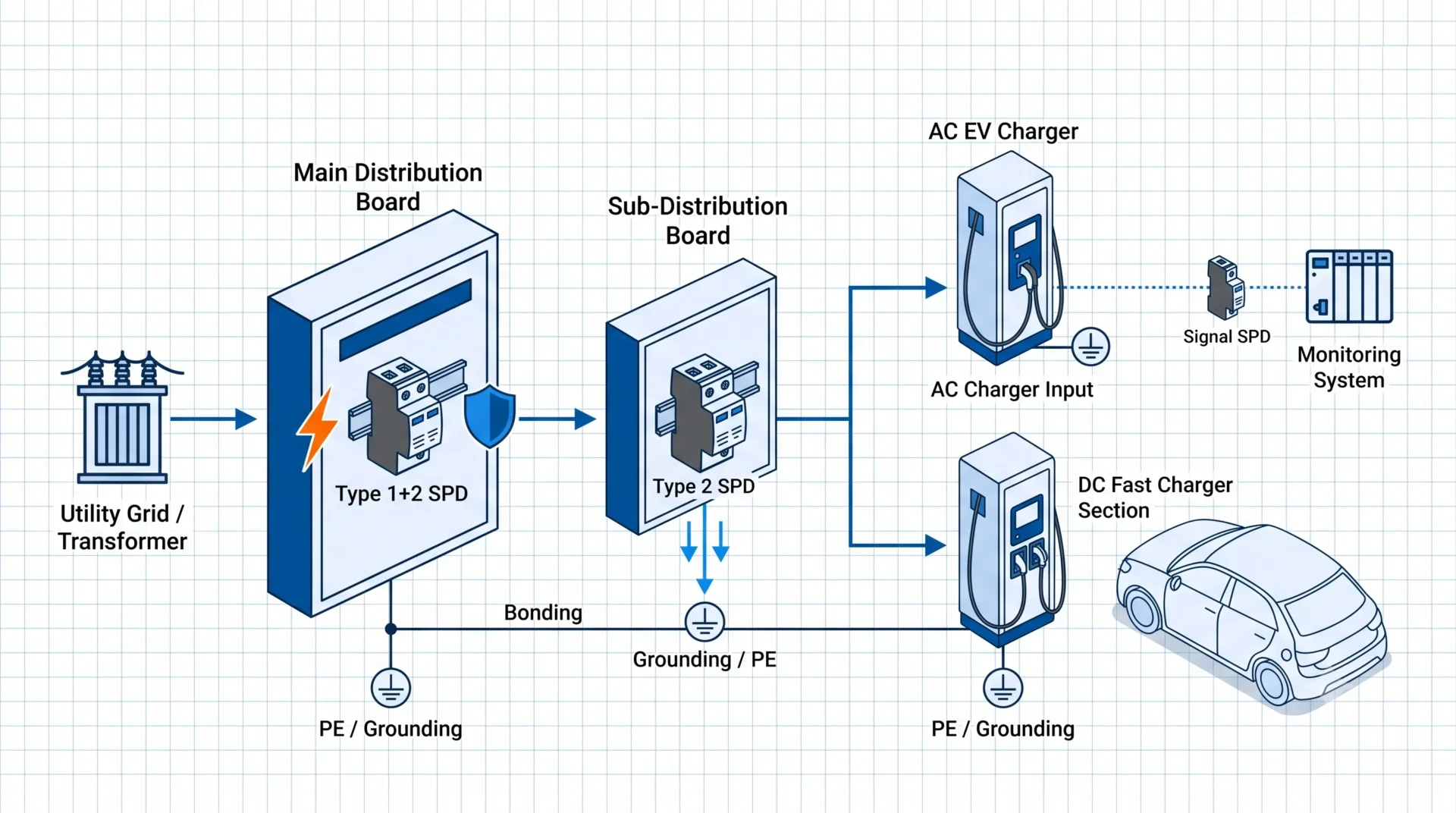
Empfohlene Architektur für den Überspannungsschutz bei Projekten von EV-Ladestationen.
Hauptverteilerschrank
Dies ist die erste Schutzstufe für die Stromversorgung von EV-Ladestationen. Verwenden Sie Typ 1+2, wenn ein Risiko von Blitzstrom zu erwarten ist, oder Typ 2 für weniger riskante eingehende Versorgung.
Unterverteilungstafel
Wenn Ladegeräte von einem lokalen Unterverteiler versorgt werden, hilft ein nachgeschalteter Typ 2 Überspannungsschutz, die Restüberspannung zu reduzieren, bevor sie den Ladegerätanschluss erreicht.
AC-Eingang des Ladegeräts
Wählen Sie den Überspannungsschutz nach AC-Systemspannung, Polkonfiguration, Erdungssystem, Ableitstrombewertung und Fernsignalanforderung.
Signal- und Überwachungsleitungen
Ethernet, RS485, Mess-, Abrechnungs- oder OCPP-bezogene Kommunikationsleitungen benötigen möglicherweise einen Signal-Überspannungsschutz, insbesondere wenn Kabel im Freien oder zwischen Schaltschränken verlaufen.
Standards und Installationsregeln, die Auftragnehmer kennen sollten
In projekten mit IEC-basierten EVSE wird der Überspannungsschutz häufig gemeinsam mit den elektrischen Installationsvorschriften für EV-Ladegeräte und dem Produkstandard für niederspannungs-AC-Systeme überprüft. Das bedeutet jedoch nicht, dass jede Anlage die gleiche Anordnung von Überspannungsschutzgeräten verwendet. Es bedeutet, dass der Auftragnehmer den Standortzustand überprüfen sollte, bevor er den Typ des Überspannungsschutzes auswählt.
| Referenzbereich | Was es für die Auswahl des Überspannungsschutzes bei EV-Ladestationen bedeutet | Aufgaben des Auftragnehmers |
|---|---|---|
| Regeln für die elektrische Installation von EVSE | Öffentliche oder gewerbliche EVSE-Installationen benötigen möglicherweise einen transienten Überspannungsschutz, abhängig von den Installationsbedingungen und dem lokalen Vorschriften. | Überprüfen Sie, ob die elektrische Einspeisung des EVSE, das Unterpanel oder der Ladestation zusätzliche SPD-Schutzvorrichtungen benötigt. |
| IEC 61643-11 für AC SPD | AC-Niederspannungs-SPDs sollten entsprechend dem relevanten SPD-Produkstandard und dem erforderlichen Zertifizierungsbereich ausgewählt und dokumentiert werden. | Bestätigen Sie Typ 1+2 oder Typ 2, Uc, In, Imax, Iimp, Up, Polkonfiguration und Zertifizierungsanforderung. |
| Abstand zwischen dem vorgelagerten SPD und dem Ladegerät | Wenn sich das Ladegerät weit vom vorgelagerten Schutzpunkt befindet, kann die nachgelagerte Ausrüstung dennoch hohen Restüberspannungen ausgesetzt sein. | Erwägen Sie zusätzlichen Typ 2 SPD in der Nähe der EVSE oder des lokalen Unterverteilungsbretts, insbesondere bei langen Zuleitungen. |
| Äußeres Blitzschutzsystem oder Oberleitung | Diese Bedingungen erhöhen die Notwendigkeit, den Blitzstromabgang an der Eingangsseite in Betracht zu ziehen. | Überprüfen Sie Typ 1+2 SPD oder koordinierte Typ 1 + Typ 2 Schutzmaßnahmen an der Hauptzufuhrstelle. |
| Lokale Inspektion und Projektspezifikation | Viele EV-Ladeprojekte haben länderspezifische Vorschriften, Anforderungen von Versorgungsunternehmen oder Spezifikationen von Beratern. | Fragen Sie den Kunden nach der Projektspezifikation, bevor Sie das endgültige SPD-Modell bestätigen. |
Praktische Regel für Käufer: fragen Sie nicht nur nach dem “EV-Ladegerät SPD-Preis”. Senden Sie zuerst das einadrige Diagramm, den Installationsort, die Ladegerätedistanz, das Erdungssystem und die Blitzexposition. Diese Details entscheiden, ob das Projekt Typ 1+2, Typ 2, Signal-SPD oder Fernalarmoptionen benötigt.
Typ 1+2 vs Typ 2 SPD für EV-Ladestationen
Die Wahl zwischen Typ 1+2 und Typ 2 SPD sollte nach dem Risikoprofil der Baustelle und der Installationsposition erfolgen. Wählen Sie Typ 1+2 nicht nur, weil er stärker klingt. Verwenden Sie auch nicht überall Typ 2, ohne die Blitzexposition und das Design des vorgelagerten Schutzes zu überprüfen.
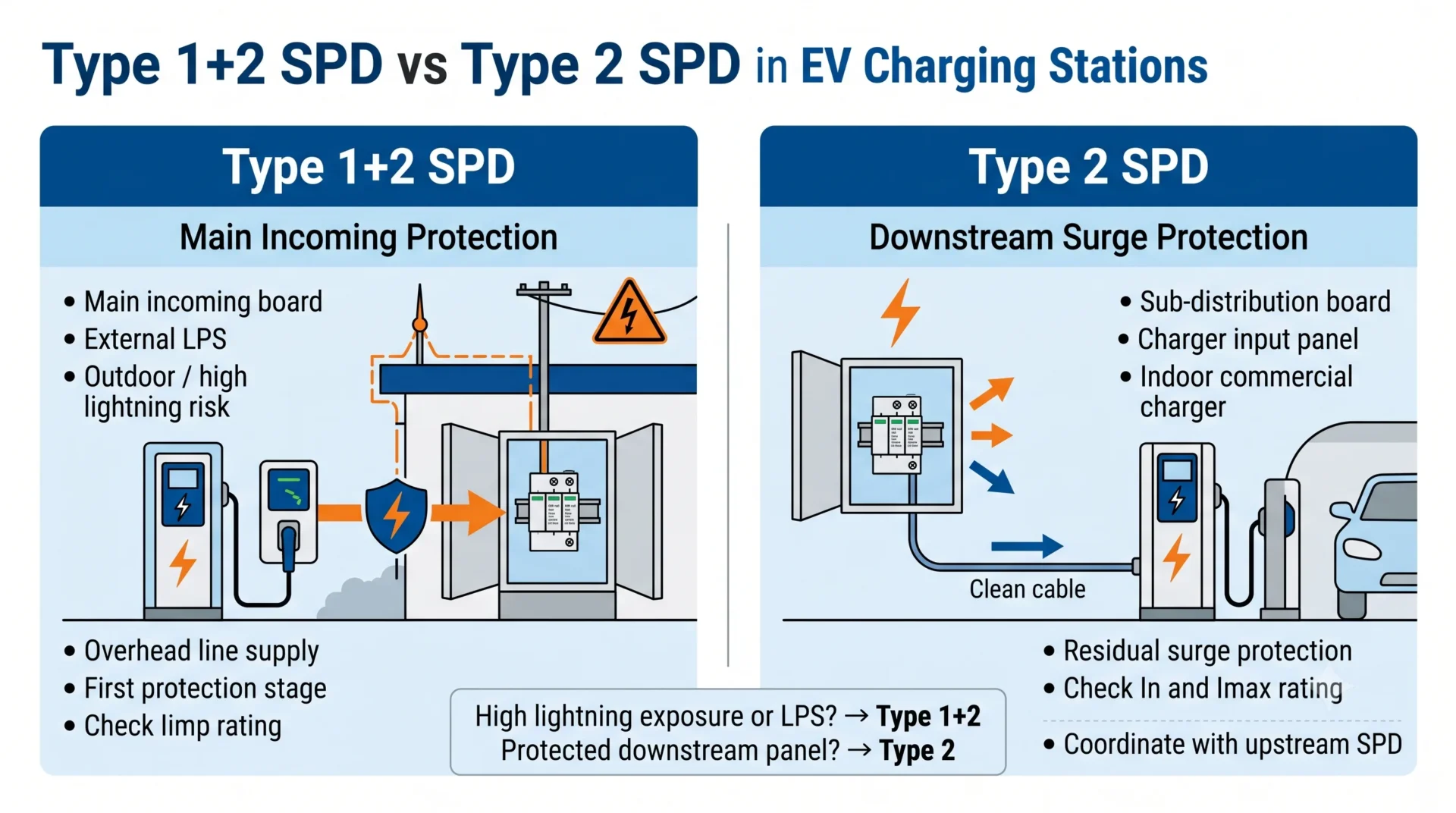
Auswahlkriterien für Typ 1+2 SPD und Typ 2 SPD für die Versorgungspanels von EV-Ladegeräten.
| Projektstatus | Bessere SPD-Richtung | Warum es wichtig ist |
|---|---|---|
| Das Gebäude verfügt über ein externes Blitzschutzsystem | Typ 1+2 SPD am Hauptverteiler oder am Eingangspanel für die Elektrofahrzeugversorgung | Der Hauptverteiler muss möglicherweise Blitzstrom ableiten und den Restsurge für nachgeschaltete Geräte reduzieren. |
| Außenladestation mit hoher Blitzeinwirkung | Typ 1+2 SPD oder koordinierter Typ 1 + Typ 2 Schutz | Außenladegeräte und lange Kabelstrecken sind stärker Blitzen induzierten Spannungsspitzen ausgesetzt. |
| Innenliegender kommerzieller AC-Ladegerät, das von geschütztem Verteiler gespeist wird | Typ 2 SPD | Typ 2 SPD wird häufig zum Schutz gegen induzierte Überspannung und Schaltüberspannung in Verteilern eingesetzt. |
| Der Lader ist weit vom Hauptpanel entfernt. | Fügen Sie einen Typ 2 SPD in der Nähe des Ladegeräts oder des lokalen Unterverteilungsschranks hinzu. | Lange Zuleitungen können die Reststoßbelastung auf der EVSE-Seite erhöhen. |
| Signalkabel verlaufen im Freien oder zwischen Schränken. | Signal SPD für die korrekte Kommunikationsschnittstelle. | Der Power SPD kann Niederspannungs-Datenleitungen nicht korrekt schützen. |
Für Projekte zur EV-Ladung sollte der SPD-Typ zusammen mit dem Schutzort ausgewählt werden. Ein Hauptanschlussfeld, Untertabelle, Laderschrank und Signalschrank benötigen möglicherweise unterschiedliche Schutzeinrichtungen.
Auswahl des AC-Eingangs-SPD für EV-Ladegeräte
Für AC-Ladegeräte und den AC-Eingang von DC-Schnellladegeräten sollte der SPD mit dem tatsächlichen Stromversorgungsnetz übereinstimmen. Auftragnehmer und Schaltschrankbauer sollten nicht nur nach “EV-Ladegerät SPD” bestellen. Der Lieferant benötigt die elektrischen Systeminformationen, um das richtige Modell zu empfehlen.
Wichtige AC SPD-Parameter zur Bestätigung.
- Systemspannung: 230V, 400V, 415V oder andere lokale Versorgungs-Spannungen.
- Phasentyp: einphasige oder dreiphasige Ladespeisung.
- Erdungssystem: TN-S, TN-C-S, TT, IT oder projektspezifisches System.
- SPD-Typ: Typ 1+2 oder Typ 2, je nach Einbauposition und Blitzrisiko.
- Konfiguration der Pole: 1P+N, 2P, 3P, 4P, 3P+N oder eine andere Anordnung, die vom Panel erforderlich ist.
- Uc / MCOV: muss mit der kontinuierlichen Betriebsspannung des Systems übereinstimmen.
- In / Imax: nomineller und maximaler Entladestrom für die Auswahl des Typ 2 SPD.
- Iimp: Impulsstrombewertung für Typ 1 oder Typ 1+2 SPD.
- Up: Überspannungsschutzniveau, das für das Ladegerät und die nachgeschaltete Elektronik geeignet ist.
- Fernalarm: Trockenkontakt / Fernsignaloption zur Wartungsüberwachung.
Für DIN-Schienen-AC-SPD-Modelle können Sie auch die entsprechenden AC-SPD-Produktseiten von LEEYEE einsehen: Type 2 DIN-Schienen-Überspannungsschutz und Type 1+2 DIN-Schienen-Überspannungsschutz.
Überspannungsschutz für DC-Schnellladegeräte: Was sollte überprüft werden?
DC-Schnellladegeräte benötigen besondere Aufmerksamkeit, da sie AC-Eingang, Leistungswandlung, DC-Ausgang, Steuerkreise, Kommunikationsports und manchmal lange Kabelwege umfassen. Die AC-Eingangsseite folgt normalerweise der Auswahllogik für AC-Niederspannungs-SPD. Die DC-Seite sollte separat überprüft werden.
Verwenden Sie nicht blind einen PV-DC-SPD für ein DC-Schnellladegerät. PV-Strings und EV-DC-Schnellladegeräte sind unterschiedliche Anwendungen. Der Schutz auf der DC-Seite hängt von der Ausgangsspannung des Ladegeräts, der Architektur des Wandlers, der Isolationskoordination, der Kabelverlegung, dem Gehäuse-Design und der Herstellerfreigabe ab.
Bevor Sie den DC-Seitenschutz auswählen, bestätigen Sie:
- Den Bereich der DC-Ausgangsspannung des Ladegeräts.
- Ob die DC-Seite für die Installation einer externen SPD zugänglich ist.
- Das interne Wandler- und Isolationsdesign.
- Das vom Hersteller genehmigte Schutzschema.
- Den anwendbaren Projektstandard und die lokalen Inspektionsanforderungen.
- Ob das Risiko am AC-Eingang, DC-Ausgangskabel, Kommunikationsleitung oder geerdeten Schrank liegt.
Überspannungsschutz für Signalleitungen in EV-Ladestationen
EV-Ladestationen sind nicht nur Stromgeräte. Sie werden häufig mit Zahlungssystemen, Lastmanagementsystemen, Backend-Plattformen, Energiemessgeräten, SPS und Überwachungsgeräten verbunden. Überspannungen können durch diese Signalleitungen eindringen.
Für die Auswahl des Signalsschutzes siehe: RS485 SPD Verdrahtungs- und Auswahlleitfaden..
Erdungs- und Bonding-Punkte, die Auftragnehmer bestätigen müssen
Ein SPD benötigt einen zuverlässigen Entladeweg. Wenn das Erdungs- und Bonding-Design schlecht ist, kann das SPD im Schrank installiert sein, aber dennoch den EV-Ladegerät nicht effektiv schützen.
- Erdungssystem: TN-S, TN-C-S, TT, IT oder projektspezifische Anordnung.
- PE-Leitungsführung von der Hauptverteilung zum EVSE-Schrank.
- Verbindung zwischen dem elektrischen Ladegeräteschrank und dem Schutzerdung.
- Gleichwertige Erdung zwischen Schränken, Metallstrukturen und Ausstattungen im Parkplatzbereich.
- Anforderung einer Erdungsstange für Außen- oder unabhängige Ladestationen.
- Kürzeste praktische SPD-Verkabelungslänge zur Reduzierung der Restspannung.
Fernalarm, visuelle Anzeige und Wartungsersatz
EV-Ladestationen haben in der Regel mehrere Ladegeräte. In dieser Situation sollte die Wartung des SPD nicht nur davon abhängen, dass jemand jeden Schrank öffnet und das Anzeige-Fenster manuell überprüft.
Für die Verkabelung von Fernalarmsystemen siehe: Wie man den SPD-Fernalarmkontakt mit einem PLC oder Überwachungssystem verbindet.
Produktanleitung für EV-Lade-SPDs für Auftragnehmer und Schaltschrankbauer
Nachdem die Projektinformationen bestätigt sind, ist der nächste Schritt, den Schutzpunkt mit der richtigen SPD-Produktdirection abzugleichen. Diese Tabelle ist kein endgültiges Modellverzeichnis. Sie hilft Auftragnehmern und OEM-Käufern, eine klarere Anfrage vorzubereiten, bevor sie um ein Angebot bitten.
Für Aufträge von OEM oder Schaltschrankherstellern kann LEEYEE die Auswahl von AC-SPD, die Auswahl von Signal-SPD, Optionen für Fernalarme, die Planung von Ersatzmodulen, Produktkennzeichnung und Anforderungen an die Serienverpackung unterstützen.
Vor der Bestellung von EV-Ladestations-SPDs: Checkliste für Auftragnehmer
Wenn Sie SPDs für ein EV-Ladeprojekt kaufen, sollte der Anbieter ein Modell nicht nur nach der Ladestromstärke empfehlen. Senden Sie zuerst die folgenden Informationen. Dies hilft, falsches Uc, falsche Polkonfiguration, falschen SPD-Typ und fehlende Fernalarmkontakte zu vermeiden.
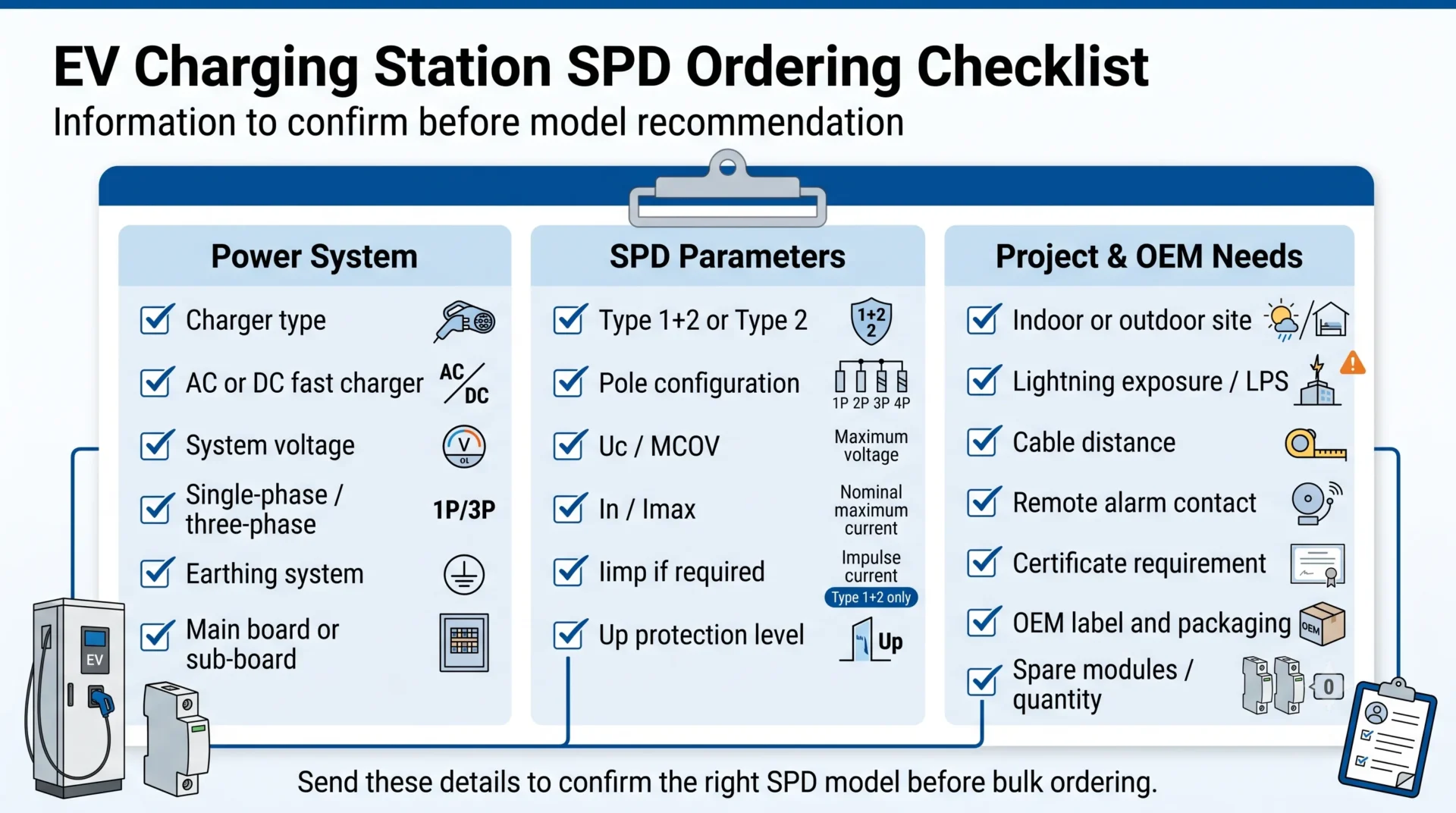
Bestellcheckliste für EV-Ladeinstallateure, Schaltschrankbauer und Projektkäufer.
Verwandte LEEYEE SPD-Seiten
Diese Seiten können Auftragnehmern und Schaltschrankbauern helfen, die relevanten SPD-Parameter vor der endgültigen Auswahl zu überprüfen.
FAQ: SPD-Auswahl für EV-Ladestationen
Braucht eine EV-Ladestation ein SPD?
Ja, EV-Ladestationen benötigen normalerweise Überspannungsschutz, insbesondere bei öffentlichen, gewerblichen, im Freien, Fuhrpark- und DC-Schnellladeprojekten.
Wo sollte das SPD für eine EV-Ladestation installiert werden?
Häufige Positionen sind das Hauptverteilerfeld, Unterverteilerfelder in der Nähe der Ladegeräte, AC-Eingang des Ladestation, Signalleitung und Überwachungsstromkreis.
Sollte ich SPD Typ 1+2 oder Typ 2 für eine EV-Ladestation verwenden?
Verwenden Sie SPD Typ 1+2 am Hauptanschlussfeld, wenn das Gelände über einen externen Blitzschutz, eine Überlandversorgung oder eine hohe Blitzeinwirkung verfügt. Verwenden Sie SPD Typ 2 für downstream-Verteilerfelder und Ladegeräteingangspanels.
Hilfe bei der Auswahl von SPDs für ein EV-Ladeprojekt benötigt?
Senden Sie uns Ihren Ladetyp, Systemspannung, Erdungssystem, Panelposition, Kabeldistanz, und ob das Gelände Innen-, Außenbereich oder durch ein externes Blitzschutzsystem geschützt ist.
- ✓ Auswahl des AC-Eingangsspd
- ✓ Empfehlung Typ 1+2 / Typ 2
- ✓ Richtung der Signalleitung SPD
- ✓ Option für Fernalarmkontakt
- ✓ Unterstützung von OEM-Label und Verpackung
- ✓ Unterstützung von Zertifikat und Datenblatt
Hinweis: Die endgültige SPD-Auswahl sollte den Projektzeichnungen, den lokalen Elektroinstallationsvorschriften, den Anforderungen des Ladegeräteherstellers und der Risikobewertung vor Ort entsprechen.