Guide de sélection BESS SPD
Vous ne savez pas où installer les dispositifs de protection contre les surtensions dans un système de stockage d'énergie par batterie ? Ce guide explique comment assurer la protection contre les surtensions dans un système BESS (Battery Energy Storage System) au niveau des armoires de batteries, du bus CC, du PCS, du côté CA, des lignes de communication, de la mise à la terre et des commandes de projets OEM.
Table des matières
Réponse rapide : À quel endroit un système BESS doit-il être équipé d'une protection contre les surtensions ?
Dans la plupart des projets BESS, il convient d'envisager une protection contre les surtensions du côté courant continu, du côté courant alternatif, au niveau de l'interface PCS, des lignes de communication et du système de mise à la terre. Le type précis de dispositif de protection contre les surtensions (SPD) dépend de la tension du système, de l'emplacement d'installation, de la longueur des câbles, du schéma de mise à la terre, de l'exposition du site et de la norme applicable au projet.
| Zone BESS | Risque de surtension typique | Protection recommandée | Signification pour l'Acheteur |
|---|---|---|---|
| Sortie CC de l'armoire de batteries | Transitoire en courant continu, différence de potentiel entre armoires, influence d'un coup de foudre à proximité | SPD CC sélectionné en fonction de la tension continue réelle et du schéma de mise à la terre | Ne vous fiez pas uniquement à la mention « 1 000 V » ou « 1 500 V ». Vérifiez la tension réelle du système et les conditions de défaut. |
| Bus CC / Combineur CC | Exposition prolongée du câble CC et accumulation d'énergie de surtension provenant de plusieurs armoires | SPD CC à proximité du bus CC ou du combinateur, lorsque la configuration du système l’exige | Utile lorsque les armoires de batteries et les PCS ne sont pas situés à proximité les uns des autres. |
| Entrée CC du PCS | Pique de tension entrant dans le circuit électronique de conversion de puissance depuis le côté batterie | Tension continue de synchronisation (DC SPD) égale ou proche de la tension d'entrée continue du PCS | Le PCS coûte cher. Vérifiez à la fois l'entrée CC et la sortie CA, et pas seulement l'une des deux. |
| Sortie CA du PCS | Surtension de commutation côté réseau, mise sous tension du transformateur, effets indirects de la foudre | Le SPD CA est choisi en fonction de la tension du réseau CA et du système de mise à la terre | Le côté CA nécessite un SPD CA. Les SPD CC et CA ne sont pas interchangeables. |
| Entrée de service CA / PCC | Pics de tension provenant du raccordement au réseau, du tableau de basse tension ou du transformateur en amont | SPD de type 1, de type 1+2 ou de type 2 CA, en fonction du LPS et du niveau de risque | Pour les armoires situées à l'extérieur ou dans des endroits très exposés, ne considérez pas le tableau électrique principal comme un tableau d'intérieur classique. |
| Tableau électrique auxiliaire de climatisation | Surtension affectant les systèmes CVC, l'alarme incendie, l'éclairage, l'alimentation de commande et l'alimentation auxiliaire | Dispositif de protection contre les surtensions (SPD) de type 2 pour les circuits de distribution auxiliaires | Les temps d'arrêt du système BESS peuvent également être dus à une défaillance des systèmes auxiliaires, et pas seulement à une défaillance de la batterie ou du PCS. |
| BMS / RS485 / CAN | Problème de communication, fausse alerte, dommage au niveau du contrôleur, arrêt du système | Signal SPD sélectionné en fonction du type d'interface et de la tension du signal | Le Power SPD ne peut pas protéger les ports de signaux RS485, CAN ou à contact sec. |
| Ethernet / SCADA / EMS | Dommages au niveau des ports réseau, défaillance de la surveillance à distance, interruption de la communication | SPD Ethernet ou de ligne de données, sélectionné en fonction du type de réseau et des exigences en matière de PoE | Une défaillance du système de surveillance peut entraîner l'arrêt du fonctionnement, même lorsque les circuits d'alimentation sont encore en bon état. |
| Mise à la terre et liaison | Tension de passage élevée due à des câbles de connexion trop longs sur les dispositifs de protection contre la foudre (SPD) ou à une liaison équipotentielle défectueuse | Câbles SPD courts, mise à la masse correcte et conception coordonnée de la mise à la terre | Un bon SPD peut présenter des performances médiocres si le chemin de mise à la terre est trop long ou mal relié. |
Quelle directive SPD s'applique à chaque circuit BESS ?
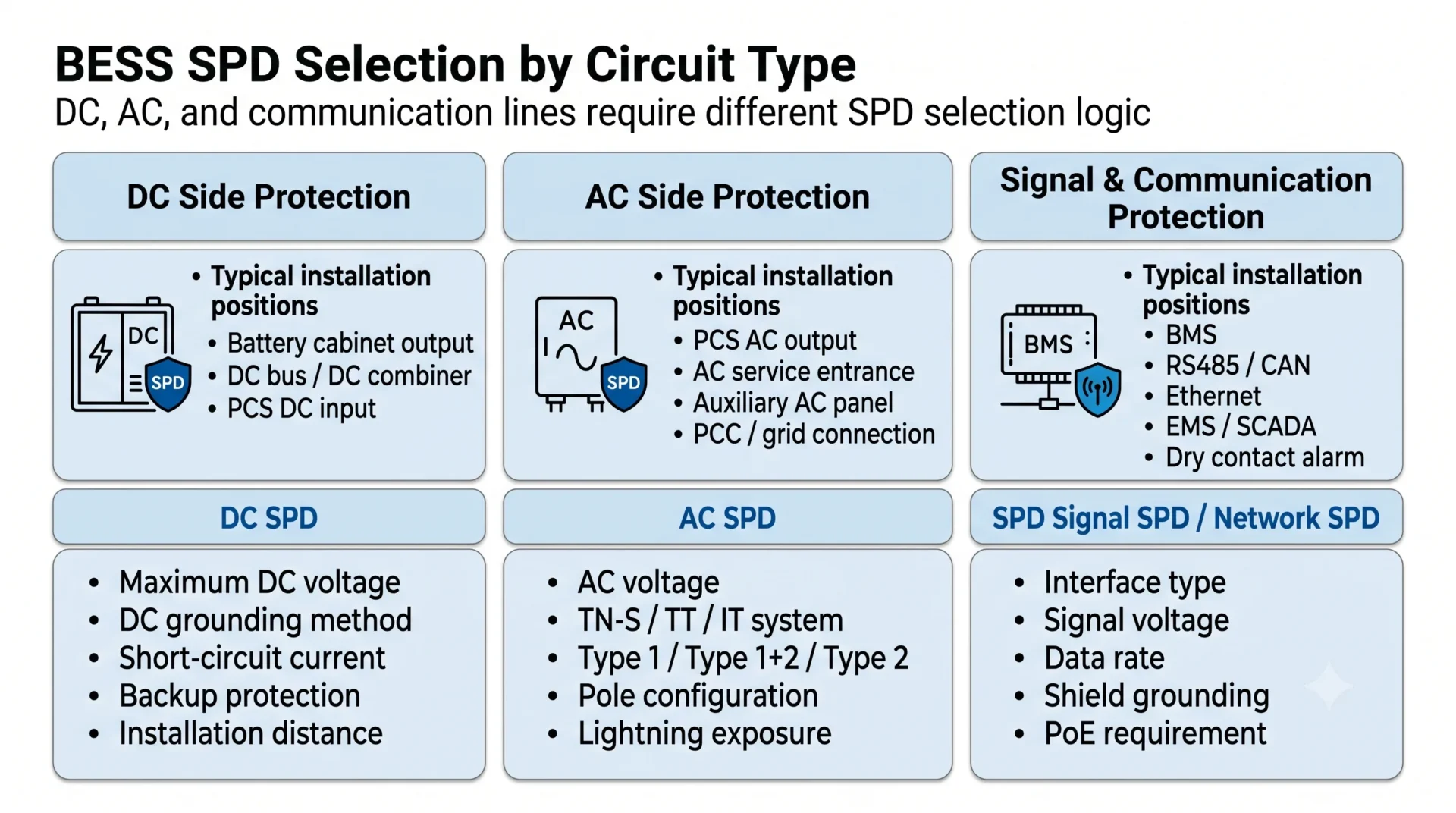
Un système de stockage d'énergie par batterie (BESS) comprend plusieurs types de circuits électriques. C'est pourquoi une seule norme relative aux dispositifs de protection contre les surtensions (SPD) ou une seule pratique relative aux produits ne peut pas couvrir l'ensemble du système. Avant de choisir un modèle, il convient de ventiler le projet en circuits d'alimentation en courant continu (CC) propres au BESS, circuits CC couplés à des panneaux photovoltaïques (PV), circuits CA basse tension et lignes de communication.
| Circuit dans un système de stockage d'énergie par batterie (BESS) | Position Typique | Directives communes standard | Avertissement à l'acheteur |
|---|---|---|---|
| Circuit d'alimentation en courant continu dédié au BESS | Sortie du coffret de batteries, bus CC, entrée CC du PCS | Directives relatives aux dispositifs de protection contre les surtensions (SPD) dans les circuits à courant continu, telles que la norme CEI 61643-41 pour les systèmes à courant continu jusqu’à 1 500 V CC, le cas échéant | Ne vous fiez pas uniquement aux valeurs nominales du disjoncteur de protection contre les surtensions (SPD). Vérifiez la tension continue réelle côté batterie, la mise à la terre et le courant de défaut. |
| Circuit à courant continu couplé à un système photovoltaïque | Chaînes photovoltaïques, combinateur photovoltaïque, bus CC hybride, côté photovoltaïque du PCS hybride | Direction SPD côté CC photovoltaïque, par exemple selon la norme CEI 61643-31 lorsque le circuit se trouve du côté CC photovoltaïque | Vérifiez si le SPD assure la protection du côté photovoltaïque, du côté batterie ou d'un bus CC hybride partagé. |
| Circuit d'alimentation basse tension en courant alternatif | Sortie CA du PCS, tableau de distribution CA, PCC, tableau auxiliaire CA | Directives relatives aux dispositifs de protection contre les surtensions (SPD) à basse tension en courant alternatif, telles que la norme CEI 61643-11, le cas échéant | Utilisez un dispositif de protection contre les surtensions (SPD) de courant alternatif pour les circuits à courant alternatif. Les SPD de courant continu et de courant alternatif ne sont pas interchangeables. |
| Réseau de signaux et de communication | BMS, RS485, CAN, Ethernet, EMS, SCADA, alarme à contact sec | Directives relatives aux dispositifs de protection contre les surtensions (SPD) dans le domaine des signaux et des télécommunications, telles que la norme CEI 61643-21, le cas échéant | Power SPD ne peut pas protéger les ports de communication. Sélectionnez-le en fonction du type d'interface et de la tension du signal. |
Règle pratique
Ne commencez pas par demander : « Quel type de SPD utilise-t-on pour un système de stockage d'énergie par batterie (BESS) ? ». Demandez plutôt : « Quel circuit dois-je protéger ? ». La réponse peut être un SPD CC, un SPD CA, un SPD de signal, un SPD Ethernet ou une combinaison coordonnée de ces éléments.
Vous avez besoin d'aide pour vérifier l'emplacement des modules SPD (protection contre les surtensions) pour le courant alternatif (CA), le courant continu (CC), le système de conversion de puissance (PCS) et les communications dans une armoire BESS ou dans le cadre d'un projet ?
Carte de protection contre les surtensions BESS : courant continu, courant alternatif, onduleur, signaux et mise à la terre
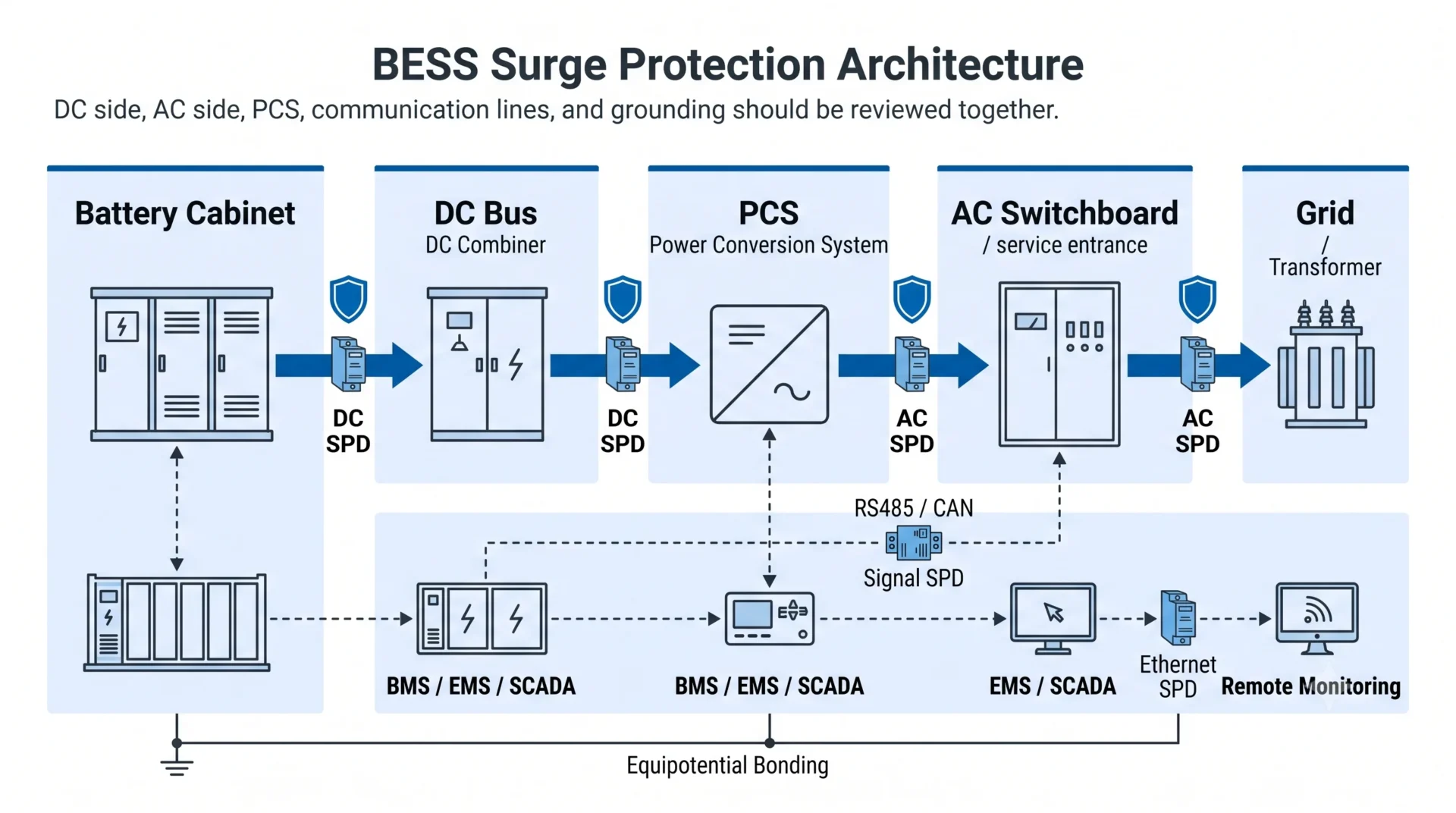
Un système de stockage d'énergie par batterie comprend généralement des racks ou des armoires de batteries, un câblage de bus CC, un système de conversion de puissance (PCS), un réseau de distribution CA, des circuits auxiliaires, un système de communication BMS, et un dispositif de surveillance à distance. La protection contre les surtensions doit respecter cette structure du système.
L'objectif n'est pas d'installer le plus grand nombre possible de SPD. L'objectif est de placer le bon SPD au niveau de la bonne interface, afin que le courant de surtension dispose d'un chemin de décharge contrôlé avant d'atteindre les composants électroniques sensibles.
Systèmes BESS autonomes vs systèmes BESS couplés à des installations photovoltaïques vs systèmes BESS couplés au réseau CA
Avant de choisir des SPD, il convient de déterminer l'architecture du système. Un système de stockage d'énergie par batterie (BESS) autonome, un BESS couplé à un système photovoltaïque et un BESS couplé au courant alternatif peuvent tous utiliser des armoires de batteries et des équipements PCS, mais les voies de dérivation des surtensions et la logique de sélection des SPD ne sont pas exactement les mêmes.
| Type de système | Circuit typique | Critères de sélection du SPD | Avertissement à l'acheteur |
|---|---|---|---|
| Système de stockage d'énergie par batterie autonome (BESS) | Armoire à batteries → Bus CC → PCS → Tableau de distribution CA | SPD CC BESS, protection de l'entrée CC du PCS, protection de la sortie CA du PCS, SPD de communication | Ne considérez pas le bus CC côté batterie comme un circuit de chaîne photovoltaïque classique sans l'avoir préalablement examiné. |
| Système de stockage d'énergie par batterie (BESS) couplé à une installation photovoltaïque | Chaînes photovoltaïques / combineur photovoltaïque + système de batteries + PCS hybride ou onduleur | Séparer les lignes côté CC photovoltaïque, côté CC batterie, onduleur, sortie CA et surveillance | Vérifiez si le positionnement du SPD se trouve du côté photovoltaïque, du côté batterie ou sur le bus CC hybride partagé. |
| Système de stockage d'énergie par batterie (BESS) couplé en courant alternatif | Batterie + PCS raccordés au réseau de distribution CA | Entrée CC du PCS, sortie CA du PCS, tableau de distribution CA, PCC, circuits auxiliaires | La protection du côté courant alternatif revêt une importance capitale, en particulier à proximité du PCC et des tableaux principaux de courant alternatif. |
| Système de stockage d'énergie par batterie en conteneur (BESS) | Armoires de batteries, systèmes de contrôle de puissance (PCS), systèmes de chauffage, ventilation et climatisation (CVC), alarme incendie, système de gestion d'urgence (EMS) et équipements réseau situés à l'intérieur ou à proximité du conteneur | SPD CC, SPD CA, SPD de signal, SPD Ethernet, coordination de la mise à la terre et des liaisons équipotentielles | L'exposition à l'extérieur, les points d'entrée des câbles et la mise à la terre des conteneurs doivent être examinés conjointement. |
Pourquoi la protection contre les surtensions BESS est différente d'un tableau de distribution classique
Un tableau de distribution basse tension classique est essentiellement un système d'alimentation en courant alternatif. Un système de stockage d'énergie par batterie (BESS) est différent. Il comprend des circuits haute tension en courant continu, des composants électroniques de conversion de puissance, des circuits en courant alternatif côté réseau, des charges auxiliaires et des réseaux de communication qui fonctionnent de concert.
Tension continue élevée
De nombreux projets BESS à échelle commerciale et industrielle utilisent une tension continue élevée. Le dispositif de protection contre les surtensions en courant continu (SPD) doit être adapté à la tension réelle du système de batteries, au schéma de mise à la terre et aux conditions de court-circuit.
Sensibilité du PCS
Le PCS est le centre de conversion d'énergie du système. Une surtension peut provenir du côté de la batterie ou du côté du réseau ; il convient donc de vérifier les deux interfaces.
Dépendance en matière de communication
Un système BESS repose sur les protocoles BMS, EMS, SCADA, RS485, CAN, Ethernet et les signaux à contacts secs. Une défaillance de communication peut mettre le système hors service.
Coordination de la mise à la terre
Les armoires de batteries, les armoires PCS, les tableaux CA et les armoires de communication doivent être correctement reliées à la terre. Les performances des SPD dépendent fortement de leur installation et de leur mise à la terre.
Protection contre les surtensions côté courant continu pour les armoires de batteries et le bus CC
Le circuit CC constitue l'un des éléments les plus importants de la protection contre les surtensions des systèmes de stockage d'énergie par batterie (BESS). Il peut comprendre les bornes de sortie des armoires de batteries, les sections de bus CC, les armoires de regroupement CC et les bornes d'entrée CC des onduleurs.
Pour les circuits d'alimentation en courant continu exclusivement destinés aux systèmes BESS, il ne faut pas se contenter de reprendre une règle de sélection de SPD pour les circuits photovoltaïques en courant continu. Le SPD doit être choisi en fonction du circuit d'alimentation en courant continu réel, de la tension de service maximale, du schéma de mise à la terre, du courant de court-circuit admissible et de la norme applicable.
Éléments à vérifier avant de choisir un SPD à courant continu
- Tension nominale et tension maximale en courant continu du coffret de batteries
- Plage de tension d'entrée CC du PCS
- Architecture BESS autonome ou couplée à un système photovoltaïque
- Système à courant continu flottant, à masse positive, à masse négative ou à référence d'impédance
- Courant de court-circuit disponible au point d'installation du SPD
- Fusible, disjoncteur ou dispositif de coupure de secours obligatoire
- Emplacement d'installation : armoire de batteries, bus CC, combinateur CC ou entrée du PCS
- Indicateur visuel ou contact d'alarme à distance obligatoire
Une erreur importante à éviter
Ne choisissez pas un SPD CC BESS uniquement parce que l'étiquette indique 1 000 V ou 1 500 V. La classe de tension n'est qu' un critère parmi d'autres pour le choix. La mise à la terre, le courant de court-circuit, le mode de protection, la protection de secours et la position d'installation sont également des facteurs importants.
Protection contre les surtensions PCS : entrée CC et sortie CA
Le système de conversion de puissance PCS fait le lien entre le côté courant continu (CC) de la batterie et le côté courant alternatif (CA) du réseau. Comme il contient des composants électroniques de puissance sensibles, il ne doit pas être protégé dans un seul sens.
Une surtension peut provenir du côté de l'armoire de batteries, notamment lorsque les câbles CC sont longs ou que les armoires sont séparées. Une surtension peut également provenir du côté du réseau CA via le transformateur, le tableau de distribution CA, ou le point de couplage commun.
| Interface PCS | Concentration de protection | Type de DOCUP | Ce qu'il faut confirmer |
|---|---|---|---|
| Entrée CC du PCS | Pics de tension provenant des armoires de batteries, du bus CC ou de longs tronçons de câbles CC | SPD DC | Tension continue maximale, mise à la terre, courant de court-circuit, protection de secours, longueur de câble |
| Sortie CA du PCS | Pics de tension provenant du réseau CA, de la commutation du transformateur ou du réseau de distribution CA en amont | SPD AC | Tension du réseau CA, réseau TN-S / TN-C-S / TT / IT, type de dispositif de protection contre les surtensions (SPD), configuration polaire |
| Ports de commande et de surveillance du PCS | Problème de communication, panne du contrôleur, défaillance de la surveillance à distance | SPD de signal ou de réseau | RS485, CAN, Ethernet, contact sec, mise à la terre du blindage, tension du signal, débit de données |
Si le fournisseur du PCS impose une exigence spécifique concernant le SPD, veuillez vous référer en priorité à la documentation du matériel. Si le projet concerne un équipement OEM ou une armoire, transmettez les informations relatives à l'interface du PCS au fournisseur du SPD avant de valider le modèle.
Protection contre les surtensions côté courant alternatif pour le raccordement au réseau et l'alimentation auxiliaire
Du côté CA d'un système de stockage d'énergie par batterie (BESS), on trouve généralement la sortie CA du PCS, le tableau électrique principal CA, le point de couplage commun, le côté transformateur et la distribution CA auxiliaire. À ces emplacements, il convient d'utiliser des parafoudres CA, et non des parafoudres CC.
Pour l'entrée principale d'alimentation CA ou l'entrée d'alimentation d'un conteneur extérieur, il convient de choisir un SPD de type 1, de type 1+2 ou de type 2 en fonction de l'exposition à la foudre, du système externe de protection contre la foudre, de la protection en amont et des règles d'installation locales.
| Poste AC | SPD typique | Remarques de sélection |
|---|---|---|
| Entrée de service CA / PCC | SPD CA de type 1, de type 1+2 ou de type 2 | Examiner les risques liés à la foudre, l'état du système de protection contre les surtensions (LPS), le raccordement au réseau et la distribution en amont. |
| Armoire de sortie CA PCS | SPD de type 2 ou SPD coordonné pour courant alternatif | Vérifiez la tension alternative, le système de mise à la terre, la configuration des pôles et la longueur du câble relié au parafoudre en amont. |
| Distribution auxiliaire du courant alternatif | Type 2 SPD AC | Protège les systèmes de chauffage, de ventilation et de climatisation (CVC), les systèmes d'alarme incendie, l'éclairage, l'alimentation des systèmes de commande et les petites charges auxiliaires. |
| Alimentation électrique de commande | SPD CA ou SPD à commande CC, selon le type d'alimentation | Vérifiez si le circuit de commande est alimenté en 230 V CA, 24 V CC, 48 V CC ou une autre tension. |
Pour choisir un dispositif de protection contre les surtensions (SPD) en courant alternatif, vous pouvez également consulter Dispositifs de protection contre les surtensions en courant alternatif et protection contre les surtensions pour les systèmes à courant alternatif et à courant continu.
Protection des liaisons de communication : BMS, RS485, CAN, Ethernet, SCADA
Les SPD de puissance ne protègent pas les ports de communication. Il s'agit d'une erreur courante dans les projets de systèmes de stockage d'énergie par batterie (BESS). Un système BESS peut tout de même s'arrêter si la ligne de communication du BMS, du contrôleur PCS, du système SCADA ou de l'EMS est endommagée par une surtension.
Le choix d'un dispositif de protection contre les surtensions (SPD) pour une ligne de communication dépend du type d'interface, de la tension du signal, du débit de données, de la longueur du câblage, de la mise à la terre du blindage et du fait que ce même câble transporte ou non de l'alimentation électrique.
| Type de ligne | Où cela apparaît-il dans BESS ? | Note relative à la protection |
|---|---|---|
| RS485 | Communication BMS, surveillance entre armoires, communication PCS | Choisissez une SPD adaptée à la tension du signal et qui ne perturbe pas la communication. |
| CAN | Gestion des batteries, communication entre modules, réseau de contrôleurs | Vérifiez la tension de l'interface, la mise à la terre, le blindage du câble et la vitesse de communication. |
| Ethernet | EMS, SCADA, surveillance à distance, enregistreur de données, commutateur réseau | Utilisez un SPD Ethernet adapté au type de réseau. Vérifiez la prise en charge du PoE si l'alimentation est acheminée par le même câble. |
| Alarme à contact sec | Alarme de défaut, interface d'alarme incendie, signalisation à distance | Vérifiez la tension de contact et déterminez si la ligne passe à l'extérieur de l'armoire ou entre deux armoires. |
| Ligne de commande 24 V / 48 V CC | Alimentation électrique, capteurs, équipements de surveillance | Utilisez un dispositif de protection contre les surtensions (SPD) de commande ou de signal en courant continu adapté à la tension de fonctionnement réelle. |
Pour les applications RS485 et les lignes de signal, voir Câblage et sélection des SPD RS485 et Câblage du contact d'alarme à distance SPD vers l'automate programmable.
Mise à la terre, liaison équipotentielle et emplacement d'installation des dispositifs de protection contre les surtensions (SPD)
Le choix du parafoudre ne représente que la moitié du travail. C'est la qualité de l'installation qui détermine si le parafoudre est réellement capable de limiter efficacement les surtensions. Des câbles de mise à la terre trop longs, une liaison équipotentielle défaillante ou un mauvais emplacement de l'armoire peuvent réduire l'efficacité de la protection.
Veillez à ce que les câbles SPD soient courts
La connexion entre le disjoncteur SPD et le circuit protégé ainsi que la barre de mise à la terre doit être aussi courte et directe que le permet la configuration de l'armoire.
Fixez correctement les armoires
Les armoires de batteries, les armoires PCS, les tableaux CA, les armoires de communication et les châssis de conteneurs doivent être reliés à la terre conformément au schéma de mise à la terre du projet.
Placez le SPD près de l'interface
Installez les SPD à proximité du point d'entrée potentiel de l'énergie de surtension ou à l'endroit où l'équipement protégé est raccordé.
Coordonnez la protection de secours
Vérifiez si le SPD nécessite un fusible, un disjoncteur ou un dispositif de coupure intégré en fonction des conditions de court-circuit du réseau.
Le SPD ne remplace ni les fusibles ni les disjoncteurs
Un dispositif de protection contre les surtensions limite les surtensions transitoires et détourne les courants de surtension. Il ne remplace pas les fusibles CC, les disjoncteurs CC, les disjoncteurs CA, les isolateurs, les sectionneurs ni les dispositifs de sécurité du système.
Comment déterminer les points d'installation des SPD dans un projet concret de système de stockage d'énergie par batterie (BESS)
Il n'existe pas de nombre fixe de SPD pour chaque système de stockage d'énergie par batterie (BESS). La configuration adéquate dépend de la distance entre les armoires, du cheminement des câbles, de l'exposition à la foudre, des zones de mise à la terre, de l'emplacement du PCS, de la distribution CA, et du tracé des câbles de communication.
| Condition du projet | Ce que cela pourrait signifier | Point d'analyse SPD |
|---|---|---|
| Les armoires de batteries et les systèmes de contrôle des batteries (PCS) se trouvent dans la même armoire ou à proximité immédiate | Une longueur réduite du câble CC peut limiter l'exposition, mais l'entrée CC du PCS doit tout de même faire l'objet d'un examen | Sortie du coffret de batteries, entrée CC du PCS, longueur du câble de mise à la terre |
| Les armoires de batteries et les systèmes de contrôle de puissance (PCS) sont reliés par de longs câbles CC. | Il peut être nécessaire de vérifier la protection contre les surtensions aux deux extrémités du câble CC. | Sortie du coffret de batteries, bus CC, entrée CC du PCS |
| Système de stockage d'énergie par batterie (BESS) en conteneur, destiné à une installation en extérieur | Exposition accrue aux coups de foudre indirects et aux surtensions provenant des entrées de câbles externes | Entrée d'alimentation CA, entrée de câble CC, entrée de câble de communication, mise à la terre du conteneur |
| Un système de protection externe contre la foudre a été installé | Les circuits d'alimentation principaux peuvent nécessiter une capacité de gestion des courants de surtension plus élevée ainsi qu'une meilleure coordination | Analyse des parafoudres de type 1 ou de type 1+2 en courant alternatif, coordination des parafoudres en courant continu, liaison équipotentielle |
| Des câbles de communication relient les armoires ou les conteneurs entre eux | Des zones de mise à la terre différentes peuvent générer des pics de tension au niveau des ports du BMS, de l'EMS et du contrôleur. | SPD RS485, SPD CAN, SPD Ethernet, protection des lignes à contact sec |
| Le PCS est situé loin du tableau électrique principal du climatiseur | Une coordination de la protection contre les surtensions CA peut s'avérer nécessaire tant du côté du PCS que du côté du tableau de distribution CA. | Sortie CA du PCS, tableau de distribution CA, PCC, distance du SPD en amont |
Tableau de sélection des SPD BESS par zone d'installation
Utilisez ce tableau comme premier outil de réflexion technique. Le choix final doit être validé en fonction de la tension du système BESS, de la configuration de l'armoire, du type de mise à la terre, du courant de défaut et de la norme applicable au projet.
| Zone d'installation | Catégorie SPD possible | Paramètres clés à vérifier | Profil type de l'acheteur |
|---|---|---|---|
| Sortie de l'armoire de batteries | SPD DC | Tension continue, mise à la terre, SCCR / courant de court-circuit, espace d'installation, alarme à distance | Fabricant d'armoires de batteries, intégrateur de systèmes BESS |
| Bus CC / Combineur CC | SPD DC | Tension du réseau, tracé des câbles, nombre d'armoires, coordination des protections | Intégrateur de systèmes, fabricant d’armoires électriques |
| Entrée CC du PCS | SPD DC | Gamme PCS DC, tension de fonctionnement maximale, protection de secours, distance par rapport aux armoires de batteries | Fournisseur de PCS, EPC, intégrateur de systèmes de stockage d'énergie par batterie (BESS) |
| Sortie CA du PCS | SPD AC | Tension alternative, système de phases, système de mise à la terre, exigences de type 1 / type 1+2 / type 2 | Fournisseur de systèmes PCS, fabricant d'armoires électriques |
| Réseau principal de distribution CA / PCC | SPD AC | Tension du réseau, raccordement du transformateur, état du LPS, protection en amont | EPC, maître d'œuvre, usine de tableaux électriques |
| BMS / EMS / SCADA | SPD de signal / SPD réseau | RS485, CAN, Ethernet, contact sec, PoE, mise à la terre du blindage, débit de données | Intégrateur BESS, fabricant de tableaux de commande |
| Alimentation auxiliaire | SPD à courant alternatif ou SPD à courant continu | 230 V CA, 24 V CC, 48 V CC, type de charge, position de l'armoire | Fabricant de conteneurs, fournisseur d'armoires électriques |
Catégories LEEYEE SPD pour les projets BESS
Pour les projets BESS, le modèle final doit être validé en fonction de la tension, du type de circuit, de l'emplacement d'installation, de la mise à la terre, des conditions de court-circuit et des exigences de certification. Les catégories ci-dessous aident les acheteurs à déterminer quelle gamme de produits examiner en priorité.
SPD CC pour l'armoire de batteries et l'entrée CC du système de conversion de puissance (PCS)
À utiliser pour la sortie d'un armoire de batteries, le bus CC, le combinateur CC ou l'entrée CC d'un onduleur, après avoir vérifié la tension continue, le schéma de mise à la terre et la protection de secours.
Afficher la catégorie SPD de Washington DCProtection contre les surtensions CA pour la sortie PCS et le tableau de distribution CA
Utilisé pour la sortie CA du PCS, l'entrée de service CA, le PCC et la distribution CA auxiliaire, conformément aux exigences relatives à la tension CA, au système de mise à la terre et aux types 1 et 2.
Afficher la catégorie SPD CASignal SPD pour BMS, RS485, CAN et contact sec
Utilisé pour les lignes de communication et de commande où les surtensions risquent d'endommager le BMS, le contrôleur PCS, les circuits d'alarme ou le câblage de signalisation entre armoires.
Consultez le guide sur les SPD RS485Option d'alarme à distance SPD pour la maintenance
Pour la maintenance des installations, les SPD équipés de contacts de signalisation à distance permettent de relier les signaux de défaillance à des automates programmables, à des systèmes de surveillance ou à des circuits d'alarme d'armoire.
Consultez le guide sur les alarmes à distanceErreurs courantes en matière de protection contre les surtensions des systèmes de stockage d'énergie par batterie (BESS)
Les projets BESS sont des systèmes à forte valeur ajoutée. Une simple erreur de choix peut entraîner des temps d'arrêt, des frais de remplacement ou des problèmes de communication. Voici les erreurs que les acheteurs et les fabricants d'armoires doivent éviter.
- Protection uniquement du côté CA. Le côté courant continu de la batterie et l'entrée courant continu du PCS peuvent encore être exposés.
- Protection uniquement du côté courant continu. Les surtensions côté réseau CA et les circuits auxiliaires CA peuvent néanmoins provoquer des pannes.
- Utilisation d'un SPD CC photovoltaïque pour chaque point CC du système de stockage d'énergie par batterie (BESS) sans vérification préalable. Les circuits CC couplés à des panneaux photovoltaïques et les circuits CC alimentés uniquement par un système de stockage d'énergie par batterie (BESS) doivent être vérifiés séparément.
- Choix limité à Imax. La classe de tension, la tension maximale admissible (Up), le SCCR, la mise à la terre, la protection de secours et la position de montage sont également des facteurs importants.
- Sans tenir compte des lignes RS485, CAN, Ethernet ou à contact sec. Une défaillance de communication peut entraîner l'arrêt du système.
- Utilisation de longs câbles de mise à la terre SPD. Des fils de connexion longs peuvent augmenter la tension de passage effective.
- Pas d'indication à distance. Dans les projets BESS, un contact d'alarme à distance peut aider les équipes de maintenance à détecter plus rapidement un SPD défaillant.
- Pas de liste de contrôle pour les commandes. Sans données concernant la tension, la mise à la terre, le courant de défaut et l'interface, le fournisseur ne peut que faire des suppositions.
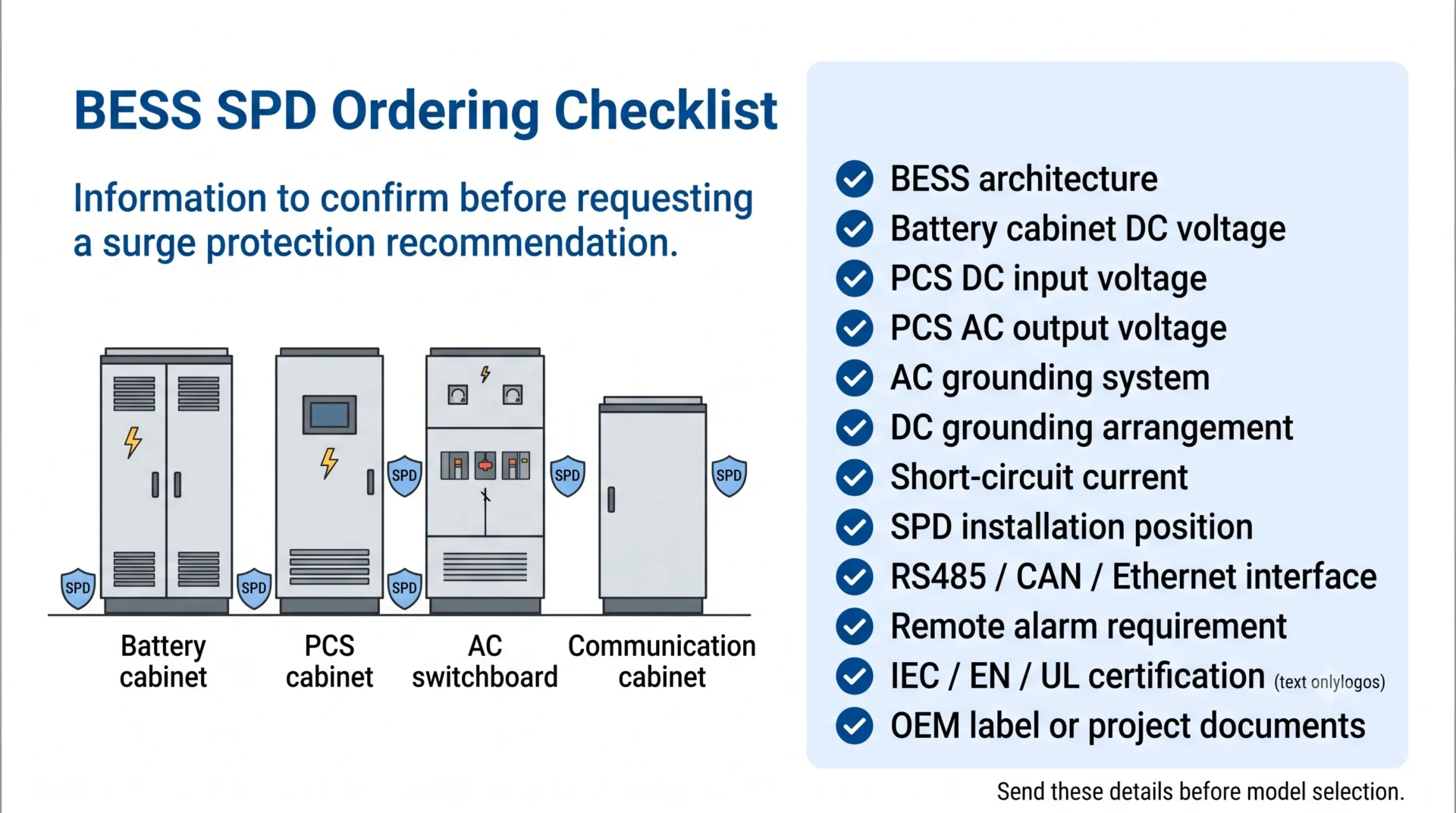
Avant de commander des SPD pour un projet BESS, veuillez vérifier les informations suivantes
Cette liste de contrôle est utile pour les fabricants d'armoires BESS, les fournisseurs de PCS, les équipes EPC, les acheteurs de projets, et les clients OEM. Veuillez nous transmettre ces informations avant de demander une recommandation de modèle.
- Architecture BESS : BESS autonome, BESS couplé à une installation photovoltaïque ou système hybride
- Tension nominale et tension maximale en courant continu du coffret de batteries
- Plage de tension d'entrée CC du PCS
- Système de tension et de phase de sortie CA du PCS
- Système de réseau électrique : TN-S, TN-C-S, TT ou IT
- Configuration de mise à la terre du courant continu : flottante, mise à la terre positive, mise à la terre négative ou référencée en impédance
- Courant de court-circuit disponible à chaque emplacement de SPD
- Emplacement d'installation : armoire de batterie, bus CC, PCS, armoire CA ou armoire de signalisation
- Interfaces de communication : RS485, CAN, Ethernet, contact sec, ligne de commande 24 V / 48 V
- Type de SPD requis : Type 1, Type 1+2, Type 2, SPD CC, SPD de signal ou SPD réseau
- Norme ou certification requise : CEI, EN, UL ou exigence spécifique au projet
- Exigences relatives au contact d'alarme à distance pour la surveillance ou la connexion à un automate programmable
- Espace disponible dans l'armoire, montage sur rail DIN, sens de câblage et longueur des câbles
- Exigences relatives aux marques OEM, aux marques de distributeur, aux emballages, aux fiches techniques et aux documents de projet
Vous avez besoin d'aide pour choisir des SPD pour une armoire BESS ou un projet PCS ?
Veuillez nous communiquer la configuration de votre système BESS, la tension de l'armoire de batteries, la tension d'entrée CC du PCS, la tension de sortie CA du PCS, le système de mise à la terre, les interfaces de communication, l'emplacement d'installation et la certification requise. LEEYEE peut vous aider à déterminer les catégories de SPD adaptées aux armoires OEM, aux projets PCS et à l'intégration de systèmes de stockage d'énergie.
FAQ : Protection contre les surtensions BESS
Un BESS a-t-il besoin d'une protection contre les surtensions à la fois sur les côtés AC et DC ?
Dans de nombreux projets de systèmes de stockage d'énergie par batterie (BESS), les deux côtés doivent être pris en compte. Le côté courant continu (CC) protège les armoires de batteries, le bus CC et l'entrée CC du système de conversion de puissance (PCS). Le côté courant alternatif (CA) protège la sortie CA du PCS, le tableau de distribution CA, le raccordement au réseau, ainsi que les circuits CA auxiliaires.
Où les SPD doivent-ils être installés dans un système BESS ?
Parmi les emplacements courants, on peut citer la sortie CC du bailli de batteries, le bus CC ou le combinateur CC, l'entrée CC du PCS, la sortie CA du PCS, l'entrée de service CA, le tableau CA auxiliaire, les lignes de communication du BMS, les lignes Ethernet ou SCADA, ainsi que les circuits d'alimentation de commande. Les emplacements exacts dépendent de la configuration du système.
Quelle SPD est nécessaire pour le PCS dans un système de stockage d'énergie ?
La protection d'un onduleur (PCS) doit généralement porter à la fois sur le côté entrée CC et sur le côté sortie CA. Un parafoudre CC peut être nécessaire au niveau de l'entrée CC de l'onduleur, tandis qu'un parafoudre CA peut être nécessaire au niveau de la sortie CA de l'onduleur ou du tableau de distribution CA associé. Les ports de communication peuvent également nécessiter des parafoudres de signaux.
Puis-je utiliser un SPD CC photovoltaïque sur le bus CC d'un système de stockage d'énergie par batterie (BESS) ?
Pas systématiquement. Si le système est couplé à une installation photovoltaïque, les exigences relatives aux SPD CC photovoltaïques peuvent s'appliquer au côté CC photovoltaïque. Pour les circuits d'alimentation en courant continu exclusivement dédiés au système de stockage d'énergie par batterie (BESS), le parafoudre CC doit être choisi en fonction de la tension CC réelle du BESS, du schéma de mise à la terre, du courant de court-circuit, du point d'installation, et de la norme applicable au projet.
Quelle est la différence entre un SPD CC BESS et un SPD CC photovoltaïque ?
Le SPD CC photovoltaïque est choisi pour les circuits CC photovoltaïques tels que les chaînes photovoltaïques, les combinateurs photovoltaïques et l’entrée CC de l’onduleur photovoltaïque. Le choix du SPD CC pour le système de stockage d’énergie par batterie (BESS) doit tenir compte du circuit CC côté batterie, de l’entrée CC du système de conversion d’énergie photovoltaïque (PCS), de la mise à la terre CC, des conditions de court-circuit et des normes du projet. Dans un système hybride, le côté photovoltaïque et le côté batterie doivent être identifiés séparément.
La norme CEI 61643-41 s'applique-t-elle aux parafoudres CC pour systèmes de stockage d'énergie par batterie (BESS) ?
La norme CEI 61643-41 constitue une référence importante pour les dispositifs de protection contre les surtensions (SPD) raccordés à des circuits d’alimentation en courant continu jusqu’à 1 500 V CC, le cas échéant. Dans le cadre d'un projet de système de stockage d'énergie par batterie (BESS), vérifiez si le circuit protégé est un circuit d'alimentation en courant continu dédié au BESS, un circuit photovoltaïque en courant continu, un circuit en courant alternatif ou une ligne de communication avant de choisir la catégorie de parafoudre.
Les lignes RS485 ou CAN du BMS doivent-elles être protégées contre les surtensions ?
Ils peuvent nécessiter une protection lorsque les câbles de communication passent d'une armoire à l'autre, à l'extérieur, à proximité de câbles électriques ou entre différentes zones de mise à la terre. Le parasurtenseur de signal doit être adapté au type d'interface, à la tension, au débit de données et à la méthode de mise à la terre.
Un conteneur BESS doit-il être équipé d'un SPD de type 1+2 ou d'un SPD de type 2 ?
Cela dépend de l'exposition du site, du système de protection contre la foudre, du tracé du câble d'alimentation, de l'emplacement de l'installation, et de la protection en amont. Les entrées principales de service ou les installations extérieures fortement exposées peuvent nécessiter une protection de type 1 ou de type 1+2, tandis que les tableaux auxiliaires en aval peuvent utiliser des parasurtenseurs de type 2 lorsque cela est approprié.
Un SPD de type 2 est-il suffisant pour un BESS ?
Cela dépend de la position d'installation et des risques liés au site. Un dispositif de protection contre les surtensions (SPD) de type 2 peut convenir à certains tableaux CA en aval ou à la protection côté équipement, mais l'entrée principale du réseau ou les sites extérieurs à forte exposition peuvent nécessiter un SPD de type 1 ou une coordination de type 1+2. Les circuits CC et de signalisation nécessitent un examen distinct.
Les dispositifs de protection contre les surtensions remplacent-ils les fusibles CC ou les disjoncteurs ?
Non. Les SPD limitent les surtensions transitoires et détournent les courants de surtension. Ils ne remplacent pas les fusibles, les disjoncteurs, les isolateurs, les sectionneurs ni les dispositifs de protection de sécurité au niveau du réseau.
Quelles informations dois-je fournir avant de demander une recommandation BESS SPD ?
Veuillez nous communiquer l'architecture du BESS, la tension continue, la tension d'entrée continue du PCS, la tension de sortie alternative du PCS, le système de mise à la terre, le courant de court-circuit, la position d'installation, l'interface de communication, les exigences de certification, ainsi que la nécessité ou non d'un contact d'alarme à distance ou d'une étiquette OEM.