
BESS SPD Selection Guide
Not sure where surge protective devices should be installed in a battery energy storage system? This guide explains BESS surge protection for battery cabinets, DC bus, PCS, AC side, communication lines, grounding, and OEM project ordering.
Table of Contents
Quick Answer: Where Does a BESS Need Surge Protection?
In most BESS projects, surge protection should be considered at the DC side, AC side, PCS interface, communication lines, and grounding system. The exact SPD type depends on system voltage, installation position, cable length, grounding arrangement, site exposure, and project standard.
| BESS Area | Typical Surge Risk | Recommended Protection | Buyer Meaning |
|---|---|---|---|
| Battery cabinet DC output | DC transient, cabinet-to-cabinet potential difference, nearby lightning influence | DC SPD selected by real DC voltage and grounding arrangement | Do not choose only by “1000V” or “1500V” label. Confirm the actual system voltage and fault condition. |
| DC bus / DC combiner | Long DC cable exposure and accumulated surge energy from multiple cabinets | DC SPD near the DC bus or combiner position when required by system layout | Useful when battery cabinets and PCS are not close together. |
| PCS DC input | Surge entering the power conversion electronics from the battery side | DC SPD at or near the PCS DC input | PCS is expensive. Review both DC input and AC output, not only one side. |
| PCS AC output | Grid-side switching surge, transformer energization, indirect lightning effects | AC SPD selected by AC system voltage and earthing system | The AC side needs AC SPD. DC SPD and AC SPD are not interchangeable. |
| AC service entrance / PCC | Surge entering from grid connection, low-voltage switchboard, or upstream transformer | Type 1, Type 1+2, or Type 2 AC SPD depending on LPS and risk level | For outdoor containers or high-exposure sites, do not treat the main AC panel as a normal indoor board. |
| Auxiliary AC panel | Surge affecting HVAC, fire alarm, lighting, control power, auxiliary supply | Type 2 AC SPD for auxiliary distribution circuits | BESS downtime can also come from auxiliary system failure, not only battery or PCS failure. |
| BMS / RS485 / CAN | Communication fault, false alarm, controller damage, system shutdown | Signal SPD selected by interface type and signal voltage | Power SPD cannot protect RS485, CAN, or dry contact signal ports. |
| Ethernet / SCADA / EMS | Network port damage, remote monitoring failure, communication interruption | Ethernet or data line SPD selected by network type and PoE requirement | Monitoring failure can stop operation even when power circuits are still healthy. |
| Grounding and bonding | High let-through voltage caused by long SPD leads or poor equipotential bonding | Short SPD leads, proper bonding, and coordinated earthing design | A good SPD can perform poorly if the grounding path is too long or poorly bonded. |
Which SPD Standard Direction Applies to Each BESS Circuit?
A BESS contains more than one type of electrical circuit. This is why one SPD standard or one product habit cannot cover the whole system. Before selecting a model, separate the project into BESS-only DC power circuits, PV-coupled DC circuits, AC low-voltage circuits, and communication lines.
| Circuit in BESS | Typical Position | Common Standard Direction | Buyer Warning |
|---|---|---|---|
| BESS-only DC power circuit | Battery cabinet output, DC bus, PCS DC input | DC power circuit SPD direction, such as IEC 61643-41 for DC systems up to 1500V DC when applicable | Do not select only by PV SPD habit. Confirm real battery-side DC voltage, grounding, and fault current. |
| PV-coupled DC circuit | PV strings, PV combiner, hybrid DC bus, PV side of hybrid PCS | PV DC SPD direction, such as IEC 61643-31 when the circuit is on the photovoltaic DC side | Confirm whether the SPD is protecting the PV side, battery side, or a shared hybrid DC bus. |
| AC low-voltage power circuit | PCS AC output, AC switchboard, PCC, auxiliary AC panel | AC low-voltage SPD direction, such as IEC 61643-11 when applicable | Use AC SPD for AC circuits. DC SPD and AC SPD are not interchangeable. |
| Signal and communication network | BMS, RS485, CAN, Ethernet, EMS, SCADA, dry contact alarm | Signal and telecommunication SPD direction, such as IEC 61643-21 when applicable | Power SPD cannot protect communication ports. Select by interface type and signal voltage. |
Practical rule
Do not ask “Which one SPD is used for BESS?” first. Ask “Which circuit am I protecting?” The answer may be DC SPD, AC SPD, signal SPD, Ethernet SPD, or a coordinated combination.
Need help checking AC, DC, PCS, and communication SPD positions for a BESS cabinet or project?
BESS Surge Protection Map: DC, AC, PCS, Signal, and Grounding
A battery energy storage system usually includes battery racks or cabinets, DC bus wiring, a PCS power conversion system, AC distribution, auxiliary circuits, BMS communication, and remote monitoring. Surge protection should follow this system structure.
The purpose is not to install as many SPDs as possible. The purpose is to place the right SPD at the right interface, so surge current has a controlled discharge path before it reaches sensitive electronics.
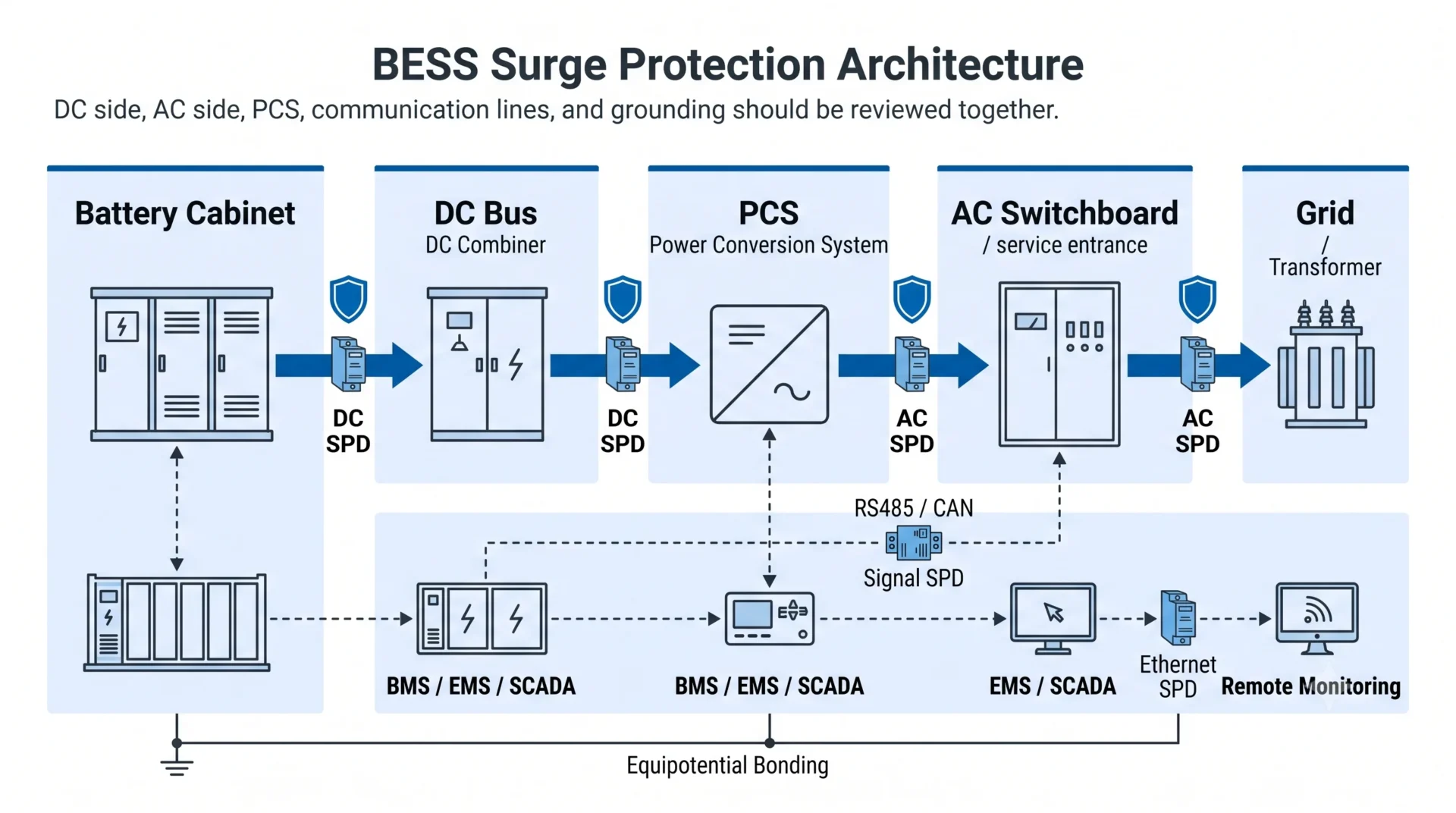
Standalone BESS vs PV-Coupled BESS vs AC-Coupled BESS
Before selecting SPDs, identify the system architecture. A standalone BESS, a PV-coupled BESS, and an AC-coupled BESS may all use battery cabinets and PCS equipment, but the surge paths and SPD selection logic are not exactly the same.
| System Type | Typical Circuit | SPD Selection Focus | Buyer Warning |
|---|---|---|---|
| Standalone BESS | Battery cabinet → DC bus → PCS → AC switchboard | BESS DC SPD, PCS DC input protection, PCS AC output protection, communication SPD | Do not treat the battery-side DC bus as a normal PV string circuit without review. |
| PV-coupled BESS | PV strings / PV combiner + battery system + hybrid PCS or inverter | Separate PV DC side, battery DC side, PCS, AC output, and monitoring lines | Confirm whether the SPD position is on PV side, battery side, or shared hybrid DC bus. |
| AC-coupled BESS | Battery + PCS connected to the AC distribution system | PCS DC input, PCS AC output, AC switchboard, PCC, auxiliary circuits | AC-side protection becomes very important, especially near PCC and main AC panels. |
| Containerized BESS | Battery cabinets, PCS, HVAC, fire alarm, EMS, network equipment in or around container | DC SPD, AC SPD, signal SPD, Ethernet SPD, grounding and bonding coordination | Outdoor exposure, cable entry points, and container bonding must be reviewed together. |
Why BESS Surge Protection Is Different from a Normal Distribution Board
A normal low-voltage distribution board is mainly an AC power system. A BESS is different. It has high-voltage DC circuits, power conversion electronics, grid-side AC circuits, auxiliary loads, and communication networks working together.
High DC voltage
Many commercial and utility-scale BESS projects use high DC voltage. The DC SPD must match the actual battery system voltage, grounding arrangement, and short-circuit condition.
PCS sensitivity
The PCS is the power conversion center of the system. A surge can enter from the battery side or from the grid side, so both interfaces should be reviewed.
Communication dependency
A BESS depends on BMS, EMS, SCADA, RS485, CAN, Ethernet, and dry contact signals. A communication fault can take the system offline.
Grounding coordination
Battery cabinets, PCS cabinets, AC panels, and communication cabinets must be bonded properly. SPD performance depends strongly on installation and grounding.
DC-Side Surge Protection for Battery Cabinets and DC Bus
The DC side is one of the most important parts of BESS surge protection. It may include battery cabinet output terminals, DC bus sections, DC combiner cabinets, and PCS DC input terminals.
For BESS-only DC power circuits, do not simply copy a PV DC SPD selection rule. The SPD should be selected according to the real DC power circuit, the maximum operating voltage, grounding arrangement, available short-circuit current, and required standard.
What to confirm before selecting a DC SPD
- Battery cabinet nominal and maximum DC voltage
- PCS DC input voltage range
- Standalone BESS or PV-coupled BESS architecture
- Floating, positive-grounded, negative-grounded, or impedance-referenced DC system
- Available short-circuit current at the SPD installation point
- Required backup fuse, breaker, or disconnecting arrangement
- Installation position: battery cabinet, DC bus, DC combiner, or PCS input
- Required visual indicator or remote alarm contact
Important mistake to avoid
Do not choose a BESS DC SPD only because the label says 1000V or 1500V. Voltage class is only one part of selection. Grounding, short-circuit current, protection mode, backup protection, and installation position also matter.
PCS Surge Protection: DC Input and AC Output
The PCS power conversion system is the bridge between the battery DC side and the AC grid side. Because it contains sensitive power electronics, it should not be protected from only one direction.
A surge may come from the battery cabinet side, especially when DC cables are long or cabinets are separated. A surge may also come from the AC grid side through the transformer, AC switchboard, or point of common coupling.
| PCS Interface | Protection Focus | SPD Type | What to Confirm |
|---|---|---|---|
| PCS DC input | Surge from battery cabinets, DC bus, or long DC cable routes | DC SPD | Maximum DC voltage, grounding, short-circuit current, backup protection, cable distance |
| PCS AC output | Surge from AC grid, transformer switching, or upstream AC distribution | AC SPD | AC system voltage, TN-S / TN-C-S / TT / IT system, SPD type, pole configuration |
| PCS control and monitoring ports | Communication fault, controller damage, remote monitoring failure | Signal or network SPD | RS485, CAN, Ethernet, dry contact, shield grounding, signal voltage, data rate |
If the PCS supplier has a specific SPD requirement, follow the equipment documentation first. If the project is OEM or cabinet-based, send the PCS interface information to the SPD supplier before confirming the model.
AC-Side Surge Protection for Grid Connection and Auxiliary Power
The AC side of a BESS normally includes the PCS AC output, main AC switchboard, point of common coupling, transformer side, and auxiliary AC distribution. These positions should use AC SPDs, not DC SPDs.
For the main AC service entrance or outdoor container power input, Type 1, Type 1+2, or Type 2 SPD should be selected according to lightning exposure, external lightning protection system, upstream protection, and local installation rules.
| AC Position | Typical SPD | Selection Notes |
|---|---|---|
| AC service entrance / PCC | Type 1, Type 1+2, or Type 2 AC SPD | Review lightning risk, LPS condition, grid connection, and upstream distribution. |
| PCS AC output cabinet | Type 2 or coordinated AC SPD | Confirm AC voltage, earthing system, pole configuration, and cable length to upstream SPD. |
| Auxiliary AC distribution | Type 2 AC SPD | Protect HVAC, fire alarm, lighting, control power, and small auxiliary loads. |
| Control power supply | AC SPD or DC control SPD depending on supply type | Check whether the control circuit is 230V AC, 24V DC, 48V DC, or another supply. |
For AC SPD product selection, you can also review AC Surge Protective Devices and surge protection for AC and DC systems.
Communication Line Protection: BMS, RS485, CAN, Ethernet, SCADA
Power SPDs do not protect communication ports. This is a common mistake in BESS projects. A BESS may still shut down if the BMS, PCS controller, SCADA, or EMS communication line is damaged by a surge.
Communication line SPD selection depends on the interface type, signal voltage, data rate, wiring distance, shield grounding, and whether the same cable also carries power.
| Line Type | Where It Appears in BESS | Protection Note |
|---|---|---|
| RS485 | BMS communication, cabinet-to-cabinet monitoring, PCS communication | Select a signal SPD that matches the signal voltage and does not disturb communication. |
| CAN | Battery management, module communication, controller network | Confirm interface voltage, grounding, cable shield, and communication speed. |
| Ethernet | EMS, SCADA, remote monitoring, data logger, network switch | Use Ethernet SPD suitable for the network type. Check PoE if power is carried on the same cable. |
| Dry contact alarm | Fault alarm, fire alarm interface, remote indication | Confirm contact voltage and whether the line runs outside the cabinet or between cabinets. |
| 24V / 48V DC control line | Control power, sensors, monitoring equipment | Use a DC control or signal SPD matched to the actual operating voltage. |
For RS485 and signal-line applications, see RS485 SPD wiring and selection and SPD remote alarm contact to PLC wiring.
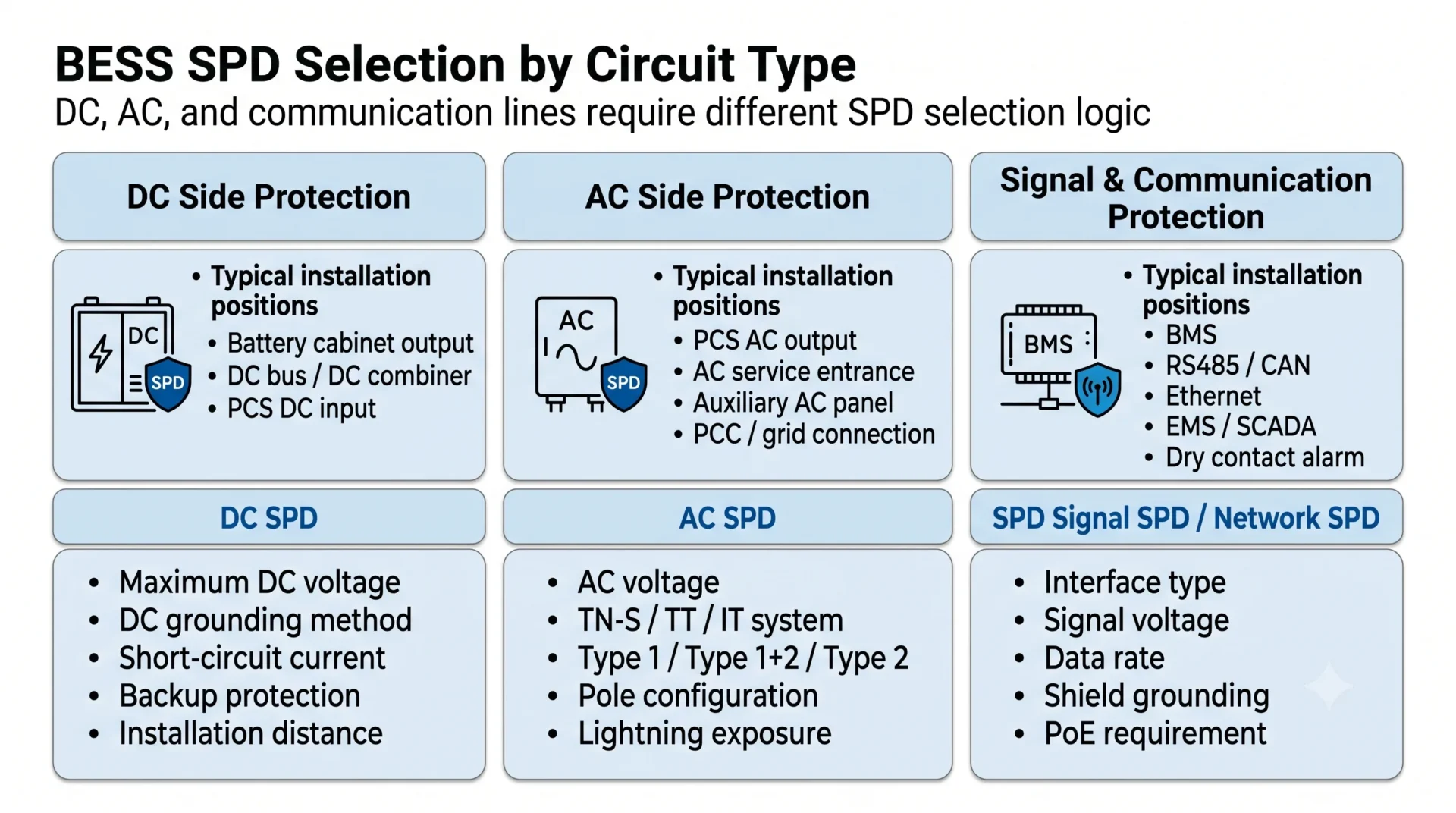
Grounding, Bonding, and SPD Installation Position
SPD selection is only half of the work. Installation quality decides whether the SPD can actually limit overvoltage effectively. Long grounding leads, poor bonding, or wrong cabinet placement can reduce the protection effect.
Keep SPD leads short
The connection from SPD to the protected circuit and grounding bar should be as short and direct as the cabinet layout allows.
Bond cabinets properly
Battery cabinets, PCS cabinets, AC panels, communication cabinets, and container frames should be bonded according to the project grounding design.
Place SPD near the interface
Install SPDs close to the point where surge energy may enter or where the protected equipment is connected.
Coordinate backup protection
Confirm whether the SPD requires a fuse, breaker, or integrated disconnecting device based on the system short-circuit condition.
SPD is not a replacement for fuses or breakers
A surge protective device limits transient overvoltage and diverts surge current. It does not replace DC fuses, DC breakers, AC circuit breakers, isolators, disconnectors, or system safety design.
How to Decide SPD Installation Points in a Real BESS Project
There is no single fixed number of SPDs for every BESS. The correct layout depends on cabinet distance, cable routing, lightning exposure, grounding zones, PCS location, AC distribution, and communication cable routes.
| Project Condition | What It May Mean | SPD Review Point |
|---|---|---|
| Battery cabinets and PCS are in the same cabinet or very close | Short DC cable path may reduce exposure, but PCS DC input still needs review | Battery cabinet output, PCS DC input, grounding lead length |
| Battery cabinets and PCS are separated by long DC cables | Both ends of the DC cable may need surge protection review | Battery cabinet output, DC bus, PCS DC input |
| Outdoor containerized BESS | Higher exposure to indirect lightning and external cable entry surges | AC service entrance, DC cable entry, communication cable entry, container bonding |
| External lightning protection system is installed | Main incoming circuits may require higher surge current handling and coordination | Type 1 or Type 1+2 AC SPD review, DC SPD coordination, equipotential bonding |
| Communication cables run between cabinets or containers | Different grounding zones may create surge stress on BMS, EMS, and controller ports | RS485 SPD, CAN SPD, Ethernet SPD, dry contact line protection |
| PCS is far from main AC switchboard | AC surge protection coordination may be needed at both PCS and AC switchboard sides | PCS AC output, AC switchboard, PCC, upstream SPD distance |
BESS SPD Selection Table by Installation Area
Use this table as a first engineering discussion tool. Final selection should be confirmed with the BESS system voltage, cabinet layout, grounding type, fault current, and project standard.
| Installation Area | Possible SPD Category | Key Parameters to Confirm | Typical Buyer |
|---|---|---|---|
| Battery cabinet output | DC SPD | DC voltage, grounding, SCCR / short-circuit current, installation space, remote alarm | Battery cabinet manufacturer, BESS integrator |
| DC bus / DC combiner | DC SPD | System voltage, cable route, number of cabinets, protection coordination | System integrator, DC cabinet builder |
| PCS DC input | DC SPD | PCS DC range, maximum operating voltage, backup protection, distance from battery cabinets | PCS supplier, EPC, BESS integrator |
| PCS AC output | AC SPD | AC voltage, phase system, earthing system, Type 1 / Type 1+2 / Type 2 requirement | PCS supplier, AC cabinet builder |
| Main AC distribution / PCC | AC SPD | Grid voltage, transformer connection, LPS condition, upstream protection | EPC, project contractor, switchboard factory |
| BMS / EMS / SCADA | Signal SPD / network SPD | RS485, CAN, Ethernet, dry contact, PoE, shield grounding, data rate | BESS integrator, control panel builder |
| Auxiliary power | AC SPD or DC control SPD | 230V AC, 24V DC, 48V DC, load type, cabinet position | Container builder, control cabinet supplier |
LEEYEE SPD Categories for BESS Projects
For BESS projects, the final model should be confirmed by voltage, circuit type, installation position, grounding, short-circuit condition, and certification requirement. The categories below help buyers identify which product direction to review first.
DC SPD for Battery Cabinet and PCS DC Input
Used for battery cabinet output, DC bus, DC combiner, or PCS DC input after confirming DC voltage, grounding arrangement, and backup protection.
View DC SPD CategoryAC SPD for PCS Output and AC Switchboard
Used for PCS AC output, AC service entrance, PCC, and auxiliary AC distribution according to AC voltage, earthing system, and Type 1 / Type 2 requirement.
View AC SPD CategorySignal SPD for BMS, RS485, CAN, and Dry Contact
Used for communication and control lines where surge may damage BMS, PCS controller, alarm circuits, or cabinet-to-cabinet signal wiring.
Read RS485 SPD GuideRemote Alarm SPD Option for Maintenance
For project maintenance, SPDs with remote indication contacts can help connect failure signals to PLC, monitoring systems, or cabinet alarm circuits.
Read Remote Alarm GuideCommon BESS Surge Protection Mistakes
BESS projects are high-value systems. A small selection mistake can cause downtime, replacement cost, or communication failure. These are the mistakes buyers and cabinet builders should avoid.
- Only protecting the AC side. The battery DC side and PCS DC input may still be exposed.
- Only protecting the DC side. AC grid-side surge and auxiliary AC circuits may still cause failure.
- Using PV DC SPD for every BESS DC point without review. PV-coupled DC and BESS-only DC circuits should be checked separately.
- Choosing only by Imax. Voltage class, Up, SCCR, grounding, backup protection, and installation position also matter.
- Ignoring RS485, CAN, Ethernet, or dry contact lines. Communication failure can stop the system.
- Using long SPD grounding leads. Long leads can increase the effective let-through voltage.
- No remote indication. In BESS projects, remote alarm contact can help maintenance teams find a failed SPD earlier.
- No ordering checklist. Without voltage, grounding, fault current, and interface data, the supplier can only guess.
Before Ordering SPDs for a BESS Project, Please Confirm These Details
This checklist is useful for BESS cabinet manufacturers, PCS suppliers, EPC teams, project buyers, and OEM customers. Send these details before asking for a model recommendation.
- BESS architecture: standalone BESS, PV-coupled BESS, or hybrid system
- Battery cabinet nominal and maximum DC voltage
- PCS DC input voltage range
- PCS AC output voltage and phase system
- AC grid system: TN-S, TN-C-S, TT, or IT
- DC grounding arrangement: floating, positive-grounded, negative-grounded, or impedance-referenced
- Available short-circuit current at each SPD position
- Installation position: battery cabinet, DC bus, PCS, AC panel, or signal cabinet
- Communication interfaces: RS485, CAN, Ethernet, dry contact, 24V / 48V control line
- Required SPD type: Type 1, Type 1+2, Type 2, DC SPD, signal SPD, or network SPD
- Required standard or certification: IEC, EN, UL, or project-specific requirement
- Remote alarm contact requirement for monitoring or PLC connection
- Cabinet space, DIN rail installation, wiring direction, and lead length
- OEM label, private label, packaging, datasheet, and project document requirements
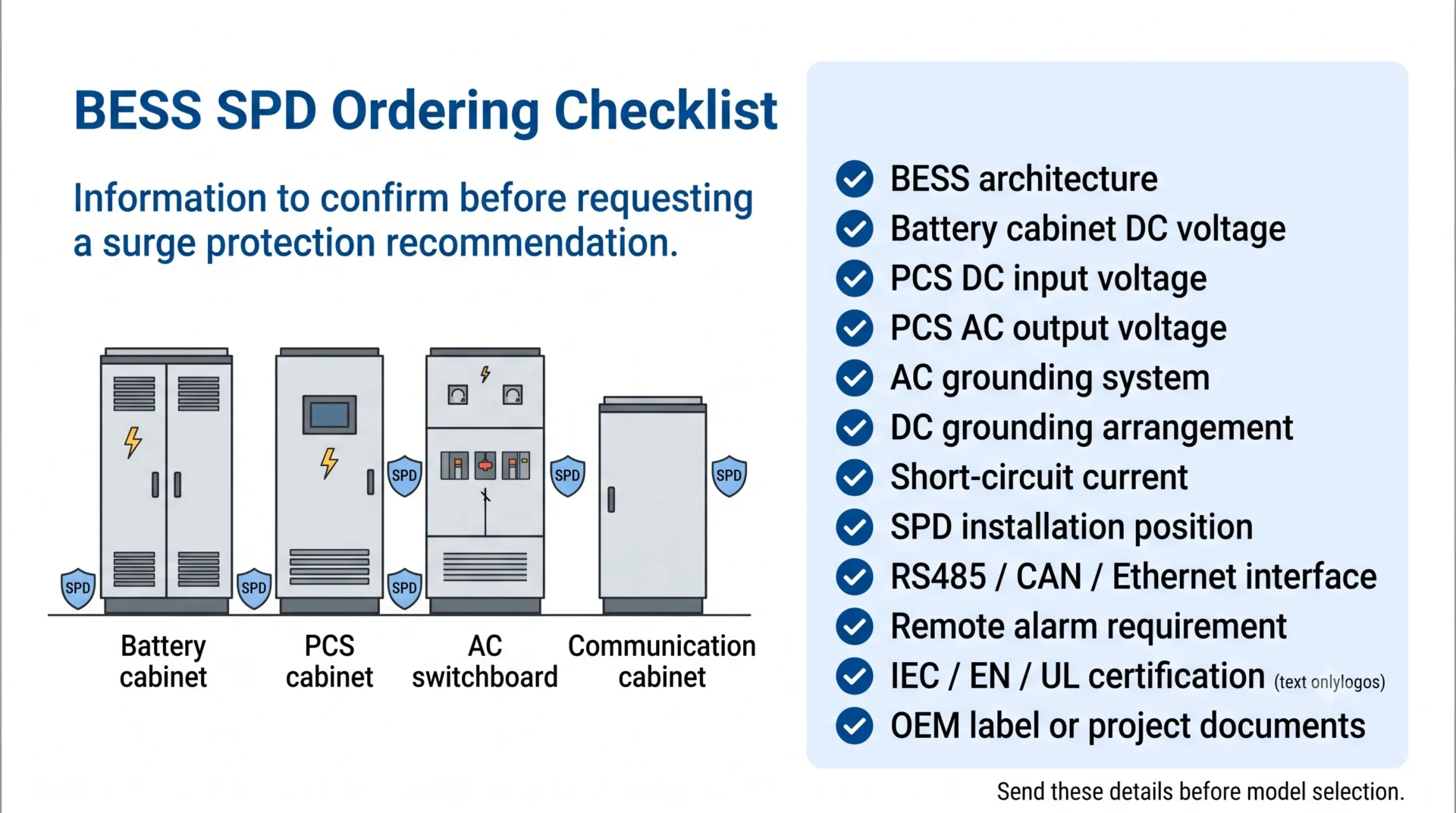
Need Help Selecting SPDs for a BESS Cabinet or PCS Project?
Send us your BESS architecture, battery cabinet voltage, PCS DC input voltage, PCS AC output voltage, grounding system, communication interfaces, installation position, and required certification. LEEYEE can help review suitable SPD categories for OEM cabinets, PCS projects, and energy storage system integration.
FAQ: BESS Surge Protection
Does a BESS need surge protection on both AC and DC sides?
In many BESS projects, both sides should be reviewed. The DC side protects battery cabinets, DC bus, and PCS DC input. The AC side protects PCS AC output, AC switchboard, grid connection, and auxiliary AC circuits.
Where should SPDs be installed in a BESS?
Common positions include battery cabinet DC output, DC bus or DC combiner, PCS DC input, PCS AC output, AC service entrance, auxiliary AC panel, BMS communication lines, Ethernet or SCADA lines, and control power circuits. The exact positions depend on the system layout.
What SPD is needed for PCS in an energy storage system?
PCS protection normally needs to review both the DC input side and the AC output side. DC SPD may be required at the PCS DC input, while AC SPD may be required at the PCS AC output or related AC distribution panel. Communication ports may also need signal SPD.
Can I use a PV DC SPD for a BESS DC bus?
Not automatically. If the system is PV-coupled, PV DC SPD requirements may be relevant to the photovoltaic DC side. For BESS-only DC power circuits, the DC SPD should be selected according to the actual BESS DC voltage, grounding arrangement, short-circuit current, installation point, and applicable project standard.
What is the difference between BESS DC SPD and PV DC SPD?
PV DC SPD is selected for photovoltaic DC circuits such as PV strings, PV combiners, and PV inverter DC input. BESS DC SPD selection should review the battery-side DC circuit, PCS DC input, DC grounding, short-circuit condition, and project standard. In a hybrid system, the PV side and battery side should be identified separately.
Is IEC 61643-41 used for BESS DC SPD?
IEC 61643-41 is an important standard direction for SPDs connected to DC power circuits up to 1500V DC when applicable. For a BESS project, confirm whether the protected circuit is a BESS-only DC power circuit, a PV DC circuit, an AC circuit, or a communication line before choosing the SPD category.
Do BMS RS485 or CAN lines need surge protection?
They may need protection when communication cables run between cabinets, outdoors, near power cables, or across different grounding zones. The signal SPD must match the interface type, voltage, data rate, and grounding method.
Should a BESS container use Type 1+2 SPD or Type 2 SPD?
It depends on site exposure, lightning protection system, incoming cable route, installation position, and upstream protection. Main service entrance or high-exposure outdoor installations may require Type 1 or Type 1+2 review, while downstream auxiliary panels may use Type 2 SPD when suitable.
Is Type 2 SPD enough for a BESS?
It depends on the installation position and site risk. Type 2 SPD may be suitable for some downstream AC panels or equipment-side protection, but main service entrance or high-exposure outdoor sites may require Type 1 or Type 1+2 coordination. DC and signal circuits require separate review.
Does surge protection replace DC fuses or circuit breakers?
No. SPDs limit transient overvoltage and divert surge current. They do not replace fuses, circuit breakers, isolators, disconnectors, or system-level safety protection.
What information should I send before asking for a BESS SPD recommendation?
Send the BESS architecture, DC voltage, PCS DC input voltage, PCS AC output voltage, grounding system, short-circuit current, installation position, communication interface, certification requirement, and whether remote alarm contact or OEM label is needed.