
Un mât CCTV extérieur n’est pas seulement un support de caméra. Il peut être raccordé à un câble PoE, à une alimentation AC ou DC, à une vidéo BNC, à un câblage de commande RS485, à une armoire métallique et à une baie réseau distante.
Toute ligne conductrice quittant le mât peut acheminer une surtension vers la caméra ou en retour vers le commutateur, le NVR ou la salle de contrôle. Le plan de protection doit donc identifier chaque circuit exposé et les deux extrémités du tracé de câble extérieur.
Ce guide explique où les SPD doivent être étudiés pour les caméras montées sur mât, comment la mise à la terre du mât et la liaison équipotentielle influencent l’installation, et ce qu’un installateur ou un acheteur de projet doit vérifier avant de commander.
Table des matières
Réponse rapide : où doivent être installés les SPD ?
Évaluez la protection à trois limites : près de la caméra, à l’intérieur du boîtier de jonction en base de mât, et avant que le câble extérieur n’atteigne l’équipement distant.
Un SPD côté caméra ne protège pas automatiquement le commutateur distant. Un SPD côté commutateur ne protège pas automatiquement la caméra. Les emplacements requis dépendent du cheminement des câbles, de l’exposition, des zones de protection contre la foudre, de la liaison et de l’évaluation des risques du projet.[1][3][7][13]
Protégez les limites des câbles extérieurs et chaque circuit conducteur réellement utilisé par le mât. Ne choisissez pas la protection uniquement en comptant les caméras.
Dans ce guide
Chaque emplacement de protection dessert un équipement différent. Il ne faut pas supposer qu’un seul emplacement couvre l’ensemble du parcours du câble.
| Limite de protection | Emplacement habituel du SPD | Équipement protégé |
|---|---|---|
| Extrémité de la caméra | Près de la caméra ou dans un boîtier étanche adapté | Caméra, unité PTZ et interfaces locales de la caméra |
| Boîtier au pied du poteau | Là où les câbles entrent ou sortent du boîtier de jonction | Commutateur local, alimentation, bornes et équipement du poteau |
| Extrémité distante | Avant que le câble extérieur n’atteigne un commutateur, un injecteur, un NVR ou une armoire | Réseau central, enregistrement et équipement de contrôle |
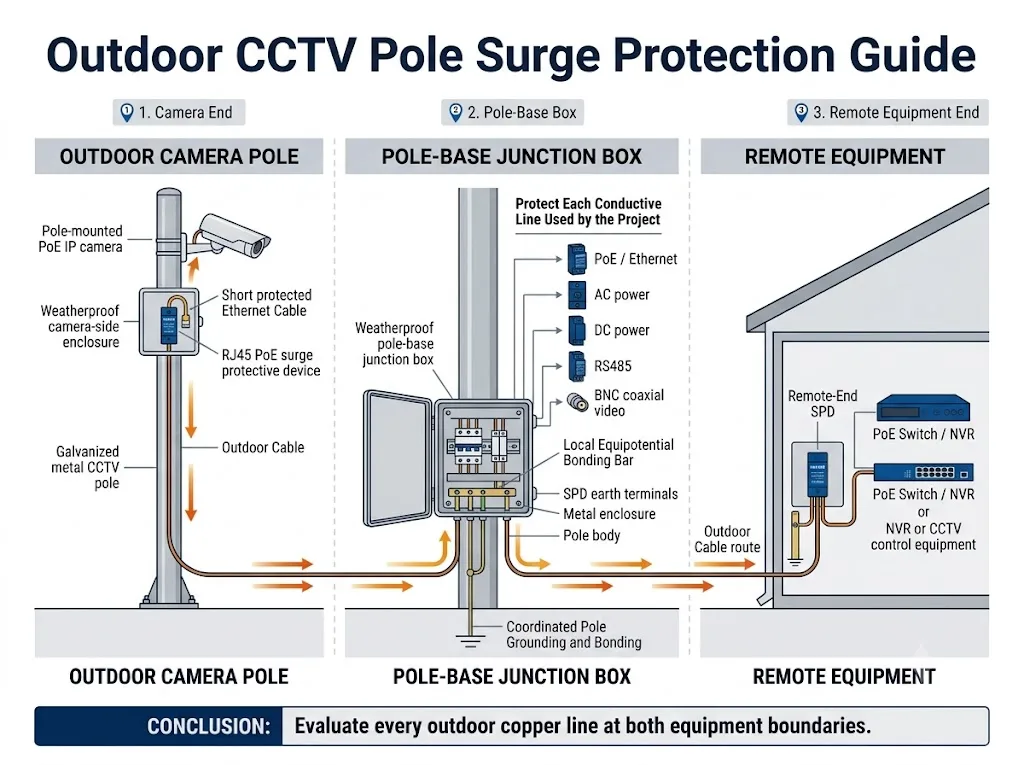
Pourquoi un mât de caméra extérieur a-t-il besoin d'un plan de protection distinct ?
Le poteau et ses câbles sont exposés à l’extérieur
Les poteaux de caméra sont couramment installés le long des routes, aux abords des portails, des parkings, des clôtures périmétriques et des zones industrielles ouvertes. Un événement de foudre à proximité peut induire une tension transitoire dans les longs conducteurs en cuivre, même lorsque la foudre ne frappe pas directement la caméra.
La norme IEC 62305 distingue l’évaluation du risque lié à la foudre, la protection physique contre la foudre et les mesures de protection contre les surtensions pour les systèmes électriques et électroniques. Les mesures requises ne peuvent pas être déterminées à partir de la seule hauteur du poteau ou du type de caméra.[1][2][3]
Une caméra peut avoir plusieurs chemins d’entrée de surtension
Une caméra montée sur poteau peut utiliser Ethernet PoE, une alimentation AC, une alimentation DC basse tension, une vidéo coaxiale BNC, un câblage de commande RS485, des conducteurs d’alarme ou un blindage métallique de câble.
Ces circuits ont des tensions de service, des exigences de signal et des agencements de conducteurs différents. Il ne faut pas supposer qu’un SPD générique protège des interfaces sans rapport entre elles.
Le poteau et l’équipement distant peuvent atteindre des potentiels différents
Lors d’une surtension, une différence de tension temporaire peut apparaître entre l’agencement de mise à la terre côté poteau et le système d’équipotentialité côté bâtiment. Le câble en cuivre de liaison peut alors conduire le courant vers la caméra ou l’équipement distant.
La mise à la terre, la liaison équipotentielle, le cheminement des câbles et l’emplacement des SPD doivent donc être examinés ensemble.
Signification technique : Une surtension entrant par un câble de poteau de caméra peut endommager à la fois la caméra et un commutateur multiports ou un NVR desservant plusieurs caméras.
Un processus pratique de décision pour le placement des SPD
Le câble reliant la caméra au boîtier est-il court et protégé par la structure du poteau mis à la terre ?
Si le câble est court, s'il est entièrement acheminé à l'intérieur d'un poteau métallique soudé ou d'un conduit et s'il se termine à proximité du dispositif de protection contre les surtensions (SPD) du boîtier du poteau, il n'est pas toujours nécessaire d'installer un SPD séparé côté caméra.
Mesure à prendre : vérifier la conception complète, le cheminement des câbles et les instructions du fabricant avant de retirer la protection côté caméra.
Y a-t-il un câble à nu entre la caméra et le boîtier de base du poteau ?
Si le câble de la caméra est acheminé à l'extérieur, s'il est relativement long ou s'il traverse une zone exposée, envisagez d'installer un SPD à proximité de l'interface de la caméra.
Mesure à prendre : utiliser un appareil adapté à une utilisation en extérieur ou installer le SPD à l'intérieur d'un boîtier correctement choisi.
Le câble en cuivre extérieur passe-t-il par un bâtiment, une armoire ou un commutateur à distance ?
Si oui, vérifiez la protection avant que ce câble n'atteigne le commutateur, l'injecteur, l'enregistreur vidéo numérique (NVR) ou l'armoire de commande.
Mesure à prendre : considérer le point de réception distant comme une zone de protection distincte.
Utilise-t-on plusieurs circuits conducteurs sur le même poteau ?
Les normes PoE, CA, CC, BNC et RS485 doivent être évaluées séparément. Ne protégez que les circuits présents, mais ne négligez aucun chemin conducteur exposé.
Action : créer une liste des circuits avant de sélectionner les produits ou de préparer le plan de la boîte de dérivation.
Il s'agit d'un processus de sélection, et non d'une règle d'installation universelle.
La configuration finale dépend des normes applicables, des zones de protection contre la foudre, de la conception des câbles, des liaisons de terre locales, des instructions relatives aux équipements et de l'évaluation des risques du projet.
Les trois limites de protection
Fin de la prise de vue
Protégez l'interface locale lorsqu'il reste un câble à nu entre la caméra et le point de protection principal du boîtier de poteau.
Boîtier de base pour mât
Coordonner la protection de l'alimentation, du réseau et des signaux au niveau du principal point local d'entrée de câbles et de mise à la terre.
Extrémité distante
Veillez à ce que le câble extérieur ne soit pas raccordé à un commutateur, à un NVR ou à une armoire de bâtiment sans qu'une évaluation distincte de la protection ait été effectuée.
Protection côté caméra
Installez une protection côté caméra lorsqu'un câble exposé se trouve entre la caméra et le boîtier de base du poteau, ou lorsque le parafoudre local principal ne peut pas être placé à proximité de l'interface de la caméra à protéger.
Si le SPD n'est pas conçu pour être exposé directement aux intempéries, placez-le dans un boîtier adapté doté d'entrées de câbles étanches, d'un espace suffisant pour le câblage et d'une connexion de mise à la terre pratique.
Le guide d'installation des caméras fourni par Holowits indique de placer un SPD côté caméra à l'intérieur d'un boîtier étanche lorsque le boîtier réseau ne peut pas être installé à proximité de la caméra.[11]
Vérifiez ces informations concernant l'appareil photo
- Méthode d'alimentation d'une caméra et tension de fonctionnement maximale
- Débit Ethernet et exigences en matière de PoE
- Cheminement et exposition du câble reliant la caméra au boîtier
- Câblage blindé ou non blindé
- Positions de montage et de collage possibles
- Niveau de protection IP ou NEMA requis pour le boîtier
- Conditions de température, d'humidité et de corrosion
Protection du boîtier de raccordement entre le poteau et la base
Le boîtier de base de poteau constitue souvent le principal point de protection local. Il peut accueillir des parasurtenseurs distincts pour l'alimentation, le réseau et les signaux, ainsi que des bornes, une protection en amont et une barre de liaison locale.
Le guide d'application de la vidéosurveillance d'OBO identifie le boîtier de raccordement d'un mât de caméra comme emplacement possible pour un dispositif de protection contre les surtensions (SPD) et recommande d'installer ce dispositif à proximité de l'équipement à protéger, avec des connexions courtes à la liaison équipotentielle locale.[12]
Placez chaque SPD à proximité de son point d'entrée de câble.
Installez le SPD à proximité du point d'entrée du câble non protégé dans le boîtier. Évitez de faire passer ensemble des conducteurs protégés et non protégés sur une longue distance, car l'énergie de surtension pourrait se propager vers le côté protégé.
Veillez à ce que les conducteurs de liaison soient courts et directs
Une surtension soudaine génère une tension le long de l'inductance du conducteur. Des conducteurs de liaison trop longs, formant des boucles ou dont le tracé est inapproprié peuvent augmenter la tension à laquelle est soumis l'équipement protégé.
Le tracé définitif du câble et sa section doivent respecter la norme d'installation applicable, les spécifications du projet et les instructions du SPD. Ne reprenez pas le calibre d'un câble utilisé dans une installation de caméras sans rapport avec la présente.
Vérifiez l'espace utile, et pas seulement les dimensions de l'enceinte
- Vérifiez l'espace disponible sur le rail DIN et la largeur du module.
- Prévoir suffisamment d'espace pour les coudes des câbles, les bornes et leur remplacement.
- Séparez le câblage d'entrée du câblage protégé.
- Vérifiez la taille du presse-étoupe, le drainage et le contrôle de la condensation.
- Vérifiez que le boîtier entièrement assemblé respecte les exigences environnementales requises.
Signification de l'acheteur : Demandez le schéma de la boîte de jonction interne avant la validation finale du produit. Le sens d’entrée des câbles et la position de la barre de liaison peuvent influencer le choix du format de dispositif de protection contre les surtensions (SPD) le plus adapté.
Commutateur à distance, NVR ou protection des accès au bâtiment
Un câble extérieur peut transmettre l'énergie des surtensions vers les équipements centraux. Il peut donc être nécessaire d'installer un parasurtenseur adapté avant que le câble n'atteigne un commutateur PoE, un injecteur, un commutateur Ethernet, un NVR, un DVR, un convertisseur de média ou une armoire de commande.
L'architecture de vidéosurveillance proposée par DEHN illustre la protection aux deux extrémités d'une connexion de caméra IP extérieure. Les exigences précises dépendent toutefois de l'exposition du câble, des zones de protection contre la foudre et de la conception du projet.[13]
Chaque poteau nécessite-t-il des parafoudres aux trois emplacements ?
Non. Ces trois points constituent des limites de protection à prendre en compte. Le nombre définitif de SPD dépend du tracé des câbles, de la distance, du blindage, de la mise à la terre, de la protection externe contre la foudre et de l'emplacement où aboutit le câble exposé.
Qu’est-ce qui change lorsque le mât de caméra utilise le PoE ?
Une connexion PoE achemine à la fois les données et l'alimentation via un même câble. Le SPD doit donc garantir les performances Ethernet requises tout en prenant en charge la configuration PoE de la caméra.
La norme CEI 61643-21:2025 concerne les dispositifs de protection contre les surtensions (SPD) raccordés aux réseaux de télécommunications et de signalisation, y compris les réseaux qui fournissent une alimentation électrique sur la même ligne, tels que le PoE.[5]
Pour l'installation d'un mât, vérifiez les quatre points suivants
- Distance entre la caméra et le boîtier : déterminer si le SPD principal peut être suffisamment proche de l'interface de la caméra.
- Exposition à l'extérieur : vérifier si le SPD lui-même ou son boîtier est adapté à l'environnement.
- Entrée de câble à distance : Vérifier la protection avant que le câble extérieur n'atteigne le commutateur ou le NVR.
- Performances réelles du PoE : Vérifier le débit de données, le type de PoE, les paires protégées, le courant et le blindage.
La norme IEEE 802.3bt a étendu la fourniture normalisée de PoE grâce à un fonctionnement sur quatre paires. Il ne faut pas partir du principe qu'un SPD conçu pour une configuration plus ancienne ou de faible puissance convienne à toutes les caméras de puissance supérieure.[9]
Limites des capacités du modèle : La vitesse Ethernet disponible, la puissance PoE, le courant de charge et les caractéristiques environnementales varient selon le modèle du produit. Veuillez consulter la fiche technique LEEYEE en vigueur ainsi que la documentation spécifique au modèle avant de choisir un appareil.
Pour plus de détails sur la sélection des paramètres PoE, consultez le Guide de placement et de sélection des parasurtenseurs PoE. Pour des vérifications approfondies de l'interface RJ45, consultez le Guide de sélection des protecteurs contre les surtensions RJ45.
Chaque ligne de mât CCTV nécessite des SPD différents
L'alimentation CA, le courant continu basse tension, l'Ethernet PoE, la vidéo BNC et la commande RS485 ne présentent pas les mêmes conditions de fonctionnement. Choisissez chaque dispositif de protection en fonction du circuit auquel il est raccordé.
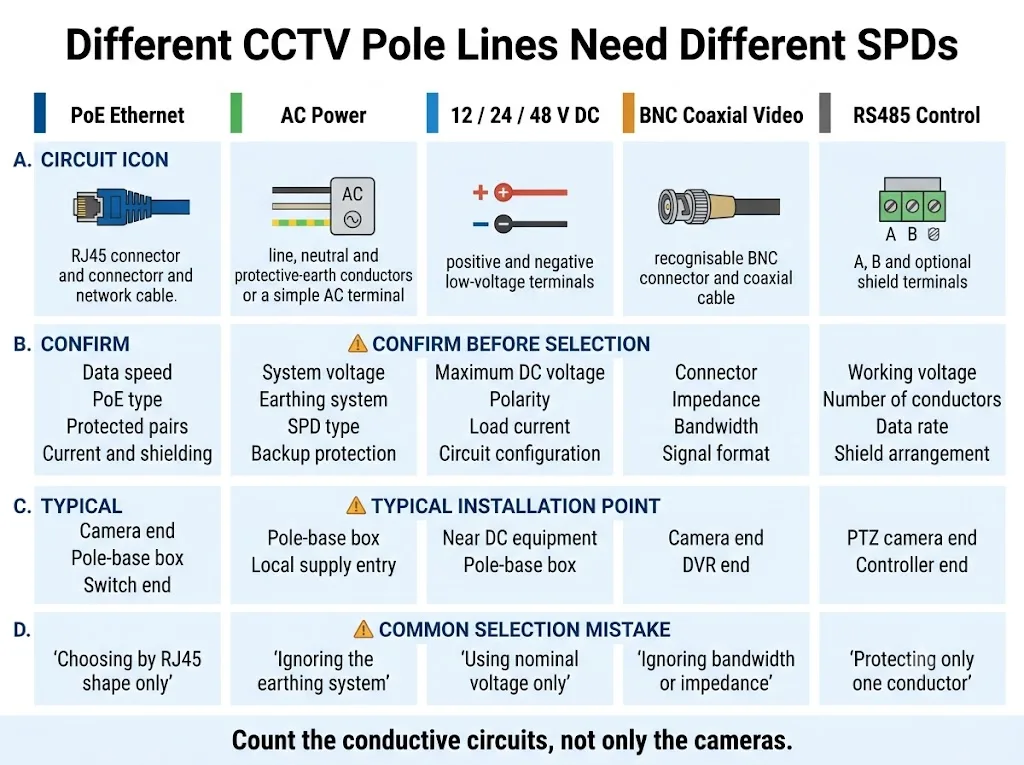
Utilisez la colonne « Confirmer avant la sélection » comme critère minimal d'information requis pour un devis de projet.
| Type de ligne | Confirmer avant de faire son choix | Lieux typiques | Erreur courante |
|---|---|---|---|
| Ethernet PoE | Débit de données, type de PoE, paires protégées, courant et blindage | Côté caméra, boîtier de mât et côté télécommande | Sélection en fonction de la forme du connecteur RJ45 uniquement |
| Alimentation AC | Tension du réseau, dispositif de mise à la terre, type de parafoudre, protection de secours et conditions de défaut | Entrée d'alimentation du boîtier de poteau et tableau en amont coordonné | Ne pas tenir compte du système d'alimentation et de mise à la terre |
| 12/24/48 V DC | Tension de fonctionnement maximale, polarité, courant, source et configuration du circuit | À proximité de la limite entre les équipements à courant continu et les câbles des boîtiers de poteaux | Sélection uniquement en fonction de la tension nominale |
| Vidéo coaxiale BNC | Connecteur, impédance, bande passante et format vidéo | Côté caméra et côté enregistreur numérique (DVR) ou récepteur | Ne pas tenir compte de l'impédance ou de la bande passante |
| Commande RS485 | Tension de fonctionnement, conducteurs, débit de données et disposition du blindage | Côté caméra PTZ et côté contrôleur | Ne pas vérifier un chemin conducteur |
Conclusion en matière d'approvisionnement : il faut compter les circuits conducteurs, et pas seulement les caméras.
Alimentation CA
Un coffret de poteau alimenté en courant alternatif nécessite un dispositif de protection contre les surtensions (SPD) adapté au réseau électrique concerné et à l'emplacement d'installation. La norme CEI 61643-11:2025 s'applique aux dispositifs de protection contre les surtensions (SPD) raccordés à des réseaux électriques basse tension à courant alternatif.[4]
Vérifier la tension maximale de fonctionnement en continu, le schéma de mise à la terre, le type de dispositif de protection contre les surtensions (SPD), la protection en amont, les conditions de court-circuit envisageables et le mode de raccordement. Ces exigences doivent figurer dans le dossier d’étude électrique du projet.
Alimentation en courant continu basse tension
Une alimentation de caméra de 12 V, 24 V ou 48 V nécessite un dispositif de protection compatible avec la tension continue maximale réelle, la polarité, le courant de charge, les caractéristiques de la source et la configuration des conducteurs.
La norme CEI 61643-41:2025 porte sur les dispositifs de protection contre les surtensions (SPD) raccordés à des réseaux d'alimentation en courant continu à basse tension et souligne que les conditions de fonctionnement normal et de défaut doivent faire l'objet d'une attention particulière.[6]
N'approuvez pas un SPD CC uniquement parce que son étiquette indique la même tension nominale que celle de la caméra.
Vidéo coaxiale BNC
Vérifiez le type de connecteur, l'impédance caractéristique, la bande passante du signal et la technologie vidéo. Un dispositif BNC mécaniquement compatible peut néanmoins ne pas convenir si ses performances de transmission ne correspondent pas à celles du système.
Commande RS485
Vérifiez la tension de service du circuit, le nombre de conducteurs, le débit de données et le traitement du blindage. Un parafoudre destiné au courant alternatif ne doit en aucun cas remplacer un parafoudre destiné aux lignes de données.
Mise à la terre et liaison équipotentielle
La mise à la terre et l'installation des dispositifs de protection contre les surtensions (SPD) doivent être conçues comme un système unique et coordonné. Elles sont liées, mais ne remplissent pas la même fonction.
Mise à la terre des poteaux
Le poteau, l'électrode locale ou une structure voisine peuvent faire partie du dispositif de mise à la terre du projet. La conception appropriée dépend des conditions du sol, des exigences de sécurité électrique, du risque de foudre, de la réglementation locale et du cahier des charges du projet.
N'utilisez pas une même valeur de résistance de mise à la terre pour tous les poteaux de caméra.
Mise à la terre de protection
Les boîtiers métalliques, les blocs d'alimentation, les interrupteurs et les parties conductrices apparentes peuvent nécessiter des connexions de mise à la terre de protection pour des raisons de sécurité électrique. Respectez les règles de câblage applicables et les instructions relatives aux équipements.
Mise à la terre équipotentielle
La liaison équipotentielle relie les parties conductrices de manière à réduire le risque d'apparition d'une différence de tension nuisible entre les équipements interconnectés en cas de surtension.
Lorsque la conception l'exige, le poteau métallique, le boîtier, les bornes de terre des parafoudres, la protection contre les chocs électriques (PE) des équipements et les blindages de câbles concernés doivent être reliés au moyen d'un dispositif de mise à la terre local coordonné. Holowits illustre ici une barre de mise à la terre commune en cuivre à l'intérieur du coffret de réseau extérieur.[11]
Une tige de mise à la terre distincte ne constitue pas automatiquement une solution complète.
Si une électrode locale n'est pas synchronisée avec le système distant auquel elle est raccordée, une surtension peut entraîner une forte différence de potentiel entre les deux sites au niveau du câble en cuivre. La configuration finale doit être vérifiée par du personnel qualifié chargé du projet.
Un SPD peut-il protéger la caméra contre un impact de foudre direct ?
Un SPD limite les tensions transitoires et détourne les courants de surtension sur un circuit raccordé. Il ne s'agit pas d'un système de mise à la terre et il ne remplace pas la protection externe contre la foudre.
La norme CEI 62305-3 porte sur la protection physique contre la foudre, tandis que la norme CEI 62305-4 traite des mesures de protection contre les surtensions destinées aux systèmes électriques et électroniques. Il s'agit de niveaux de protection coordonnés, mais l'un ne doit pas être présenté comme un substitut de l'autre.[2][3]
La nécessité d'équiper un poteau d'un système de mise à la terre, d'un conducteur de descente, d'une distance de séparation ou de toute autre mesure de protection contre les coups de foudre directs doit être déterminée à partir de l'évaluation des risques sur site et des règles applicables au projet.
Erreurs courantes d’installation des SPD sur les mâts CCTV
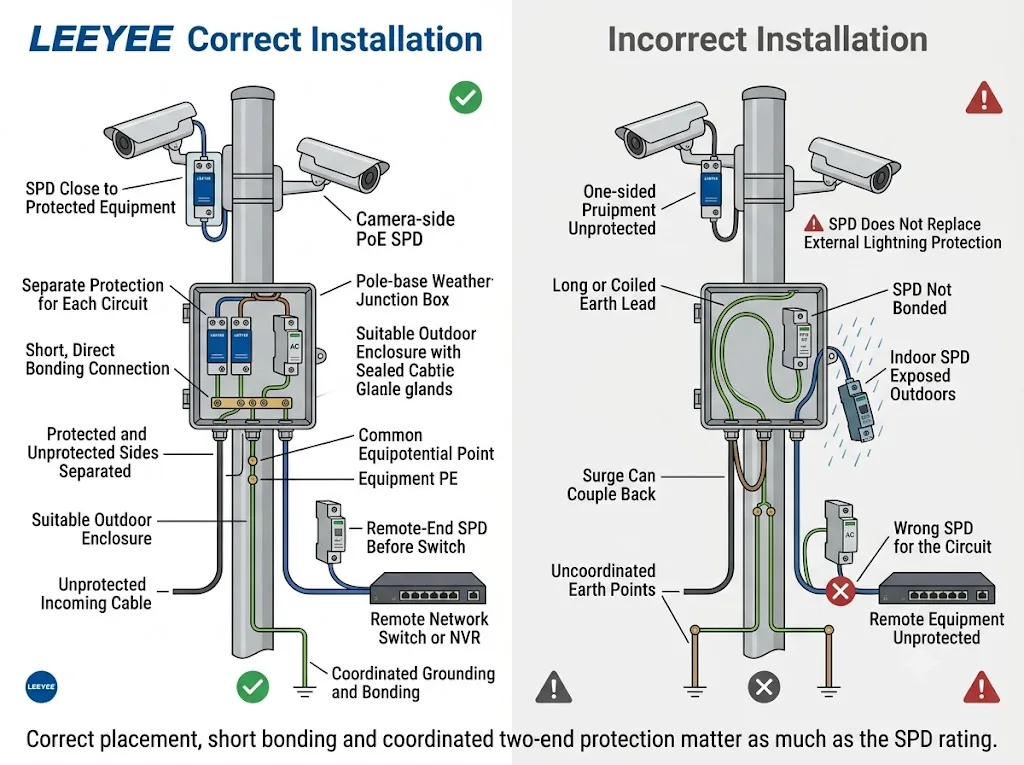
- Protection réservée à l'appareil photo. Le câble extérieur peut tout de même transmettre une surtension jusqu'au commutateur distant ou au NVR.
- Protection réservée au commutateur. Un SPD situé à distance ne protège pas automatiquement l'interface exposée de la caméra.
- Installation du SPD à une certaine distance de l'équipement. Une longueur de conducteur excédentaire peut augmenter la tension résiduelle et permettre un nouveau couplage.
- En utilisant un fil de raccordement long ou enroulé. Le raccordement doit emprunter le trajet le plus court possible, dans la mesure où la conception le permet.
- En partant du principe que chaque SPD RJ45 est compatible avec toutes les caméras PoE. Il convient de vérifier la vitesse, le type de PoE, les paires, le courant et le blindage.
- Laisser un SPD d'intérieur à l'air libre. L'ensemble de l'installation doit bénéficier d'une protection environnementale adaptée.
- Poser ensemble des câbles protégés et non protégés. Les lignes parallèles de grande longueur peuvent réinjecter l'énergie de surtension du côté protégé.
- Utilisation d’un seul SPD pour des circuits incompatibles. Les signaux CA, CC, PoE, BNC et RS485 nécessitent une protection adaptée au circuit.
- Création de points de terre indépendants. Les conditions de raccordement locales et à distance doivent être coordonnées tout au long de la conception du projet.
- Considérer le SPD comme une protection contre les frappes directes. La protection externe contre la foudre reste un choix technique distinct.
Avant de commander pour un projet de mâts CCTV en série
Un fournisseur ne peut pas formuler une recommandation fiable concernant un modèle en se basant uniquement sur la mention « caméra PoE d'extérieur ». Veuillez préparer les informations réelles relatives au système avant de valider des échantillons ou de passer une commande OEM.
Informations sur la caméra et le réseau
- Modèle de l'appareil photo ou fiche technique
- Nombre de caméras par poteau
- Débit Ethernet
- Type de PoE et besoins en alimentation
- Câble blindé ou non blindé
- Parcours du câble entre la caméra et le boîtier
- Tracé du câble entre le poteau et le commutateur
- Modèle de commutateur ou d'injecteur
Informations relatives à l'alimentation et aux signaux
- Alimentation en courant alternatif ou continu
- Tension nominale et maximale
- Dispositif de mise à la terre
- Protection des circuits en amont
- Connecteur BNC et format vidéo
- Conducteurs RS485 et tension de service
- Lignes de signal d'alarme ou auxiliaires
- Procédé de raccordement du blindage d'un câble
Informations techniques et relatives au projet
- Matériau du poteau et environnement d'installation
- Dimensions intérieures de la boîte de dérivation
- Espace disponible sur rail DIN
- Emplacements des entrées de câbles et des barres de liaison
- Niveau de protection IP ou NEMA requis
- Conditions de température et de corrosion
- Norme applicable ou cahier des charges du projet
- Certificats ou documents de contrôle requis
- Quantité du projet
- Exigences relatives à l'étiquette ou à l'emballage OEM
Validation technique avant une installation en masse
Ne choisissez pas un SPD pour poteau de vidéosurveillance en vous basant uniquement sur une photo du produit, la forme du connecteur ou la valeur nominale du courant de surtension indiquée.
L'examen technique doit permettre de vérifier :
- Compatibilité des circuits et des connecteurs
- Tension de fonctionnement maximale continue
- Performances en matière d'alimentation PoE et de transmission de données
- Modes de protection et conducteurs protégés
- Catégorie et valeurs déclarées pour l'essai de surtension
- Niveau de protection de la tension
- Capacité de courant de charge
- Méthode de mise à la terre ou de liaison à la terre
- Orientation côté ligne et côté équipement
- Dimensions d'installation
- Enceinte environnementale
- Champ d'application du modèle de certificat et de rapport
Pour un projet récurrent, il convient d'installer et de tester un échantillon comprenant la caméra, l'interrupteur, le câble et le boîtier réels avant de valider la quantité totale. Les critères d'acceptation sur site doivent être convenus entre l'entrepreneur, le consultant et le maître d'ouvrage.
Confirmer une configuration de SPD pour mât CCTV
Veuillez nous communiquer la fiche technique de la caméra, les exigences en matière de PoE, les informations relatives à l'alimentation électrique, le tracé des câbles, les dimensions du boîtier de poteau et les conditions de mise à la terre. Ces informations permettent d'examiner séparément les interfaces CA, CC, PoE, BNC et RS485.
Demande de révision de la configuration du dispositif de protection contre les surtensions (SPD) d'un poteau de vidéosurveillanceLEEYEE est un fournisseur spécialisé dans la protection contre les surtensions et la protection basse tension. CNSPD est la plateforme de LEEYEE dédiée à la protection contre les surtensions pour les acheteurs techniques internationaux.
Questions fréquemment posées
À quel endroit faut-il installer un parasurtenseur sur un poteau de vidéosurveillance extérieur ?
Évaluez trois zones : à proximité de la caméra, à l'intérieur du boîtier de base du poteau et avant que le câble extérieur n'atteigne l'équipement distant. Les emplacements requis dépendent de l'exposition du câble, de la distance, de la mise à la terre et de la conception du projet.
Un SPD avec embase suffit-il pour la caméra ?
Cela peut suffire lorsque le câble protégé reliant le boîtier du poteau à la caméra est court et correctement acheminé à l'intérieur de la structure coordonnée. S'il reste du câble à l'air libre, envisagez une protection plus proche de la caméra.
Chaque poteau de caméra d'extérieur doit-il être équipé de dispositifs SPD aux deux extrémités du câble ?
Il n'existe pas de règle universelle applicable à tous les projets. Il convient d'examiner le cheminement des câbles, les zones de protection contre la foudre, la mise à la terre, l'exposition et les équipements situés à chaque extrémité.
La mise à la terre du poteau métallique protège-t-elle la caméra ?
La mise à la terre des poteaux ne constitue qu'une partie du système. Les interfaces de câbles, les raccordements aux parafoudres, le boîtier, le commutateur et les équipements distants nécessitent toujours une protection et une mise à la terre coordonnées.
Un seul SPD peut-il protéger le PoE, l'alimentation CA et la liaison RS485 ?
Uniquement lorsque le dispositif est spécialement conçu et validé pour chacune des interfaces qu'il intègre. Dans la plupart des projets, les types de circuits sans rapport entre eux sont protégés séparément.
Peut-on installer un SPD PoE à l'extérieur sans boîtier de protection ?
À condition que l'ensemble de l'appareil, les connecteurs et les entrées de câbles soient adaptés à l'environnement réel. Dans le cas contraire, utilisez un boîtier adapté et respectez les instructions d'installation.
Un SPD peut-il protéger une caméra installée sur un poteau contre un coup de foudre direct ?
Un SPD limite les tensions transitoires sur les circuits raccordés. Il ne remplace pas un système externe de protection contre la foudre et ne peut garantir la résistance à tous les coups de foudre directs.
Références
- Commission électrotechnique internationale, IEC 62305-2:2024, Protection contre la foudre — Partie 2 : Gestion des risques.
- Commission électrotechnique internationale, IEC 62305-3:2024, Protection contre la foudre — Partie 3 : Dommages physiques aux ouvrages et risques pour la vie humaine.
- Commission électrotechnique internationale, IEC 62305-4:2024, Protection contre la foudre — Partie 4 : Systèmes électriques et électroniques à l'intérieur des bâtiments.
- Commission électrotechnique internationale, IEC 61643-11:2025, Parafoudres basse tension — Partie 11 : Parafoudres connectés aux réseaux basse tension — Exigences et méthodes d'essai.
- Commission électrotechnique internationale, IEC 61643-21:2025, Dispositifs de protection contre les surtensions à basse tension — Partie 21 : Dispositifs de protection contre les surtensions (SPD) raccordés aux réseaux de télécommunications et de signalisation — Exigences et méthodes d'essai.
- Commission électrotechnique internationale, IEC 61643-41:2025, Dispositifs de protection contre les surtensions à basse tension — Partie 41 : Dispositifs de protection contre les surtensions (SPD) raccordés à des réseaux d'alimentation à basse tension en courant continu — Exigences et méthodes d'essai.
- Commission électrotechnique internationale, IEC 61643-22:2015, Principes de sélection et d’application des SPD raccordés aux réseaux de télécommunications et de signalisation.
- Commission électrotechnique internationale, IEC 61643-12:2020, Principes de sélection et d'application des dispositifs de protection contre les surtensions (SPD) raccordés aux circuits d'alimentation en courant alternatif.
- Association des normes de l'IEEE, IEEE 802.3bt-2018, Paramètres de la couche physique et de gestion pour l'alimentation par Ethernet sur quatre paires.
- Commission électrotechnique internationale, IEC 61643-01:2024, Dispositifs de protection contre les surtensions à basse tension — Exigences générales et méthodes d'essai.
- Holowits, Guide technique sur la protection contre la foudre et la mise à la terre des caméras.
- OBO Bettermann, Protection contre les surtensions pour les systèmes de télévision en circuit fermé.
- DEHN, Protection contre les surtensions pour les systèmes de vidéosurveillance.