
Un cabinet de télécommunications extérieur nécessite généralement plus d'un SPD. Protégez chaque ligne conductrice AC, DC, Ethernet et signal selon sa tension réelle, son interface, sa position d'installation et son arrangement de mise à la terre.
Table des matières
Quel protection contre les surtensions un cabinet de télécommunications extérieur nécessite-t-il ?
Commencez par identifier chaque câble conducteur entrant ou sortant de l'enveloppe. Ne commencez pas par sélectionner un SPD à usage général.
L'alimentation CA, l'alimentation CC basse tension et les circuits de télécommunications ou de signalisation sont couverts par différentes exigences de SPD et cadres d'essai. [1] [2] [3]
Entrée AC
Protège l'alimentation de service, la distribution CA et l'entrée du redresseur.
48V / -48V CC
Protège la sortie du redresseur, le bus de batterie et la distribution CC.
Ethernet
Protège les lignes de données en cuivre tout en prenant en charge la vitesse requise et l'agencement PoE.
RS485 et capteurs
Protège les circuits de surveillance, d'alarme, de contrôle et des capteurs environnementaux. .
Alarme à distance
Signale un changement d'état d'un SPD au système de surveillance du cabinet.
Architecture de protection contre les surtensions pour cabinet de télécommunications extérieur
Examinez chaque ligne conductrice traversant la limite du cabinet. Placez le SPD pertinent près du point d'entrée ou de distribution des câbles.
Les SPD, l'enceinte du cabinet et les écrans de câble pertinents doivent être intégrés dans la conception de mise à terre et de liaison du projet. [5] [6]

Matrice de sélection de SPD pour cabinet de télécommunications extérieur
Définissez le circuit protégé avant de comparer les modèles des fournisseurs. Les produits qui s'adaptent au même rail DIN peuvent encore servir à des applications complètement différentes.
| Interface de cabinet | Catégorie SPD typique | Équipements protégés | Paramètres à confirmer | Erreur d'achat commune |
|---|---|---|---|---|
| Entrée de l'utilitaire AC | Type 1+2 ou Type 2 SPD AC selon la conception du projet | Distribution AC, redresseur, ventilateur, chauffage et charges AC auxiliaires | Tension, phases, système de mise à la terre, Uc, Iimp éventuellement, In, Imax, Up, pôles et protection de secours | Sélection uniquement à partir de la tension nominale AC |
| Bus DC 48V / -48V | SPD DC basse tension adapté au système DC de télécommunications réel | Sortie du redresseur, bus de batterie, distribution DC et charges de télécommunications | Tension continue maximale, polarité, conducteur relié, Uc, classe de décharge, Up et disposition des pôles | Sélection uniquement à partir de la description nominale “48V” |
| Ethernet RJ45 | SPD de ligne de données RJ45 | Commutateur Ethernet, routeur, passerelle, caméra, radio et contrôleur | Vitesse de données, catégorie de câble, blindage, paires protégées, agencement des connecteurs et pertes d'insertion | En supposant que chaque SPD RJ45 prend en charge l'Ethernet Gigabit |
| Ligne PoE | SPD RJ45 compatible avec l'agencement PoE requis | Caméra extérieure, point d'accès sans fil et dispositif alimenté par PoE | Méthode PoE, puissance, paires alimentées, courant, vitesse et blindage | En supposant que chaque SPD de données prend en charge la puissance PoE requise |
| RS485, capteur ou alarme | SPD de ligne de signal adapté à l'interface | RTU, contrôleur, capteur, alarme de porte et entrée/sortie à distance | Tension de signal, courant, nombre de paires, protocole, taux de transmission, blindage et terminaux | Remplacer un SPD de signal par un SPD d'alimentation CC |
| Sortie d'état SPD | SPD avec contact distant sans potentiel | NMS, PLC, RTU ou contrôleur d'alarme de cabinet reçoit le signal | Logique COM, NO et NC, cote de contact et état normal/échec | Commander une version standard sans signalisation à distance |
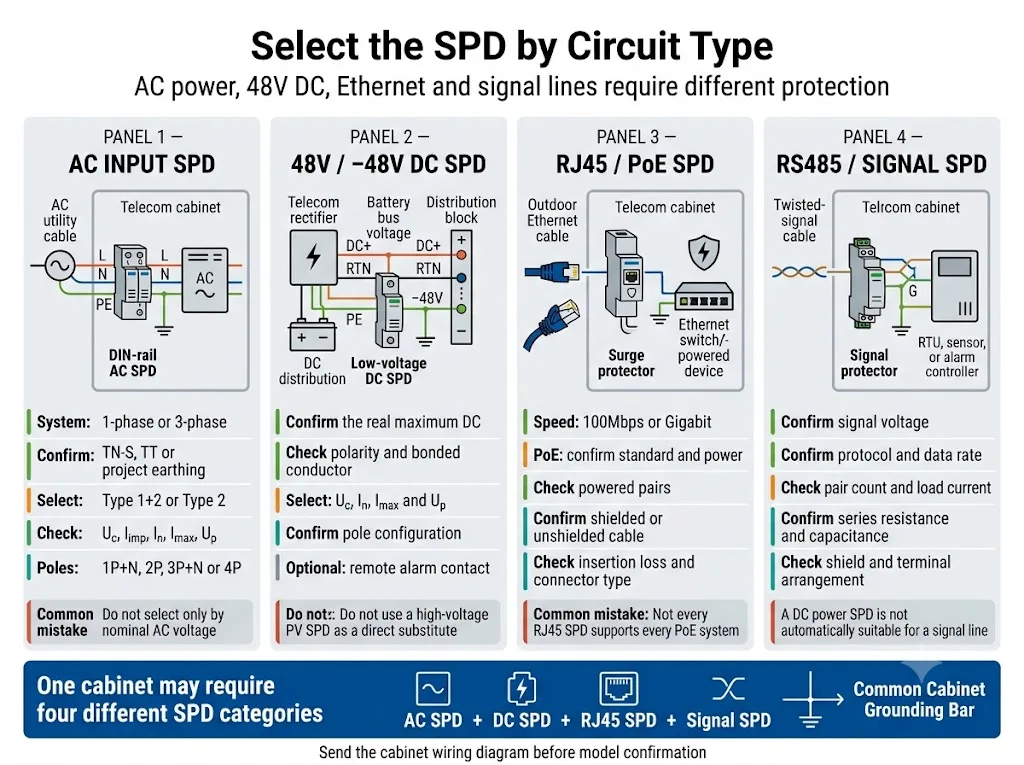
Sélection de SPD pour entrée AC
Le SPD AC protège l'alimentation électrique entrante et le côté AC du redresseur. La sélection et la coordination doivent suivre le système AC réel, la position d'installation et le concept de protection du projet. [1] [8]
Sélection de SPD 48V / -48V DC
« 48 V » est une désignation nominale du système. La tension réelle du bus CC peut être supérieure pendant le fonctionnement du redresseur et la charge de la batterie.
Choisissez le parafoudre en fonction de la tension continue maximale, de la polarité, du type de conducteur relié, des modes de protection et de la position de montage. La norme CEI 61643-41:2025 définit le cadre d'essai pour les parafoudres raccordés à des circuits à courant continu basse tension. [2]
Vérifier la tension
Indiquez la tension nominale, la plage de redressement, la plage de charge de la batterie et la tension continue maximale.
Vérifier la polarité
Identifiez les bornes DC+, RTN, DC− ou −48 V, PE et le conducteur relié à la mise à la terre de l'armoire.
Confirmer le lieu
Précisez si le SPD est situé au niveau de la ligne d'alimentation d'entrée, de la sortie du redresseur, du bus de batterie ou de l'unité de distribution CC.
Confirmer la maintenance
Préciser les indications visuelles, les modules remplaçables et la signalisation à distance , le cas échéant.
Lire le compte rendu détaillé Guide sur les SPD 48 V / −48 V CC pour les télécommunications pour l'ensemble du processus de tension et de mode de protection.
Protection contre les surtensions RJ45 et PoE
Un connecteur RJ45 ne suffit pas à définir l'ensemble des exigences techniques.
La norme CEI 61643-21:2025 s'applique aux réseaux de télécommunications et de signalisation équipés de dispositifs de protection contre les surtensions (SPD), y compris les réseaux acheminant de l'énergie sur la même ligne, tels que le Power over Ethernet. [3]
Poursuivre avec le Guide de sélection des parafoudres RJ45 et le Guide sur la protection contre les surtensions PoE .
Protection des lignes RS485, capteurs et surveillance
Les armoires de télécommunications extérieures sont souvent équipées d'alarmes de porte, de capteurs environnementaux, de systèmes de surveillance des batteries et d'interfaces de commande à distance.
Sélectionnez le signal SPD en fonction du protocole, de la tension, du nombre de paires, du courant, des exigences de transmission et de la disposition des bornes.
Communication RS485
Vérifier la tension du signal, le nombre de paires, le débit de données, le courant et le blindage du câble.
Lignes de porte et d'alarme
Vérifiez les contacts de porte, le câblage de sécurité et tout conducteur de commande sortant de l'armoire.
Capteurs environnementaux
Adaptez le SPD à l'alimentation du capteur, au signal de sortie, au nombre de conducteurs et au mode de mise à la terre.
Voir le Guide de sélection des parasurtenseurs RS485 pour obtenir des conseils spécifiques à chaque protocole.
Contact d'alarme à distance pour l'état du SPD
Un indicateur visuel nécessite une visite sur place. Un contact sans potentiel (en option) permet au système de surveillance de recevoir à distance une information relative à un changement d'état du SPD.
Définir la logique
Vérifiez quel état des contacts correspond à un fonctionnement normal, au retrait du module ou à une défaillance du SPD.
Consultez la note
Vérifiez que la tension et le courant d'entrée du variateur se situent dans les limites de la capacité nominale des contacts.
Mise en service et essais
Vérifiez l'intégralité du chemin de transmission des alarmes, depuis le SPD jusqu’à la plateforme de surveillance à distance.
Voir le Guide de câblage de l'alarme à distance SPD et de l'automate programmable (PLC) .
La mise à la terre et le lien affectent la protection obtenue
La barre de mise à la terre interne de l'armoire doit être intégrée au système global de mise à la terre et de liaison équipotentielle du site.
Les normes UIT-T K.56 et K.112 fournissent des recommandations destinées au secteur des télécommunications concernant la protection contre la foudre, la mise à la terre et la liaison équipotentielle dans les environnements de stations de base radio. [5] [6]
Utilisez un collage coordonné
Intégrer les SPD, le boîtier métallique et les blindages de câbles concernés dans la conception du système de liaison du projet.
Privilégiez les chemins courts
Évitez les conducteurs trop longs, les boucles inutiles et les chemins détournés entre le parafoudre et la barre de mise à la terre.
Parcours de câbles distincts
Évitez de faire passer des conducteurs entrants non protégés à côté de conducteurs sortants protégés.
Relier à la terre du site
Une barre de cuivre interne ne peut pas remplacer un système complet de mise à la terre du site.
Ressources connexes : Longueur du câble de raccordement SPD et Exigences en matière de mise à la terre des SPD .
L'indice de protection IP et la condensation sont des questions différentes
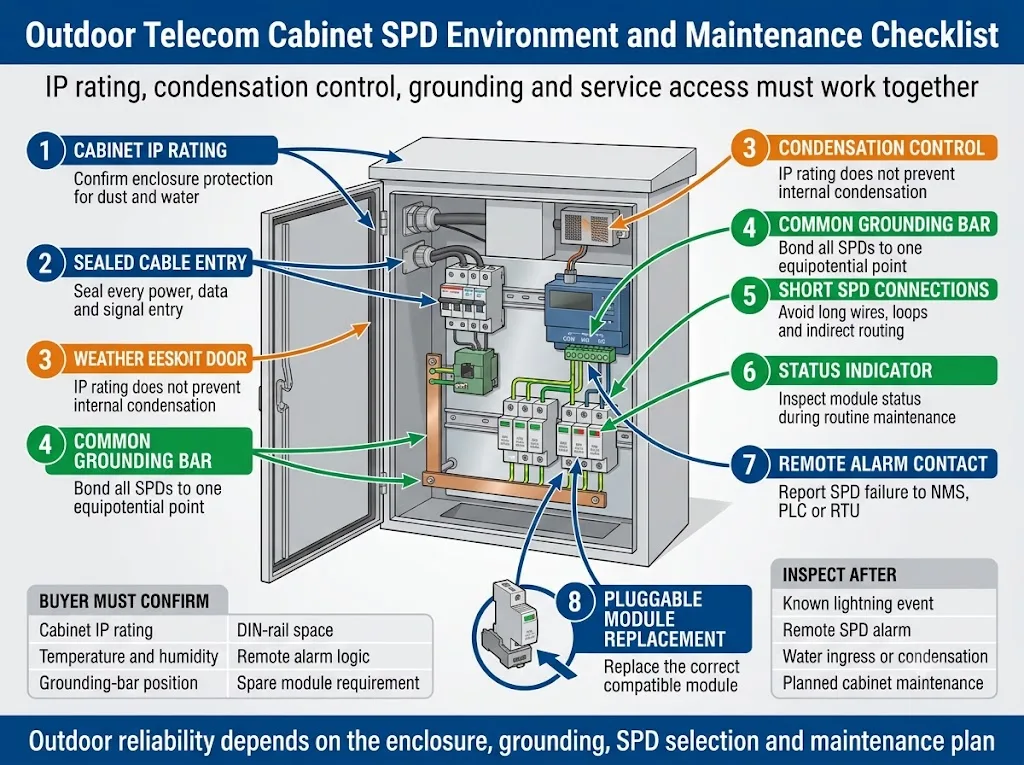
Un boîtier certifié IP offre une protection contre certaines conditions de pénétration de poussière et d’eau. Cela ne résout toutefois pas automatiquement le problème de la condensation interne.
La norme CEI 60529 définit les degrés de protection des boîtiers à l'aide du code IP. Cette classification ne définit pas l'ensemble de la stratégie de contrôle de la température, de l'humidité ou de la condensation à l'intérieur du boîtier. [7]
Contrôle des intrusions externes
- Indice de protection IP des armoires
- Joints de porte et joints d'étanchéité
- Presse-étoupes et plaques d'entrée
- Conception de la capote anti-pluie et du système d'évacuation des eaux
- Matériaux résistants à la corrosion
- Exposition aux rayons UV, à l'air salin et à la pollution
Régulation climatique interne
- Variations de température entre le jour et la nuit
- Conditions d'humidité et de point de rosée
- Chauffage ou déshumidification
- Ventilation ou échangeur de chaleur
- Surfaces froides et ponts thermiques
- Contrôle de l'humidité et de la corrosion
Familles de produits typiques LEEYEE pour cabinets de télécommunications
Ce tableau permet aux acheteurs d'identifier la famille de produits la plus probable. Il ne s'agit pas d'un tableau universel de substitution des modèles.
Ce que les acheteurs devraient vérifier au-delà de la fiche technique
Même si un SPD est techniquement adapté, il nécessite tout de même une documentation produit, un contrôle de fabrication et une validation par échantillonnage avant toute commande en grande quantité.
Essais des composants et des produits
Les capacités d'essai de LEEYEE comprennent les essais MOV et GDT, les équipements d'impulsion, les essais de stabilité thermique et les essais d'ondes combinées. Les essais applicables dépendent de la catégorie de produit et du plan d'essai.
Confirmation de la portée du document
Vérifiez que la fiche technique, le certificat ou le rapport correspond bien au modèle, à la tension, à la configuration polaire et aux caractéristiques nominales déclarées faisant l’objet de la commande.
Approbation d'échantillon
Vérifier la disposition des bornes, l'espace sur le rail DIN, le contact à distance, les étiquettes et les modules de remplacement avant le lancement de la production en série.
Maintenance des SPD et remplacement de module
Prévoir des inspections de routine, des tests d'alarme à distance et le remplacement des modules compatibles sans avoir à remanier la partie distribution de l'armoire.
La norme CEI 61643-22 traite de la sélection, de l’emplacement, de la coordination et des considérations opérationnelles relatives aux dispositifs de protection contre les surtensions (SPD) des réseaux de télécommunications et de signalisation. [4]
Inspection de routine
Vérifiez les voyants d'état, les bornes, le câblage, la surchauffe, la contamination, l'humidité et la corrosion.
Test d'alarme à distance
Vérifiez que le système de surveillance reçoit bien les états normaux et les états de défaillance prévus.
Remplacement d'un module
Utilisez la cartouche de rechange compatible spécifiée pour le type d'appareil installé, la tension et les caractéristiques de protection.
Vérification après la poussée
Inspectez les SPD, les bornes, les conducteurs de mise à la terre et les équipements protégés après un événement de surtension grave avéré.
Informations à envoyer avant de demander un devis
Ces informations permettent au fournisseur de comparer des spécifications techniques identiques et de réduire les erreurs de sélection de modèle.
Besoin d'une recommandation initiale de SPD ?
Veuillez nous envoyer le schéma de l'armoire, la tension d'entrée CA, la tension continue maximale en service continu, les exigences relatives aux connecteurs RJ45 ou PoE, la liste des lignes de signal, le schéma de mise à la terre et la quantité prévue.
Soutien pour l'OEM de cabinet de télécommunications et approvisionnement de projet
LEEYEE est un fournisseur spécialisé dans la protection contre les surtensions et la protection basse tension, qui jouit d'une grande confiance dans les domaines de l'énergie solaire photovoltaïque, de la distribution d'électricité, des télécommunications, de l'industrie et des applications OEM.
CNSPD est la plateforme de marque de LEEYEE dédiée à la protection contre les surtensions, conçue pour aider les acheteurs du monde entier à trouver des SPD fiables et d’autres produits de protection basse tension.
Conçu pour protéger. Fiable pour durer.
Assistance B2B disponible
- Vérification des paramètres des SPD pour courant alternatif, courant continu et signaux
- Examen de l'interface de l'armoire et de l'espace disponible sur le rail DIN
- Configuration des contacts d'alarme à distance
- Confirmation de la fiche technique et du champ d'application du document
- Débat sur les marques OEM et les marques de distributeur
- Évaluation d'échantillons avant la production en série
- Planification des modules remplaçables et des pièces de rechange
FAQ sur les SPD pour cabinets de télécommunications extérieurs
Quels sont les SPD généralement requis dans une armoire de télécommunications installée à l'extérieur ?
Une armoire peut nécessiter un parasurtenseur d'entrée CA, un parasurtenseur 48 V ou −48 V CC, une protection RJ45 ou PoE, des parasurtenseurs pour lignes de signal et des contacts d'alarme à distance. La combinaison exacte dépend des lignes conductrices entrant et sortant de l'armoire.
Un seul SPD peut-il protéger l'ensemble de l'armoire de télécommunications ?
En général, non. Les circuits d'alimentation CA, CC, Ethernet, PoE et de signal ont des tensions de fonctionnement, des interfaces et des exigences de performance différentes.
Où faut-il installer le SPD de courant alternatif ?
Il est généralement installé à proximité du point d'entrée du câble CA ou au sein de la section de distribution CA, en amont du redresseur et des charges CA sensibles. Son emplacement définitif doit respecter les spécifications du projet.
Comment choisir un SPD de télécommunications de −48 V ?
Vérifiez la tension continue maximale, la polarité, le conducteur relié, les modes de protection, les intensités nominales de décharge, le niveau de protection contre les surtensions et le schéma de mise à la terre.
Peut-on utiliser un SPD photovoltaïque en courant continu pour une armoire de télécommunications de 48 V ?
Il ne doit pas être considéré comme un substitut direct. Un circuit photovoltaïque haute tension et un bus CC de télécommunications basse tension présentent des conditions de fonctionnement différentes.
Tous les SPD RJ45 prennent-ils en charge le PoE et le Gigabit Ethernet ?
Non. Vérifiez le débit, la configuration PoE, les paires alimentées, le courant, la catégorie de câble, le blindage et les exigences en matière de perte d'insertion.
Une armoire IP65 empêche-t-elle la formation de condensation à l'intérieur ?
Non. Un indice de protection IP définit les conditions d'étanchéité de l'enceinte. De la condensation interne peut tout de même se former lorsque la température et l'humidité varient.
Une alarme à distance est-elle utile pour un parafoudre (SPD) installé dans une armoire de télécommunications en extérieur ?
Il est utile pour les armoires situées à distance et sans surveillance. Un contact sans potentiel peut signaler un changement d'état à un NMS, un API, une RTU ou un contrôleur d'alarme.
Pourquoi les conducteurs de mise à la terre SPD doivent-ils être courts ?
Un courant de pointe élevé peut générer une tension supplémentaire aux bornes de l' inductance des conducteurs longs. Un acheminement court et direct permet de réduire cette tension supplémentaire inutile.
Quels documents un fabricant de meubles sur mesure doit-il envoyer avant de demander un devis ?
Veuillez nous envoyer le schéma électrique, les caractéristiques d'entrée CA, la tension CC maximale, le schéma de mise à la terre, les exigences relatives à l'Ethernet et au PoE, la liste des signaux, la logique d'alarme à distance, l'encombrement mécanique, les conditions environnementales, les documents et les quantités.
Normes et cadre de référence technique
- IEC 61643-11:2025 — Dispositifs de protection contre les surtensions à basse tension raccordés aux réseaux d'alimentation à basse tension en courant alternatif : exigences et méthodes d'essai. Publication de la CEI
- IEC 61643-41:2025 — Dispositifs de protection contre les surtensions raccordés aux réseaux d'alimentation à basse tension en courant continu : exigences et méthodes d'essai. Publication de la CEI
- IEC 61643-21:2025 — Dispositifs de protection contre les surtensions raccordés aux réseaux de télécommunications et de signalisation : exigences et méthodes d'essai, y compris les réseaux acheminant de l'énergie sur la même ligne, tels que le Power over Ethernet. Publication de la CEI
- IEC 61643-22:2015 — Principes de sélection et d'application des dispositifs de protection contre les surtensions raccordés aux réseaux de télécommunications et de signalisation . Publication de la CEI
- UIT-T K.56:2021 — Protection des stations de base radio contre les coups de foudre. Recommandation de l'UIT-T
- UIT-T K.112:2021 — Protection contre la foudre, mise à la terre et liaison équipotentielle : procédures pratiques pour les stations de base radio. Recommandation de l'UIT-T
- IEC 60529:1989+A1:1999+A2:2013 — Degrés de protection assurés par les enveloppes, code IP. Publication de la CEI
- IEC 61643-12:2020 — Principes de sélection et d’application des dispositifs de protection contre les surtensions (SPD) raccordés aux réseaux électriques basse tension à courant alternatif. Publication de la CEI
- IEC 62305-4:2024 — Protection contre la foudre : systèmes électriques et électroniques à l'intérieur des bâtiments. Publication de la CEI