
Sebuah kabinet telekomunikasi luar ruangan biasanya memerlukan lebih dari satu SPD. Lindungi setiap jalur AC, DC, Ethernet, dan sinyal yang konduktif sesuai dengan tegangan, interface, posisi instalasi, dan pengaturan grounding yang sebenarnya.
Daftar Isi
Perlindungan lonjakan apa yang dibutuhkan oleh kabinet telekomunikasi luar ruangan?
Mulailah dengan mengidentifikasi setiap kabel konduktif yang masuk atau keluar dari kotak. Jangan mulai dengan memilih satu SPD serba guna.
Daya AC, daya DC tegangan rendah, dan sirkuit telekomunikasi atau sinyal diatur oleh persyaratan dan kerangka uji SPD yang berbeda. [1] [2] [3]
input AC
Melindungi pasokan utilitas, distribusi AC, dan input penyearah.
48V / -48V DC
Melindungi output penyearah, bus baterai, dan distribusi DC.
Ethernet
Melindungi jalur data tembaga sambil mendukung kecepatan yang diperlukan dan pengaturan PoE.
RS485 dan sensor
Melindungi sirkuit pemantauan, alarm, kontrol, dan sensor lingkungan.
Alarm jarak jauh
Melaporkan perubahan status SPD ke sistem pemantauan kabinet.
Arsitektur perlindungan lonjakan kabinet telecom luar ruangan.
Tinjau setiap jalur konduktif yang melewati batas kabinet. Tempatkan SPD yang relevan dekat dengan titik masuk kabel atau distribusi.
SPD, penutup kabinet, dan pelindung kabel yang relevan harus terintegrasi ke dalam desain pembumian dan pengikatan proyek. [5] [6]

Matriks pemilihan SPD kabinet telekomunikasi luar ruangan
Tentukan sirkuit yang dilindungi sebelum membandingkan model pemasok. Produk yang sesuai dengan rel DIN yang sama mungkin masih melayani aplikasi yang sepenuhnya berbeda.
| Antarmuka kabinet | Kategori SPD yang umum | Peralatan yang dilindungi | Parameter untuk dikonfirmasi | Kesalahan pembelian umum |
|---|---|---|---|---|
| Input utilitas AC | SPD AC Tipe 1+2 atau Tipe 2 sesuai dengan desain proyek | Distribusi AC, penyearah, kipas, pemanas, dan beban AC tambahan | Tegangan, fase, sistem pentanahan, Uc, Iimp jika diperlukan, In, Imax, Up, kutub dan perlindungan cadangan | Memilih hanya dari tegangan AC nominal |
| Bus DC 48V / −48V | SPD DC tegangan rendah yang cocok untuk sistem DC telekom aktual | Keluaran rectifier, bus baterai, distribusi DC dan beban telekom | Tegangan terus maksimal, polaritas, konduktor yang terikat, Uc, peringkat pelepasan, Up dan pengaturan kutub | Memilih hanya dari deskripsi nominal “48V” |
| Ethernet RJ45 | RJ45 SPD jalur data | Switch Ethernet, router, gateway, kamera, radio, dan pengontrol | Kecepatan data, kategori kabel, pelindung, pasangan terlindung, pengaturan konektor dan kehilangan penyisipan | Dengan asumsi setiap RJ45 SPD mendukung Gigabit Ethernet |
| Jalur PoE | RJ45 SPD yang kompatibel dengan pengaturan PoE yang diperlukan | Kamera luar ruangan, titik akses nirkabel, dan perangkat yang diberdayakan PoE | Metode PoE, daya, pasangan yang diberdayakan, arus, kecepatan, dan pelindung | Dengan asumsi setiap SPD data mendukung daya PoE yang diperlukan |
| RS485, sensor atau alarm | SPD jalur sinyal yang sesuai dengan antarmuka | RTU, pengontrol, sensor, alarm pintu, dan I/O jarak jauh | Tegangan sinyal, arus, jumlah pasangan, protokol, laju transmisi, pelindung, dan terminal | Mengganti SPD sinyal dengan SPD daya DC |
| Status output SPD | SPD dengan kontak remote bebas potensial | NMS, PLC, RTU atau pengontrol alarm kabinet menerima sinyal | Logika COM, NO dan NC, peringkat kontak dan status normal/kerusakan | Memesan versi standar tanpa sinyal remote |
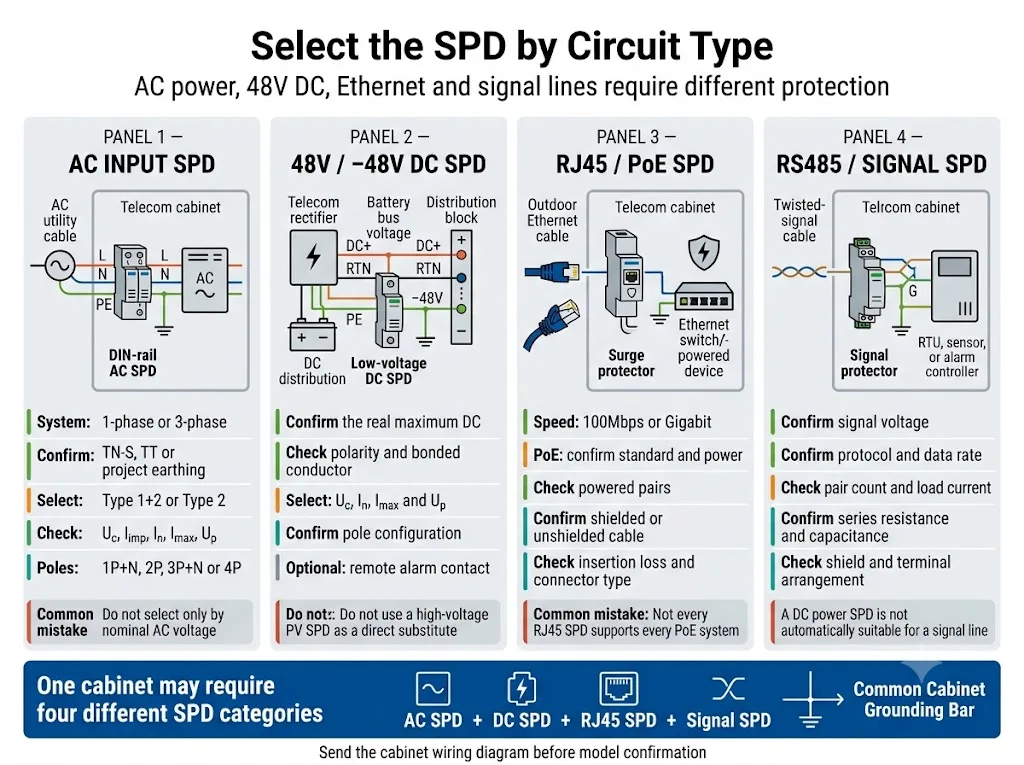
Pemilihan SPD input AC
SPD AC melindungi pasokan utilitas yang masuk dan sisi AC dari penyearah. Pemilihan dan koordinasi harus mengikuti sistem AC yang sebenarnya, posisi pemasangan, dan konsep perlindungan proyek. [1] [8]
Pemilihan SPD 48V / -48V DC
“48V” adalah deskripsi sistem nominal. Tegangan bus DC yang sebenarnya dapat lebih tinggi selama operasi penyearah dan pengisian baterai.
Pilih SPD dari tegangan DC kontinu tertinggi, polaritas, konduktor yang terikat, mode perlindungan, dan posisi pemasangan. IEC 61643-41:2025 menyediakan kerangka pengujian untuk SPD yang terhubung ke sirkuit DC tegangan rendah. [2]
Konfirmasi tegangan.
Berikan tegangan nominal, rentang penyearah, rentang pengisian baterai, dan tegangan kontinu tertinggi.
Konfirmasi polaritas.
Identifikasi DC+, RTN, DC− atau −48V, PE dan konduktor yang terikat ke tanah kabinet.
Konfirmasi lokasi.
Nyatakan apakah SPD berada di feeder masuk, keluaran penyearah, bus baterai, atau unit distribusi DC.
Konfirmasi pemeliharaan
Tentukan indikasi visual, modul yang dapat diganti, dan sinyal jarak jauh di mana diperlukan.
Baca yang lebih detail Panduan SPD DC 48V / −48V untuk telekom untuk proses voltase dan mode perlindungan yang lengkap.
Perlindungan terhadap lonjakan untuk RJ45 dan PoE
Sebuah konektor RJ45 tidak menentukan persyaratan teknis yang lengkap.
IEC 61643-21:2025 mencakup jaringan telekomunikasi dan sinyal SPD, termasuk jaringan yang membawa daya di jalur yang sama, seperti Daya melalui Ethernet. [3]
Lanjutkan dengan panduan pemilihan pelindung lonjakan RJ45 dan panduan perlindungan lonjakan PoE .
Perlindungan jalur RS485, sensor, dan pemantauan
Kabin telekom luar ruangan sering kali dilengkapi dengan alarm pintu, sensor lingkungan, pemantauan baterai, dan antarmuka kontrol jarak jauh.
Pilih SPD sinyal dari protokol, tegangan, jumlah pasangan, arus, persyaratan transmisi, dan pengaturan terminal.
Komunikasi RS485
Konfirmasi tegangan sinyal, jumlah pasangan, laju data, arus, dan pelindung kabel. .
Garis pintu dan alarm
Tinjau kontak pintu, kabel keamanan, dan konduktor kontrol yang membentang di luar kabinet.
Sensor lingkungan
Cocokkan SPD dengan pasokan sensor, sinyal keluaran, nomor konduktor, dan metode pembumian.
Lihat panduan pemilihan pelindung lonjakan RS485 untuk panduan spesifik protokol.
Kontak alarm jarak jauh untuk status SPD
Indikator visual memerlukan kunjungan ke lokasi. Kontak bebas potensial opsional memungkinkan sistem pemantauan menerima perubahan status SPD dari jarak jauh.
Tentukan logika
Konfirmasi kondisi kontak mana yang mewakili operasi normal, penghilangan modul, atau kegagalan SPD.
Periksa peringkat
Verifikasi bahwa tegangan dan arus input pengendali berada dalam peringkat kontak.
Uji pengujian
Verifikasi jalur alarm lengkap dari SPD ke platform pemantauan jarak jauh.
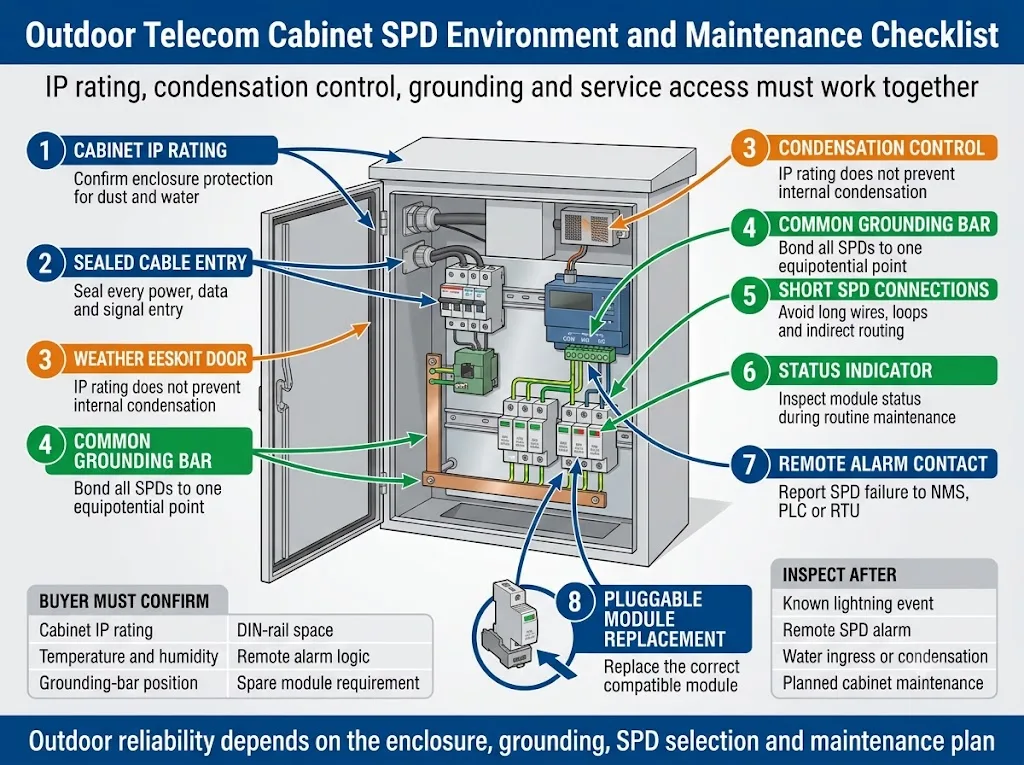
Pemasangan dan pengikatan berdampak pada perlindungan yang dicapai
Batang penyuplai arus tanah internal harus diintegrasikan ke dalam sistem pembumian dan pengikatan area yang lebih luas.
ITU-T K.56 dan K.112 memberikan panduan sektor telekomunikasi terkait perlindungan petir, pembumian, dan pengikatan untuk lingkungan stasiun basis radio. [5] [6]
Gunakan pengikatan yang terkoordinasi
Integrasikan SPD, enclosur logam, dan pelindung kabel yang relevan ke dalam desain pengikatan proyek.
Jaga jalur tetap pendek
Hindari konduktor panjang, loop yang tidak perlu, dan rute tidak langsung antara SPD dan batang tanah.
Pisahkan jalur kabel
Hindari merutekan konduktor yang tidak terlindungi di samping konduktor keluar yang terlindungi.
Sambungkan ke tanah situs
Batang tembaga internal tidak dapat menggantikan sistem pembumian situs yang lengkap.
Sumber daya terkait: Panjang kabel koneksi SPD dan Persyaratan pembumian SPD .
Peringkat IP dan kondensasi adalah pertanyaan yang berbeda
Enclosure yang memiliki peringkat IP dapat melindungi terhadap kondisi masuknya debu dan air yang ditentukan. Itu tidak secara otomatis menyelesaikan kondensasi internal.
IEC 60529 mendefinisikan derajat perlindungan enclosure menggunakan Kode IP. Klasifikasi tersebut tidak mendefinisikan strategi kontrol suhu, kelembaban, atau kondensasi internal secara lengkap. [7]
Kontrol masuk eksternal
- Klasifikasi IP kabinet
- Seal pintu dan gasket
- Pengangkut kabel dan pelat masuk
- Hood hujan dan desain drainase
- Bahan tahan korosi
- Paparan UV, udara garam dan polusi
Pengendalian iklim internal
- Perubahan suhu siang dan malam
- Kondisi kelembapan dan titik embun
- Pemanasan atau dehumidifikasi
- Ventilasi atau penukar panas
- Permukaan dingin dan jembatan termal
- Inspeksi kelembapan dan korosi
Keluarga produk LEEYEE yang khas untuk kabinet telekomunikasi
Pemetaan ini membantu pembeli mengidentifikasi kelompok produk yang mungkin. Ini bukan tabel substitusi model universal.
Apa yang harus diverifikasi pembeli di luar lembar data
SPD yang cocok secara teknis masih memerlukan dokumentasi produk, kontrol manufaktur, dan konfirmasi sampel sebelum pemesanan dalam jumlah besar.
Pengujian komponen dan produk
Kemampuan pengujian LEEYEE mencakup pengujian MOV dan GDT, peralatan impuls, pengujian stabilitas termal, dan pengujian gelombang kombinasi. Pengujian yang berlaku bergantung pada kategori produk dan rencana pengujian.
Konfirmasi cakupan dokumen
Konfirmasikan bahwa lembar data, sertifikat, atau laporan berlaku untuk model, tegangan, pengaturan kutub, dan peringkat yang dipesan.
Persetujuan sampel
Verifikasi tata letak terminal, ruang rel DIN, kontak jarak jauh, label, dan modul pengganti sebelum produksi massal.
Pemeliharaan SPD dan Penggantian Modul
Rencanakan inspeksi rutin, pengujian alarm jarak jauh, dan penggantian modul yang kompatibel tanpa merombak bagian distribusi kabinet.
IEC 61643-22 membahas pemilihan, lokasi, koordinasi, dan pertimbangan operasional untuk SPD jaringan telekomunikasi dan persinyalan. [4]
Inspeksi Rutin
Periksa indikator status, terminal, pengkabelan, panas berlebih, kontaminasi, kelembapan, dan korosi.
Pengujian Alarm Jarak Jauh
Verifikasi bahwa sistem pemantauan menerima status normal dan kegagalan yang diinginkan.
Penggantian Modul
Gunakan kartrid pengganti yang kompatibel sesuai dengan basis terpasang, tegangan, dan karakteristik perlindungan.
Pemeriksaan Pasca-Lonjakan
Periksa SPD, terminal, konduktor pembumian, dan peralatan yang dilindungi setelah kejadian lonjakan parah yang diketahui.
Informasi yang harus dikirim sebelum meminta penawaran
Detail ini memungkinkan pemasok untuk membandingkan persyaratan teknik yang sama dan mengurangi kesalahan pemilihan model.
Butuh rekomendasi SPD awal?
Kirimkan gambar kabinet, input AC, tegangan DC kontinu tertinggi, persyaratan RJ45 atau PoE, daftar jalur sinyal, tata letak pentanahan, dan kuantitas yang diharapkan.
Dukungan untuk pemasok OEM dan proyek kabinet telekomunikasi
LEEYEE adalah pemasok perlindungan lonjakan arus (surge protection) dan perlindungan tegangan rendah yang terspesialisasi, tepercaya untuk aplikasi tenaga surya PV, distribusi daya, telekomunikasi, industri, dan OEM.
CNSPD adalah platform merek LEEYEE yang berfokus pada perlindungan lonjakan arus, dibangun untuk membantu pembeli global mendapatkan SPD yang andal dan produk perlindungan tegangan rendah terkait.
Dirancang untuk Melindungi. Dipercaya untuk Bertahan.
Dukungan B2B yang tersedia
- Konfirmasi parameter SPD AC, DC, dan sinyal
- Tinjauan antarmuka kabinet dan ruang rel DIN
- Konfigurasi kontak alarm jarak jauh
- Konfirmasi lembar data dan cakupan dokumen
- Diskusi label OEM dan label pribadi (private-label)
- Evaluasi sampel sebelum produksi massal
- Perencanaan modul yang dapat diganti dan suku cadang
FAQ SPD kabinet telekomunikasi luar ruangan
SPD apa saja yang biasanya diperlukan dalam kabinet telekomunikasi luar ruangan?
Kabinet mungkin memerlukan SPD input AC, SPD DC 48V atau −48V, perlindungan RJ45 atau PoE, SPD saluran sinyal, dan kontak alarm jarak jauh. Kombinasi yang tepat bergantung pada jalur konduktif yang masuk dan keluar dari kabinet.
Bisakah satu SPD melindungi seluruh kabinet telekomunikasi?
Biasanya tidak. Sirkuit daya AC, daya DC, Ethernet, PoE, dan sinyal memiliki tegangan operasi, antarmuka, dan persyaratan kinerja yang berbeda.
Di mana SPD AC harus dipasang?
Biasanya dipasang di dekat pintu masuk kabel AC atau di dalam bagian distribusi AC sebelum penyearah dan beban AC yang sensitif. Lokasi akhir harus mengikuti desain proyek.
Bagaimana cara memilih SPD telekomunikasi −48V?
Pastikan tegangan kontinu tertinggi, polaritas, konduktor yang diikat, mode perlindungan, peringkat pelepasan, tingkat perlindungan tegangan, dan pengaturan pembumian.
Bisakah SPD DC PV digunakan untuk kabinet telekomunikasi 48V?
Ini tidak boleh dianggap sebagai pengganti langsung. Sirkuit fotovoltaik tegangan tinggi dan bus DC telekomunikasi tegangan rendah memiliki kondisi sistem yang berbeda.
Apakah setiap SPD RJ45 mendukung PoE dan Gigabit Ethernet?
Tidak. Pastikan kecepatan data, pengaturan PoE, pasangan berdaya, arus, kategori kabel, pelindung, dan persyaratan kerugian penyisipan (insertion loss).
Apakah kabinet IP65 mencegah kondensasi internal?
Tidak. Klasifikasi IP membahas kondisi masuknya (ingress) ke dalam selungkup yang ditentukan. Kondensasi internal masih dapat terjadi ketika suhu dan kelembapan berubah.
Apakah alarm jarak jauh berguna untuk SPD kabinet telekomunikasi luar ruangan?
Ini berguna untuk kabinet jarak jauh dan tanpa pengawasan. Kontak bebas potensial dapat melaporkan perubahan status ke NMS, PLC, RTU, atau pengontrol alarm.
Mengapa konduktor pembumian SPD harus pendek?
Arus lonjakan yang cepat dapat menciptakan tegangan tambahan melintasi induktansi konduktor yang panjang. Perutean yang pendek dan langsung mengurangi tegangan tambahan yang tidak perlu.
Apa yang harus dikirimkan oleh OEM kabinet sebelum meminta penawaran?
Kirimkan gambar kelistrikan, input AC, tegangan DC maksimum, tata letak pembumian, persyaratan Ethernet dan PoE, daftar sinyal, logika alarm jarak jauh, ruang mekanis, lingkungan, dokumen, dan jumlah.
Standar dan kerangka acuan teknis
- IEC 61643-11:2025 — Perangkat pelindung lonjakan tegangan rendah yang terhubung ke sistem daya tegangan rendah AC: persyaratan dan metode pengujian. Publikasi IEC
- IEC 61643-41:2025 — Perangkat pelindung lonjakan tegangan yang terhubung ke sistem daya tegangan rendah DC: persyaratan dan metode pengujian. Publikasi IEC
- IEC 61643-21:2025 — Perangkat pelindung lonjakan tegangan yang terhubung ke jaringan telekomunikasi dan persinyalan: persyaratan dan metode pengujian, termasuk jaringan yang membawa daya pada saluran yang sama seperti Power over Ethernet. Publikasi IEC
- IEC 61643-22:2015 — Prinsip pemilihan dan penerapan untuk perangkat pelindung lonjakan tegangan yang terhubung ke jaringan telekomunikasi dan persinyalan. Publikasi IEC
- ITU-T K.56:2021 — Perlindungan stasiun pangkalan radio terhadap pelepasan petir. Rekomendasi ITU-T
- ITU-T K.112:2021 — Perlindungan petir, pembumian, dan ikatan: prosedur praktis untuk stasiun pangkalan radio. Rekomendasi ITU-T
- IEC 60529:1989+A1:1999+A2:2013 — Derajat perlindungan yang disediakan oleh selungkup, Kode IP. Publikasi IEC
- IEC 61643-12:2020 — Prinsip pemilihan dan penerapan untuk SPD yang terhubung ke sistem daya tegangan rendah AC. Publikasi IEC
- IEC 62305-4:2024 — Perlindungan terhadap petir: sistem listrik dan elektronik di dalam struktur. Publikasi IEC