
Sistem alarm kebakaran menggabungkan catu daya AC, sirkuit daya tegangan rendah, loop alarm yang dipantau, antarmuka komunikasi, dan perangkat lapangan jarak jauh. Lonjakan dapat mencapai peralatan kontrol melalui jalur konduktif apa pun yang terpapar.
Panduan ini menjelaskan cara meninjau perlindungan lonjakan pada sistem alarm kebakaran tanpa mengganggu komunikasi alarm, pemantauan jalur, atau persetujuan peralatan. Panduan ini ditujukan bagi integrator sistem, kontraktor arus lemah, produsen panel kontrol alarm kebakaran, tim pemeliharaan, dan pembeli B2B yang menyiapkan permintaan SPD.
Daftar Isi
Jawaban Cepat
Sistem alarm kebakaran mungkin memerlukan proteksi lonjakan pada catu daya panel kontrol dan pada rangkaian tegangan rendah yang terekspos. Konfigurasi akhir bergantung pada kode kelistrikan dan kebakaran yang diadopsi secara lokal, petunjuk dari produsen sistem alarm kebakaran, paparan kabel, risiko petir, dan persyaratan persetujuan proyek.
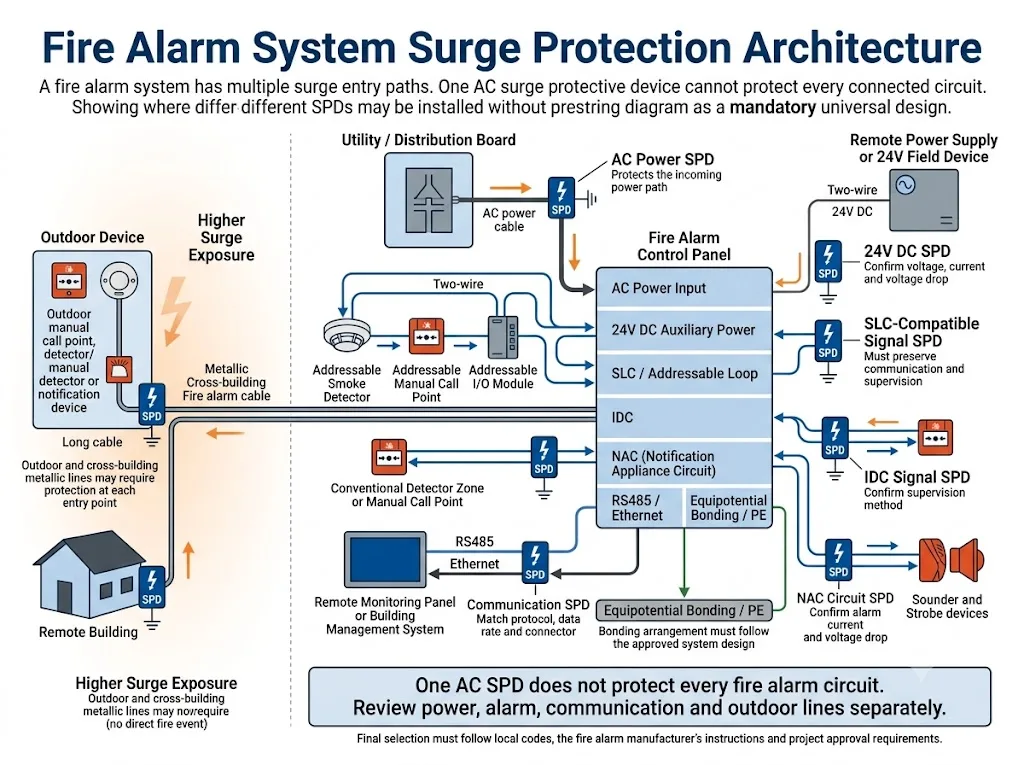
SPD AC melindungi jalur daya masuk. Perangkat ini tidak secara otomatis melindungi rangkaian bantu 24V, SLC, IDC, NAC, RS485, Ethernet, atau koneksi lapangan logam lainnya.
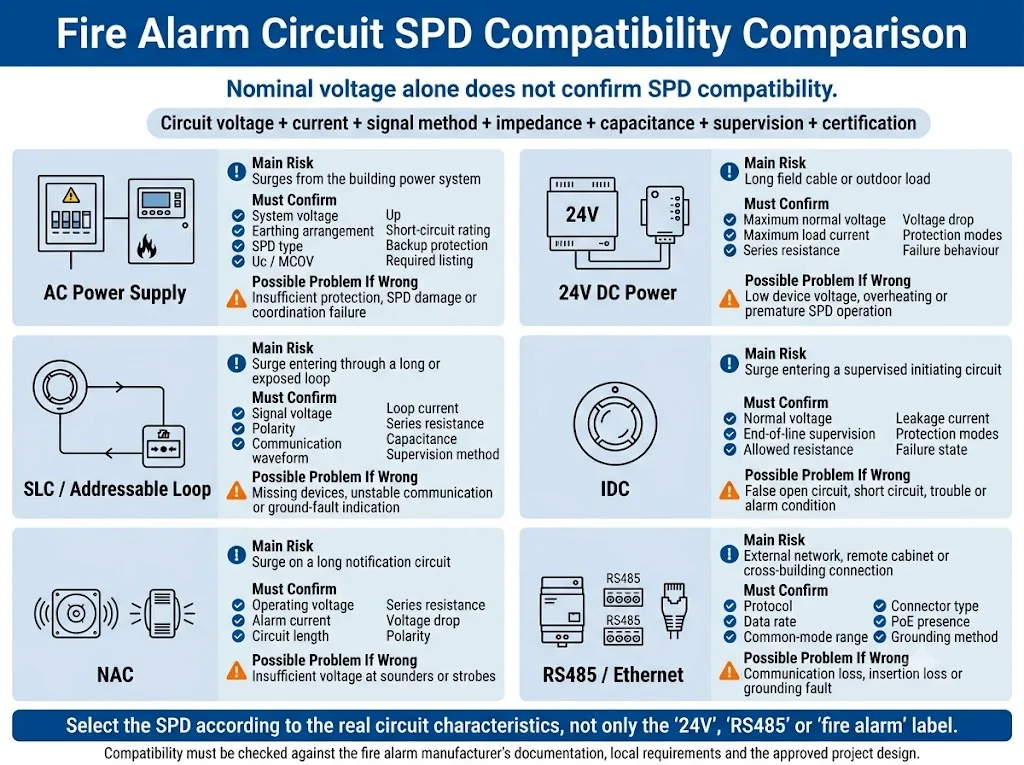
Untuk rangkaian alarm dan komunikasi, tegangan nominal hanya salah satu parameter seleksi. SPD juga harus kompatibel dengan arus rangkaian, resistansi seri, kapasitansi, karakteristik sinyal, metode pengawasan, pengaturan pentanahan, dan sertifikasi yang dipersyaratkan.
Apakah Setiap Sistem Alarm Kebakaran Memerlukan SPD?
Tidak ada satu aturan global yang mewajibkan susunan SPD yang sama untuk setiap sistem alarm kebakaran.
Persyaratan bervariasi menurut yurisdiksi. Jika edisi 2023 U.S. National Electrical Code telah diadopsi dan berlaku, Pasal 760.33 mewajibkan SPD terdaftar pada sisi suplai dari panel kontrol alarm kebakaran.[4] Adopsi lokal, amandemen, dan interpretasi tetap harus dikonfirmasi.
Persyaratan pada sisi suplai tersebut berkaitan dengan sumber daya panel kontrol alarm kebakaran. Hal ini tidak menegaskan bahwa satu SPD daya melindungi setiap rangkaian sinyal, notifikasi, atau komunikasi yang terhubung ke panel.
Proyek berbasis IEC biasanya mengevaluasi proteksi lonjakan sebagai bagian dari sistem yang lebih luas yang mencakup langkah-langkah proteksi petir, bonding equipotensial, penataan kabel, batas zona terlindungi, dan SPD yang dikoordinasikan.[1]
Di Mana Lonjakan Dapat Masuk ke Sistem Alarm Kebakaran?
Panel kontrol alarm kebakaran terhubung ke beberapa sistem kelistrikan. Setiap sambungan dapat menjadi jalur lonjakan yang terpisah.
Karena itu, konsep perlindungan alarm kebakaran memperlakukan input daya, loop detektor, perangkat alarm, jaringan, dan antarmuka eksternal sebagai titik perlindungan terpisah, bukan satu rangkaian yang identik.[6]
Sirkuit Alarm Kebakaran Mana yang Harus Ditinjau?
Kolom yang paling penting adalah “Fokus kompatibilitas.” Kolom ini menunjukkan apa yang harus dikonfirmasi sebelum suatu produk dipilih.
| Sirkuit | Paparan tipikal | Fokus kompatibilitas | Risiko jika tidak sesuai |
|---|---|---|---|
| Pasokan panel AC | Jaringan distribusi gedung | Tegangan sistem, pentanahan, tipe SPD, Uc atau MCOV, Up, peringkat hubung singkat, dan perlindungan cadangan | Kerusakan SPD, koordinasi yang buruk, atau tegangan sisa yang berlebihan |
| Daya 24V DC | Jalur lapangan panjang, beban luar ruangan, atau kabinet jarak jauh | Tegangan normal maksimum, arus beban, resistansi seri, penurunan tegangan, dan perilaku kegagalan | Tegangan beban rendah, panas berlebih, atau operasi SPD prematur |
| SLC | Loop yang dapat dialamati (addressable), bagian atap, atau perangkat eksternal | Rentang sinyal, polaritas, arus loop, karakteristik komunikasi, kapasitansi, dan pengawasan | Perangkat yang hilang, komunikasi tidak stabil, atau indikasi masalah |
| IDC | Zona detektor konvensional atau perangkat pemicu eksternal | Tegangan normal, pengawasan ujung saluran (end-of-line), kebocoran, resistansi tambahan, dan status kegagalan | Kesalahan buka, hubungan arus pendek, masalah, atau kondisi alarm |
| NAC | Sirkuit sounder atau strobo yang panjang | Arus alarm, polaritas, panjang sirkuit, resistansi seri, dan penurunan tegangan | Tegangan tidak mencukupi pada alat pemberitahuan |
| RS485 atau Ethernet | Kabinet jarak jauh, jaringan eksternal, atau tautan gedung | Protokol, kecepatan data, rentang mode umum, pelindung, konektor, dan keberadaan PoE | Kehilangan komunikasi, kerugian penyisipan (insertion loss), atau masalah pentanahan |
Kesimpulan pengadaan: sesuaikan SPD dengan karakteristik sirkuit yang sebenarnya, bukan hanya label seperti "24V," "RS485," atau "fire alarm."
Bagaimana Catu Daya AC Panel Kontrol Harus Dilindungi?
Catu daya panel alarm kebakaran harus ditinjau sebagai bagian dari sistem perlindungan lonjakan arus AC yang terkoordinasi di bangunan tersebut.
SPD hulu dapat mengurangi energi lonjakan arus yang masuk melalui jaringan distribusi. SPD yang sesuai dan ditempatkan lebih dekat ke panel alarm kebakaran dapat memberikan perlindungan tambahan jika diperlukan oleh desain atau kode yang diadopsi.
Tinjauan proyek harus mengonfirmasi:
- Tegangan dan frekuensi AC nominal.
- Pengaturan pembumian (earthing).
- Tipe atau klasifikasi SPD yang diperlukan.
- Tegangan operasi kontinu maksimum.
- Tingkat perlindungan tegangan.
- Arus hubung singkat prospektif yang tersedia.
- Perlindungan cadangan eksternal yang diperlukan.
- Posisi pemasangan dan panjang sambungan.
- Indikasi status visual atau jarak jauh yang diperlukan.
- Pencatatan, sertifikasi, dan cakupan model tepat yang diperlukan.
SPD AC bukanlah perlindungan sistem alarm kebakaran yang lengkap
SPD pada suplai AC tidak dapat mencegat transien yang masuk melalui loop alarm terpisah, kabel lapangan 24V, kabel jaringan, atau saluran komunikasi eksternal. Antarmuka ini memerlukan tinjauan paparan dan kompatibilitasnya sendiri.
Pembeli yang meninjau input daya panel dapat melanjutkan ke halaman pemilihan perangkat pelindung lonjakan arus LEEYEE setelah mengonfirmasi tegangan sistem, posisi pemasangan, dan standar proyek.
Haruskah Panel Menggunakan Perlindungan Lonjakan Tipe 1 atau Tipe 2?
Tipe SPD yang tepat ditentukan oleh posisi pemasangan dan paparan lonjakan arus yang diperkirakan, bukan semata-mata karena beban yang dilindungi adalah panel alarm kebakaran.
SPD Tipe 1 ditujukan untuk lokasi di mana arus petir parsial mungkin perlu dibuang. SPD Tipe 2 umumnya digunakan dalam sistem distribusi untuk membatasi petir induksi dan lonjakan arus peralihan. Perlindungan Tipe 3 dapat digunakan lebih dekat ke peralatan sensitif sebagai bagian dari pengaturan yang terkoordinasi.[10]
Ini tidak berarti setiap panel kontrol alarm kebakaran memerlukan SPD Tipe 1. Keputusan bergantung pada pengaturan layanan, sistem proteksi petir eksternal, SPD hulu, risiko petir, lokasi pemasangan, dan aturan yang diadopsi secara lokal.
Untuk penjelasan yang lebih lengkap mengenai tingkat perlindungan, lihat panduan koordinasi SPD Tipe 1, Tipe 2, dan Tipe 3.
Bagaimana Sirkuit Daya Alarm Kebakaran 24V Harus Dilindungi?
Penandaan nominal 24V saja tidak cukup untuk mengonfirmasi kesesuaian.
Sirkuit mungkin beroperasi di atas 24V selama toleransi catu daya normal, kondisi pengisian daya, atau pengoperasian sistem. Tegangan sirkuit kontinu maksimum yang sebenarnya harus tetap di bawah batas pengoperasian kontinu yang dinyatakan oleh SPD.
Konfirmasi tegangan sirkuit normal tertinggi
Jika ambang batas pengoperasian SPD terlalu rendah, perangkat mungkin mengalirkan arus, bocor, atau menua selama layanan normal. Jika terlalu tinggi, peralatan yang dilindungi dapat mengalami tegangan sisa yang lebih tinggi.
Konfirmasikan arus sirkuit penuh
SPD yang terhubung seri harus membawa arus normal, startup, dan alarm tertinggi yang diharapkan pada sirkuit yang dilindungi.
Hitung penurunan tegangan tambahan
Kabel alarm kebakaran yang panjang sudah menghasilkan penurunan tegangan. Resistansi seri tambahan dapat mengurangi tegangan yang tersedia untuk modul jarak jauh, pengeras suara, atau lampu strobo.
Konfirmasikan perilaku kegagalan yang dinyatakan
Tim proyek harus mengetahui apakah modul pelindung yang kelebihan beban menjadi sirkuit terbuka, sirkuit pendek, terputus, atau mengubah status. Perilaku yang dapat diterima bergantung pada sirkuit yang dilindungi dan metode pengawasannya.
Jangan memodifikasi kabel baterai tanpa persetujuan
Sambungan baterai internal yang pendek berbeda dengan sirkuit lapangan 24V eksternal yang terbuka. Jangan tambahkan SPD ke kabel baterai kecuali produsen alarm kebakaran dan desain sistem yang disetujui secara khusus mengizinkan modifikasi tersebut.
Mengapa SPD Harus Menjaga Keandalan Sinyal Alarm?
Sirkuit alarm kebakaran bukanlah saluran listrik tegangan rendah biasa. Banyak yang diawasi terus-menerus oleh panel kontrol.
Panel dapat mendeteksi konduktor terbuka, hubung singkat, kesalahan pembumian, perangkat beralamat yang hilang, atau arus yang tidak normal. SPD yang tidak sesuai dapat mengubah nilai sirkuit yang dibaca oleh panel.
SLC dan loop yang dapat dialamati
SPD harus menoleransi tegangan dan arus loop sambil menjaga bentuk gelombang komunikasi. Kapasitansi, kebocoran, atau impedansi tambahan dapat memengaruhi stabilitas loop.
Sirkuit IDC
Pelindung tidak boleh menggeser sirkuit yang diawasi keluar dari rentang normal yang diizinkan atau mengganggu pemantauan ujung jalur (end-of-line).
Sirkuit NAC
Pelindung harus membawa beban notifikasi tanpa menyebabkan kehilangan tegangan yang tidak dapat diterima di ujung sirkuit.
RS485 dan bus berpemilik
Produk yang dijelaskan sebagai SPD RS485 tidak secara otomatis disetujui untuk setiap jaringan alarm kebakaran berpemilik. Konfirmasikan antarmuka elektrik, batas mode umum, perlakuan pelindung (shield), kecepatan data, dan batasan produsen.
Komunikasi Ethernet dan IP
Konfirmasikan kategori Ethernet, kecepatan data, pengaturan konektor, konfigurasi pelindung, dan apakah daya dibawa pada kabel yang sama. IEC 61643-21:2025 mencakup jaringan telekomunikasi dan persinyalan yang mungkin juga menyediakan daya pada saluran yang sama, seperti PoE.[2]
Poin pemilihan kritis
SPD dapat menahan tegangan nominal namun tetap tidak sesuai untuk sinyal tersebut. Kompatibilitas harus mencakup tegangan, arus, impedansi, kapasitansi, perilaku sinyal, pengawasan, dan pembumian.
Parameter SPD Mana yang Harus Sesuai dengan Sirkuit?
IEC 61643-21 menetapkan persyaratan dan metode pengujian untuk SPD yang terhubung ke jaringan telekomunikasi dan persinyalan. IEC 61643-22 menyediakan prinsip pemilihan, pengoperasian, lokasi, dan koordinasi untuk perangkat ini.[2][3]
Untuk aplikasi Amerika Utara, UL mengidentifikasi UL 497B sebagai standar untuk pelindung yang digunakan pada sirkuit komunikasi data dan alarm kebakaran. Kategori sertifikasi, penandaan, dan cakupan pemasangan harus diverifikasi untuk model yang disuplai.[5]
Tim proyek harus memperoleh nilai-nilai ini dari dokumentasi alarm kebakaran maupun lembar data SPD.
| Parameter | Hal yang perlu diverifikasi | Mengapa hal ini memengaruhi proyek |
|---|---|---|
| Uc atau MCOV | Tegangan tertinggi yang mungkin tetap ada secara terus-menerus pada sirkuit | SPD tidak boleh beroperasi atau mengalami penuaan selama kondisi normal |
| Tingkat perlindungan tegangan | Tegangan residu di bawah kondisi pengujian yang dinyatakan | Hal ini harus ditinjau terhadap kemampuan ketahanan antarmuka yang dilindungi |
| Icurrent beban | Arus normal, arus start-up, dan arus alarm maksimum | Perangkat seri harus mampu membawa arus sirkuit dengan aman |
| Resistensi seri | Resistansi ditambahkan ke setiap konduktor yang dilindungi | Hal ini mengubah penurunan tegangan dan nilai loop yang diawasi |
| Kapasitansi dan bandwidth | Karakteristik sinyal yang dinyatakan dan kecepatan data yang didukung | Pemuatan yang berlebihan dapat mendistorsi atau melemahkan komunikasi |
| Mode perlindungan | Pengaturan perlindungan line-to-line, line-to-earth, dan shield | SPD harus menangani jalur lonjakan common-mode dan differential-mode yang diperkirakan |
| Perilaku kegagalan | Status yang dinyatakan setelah kelebihan beban atau akhir masa pakai | Hasilnya harus kompatibel dengan kontinuitas sirkuit dan pemantauan kesalahan |
| Cakupan sertifikasi | Model eksak, rentang tegangan, kategori sirkuit, dan pasar yang berlaku | Sertifikat untuk satu model tidak secara otomatis mencakup model atau aplikasi lain |
Mintalah data teknis khusus model. Pernyataan katalog umum tidak cukup untuk persetujuan proyek.
Apa yang Dapat Diverifikasi LEEYEE Sebelum Merekomendasikan Kandidat SPD?
LEEYEE dapat membandingkan sirkuit yang diminta dengan data SPD daya AC, daya DC, saluran sinyal, dan jaringan yang tersedia. Ini adalah tinjauan parameter, bukan persetujuan otomatis untuk sistem alarm kebakaran.
Informasi SPD sinyal LY10 saat ini mencakup versi 12V, 24V, dan 48V. Tegangan yang dipilih harus tetap sesuai dengan rentang sirkuit yang sebenarnya.[7]
Karakteristik arus beban dan penyisipan khusus model dapat diperiksa terhadap loop atau antarmuka komunikasi yang dituju.
Halaman LY10 saat ini mencantumkan kecepatan transmisi hingga 10Mbps dan insertion loss tidak lebih besar dari 0,2dB untuk konfigurasi yang dinyatakan.[7]
Perlindungan RJ45 harus disesuaikan dengan kecepatan Ethernet, kategori kabel, pasangan yang dilindungi, pelindung (shielding), dan persyaratan PoE.[8]
Posisi DIN-rail, jumlah konduktor, penandaan sisi yang dilindungi, terminal bumi, dan ruang kabinet dapat ditinjau sebelum pengambilan sampel.
Pembeli harus meminta lembar data yang tepat, informasi perkabelan, dan cakupan sertifikat untuk model yang sedang dipertimbangkan.
Penting: LEEYEE LY10, pelindung RJ45, atau SPD sinyal lainnya hanya boleh dianggap sebagai kandidat setelah produsen panel alarm kebakaran, parameter sirkuit, dan persyaratan proyek diperiksa. Perangkat tersebut tidak disetujui secara universal untuk semua loop SLC, IDC, NAC, atau loop alarm kebakaran eksklusif.
Tinjau SPD sinyal data LY10 atau panduan pemilihan pelindung lonjakan RJ45 hanya setelah mengidentifikasi antarmuka yang sebenarnya.
Mengapa Jalur Luar Ruangan dan Antar-Bangunan Memiliki Risiko Lebih Tinggi?
Kabel eksternal yang panjang dapat mengalami tegangan transien induksi dari aktivitas petir di sekitar. Saluran logam antar bangunan juga dapat menghubungkan lokasi yang naik ke potensi bumi yang berbeda selama lonjakan arus.
Contoh paparan yang lebih tinggi meliputi:
- Titik panggil manual luar ruangan.
- Sounder, strobo, atau detektor eksternal.
- Perangkat yang dipasang di atap.
- Ruang pompa atau pos penjagaan terpisah.
- Tautan alarm kebakaran antar bangunan terpisah.
- Kabel yang dirutekan di samping sirkuit daya.
- Layanan komunikasi yang masuk dari luar struktur yang dilindungi.
IEC 62305-4 membahas tindakan perlindungan lonjakan untuk sistem listrik dan elektronik di dalam struktur, termasuk pertimbangan desain, pemasangan, inspeksi, pemeliharaan, dan pengujian.[1]
Untuk sirkuit logam antar bangunan, perlindungan dapat dipertimbangkan di setiap pintu masuk bangunan. Pelindung yang tepat, pengaturan pelindung (shield), metode ikatan, dan referensi bumi memerlukan rekayasa proyek karena kedua bangunan mungkin tidak berada pada potensi yang sama selama lonjakan arus.[6]
Di Mana SPD Alarm Kebakaran Harus Dipasang?
Posisi yang benar bergantung pada batas perlindungan dan sirkuit yang dilindungi. IEC 61643-22 membahas pemilihan, lokasi, dan koordinasi SPD untuk jaringan persinyalan.[3]
-
Identifikasi titik masuk yang terpapar.
Tentukan lokasi di mana kabel eksternal atau kabel berisiko lebih tinggi memasuki gedung, ruang terlindung, kabinet, atau zona proteksi petir.
-
Pasang SPD di dekat batas proteksi.
Bagian kabel panjang yang tidak terlindung di dalam area yang diproteksi masih dapat mengalirkan lonjakan arus menuju peralatan.
-
Buat jalur arus lonjakan sependek mungkin.
Gunakan sambungan terpendek yang dimungkinkan sesuai instruksi SPD dan desain panel yang disetujui.
-
Gunakan titik bonding yang disetujui.
Hubungkan SPD ke pengaturan ekuipotensial bonding atau pelindung arde (protective-earth) yang telah ditentukan. Jangan melakukan improvisasi arde sinyal.
-
Pisahkan kabel yang terlindung dan yang tidak terlindung.
Menjalurkan keduanya secara bersamaan dapat menyebabkan energi transien berpindah kembali ke konduktor yang terlindung. Panduan aplikasi alarm kebakaran juga menekankan persyaratan pemisahan ini.[6]
-
Verifikasi setiap konduktor yang diperlukan.
Tinjau pasangan saluran, konduktor balik (return), pelindung (shields), konduktor daya, dan jalur komunikasi paralel.
-
Uji fungsi alarm kebakaran secara menyeluruh.
Setelah pemasangan, verifikasi status normal, alarm, kondisi gangguan, komunikasi, pemantauan gangguan arde (earth-fault), beban notifikasi, dan pelaporan jarak jauh sesuai prosedur yang disetujui.
-
Catat SPD dalam dokumen pemeliharaan.
Dokumentasikan model, lokasi, sirkuit yang dilindungi, indikasi status, dan prosedur penggantian.
Untuk prinsip umum sambungan power-SPD, lanjutkan ke Panduan pemasangan SPD IEC 60364-5-534. Persyaratan produsen alarm kebakaran tetap menjadi prioritas untuk modifikasi panel dan loop sinyal.
Apakah SPD Dapat Dipasang di Dalam Panel Kontrol Alarm Kebakaran?
Hanya jika produsen panel, desain penutup (enclosure), instruksi SPD, dan dokumentasi proyek yang disetujui mengizinkan pemasangan tersebut.
Menambahkan perangkat di dalam panel dapat memengaruhi ruang pengkabelan yang tersedia, jarak pemisahan, pembuangan panas, akses pemeliharaan, penahanan gangguan (fault containment), dan konfigurasi peralatan yang telah disetujui.
Penutup (enclosure) terpisah di dekat panel alarm kebakaran mungkin lebih disukai jika pemasangan internal tidak disetujui atau akan mempersulit pemeliharaan dan pemisahan pengkabelan. Ini adalah keputusan proyek, bukan aturan universal.
Haruskah SPD Alarm Kebakaran Memiliki Indikasi Status?
Indikasi status membantu tim pemeliharaan mengidentifikasi apakah SPD masih tersedia untuk digunakan. Metode yang diperlukan bergantung pada jenis SPD, lokasi pemasangan, dan strategi pemeliharaan.
Jendela status atau indikator memungkinkan pemeriksaan di kabinet. Arti yang tepat dari setiap warna harus diperiksa dalam instruksi model.
SPD daya tertentu dapat menyediakan kontak NO, NC, dan COM untuk dihubungkan ke input pemantauan atau alarm pemeliharaan.[9]
Desain pluggable (dapat dicolokkan) dapat menyederhanakan penggantian, tetapi modul cadangan dan prosedur isolasi yang disetujui harus didokumentasikan.
Rencana pemeliharaan harus menyatakan siapa yang memeriksa SPD, bagaimana gangguan dilaporkan, dan apa yang terjadi jika penggantian diperlukan.
Kontak jarak jauh standar biasanya melaporkan status SPD atau pemutusan internal. Kontak ini tidak secara otomatis mencatat setiap kejadian lonjakan arus atau membuktikan bahwa sistem alarm kebakaran berfungsi dengan baik sepenuhnya.[9]
Jika pemantauan jarak jauh diperlukan, tinjau panduan kontak sinyal jarak jauh SPD dan konfirmasikan nilai kontak, logika status normal, dan desain sirkuit pemantauan.
Apa yang Dapat Salah dengan SPD yang Tidak Tepat?
Tegangan operasi terlalu rendah
SPD dapat menghantarkan arus atau bocor selama penggunaan normal, mengalami penuaan dini, atau memengaruhi pemantauan gangguan arde.
Tegangan operasi terlalu tinggi
Tegangan sisa yang mencapai antarmuka alarm kebakaran mungkin lebih tinggi dari yang diperlukan.
Nilai arus tidak mencukupi
Perangkat seri dapat mengalami panas berlebih, memutus sirkuit, atau membatasi arus yang diperlukan oleh peralatan notifikasi dan modul kontrol.
Resistansi tambahan terlalu tinggi
Sirkuit mungkin mengalami penurunan tegangan yang berlebihan atau keluar dari rentang pengawasan yang diizinkan oleh panel.
Kapasitansi atau bandwidth tidak sesuai
Loop yang dapat dialamatkan (addressable loop) atau bus komunikasi dapat mengalami gangguan terputus-putus, perangkat yang hilang, atau transfer data yang tidak stabil.
Mode proteksi atau pentanahan salah
Pemasangan mungkin menciptakan indikasi gangguan arde, proteksi mode umum yang tidak efektif, atau arus sirkulasi yang tidak diinginkan.
Status kegagalan tidak ditinjau
Status akhir masa pakai (end-of-life) SPD dapat mengganggu sirkuit, menghubung-singkatkan konduktor, atau membuat indikasi gangguan. Hasil yang dapat diterima harus disepakati untuk sirkuit tertentu.
Dokumentasi tidak mencakup model yang disediakan
Proyek mungkin menghadapi penolakan teknis, penundaan persetujuan, pengerjaan ulang, atau ketidaksepakatan mengenai garansi dan tanggung jawab sistem.
Bagaimana Proyek Harus Memastikan Konfigurasi SPD?
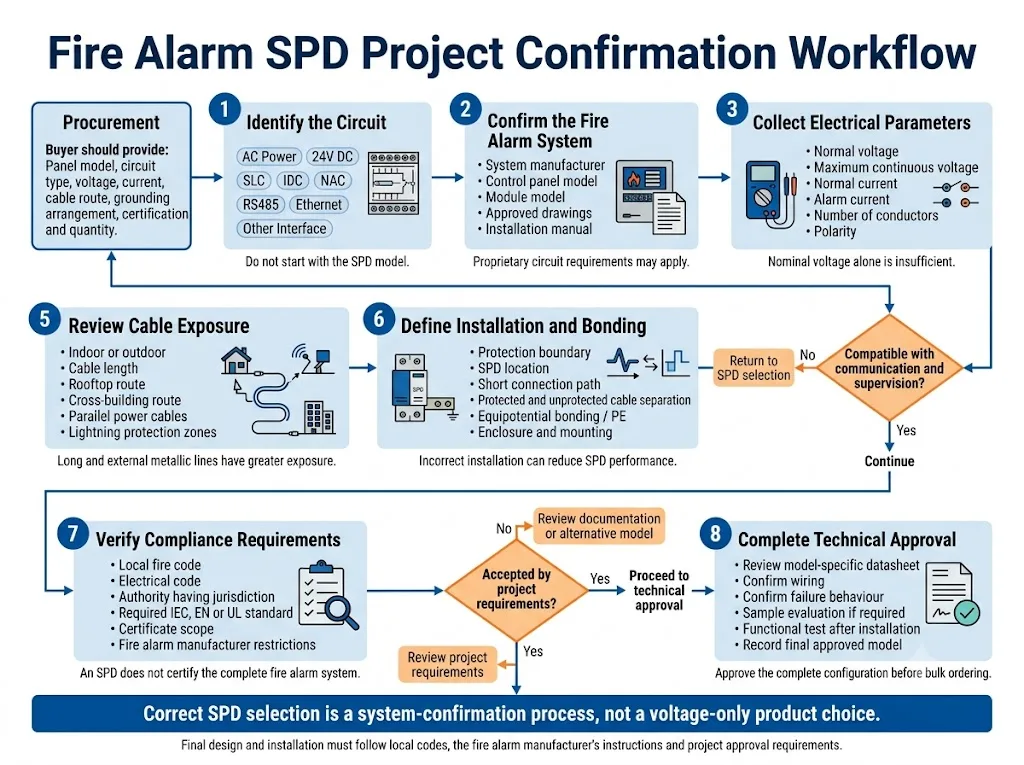
Proses yang paling andal dimulai dari sirkuit alarm kebakaran, bukan dari nomor katalog SPD.
-
Identifikasi jenis sirkuit.
Pastikan apakah jalur yang dilindungi adalah daya AC, daya 24V, SLC, IDC, NAC, RS485, Ethernet, atau antarmuka lainnya.
-
Identifikasi peralatan alarm kebakaran.
Catat produsen panel kontrol, model panel, model modul, dan dokumentasi sistem yang disetujui.
-
Kumpulkan nilai-nilai kelistrikan.
Pastikan tegangan kontinu maksimum, arus normal, arus alarm, polaritas, dan pengaturan konduktor.
-
Tinjau kompatibilitas sinyal dan supervisi.
Pastikan resistansi yang diizinkan, kapasitansi, karakteristik data, supervisi akhir jalur (end-of-line), dan pemantauan gangguan bumi (earth-fault).
-
Nilai paparan kabel.
Catat panjang kabel, perutean dalam atau luar ruangan, bagian antarbangunan, dan hubungannya dengan sistem proteksi petir bangunan.
-
Tentukan pemasangan dan pengikatan (bonding).
Pastikan batas proteksi, posisi pemasangan, titik pengikatan, penutup (enclosure), serta pemisahan antara kabel yang dilindungi dan yang tidak dilindungi.
-
Verifikasi standar dan sertifikat.
Periksa kode yang diadopsi secara lokal, standar IEC, EN, atau UL yang disyaratkan, cakupan sertifikat yang tepat, dan batasan produsen alarm kebakaran.
-
Selesaikan persetujuan teknis sebelum melakukan pemesanan dalam jumlah besar.
Tinjau lembar data model spesifik, pengabelan, perilaku kegagalan, dan pengujian sampel atau fungsional yang diperlukan.
Sebelum Memesan Pelindung Lonjakan Alarm Kebakaran
Kirimkan informasi proyek berikut kepada pemasok SPD:
Bagikan Detail Sirkuit Alarm Kebakaran Anda untuk Ditinjau
Kirimkan model panel, jenis sirkuit, tegangan maksimum, arus beban, metode sinyal, rute kabel, pengaturan pentanahan, dan sertifikasi yang diperlukan kepada LEEYEE. Konfigurasi SPD yang tersedia kemudian dapat ditinjau untuk diskusi teknis, pengambilan sampel, atau pengadaan OEM.
Konfigurasi akhir tetap tunduk pada instruksi produsen alarm kebakaran, kode yang diadopsi secara lokal, dan persetujuan proyek.
Minta Tinjauan Kompatibilitas SPDLEEYEE adalah pemasok khusus perlindungan lonjakan arus dan perlindungan tegangan rendah. CNSPD adalah platform LEEYEE yang berfokus pada perlindungan lonjakan arus untuk pembeli teknis global.
Pertanyaan yang Sering Diajukan
Apakah setiap panel kontrol alarm kebakaran memerlukan SPD?
Tidak ada aturan tunggal di seluruh dunia yang berlaku untuk setiap proyek. Persyaratan bergantung pada kode yang diadopsi secara lokal dan desain yang disetujui. Jika NEC A.S. 2023 berlaku, Bagian 760.33 mewajibkan SPD terdaftar pada sisi suplai panel kontrol alarm kebakaran. Adopsi dan amendemen lokal harus dikonfirmasi.
Apakah satu SPD AC cukup untuk seluruh sistem alarm kebakaran?
Tidak. Itu hanya melindungi jalur daya AC. Lonjakan arus juga dapat masuk melalui sirkuit 24V, SLC, IDC, NAC, RS485, Ethernet, dialer, atau kabel logam luar ruangan.
Haruskah panel alarm kebakaran menggunakan SPD Tipe 1 atau Tipe 2?
Jenis SPD bergantung pada posisi pemasangan, paparan petir, dan proteksi hulu. Tipe 1 dikaitkan dengan proteksi arus petir pada titik masuk dengan paparan lebih tinggi. Tipe 2 umumnya digunakan dalam sistem distribusi. Beban alarm kebakaran saja tidak menentukan jenisnya.
Bisakah SPD 24V dipasang pada loop alarm kebakaran 24V?
Tidak. Pastikan tegangan kontinu maksimum, arus beban, resistansi seri, kapasitansi, metode sinyal, metode supervisi, mode proteksi, dan perilaku kegagalan.
Bisakah SPD menyebabkan indikasi masalah (trouble) pada alarm kebakaran?
Ya. Resistansi, kapasitansi, kebocoran yang berlebihan, atau sambungan arde (ground) yang tidak tepat dapat mengubah nilai sirkuit yang terbaca oleh panel kontrol.
Di mana SPD saluran sinyal harus dipasang?
Umumnya ditempatkan di dekat titik di mana saluran terbuka masuk ke gedung, ruangan, atau kabinet yang dilindungi. Lokasi dan pengaturan bonding yang tepat harus mengikuti instruksi SPD dan desain alarm kebakaran yang disetujui.
Dapatkah SPD dipasang di dalam panel kontrol alarm kebakaran?
Hanya jika produsen panel, desain selungkup, instruksi produk, dan dokumentasi proyek yang disetujui mengizinkannya. Jika tidak, mungkin diperlukan selungkup terpisah di dekatnya.
Haruskah SPD memiliki indikasi status visual atau jarak jauh?
Indikasi status berguna jika staf pemeliharaan perlu mengidentifikasi SPD yang sudah mencapai akhir masa pakai atau terputus. Pastikan apakah proyek memerlukan jendela lokal, alarm kontak kering, modul yang dapat diganti, atau prosedur inspeksi yang didokumentasikan.
Apakah kabel alarm kebakaran antar-gedung memerlukan SPD di kedua ujungnya?
Perlindungan di kedua pintu masuk gedung mungkin sesuai untuk sirkuit antar-gedung berbahan logam. Perbedaan potensial arde, pelindung (shielding), pengawasan, dan bonding harus ditinjau sebelum pengaturan tersebut disetujui.
Apakah SPD perlu ditambahkan ke kabel baterai panel alarm kebakaran?
Tidak secara otomatis. Sambungan baterai internal yang pendek berbeda dari kabel 24V eksternal yang terbuka. Jangan memodifikasi sirkuit baterai kecuali produsen alarm kebakaran dan desain yang disetujui mengizinkannya secara spesifik.
Standar apa yang berlaku untuk pelindung saluran sinyal alarm kebakaran?
Proyek berbasis IEC dapat menggunakan IEC 61643-21 untuk persyaratan SPD jaringan persinyalan dan IEC 61643-22 untuk prinsip pemilihan dan penerapan. Proyek di Amerika Utara mungkin memerlukan produk yang dievaluasi berdasarkan UL 497B. Cakupan model yang tepat dan persyaratan persetujuan lokal harus diverifikasi.
Apakah memasang SPD membuat sistem alarm kebakaran menjadi patuh (compliant)?
Tidak. Kepatuhan bergantung pada sistem lengkap yang disetujui, sertifikasi peralatan, pengabelan, catu daya, pemasangan, inspeksi, pengujian, pemeliharaan, dan penerimaan oleh otoritas terkait.[11]
Referensi
- Komisi Elektroteknik Internasional, IEC 62305-4:2024, Perlindungan terhadap petir – Bagian 4: Sistem kelistrikan dan elektronik di dalam struktur. Halaman publikasi resmi IEC.
- Komisi Elektroteknik Internasional, IEC 61643-21:2025, Perangkat pelindung lonjakan arus tegangan rendah – Bagian 21: Perangkat pelindung lonjakan arus yang terhubung ke jaringan telekomunikasi dan persinyalan – Persyaratan dan metode pengujian. Halaman publikasi resmi IEC.
- Komisi Elektroteknik Internasional, IEC 61643-22:2015, Perangkat pelindung lonjakan tegangan rendah – Bagian 22: Perangkat pelindung lonjakan yang terhubung ke jaringan telekomunikasi dan persinyalan – Prinsip pemilihan dan penerapan. Halaman publikasi resmi IEC.
- National Fire Protection Association, NFPA 70, National Electrical Code, Edisi 2023, Pasal 760.33, Supply-Side Overvoltage Protection. Konfirmasikan edisi yang diadopsi oleh yurisdiksi proyek. Halaman resmi NFPA 70.
- UL Solutions, Panduan Aplikasi Perlindungan Petir, termasuk kategori produk UL 497B untuk pelindung yang digunakan pada sirkuit komunikasi data dan alarm kebakaran. Panduan resmi UL Solutions.
- DEHN SE, Perlindungan Lonjakan Arus untuk Sistem Alarm Kebakaran, kertas putih teknis yang mencakup antarmuka alarm kebakaran, zona perlindungan, kabel antar-gedung, bonding, dan perutean kabel yang dilindungi/tidak dilindungi. Kertas putih teknis.
- LEEYEE, LY10 Pelindung Lonjakan Sinyal Data RS485 DIN-Rail, informasi model resmi yang mencakup versi tegangan yang tersedia, kecepatan transmisi, rugi penyisipan, dan batasan aplikasi. Halaman produk resmi LEEYEE.
- LEEYEE, Panduan Pemilihan Pelindung Lonjakan Arus RJ45: Cat6, Gigabit, dan PoE. Panduan teknis resmi LEEYEE.
- LEEYEE, Perangkat Pelindung Lonjakan dengan Kontak Sinyal Jarak Jauh, mencakup status visual, kontak kering NO/NC/COM, dan batasan pemantauan pemeliharaan. Panduan teknis resmi LEEYEE.
- Komisi Elektroteknik Internasional, IEC 61643-11:2025, Perangkat pelindung lonjakan arus tegangan rendah – Bagian 11: Perangkat pelindung lonjakan arus yang terhubung ke sistem daya tegangan rendah AC – Persyaratan dan metode pengujian. Halaman publikasi resmi IEC.
- National Fire Protection Association, NFPA 72, National Fire Alarm and Signaling Code. Halaman resmi NFPA 72.
Standar, edisi kode, sertifikat produk, dan persyaratan produsen dapat berubah. Verifikasi edisi saat ini, adopsi lokal, cakupan sertifikat yang tepat, dan dokumentasi alarm kebakaran yang disetujui sebelum melakukan desain, pemasangan, pengujian, atau pengadaan.