
Sebuah automatic transfer switch (ATS), a changeover switch, and an isolator may all appear in low-voltage panels, but they do not solve the same engineering problem. For a generator panel, distribution board, control cabinet, or OEM project, the first question should be: do you need automatic source transfer, manual source selection, electrical isolation, or a combination of these functions?
Daftar Isi
Quick Answer: ATS vs Changeover Switch vs Isolator
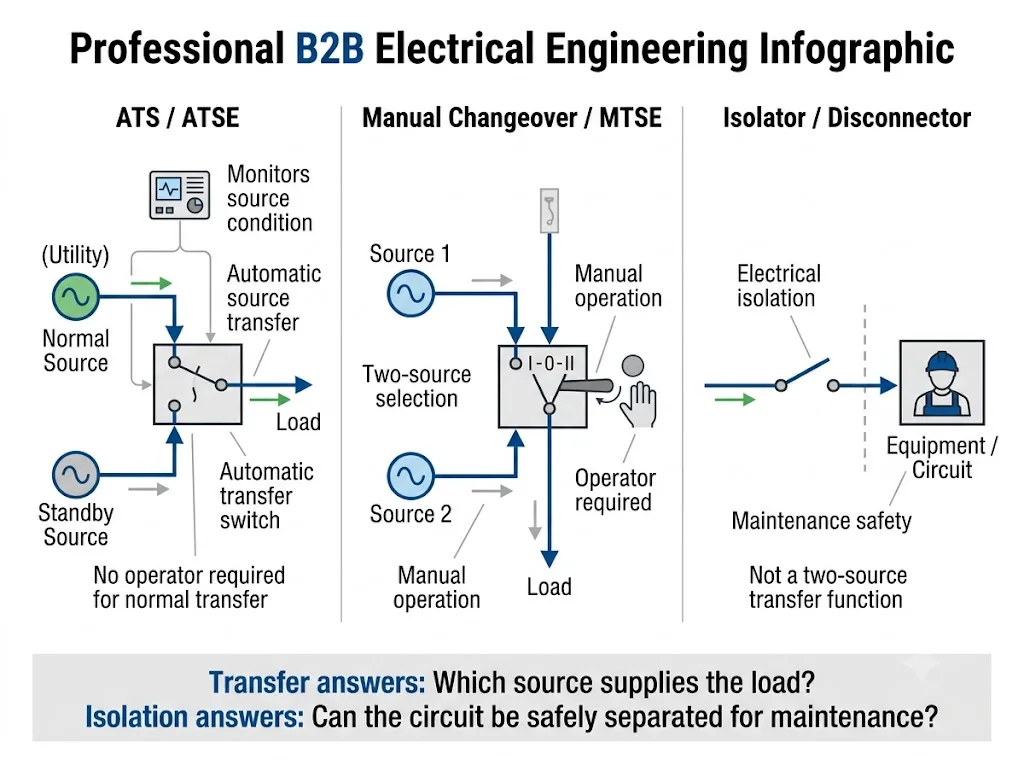
Sebuah ATS automatically monitors defined source conditions and transfers a load between power sources according to its control logic. A manual changeover switch also transfers a load between sources, but a person performs the transfer. An isolator or disconnector has a different primary purpose: establishing electrical isolation for maintenance.
In IEC 60947-6-1 terminology, automatic transfer switching equipment is classified as ATSE. The same standard also distinguishes manually operated transfer switching equipment (MTSE) and remotely operated transfer switching equipment (RTSE). [1]
The practical buying rule is simple: do not choose by appearance, rated current, pole count, or product name alone. First define what the panel actually needs to do.
| Perbandingan | ATS / ATSE | Manual Changeover / MTSE | Isolator / Pemutus Sambungan |
|---|---|---|---|
| Main job | Automatic source transfer | Manual source transfer | Electrical isolation |
| Two-source transfer | Ya | Ya | Not its primary function |
| Automatic source monitoring | Yes, according to controller design | No automatic decision function | Tidak |
| Operator needed for normal transfer | Normally no | Ya | Manual operation is typical |
| Maintenance isolation | Do not assume; verify design | Verify product classification | Fungsi utama |
Rated current tells you current capacity under declared conditions. It does not tell you whether a device performs automatic transfer, manual transfer, or maintenance isolation.
Why the LEEYEE Compact ATS Fits the ATS Side of This Comparison
The LEEYEE compact ATS shown for this product family is designed around a clear two-source transfer function. The front layout provides separate source connections and a load output, together with Auto / Manual operating modes and visible source/load status indication.
What the Product Layout Tells a Buyer
- Two source sides: the unit is arranged for two incoming supplies rather than a single isolation point.
- Load output: the purpose is to connect the load to the selected source.
- Auto / Manual operation: automatic operation is part of the ATS function, while manual operation provides another operating mode.
- Grid / generator application marking: the product layout directly matches a common utility-and-generator backup use case.
- 4-pole configuration shown: the illustrated unit is a four-pole version, so pole selection must still match the actual system design.
This distinction matters in purchasing. A buyer may see a manual handle on both products and assume they are equivalent. They are not necessarily equivalent. The key question is whether the device includes automatic source monitoring and automatic transfer control.
Need to confirm whether this compact ATS fits your panel?
Send the normal source, standby source, voltage, rated current, pole requirement, and whether your backup source is a generator or another utility supply.
Start With the Function, Not the Product Name
“Changeover switch” is widely used as a commercial description, but the term alone is not precise enough for an engineering purchase order. IEC 60947-6-1:2026 uses more specific classifications for transfer switching equipment. [1]
Manually operated transfer switching equipment.
Remotely operated transfer switching equipment.
Automatic transfer switching equipment with automatic control functionality.
What About an “Automatic Changeover Switch”?
“Automatic changeover switch” is a common commercial term for equipment that changes a load between power sources automatically. For a project RFQ, do not rely on the name alone. Confirm the declared product category, controller functions, transfer sequence, ratings, and applicable standard.
When Is an ATS the Correct Choice?
An ATS is appropriate when the load should move between available power sources without relying on a person to perform the normal transfer. Typical ATS controllers monitor source conditions and initiate transfer according to programmed criteria. [3]
This matches the main role of the LEEYEE compact ATS shown here: it is intended for two-source applications in which automatic source transfer is required, while still allowing manual operation when needed.
ATS is usually worth evaluating when:
- The site may be unattended when the normal source fails.
- The load should not wait for an operator to reach the panel.
- The project requires automatic monitoring of two sources.
- A generator is used as the standby source.
- Transfer and retransfer should follow defined controller logic.
- Status or alarm indication is required at the panel.
When Is a Manual Changeover Switch Enough?
A manual changeover switch transfers a load from one source to another through deliberate operator action. Socomec classifies manual transfer products as MTSE and describes them as manually operated devices for switching loads between sources. [4]
Manual changeover may be reasonable when a trained operator is always available and the application can tolerate the required interruption. The important point is that this is a different operating philosophy from an ATS.
Why an Isolator Solves a Different Problem
Transfer switching answers “Which source supplies the load?” Isolation answers “Can the circuit be electrically separated for maintenance?”
IEC 60947-3 covers switches, disconnectors, switch-disconnectors, and fuse-combination units within its scope. [2]
Which One Should Your Project Use?
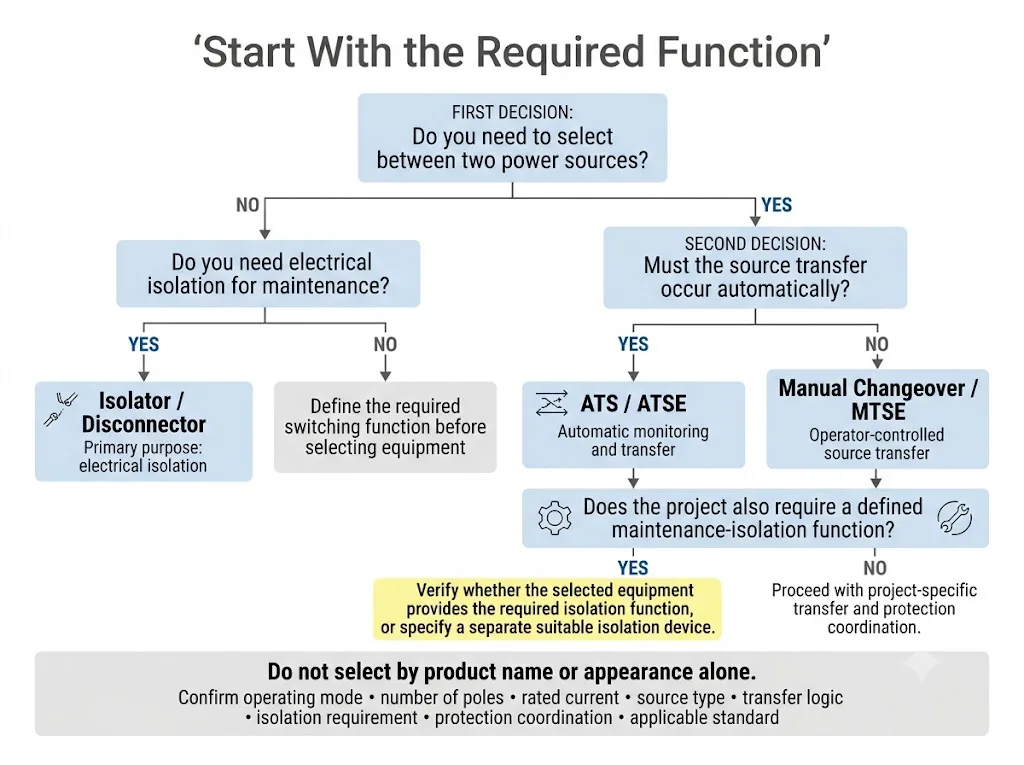
Need automatic two-source transfer?
Evaluate ATS / ATSE. This is the application area that matches the LEEYEE compact ATS shown in this article.
Need two-source selection but manual operation is acceptable?
Evaluate a suitable manual changeover / MTSE arrangement.
Need only electrical isolation for maintenance?
Evaluate a suitable disconnector or switch-disconnector instead of transfer switching equipment.
One Panel May Need Transfer, Protection and Isolation
ATS, protection devices, and isolation devices are not automatically alternatives to one another. A complete low-voltage panel can require more than one of these functions.
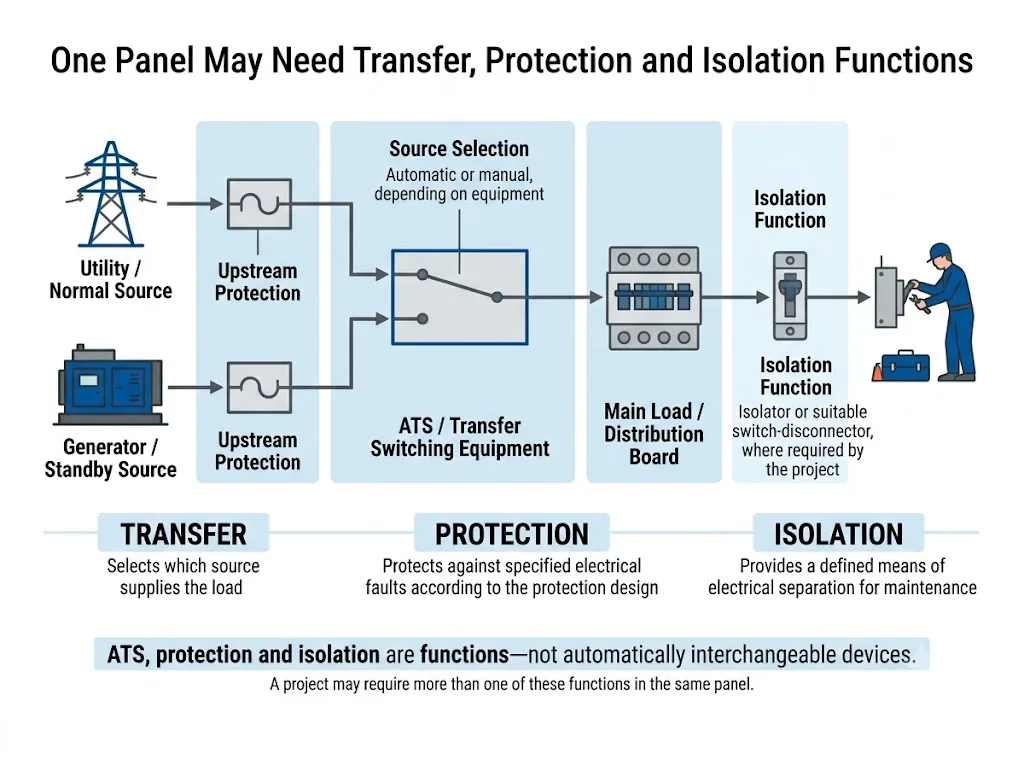
Selects which source supplies the load.
Provides the required fault-protection function.
Provides the required maintenance-separation function.
Typical B2B Project Scenarios
| Scenario | Starting Direction | Apa yang Perlu Dikonfirmasi |
|---|---|---|
| Utility + standby generator | ATS / ATSE | Automatic transfer logic, poles, current, generator interface |
| Staffed site with manually started backup source | Manual changeover may be suitable | Permitted interruption and operating procedure |
| Maintenance isolation | Disconnector / switch-disconnector | Required isolation and switching duty |
| Compact OEM backup panel | Compact ATS if automatic source transfer is required | System voltage, current, poles, source arrangement, control requirements |
Common Procurement Mistakes
1. Seeing a Manual Handle and Assuming It Is a Manual Changeover Switch
A compact ATS can include manual operation while still providing automatic transfer functionality. Check the control system and declared product function.
2. Choosing Only by Current Rating
Two products with the same current rating may have completely different transfer and control functions.
3. Choosing Only by Pole Count
A 4-pole ATS, 4-pole manual changeover switch, and 4-pole isolator are not functionally interchangeable simply because all switch four conductors.
4. Assuming ATS Also Provides Every Protection Function
Transfer, overload protection, short-circuit protection, and isolation are separate engineering functions. Verify the complete panel design.
What Should You Specify Before Ordering?
ATS / OEM Selection Checklist
- Normal-source voltage and frequency
- Standby-source voltage and frequency
- Utility-generator or utility-utility arrangement
- Sistem fase tunggal atau tiga fase
- Arus beban terukur
- Konfigurasi kutub yang diperlukan
- Automatic transfer required?
- Manual operating function required?
- Generator start interface required?
- Transfer and retransfer requirements
- Permitted interruption time
- Upstream protective-device arrangement
- Maintenance isolation requirement
- Installation space and panel dimensions
- Applicable standard or certificate requirement
- Label OEM atau persyaratan pengemasan
Need help confirming the compact ATS configuration?
Send LEEYEE your system voltage, current, source arrangement, pole requirement, panel drawing, and control requirements.
Pertanyaan yang Sering Diajukan
Is an ATS the same as a manual changeover switch?
No. Both can transfer a load between two sources, but an ATS includes automatic source-transfer functionality, while a manual changeover switch depends on operator action.
If an ATS has a Manual mode, does that make it a manual changeover switch?
No. Manual mode is one operating mode of the ATS. If the equipment also includes automatic source monitoring and automatic transfer control, it remains an ATS / ATSE application rather than a basic manual changeover device.
Is a changeover switch always manual?
No. Market terminology varies. For procurement, specify whether the required transfer is manual, remote, or automatic.
Can an isolator replace an ATS?
Not when the project requires automatic two-source transfer. An isolator is selected primarily for electrical isolation, while an ATS performs source-transfer functionality.
Is a 4-pole ATS automatically suitable for every three-phase project?
No. Pole selection and neutral switching depend on the actual system architecture, earthing arrangement, source configuration, and project requirements. Confirm the electrical drawings before ordering.
Can the compact ATS be used for grid and generator applications?
Grid-and-generator backup is a typical two-source ATS application, and the LEEYEE product layout shown here identifies grid and generator source positions. Final suitability still depends on voltage, current, poles, generator controls, and the required transfer sequence.
Referensi
- Komisi Elektroteknika Internasional (IEC). IEC 60947-6-1:2026 — Peralatan sakelar dan pengatur tegangan rendah — Bagian 6-1: Peralatan multifungsi — Peralatan pengalih.
- Komisi Elektroteknika Internasional (IEC). IEC 60947-3:2020 + AMD1:2025 — Low-voltage switchgear and controlgear — Part 3: Switches, disconnectors, switch-disconnectors and fuse-combination units.
- Eaton. Automatic Transfer Switch Fundamentals. Technical guidance covering source monitoring, transfer sequence, and automatic transfer operation.
- Socomec. Manual Transfer Switches (MTSE). Manufacturer technical documentation covering manually operated transfer switching equipment.
Final ATS selection must follow the actual electrical design, source arrangement, voltage, rated current, pole configuration, manufacturer documentation, applicable standards, and project approval requirements.