
PC Class vs CB Class ATS is mainly a question of short-circuit protection architecture. Both can transfer a load between two power sources, but they assign fault interruption differently. For a panel builder, consultant, generator integrator or project buyer, the correct choice should come from the single-line diagram, prospective short-circuit current, existing protective devices, selectivity requirements and project specification — not from price or the class name alone.
Daftar Isi
PC Class vs CB Class ATS: Which Should You Choose?
Under the current IEC 60947-6-1:2026 framework for transfer switching equipment, the practical difference is how short-circuit current is handled.[1]
A Kelas PC transfer switching equipment arrangement is capable of making and withstanding short-circuit current but is not intended to interrupt that short-circuit current itself. The fault is therefore cleared by a coordinated short-circuit protective device elsewhere in the system. A Kelas CB arrangement uses devices capable of making, withstanding and breaking short-circuit current and is provided with overcurrent releases.[2]
The selection question is therefore not simply “Which class is better?” It is: “Where should the short-circuit fault be interrupted in this electrical system?”
LEEYEE Product Scope for This Guide
LEEYEE's standard ATS offering for this application is the compact integrated automatic transfer switch format with source indication, Auto/Manual control and an integrated transfer mechanism. This guide compares PC and CB architectures so buyers can determine whether this compact ATS approach fits the project or whether the single-line diagram calls for a different breaker-based switchboard architecture.
Do not determine IEC class or short-circuit suitability from product appearance alone. The final Class PC designation, Iq, Icw or other short-circuit ratings must be confirmed from the technical documentation for the exact LEEYEE model being supplied.
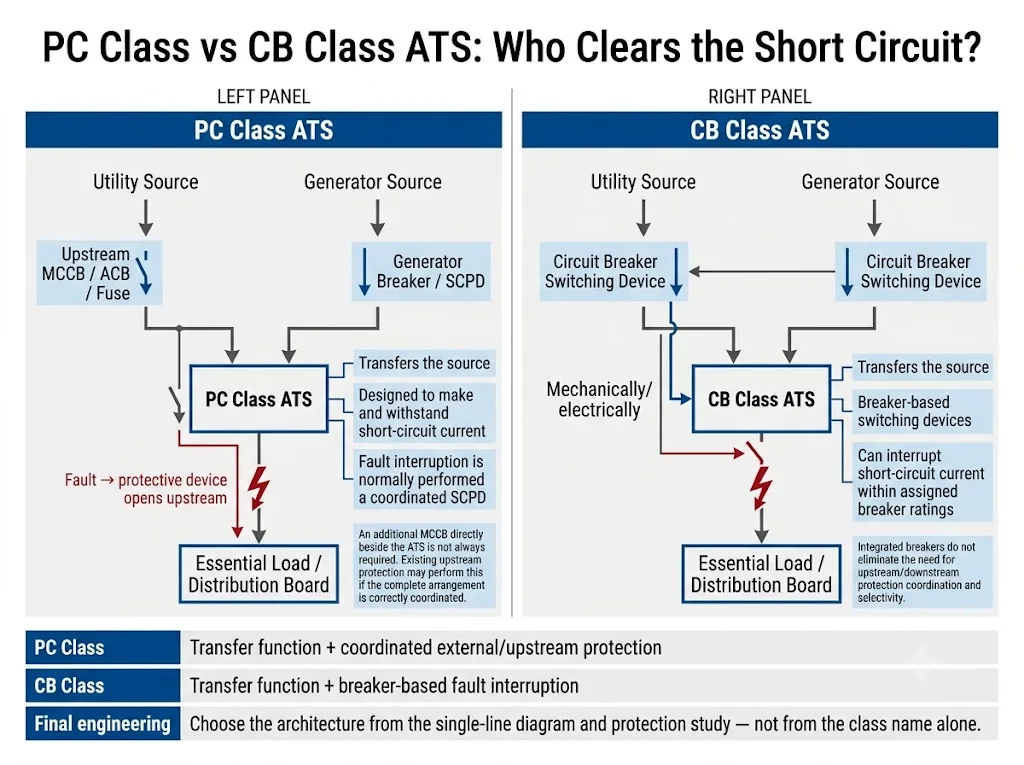
PC Class vs CB Class ATS: Core Differences for Buyers
The ATS class affects more than the switching mechanism. It changes which device clears a fault, which short-circuit parameters matter, how protection is coordinated and what the buyer must confirm before approving the switchboard design.
Start with the short-circuit role. That is the most important purchasing difference.
| Decision Point | PC Class ATS | CB Class ATS |
|---|---|---|
| Short-circuit role | Makes and withstands assigned short-circuit current but is not intended to clear the fault itself. | Uses breaker-based devices intended to make, withstand and break short-circuit current within assigned ratings. |
| Overcurrent release | Not part of the PC transfer switching function. | Provided through the circuit-breaker protection arrangement. |
| Fault clearing | Handled by a coordinated upstream or associated SCPD. | Can be handled by the breaker-based switching device, subject to its ratings and settings. |
| Key short-circuit checks | Iq, Icw where assigned, specified SCPD and clearing time. | Breaker Icu/Ics, Icw where assigned, trip settings and selectivity. |
| Arsitektur perlindungan | Transfer and short-circuit interruption are normally separated. | Transfer and breaker-based fault interruption can be combined at the transfer point. |
| Main buyer risk | Assuming rated current alone proves short-circuit suitability. | Assuming integrated breakers eliminate protection-coordination work. |
ABB describes Class PC, Class CB and their short-circuit characteristics in IEC-market ATS guidance. Schneider Electric likewise distinguishes circuit-breaker-based Class CB and switch-disconnector-based Class PC transfer architectures.[2][3]
PC Class vs CB Class ATS: Quick Selection Matrix
Use this matrix as an initial direction only. It does not replace project-specific short-circuit or selectivity verification.
| Kondisi Proyek | PC Class Direction | CB Class Direction |
|---|---|---|
| Fault interruption already provided by coordinated upstream devices | A compact PC-type transfer architecture may be considered if its short-circuit conditions are satisfied. | CB Class remains possible, but check whether another breaker level is necessary. |
| Transfer point must also provide breaker-based overcurrent protection | Normally not the primary role of the transfer device itself. | A CB Class breaker-based architecture may be the more appropriate configuration to investigate. |
| SDB feeder already protected from the MDB and generator side | May avoid duplicated protection if ATS ratings and coordination are satisfactory. | Adding another breaker level requires a selectivity review. |
| Fault current, SCPD or selectivity data is incomplete | Engineering review required before selection. | Engineering review required before selection. |
Do not turn this table into a fixed rule. A PC or CB Class decision must still be checked against the actual fault current, protective devices, ATS ratings and project specification.
Where Is the Short-Circuit Fault Cleared?
This is the core engineering question behind PC Class vs CB Class ATS selection.
A PC Class ATS does not mean that the circuit is unprotected. It means the device intended to interrupt the short-circuit fault is located elsewhere in the protection architecture.
That protective device may be an upstream MCCB, ACB, fuse or another specified short-circuit protective device. In a utility-generator system, protection may exist independently on the utility feeder and generator side.
With a CB Class ATS, circuit-breaker-based switching devices can also provide fault interruption within their assigned short-circuit ratings and protection settings.[2]
Does a PC Class ATS Need an External MCCB or Fuse?
PC Class requires suitable system-level short-circuit protection, but that does not mean every PC Class ATS needs an additional MCCB installed immediately beside it.
ABB states that Class PC equipment must be protected by circuit breakers or fuses and also provides a sub-distribution-board example where the outgoing circuit breaker in the main distribution board and the generator-side breaker already provide line protection. In that arrangement, additional incoming breakers in the SDB are not automatically necessary.[2]
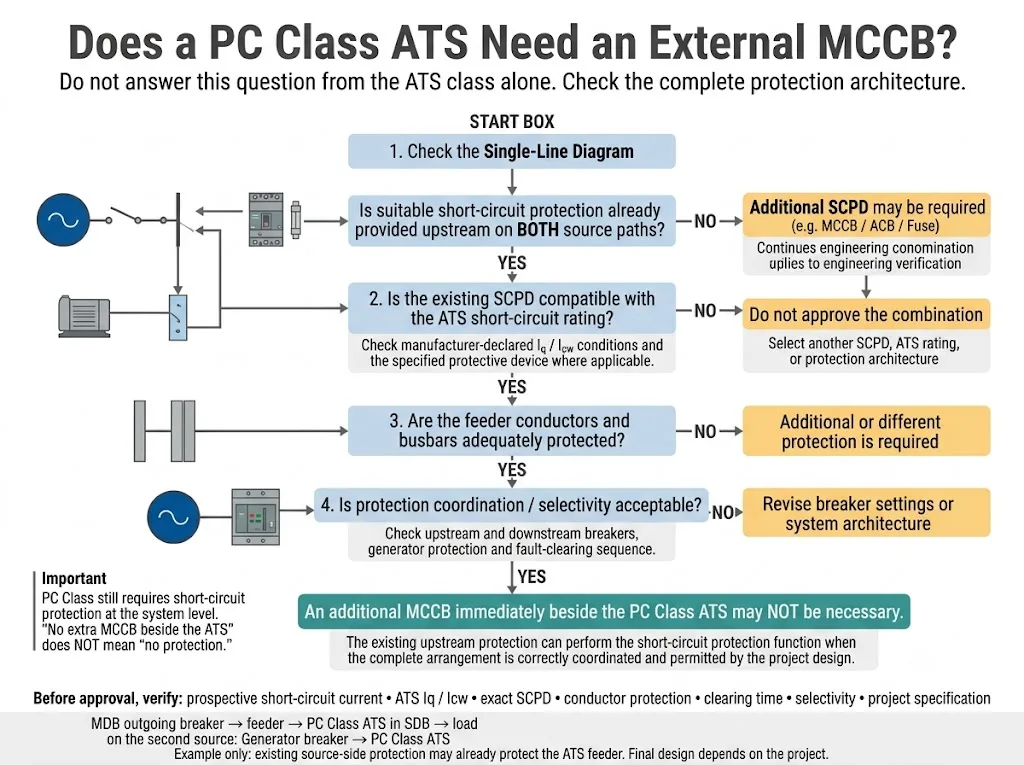
Before deciding that no additional MCCB is required at the ATS location, verify:
- prospective short-circuit current at the ATS installation point;
- the exact model's assigned Iq and/or Icw data where applicable;
- the fuse, MCCB or ACB used as the protective device;
- fault-clearing time;
- feeder conductor and busbar protection;
- generator-side protection;
- upstream and downstream selectivity;
- the project specification and applicable local requirements.
Penting: “No additional MCCB beside the ATS” does not mean “no short-circuit protection.” A compact transfer switch must still operate inside a correctly coordinated protection system.
Which Short-Circuit Ratings Matter?
Rated operational current tells you how much normal load current the ATS is intended to carry. It does melakukan prove that the transfer equipment is suitable for the prospective short-circuit current at the installation point.
Iq — Rated Conditional Short-Circuit Current
ABB describes Iq for Class PC transfer switching equipment as the prospective current that the TSE can satisfactorily withstand when protected by a specified short-circuit protective device for the operating time of that device under the applicable test conditions.[2]
An Iq value therefore should not be separated from the manufacturer's stated protective-device conditions. Do not assume that any breaker with a similar current rating produces the same tested combination.
Icw — Rated Short-Time Withstand Current
Icw is the short-time current assigned by the manufacturer that the equipment can carry without unacceptable damage under specified test conditions. ABB notes that Icw may apply to both Class PC and Class CB equipment where this characteristic is assigned.[2]
The associated duration matters. A short-circuit value without its rating type and, where relevant, withstand time can be misleading.
Icu and Ics — Circuit-Breaker Breaking Ratings
For a CB Class solution, the circuit breaker's short-circuit breaking capability and trip characteristics become part of the transfer-system design. IEC 60947-2:2024 is the current sixth edition of the IEC product standard for low-voltage circuit breakers.[4]
Verify the actual breaker type, operating voltage, Icu/Ics ratings, trip unit and coordination conditions for the proposed breaker.
When Does the LEEYEE Compact ATS Approach Make Sense?
LEEYEE's standard product format is a compact integrated ATS rather than a large breaker-based transfer assembly. This type of product is most naturally evaluated where the transfer function and the main short-circuit interruption function are handled as separate parts of the distribution system.
The compact ATS approach may fit when:
- suitable short-circuit protection already exists upstream;
- the generator has appropriately selected output protection;
- the ATS is used in a downstream essential-load or distribution board;
- the exact ATS short-circuit data is compatible with the proposed SCPD arrangement;
- the design deliberately separates transfer and protection functions.
Engineering review is required when:
- fault current at the ATS is unknown;
- the upstream SCPD is unclear;
- the transfer point must also perform breaker protection;
- the specification explicitly requires a CB Class architecture;
- maintenance, isolation or bypass requirements are not yet confirmed.
Important Product Boundary
The compact LEEYEE ATS shown in product materials should not be presented as a CB Class breaker assembly simply because it has a manual operating handle or switching mechanism. CB Class refers to the applicable protection architecture and breaker-based short-circuit interruption capability, not merely to the physical appearance of the switching device.
Where a tender or single-line diagram specifically requires CB Class, breaker trip units, integrated circuit-breaker protection or a breaker-based incomer arrangement, that requirement should be reviewed separately rather than assumed to be covered by the standard compact ATS.
When Does a Project Need a CB Class Architecture?
CB Class can be appropriate when the switching devices at the transfer point are also intended to perform breaker-based protection functions.
Typical reasons to investigate a CB Class architecture include:
- the transfer-point incomers must also provide overcurrent protection;
- the single-line diagram requires circuit breakers as the source switching devices;
- breaker trip settings are an intentional part of the protection scheme;
- fault interruption is required directly at the transfer switching point;
- the consultant or project specification explicitly requires CB Class equipment.
Schneider Electric's current TransferPacT offering includes Class CB arrangements based on circuit breakers and Class PC arrangements based on switch-disconnectors, illustrating why the architecture should be selected from system requirements rather than appearance alone.[3]
Do not substitute the standard compact LEEYEE ATS for a specified CB Class breaker-based assembly without technical confirmation. If the tender requires CB Class, confirm the complete protection architecture before quotation or model approval.
Protection Coordination and Selectivity Matter More Than the Class Name
Adding circuit breakers at the ATS does not remove the need for coordination. It can create another protection level that must coordinate with upstream and downstream breakers.
ABB notes that when Class CB equipment is installed in a sub-distribution-board arrangement, a selectivity study can be required between the MDB outgoing breaker and the SDB incoming breaker.[2]
The protection study should establish which device is expected to operate first for a downstream fault and whether the selected settings maintain the required continuity for unaffected loads.
Cost, Panel Space and Maintenance: Compare the Complete System
Comparing only the price of the ATS device can lead to the wrong procurement decision.
Cost
A compact transfer-switch arrangement may require additional protective devices when suitable protection does not already exist. If source-side protection is already correctly provided, unnecessary duplication may be avoided.
A CB Class arrangement can combine switching and breaker protection at the transfer point, but complete cost may also include breaker frames, trip units, motor mechanisms, interlocking and additional control hardware.
Panel Space
LEEYEE's compact ATS format can be useful where panel space and straightforward source transfer are important. However, enclosure suitability must still be checked from the exact model dimensions, terminal arrangement, conductor size and required clearances.
A breaker-based CB architecture can occupy substantially different cabinet space depending on current frame, pole configuration, motor operators and busbar arrangement.
Pemeliharaan
A compact ATS and a breaker-based transfer system also create different maintenance tasks. CB architectures may require breaker trip-unit checks, mechanism maintenance and additional protection-setting verification.
Follow the maintenance documentation for the exact equipment selected for the project.
Do Not Choose PC or CB Class by Transfer Speed Alone
The class designation alone does not define the final interruption time experienced by the load.
Actual transfer performance can depend on:
- mechanical operating time;
- source-failure detection delay;
- controller logic;
- generator starting and voltage stabilisation time;
- programmed transfer and retransfer delays;
- the selected transition sequence;
- model-specific operating characteristics.
IEC 60947-6-1:2026 is the fourth edition of the IEC transfer-switching-equipment standard, published on 2 April 2026. Its scope covers MTSE, RTSE, ATSE, stand-alone ATS controllers, bypass/isolation TSE, closed-transition ATSE and fire-pump TSE.[1]
If interruption time is critical, specify the permitted load interruption and required transfer sequence instead of assuming that the PC or CB designation guarantees a particular transfer speed.
Three Project Scenarios That Can Change the Decision
Scenario 1: Compact ATS as an SDB Incomer
The MDB already contains an outgoing breaker protecting the feeder, and the generator also has a correctly selected output breaker.
This is the type of architecture where a compact ATS may be practical if the model-specific short-circuit conditions are correctly coordinated with those source-side protective devices. ABB publishes a comparable Class PC SDB arrangement as an IEC-market example.[2]
Konfirmasi proyek: verify conductor protection, prospective fault current, ATS data and protective-device coordination before approval.
Scenario 2: Transfer Point Must Also Provide Breaker Protection
The source incomers are expected to perform both source switching and busbar or feeder protection duties.
This requirement points toward a breaker-based CB Class architecture rather than automatically applying the standard compact ATS format.
Konfirmasi proyek: check source fault level, breaker interrupting ratings, trip settings, isolation and selectivity before fixing the architecture.
Scenario 3: Essential or Critical Load Board
A critical load does not automatically mean PC Class or CB Class.
The engineering review should also consider permitted interruption time, transfer sequence, source availability, protection selectivity, neutral switching, isolation, maintenance strategy and the applicable project standard.
Konfirmasi proyek: never infer the correct ATS architecture from the phrase “critical load” alone.
Common PC Class vs CB Class ATS Buying Mistakes
1. “CB Class is always safer.”
CB Class provides breaker-based fault interruption, but system safety and continuity still depend on equipment ratings, protection settings, selectivity and the complete installation design.
2. “PC Class has no short-circuit protection.”
Incorrect. PC Class relies on coordinated protection elsewhere in the system. The important question is which SCPD clears the fault.
3. “Every compact PC Class ATS needs two extra MCCBs beside it.”
Not universally. Existing upstream and generator-side protective devices may already provide the required protection in some architectures. The actual combination must be verified for the project.[2]
4. “A compact ATS with a manual handle is a CB Class ATS.”
Physical appearance does not determine IEC class. Classification depends on the switching and short-circuit performance defined for the equipment.
5. “ATS rated current is enough for selection.”
A normal current rating does not prove short-circuit suitability. Prospective fault current and the applicable equipment short-circuit data must also be reviewed.
6. “The cheaper ATS gives the cheaper panel.”
Compare the complete protection and transfer architecture rather than one component price.
A Five-Step PC or CB Class ATS Selection Process
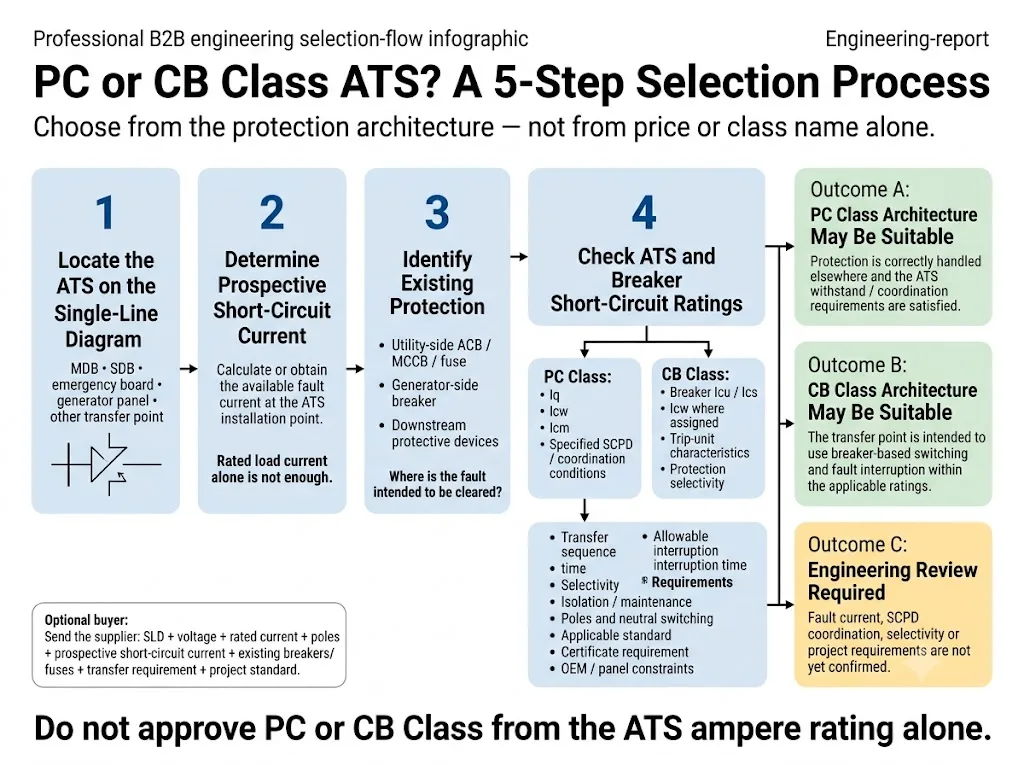
Step 1 — Locate the ATS on the Single-Line Diagram
Identify whether the ATS is installed at the MDB, SDB, emergency distribution board, generator panel or another transfer point.
Step 2 — Determine Prospective Short-Circuit Current
Obtain the calculated or documented available fault current at the ATS terminals. Do not substitute normal load current for fault current.
Step 3 — Identify Existing Protective Devices
Record the utility-side and generator-side ACBs, MCCBs or fuses, together with important downstream protective devices.
Step 4 — Compare the Required Architecture with the Actual ATS
If the system uses coordinated source-side short-circuit protection and requires a compact transfer device, check whether the exact LEEYEE ATS model satisfies the required ratings and configuration.
If the specification requires integrated breaker trip protection at the transfer point, treat that as a CB Class architecture requirement and review it separately.
Step 5 — Check the Complete Project Requirement
Confirm transfer sequence, number of poles, neutral switching, permitted interruption time, protection selectivity, applicable standard, certification, maintenance strategy and enclosure constraints.
Before Ordering: What Should the Buyer Send?
A message such as “Need 63 A ATS” atau “Need 400 A ATS” is not enough to confirm whether the standard compact LEEYEE ATS is the correct solution.
ATS Project Confirmation Checklist
Prepare the following before requesting model selection or an OEM quotation:
Check whether the LEEYEE compact ATS fits your single-line diagram
Send the source arrangement, rated current, poles, prospective fault-current information and existing protective devices. LEEYEE can review whether the standard compact ATS is suitable or whether the specified protection architecture requires a different switchboard solution.
Pertanyaan yang Sering Diajukan
What is the main difference between PC Class and CB Class ATS?
PC Class transfer switching equipment is capable of making and withstanding short-circuit current but is not intended to interrupt that fault itself. CB Class equipment uses switching devices capable of making, withstanding and breaking short-circuit current and includes overcurrent releases.[2]
Does a compact PC Class ATS always need an external MCCB?
It needs suitable system-level short-circuit protection, but an additional MCCB immediately beside the ATS is not always required. Existing source-side protection may already perform that function if conductor protection, ATS short-circuit ratings and the complete coordination arrangement are acceptable.
Is the LEEYEE compact ATS automatically a CB Class ATS because it has a manual operating handle?
No. Physical appearance, a manual handle or Auto/Manual control does not determine IEC classification. The class and short-circuit capability must be confirmed from the exact model's technical documentation.
Can the LEEYEE compact ATS replace a breaker-based CB Class arrangement?
Not automatically. If the single-line diagram requires the transfer switching devices themselves to provide breaker-based overcurrent or short-circuit interruption, that requirement must be reviewed separately.
Can a compact ATS be used in a main distribution board?
Potentially, depending on the protection architecture. The ATS location alone does not determine suitability. Review prospective fault current, existing source protection, required incomer duties, isolation and project specifications.
Is CB Class automatically better for high short-circuit current?
No universal threshold should be used. Compare the actual prospective fault current with the manufacturer's assigned ratings and complete protection arrangement for the proposed solution.
Which is cheaper: PC Class or CB Class ATS?
There is no universal answer. Compare the total switchboard BOM, including protective devices, breaker mechanisms, interlocking, controller, enclosure space, wiring and maintenance requirements.
What should I check first before selecting this type of compact ATS?
Start with the single-line diagram and prospective short-circuit current at the ATS location. Then identify which source-side protective devices already exist and whether the project requires fault interruption at the ATS itself.
Final buyer takeaway: PC Class vs CB Class ATS is a protection-architecture decision, not a product ranking.
LEEYEE's standard compact ATS format is most relevant where the project needs a compact source-transfer device and the required short-circuit protection is correctly coordinated elsewhere in the system. If the transfer point itself must provide breaker-based fault interruption, the project should be reviewed as a CB Class switchboard architecture rather than assuming the standard compact ATS is interchangeable.
Confirm the protection architecture before fixing the ATS model
For an OEM panel or project quotation, prepare the SLD, voltage, rated current, poles, prospective fault-current information and existing breakers or fuses.
Referensi
- Komisi Elektroteknika Internasional (IEC). IEC 60947-6-1:2026 — Peralatan sakelar dan pengatur tegangan rendah — Bagian 6-1: Peralatan multifungsi — Peralatan pengalih arus. Edition 4.0, published 2 April 2026. Halaman publikasi resmi IEC.
- ABB. How to Select an Automatic Transfer Switch Class — A Guide for IEC Markets. Document 1SCC303022C0201. Technical guidance covering Class PC, Class CB, Iq, Icw, Icu, protection architecture and selectivity. Laporan Teknis ABB.
- Schneider Electric. TransferPacT Source Changeover Switches. Manufacturer information covering configurable transfer solutions using circuit breakers for Class CB and switch-disconnectors for Class PC. Schneider Electric source changeover range.
- Komisi Elektroteknika Internasional (IEC). IEC 60947-2:2024 — Peralatan sakelar dan pengatur tegangan rendah — Bagian 2: Pemutus arus. Edition 6.0. Halaman publikasi resmi IEC.