
Selecting an outdoor telecom cabinet ATS starts with the power architecture, not the cabinet size. For cabinet manufacturers, telecom system integrators and project buyers, the ATS must match the two AC sources, design load current, 2P or 4P configuration, available installation space, environmental conditions and required monitoring signals.
A compact automatic transfer switch can be installed on the AC input side of an outdoor telecom cabinet when the cabinet must transfer a load automatically between two suitable AC sources, such as utility power and a standby generator. IEC 60947-6-1 covers transfer switching equipment used for transferring a load between power supply sources.[1]
The LEEYEE compact ATS configuration relevant to this application uses an integrated format with Auto/Manual operation and 2P or 4P versions. Before choosing a model, confirm the two source voltages, phase arrangement, design load current, neutral-switching requirement, cabinet space, internal environmental conditions and any required auxiliary signals.
The outdoor cabinet and the ATS perform different functions. The cabinet provides environmental protection to the equipment installed inside it, while the ATS must separately be suitable for the conditions at its actual mounting position.[2]
Daftar Isi
Where Should the ATS Be Installed?
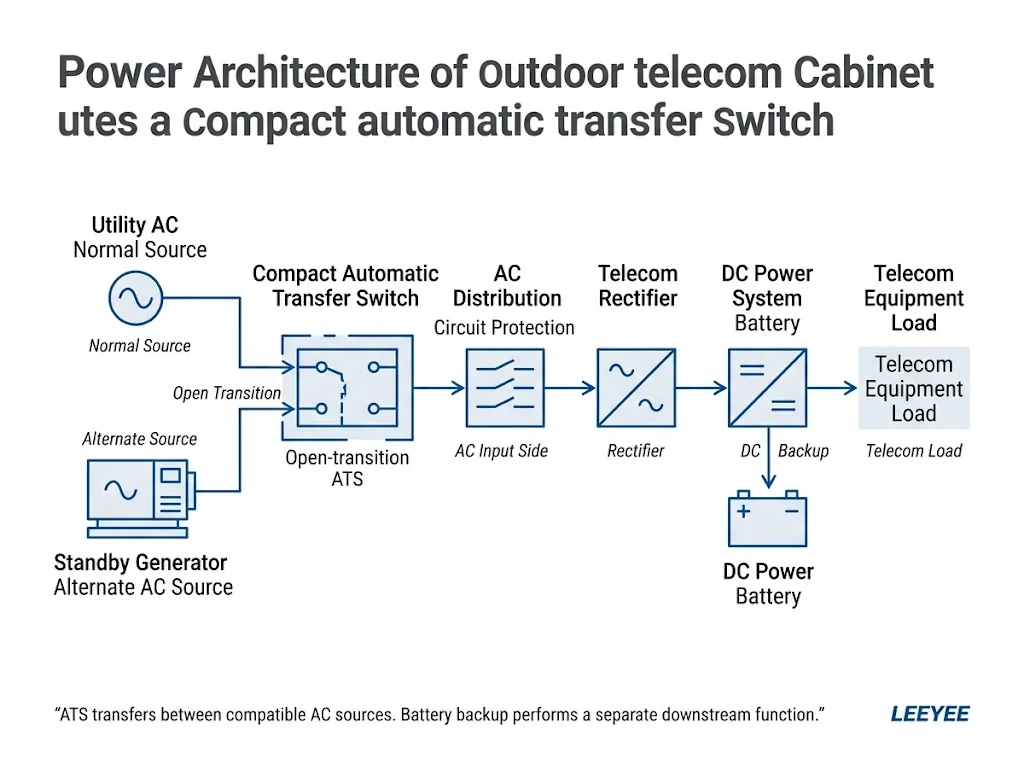
In a typical telecom cabinet power architecture, the ATS is positioned upstream of the AC equipment that requires source redundancy. Its job is to select between Source A and Source B and supply the downstream circuit according to the defined transfer logic.[1]
The downstream equipment may include AC protective devices, distribution equipment and telecom rectifiers. Batteries and the DC subsystem perform a separate backup function and should not be treated as another AC source connected directly to the ATS.
Makna rekayasa: determine the ATS location from the complete power architecture first. If source transfer already takes place elsewhere in the site power system, another ATS inside the telecom cabinet may not be necessary.
Does Every Outdoor Telecom Cabinet Need an ATS?
No. An ATS is relevant only when two suitable power sources exist and automatic transfer between them is required. Outdoor installation by itself does not create a need for an ATS.
Use the “Project Confirmation” column as the decision point before specifying the transfer switch.
| Power Arrangement | Possible ATS Role | Konfirmasi Proyek |
|---|---|---|
| Utility + generator | Transfer between normal and standby AC power | Confirm voltage, phase, generator arrangement and control sequence |
| Two AC feeders | Transfer between preferred and alternate feeders | Confirm source compatibility and transfer requirements |
| Single AC source | No alternate source is available | Do not specify an ATS only because the cabinet is outdoors |
| Transfer already provided upstream | Cabinet ATS may duplicate an existing function | Review the approved site single-line diagram |
Kesimpulan pengadaan: define the two AC sources and the downstream load first; select the ATS only after the power architecture is clear.
Why This Compact ATS Format Fits Telecom Cabinet Integration
The LEEYEE product format used for this application is a compact integrated ATS rather than a separate large transfer-switch cabinet. This makes the product direction more suitable for equipment cabinets where electrical space must be shared with breakers, rectifiers, terminals, monitoring devices and other components.
The following points describe visible functions and configuration choices relevant to cabinet integration. Additional electrical and communication functions must be confirmed for the selected model.
| Product Feature | Makna Teknik | Pemeriksaan Proyek |
|---|---|---|
| Compact integrated body | Suitable for integration into space-limited electrical cabinets | Verify actual model dimensions and terminal clearance |
| 2P configuration | Relevant to suitable single-phase source arrangements | Confirm which conductors must be switched |
| 4P configuration | Available where a three-phase application requires neutral switching | Confirm neutral and earthing arrangement |
| Auto / Manual operation | Supports automatic transfer and local operating access | Leave sufficient front operating clearance |
| A / B source indication | Makes the two-source operating concept easy to identify locally | Confirm required external status outputs separately |
Penting: panel indication does not prove that every model includes generator-start output, RS485, Modbus or a specific dry-contact arrangement. Those functions must be confirmed from the selected ATS documentation.
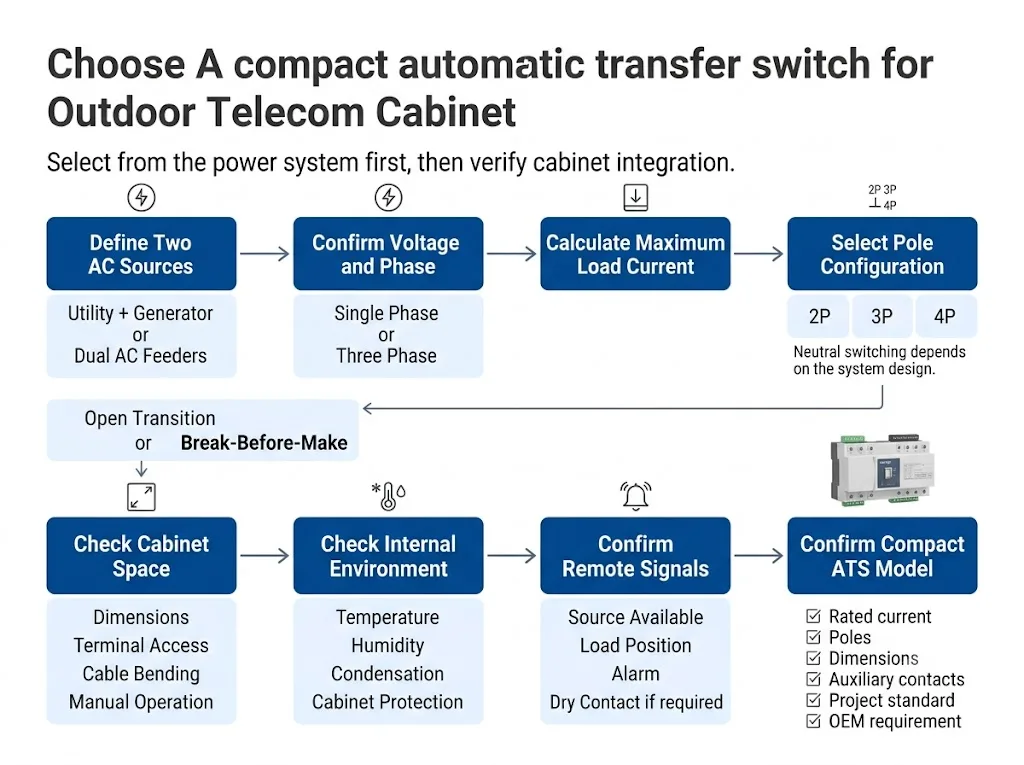
Use the Power System to Drive ATS Selection
A compact telecom cabinet ATS should be selected from the electrical system outward. Starting with a preferred switch size and trying to make the project fit around it increases the risk of selecting an unsuitable pole arrangement, current rating or cabinet layout.
How Should the ATS Current Rating Be Selected?
Select the ATS current rating from the electrical load and complete circuit requirements. Cabinet size alone does not determine the required current rating.
The designer should establish the expected load current, load characteristics and upstream protective arrangement before confirming the transfer switch. The proposed model must then be checked against its actual manufacturer ratings and project requirements.
Do not select an ATS from generator kW alone. Generator capacity may be part of the system review, but ATS selection must be based on the actual electrical circuit, including source voltage, phase arrangement, load current and protective-device coordination.
2P or 4P: Which Configuration Fits the Cabinet?
For the LEEYEE compact ATS product direction shown for this application, the main pole-selection question is whether the project requires a 2P or 4P configuration.
The decision is not based on cabinet size. It depends on the electrical system, particularly whether the neutral must be switched.
Use this table as a project-confirmation guide rather than as a substitute for the approved source and earthing design.
| Konfigurasi | Typical Application Question | What Must Be Verified |
|---|---|---|
| 2P | Is the telecom cabinet using a suitable single-phase dual-source arrangement? | Which conductors must be switched and how the neutral is handled |
| 4P | Does the three-phase application require neutral switching? | Source neutrals, generator arrangement and project earthing design |
Makna pembeli: do not choose 4P simply because it has more poles. Send the single-line diagram or a clear description of the source and neutral arrangement before model confirmation.
Keep the Transfer Type Within the Real Product Scope
Transfer switching equipment is not one single functional category. IEC 60947-6-1:2026 covers automatic transfer switching equipment and includes specific requirements for configurations such as bypass/isolation equipment, closed-transition ATSE and stand-alone ATS controllers.[1]
For this telecom cabinet application, the relevant LEEYEE product direction is a compact conventional open-transition ATS. Open transition disconnects the load from one source before connecting it to the other source.
Whether the short transfer interruption is acceptable must be evaluated from the complete telecom power architecture, including the downstream rectifier, DC system and battery arrangement.
LEEYEE product boundary: closed-transition and bypass/isolation systems are separate engineered solutions and should not be presented as standard functions of this compact ATS product.
Cabinet Space Is Part of ATS Selection
Outdoor telecom cabinets often combine power conversion, circuit protection, monitoring, batteries and thermal-management equipment in a limited volume. A compact ATS may reduce space pressure compared with a separate transfer-switch cabinet, but physical fit alone is not enough.
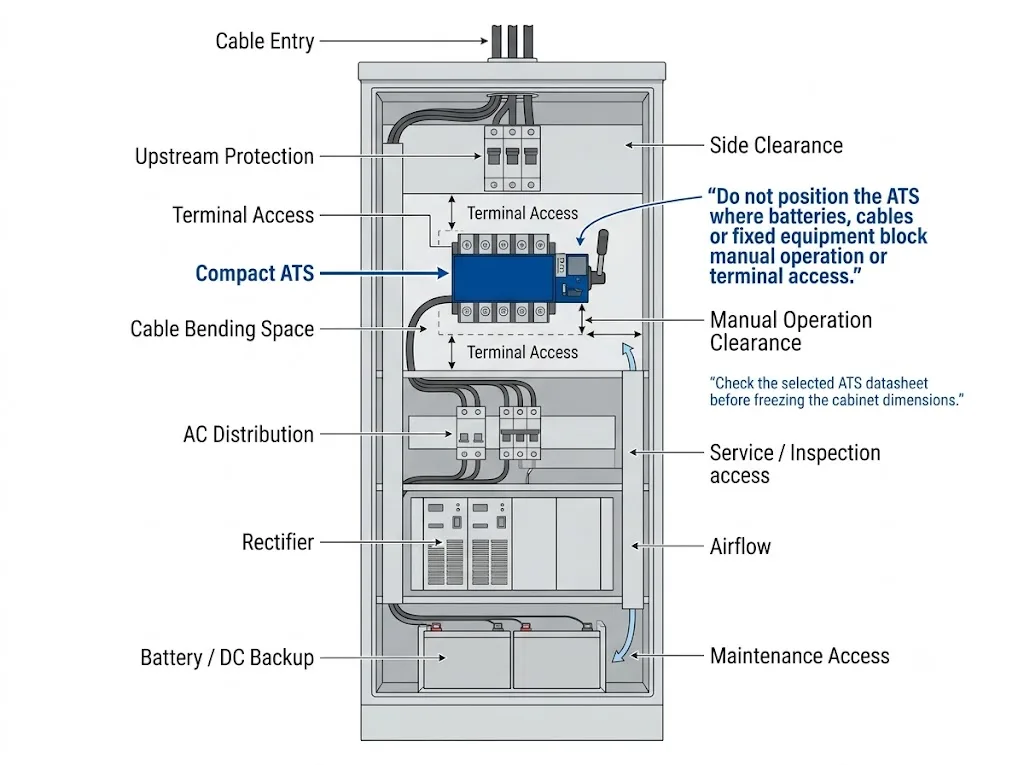
Check cable entry, terminal access, conductor bending space, Auto/Manual operating clearance, airflow and future replacement access before the mechanical layout is frozen.
Before approving the cabinet layout, confirm:
- Actual ATS width, height and depth from the selected model drawing.
- 2P or 4P configuration and resulting installation dimensions.
- Required installation orientation.
- Incoming Source A and Source B cable direction.
- Outgoing load cable direction.
- Terminal access for installation and maintenance.
- Conductor bending space.
- Front clearance for Auto/Manual operation.
- Distance from major heat-producing components.
- Accessibility after rectifiers, batteries and other equipment are installed.
Outdoor Cabinet Protection and ATS Conditions Are Different Questions
IEC 60529 defines degrees of protection provided by enclosures for electrical equipment.[2] This means the IP rating of the complete outdoor telecom cabinet should not automatically be applied to every component installed inside it.
ETSI Environmental Engineering work addresses environmental conditions for telecommunications equipment, including temperature, humidity, contaminants, mechanical conditions and outdoor enclosure applications.[3]
For ATS selection, the useful engineering question is therefore: what conditions will exist at the ATS mounting position inside the cabinet?
- Can moisture or water ingress reach the electrical compartment?
- What internal temperature is expected under solar and equipment heat loads?
- How is the cabinet cooled or ventilated?
- Is condensation possible?
- What humidity range may occur internally?
- Is heavy dust, salt or corrosive contamination expected?
Diperlukan konfirmasi proyek: do not claim that the ATS is suitable for a specific IP class, temperature or humidity range unless the selected model documentation confirms it. Compare the cabinet's expected internal conditions with the actual ATS operating limits.
Thermal Conditions Inside the Cabinet Matter
Conditions around the ATS can differ significantly from outdoor ambient conditions. Solar heating, telecom rectifiers, power supplies and restricted airflow may all affect the internal cabinet temperature.
ETSI Environmental Engineering includes thermal-management considerations for telecommunications equipment and enclosures.[3] ETSI also maintains environmental-condition standards for telecommunications equipment used at weatherprotected and non-weatherprotected locations.[4]
For procurement, compare the selected ATS operating limits with the expected cabinet micro-environment rather than copying an outdoor temperature range from an unrelated telecom product.
What Changes When Source B Is a Generator?
The LEEYEE compact ATS product format shown for this application clearly supports a two-source operating concept, and the 4P product marking identifies generator and grid use. However, that does not mean every controller function required by a generator project should be assumed to be built in.
A utility-generator project must define how source availability is detected, how the generator is started, when transfer is permitted and when the system should return to the preferred source.
IEC 60947-6-1 covers automatic transfer switching equipment and ATS controllers, but specific generator-start interfaces, time-delay functions and auxiliary contacts depend on the actual equipment configuration.[1]
For a utility-generator telecom cabinet, confirm:
- Utility voltage and phase configuration.
- Generator output voltage and phase configuration.
- 2P or 4P requirement.
- Required generator start and stop interface.
- Source monitoring requirements.
- Transfer and return timing requirements.
- Neutral-switching requirement.
- Whether downstream equipment can tolerate open-transition interruption.
Do not assume that the generator symbol or source marking on the ATS proves the presence of a particular generator-start output, programmable delay or communication terminal. Confirm those functions against the selected LEEYEE model documentation.
Plan Remote Status Signals Before Wiring the Cabinet
Outdoor telecom cabinets may be installed at remote or unattended sites, so some projects require ATS status to be reported to an external monitoring system.
The front-panel source and operating indicators are useful for local inspection, but local indication and external signalling are not the same feature.
Define the information the monitoring system requires first, then verify whether the selected ATS/controller provides the necessary auxiliary outputs.
| Information Needed | Pertanyaan Proyek | Supplier Confirmation |
|---|---|---|
| Source availability | Must the remote system know whether Source A or Source B is available? | Confirm available auxiliary contacts |
| Load position | Must the system know which source is supplying the load? | Confirm external position/status output |
| Alarm status | Which abnormal conditions must be reported? | Confirm actual controller alarm capability |
| External integration | Are dry contacts or a communication interface required? | Verify the selected model before ordering |
Batasan proyek: do not assume RS485, Modbus, BMS integration or a specific number of dry contacts from the product appearance. These functions require separate model confirmation.
Leave Space for Auto/Manual Operation and Maintenance
The LEEYEE compact ATS has local Auto/Manual operation on the front panel. That makes front access an important part of cabinet layout rather than an optional detail.
Avoid positioning the ATS behind batteries, cable bundles, rectifier modules or fixed equipment that blocks the operating interface or makes terminal access difficult.
A layout that looks acceptable before wiring may become difficult to use after Source A, Source B and load conductors are installed. Review access using the actual final cabinet arrangement.
Common Selection Mistakes to Avoid
Selecting by current rating only
Rated current is only one part of the decision. Source voltage, phase configuration, 2P or 4P selection, transfer method, protective-device coordination and installation conditions also matter.
Assuming “outdoor cabinet” means “outdoor-rated ATS”
The cabinet enclosure and internal ATS perform different functions. Verify cabinet protection and ATS operating conditions separately.[2]
Choosing 4P simply because it has more poles
A 4P ATS is not automatically a better choice. Neutral switching must follow the actual source, generator and earthing arrangement.
Freezing cabinet dimensions before checking the ATS drawing
Physical fit is not enough. Terminal access, cable bending, Auto/Manual operation and maintenance clearance must remain practical.
Assuming front-panel indication equals remote communication
Visible source and operating indicators support local inspection, but remote dry contacts or communication functions must be confirmed separately.
Treating the ATS as the complete telecom backup-power system
The ATS performs AC source transfer. Rectifiers, batteries, DC distribution, generator controls and monitoring equipment perform separate functions within the overall telecom power architecture.
What Should a Buyer Send Before Requesting an ATS Model?
Outdoor Telecom Cabinet ATS Enquiry Checklist
A cabinet drawing, electrical single-line diagram and monitoring I/O list are especially useful when the project involves generator control, neutral switching or remote supervision.
Need Help Confirming an ATS for Your Telecom Cabinet?
Send LEEYEE the two source voltages, phase configuration, design current, 2P or 4P requirement, available cabinet space and required auxiliary signals. The project can then be reviewed against the available compact ATS configuration.
Pertanyaan yang Sering Diajukan
Is this compact LEEYEE ATS suitable for an outdoor telecom cabinet?
It can be suitable as an internal AC source-transfer component when the electrical ratings, 2P or 4P configuration, available cabinet space and internal environmental conditions match the project. The outdoor enclosure must provide the required protection for the installed equipment.
Where is the ATS normally installed in the telecom cabinet?
It is typically positioned on the AC input side before downstream distribution or power-conversion equipment that requires dual-source supply. The exact position must follow the approved electrical architecture.
Can this ATS be used between utility power and a generator?
The product format supports a two-source utility/generator application concept. However, generator-start control, monitoring, delay functions and auxiliary outputs must be confirmed for the specific ATS/controller configuration.
Should I choose a 2P or 4P ATS?
Use 2P or 4P according to the actual phase, neutral and earthing arrangement. Do not choose 4P automatically simply because it has more poles.
Does an outdoor telecom cabinet automatically require an IP65 ATS?
No. IEC 60529 applies IP codes to protection provided by enclosures.[2] If the ATS is installed inside a protected cabinet, evaluate the cabinet protection and the internal environment separately, then confirm that the ATS is suitable for those conditions.
Does Auto/Manual operation mean the ATS has remote communication?
No. Auto/Manual operation and front-panel indication are local functions. Dry contacts, RS485, Modbus or other remote interfaces must be confirmed separately for the selected controller and model.
Is a closed-transition ATS necessary for a telecom cabinet?
Not automatically. IEC 60947-6-1 treats closed-transition capability as a specific ATS configuration.[1] The LEEYEE compact ATS direction discussed on this page is conventional open-transition transfer unless another engineered solution has been specifically confirmed.
What information should I provide when requesting a telecom cabinet ATS quotation?
Provide both source voltages, phase arrangement, design current, required 2P or 4P configuration, source type, cabinet dimensions, expected internal environment, required auxiliary signals, project specification, quantity and OEM requirements.
Referensi
- Komisi Elektroteknika Internasional (IEC), IEC 60947-6-1:2026 — Peralatan sakelar dan pengatur tegangan rendah — Bagian 6-1: Peralatan multifungsi — Peralatan pengalih arus. Halaman publikasi resmi IEC.
- Komisi Elektroteknika Internasional (IEC), IEC 60529 — Degrees of protection provided by enclosures (IP Code). Halaman publikasi resmi IEC.
- European Telecommunications Standards Institute (ETSI), Environmental Engineering (EE), covering environmental conditions, power supply, thermal management, racks, cabinets and outdoor ICT deployments. ETSI Environmental Engineering.
- European Telecommunications Standards Institute (ETSI), EN 300 019 series — Environmental conditions and environmental tests for telecommunications equipment. ETSI EN 300 019 documents.
