
For a commercial building, the right automatic transfer switch is selected from the backup circuit it actually supplies, not simply from the total electrical capacity of the building. This is especially important for compact 2P and 4P ATS products used in small commercial distribution boards and backup panels.
This guide focuses on light-commercial applications such as selected backup circuits in offices, retail premises, apartment common areas, small commercial facilities, control panels and auxiliary distribution boards. It is written for panel builders, electrical contractors, generator integrators, distributors and project buyers.
Daftar Isi
Quick Answer: When Does a Compact ATS Fit a Commercial Building?
A compact ATS can be suitable when a defined commercial backup branch needs to transfer between two AC sources and the circuit falls within the ATS ratings. For a typical utility-generator arrangement, one source is utility power and the other is the generator supply. [2][3][4]
The published LEEYEE ATS-63 range is 6A–63A, 2P or 4P, AC110V / AC220V / AC400V, 50/60Hz, PC class and AC-31B. LEEYEE lists compact generator backup, control panels, distribution boards and light-commercial systems among its intended applications. [4]
Which Commercial Loads Should Be Put on the Backup Branch?
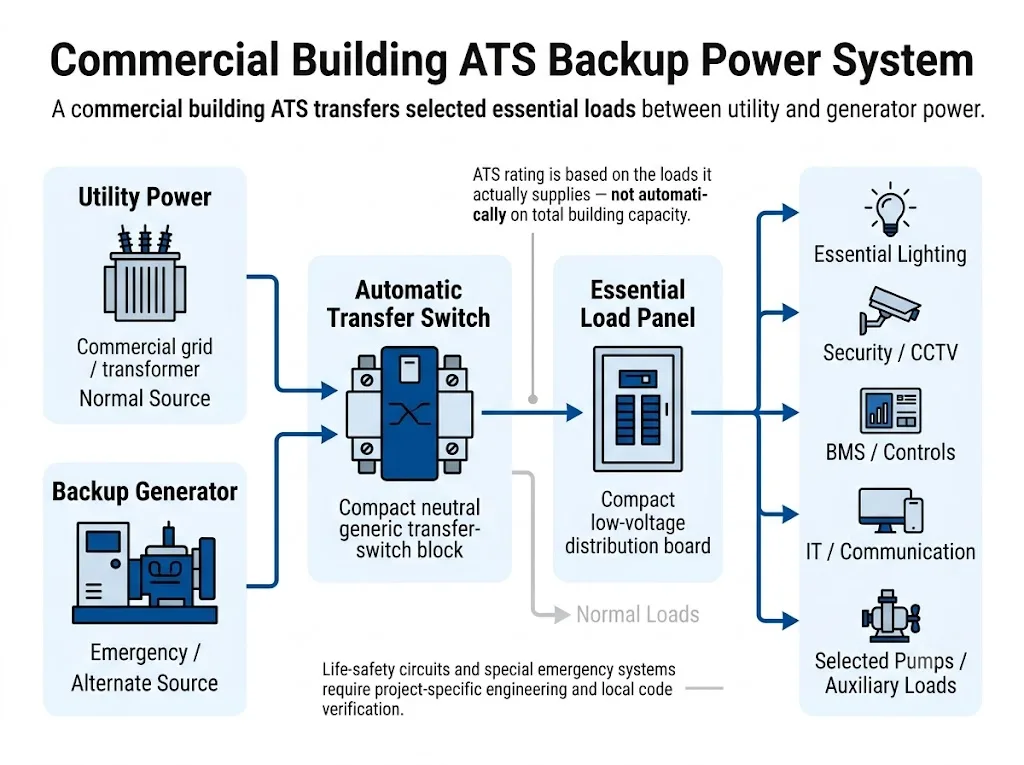
There is no universal commercial-building load list. The electrical designer should first decide which circuits require the alternate source. Only then can the transfer branch be sized.
The most important column below is “What to confirm” because the load name alone is not enough for ATS selection.
| Load Group | Contoh Tipikal | Apa yang Perlu Dikonfirmasi |
|---|---|---|
| Lighting | Selected backup or essential lighting circuits | Actual branch current and project backup requirement |
| Security | CCTV, access control and monitoring equipment | Load current and whether separate UPS support is used |
| Komunikasi | Network cabinet or communication equipment | Whether the equipment can tolerate transfer interruption |
| Controls | Control panels and selected BMS auxiliary circuits | Required source continuity and monitoring interfaces |
| Pumps / Motors | Selected small auxiliary pumps or motors | Running current, starting current and switching duty |
Procurement conclusion: define the circuits on the backup branch first. Do not size a compact ATS from the building's total service rating.
Life-safety circuits require separate project confirmation
Fire-pump systems and other life-safety circuits can have dedicated equipment, transfer and approval requirements. IEC 60947-6-1:2026 includes specific provisions for transfer switching equipment used with electric-driven fire-pump control equipment. [1]
Do not approve a compact ATS for a life-safety application only because the current rating appears sufficient. The responsible engineer must confirm the equipment category, transfer function, protection, certification and local project requirements.
Where Does the ATS Sit in a Commercial Backup-Power System?
An ATS transfers a load between power sources. It does not replace the upstream circuit breaker, fuse, generator controls, distribution board or the engineering design of the complete installation.
For a small commercial branch, a common concept is: utility source + alternate source → ATS → backup distribution branch. Larger commercial buildings may instead use multiple transfer switches or engineered switchgear assemblies.
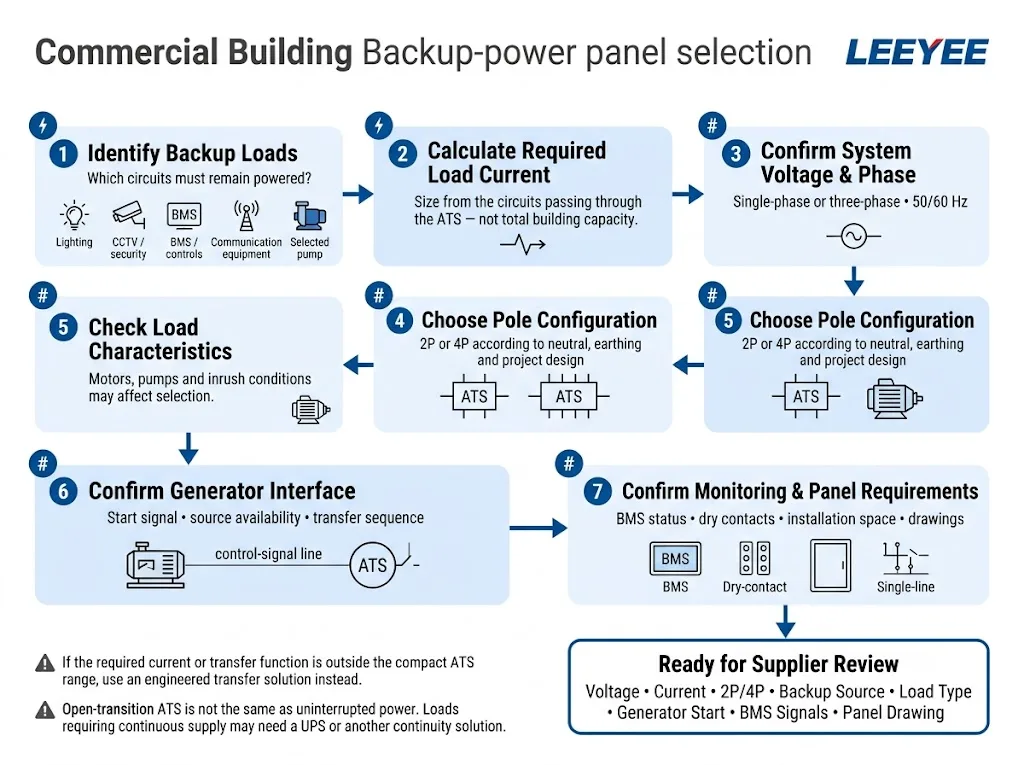
How Should You Size the ATS Current?
Start with the load passing through the switch. The ATS current rating must be suitable for that branch, while the load characteristics and surrounding protection system also need to be checked.
- Identify the transferred circuits. Separate the loads requiring backup power from circuits that remain outside the ATS branch.
- Determine the operating current. Confirm the load current together with system voltage, phase arrangement and frequency.
- Review load characteristics. Motors, pumps and similar loads can have starting or inrush conditions that are not represented by running current alone.
- Check the protection system. The ATS must be applied within its published ratings and coordinated with the actual short-circuit and upstream protective-device conditions.
- Confirm panel space and wiring. Verify the mounting arrangement, conductor routing and available installation dimensions before ordering.
What Does the Real LEEYEE ATS-63 Look Like?
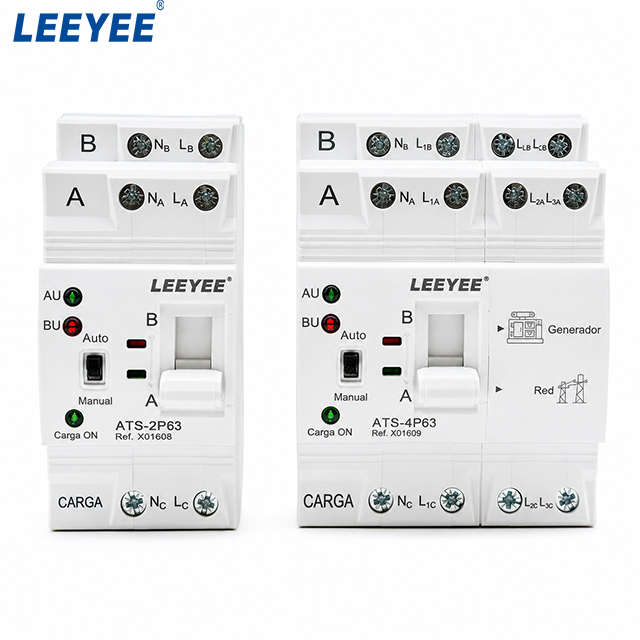
The product used for this application is LEEYEE's actual compact ATS-63 family, not a large cabinet-style transfer switch and not a standard circuit-breaker-looking device. The real product is available in 2P and 4P versions. [4]
Where Is ATS-63 a Good Fit?
Typical application direction
- Small commercial backup distribution boards
- Selected office or retail backup circuits
- Apartment common-area auxiliary circuits
- Compact control cabinets
- Telecom or monitoring cabinets
- Utility-to-generator backup branches where all electrical conditions match
Use another engineered solution when required
- The transfer circuit exceeds 63A
- The application is a large building main incomer
- Closed transition or source paralleling is required
- Bypass-isolation transfer equipment is required
- A specialized life-safety transfer system is specified
- The connected load cannot tolerate transfer interruption
What Are the Published ATS-63 Selection Limits?
These values are for initial model screening. Final approval should use the latest LEEYEE documentation for the exact ordered configuration. [4]
| Parameter | Published ATS-63 Data | Selection Meaning |
|---|---|---|
| Rated current Ie | 6 / 10 / 16 / 20 / 25 / 32 / 40 / 50 / 63 A | Choose from the actual transferred-load requirement |
| Poles | 2P / 4P | Match the phase and neutral arrangement |
| Working voltage Ue | AC110V / AC220V / AC400V | Match the project system voltage |
| Frekuensi | 50/60Hz | Confirm destination-system frequency |
| Kelas | PC | Coordinate the ATS with the required upstream protection |
| Kategori pemanfaatan | AC-31B | Confirm the actual load duty against product documentation |
| Arus hubung singkat pengenal Iq | 5kA | Verify project fault conditions and upstream protection |
| Pemasangan | rel DIN | Suitable for compact panel integration when dimensions and clearances match |
Procurement conclusion: “63A ATS” is not a complete specification. Current, voltage, poles, load duty, wiring, protection and installation conditions all need confirmation.
Should You Choose 2P or 4P?
ATS-63 is available in both 2P and 4P versions. [4] Pole selection should follow the actual electrical system rather than a simple purchasing shortcut.
| Opsi | Typical Direction | Pemeriksaan Proyek |
|---|---|---|
| 2P | Commonly evaluated for single-phase circuits | Confirm line, neutral, source wiring and earthing arrangement |
| 4P | Used where three phases and neutral are switched | Confirm neutral switching, source configuration and project requirements |
Procurement conclusion: do not order 2P or 4P from phase count alone. The approved neutral and earthing arrangement must also be checked.
What Does Open Transition Mean for Commercial Loads?
In an open-transition transfer, the switch uses a break-before-make sequence: it disconnects the load from one source before connecting the other source. [2]
That means the sources are not intentionally paralleled during transfer. It also means the load experiences an interruption while the source connection changes. [2]
ATS is not the same as UPS power
If a communication device, server, controller or other load cannot tolerate a transfer interruption, the complete power system may need a UPS or another continuity solution in addition to source transfer.
Confirm this from the real load requirement rather than assuming that the ATS alone provides uninterrupted power.
IEC 60947-6-1:2026 separately covers automatic transfer switching equipment and includes specific provisions for closed-transition and bypass/isolation transfer equipment. [1] Projects requiring those functions should use equipment specifically designed and verified for them.
Can ATS-63 Be Used with a Backup Generator?
Yes. LEEYEE's current ATS-63 product information lists generator backup as an intended application for switching between utility power and generator backup power in small power systems, provided the electrical parameters match the application. [4]
However, generator backup switching dan generator auto-start output are different functions. Some ATS systems can send a genset-start signal when the normal source becomes unacceptable, but that capability is controller-specific. [3]
Do not assume a generator-start dry contact from the product photo
The real ATS-63 image clearly shows generator/grid application markings, but an image cannot prove a specific remote generator-start output. The current public ATS-63 product page also does not publish a generator-start dry-contact specification. [4]
If the project requires the ATS to start a generator, confirm the exact controller, terminal functions and wiring documentation with LEEYEE before approval.
What About BMS, Dry Contacts or Modbus?
Commercial projects may require source status, switch-position information or alarms to be sent to a BMS or PLC. That requirement should be defined during project specification.
The current public ATS-63 technical data does not list Modbus communication, BMS integration or a defined set of remote status dry contacts as standard published functions. [4]
What Changes When the ATS Is Installed in a Low-Voltage Panel?
The ATS is only one device inside the complete assembly. When it is integrated into a low-voltage power switchgear and controlgear assembly, the finished assembly must be evaluated as an assembly rather than treating the ATS specification as approval of the whole panel.
IEC 61439-1:2020 provides general rules for low-voltage switchgear and controlgear assemblies, while IEC 61439-2:2020 provides specific requirements for power switchgear and controlgear assemblies within its scope. [5][6]
The panel designer must therefore consider the complete arrangement, including protection, conductors, short-circuit conditions, temperature rise, clearances, enclosure design and the applicable verification requirements.
Example: Small Commercial Backup Panel
Consider a small commercial facility that wants backup power for selected lighting, security equipment, a network cabinet and control circuits.
The panel builder first calculates the transferred load. Then the builder confirms system voltage, phase arrangement, 2P or 4P requirement, load characteristics, protection and installation space.
If those conditions fall within the selected ATS-63 configuration and the project does not require unsupported transfer or communication functions, the compact DIN-rail ATS can be evaluated for the branch. [4]
If the project instead needs a 250A or 630A building main transfer system, closed transition, bypass isolation or another specialized transfer function, ATS-63 is outside that application direction.
Common Commercial ATS Selection Mistakes
The last column shows the information that should replace each common purchasing shortcut.
| Shortcut | What It Misses | Better Confirmation |
|---|---|---|
| “I need 63A.” | Voltage, poles, wiring and load duty | Send current, voltage, phase and wiring details |
| Use the building incomer rating | Actual backup branch | Calculate only the circuits transferred by this ATS |
| Ignore motor starting | Inrush and switching duty | Provide the actual load type and starting conditions |
| Choose 2P / 4P from phase count only | Neutral and earthing requirements | Review the approved system wiring |
| Treat ATS as UPS | Transfer interruption | Check the load's continuity requirement |
| Assume BMS or genset-start terminals | Exact controller I/O | Send the required signal list before ordering |
Procurement conclusion: selecting the ATS by ampere rating alone is not enough for commercial panel approval.
What Should You Send Before Ordering?
A useful commercial ATS enquiry should give LEEYEE enough information to check the application against the actual product scope.
Commercial ATS Project Checklist
- Sistem fase tunggal atau tiga fase
- Tegangan sistem yang terukur
- 50Hz or 60Hz
- Calculated transferred-load current
- Load type: lighting, electronics, motor, pump, etc.
- Jenis sumber normal
- Jenis sumber alternatif
- Required 2P or 4P configuration
- Neutral switching requirement
- Pengaturan pembumian
- Perangkat pelindung hulu (upstream)
- Available panel space
- Diagram satu garis
- Wiring or panel drawing
- Generator-start requirement, if any
- BMS / dry-contact / communication requirement, if any
- Required approval or documentation
- Quantity and OEM requirement, if applicable
Need to confirm whether ATS-63 fits your commercial backup branch?
Send the system voltage, transferred-load current, 2P / 4P requirement, source type, load type, panel space and available electrical drawings. If you need generator-start or BMS signals, include the required I/O list so the exact configuration can be checked rather than assumed.
Pertanyaan yang Sering Diajukan
Can LEEYEE ATS-63 be used in a commercial building?
Yes, for a suitable small commercial backup branch when current, voltage, pole configuration, load duty, protection and installation conditions match the selected ATS-63 configuration. The published product range is 6A–63A. [4]
Can ATS-63 be used as the main ATS for a large hotel or shopping mall?
Not when the required transfer circuit exceeds the ATS-63 product scope. ATS-63 is intended for compact backup systems and light-commercial applications rather than high-current main-building transfer switchgear. [4]
Can ATS-63 switch between utility and generator power?
Yes. The published ATS-63 application information includes generator backup, provided the electrical parameters match the application. [4] Generator-start control must be confirmed separately if the project requires it.
Does ATS-63 automatically start the generator?
Do not assume this from the standard product page or product image. The current public ATS-63 specification does not publish a generator-start dry-contact function. Confirm the exact controller and terminal documentation before specifying this function. [4]
Does ATS-63 support BMS, dry contacts or Modbus?
These functions are not listed as standard features in the current public ATS-63 technical data. If the project requires them, send the required interface or signal list to LEEYEE for configuration confirmation before ordering. [4]
Should I use 2P or 4P?
ATS-63 is available in both 2P and 4P versions. [4] Selection depends on the actual phase, neutral, earthing and project wiring arrangement. Do not choose the pole number from current rating alone.
Does an open-transition ATS provide uninterrupted power?
No. Open transition uses break-before-make operation, so the first source is disconnected before the second source is connected. [2] Loads that cannot tolerate that interruption require another continuity solution.
Final Selection Principle
For a commercial building, select the ATS from the actual backup branch, not the size or name of the building. First define the transferred loads. Then confirm current, voltage, phase arrangement, neutral treatment, 2P / 4P configuration, source type, protection and installation space.
For small commercial backup panels within its published electrical scope, LEEYEE ATS-63 provides a compact 2P / 4P DIN-rail transfer option. Requirements outside that scope — including higher current, specialized transfer modes, life-safety arrangements or unverified control interfaces — should be handled with an appropriately engineered solution.
Referensi
- IEC. IEC 60947-6-1:2026 — Low-voltage switchgear and controlgear — Part 6-1: Multiple function equipment — Transfer switching equipment. Halaman publikasi resmi IEC .
- Eaton. Fundamentals of Automatic Transfer Switches (ATS). Technical explanation of ATS operation and open-transition break-before-make transfer. Eaton technical resource .
- Schneider Electric. TransferPacT Active Automatic and Automatic User Guide — Utility-Generator Operation. Official documentation describing a utility-generator sequence including genset-start signaling, transfer, retransfer and cooldown for that product family. Schneider Electric official documentation .
- LEEYEE. ATS-63 Automatic Transfer Switch 2P 4P 6A–63A for Backup Power Systems. Current published ATS-63 application and technical data. Halaman produk LEEYEE ATS-63 .
- IEC. IEC 61439-1:2020 — Low-voltage switchgear and controlgear assemblies — Part 1: General rules.
- IEC. IEC 61439-2:2020 — Low-voltage switchgear and controlgear assemblies — Part 2: Power switchgear and controlgear assemblies.