
Buying an AC SPD? Check IEC 61643-11. Buying a PV/DC SPD for the solar DC side? Check IEC 61643-31.
This guide explains the difference between IEC 61643-11 and IEC 61643-31 in a practical way. It is written for solar EPCs, panel builders, distributors, electrical contractors, and OEM buyers who need to check whether an SPD certificate really matches the project.
The key is not only the standard number. Buyers should also check the certificate scope, model number, voltage rating, SPD Type, In, Imax, Iimp, pole configuration, and AC or PV/DC application.
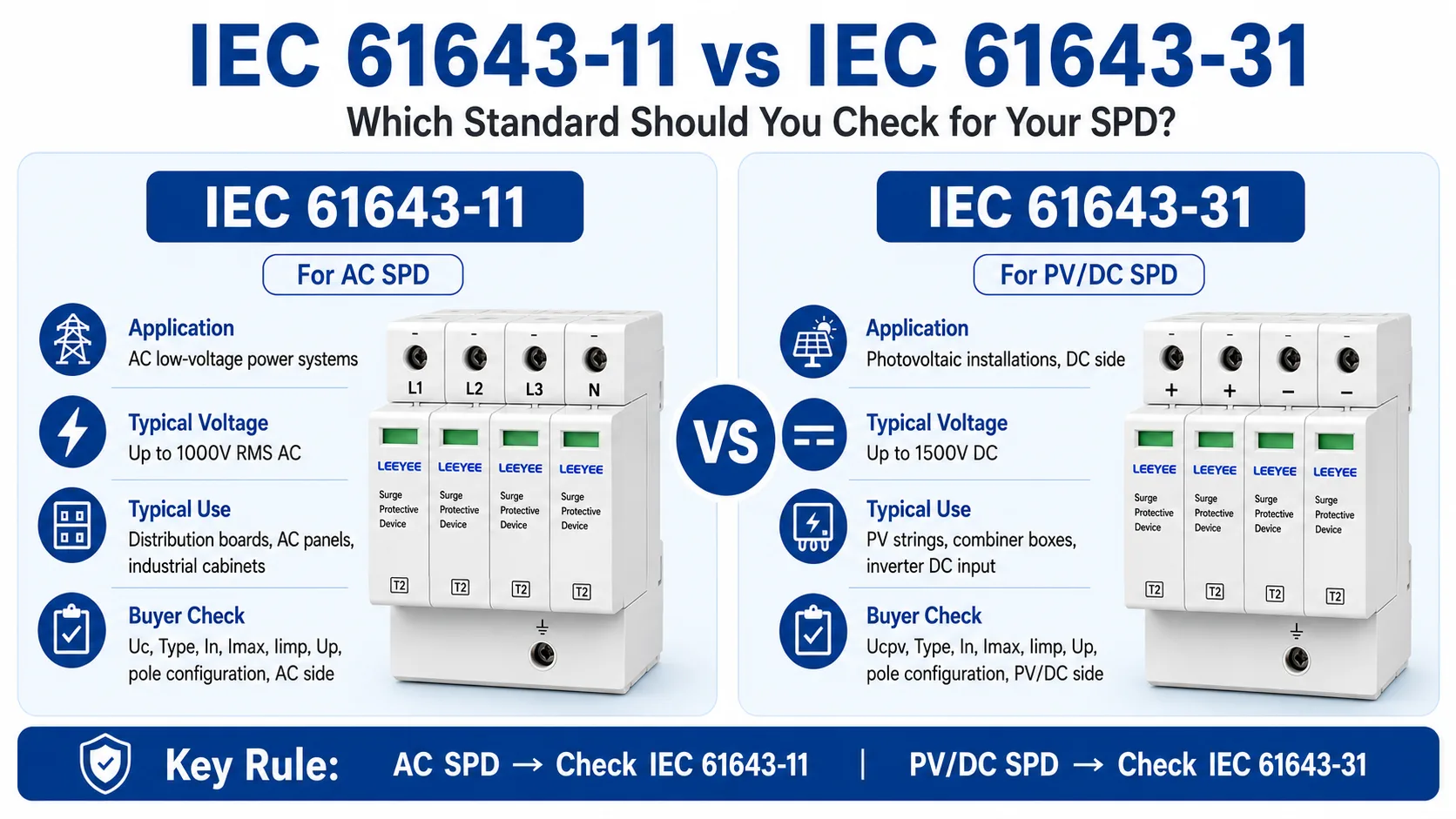
IEC 61643-11 applies to surge protective devices connected to AC low-voltage power systems. For buyers, this is the standard normally checked for AC SPD used in distribution boards, AC panels, industrial cabinets, and building power systems.
IEC 61643-31 applies to SPDs installed on the DC side of photovoltaic systems. For buyers, this is the standard normally checked for PV/DC SPD used in solar strings, combiner boxes, and inverter DC input protection.
Not sure whether your project needs AC SPD or PV/DC SPD? Send us your system voltage and installation position.
Ask for SPD Standard HelpTable of Contents
IEC 61643-11 vs IEC 61643-31 comparison table
The fastest way to understand the difference is to look at the application. IEC 61643-11 is for AC low-voltage power systems. IEC 61643-31 is for photovoltaic DC-side surge protection.
| Buyer question | IEC 61643-11 | IEC 61643-31 |
|---|---|---|
| Main application | AC low-voltage power systems. | Photovoltaic installations on the DC side. |
| Typical SPD | AC SPD for distribution boards, AC panels, and power cabinets. | PV/DC SPD for solar strings, combiner boxes, and inverter DC inputs. |
| Typical voltage range | AC systems up to 1000 V RMS, depending on the standard scope and product rating. | PV DC systems up to 1500 V DC, depending on the standard scope and product rating. |
| Common buyer | Panel builders, electrical contractors, distributors, OEM cabinet manufacturers. | Solar EPCs, PV combiner box manufacturers, inverter cabinet builders, solar distributors. |
| Key rating to check | Uc, Type, In, Imax, Iimp, Up, pole configuration, AC system type. | Ucpv, Type, In, Imax, Iimp, Up, pole configuration, PV DC-side application. |
| Certificate meaning | The certificate should match the AC SPD model and AC system application. | The certificate should match the PV/DC SPD model and photovoltaic DC-side application. |
When should buyers check IEC 61643-11?
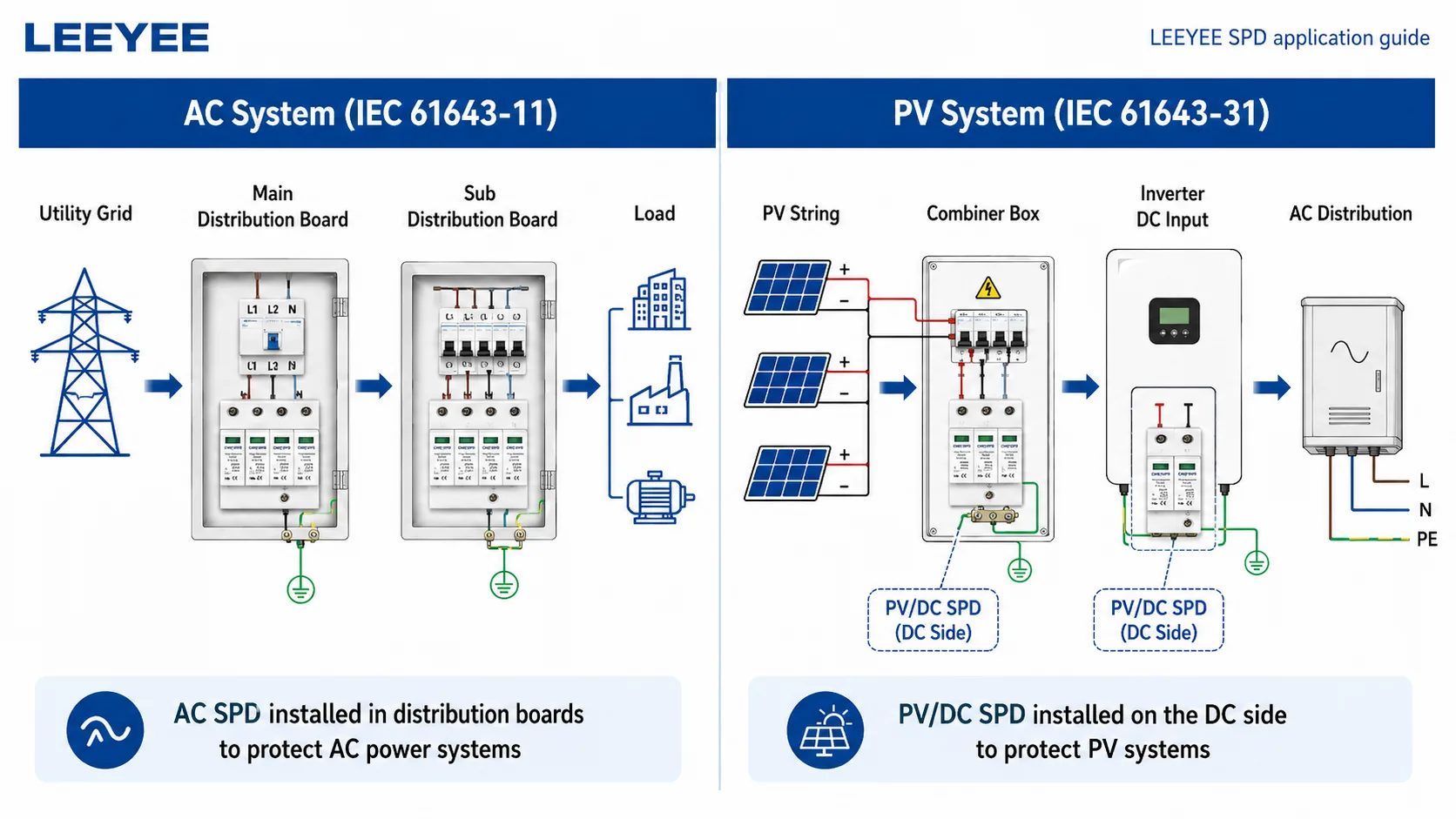
Buyers should check IEC 61643-11 when purchasing SPD for AC low-voltage power systems. This normally includes AC distribution boards, main switchboards, sub-distribution boards, building power panels, and industrial control cabinets.
For these applications, the SPD is connected to an AC system. The buyer should not only ask whether the SPD is “IEC certified”. The certificate should be checked against the real product model, voltage rating, Type, and discharge current values.
Common AC SPD applications
| Application | Common SPD requirement | What buyers should check |
|---|---|---|
| Main AC panel | Type 1 or Type 1+2 SPD may be required when lightning current risk is high. | IEC 61643-11 certificate, Iimp, Type, Uc, pole configuration. |
| Distribution board | Type 2 SPD is commonly used for induced surges and switching transients. | IEC 61643-11 certificate, In, Imax, Uc, Up, poles. |
| Industrial cabinet | SPD selection depends on power system voltage and equipment sensitivity. | AC voltage, grounding system, SPD Type, remote signal option. |
| OEM electrical panel | The SPD must match the panel design, export market, and certificate requirement. | Certificate scope, private label needs, datasheet, model marking. |
When should buyers check IEC 61643-31?
Buyers should check IEC 61643-31 when purchasing SPD for the DC side of photovoltaic systems. This includes PV string protection, PV combiner boxes, solar inverter DC input protection, and other photovoltaic DC-side surge protection points.
In this application, the SPD must be designed for PV/DC voltage behavior. A normal AC SPD certificate should not be used as proof that the product is suitable for a photovoltaic DC-side system.
Common PV/DC SPD applications
| Application | Common SPD requirement | What buyers should check |
|---|---|---|
| PV string | DC SPD selected according to PV string voltage. | IEC 61643-31 certificate, Ucpv, Type, In, Imax, poles. |
| PV combiner box | PV/DC SPD is commonly installed before the inverter input. | Ucpv 600V, 1000V, or 1500V according to system design. |
| Inverter DC side | SPD should match inverter DC input voltage and protection design. | PV certificate scope, Up, discharge current rating, installation position. |
| Solar OEM assembly | SPD must match the combiner box or cabinet export requirement. | Certificate, datasheet, label, wiring diagram, OEM marking. |
Product standard vs selection and application standard
Buyers often see different IEC 61643 standard numbers and get confused. A simple way to understand them is to separate product testing standards from selection and application standards.
| Standard | Main meaning for buyers | How to use it in purchasing |
|---|---|---|
| IEC 61643-11 | Requirements and test methods for SPDs connected to AC low-voltage power systems. | Check this for AC SPD certificates and product compliance. |
| IEC 61643-31 | Requirements and test methods for SPDs for photovoltaic installations. | Check this for PV/DC SPD certificates and product compliance. |
| IEC 61643-12 | Selection, operation, location, and coordination principles for SPDs in AC power circuits. | Use this when considering AC SPD application and installation design. |
| IEC 61643-32 | Selection, installation, and coordination principles for SPDs used in PV systems. | Use this when considering PV SPD placement and coordination. |
For most purchasing work, IEC 61643-11 and IEC 61643-31 are the first standards buyers check on product certificates. IEC 61643-12 and IEC 61643-32 are more related to selection, application, installation, and coordination.
How to check an SPD certificate before buying
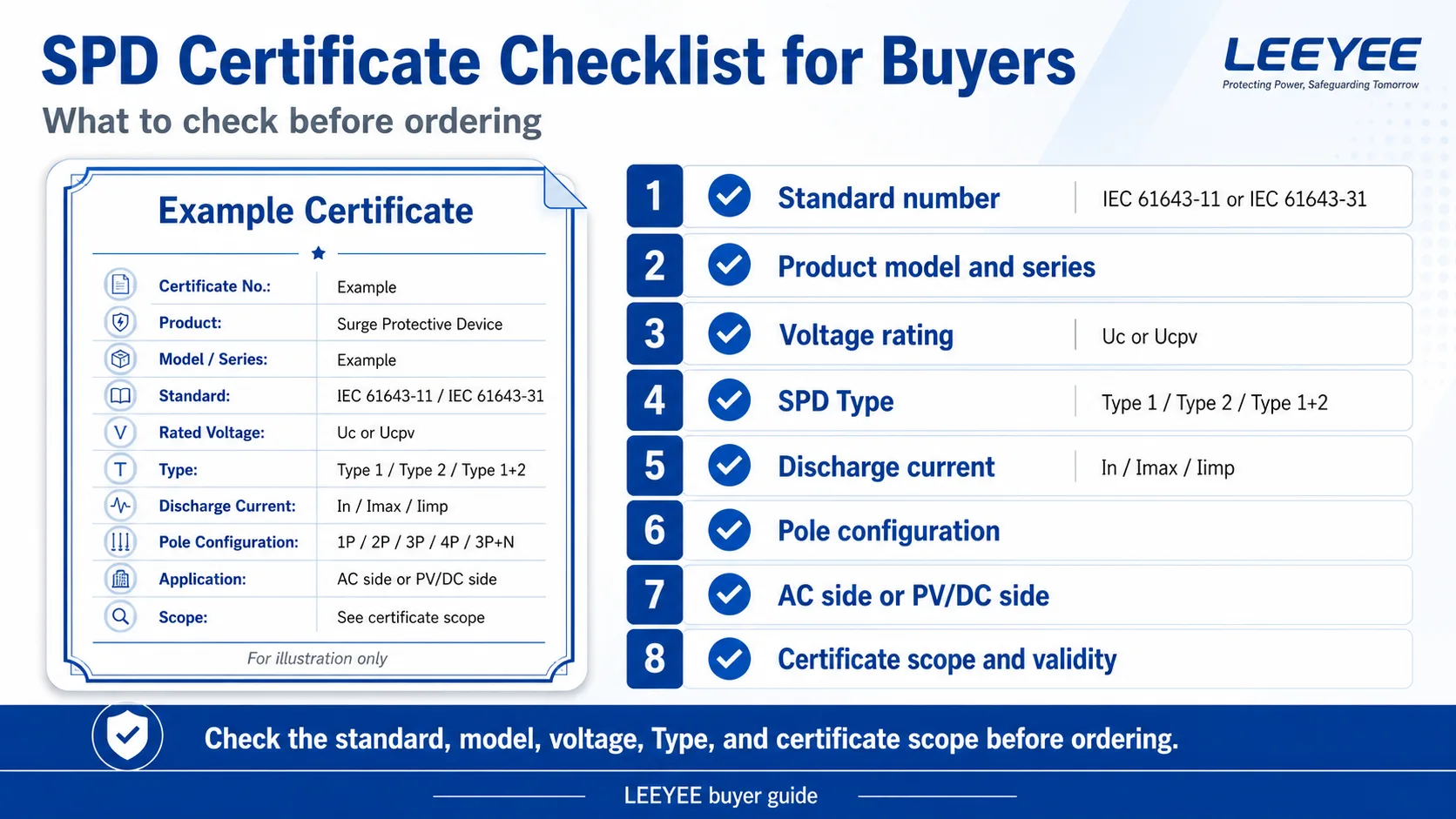
A certificate is useful only when it matches the actual product and project. Before confirming an SPD order, buyers should check the following points.
Simple decision flow for SPD standard selection
If you are not sure which standard to check, start from the installation side. The circuit type is usually the first decision point.
Common mistakes when comparing IEC 61643-11 and IEC 61643-31
Mistake 1: Thinking all IEC 61643 certificates are the same
This is not correct. IEC 61643 is a family of standards. A certificate for an AC SPD does not automatically prove that the same product is suitable for PV/DC application.
Mistake 2: Using an AC SPD for a PV DC system
PV DC systems have different operating conditions from AC power systems. For PV/DC surge protection, buyers should check whether the SPD is designed and certified for photovoltaic DC-side use.
Mistake 3: Looking only at the voltage
Voltage is important, but it is not the only selection point. Buyers should also check SPD Type, discharge current values, protection level, pole configuration, system type, and certificate scope.
Mistake 4: Assuming higher rating is always better
A higher voltage or discharge current rating does not automatically mean the SPD is the best choice. The SPD should match the real system voltage, installation position, and protection requirement.
What information should buyers send before ordering?
To recommend the right SPD model, the supplier needs more than a general request such as “I need IEC SPD”. A clear requirement helps avoid wrong models, wrong certificates, and project delays.
Send your system voltage, installation position, and required certificate. We can help check whether AC SPD or PV/DC SPD is more suitable.
Send Your SPD RequirementRelated reading for SPD buyers
FAQ: IEC 61643-11 vs IEC 61643-31
What is the difference between IEC 61643-31 and IEC 61643-11 standards?
IEC 61643-11 applies to surge protective devices connected to AC low-voltage power systems, typically up to 1000V RMS AC. IEC 61643-31 applies to SPDs installed on the DC side of photovoltaic systems, typically up to 1500V DC. For buyers, AC SPD should be checked against IEC 61643-11, while PV/DC SPD should be checked against IEC 61643-31.
Is IEC 61643-11 for AC SPD?
Yes. IEC 61643-11 is the standard buyers normally check for SPD used in AC low-voltage power systems, such as distribution boards, AC panels, and industrial power cabinets.
Is IEC 61643-31 for PV SPD?
Yes. IEC 61643-31 is used for surge protective devices for photovoltaic installations, especially the DC side of PV systems. It is the key standard for PV/DC SPD used in solar strings, combiner boxes, and inverter DC input protection.
Can I use an AC SPD in a PV DC system?
In general, no. A PV DC system should use an SPD designed and certified for photovoltaic DC-side application. An AC SPD certificate under IEC 61643-11 should not be used as proof that the SPD is suitable for PV/DC installation.
Can an IEC 61643-31 certificate replace IEC 61643-11 for AC panels?
No. IEC 61643-31 is for PV/DC-side SPD. If the product will be installed in an AC distribution board or AC power cabinet, buyers should check the AC SPD certificate and related ratings under IEC 61643-11.
What should I check on an SPD certificate before ordering?
Check the standard number, product model, voltage rating, SPD Type, In, Imax, Iimp, protection level, pole configuration, and certificate scope. The certificate should match the exact SPD model and application you plan to buy.
Need help checking the correct SPD standard?
LEEYEE supplies AC SPD and PV/DC SPD for power distribution, solar PV, OEM panels, and export projects. If you are not sure whether your project should use IEC 61643-11 or IEC 61643-31, send us your system details.
Our team can help you check the application side, voltage rating, SPD Type, discharge current values, certificate requirement, and suitable model range before ordering.