
SPD Procurement Guide
When buying surge protective devices, do not only ask whether the supplier has CE, TUV, CB or RoHS. The real question is whether those documents match the exact SPD model you plan to buy.
This guide explains what buyers should check before placing an SPD order, including model coverage, voltage rating, SPD type, IEC standard, brand name, manufacturer name, validity and test report number.
Table of Contents
Quick Answer: Which SPD Certificate Should Buyers Check First?
For serious SPD procurement, buyers should first check whether the certificate or test report covers the actual surge protective device model, voltage, type and standard.
A CE mark, TUV logo, CB certificate or RoHS declaration is useful only when it can be connected to the product you are buying. If the certificate covers a different model, a different voltage range or a different product family, it may not support your order.
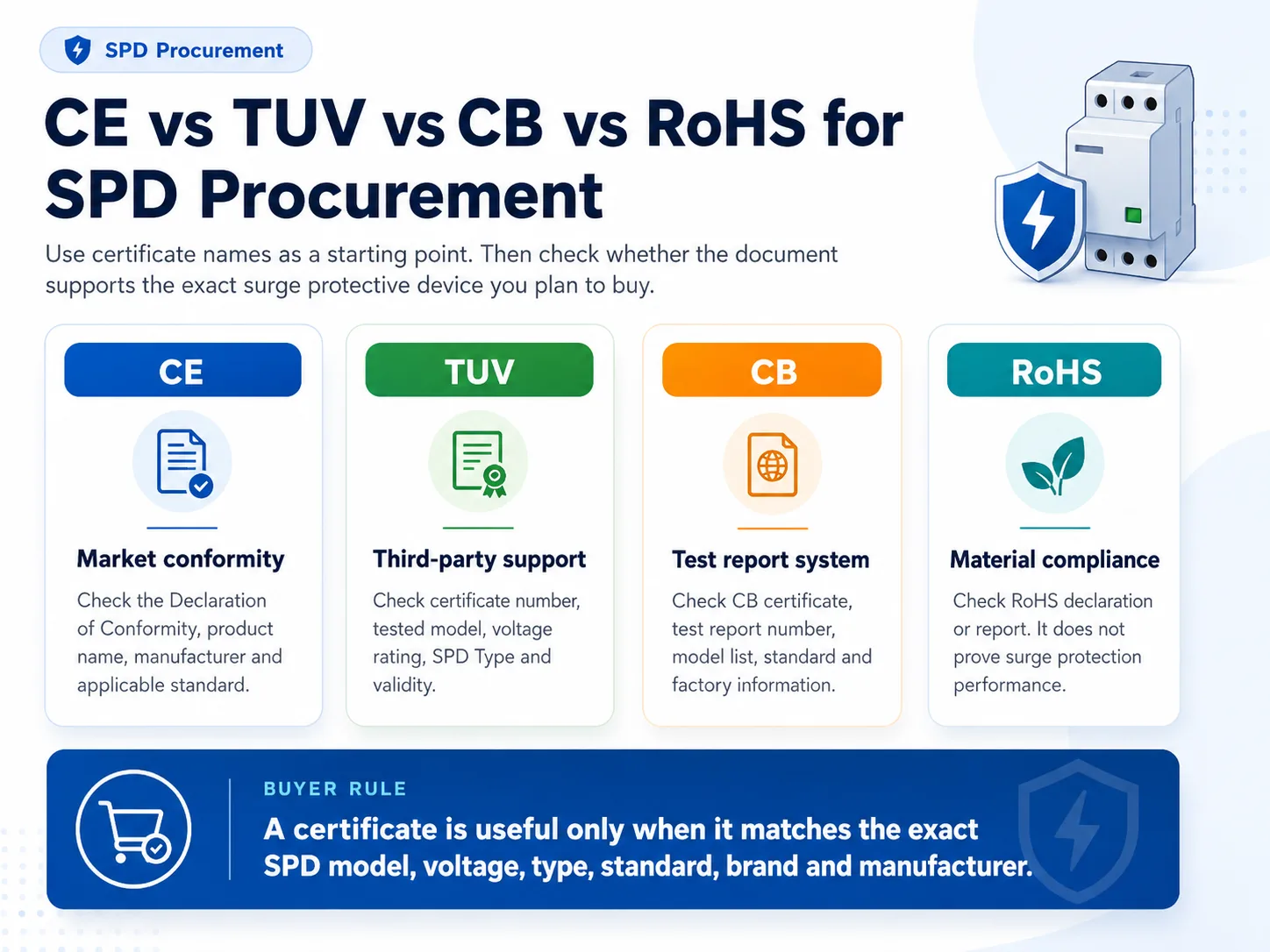
| Document | Buyer Meaning | What to Check | Can It Prove SPD Performance? |
|---|---|---|---|
| CE | EU conformity marking for products placed on the European market. | Declaration of Conformity, product name, applicable directive or standard, manufacturer, responsible signature. | Not by itself. It should be supported by correct technical files and test evidence. |
| TUV / TÜV | Third-party certification or testing support, depending on the document type. | Certificate number, tested model, voltage rating, SPD type, standard, issuer and validity. | Useful when it clearly covers the exact SPD model and rating. |
| CB | International IECEE system based on test reports and certificates. | CB certificate, CB test report number, standard, model list, manufacturer and factory details. | Strong support when the report scope matches the product. |
| RoHS | Restriction of hazardous substances for electrical and electronic products. | RoHS declaration or test report, product coverage, material scope and issue date. | No. RoHS supports material compliance, not surge protection performance. |
CE, TUV, CB and RoHS: Buyer Meaning, Not Dictionary Meaning
Certificate names are easy to list, but procurement decisions need more than names. Buyers should understand what each document can prove, and what it cannot prove.
CE for SPD Procurement
CE marking is commonly required for products placed on the European Economic Area market when the product falls under applicable EU rules. For SPD buyers, CE is part of the compliance file, but it should not be treated as a full replacement for product-level test evidence.
Buyers should ask for the Declaration of Conformity and check whether it identifies the surge protective device, the manufacturer, the applicable standard or directive, and the responsible party.
TUV / TÜV for SPD Procurement
TUV certification is valuable because it can show that a third party has reviewed or tested the product under defined requirements. But not every document with a TUV logo means the same thing.
Buyers should check the certificate number, the exact model list, the voltage rating, the SPD type and the standard written on the certificate. For example, a certificate for one AC SPD family should not be assumed to cover a different DC/PV SPD series.
CB for SPD Procurement
CB documents are especially useful for importers, distributors and OEM buyers who sell to multiple markets. A CB certificate is normally supported by a CB test report, so buyers can check both the certificate and the technical testing scope.
The most important point is the scope. The model list, voltage range, testing standard, applicant, manufacturer and factory information should be consistent with the product you plan to buy.
RoHS for SPD Procurement
RoHS is not a surge performance certificate. It is related to hazardous substance restrictions for electrical and electronic equipment.
RoHS can be important for distributors, European projects, OEM supply chains and customers who need environmental compliance files. But it cannot replace SPD testing under the correct surge protection standard.
The Certificate Is Useful Only If It Matches the Product You Buy
Many certificate problems happen because the supplier really has a document, but the document does not match the buyer’s required product.
For example, a buyer may need a 1500V DC/PV SPD, but the supplier sends a certificate for a 600V product. Or the certificate may cover Type 2 SPDs, while the project asks for Type 1+2. In both cases, the certificate exists, but it may not support that order.
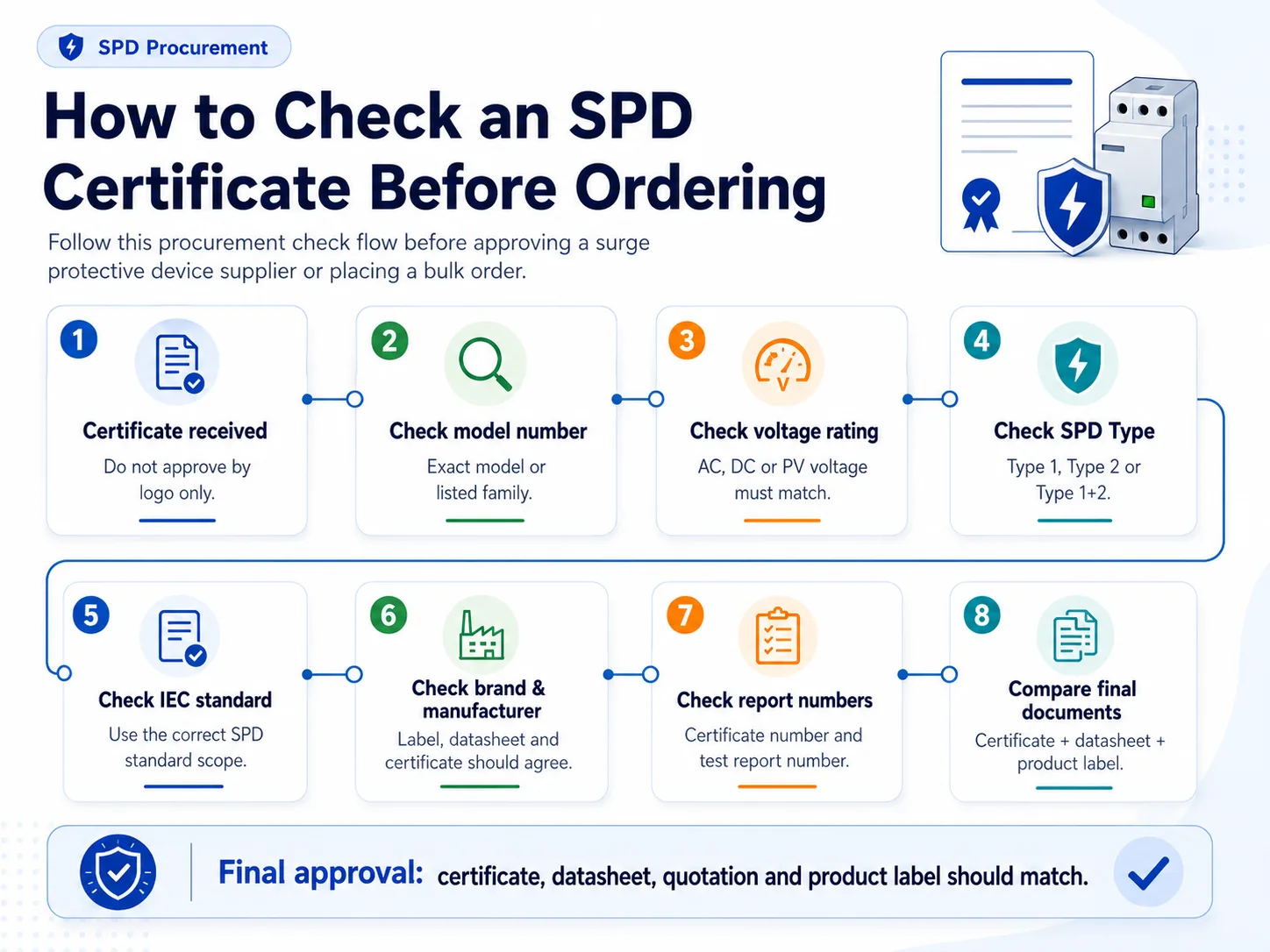
What should match?
Before approving a supplier, compare the certificate, datasheet, product label and quotation. These four documents should tell the same story.
- Same model number or clearly listed model family.
- Same AC or DC/PV application.
- Same voltage rating or voltage range.
- Same SPD Type, such as Type 1, Type 2 or Type 1+2.
- Same standard or applicable test method.
- Same brand name or private label arrangement.
- Same manufacturer or factory information.
Certificate Field Check Example
When a supplier sends a certificate or scope sheet, buyers should read it field by field. The table below shows a simple way to check whether the document can support your actual SPD order.
| Certificate Field | Buyer Should Check | Why It Matters |
|---|---|---|
| Product / Model | Does it show the quoted SPD model or clearly include it in the model list? | A certificate for a different model may not support your order. |
| Voltage Rating | Does it cover the required voltage, such as 275V AC, 385V AC, 600V DC, 1000V DC or 1500V DC? | Voltage mismatch is one of the most common certificate problems. |
| SPD Type | Does it match Type 1, Type 2, Type 1+2, AC SPD, DC/PV SPD or signal SPD as required? | Different SPD applications may need different test scope and product structure. |
| Standard | Does the certificate or report refer to the correct applicable SPD standard? | The standard tells buyers what product category and test method the document supports. |
| Applicant / Manufacturer | Does the manufacturer, applicant or factory information match the supplier file? | This helps avoid confusion between trading company documents and factory documents. |
| Brand / Trademark | Does the brand name match the product label, or is the OEM/private label arrangement clear? | Brand mismatch can create approval issues for distributors and project buyers. |
| Certificate No. / Report No. | Is there a certificate number and, when applicable, a test report number? | Numbers make the document easier to trace, verify and reference in a procurement file. |
| Issue Date / Validity | Is the certificate still valid or acceptable for your customer’s audit requirement? | Some buyers, projects or distributors require recent or valid documents. |
This is also where standards can cause confusion. If you are not sure whether your product should follow IEC 61643-11 or IEC 61643-31, read our separate guide: IEC 61643-11 vs IEC 61643-31 for SPD selection.
In this article, we only use IEC standards as a certificate checking item. The detailed standard comparison is handled in the dedicated standard guide to avoid mixing two different search intentions.
SPD Certificate Checklist Before Ordering
Before placing a bulk order, buyers should check the certificate like a procurement file, not like a marketing image. The following checklist is suitable for importers, distributors, EPC buyers, panel builders and OEM customers.
Need to check whether a certificate covers your SPD order?
Send us your required model, voltage, SPD type, application and target market. LEEYEE can help match the suitable SPD series and supporting documents for distribution, project or OEM orders.
Common Certificate Mistakes in SPD Procurement
Certificate checking is not only about collecting files. It is about avoiding mismatch before payment, shipment or project approval.
Mistake 1: Treating a CE logo as complete proof
A CE mark or CE logo on a brochure is not enough for serious SPD procurement. Buyers should ask for the Declaration of Conformity and supporting technical documents.
Mistake 2: Using an AC SPD certificate for a DC/PV SPD order
AC and DC/PV surge protective devices may have different test requirements and product structures. A certificate for an AC SPD should not be used as proof for a PV SPD unless the document clearly covers that product.
For high-voltage PV applications, buyers can also review our DC SPD up to 1500V selection page to understand how voltage and application affect product selection.
Mistake 3: Ignoring voltage coverage
Voltage mismatch is a common risk. A certificate for 600V does not automatically cover 1000V or 1500V products. The required voltage should appear in the certificate, model list, scope sheet or test report.
Mistake 4: Assuming one family certificate covers every customized model
OEM labels, customized shells, different pole configurations or different voltage ratings may affect the certificate file. If the order is for private label products, ask the supplier how the brand and model information will be handled.
Mistake 5: Checking the certificate but not the product label
The product label is part of the compliance story. If the certificate, datasheet and product label show different ratings or model names, the buyer should ask the supplier to clarify before shipment.
What Documents Should Buyers Request from an SPD Supplier?
For B2B procurement, one certificate is usually not enough. A reliable SPD supplier should be able to provide a clear document package.
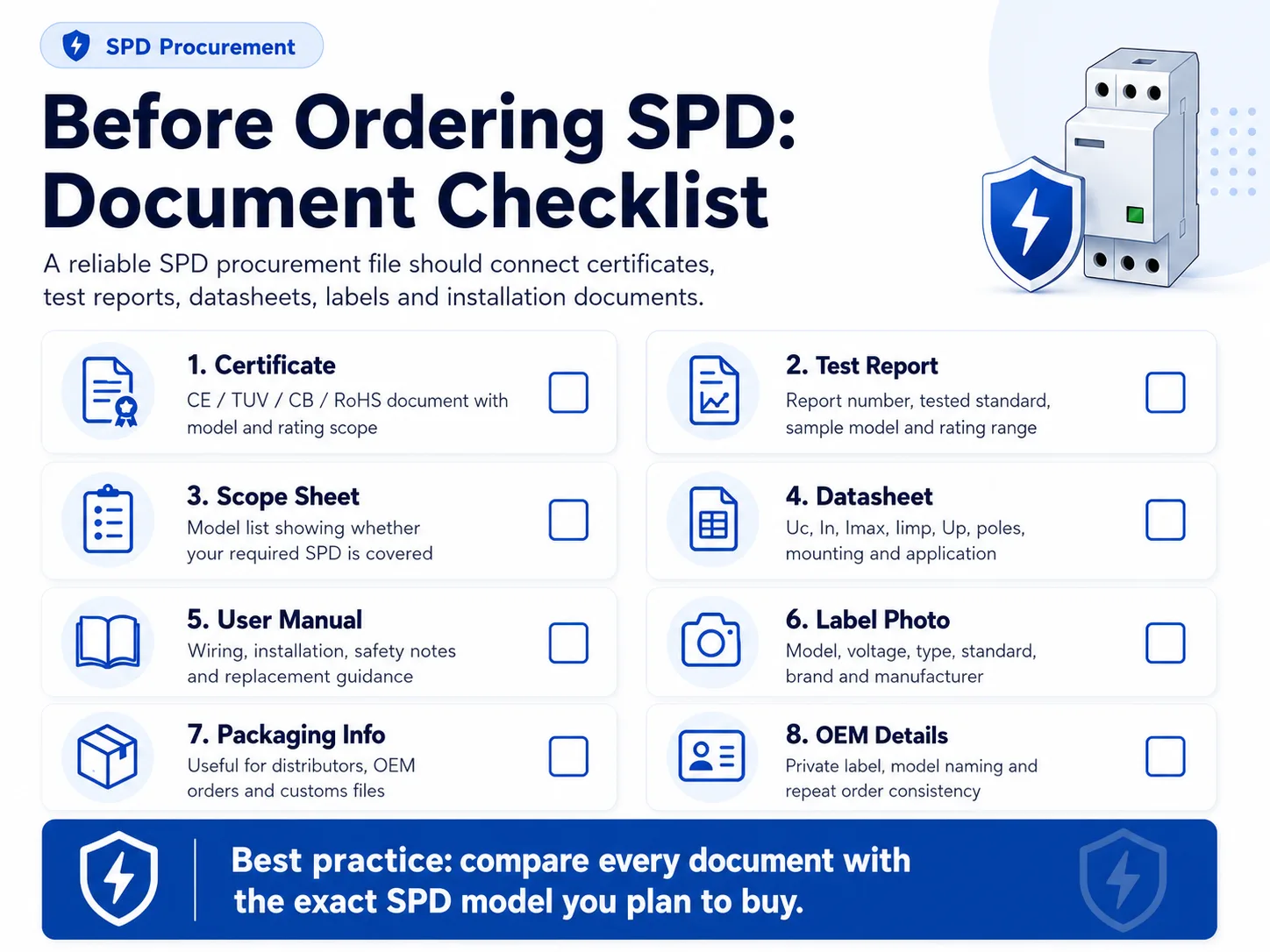
| Document | Why Buyers Need It | What to Compare |
|---|---|---|
| Certificate | Shows third-party certification or formal conformity support. | Model, rating, standard, issuer, certificate number. |
| Test Report | Provides technical testing evidence behind the certificate. | Report number, test standard, sample model, rating range. |
| Scope Sheet / Model List | Shows which models are covered under the certificate. | Your required model, voltage and product family. |
| Datasheet | Helps engineers confirm electrical parameters before ordering. | Uc, In, Imax, Iimp, Up, pole configuration and mounting. |
| User Manual | Supports installation, wiring and maintenance communication. | Application, wiring, safety notes and replacement guidance. |
| Product Label Photo | Helps buyers confirm actual marking before shipment. | Model, voltage, Type, standard, brand and manufacturer. |
You can also review LEEYEE’s document resources here: SPD certificates and technical downloads.
Which Certificate Matters Most for Different Buyers?
The answer depends on your market, customer requirement and product application. There is no single certificate that replaces all other documents.
| Buyer Type | Most Important Check | Practical Advice |
|---|---|---|
| Importer | Market compliance and customs/customer documentation. | Check CE, RoHS, CB/TUV support and product label consistency. |
| Distributor | Product credibility and after-sales risk. | Keep certificates, datasheets and label photos ready for customers. |
| Solar EPC | PV/DC voltage and project approval documents. | Confirm the certificate covers the required DC/PV SPD voltage and application. |
| Panel Builder | Correct SPD type, pole configuration and installation position. | Compare the certificate with the datasheet and panel specification. |
| OEM Buyer | Brand, model naming and repeat order consistency. | Clarify private label requirements before mass production. |
For solar PV projects, certification checks should be connected with real application needs. You can also read our Solar PV Surge Protection solution for PV combiner boxes, inverter cabinets and DC-side protection architecture.
How LEEYEE Supports Certificate-Based SPD Procurement
LEEYEE supplies surge protective devices for solar PV, power distribution, telecom, industrial and OEM applications. For procurement teams, our focus is not only to provide the product, but also to help buyers prepare the correct technical file before ordering.
For SPD projects, buyers can request model selection support, certificate matching, datasheets, user manuals, label information and technical documents according to their application.
Before contacting us, it helps to prepare:
- Required AC, DC or PV system voltage.
- SPD Type, such as Type 1, Type 2 or Type 1+2.
- Number of poles and installation position.
- Target market or customer certification requirement.
- OEM or private label requirement, if any.
- Expected order quantity and project schedule.
Send your SPD requirement for document matching
If you are not sure which certificate or document applies to your required SPD model, send us your application details. Our team can help check the suitable product range and supporting documents.
FAQ: CE, TUV, CB and RoHS for SPD Buyers
Is CE enough for SPD procurement?
CE may be required for market compliance, but serious SPD procurement should also check the technical file, test evidence, model coverage, voltage rating and applicable standard. A CE logo alone is not enough.
Is TUV better than CE for surge protective devices?
They are different. CE is a market conformity marking, while TUV usually refers to third-party testing or certification support. For buyers, a TUV certificate is useful only when it clearly covers the exact SPD model and rating.
What should I check on a CB certificate for SPD?
Check the CB certificate number, CB test report number, tested standard, model list, voltage rating, applicant, manufacturer and factory information. The model you buy should be within the certificate scope.
Does RoHS prove that an SPD has good surge protection performance?
No. RoHS is related to hazardous substance restriction. It supports environmental compliance, but it does not replace surge performance testing or certification under the correct SPD standard.
Can one SPD certificate cover many models?
Sometimes yes, but only when the certificate scope or model list clearly includes those models. Buyers should not assume that every product in the supplier’s catalog is covered by one certificate.
What if the certificate brand is different from the product label?
Ask the supplier to explain the relationship between the brand, manufacturer and private label arrangement. For OEM orders, brand and model naming should be clarified before production.
Official references for compliance context
The links below are provided for general compliance context. They do not replace project-specific legal, certification or market-entry advice.