
Un ATS generator backup system has two separate jobs that are often confused: the generator must become an available backup power source, and the automatic transfer switch must then transfer the load to that source. For a compact dual-power ATS such as the LEEYEE ATS-63, the documented terminals are for normal power A, backup power B and load output. The current ATS-63 documentation reviewed for this guide does not list a dedicated generator remote-start dry contact. [1]
Indice dei contenuti
Quick Answer: Does This ATS Start the Generator?
Do not assume so. The LEEYEE ATS-63 product documentation currently shows Source A, Source B and Load connections, but does not document a dedicated generator-start output. In a generator-backup application, the generator therefore needs its own compatible controller or another approved automatic-start arrangement to make backup power available. Once Source B is available and acceptable, the ATS can transfer the load from Source A to Source B. [1] [3]
What Does the LEEYEE ATS-63 Actually Switch?
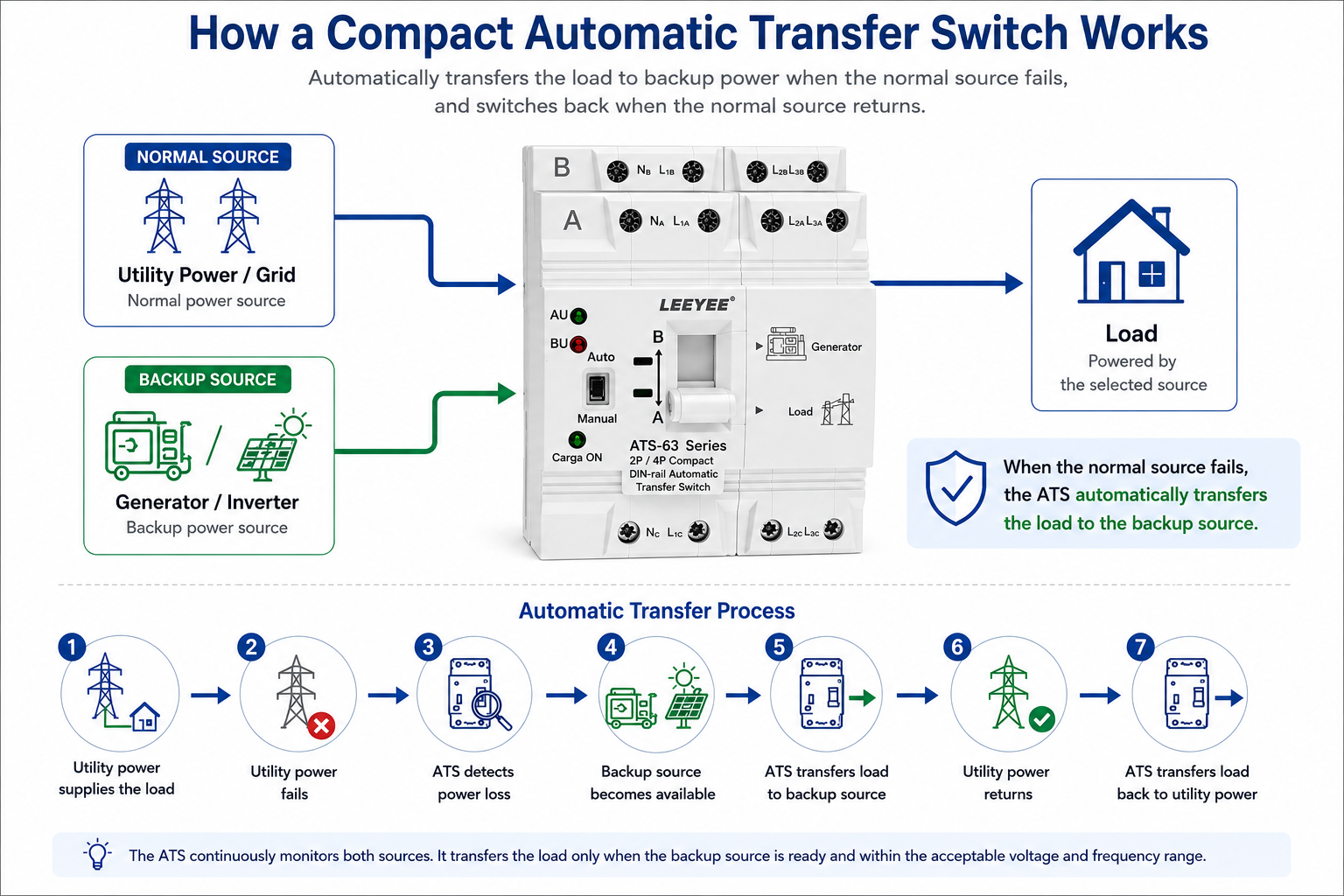
The ATS-63 is documented as a compact automatic transfer switch for switching between two AC power sources. LEEYEE identifies these as common or normal power A e backup power B. [1]
In a generator-backup panel, Source A can be the utility supply and Source B can be the generator output. The load is connected to the ATS output. The ATS monitors the available sources and transfers the load according to its control logic.
| Connessione | Funzione | Generator-Backup Meaning |
|---|---|---|
| Source A | Normal / preferred power input. | Typically the utility or common power source. |
| Source B | Backup power input. | Can receive generator output when the system design matches. |
| Load | Common ATS output. | Receives power from the source selected by the ATS. |
Buyer meaning: the ATS selects between two electrical sources. It does not automatically mean that the ATS also provides every control function required to create those sources.
Core distinction: “generator backup compatible” and “generator remote-start output included” are not the same statement.
How Are A, B and Load Connected on the 2P ATS?
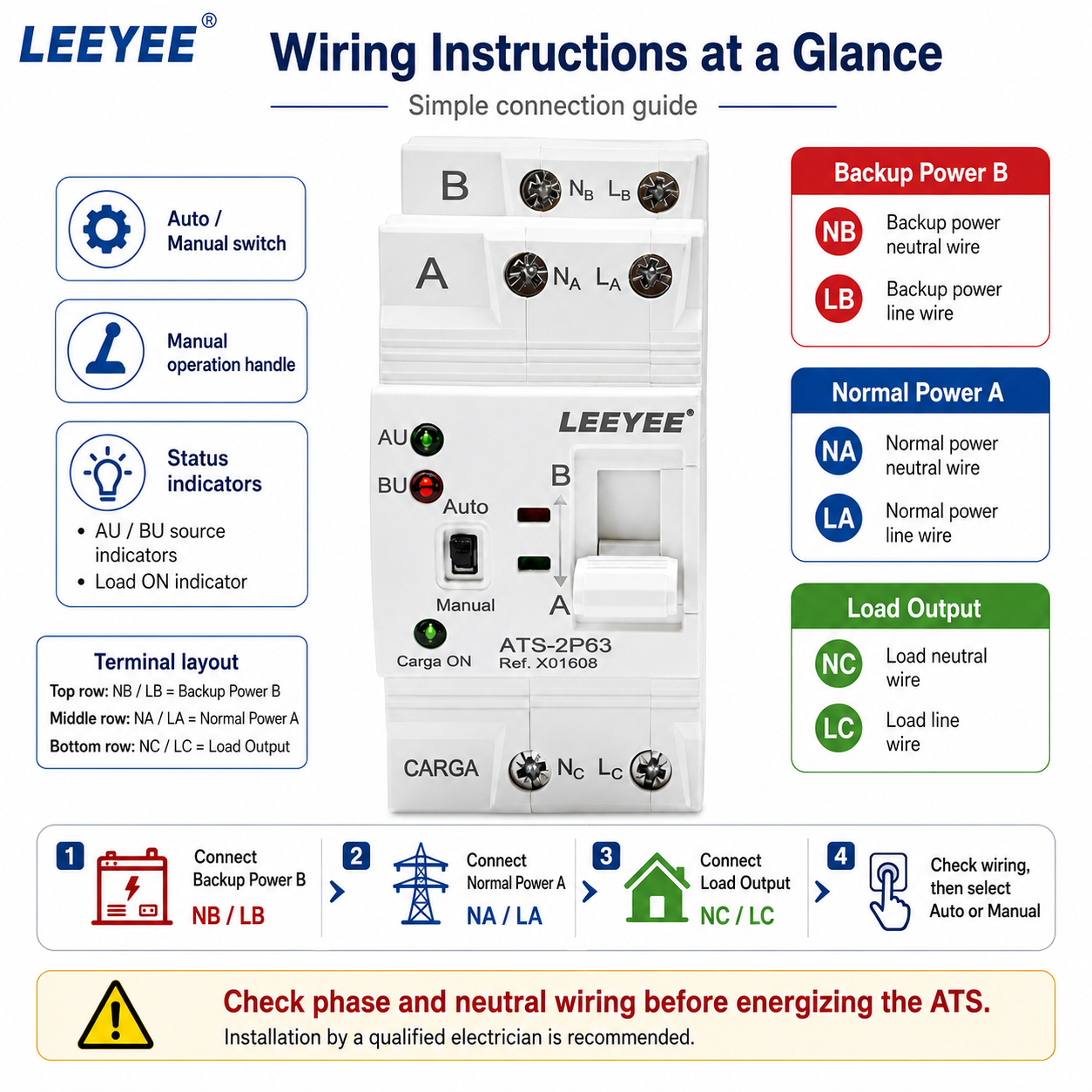
On the documented ATS-2P63 terminal arrangement, the top input is Backup Power B, the middle input is Normal Power A, and the lower terminals are the load output. [1]
| 2P Terminal | Documented Function | Typical Project Connection |
|---|---|---|
| NB / LB | Backup Power B neutral and line. | Generator or another compatible AC backup source. |
| NA / LA | Normal Power A neutral and line. | Utility / common power source. |
| NC / LC | Load neutral and line. | Downstream load or distribution circuit. |
Do not treat this table as a universal ATS terminal standard. It describes the documented LEEYEE ATS-2P63 arrangement shown here. A 4P version and other transfer-switch products use different conductor layouts. Installation must follow the approved wiring diagram for the exact model.
How Does a Generator Backup System Work with This Type of ATS?
The safest way to understand the system is to separate generator availability from load transfer.
-
Utility power supplies Source A.
Under normal operating conditions, Source A supplies the load through the ATS. -
Source A fails or becomes unacceptable.
The ATS detects the source condition according to its controller design. -
The generator must be started by the generator-side control system.
For the ATS-63 configuration documented here, no dedicated generator-start terminal is listed in the product terminal information. If automatic generator start is required, the project needs a compatible generator controller, AMF function or another approved start arrangement. -
Generator output appears at Source B.
The generator must first reach an electrical condition that the ATS can accept as a usable backup source. -
The ATS transfers the load to Source B.
General ATS practice is to transfer to an alternate source only when that source is available and acceptable. [3] -
L'alimentazione di rete ritorna.
The ATS retransfers the load according to its controller logic. Generator shutdown is then handled by the generator-side control arrangement unless a separate integrated control scheme has been designed.
Why Must the Generator Be Ready Before the ATS Transfers?
An engine-generator does not produce stable usable power at the instant its engine begins cranking. It needs time to start and establish acceptable output.
Eaton's ATS technical guidance describes a typical transfer sequence in which the switch transfers the load only when generator or alternate-source power is stable and within the prescribed voltage and frequency limits. [3]
This distinction also explains why ATS switching time is not the same as total backup recovery time. Even if the switching mechanism can change source quickly, a generator may require substantially more time to start and become available.
Significato ingegneristico: for generator applications, check both the ATS transfer characteristics and the generator-start / stabilization sequence. A fast ATS does not eliminate generator start-up time.
Does Every ATS Start the Generator?
No. ATS products are not all built with the same control architecture.
Some engineered automatic transfer-switch systems include a dedicated generator-start function. Schneider Electric, for example, describes generator-start signalling as a function on ATS systems designed for that purpose. [4]
However, that does not mean every compact dual-power transfer switch includes such an output. The current LEEYEE ATS-63 documentation reviewed for this article documents Source A, Source B and Load terminals but does not list a dedicated dry-contact generator-start interface. [1]
Do not connect a generator remote-start input to an ATS terminal unless the product documentation explicitly identifies that terminal for generator control. Power-source terminals and generator-control terminals perform different functions.
What If the Project Requires Automatic Generator Starting?
If the generator should start automatically when utility power fails, the project needs a defined method for creating that start command.
Depending on the generator and system architecture, this may be handled by the generator controller itself, an AMF controller, a separate monitoring relay/control system, or an ATS specifically designed with a compatible generator-start output.
The correct method must be confirmed from the generator controller manual and the approved panel control schematic. Do not assume that a compact A/B transfer switch can replace a generator auto-start controller.
| Project Requirement | What Must Be Provided | ATS-63 Consideration |
|---|---|---|
| Switch between two live AC sources | Normal A and backup B sources. | ATS-63 is designed for A/B automatic transfer when the selected product and source conditions match the project. |
| Automatically start a generator after utility failure | Generator-start control logic and a compatible remote-start interface. | The ATS-63 documentation reviewed here does not list a dedicated generator-start contact. |
| Switch only after generator output is usable | Compatible source-sensing and transfer logic. | Confirm the actual model voltage, frequency and application requirements before approval. |
Why Can the Generator Be Running but the ATS Still Not Switch?
A running engine does not automatically mean Source B is electrically acceptable to the ATS.
If a generator is running but the ATS remains on Source A or does not complete the expected transfer, diagnose the source path before assuming that the switching mechanism has failed.
| Controllo | Perché è importante | Project Action |
|---|---|---|
| Voltage at Source B | The ATS must receive the expected backup-source voltage. | Measure and compare it with the rating of the exact ATS model. |
| Frequenza | Generator frequency can be unstable during start-up. | Confirm generator output and ATS requirements. |
| Line / neutral wiring | Incorrect wiring can prevent correct source detection or safe transfer. | Check the approved wiring diagram with power isolated. |
| Auto / Manual mode | The ATS must be in the intended operating mode. | Verify front-panel mode and status indicators. |
| Source preference / controller logic | Transfer behaviour depends on the actual controller design. | Use the manual for the exact product revision. |
Troubleshooting boundary: electrical testing inside an energized ATS should be carried out only by qualified personnel following the equipment documentation and local electrical rules.
What Do the Product Ratings Tell a Panel Builder?
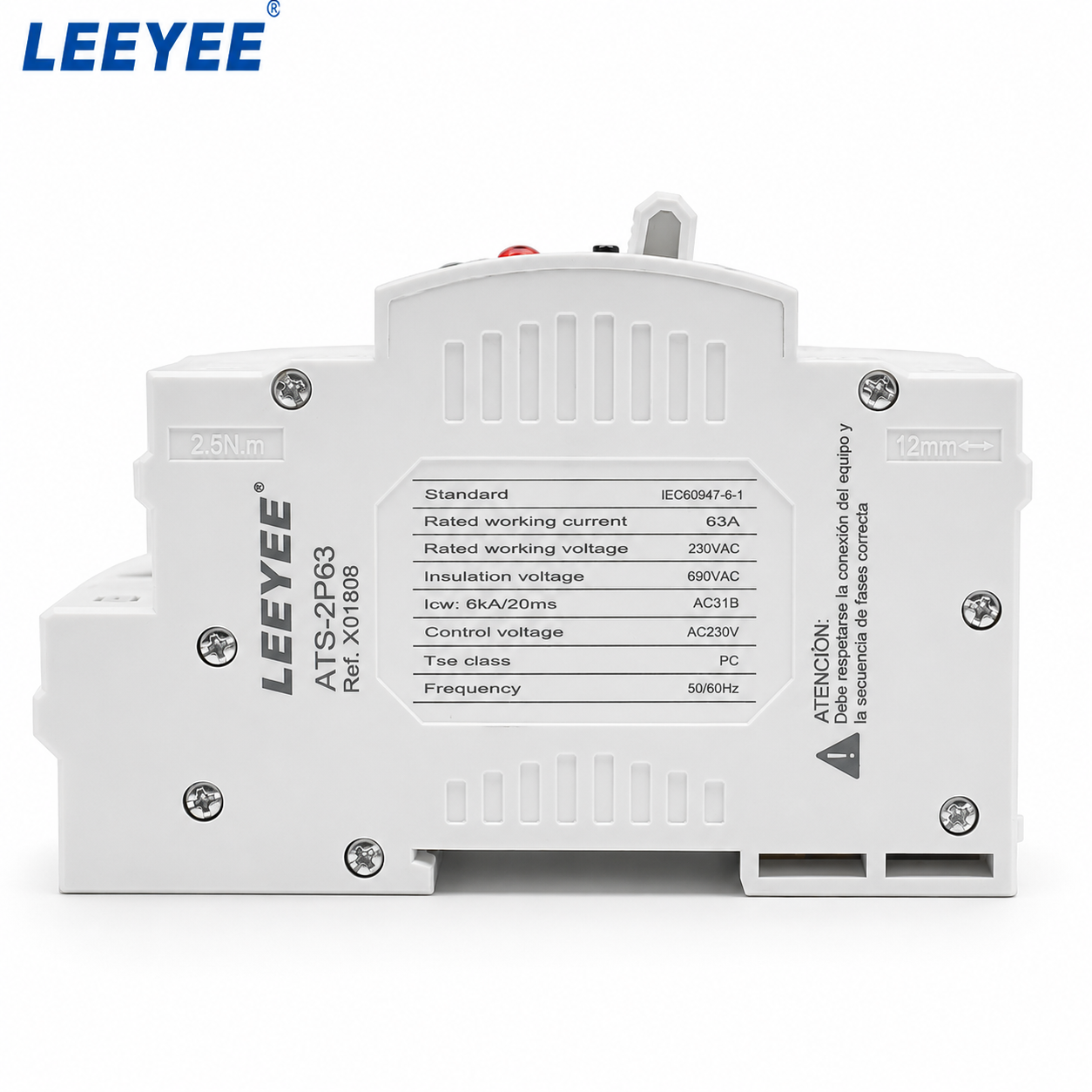
Product markings and series data should be treated carefully. The exact delivered unit must match the approved project data rather than a generic series description.
| Elemento | ATS-63 Series Information | Significato dell'acquirente |
|---|---|---|
| Corrente nominale | 6 A to 63 A options. | Select for the real load and project duty. |
| Tensione nominale | AC110 V / AC220 V / AC400 V configurations are listed. | Confirm the exact selected variant and nameplate. |
| Pali | 2P / 4P. | Match the phase and neutral-switching design. |
| Classe | PC. | Do not assume the ATS replaces upstream protective devices. |
| Frequenza | 50/60 Hz. | Generator output must match the selected ATS configuration. |
The example ATS-2P63 nameplate shown above uses 230 VAC wording, while the wider ATS-63 product data lists several voltage variants. For procurement approval, use the selected unit's nameplate, final datasheet and order confirmation rather than combining specifications from different variants.
What Does IEC 60947-6-1 Mean Here?
The sample ATS-2P63 product marking references IEC 60947-6-1. The current IEC 60947-6-1:2026 standard applies to transfer switching equipment used to transfer a load between power-supply sources. [2]
The standard reference should not be used to invent an unlisted generator-start function. Standard scope and actual product terminals are separate questions.
Significato di approvvigionamento: if a project requires a particular IEC edition, certificate, declaration or test-report scope, request the exact document for the ordered ATS model. A standard number printed on a product is not a substitute for certificate-scope verification.
2P or 4P for Generator Backup?
LEEYEE ATS-63 is available in 2P and 4P versions. [1]
Pole selection must follow the actual phase arrangement, neutral treatment, earthing system, generator configuration and local/project rules. Do not select 2P or 4P only from the current rating.
Information to Confirm Before Ordering an ATS for Generator Backup
- Normal source voltage and frequency.
- Generator output voltage and frequency.
- Sistema monofase o trifase.
- Required 2P or 4P switching arrangement.
- Maximum continuous load current.
- Motor, pump or other inrush-current requirements where relevant.
- Generator controller brand and model.
- Whether the generator already has automatic-start capability.
- Whether the project specifically requires an ATS generator-start contact.
- Neutral and earthing arrangement.
- Upstream fuse or circuit-breaker design.
- DIN-rail and panel-space limits.
- Required transfer behaviour and acceptable interruption time.
- Applicable standard, document and certificate requirements.
- Quantity and OEM label or packaging requirements.
Need to Check Whether ATS-63 Fits Your Generator Backup System?
Send the generator controller model, source voltage, load current, phase system, pole requirement and a simple wiring diagram. LEEYEE can review whether the ATS-63 matches the source-transfer requirement and identify when the project needs separate generator-start control.
Domande frequenti
Can LEEYEE ATS-63 be used with a generator?
It is documented for backup-source switching and can be used with generator backup when the system voltage, current, pole arrangement, wiring and operating conditions match the ATS. [1]
Does LEEYEE ATS-63 automatically start the generator?
The current ATS-63 product documentation reviewed for this guide does not list a dedicated generator-start output. Do not assume that the ATS itself sends a remote-start signal. Confirm the generator auto-start arrangement separately.
Which ATS input should the generator use?
In the documented ATS-2P63 arrangement shown in this guide, Backup Power B uses the NB/LB terminals. The exact ordered product wiring diagram remains the final authority.
Why is the generator running but the ATS not switching?
Check whether Source B has the correct voltage and frequency, whether line and neutral are wired correctly, whether the ATS is in the required mode, and whether the backup source meets the controller's acceptance conditions.
Can I connect the generator remote-start wires to Source B terminals?
No. Source B terminals are power-source connections, not automatically generator-control contacts. A generator remote-start circuit must connect only to an interface specifically documented for that control function.
Is ATS transfer time the same as generator start-up time?
No. Transfer time describes the switching action after the required source conditions exist. Generator start-up and stabilization occur before the generator can serve as an acceptable backup source. [3]
Riferimenti
- LEEYEE, ATS-63 Automatic Transfer Switch for Backup Power — 2P / 4P Product Data and Wiring Information. Product information covering A/B source switching, ATS-63 series ratings and the documented terminal arrangement. Pagina prodotto LEEYEE.
- Commissione Elettrotecnica Internazionale, IEC 60947-6-1:2026 — Low-voltage switchgear and controlgear — Part 6-1: Multiple function equipment — Transfer switching equipment. Pagina delle pubblicazioni ufficiali dell’IEC.
- Eaton, Automatic Transfer Switches (ATS) Fundamentals. Technical explanation of source monitoring and transfer to an alternate source after generator or backup power is stable and within applicable voltage and frequency tolerances. Eaton technical guide.
- Schneider Electric / ASCO Power Technologies, What Is a Transfer Switch?. General ATS technical explanation including transfer-switch systems that incorporate generator-start signalling, illustrating why generator-start capability must be confirmed by product design rather than assumed for every ATS. Schneider Electric technical article.