
Selecting an automatic transfer switch for a hotel starts with the backup-power circuit, not with the total electrical capacity of the building. For compact ATS applications, the project team should first identify the selected loads that need generator backup and then confirm current, pole configuration, generator interface and control requirements for that specific distribution circuit.
This guide is intended for hotel engineering teams, electrical contractors, generator-set integrators, distribution-board manufacturers, consultants, distributors and B2B buyers selecting a compact ATS for utility-to-generator backup applications.
Indice dei contenuti
Quick Answer: How Should a Hotel ATS Be Selected?
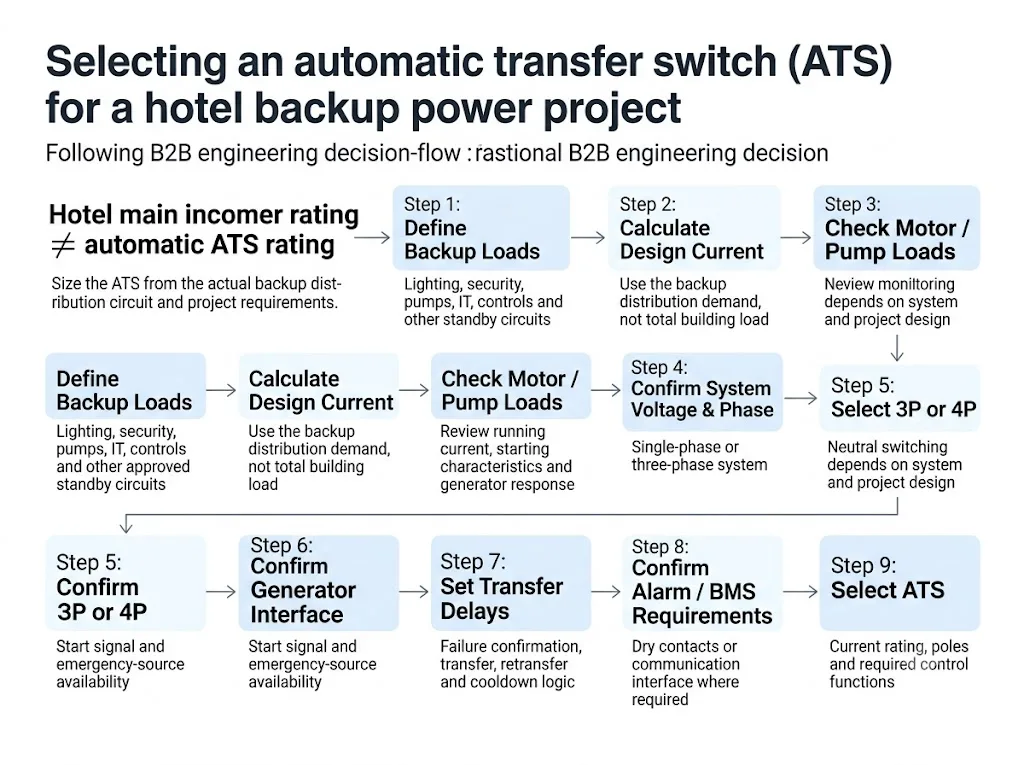
Start with the actual backup circuit. Define which hotel loads the generator will support, calculate the design current of that circuit, check motor or pump starting behaviour, confirm single-phase or three-phase operation, decide whether the neutral must be switched, and then confirm generator-start, transfer-delay and remote-status requirements.
Which Hotel Loads Should Be Connected to the ATS?
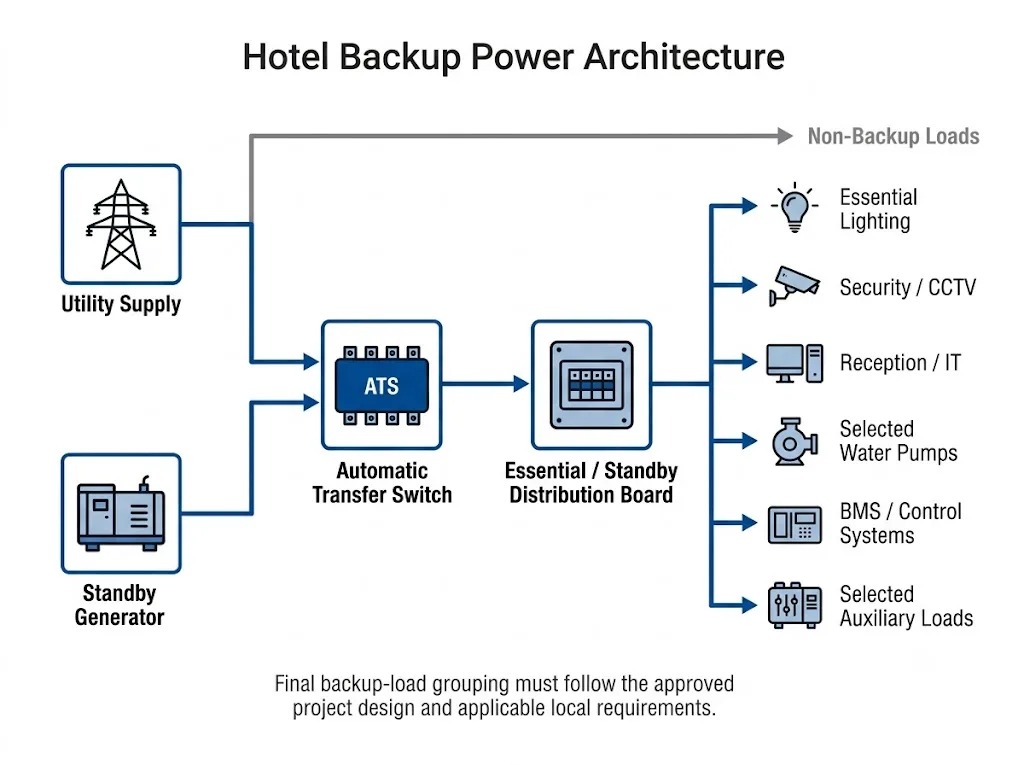
A hotel can contain lighting, security equipment, reception systems, pumps, communications, controls, refrigeration, HVAC equipment and many other loads. The project should not automatically place every load on the same compact ATS.
Instead, the engineer should identify a practical standby circuit or small group of selected circuits that match the generator strategy and the electrical rating of the selected ATS.
| Load group | Typical consideration | ATS selection impact |
|---|---|---|
| Essential lighting | Selected lighting circuits may be included in the standby distribution design. | Include only the actual selected circuits in the load calculation. |
| Security / CCTV / access control | Often low-power but operationally important. | Confirm whether these circuits are generator-backed, UPS-backed or both. |
| Reception / communication | May require continuity during a utility outage. | ATS backup and UPS requirements should be considered separately. |
| Small pumps | Motor starting may be higher than running current. | Confirm motor rating, starting method and generator response. |
| BMS / control circuits | Low-load control circuits may be useful to keep available. | Check remote alarm or status requirements. |
| Large elevators / large HVAC / high-power pumps | These can involve high starting current, regenerative operation or more complex switching requirements. | Do not assume a compact ATS is suitable. Require a dedicated engineering review. |
One Hotel Does Not Necessarily Mean One ATS
For a smaller hotel or a limited backup circuit, one compact ATS may transfer a defined group of selected loads. In a larger property, different backup circuits may use separate transfer devices at different distribution levels.
The correct design question is: Which circuit needs source transfer, and is that circuit within the electrical capability of the selected ATS?
Do Not Size the ATS From the Hotel Main Incomer
The hotel main incomer can be much larger than the standby circuit served by a compact ATS. If the generator only supplies selected lighting, security, reception systems, controls or other limited loads, the ATS should be evaluated from the current and electrical characteristics of that specific backup circuit.
Confirm these items before fixing the current rating
- Backup circuit design current;
- Single-phase or three-phase configuration;
- Continuous load current;
- Motor or pump starting behaviour;
- Generator output and transient response;
- Upstream protective device;
- Prospective short-circuit conditions;
- Installation temperature and enclosure conditions;
- Verified ratings of the exact LEEYEE ATS model.
Motor and Pump Loads Need Additional Checking
Hotel backup circuits may include small pumps, ventilation fans or other motor loads. Motor starting can create a short-duration demand much higher than normal running current, while the generator may experience voltage and frequency changes during the load step.[5]
This does not mean the ATS should be selected from motor starting current alone. The engineer must verify that the motor, generator, protective devices and ATS all operate correctly together.
Should the Hotel Use a 2P or 4P ATS?
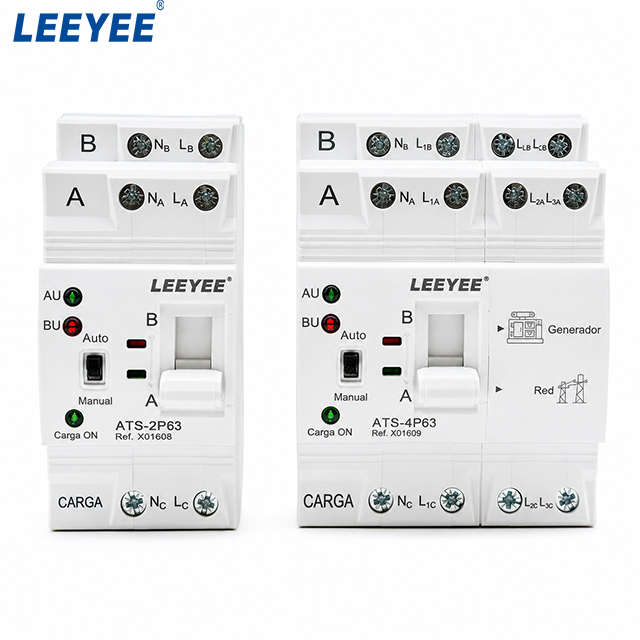
The real LEEYEE product shown on this page includes 2P and 4P compact configurations. These two versions suit different circuit arrangements.
The number of poles should not be selected from phase count alone. The engineer must also confirm the grounding arrangement, generator neutral, bonding method, residual-current protection and the applicable electrical design requirements.[3]
How Does This Compact ATS Work With a Generator?
In a standard utility-to-generator backup circuit, the ATS monitors source conditions and transfers the load when the normal source becomes unavailable and the alternate source becomes acceptable according to the controller logic.
- Utility normal: the selected load is supplied from the normal source.
- Utility abnormal: the ATS controller detects the source condition.
- Generator start request: where the model and generator interface support it, the ATS initiates the generator-start sequence.
- Generator available: the alternate source reaches acceptable conditions.
- Transfer: the ATS transfers the selected backup circuit to the generator.
- Utility restored: the normal source is checked according to the configured logic.
- Retransfer: the selected load returns to utility supply.
ATS control systems commonly use source monitoring, generator-start logic and timing functions to manage the transfer process.[4][6]
Why Transfer Delays Matter
A brief utility disturbance should not necessarily cause the same sequence as a sustained power failure. ATS controllers can use timing functions for failure confirmation, transfer, retransfer and generator stop logic.[4][6]
Do not copy a universal delay value into every hotel project. Use the settings supported by the exact ATS model and confirm them against the generator and load requirements.
Is Open-Transition ATS Suitable for This Application?
A compact ATS of this type is best positioned for conventional open-transition transfer, where one source is disconnected before the other source is connected. This is commonly called break-before-make operation.[2]
It should not be presented as a closed-transition or bypass-isolation ATS. Those are different transfer-switch solutions with different hardware, control and system requirements.
What About Remote Alarm or BMS Monitoring?
Hotel engineering teams may want remote indication of source availability, load position, operating mode or fault conditions. Whether this is available depends on the exact controller and ATS model.
ATS control systems can use status contacts, programmable I/O or communication interfaces for remote monitoring, but these features are model-specific and must be checked before specification.[4]
Use the Applicable Transfer-Switch Standard
For IEC-based projects, IEC 60947-6-1 is the relevant international transfer-switch standard. The 2026 edition covers transfer switching equipment and includes requirements related to automatic transfer switching equipment and ATS controllers.[1]
A Practical Selection Process for This Compact Hotel ATS
- Define the selected backup circuit. Identify the actual lighting, security, reception, small pump, control or other approved loads that will pass through the ATS.
- Calculate the circuit current. Use the backup circuit—not the hotel main incomer—as the basis for model selection.
- Check motor loads. Confirm starting characteristics where pumps, fans or other motors are included.
- Confirm single-phase or three-phase operation. Match the electrical system to the appropriate ATS configuration.
- Confirm 2P or 4P. Review whether neutral switching is required by the actual system design.
- Confirm the generator interface. Check generator-start requirements and source-availability logic.
- Confirm delay and operating mode. Verify Auto/Manual operation and available timing functions for the exact product.
- Confirm remote status requirements. Check whether the project requires alarm contacts or another interface.
- Verify the exact product documentation. Confirm rated current, poles, dimensions, short-circuit capability, terminals, environment and applicable certificates before order approval.
Errori comuni nella selezione
| Errore | Perché è un problema | Approccio migliore |
|---|---|---|
| Using the hotel main incomer as the ATS rating | The compact ATS may serve only one selected backup circuit. | Size from the actual circuit passing through the ATS. |
| Treating a compact ATS as a whole-building transfer switch | Large hotels may require much larger engineered switchgear. | Keep the product within its verified current and application range. |
| Ignoring motor starting | Running current alone may not describe generator performance during starting. | Check the motor and generator together. |
| Assuming 4P is always better | Neutral switching depends on grounding and system design. | Confirm the actual earthing and generator-neutral arrangement. |
| Expecting zero interruption | Open-transition transfer and generator starting create an interruption. | Use a UPS where uninterrupted power is required. |
| Promising unsupported BMS functions | Remote signalling and communication depend on the exact controller. | Verify the model-specific I/O and communication functions first. |
What Should You Send Before Requesting a Hotel ATS?
Project Checklist
- Backup circuit single-line diagram
- Utility voltage
- Generator voltage
- Monofase o trifase
- Calculated circuit current
- Load list
- Motor or pump details
- 2P or 4P requirement
- Grounding / earthing arrangement
- Generator start-interface requirement
- Auto / Manual operating requirement
- Required alarm or status contacts
- Standard o certificato richiesto
- Installation space
- Quantità
- OEM / private-label requirements
Need Help Selecting a Compact ATS for a Hotel Backup Circuit?
Send the backup-circuit diagram, calculated current, generator information and required pole configuration. LEEYEE can help confirm whether the compact 2P or 4P ATS range is suitable for the application.
Hotel Automatic Transfer Switch FAQ
Can this compact ATS be used in a hotel?
Yes, when the selected backup circuit falls within the verified electrical ratings and application conditions of the exact ATS model. It should not automatically be treated as the transfer switch for the entire hotel.
Can one compact ATS supply the whole hotel?
Not necessarily. Larger hotels can have main currents and mechanical loads far above the capability of a compact ATS. This product is more appropriately evaluated for selected backup circuits or smaller distribution sections.
Should I choose 2P or 4P?
2P is commonly considered for single-phase transfer circuits, while 4P can be considered for three-phase systems that require the neutral to be transferred. Final selection depends on the actual grounding and generator-neutral design.[3]
Can the ATS work with a standby generator?
Yes, for a compatible utility-to-generator application. The generator-start interface, source conditions and controller functions must be confirmed for the exact ATS and generator combination.
Can I use it for a hotel pump?
Possibly, but motor starting characteristics must be checked. Provide the pump rating, starting method, running current and generator information before confirming suitability.
Can this compact ATS provide uninterrupted power?
No. A conventional open-transition ATS does not provide zero-interruption transfer. Sensitive loads that cannot tolerate an outage may require a UPS or another continuity solution.[2]
Does it support BMS monitoring?
That depends on the exact controller and model configuration. Do not assume every compact ATS has dry contacts or communication functions. Confirm the required points with LEEYEE before ordering.
Confirm the Circuit Before Confirming the ATS Model
If you already have the backup circuit and generator information, send them to LEEYEE together with the required 2P or 4P configuration. This helps avoid selecting a compact ATS for a load or system that needs a larger engineered transfer-switch solution.
Riferimenti
- IEC — IEC 60947-6-1:2026, Low-voltage switchgear and controlgear – Part 6-1: Multiple function equipment – Transfer switching equipment. Pagina delle pubblicazioni ufficiali dell’IEC.
- Schneider Electric / ASCO — Technical guidance on transfer modes, including open-transition break-before-make operation. Schneider Electric official technical FAQ.
- Schneider Electric / ASCO — Technical guidance on solid-neutral and switched-neutral transfer-switch configurations. Schneider Electric official technical FAQ.
- ABB — TruONE Automatic Transfer Switch Installation and Operating Instructions, covering automatic operation, source monitoring, generator-start signalling, status, alarms and control functions. ABB official technical manual.
- Generac Industrial Power — Technical guidance on commercial and industrial generator sizing, including motor starting and transient generator performance. Generac official technical paper.
- Eaton — ATC-300+ Automatic Transfer Switch Controller Operation and Maintenance Manual, covering generator starting, transfer timing, retransfer timing and generator cool-off functions. Manuale ufficiale Eaton.
