
An automatic transfer switch can be useful in a factory without being responsible for the entire factory power system. For a compact ATS, the more realistic industrial application is usually a selected low-voltage load group: a control panel, a small distribution board, a generator-backed auxiliary circuit or another group of loads that can tolerate a short interruption during transfer.
Indice dei contenuti
Quick Answer: Where Does a Compact ATS Fit in a Factory?
A compact open-transition ATS is best evaluated around the specific loads connected to the transfer circuit, not the total connected load of the plant. Confirm the simultaneous load current, important motor starting conditions, generator capability, system voltage, required poles and upstream protection before selecting the ATS. IEC 60947-6-1 provides the IEC product-standard framework for transfer switching equipment.[1]
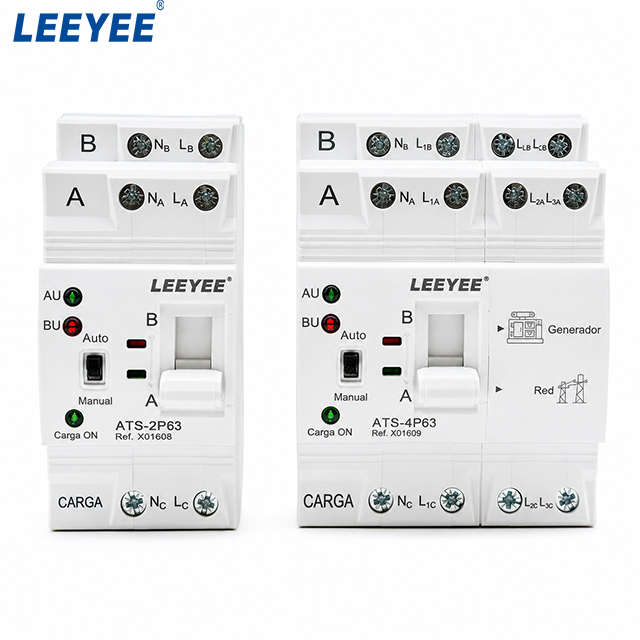
Which Factory Loads Are More Suitable for a Compact ATS?
The key question is not “How large is the factory?” It is “Which loads will actually pass through this ATS?”
A compact ATS is more naturally applied to a defined low-voltage load group rather than to the full incoming supply of a large industrial facility.
The examples below are practical application categories, not automatic approvals. Actual suitability must still be checked against the selected ATS data and project conditions.
| Load or Circuit | Typical Fit | Cosa confermare |
|---|---|---|
| PLC and control circuits | Often suitable | Allowed interruption and control-power requirements |
| Small control panels | Often suitable | Total current and control logic |
| Small distribution boards | Often suitable | Maximum simultaneous load and protection |
| Lighting and monitoring circuits | Often suitable | Load current and required backup duration |
| Small pumps and fans | Needs checking | Motor starting current and switching duty |
| Large compressors or heavy motors | Requires detailed engineering review | Starting method, utilisation duty, generator response and ATS capability |
| Plant-wide main incoming supply | Not automatically within compact ATS scope | Complete switchboard architecture and project requirements |
Procurement conclusion: select the ATS around the actual transferred load group. Do not use total transformer capacity or total factory connected load as the only sizing basis.
Typical Utility-to-Generator Arrangement
A common industrial backup arrangement uses the utility as the normal source and a generator as the standby source. Both sources are connected to the transfer system, while the ATS supplies the selected backup-load circuit.
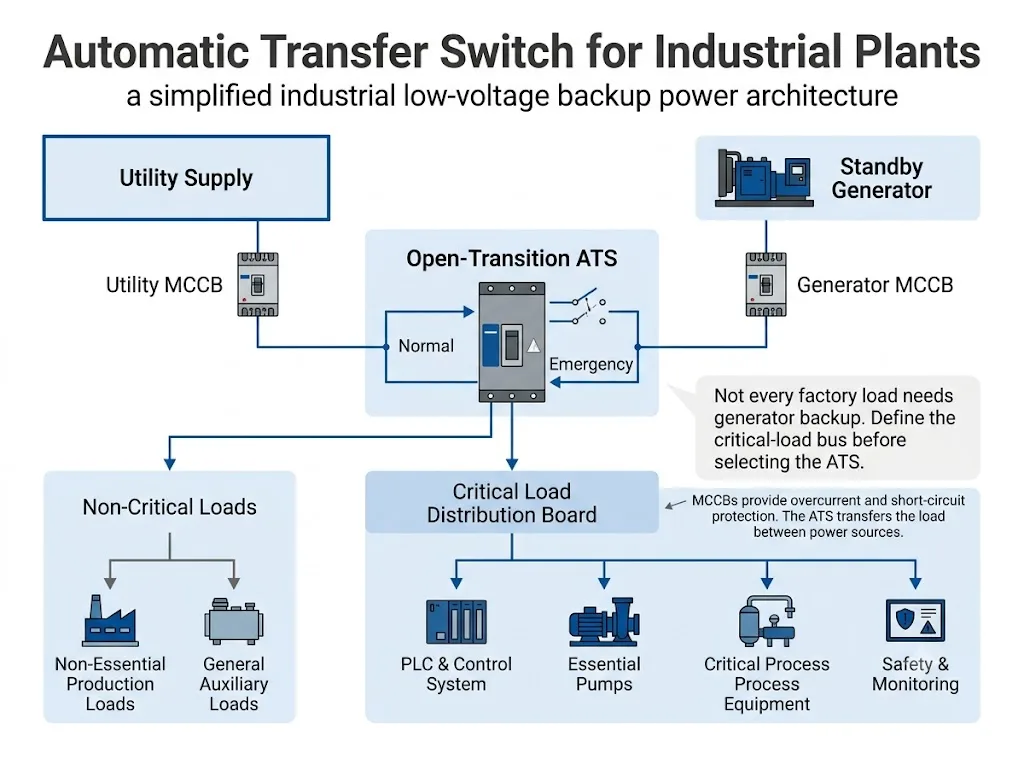
When the normal source becomes unacceptable and the generator reaches the required operating condition, the ATS can transfer the connected load to the emergency source. After normal power is restored and the programmed conditions are satisfied, the load can transfer back.[2]
Do Not Treat a Compact ATS as the Entire Factory Power System
An ATS performs one main job: it transfers a load between available power sources. It does not automatically replace the other protection, distribution and continuity functions required in an industrial electrical system.
Upstream circuit-breakers, conductors, generator controls and the transfer switch must therefore be considered together. IEC 60947-2 covers low-voltage circuit-breakers, while IEC 60947-6-1 covers transfer switching equipment.[1][3]
How Should the ATS Current Rating Be Selected?
Start with the maximum current expected to pass through the ATS during normal transferred operation. Then check whether the load characteristics create additional requirements.
For a compact industrial ATS application, confirm:
- Tensione e frequenza di sistema of both sources.
- Maximum simultaneous load current of the transferred circuit.
- Tipo di carico, especially motors and inductive loads.
- ATS utilisation data for the intended switching duty.
- Numero di poli and whether the neutral must be switched.
- Corrente di guasto disponibile at the installation point.
- Dispositivo di protezione a monte and required coordination.
- Installation conditions, including enclosure and ambient conditions where relevant.
Why Do Motor Loads Need Extra Attention?
Motors can draw much more current during starting than during normal running. This means that a small pump, fan or machine auxiliary motor cannot be evaluated only from its steady-state current.
Generator application guidance also shows that motor starting can produce substantial transient demand and voltage dip. Generator response depends on factors such as starting kVA, starting method, alternator characteristics and engine response.[4][5]
- Identify the motors on the backup circuit. Do not mix the complete factory motor list with the motors actually supplied through this ATS.
- Record the motor rating and starting method. Direct-on-line, soft-start and variable-frequency-drive applications can create different system behaviour.
- Check whether several motors can start together. Simultaneous starting can create a larger transient demand.
- Confirm generator capability. Check acceptable voltage and frequency performance during the expected starting event.
- Confirm the ATS switching duty. The ATS must be suitable for the actual load type and application.
Should a Factory ATS Be 3P or 4P?
Pole selection depends on the electrical system and neutral arrangement, not simply on whether the system is three-phase.
A 3P ATS switches the three phase conductors while leaving the neutral unswitched. A 4P ATS switches the neutral together with the phase conductors. Whether the neutral should be switched depends on the generator connection, earthing and bonding arrangement, protection design and applicable project requirements.[2]
How Should the ATS Work With MCCBs?
| Dispositivo | Main Job | What the Buyer Must Check |
|---|---|---|
| ATS / ATSE | Transfers the selected load between sources | Current, poles, transfer logic and switching data |
| MCCB / circuit-breaker | Provides the specified circuit switching and protection functions | Breaking capacity, trip settings and coordination |
| Generator controller | Starts and monitors the generator set | Start request, voltage/frequency readiness and operating sequence |
Procurement conclusion: matching the ampere number printed on an ATS and an MCCB does not prove that the combination is correctly coordinated.
What Happens During a Utility Failure?
The exact thresholds and delay settings depend on the controller and project, but a typical utility-to-generator sequence follows this logic:
- The normal source becomes unacceptable. The controller monitors the source according to its available sensing functions.
- The generator receives a start request. The generator starts and reaches acceptable operating conditions.
- The ATS transfers the selected load. In open transition, the normal source is disconnected before the emergency source is connected.
- The generator supplies the backup circuit. The generator must support the actual running and transient load.
- The load retransfers when normal power returns. Retransfer and generator cooldown timing depend on the controller and generator-system settings.
Which ATS Indications Are Useful in a Factory Panel?
Maintenance personnel should be able to understand source availability and load position without guessing the current switch state.
For LEEYEE compact ATS project confirmation, useful functions can include:
- Normal Available
- Emergency Available
- Load to Normal
- Load to Emergency
- Auto / Manual
- Fault Alarm, where provided by the selected configuration
If remote indication, generator-start contacts, dry-contact status, BMS integration or communication is required, specify the exact signal list before ordering. Do not assume that every controller version provides the same terminals or communication functions.
When Is This Compact ATS a Good Match?
| Applicazione | Suitability | Significato ingegneristico |
|---|---|---|
| Utility + standby generator | Applicazione tipica | Confirm current, voltage, poles and control logic |
| Factory control panel | Potentially suitable | Confirm transferred load and allowable interruption |
| Small backup distribution board | Potentially suitable | Check maximum simultaneous load and protection |
| Small pump or fan backup circuit | Needs motor check | Confirm motor starting and ATS switching duty |
| Large factory main incoming system | Not automatically suitable | Requires complete switchboard and protection review |
| No-break process | Not suitable by itself | Open transition causes an interruption |
| Bypass-isolation requirement | Not the standard compact product | Requires a separate engineered architecture |
The product should be selected where a compact open-transition ATS matches the actual electrical and process requirement, rather than forcing the product into a higher-level industrial application for which it was not intended.
Quali informazioni dovresti inviare prima di ordinare?
A useful industrial ATS enquiry should describe the transferred circuit, not just provide one ampere value.
Need help confirming a compact ATS for a factory panel?
Send the system voltage, backup-load current, motor information, pole requirement, generator details and single-line diagram. LEEYEE can help confirm whether the compact open-transition ATS configuration matches the intended application.
FAQ
Can this ATS supply an entire factory?
Can a compact ATS be used for factory control panels?
Can it be used with a standby generator?
Can I select the ATS only from the motor running current?
Does every three-phase factory need a 4P ATS?
Does the ATS replace an MCCB?
Is this ATS suitable for uninterrupted industrial processes?
Riferimenti
- IEC, IEC 60947-6-1:2026 — Apparecchiature di commutazione e controllo a bassa tensione — Parte 6-1: Apparecchiature multifunzionali — Apparecchiature di commutazione di trasferimento. Negozio online IEC.
- Eaton, published technical literature covering automatic transfer switches, open-transition operation and switched-neutral applications. Eaton.
- IEC, IEC 60947-2 — Low-voltage switchgear and controlgear — Part 2: Circuit-breakers. Negozio online IEC.
- Cummins Power Generation, generator-set application guidance covering motor starting and transient load behaviour. Cummins Power Generation.
- Cummins Power Generation, generator sizing and motor-starting technical guidance. Final generator selection should be confirmed using the applicable generator data and project conditions. Cummins Power Generation.