
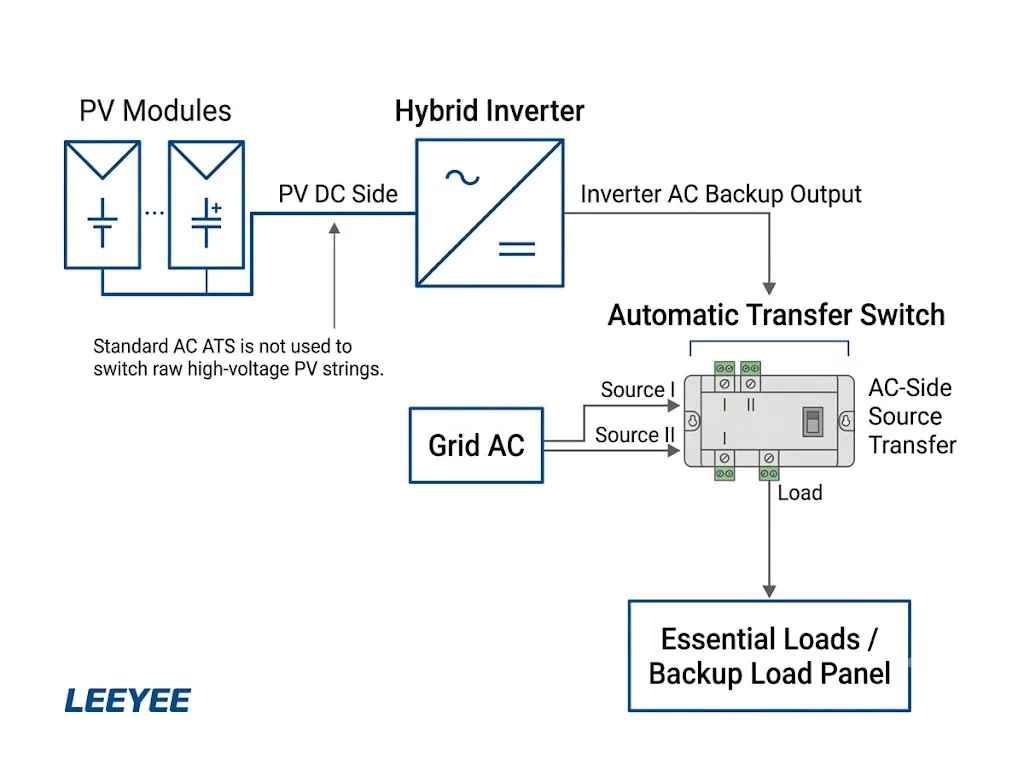
A solar automatic transfer switch is normally used on the Lado AC of a PV backup system to transfer a load between two available AC sources, such as grid power and an inverter backup output, or an inverter and a generator. It should not automatically be treated as a switch for raw high-voltage PV strings.
The first engineering question is therefore not “Which ATS current rating should I buy?” It is “Does this PV system need an external ATS at all, and where should it be installed?” A hybrid inverter may already provide an approved transfer or backup function, while other systems may benefit from an external ATS that gives critical loads access to another AC source.[2][3]
Use the ATS to transfer AC sources, not to assume control of the PV DC string. PV modules normally feed the inverter on the DC side. The inverter then provides an AC output. An external ATS may be appropriate where two compatible AC sources need to alternatively feed the same load.
Índice
Where Does an ATS Fit in a PV Backup System?
An ATS is fundamentally a load-transfer device. IEC 60947-6-1 defines transfer switching equipment as equipment used to transfer a load between power-supply sources. The standard has both AC and DC scope, but the scope of a standard must not be confused with the approved application of a specific ATS model.[1]
For the LEEYEE compact ATS discussed on this page, the intended application is low-voltage AC-side dual-source transfer. This page does not present the product as a high-voltage PV-string DC transfer device.
IEC 60947-6-1 includes transfer switching equipment up to the voltage limits stated in the standard.[1] This does not mean every transfer switch is suitable for photovoltaic DC. Product voltage rating, switching category, markings, manufacturer data and actual circuit conditions must all match the application.
Common AC-side transfer positions
| PV backup architecture | Possible ATS role | Significado de engenharia |
|---|---|---|
| Grid + inverter backup output | Alternative AC path to the backup-load panel | Use only where the inverter architecture permits external transfer |
| Inverter AC + generator AC | Selects which AC source feeds the load | Generator and inverter operating requirements must be coordinated |
| Grid AC + generator AC | Traditional dual-source transfer | May operate upstream of a PV-backed distribution architecture |
| PV strings before the inverter | Not the standard application covered here | Use equipment specifically rated and approved for the actual PV DC circuit |
Procurement conclusion: first identify the two sources that can genuinely supply the downstream load as AC sources. Only then select the transfer equipment.
Does a Hybrid Inverter Still Need an External ATS?
Nem sempre. Many hybrid-inverter systems already contain switching, isolation or dedicated backup functions within the manufacturer's approved architecture. Adding another ATS simply because the system contains solar panels can create unnecessary complexity or conflict with the intended backup topology.
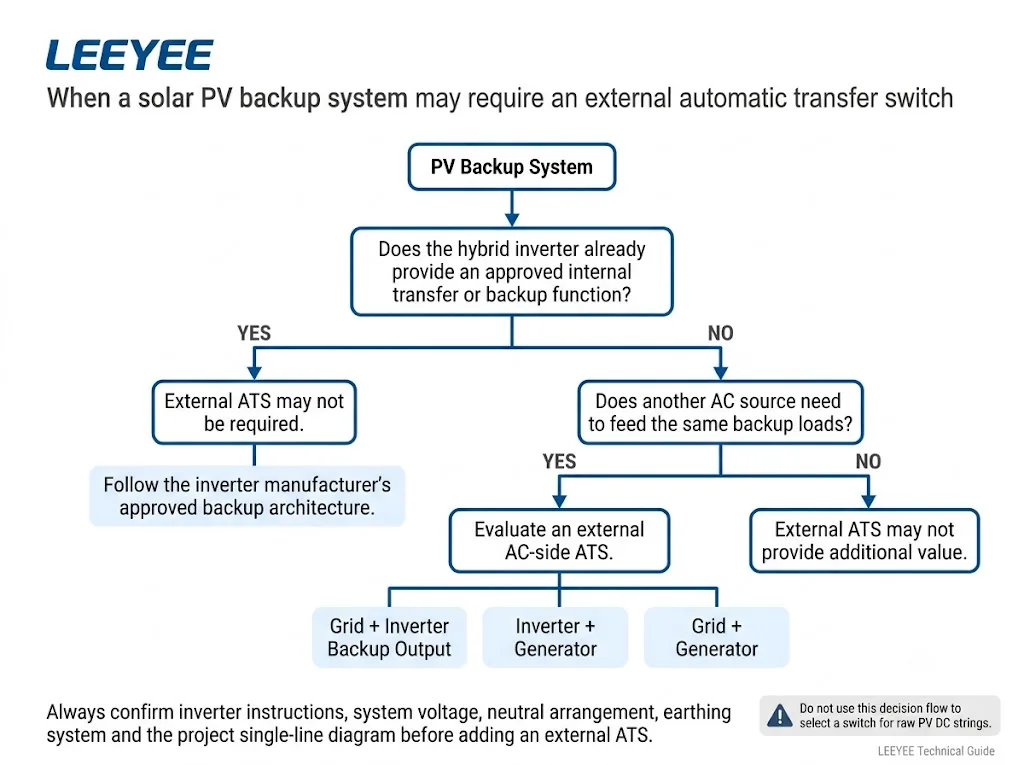
Integrated backup transfer already exists
Follow the inverter manufacturer's approved arrangement first. An additional ATS may not be required.
Confirme: backup/EPS output, grid isolation method and whether external switching is supported.
Inverter failure must not remove the backup-load supply
An external ATS may provide an alternative grid path where the inverter manufacturer supports such an architecture.
Solis publishes one model-specific example for selected hybrid inverter systems.[2]
Two independent AC sources feed one load panel
Examples include inverter backup AC versus generator AC, or grid AC versus generator AC.
This is close to the normal role of a compact dual-source ATS.
The PV system has no separate backup source
A grid-tied PV inverter alone does not automatically create a second independent AC source for protected loads.
An ATS should not be added merely because PV modules are present.
Three Practical AC Transfer Architectures
1. Grid AC ↔ Inverter Backup AC → Essential Loads
This arrangement may be considered where the inverter backup output normally feeds an essential-load panel but an alternative grid path is required under defined operating conditions.
The inverter manufacturer's documentation must permit the way the grid, backup output and transfer device interact. The system must not create an unintended parallel connection between independent sources.
2. Inverter AC ↔ Generator AC → Backup Loads
This architecture can be relevant in off-grid or extended-outage applications where a generator provides a second AC source. The ATS transfers the downstream load between the inverter-side supply and generator-side supply.
Generator start control is a separate engineering function. Depending on the inverter, genset and controller architecture, start/stop logic may be handled by the inverter, the generator controller or another control device.
3. Grid AC ↔ Generator AC → Solar-Backed Distribution System
In other projects, the ATS remains a conventional grid-versus-generator transfer device while the hybrid inverter and battery system form another part of the electrical architecture. SolarEdge documentation, for example, shows manufacturer-defined systems connecting grid, backed-up loads, inverter equipment and optional generator functions.[3]
How to Select an ATS for a Solar Backup System
Once the AC transfer position is confirmed, ATS selection becomes much easier. Do not start from current rating alone.
| Confirmar primeiro | Por que isso importa | O que enviar ao fornecedor |
|---|---|---|
| Tensão do sistema AC | The ATS must match the actual source and load voltage | Rated voltage and frequency |
| Corrente de carga máxima | Defines the required current-carrying capacity | Continuous load and relevant peak-load information |
| Monofásico ou trifásico | Defines the basic conductor arrangement | System type and single-line diagram |
| Neutral arrangement | Determines whether neutral switching must be considered | Earthing and source-neutral information |
| Inverter type | Hybrid, grid-tied and off-grid inverters have different backup functions | Manufacturer and exact model |
| Generator included? | May change transfer and control logic | Generator voltage, phase and control arrangement |
| Allowed interruption | Determines whether open transition suits the load | Critical-load requirements |
How Do You Size a Solar ATS?
Size the ATS from the AC current that will pass through the transfer point, not from PV-array DC current or solar-panel wattage alone.
A 30 kWp PV array, for example, does not automatically determine the ATS current rating. The ATS sits in the AC distribution path, so selection must reflect the real downstream AC load and the capability of the sources feeding that transfer point.
- Maximum continuous downstream AC load current
- Actual system voltage and phase arrangement
- Inverter AC output capability
- Generator output capability, if included
- Motor, pump, compressor, transformer or other high-inrush loads
- Project-specific derating, coordination or margin requirements
2P or 4P ATS for Solar Backup?
Pole count should not be selected only from the words “single-phase” or “three-phase.” The real question is which conductors must be transferred between the two sources.
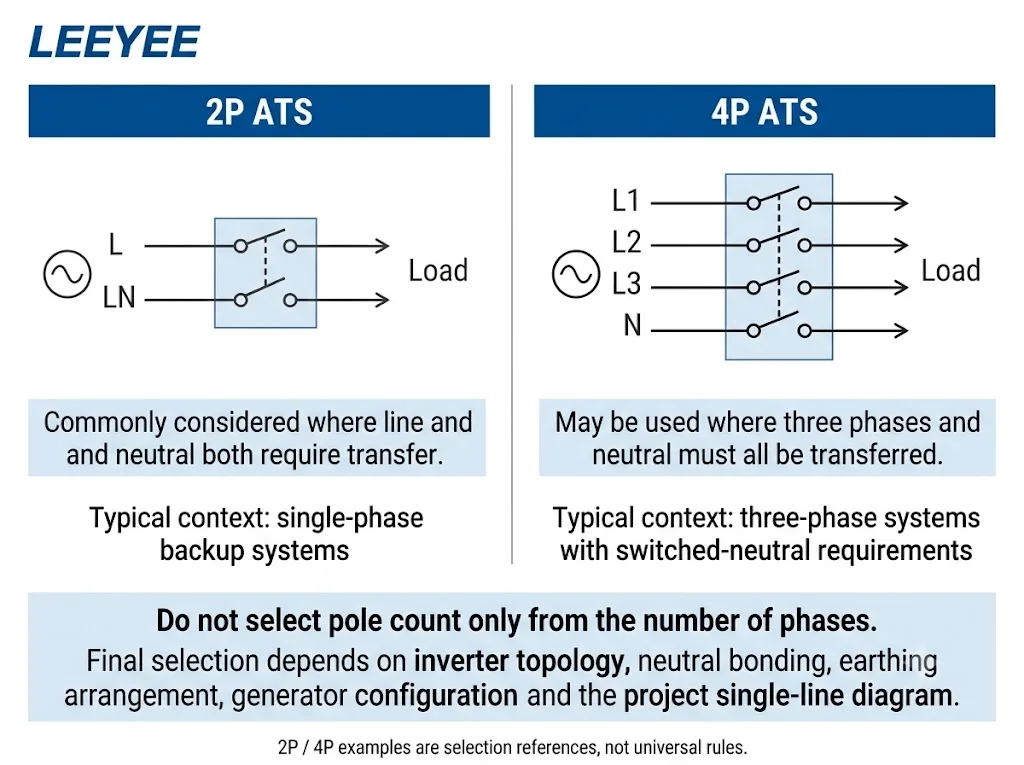
In a single-phase system, a 2P arrangement may be considered where both line and neutral are intended to transfer. In a three-phase system, 4P may be considered where all three phase conductors and neutral must transfer. A three-phase application does not automatically mean that 4P is always mandatory.
Whether neutral should be switched depends on factors including the grounding arrangement, source configuration, generator neutral arrangement, inverter topology and applicable project rules. Eaton's engineering guidance on three-pole and four-pole transfer switches illustrates why neutral treatment is a system-design question rather than a simple phase-count rule.[5]
Send the inverter model, generator information if applicable, earthing arrangement and single-line diagram for project confirmation.
Is Open Transition Suitable for PV Backup Loads?
The standard LEEYEE compact ATS considered on this page is an open-transition solution. In open transition, the first source is disconnected before the second source is connected. Eaton describes this as break-before-make transfer.[4]
This avoids intentional paralleling of the two sources during normal transfer, but it also means the downstream load experiences an interruption while changing sources.
Victron's transfer-switch documentation similarly notes that appliances are not supplied for a short period while its transfer switch changes between sources, and that sensitive electronic equipment may be affected.[6]
The downstream load can tolerate the transfer interruption and the source arrangement is compatible with break-before-make switching.
The load cannot tolerate even a brief interruption, or when the inverter, UPS, generator or process equipment has specific transfer requirements. A standard open-transition ATS should not be marketed as a seamless or zero-interruption transfer solution.
Check Short-Circuit Rating and Upstream Protection
ATS selection does not end with voltage, poles and rated current. The transfer switch also has to be suitable for the prospective short-circuit conditions at its installation point and for the protective devices used with it.
Transfer-switch manufacturers publish short-circuit withstand and coordination information for their equipment. Eaton's ATS guidance explains that transfer-switch application must consider system fault current and the ability of the transfer equipment to withstand specified short-circuit conditions.[4][7]
Available fault current, upstream breaker or fuse, selected ATS model and manufacturer-declared coordination conditions must be checked together.
For project review, provide the available short-circuit level if known, upstream protective-device information and the single-line diagram. LEEYEE model-specific short-circuit data should be checked from the selected product documentation rather than assumed from a generic value.
What an ATS Does Not Replace in a PV System
- PV DC isolating equipment: PV DC circuits require equipment rated and approved for their actual DC conditions.
- Inverter anti-islanding and grid-interface functions: these remain part of the inverter and approved system architecture.
- Overcurrent and short-circuit protection: protective devices still need to be selected for the circuit.
- UPS functionality: an open-transition ATS does not guarantee uninterrupted power.
- Generator start and engine control: this depends on the genset and control architecture.
- Earthing and neutral design: an ATS cannot correct an incorrectly designed grounding system.
- Manufacturer-required backup interface: where an inverter manufacturer requires a dedicated approved interface, that system requirement should be followed.
LEEYEE Compact ATS for AC-Side Solar Backup Applications
LEEYEE's standard product for this type of application is a compact integrated automatic transfer switch for low-voltage dual-source AC systems. The same compact product family can be supplied in different pole configurations for different AC distribution requirements.
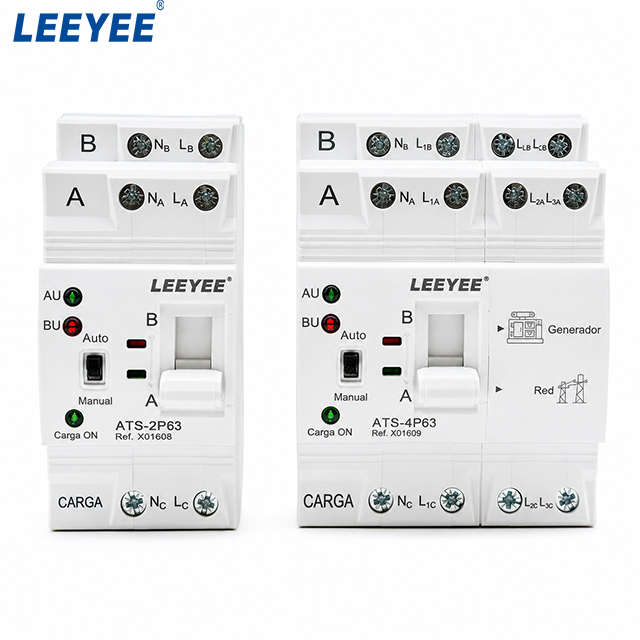
The real product shown above matches the type of ATS discussed throughout this guide: a compact integrated unit intended for AC source transfer. In a PV backup project, it can be evaluated for suitable positions such as grid versus inverter backup AC, inverter versus generator AC, or grid versus generator AC.
It should not be represented as a high-voltage PV-string DC switch, a static transfer switch, a bypass-isolation cabinet or a complete microgrid transfer system.
The most useful enquiry is not simply “I need a solar ATS.” A better request is: “I have these two AC sources, this inverter, this voltage and this load panel. Please confirm whether your compact ATS fits this transfer position.”
Before Ordering: Send Your PV Backup System Details
- Inverter manufacturer and exact model
- Inverter type: grid-tied, hybrid or off-grid
- Backup / EPS output information
- AC system voltage and frequency
- Monofásico ou trifásico
- Maximum backup-load current or load schedule
- Source combination: grid + inverter, inverter + generator, or grid + generator
- Earthing and neutral arrangement
- Required 2P / 3P / 4P configuration if already specified
- Upstream circuit breaker or fuse information
- Available short-circuit level, if known
- Diagrama unifilar
- Quantidade necessária
- OEM or private-label requirements
Need an ATS configuration review for a PV backup panel?
Send the inverter model, intended AC sources, system voltage, load current and single-line diagram. LEEYEE can review whether a standard compact open-transition ATS fits the proposed AC-side transfer position.
Perguntas mais frequentes
Do all solar systems need an automatic transfer switch?
No. A grid-tied system may not have a separate backup AC source, while a hybrid inverter may already include or require its own approved backup-transfer architecture. An external ATS should be added only when it solves a defined AC-source transfer requirement.
Can I install an ATS between the solar panels and inverter?
Do not assume a standard AC ATS is suitable for that position. The PV array-to-inverter circuit is DC, and any device installed there must be specifically rated and approved for the actual PV DC conditions.
Does a hybrid inverter with backup output still need an external ATS?
It depends on the inverter and system architecture. If the inverter already provides the required approved transfer function, another ATS may be unnecessary. In other systems, an external ATS may provide a useful alternative AC supply path.[2]
Can the ATS switch between an inverter and a generator?
Potentially yes, when both are compatible AC sources for the intended load and the complete system architecture permits the arrangement. Generator voltage, frequency, neutral configuration, control logic and inverter requirements must all be confirmed first.
What size ATS do I need for a solar inverter?
Base the selection on the AC current at the transfer point, not on PV-array DC current or solar-panel wattage alone. Confirm downstream load current, inverter AC capability, generator capability if present, voltage, phase arrangement and high-inrush loads.
Should a single-phase solar backup system use a 2P ATS?
A 2P ATS may be appropriate where both line and neutral need to transfer, but this is not universal. Neutral treatment, earthing arrangement, inverter design and project requirements must be checked first.
Should a three-phase hybrid inverter always use a 4P ATS?
No. A 4P ATS transfers L1, L2, L3 and neutral, but whether the neutral should be switched depends on the source configuration, grounding arrangement and project design.[5]
Is an open-transition ATS suitable for sensitive electronics?
Only if the load can tolerate the transfer interruption. Open transition is break-before-make, so there is an interruption between the two sources.[4] Loads requiring continuous power may need UPS support, inverter ride-through or another engineered solution.
Do I need to check short-circuit rating when selecting a solar ATS?
Yes. Voltage, poles and rated current are not the only checks. The prospective fault current and upstream protective device must also be compatible with the selected ATS and its declared short-circuit coordination data.[4][7]
Referências
- [1] IEC. IEC 60947-6-1:2026, Low-voltage switchgear and controlgear – Part 6-1: Multiple function equipment – Transfer switching equipment. Página de publicações oficiais da IEC.
- [2] Solis North America. External Automatic Transfer Switch (ATS) for Backup Load Protection. Solis technical article.
- [3] SolarEdge Technologies. Backup Interface Installation Guide. SolarEdge technical documentation.
- [4] Eaton. Fundamentals of Automatic Transfer Switches. Eaton ATS fundamentals.
- [5] Eaton. 3-Pole and 4-Pole Transfer Switch Switching Characteristics. Eaton engineering paper.
- [6] Victron Energy. VE Transfer Switch – Operation. Victron transfer-switch documentation.
- [7] Schneider Electric. O que é um comutador de transferência? Schneider Electric technical overview.
Engineering note: solar backup architectures vary by inverter manufacturer, grid requirements, earthing arrangement, generator design and local electrical rules. The examples above are selection guidance, not project-specific wiring instructions. Final source arrangement, neutral treatment, protective devices, short-circuit coordination and ATS model must be confirmed against the actual project documents.
