
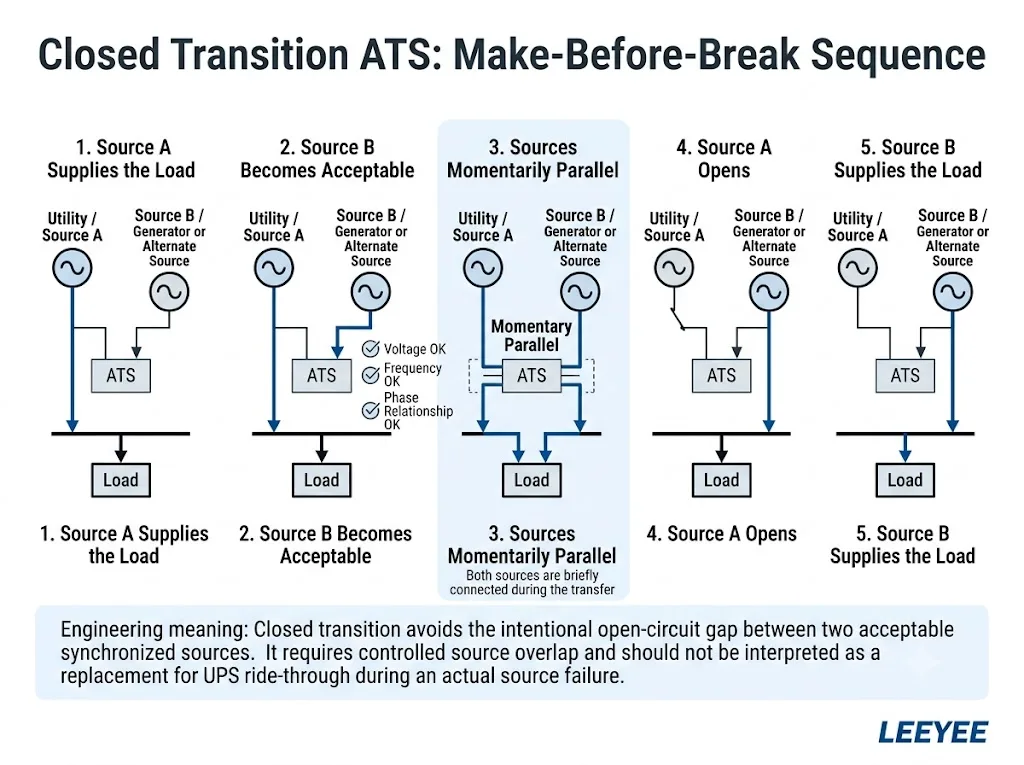
A closed transition ATS, also called a closed transition transfer switch or CTTS, uses a controlled make-before-break sequence. When two power sources are available and suitably synchronized, the incoming source closes before the outgoing source opens, creating a brief period of source overlap.
The important purchasing question is not whether closed transition sounds more advanced. It is whether the project actually needs momentary source paralleling. Many compact backup-power applications are better served by a conventional ATS that keeps the two sources separated.
Índice
Quick Answer: What Is a Closed Transition ATS?
A closed transition ATS transfers the load between two acceptable sources without intentionally opening the load circuit between them. The incoming source is connected first and the outgoing source is disconnected immediately afterward. Eaton and Schneider Electric describe this as make-before-break operation.[2][5]
Closed transition is mainly useful when both sources are already healthy—for example during planned transfer, generator testing or retransfer to utility. If utility power has already failed, there is no healthy normal source available for make-before-break overlap. Cummins therefore notes that a closed-transition system operates as an open transition when one source is unavailable.[4]
Is the LEEYEE ATS-63 a Closed Transition ATS?
The current published ATS-63 product information should not be interpreted as closed-transition capability.
LEEYEE ATS-63 is a compact DIN-rail automatic transfer switch for general backup source switching. The published series includes 2P and 4P versions, rated-current options from 6A to 63A and applications such as generator backup, inverter backup, distribution boards and control cabinets.[8]
The published <50 ms transfer switching time does not mean zero interruption and does not prove closed-transition operation. Current LEEYEE guidance states that compact DIN-rail ATS products should not automatically be assumed to support source synchronization or closed transition. If a project specifically requires momentary paralleling or no-break planned transfer, that requirement needs a different engineered solution unless a model-specific document explicitly confirms closed-transition capability.[8]
Significado do comprador: for a normal generator, inverter or dual-source backup panel, ATS-63 may be appropriate when voltage, current, poles, wiring and switching requirements match. If the specification explicitly says closed transition, make-before-break, source synchronization ou momentary paralleling, do not substitute ATS-63 without written model-specific confirmation.
Not sure whether your project needs a compact ATS-63 or a closed-transition system? Send the two source types, voltage, current, poles and required transfer behaviour for technical review.
How Does a Closed Transition ATS Work?
The defining difference is the order in which the contacts operate. A conventional open-transition ATS disconnects one source before connecting the next. A closed-transition system temporarily reverses that order.
- Source A is carrying the load. Source B is available but not yet connected.
- The controller verifies Source B and the relationship between both sources. Voltage, frequency and synchronization conditions are checked according to the equipment design and project settings.
- The incoming source closes. Both sources are briefly connected to the load bus.
- The outgoing source opens. The momentary parallel condition ends.
- The load remains on Source B. The closed-transition sequence is complete.
The critical event is the momentary source overlap. Because two live power sources are electrically connected together, closed transition requires synchronization and protection functions that should not be assumed to exist in a compact general-purpose ATS.
Does Closed Transition Mean Zero Interruption?
Closed transition avoids the intentional open-circuit interval that occurs when an open-transition switch separates one healthy source before connecting another.
That does not mean every downstream load experiences a mathematically perfect voltage and frequency waveform throughout the transfer.
Generator loading can change rapidly. Cummins explains that fast closed transfer may still produce generator voltage or frequency disturbance because the generator requires time to respond to a sudden change in load.[4]
A specification such as “transfer switching time <50 ms” does not by itself describe a closed-transition ATS. A fast break-before-make ATS can still interrupt the load briefly. Closed transition is defined by the make-before-break contact sequence and controlled source overlap—not simply by a small millisecond value.
How long can the two sources overlap?
Some commercial fast closed-transition designs limit source paralleling to approximately 100 ms or less. Schneider Electric documents a sub-100 ms sequence for the referenced ASCO closed-transition design.[2]
This should not be treated as a universal value. The acceptable overlap time depends on equipment design, controller logic, certification, utility requirements and project protection philosophy.
Why Must the Two Sources Be Synchronized?
Closed transition connects two live AC sources together. The sources therefore need to be sufficiently aligned before the contacts are allowed to overlap.
Typical synchronizing logic evaluates:
- voltage difference;
- frequency difference;
- phase relationship.
The exact permitted window depends on the selected transfer-switch controller and project requirements.[3][4]
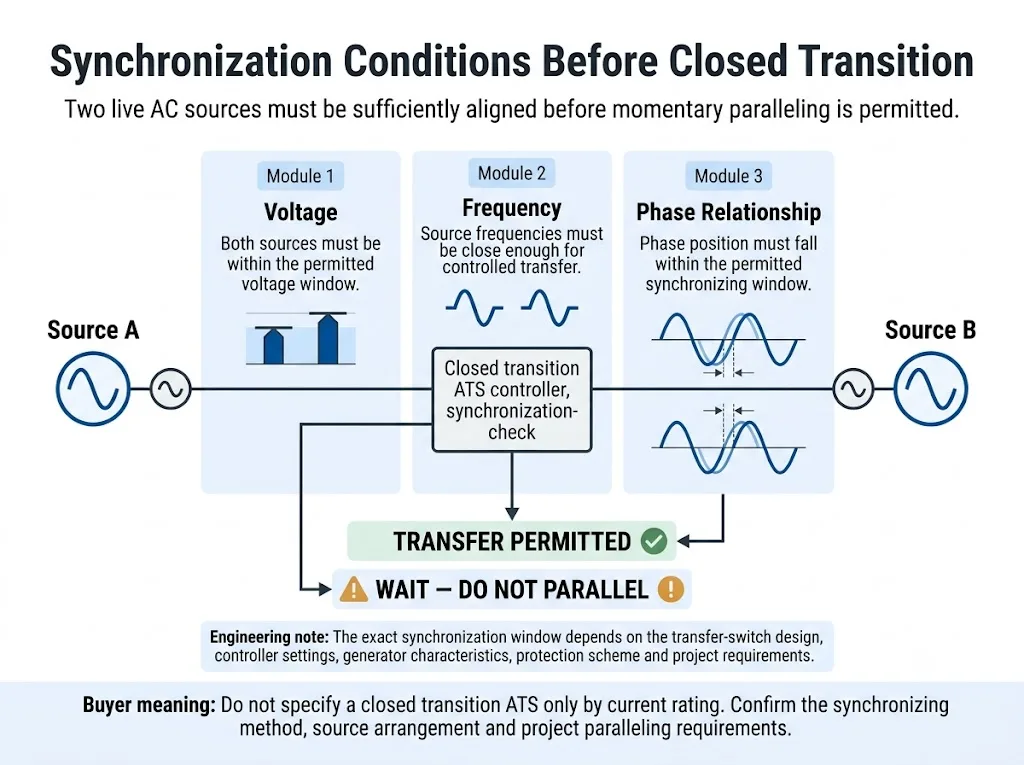
Schneider Electric documents an in-sync window for certain ASCO closed-transition products of less than ±5 electrical degrees phase difference, less than ±0.2 Hz frequency difference and less than 5% voltage difference. These are product-specific values, not universal settings for every CTTS.[3]
Significado do comprador: a closed-transition RFQ should ask for the controller's synchronization method and limits. Current rating and transfer speed alone do not establish closed-transition capability.
What Happens During a Real Utility Failure?
Closed transition needs two acceptable sources before make-before-break operation is possible.
If utility power suddenly fails, the normal source is already unavailable. A conventional utility-generator backup sequence therefore looks different:
- Utility power becomes unacceptable. The failed source cannot participate in controlled overlap.
- The generator receives a start command. The generator needs time to start and establish acceptable voltage and frequency.
- The alternate source becomes acceptable. The ATS can then transfer the load.
Cummins states that closed-transition equipment operates in open transition when one source has failed.[4]
A closed-transition ATS cannot provide energy while a generator is starting. If the connected equipment cannot tolerate this interval, a UPS or other ride-through architecture may still be required.[4]
This is why closed transition is especially valuable during planned generator testing or retransfer back to utility, when both sources can already be available.
ATS de Transição Aberta vs ATS de Transição Fechada
For procurement, focus on source behaviour rather than assuming the more complex transition method is automatically better.
| Decision Point | Open Transition | Closed Transition |
|---|---|---|
| Switching sequence | Break before make | Make before break |
| Source overlap | Não | Brief controlled overlap |
| Planned-transfer interruption | A short interruption occurs | Intentional open gap is avoided |
| Synchronization for overlap | Not applicable because sources are kept separated | Required |
| Source paralleling | No intentional paralleling | Momentary paralleling |
| Control complexity | Inferior | Mais alto |
| Typical compact ATS application | General generator, inverter and dual-source backup | Engineered systems requiring no-break planned transfer |
| LEEYEE ATS-63 | Suitable for general backup switching when system parameters match | Do not specify as CTTS based on current published product information |
For the current LEEYEE compact ATS-63 range, treat the product as a general backup transfer solution rather than assuming closed-transition capability.
When Is the LEEYEE ATS-63 the Better Fit?
The ATS-63 is more relevant when the project needs a compact automatic transfer between two AC sources and can tolerate the brief interruption associated with conventional source switching.
Backup de Gerador
For switching between utility and generator in compact backup systems, provided voltage, current, poles, wiring and generator-control requirements match the selected ATS.
Inverter Backup
For grid-to-inverter switching where the inverter output, frequency, neutral arrangement and project wiring are compatible.
Gabinetes de Controle
Its compact DIN-rail format can suit auxiliary and backup circuits in control panels where source synchronization is not required.
Small Distribution Systems
The 2P and 4P options support different source and conductor arrangements, subject to the exact project wiring design.
The specification requires closed transition, synchronized source paralleling, zero-break planned transfer, soft-load transfer or another engineered critical-power function that is not confirmed in the ATS-63 model documentation.
Closed Transition Is Not the Same as Soft-Load Transfer
Fast closed transition and soft-load transfer can both involve source paralleling, but they solve different engineering problems.
A fast closed-transition ATS can move load rapidly once synchronization conditions are satisfied. A generator can therefore see a relatively abrupt change in load.
Cummins describes soft-load transfer as a more controlled arrangement in which synchronization and generator governing are used while load is gradually ramped from one source to the other.[4]
If a project specification mentions load ramping, extended paralleling or generator kW control, do not assume a conventional closed-transition ATS—or a compact ATS-63—is sufficient.
Why Do Utility and Protection Requirements Matter?
A utility-generator closed transition briefly connects the generator and utility together. Even when the intended overlap is short, the project may need to address utility interconnection rules, protection and failure-to-disconnect conditions.
Cummins notes that serving-utility requirements vary and additional protective controls may be required for closed-transition applications.[4]
- Is momentary utility paralleling permitted?
- What synchronization window is required?
- What happens if the outgoing source fails to disconnect?
- What protection is required during the parallel interval?
- What fault-current contribution exists with both sources connected?
- What utility, AHJ or project approval is required?
These conditions are project-specific and should be confirmed by the qualified system designer and serving utility where applicable.
Do Hospitals and Data Centers Always Need Closed Transition?
Não. The name of the facility does not determine the ATS transition method.
Hospitais
Closed transition may help where planned testing or retransfer should avoid a power blink, but healthcare electrical requirements and the complete emergency-power system still govern the design.
Centros de dados
A data center may already use UPS systems, redundant buses, static transfer equipment and other continuity architecture. CTTS should be evaluated as one part of the complete power path.
Industrial Processes
Continuous production can justify closed transition if a brief planned interruption would trip the process, but generator load response must also be considered.
General Backup Power
If a brief interruption is acceptable, a simpler open-transition ATS is often more appropriate and easier to coordinate.
Does a Normal Generator Backup Project Need Closed Transition?
Often, it does not.
If the requirement is simply:
utility fails → generator starts → backup source becomes acceptable → ATS transfers the load
then closed transition cannot eliminate generator starting time because the utility source has already failed.
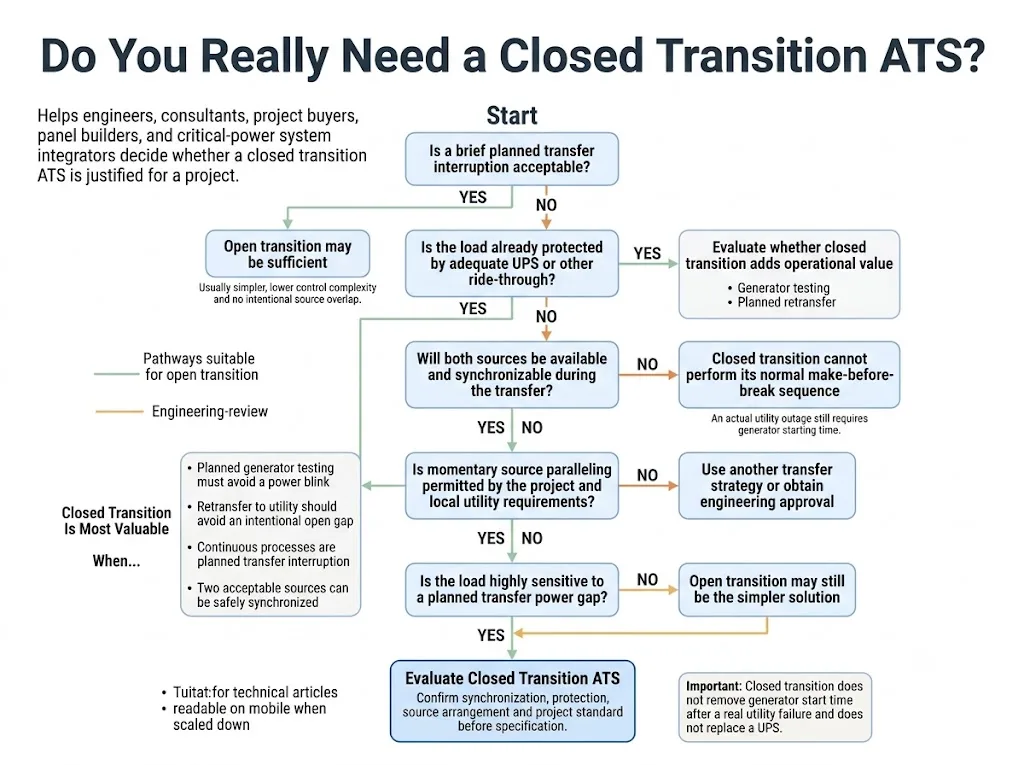
Closed transition becomes more relevant when the system needs to avoid an intentional interruption during:
- planned generator testing;
- planned transfer between healthy sources;
- retransfer from generator back to restored utility;
- continuous-process source changeover.
When Should You Use a Closed Transition ATS?
| Condição do Projeto | Engineering Direction |
|---|---|
| Short planned interruption is acceptable | A conventional ATS may be sufficient. |
| Generator testing must avoid a power blink | Evaluate closed transition. |
| Retransfer to utility should avoid an intentional open gap | Common closed-transition use case. |
| Sources cannot synchronize reliably | Normal closed transition should not proceed. |
| Utility paralleling is prohibited | Use another approved transfer strategy. |
| Load must remain powered while generator starts | ATS alone is not enough; evaluate UPS or other ride-through. |
| Compact 2P/4P backup switching up to 63A is required | Evaluate LEEYEE ATS-63 if its electrical and wiring parameters match. |
What Does IEC 60947-6-1:2026 Say About Closed-Transition ATSE?
IEC 60947-6-1:2026 is the fourth edition of the IEC transfer switching equipment standard. It was published on April 2, 2026 and includes dedicated requirements for ATSE having closed transition capability in Annex D.[1]
This does not mean every ATS claiming IEC 60947-6-1 automatically has closed-transition capability.
For procurement, verify:
- the exact product model;
- the standard edition;
- the certificate or test-report scope;
- whether closed-transition capability is actually included;
- the destination-market requirements.
For North American projects, UL 1008 is also a relevant transfer-switch standard. Project-specific NEC, NFPA and AHJ requirements must be confirmed separately.[6]
What Should You Confirm Before Choosing the ATS?
Project and RFQ Checklist
- Tipo de fonte normal
- Tipo de fonte alternativo
- Tensão do sistema
- Frequência
- Monofásico ou trifásico
- Configuração de polos necessária
- Corrente de carga contínua
- Corrente de falta disponível
- Generator starting characteristics
- Load sensitivity to interruption
- Required transfer method
- Required transfer time
- Need for source synchronization
- Need for momentary paralleling
- UPS or ride-through already installed
- Utility interconnection requirement
- Norma aplicável
- Required certificate scope
Not Sure Whether ATS-63 or Another Transfer Solution Fits?
Share your voltage, current, poles, normal source, backup source, load type and required transfer behaviour. LEEYEE can help confirm whether the project matches the compact ATS-63 range or requires a different engineered transfer approach.
Perguntas mais frequentes
What is a closed transition ATS?
A closed transition ATS uses make-before-break operation. It briefly connects two acceptable synchronized sources before disconnecting the outgoing source.[2]
Is the LEEYEE ATS-63 a closed transition ATS?
Current published LEEYEE ATS-63 information describes it as a compact DIN-rail automatic transfer switch for general backup source switching and does not establish closed-transition synchronization or momentary paralleling capability. Do not specify ATS-63 as CTTS without model-specific documentation confirming that function.[8]
Does the ATS-63 switching time of less than 50 ms mean zero interruption?
No. The published value is the ATS switching time. It does not mean a generator starts within 50 ms, and it does not by itself mean make-before-break or zero-break transfer.[8]
O ATS-63 pode ser usado para backup de gerador?
Yes, when the system voltage, current, pole configuration, wiring and generator interface match the product requirements. It should be treated as a compact backup transfer application rather than assumed to provide closed-transition paralleling.[8]
Does a closed transition ATS replace a UPS?
No. An ATS transfers a load between sources but does not store energy. A UPS or other ride-through system may still be needed while a generator starts or whenever no acceptable source is available.[4]
Why must the two sources be synchronized?
Because closed transition briefly connects both live sources. Voltage, frequency and phase relationship therefore need to fall inside the permitted synchronization window before overlap is allowed.[3]
Can closed transition remove generator starting time?
No. If utility power has already failed, the generator must still start and reach acceptable conditions before it can supply the load. Closed transition does not provide stored energy during this period.[4]
Does closed transition require utility approval?
Where utility and generator are momentarily paralleled, the serving utility's interconnection and protection requirements should be confirmed. Requirements vary by location and system design.[4]
Is closed transition mandatory for hospitals or data centers?
No universal decision should be based only on facility type. The required transfer method depends on load continuity, UPS architecture, project specification, applicable codes and the complete power system.
Referências
- Comissão Eletrotécnica Internacional. IEC 60947-6-1:2026 — Aparelhagem de baixa tensão — Parte 6-1: Equipamentos multifuncionais — Equipamentos de comutação de transferência. Página de publicação oficial da IEC.
- Schneider Electric / ASCO. What are the different ASCO ATS transition modes? Official Schneider Electric technical guidance.
- Schneider Electric / ASCO. What is the difference between in-sync and in-phase of ASCO transfer switches? Official Schneider Electric technical guidance.
- Cummins Power Generation. T-011 Transfer Switch Application Manual. Technical guidance covering closed transition, utility coordination, synchronizing, source availability and soft-load transfer. Official Cummins manual.
- Eaton. Automatic Transfer Switch Fundamentals. Describes open transition as break-before-make and closed transition as make-before-break. Official Eaton technical page.
- UL Solutions. Serviços de certificação e avaliação de comutadores. Identifies UL 1008 for applicable automatic transfer switch equipment. Official UL Solutions page.
- LEEYEE. What Is an Automatic Transfer Switch? How ATS Works & How to Choose. Published LEEYEE information covering ATS-63 product scope, 2P/4P configurations, 6A–63A current options, transfer switching time and compact backup applications. LEEYEE ATS technical guide.