
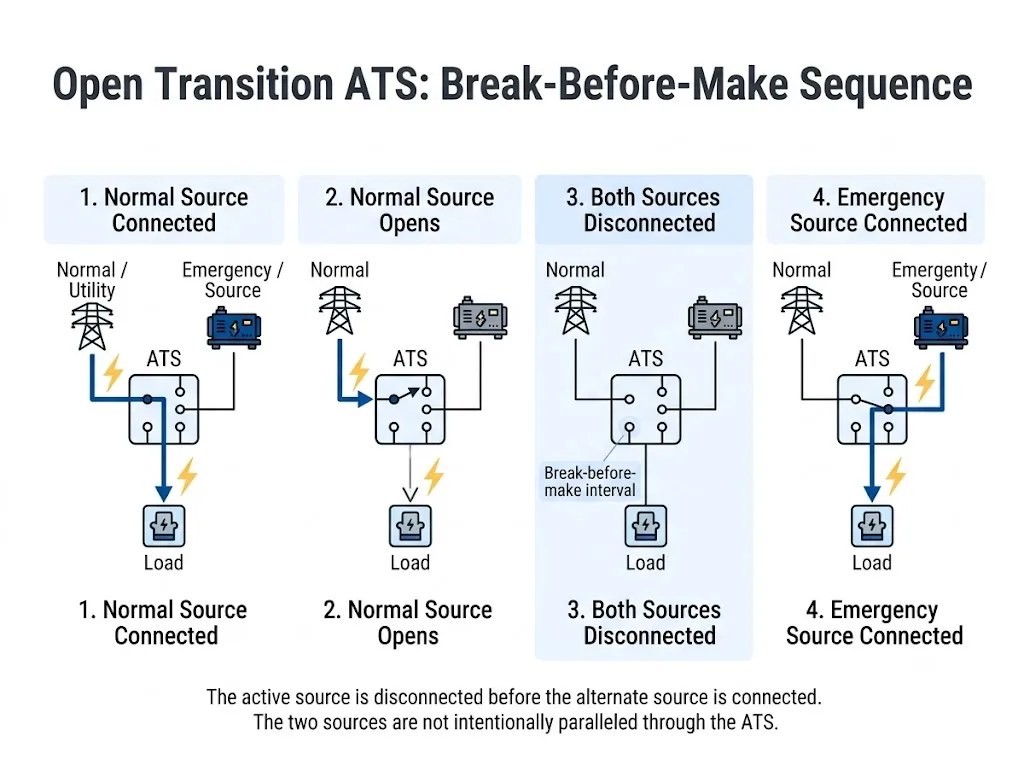
Um open transition ATS, also called an open transition automatic transfer switch, disconnects the load from one source before connecting it to the alternate source. This break-before-make sequence creates a brief period when the load is not connected to either source. [1]
For compact two-source backup systems, the real selection question is not simply how fast the switch moves. Buyers must confirm whether the connected load can tolerate the interruption, how the alternate source becomes available, and whether sensitive downstream equipment needs UPS ride-through.
This guide is intended for panel builders, electrical contractors, generator or backup-power integrators, distributors and B2B buyers evaluating compact ATS applications such as the LEEYEE two-pole transfer switch shown later in this article.
Índice
Resposta Rápida
An open transition ATS is a practical choice when the connected load can tolerate a temporary interruption during source transfer. The active source is disconnected first, and the alternate source is connected afterwards. [1]
- Break-before-make: Source A opens before Source B closes.
- Compact backup systems: the key issue is whether the actual load can tolerate the transfer and restart behaviour.
- Generator applications: total outage can be much longer than ATS contact-transfer time because the generator must first become acceptable. [2]
- Sensitive controls: selected downstream loads may need a UPS even when open transition is suitable for the main circuit.
What Is an Open Transition ATS?
Um open transition ATS uses a break-before-make transfer sequence. Eaton defines open transition as an operation in which the connection to one source is broken before the connection to the other source is made. [1]
Source A connected → Source A opens → load temporarily disconnected → Source B closes → load supplied by Source B.
For procurement, this definition matters because open transition describes the source-switching method, not the complete backup-system recovery time.
Do not approve an ATS only because a quotation says “automatic transfer” or lists a short transfer time. Confirm the actual source sequence, allowable interruption, rated voltage, current, poles and the behaviour of the connected load.
How Does This Relate to the LEEYEE Compact 2P ATS?
The LEEYEE unit shown below is a compact two-source transfer switch marked ATS-2P63. The front panel identifies Source A, Source B, a downstream load connection and Auto/Manual operation.
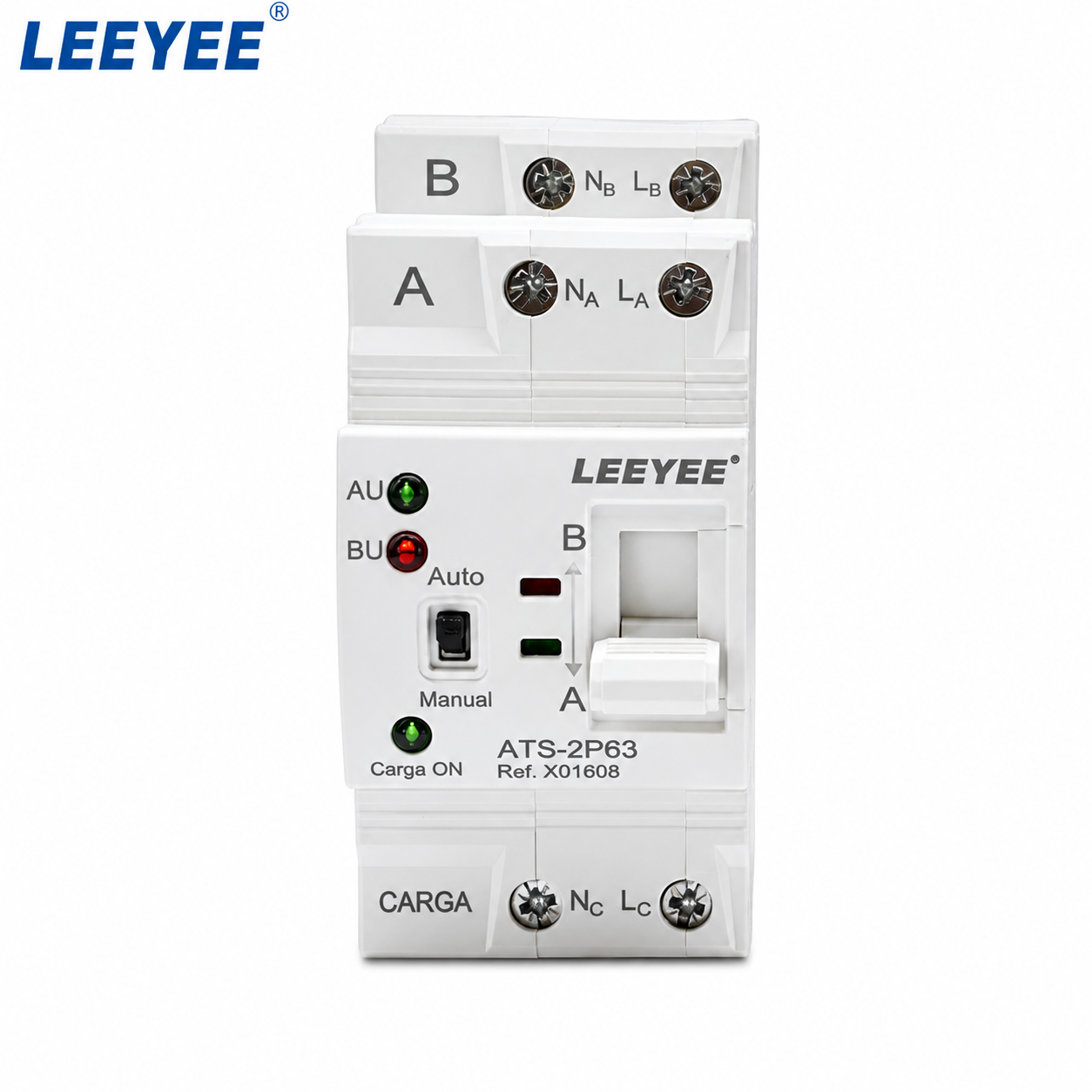
This article explains open-transition selection logic. The exact transition sequence, rated operating data, utilization category, transfer time and permitted applications of the LEEYEE ATS-2P63 must be confirmed from the model-specific datasheet or technical documentation before project approval.
This product format is most relevant when the project needs a compact two-pole transfer solution between two compatible AC sources and the downstream circuit can tolerate the actual transfer behaviour.
It should not automatically be treated as a substitute for large-frame ATS equipment used in high-current generator rooms, closed-transition systems, synchronized paralleling applications or specialized motor-transfer systems.
Why Does an Open Transition ATS Interrupt Power?
The interruption exists because neither source is connected to the load during the break-before-make interval. The exact switching interval depends on the ATS mechanism, controller logic and specific product design.
For a buyer, two different time periods must be kept separate.
1. ATS transfer gap
If both sources are already available and acceptable, the ATS still requires time to disconnect one source and connect the other. The actual value must be checked from the model-specific documentation rather than assumed from a generic industry number.
2. Total outage when a standby generator must start
If Source B is a standby generator that is not already running, the load must also wait while the controller detects source failure, the generator starts, and the generator reaches acceptable voltage and frequency. Only then can transfer occur. [1][2]
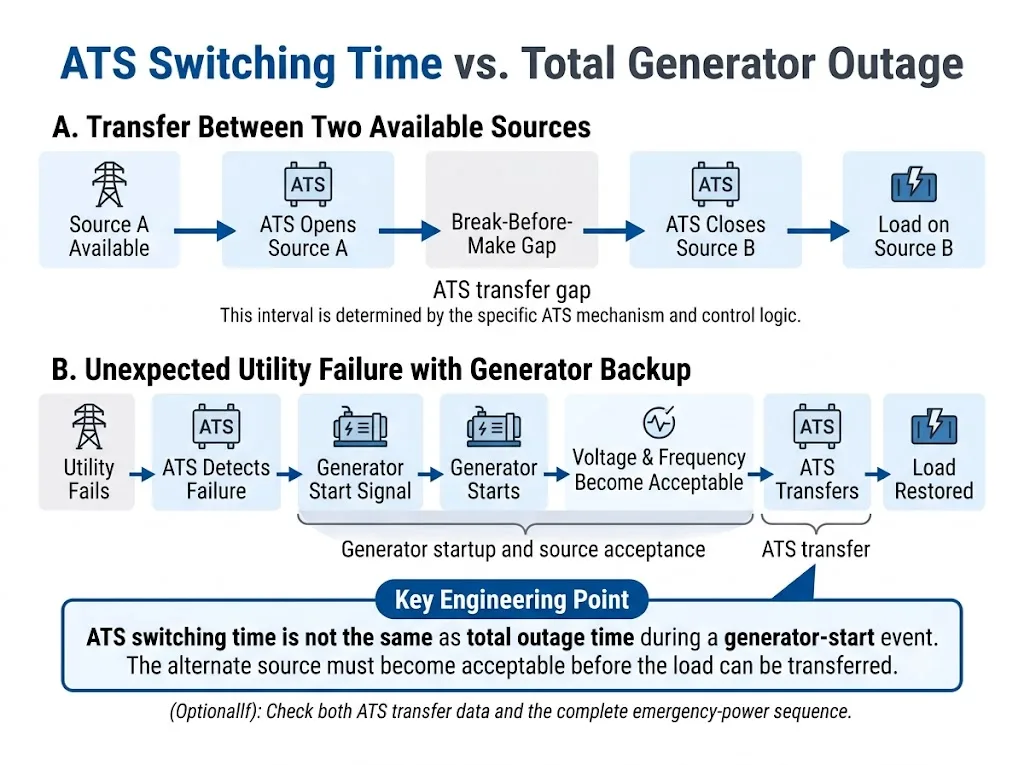
A short ATS transfer specification does not mean the backup generator will restore the load in the same amount of time. If a generator must start after utility failure, the complete backup sequence must be considered. [2]
Which Loads Are a Good Match for a Compact Open Transition ATS?
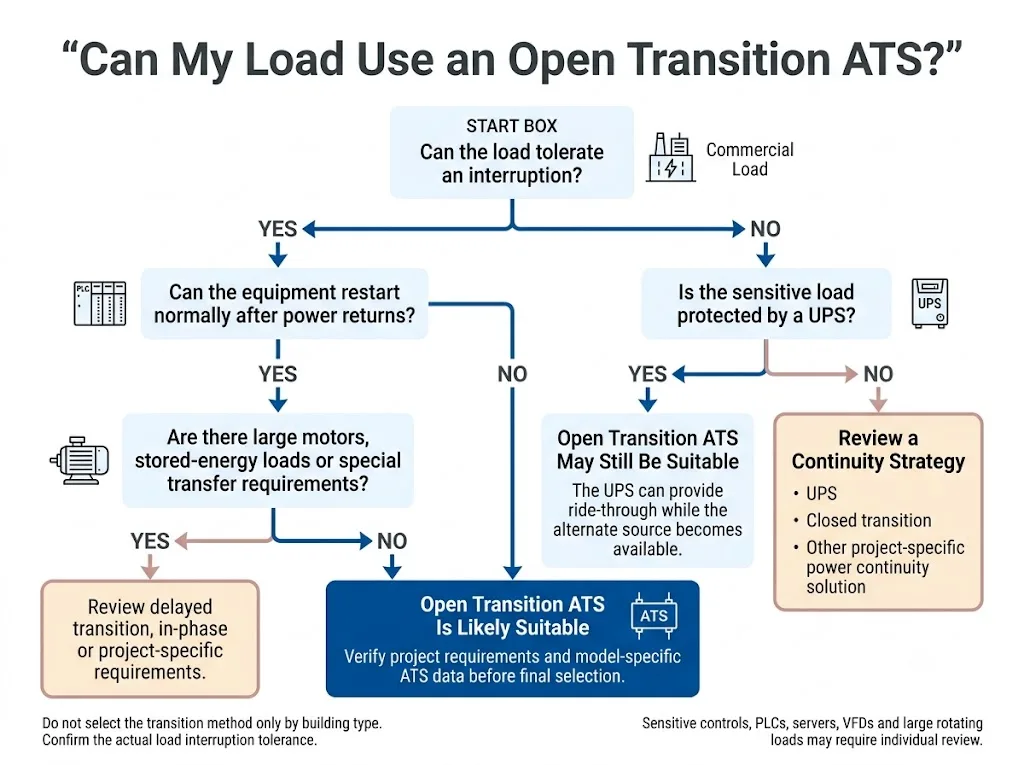
For a compact two-pole ATS, the most useful selection question is: Can the downstream circuit tolerate a short loss of supply and then resume normal operation when the alternate source is connected?
| Application condition | Direção de seleção | O que confirmar |
|---|---|---|
| General circuit can tolerate interruption | Often suitable | Allowable outage and restart behaviour |
| Load automatically resumes after transfer | Often suitable | No nuisance trip or manual reset required |
| Sensitive control equipment has UPS support | May still be suitable | UPS runtime and compatibility |
| Process cannot tolerate a power blink | Standard open transition may not be suitable | Continuity architecture |
| Large motors or stored-energy loads dominate the circuit | Requires separate engineering review | Motor duty, residual voltage and transition method |
Conclusão da aquisição: compact ATS selection should be based on the actual circuit and load behaviour, not only on nominal current.
Typical Compact ATS Application Scenarios
Small commercial distribution circuit
A compact two-pole ATS can be considered where two compatible AC sources supply a downstream circuit and a brief transfer interruption is acceptable.
Confirme: voltage, current, poles, source type and load restart behaviour.
Control cabinet auxiliary supply
A secondary source can provide backup for selected auxiliary circuits when the connected controls can tolerate the source-transfer sequence.
Confirme: controller sensitivity and whether selected devices need UPS ride-through.
Utility plus compatible backup AC source
The ATS can transfer between two compatible sources when the source characteristics and product ratings match the project requirements.
Confirme: voltage, frequency and how the alternate source becomes available.
Sensitive load behind a UPS
The main circuit can use open transition while a correctly selected UPS supports equipment that should not lose power during the transfer interval.
Confirme: UPS topology, runtime, bypass arrangement and downstream load.
Do not infer suitability for large motors, synchronized generator paralleling, closed-transition transfer or other specialized applications from the compact ATS form factor alone. Those projects require product-specific engineering confirmation.
Can a Compact ATS Be Used with a Standby Generator?
Potentially yes, but the complete generator-control architecture must be checked.
An ATS can only transfer to a generator after the generator source is available and acceptable. Some backup systems use a separate generator controller or dry-contact start circuit, while other systems integrate start logic differently.
The presence of Source A and Source B terminals does não by itself prove that an ATS provides a generator-start output. If generator autostart is required, verify the exact ATS model documentation and the generator-controller interface before ordering.
This distinction is especially important for a compact ATS such as the ATS-2P63 shown above. The source-transfer function and the generator-start function should be verified separately.
Do Sensitive Loads Need a UPS?
An ATS changes the source supplying a circuit. A UPS provides ride-through power to supported loads when its input is temporarily unavailable. These are different functions. [5]
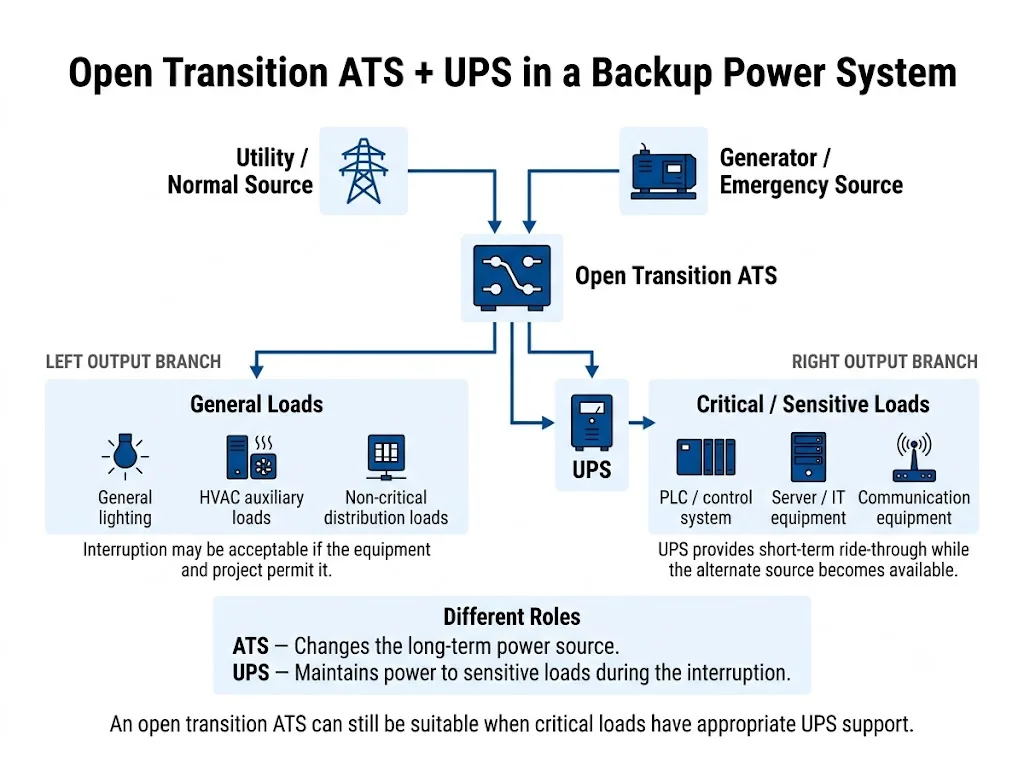
ATS: changes the source supplying the circuit.
UPS: bridges the interruption for supported downstream loads, subject to UPS design and runtime.
This can be useful where most of the circuit can tolerate open transition but a PLC, network device, controller or similar sensitive load should remain powered.
Open Transition vs. Closed Transition ATS
Closed transition uses a make-before-break sequence under suitable conditions. That allows momentary source overlap, unlike standard open transition. [1]
| Ponto de decisão | Transição aberta | Transição fechada |
|---|---|---|
| Sequence | Break before make | Make before break |
| Source overlap | No intentional overlap | Brief overlap under controlled conditions |
| Load interruption | Expected during transfer | Can be avoided during qualified transfer conditions |
| Compact ATS relevance | Common selection concept | Requires equipment specifically designed for closed transition |
Do not interpret this comparison as a claim that the LEEYEE ATS-2P63 can be configured for closed transition. Closed-transition capability must be explicitly stated and supported by the specific ATS design and documentation.
Also remember that closed transition does not make a standby generator instantly available after a sudden utility failure. If the normal source has already failed, the system must still wait for the generator to become acceptable before load transfer. [4]
What About Delayed Transition and Large Motor Loads?
Delayed transition is relevant to the wider ATS market, but it should not be treated as an assumed feature of a compact two-pole ATS.
Schneider Electric / ASCO describes delayed transition as intentionally holding the load disconnected for a defined period before connecting the alternate source, which can be useful for inertial loads such as large motors. [3]
For the compact LEEYEE ATS shown on this page, buyers should not assume delayed transition, in-phase transfer or specialized motor-transfer capability unless the model-specific documentation explicitly confirms it.
If the project includes large motors, VFD-driven equipment, high-inrush machinery or stored-energy loads, provide those details before selecting the ATS.
Which Standard Should Be Checked?
For IEC-market projects, the current international transfer-switching standard to review is IEC 60947-6-1:2026, Low-voltage switchgear and controlgear – Part 6-1: Multiple function equipment – Transfer switching equipment. The fourth edition was published in 2026 and replaces the previous edition. [6]
Citing a standard is not the same as proving that a particular ATS model has been certified or tested to that standard. Verify the actual model marking, test report or certificate scope required by the project before approval.
What Should Buyers Confirm Before Ordering a Compact 2P ATS?
For a product such as the LEEYEE ATS-2P63, send the supplier the information that directly affects model approval:
- Tipo de fonte normal
- Backup source type
- Rated system voltage
- Frequência do sistema
- Required current rating
- Two-pole switching requirement
- Line and neutral arrangement
- Type of downstream load
- Maximum acceptable interruption
- Automatic restart behaviour
- Whether a UPS is installed
- Whether a generator must auto-start
- How generator start is controlled
- Required transfer logic
- Padrão ou certificado requerido
- Ambiente de instalação
- Panel integration requirements
- OEM label or documentation requirements
Need to Confirm Whether This ATS Fits Your Backup Circuit?
Send the source voltage, required current, backup-source type, downstream load, acceptable interruption and whether a UPS or generator-start function is required.
LEEYEE can then help confirm whether the compact ATS configuration matches the actual project requirements before model approval.
Perguntas mais frequentes
Does an open transition ATS interrupt power?
Yes. Open transition uses a break-before-make sequence, so the load is disconnected from the first source before connection to the alternate source. [1]
How long is the interruption?
There is no universal transfer time for every ATS. Use the model-specific datasheet. If the backup source is a generator that must start after utility failure, total outage also includes generator starting and source acceptance. [2]
Is a compact 2P ATS suitable for every generator application?
No. Confirm rated voltage, current, load type, generator interface, source-acceptance logic and whether the ATS itself provides or supports the required generator-start control. Do not assume generator-start capability from the source terminals alone.
Can a compact open transition ATS be used with a UPS?
Yes, depending on system design. The ATS can transfer the circuit between sources while the UPS provides ride-through to selected sensitive downstream loads. UPS topology, runtime and source compatibility must still be confirmed. [5]
Can this ATS be used for large motors?
Do not assume so from current rating alone. Large motors introduce inrush, residual-voltage and transition concerns. Confirm the exact utilization category, switching capability and manufacturer application limits for the ATS model before selection.
Does ATS-2P63 automatically mean 63 A is suitable for my project?
No. The marking identifies the product model, but final selection must consider actual load current, load type, utilization category, protective coordination, system voltage and project requirements. Use the model-specific datasheet for approval.
Does closed transition eliminate generator startup delay?
No. Closed transition can maintain continuity only when two acceptable sources are available and the required synchronization conditions are met. A standby generator that has not yet started cannot provide an immediate alternate source. [4]
Referências
- Eaton. Fundamentals of Automatic Transfer Switches (ATS). Defines open transition as break-before-make and explains ATS source-transfer operation. Official Eaton source.
- Pacific Northwest National Laboratory. Best Practices for Automatic Transfer Switches Operation and Maintenance. Describes detection of primary-source failure, generator starting, source verification and subsequent transfer. Official PNNL source.
- Schneider Electric / ASCO. What Are the Different ASCO ATS Transition Modes?. Explains open and delayed transition and the use of delayed transfer for inertial loads. Official Schneider Electric source.
- Siemens Russelectric. RTS-03 ATS. Describes generator source acceptance and transfer/retransfer behaviour in a closed-transition ATS system. Official Siemens source.
- Eaton. Uninterruptible Power Supply (UPS) FAQs. Explains UPS emergency and ride-through power functions. Official Eaton source.
- Comissão Eletrotécnica Internacional. IEC 60947-6-1:2026 — Aparelhagem de baixa tensão – Parte 6-1: Equipamentos multifuncionais – Equipamentos de comutação de transferência. Página de publicação oficial da IEC.
Model ratings, transfer behaviour, utilization category, generator-start interface, standards and certificate scope must be verified from the exact LEEYEE ATS technical documentation before project approval.