
Não tem certeza se deve pedir um SPD 3P+N ou um SPD 4P para um quadro de distribuição trifásico?
Esta é uma pergunta comum para montadores de painéis, distribuidores elétricos, compradores de OEM e engenheiros de projetos. Os dois produtos podem parecer semelhantes por fora. Ambos podem ter quatro módulos. Ambos podem ser usados em sistemas trifásicos com neutro.
Mas internamente, eles podem usar estruturas de proteção diferentes. A principal diferença não está apenas no número de polos. A principal diferença geralmente é o caminho de proteção entre neutro e terra, também chamado de proteção N-PE.
Índice
Resposta Rápida: Qual é a Diferença Entre SPD 3P+N e SPD 4P?
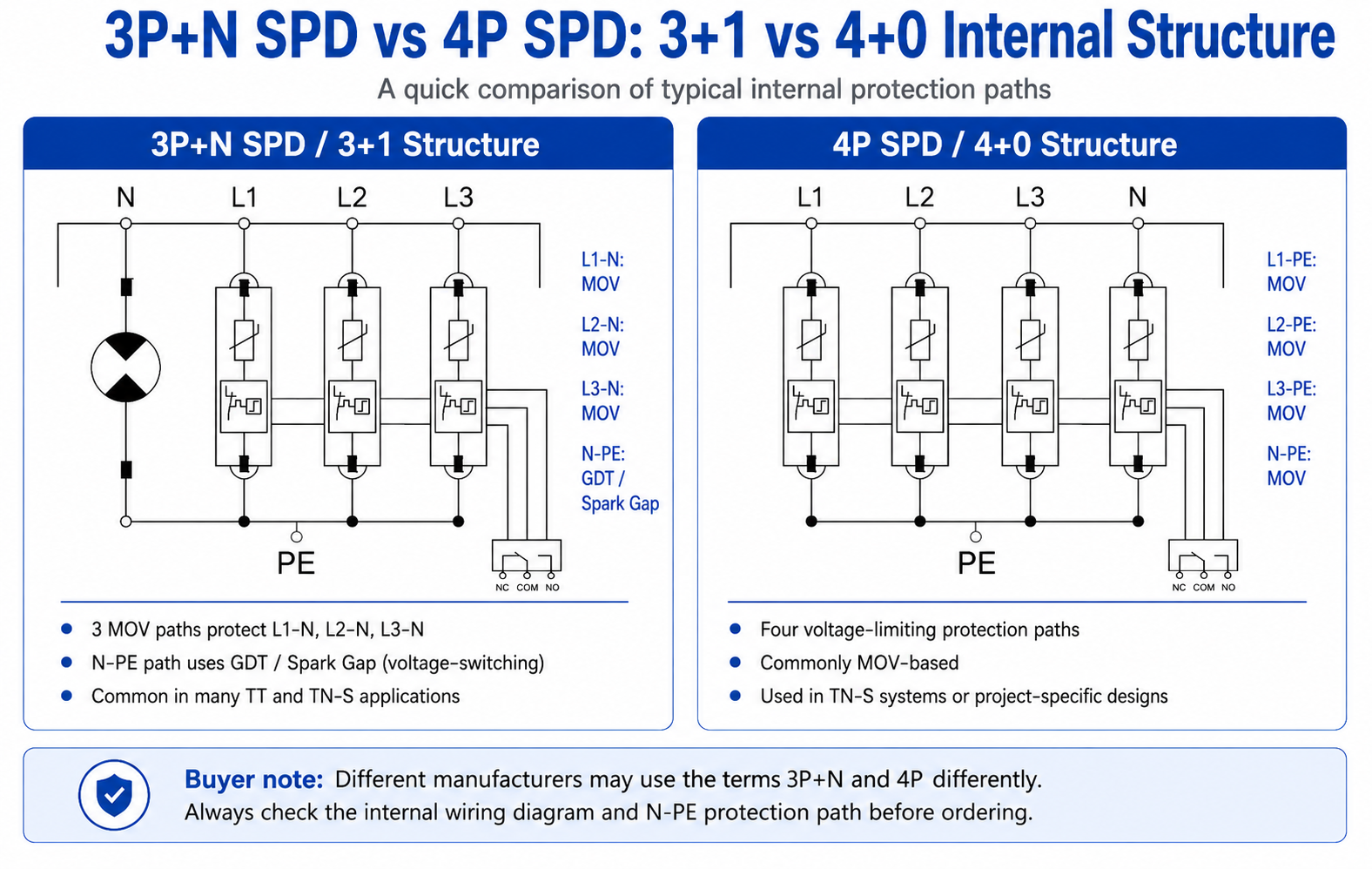
A SPD 4P geralmente se refere a uma estrutura 4+0.. Neste design, os caminhos de proteção L1-PE, L2-PE, L3-PE e N-PE são comumente caminhos limitadores de tensão, frequentemente baseados em MOV.
A SPD 3P+N geralmente se refere a uma estrutura 3+1.. Neste design, L1-N, L2-N e L3-N usam caminhos de proteção MOV, enquanto o caminho N-PE frequentemente utiliza um componente de comutação de tensão, como um GDT ou gap de centelha..
| Item | SPD 3P+N | SPD 4P |
|---|---|---|
| Estrutura comum | 3+1 | 4+0 |
| proteção de fase | Caminhos MOV L1-N, L2-N, L3-N | Caminhos de limitação de tensão L1-PE, L2-PE, L3-PE |
| proteção N-PE | Geralmente GDT / gap de faísca | Geralmente baseado em MOV, dependendo do projeto |
| Uso comum | TT, TN-S, TN-C-S após a divisão do PEN | TN-S ou projetos específicos do projeto |
| Aviso ao comprador | Confirme o tipo de módulo N-PE | Confirme o diagrama de fiação interno |
Regra simples: não escolha apenas pelas palavras “3P+N” ou “4P” no nome do produto. Sempre verifique o sistema de aterramento e o diagrama de fiação do fabricante.
O que Significa SPD 3P+N?
A SPD 3P+N é comumente utilizado para sistemas de potência trifásicos com neutro.
Também é chamado de SPD 3PN, SPD 3+1, SPD trifásico com neutro ou SPD com proteção N-PE.
Em um design típico 3+1, o SPD protege:
- L1 para N
- L2 para N
- L3 para N
- N para PE
Os caminhos de fase geralmente são protegidos por componentes limitadores de tensão, como MOVs. O caminho N-PE é frequentemente protegido por um componente de comutação de tensão, como um GDT ou gap de faísca.
Este design é importante porque o condutor neutro pode aumentar de potencial durante condições de surto ou falha. O módulo N-PE ajuda a descarregar essa sobrecarga para a terra durante eventos de surto.
O que Significa SPD 4P?
A SPD 4P significa dispositivo de proteção contra surtos de quatro polos.
Em muitas linhas de produtos, um SPD 4P se refere a um. estrutura 4+0.. Ele utiliza quatro caminhos de proteção limitadores de tensão, comumente baseados em MOV.
Um SPD 4P pode proteger quatro condutores em um sistema trifásico com neutro. Mas o nome sozinho não é suficiente.
Diferentes fabricantes podem usar “4P” de maneira diferente. Alguns fornecedores usam 4P para uma estrutura 4+0. Alguns compradores usam 4P para significar qualquer SPD de quatro módulos. Em alguns mercados, um produto 3P+N também pode ser chamado de SPD de quatro polos porque possui quatro módulos físicos.
Nota do comprador: antes de fazer o pedido, verifique o diagrama de circuito interno. Isso é mais confiável do que o nome do polo.
3P+N vs 4P SPD: Comparação Principal
| Ponto de Seleção | SPD 3P+N | SPD 4P |
|---|---|---|
| Também chamado de | SPD 3PN, SPD 3+1 | SPD de 4 polos, SPD 4+0 |
| Conceito interno | Caminhos trifásicos para neutro mais um caminho N-PE | Quatro caminhos de proteção limitadores de tensão |
| proteção N-PE | Normalmente comutação de tensão | Normalmente limitante de tensão, dependendo do design |
| Componente típico N-PE | GDT ou gap de centelha. | MOV, dependendo do design do fabricante |
| Sistemas de aterramento comuns | TT, TN-S, TN-C-S após a divisão do PEN | Sistemas TN-S ou sistemas específicos do projeto |
| Melhor para | Sistemas onde a proteção neutro-terra é importante | Sistemas onde o desenho requer proteção 4+0 |
| Principal risco se selecionado incorretamente | Design de proteção N-PE incorreto | Conexão de aterramento errada ou estrutura interna inadequada |
| O comprador deve confirmar | Tipo de módulo N-PE | Diagrama de circuito e sistema de aplicação |
Por que o Caminho de Proteção N-PE é Importante
A diferença mais importante é a Caminho N-PE.
Em um sistema trifásico com neutro, a sobretensão pode aparecer não apenas entre fase e neutro. Pode também aparecer entre neutro e terra de proteção.
Isso é especialmente importante em sistemas TT e algumas instalações TN-S ou TN-C-S.
Um SPD 3P+N normalmente usa um módulo N-PE especial. Este módulo é frequentemente um espaço de ruptura ou GDT. Ele permanece isolado durante a operação normal e conduz durante eventos de sobretensão.
Isso ajuda a reduzir a corrente de fuga durante a operação normal. Também ajuda a lidar com sobrecarga neutro-terra durante condições de sobretensão.
Um SPD 4P pode utilizar proteção baseada em MOV em todos os quatro caminhos. Isso pode ser adequado para alguns sistemas, mas não é automaticamente melhor.
A verdadeira questão é simples:
O que o seu sistema precisa entre N e PE?
O SPD 3P+N é o Mesmo que o SPD 4P?
Não, nem sempre.
Eles podem parecer semelhantes. Ambos podem ter quatro módulos. Ambos podem ser instalados em um quadro de distribuição trifásico com neutro.
Mas eletricamente, podem ser diferentes.
A SPD 3P+N geralmente significa um circuito 3+1.. Um SPD 4P geralmente significa um circuito 4+0..
A diferença é o quarto caminho de proteção.
Em um SPD 3P+N, o quarto caminho é geralmente a proteção N-PE com um componente de comutação. Em um SPD 4P, o quarto caminho é geralmente outro caminho de proteção limitadora de tensão.
Não pergunte apenas: “Você tem SPD 4P?”
Pergunte em vez disso: “É este um SPD 4+0, ou é um SPD 3P+N / 3+1 com proteção de espaço de faísca N-PE?”
Qual SPD Deve Ser Usado em Sistemas TT?
Para muitos sistemas TT trifásicos, um SPD 3P+N / SPD 3+1 é comumente preferido.
Em sistemas TT, o neutro e a terra de proteção são separados. O caminho N-PE pode se tornar importante durante eventos de surto.
Um design 3+1 oferece proteção contra surtos específica entre o neutro e a terra.
Para um quadro de distribuição TT 230/400V, os compradores costumam perguntar por:
- SPD 3P+N Tipo 2
- SPD 3P+N Tipo 1+2
- 275V, 320V ou 385V Uc dependendo da tensão do sistema e da condição da rede
- Contato de sinal remoto, se necessário
- Montagem em trilho DIN
- Conformidade com a IEC 61643-11
Para sistemas TT, não escolha um SPD 4P apenas porque possui quatro módulos. Confirme se o design é adequado para uso TT e se o caminho N-PE está correto.
Qual SPD Deve Ser Usado em Sistemas TN-S?
Em sistemas TN-S, neutro e PE são condutores separados.
Tanto configurações 3P+N quanto 4P podem aparecer no mercado. A escolha correta depende do design do projeto, da prática local e do diagrama de circuito do SPD.
Para muitos compradores, um SPD 3P+N é uma escolha comum quando o quadro possui L1, L2, L3, N e PE.
Mas um SPD 4P também pode ser especificado em alguns quadros de distribuição TN-S.
O ponto importante é este:
TN-S não significa automaticamente 4P. TN-S também não significa automaticamente 3P+N.
Você precisa confirmar se o projeto requer uma estrutura 3+1 ou 4+0.
Qual SPD Deve Ser Usado em Sistemas TN-C-S?
Os sistemas TN-C-S precisam de mais atenção.
Em um sistema TN-C-S, o PEN é combinado em uma parte do sistema e separado em PE e N em outro ponto.
Antes da separação do PEN, não há neutro e PE independentes. Após a separação do PEN, o sistema se comporta mais como uma seção TN-S.
Portanto, a seleção do SPD depende do ponto de instalação.
| Ponto de instalação | Escolha Comum de SPD | Razão |
|---|---|---|
| Antes da separação do PEN | SPD 3P | L1, L2 e L3 estão protegidos até o PEN. N e PE ainda não estão separados. |
| Após a separação do PEN | SPD 3P+N ou 4P | N e PE estão disponíveis como condutores separados. Trate esta seção mais como TN-S. |
| Dentro do quadro de distribuição final | Confirmar desenho do projeto | A estrutura correta depende do caminho N-PE, arranjo do DR e requisito do projeto. |
Esta é uma fonte comum de erros. Um comprador pode dizer: “Meu sistema é TN-C-S, por favor me forneça SPD 4P.” Mas o fornecedor ainda precisa saber onde o SPD será instalado.
Qual SPD Deve Ser Usado em Sistemas TN-C?
Em um sistema TN-C, neutro e terra de proteção são combinados como PEN.
Não há condutor N e PE separado no ponto de instalação.
Por esta razão, um SPD de três polos é comumente usado para proteção de L1, L2 e L3 até o PEN.
Um SPD 3P+N normalmente não é utilizado antes da separação do PEN porque não há um caminho separado N-PE.
Tabela de Seleção: TT vs TN-S vs TN-C-S vs TN-C
| Sistema de Aterramento | Neutro disponível? | PE separado? | Escolha Comum de SPD | Nota do Comprador |
|---|---|---|---|---|
| TT | Sim | Sim | 3P+N / 3+1 | A proteção contra surtos N-PE é importante. |
| TN-S | Sim | Sim | 3P+N ou 4P | Verifique o design 3+1 ou 4+0. |
| TN-C-S antes da divisão do PEN. | Sem N/PE separado. | Não | 3P | Proteger L1, L2, L3 até o PEN. |
| TN-C-S após a separação do PEN | Sim | Sim | 3P+N ou 4P | Tratar como seção TN-S |
| TN-C | Somente PEN | Não | 3P | Não presuma que 4P é necessário |
| TI | Depende | Depende | Específico do projeto | Pergunte ao engenheiro ou fornecedor |
Diferença de Fiação: SPD 3P+N vs SPD 4P
Para este tópico, o diagrama de fiação é muito importante.
Uma explicação em texto não é suficiente para muitos compradores. Um fabricante de painéis precisa ver os reais caminhos de proteção.
Conceito Típico de SPD 3P+N
Uma estrutura comum de SPD 3P+N / 3+1 utiliza:
- L1 para N
- L2 para N
- L3 para N
- N para PE
Os primeiros três caminhos geralmente são baseados em MOV. O caminho N-PE é frequentemente baseado em GDT ou gap de faísca.
Conceito Típico de SPD 4P
Uma estrutura comum de SPD 4P / 4+0 utiliza quatro caminhos de proteção de limite de tensão.
O caminho real de fiação depende do design do produto e do diagrama de circuitos do fabricante.
É por isso que o desenho deve ser verificado antes de fazer o pedido.
Aplicações Comuns
SPDs 3P+N e 4P são amplamente utilizados em sistemas de distribuição trifásica de baixa tensão.
| Aplicação | Requisito Comum |
|---|---|
| Quadro de distribuição principal | Tipo 1+2 ou Tipo 2 SPD dependendo do risco de raios |
| Quadro de subdistribuição | DUP tipo 2 |
| Painel de edifício comercial | 3P+N ou 4P dependendo do sistema de aterramento |
| Armário de controle industrial | Tipo 2 SPD com diagrama de fiação claro |
| Painel elétrico OEM | Confirme 3+1 ou 4+0 antes da produção |
| Combiner AC solar / lado de distribuição AC | Confirme o sistema de rede e o tipo de SPD |
| Painel de telecomunicações ou sala de equipamentos | Frequentemente requer contato de sinal remoto |
Erros Comuns ao Comprar
Erro 1: Pensar que 4P é sempre melhor que 3P+N
Mais polos não significam necessariamente melhor proteção.
Um SPD 4P pode ser correto para um sistema. Um SPD 3P+N pode ser melhor para outro.
A escolha certa depende do sistema de aterramento e do circuito interno.
Erro 2: Tratar 3P+N e 4P como o mesmo produto
Eles podem ter quatro módulos. Mas a estrutura de proteção pode ser diferente.
Um SPD 3P+N frequentemente tem um módulo N-PE especial. Um SPD 4P pode não ter.
Sempre verifique o diagrama do circuito.
Erro 3: Ignorar as diferenças TT / TN-S / TN-C-S
Um produto que funciona em TN-S pode não ser a melhor escolha para TT.
Um produto selecionado após a separação do PEN pode não ser correto antes da separação do PEN.
O sistema de aterramento não é um pequeno detalhe. Ele decide a estrutura do SPD.
Erro 4: Escolher apenas pela tensão Uc
Uc é importante. Mas Uc sozinho não decide se você precisa de 3P+N ou 4P.
Por exemplo, SPDs de 275V, 320V e 385V podem existir em diferentes configurações de polos.
Você precisa confirmar tanto a classificação elétrica quanto a estrutura de fiação interna.
Erro 5: Não confirmar a posição do RCD.
Em algumas instalações, a coordenação do RCD pode afetar a seleção do SPD e a fiação.
Isso é especialmente importante em sistemas TT.
Antes de pedir, confirme se o RCD está a montante ou a jusante do SPD. Se você não tiver certeza, envie o desenho do painel para o fornecedor.
Como Escolher: Processo de Decisão Simples
Passo 1: Confirmar o Sistema de Aterramento.
Verifique se o sistema é TT, TN-S, TN-C-S, TN-C ou IT. Não adivinhe.
Passo 2: Confirmar N e PE.
Verifique se o neutro e o PE estão separados ou se o PEN ainda está combinado.
Etapa 3: Confirme o Circuito
Pergunte se o projeto requer lacuna de faísca de 3+1, 4+0, N-PE, ou outra estrutura.
Etapa 4: Confirme o Tipo de SPD
Escolha Tipo 1+2 ou Tipo 2 de acordo com a posição de instalação e requisitos do projeto.
Seleção Recomendada para Compradores
Para a maioria dos compradores B2B, o nome do produto não é suficiente.
Um formato de consulta melhor é:
Precisamos de um SPD para um quadro de distribuição trifásico.
Sistema: TT / TN-S / TN-C-S.
Tensão: 230/400V.
Configuração necessária: 3P+N / 3+1 ou 4P / 4+0.
Tipo de SPD: Tipo 2 ou Tipo 1+2.
Uc: 275V / 320V / 385V.
Sinal remoto: sim / não.
Por favor, recomende um SPD adequado para trilho DIN com diagrama de fiação.
Isso dá ao fornecedor informações suficientes para recomendar o modelo correto.
Checklist Antes do Pedido
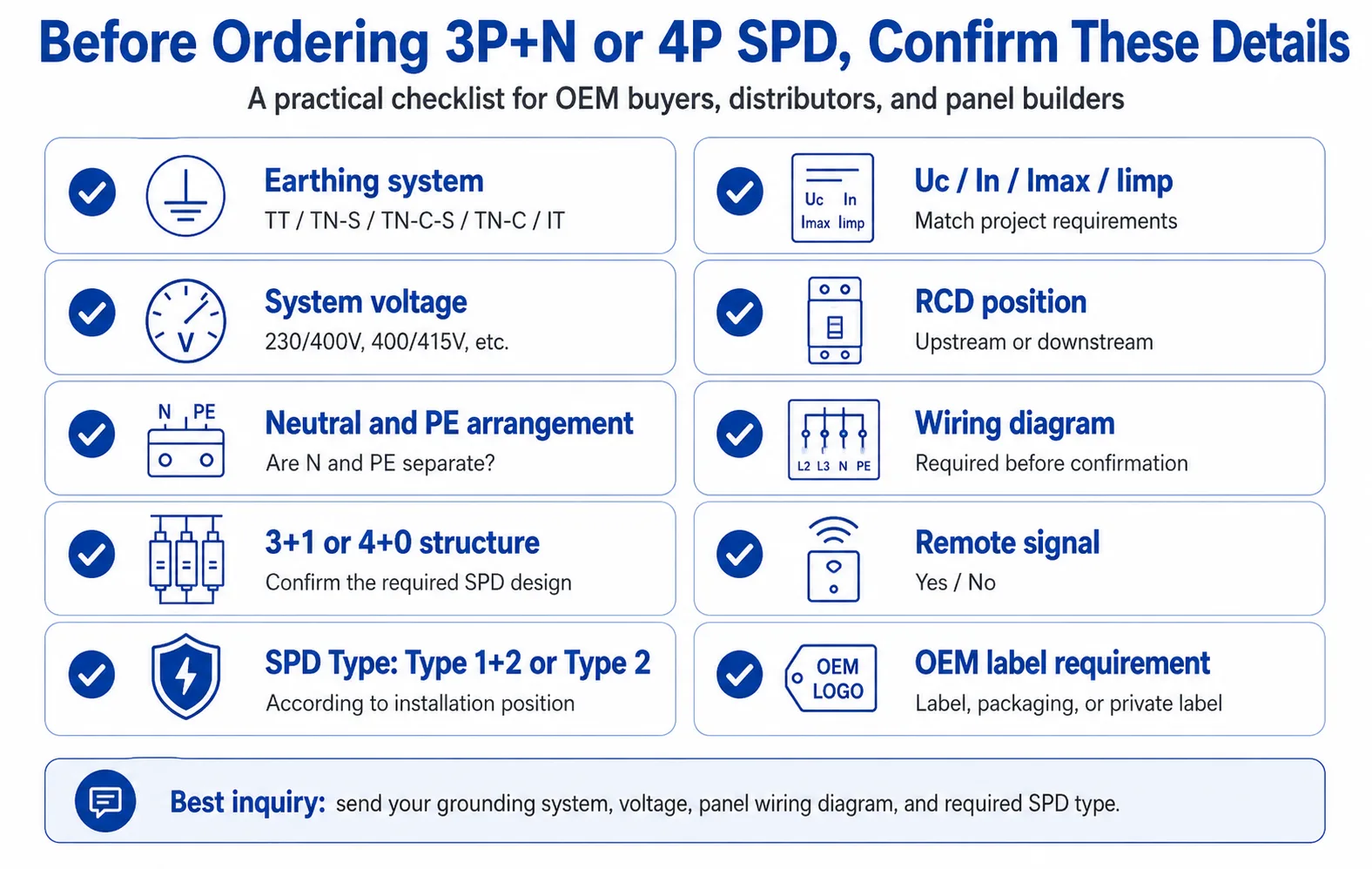
Antes de escolher SPD 3P+N ou 4P, confirme estes detalhes:
- Sistema de aterramento: TT, TN-S, TN-C-S, TN-C ou IT
- Se o neutro está disponível
- Se o PE é separado do neutro
- Se o PEN já foi dividido
- Posição de instalação no painel
- Tipo de SPD: Tipo 1, Tipo 1+2, ou Tipo 2
- Estrutura necessária: 3+1 ou 4+0
- Requisito de proteção N-PE
- Tensão Uc
- Classificação In, Imax, e Iimp
- Requisito de fusível de backup
- Contato de sinal remoto
- Posição do RCD
- Espaço para trilho DIN
- Padrão ou certificado requerido
- Requisito de rótulo OEM ou rótulo privado
Direção de Recomendações de Produtos
Opção 1: SPD Tipo 2 3P+N
Adequado para muitos quadros de distribuição TT e TN-S onde a proteção Tipo 2 é exigida.
Comum para quadros de distribuição comercial, painéis de sub-distribuição, painéis elétricos OEM, e distribuição de energia em edifícios.
Opção 2: SPD Tipo 1+2 3P+N
Adequado para instalações com maior exposição a raios ou quadros de distribuição principal onde a capacidade de descarga de corrente de raios é necessária.
Comum para quadros de entrada principais, edifícios com proteção externa contra raios, fornecimento de linha aérea, e distribuição de energia industrial.
Opção 3: SPD Tipo 2 4P
Adequado onde o desenho do projeto especifica um design de 4 polos / 4+0.
Comum para quadros de distribuição TN-S, projetos de painéis específicos de cada projeto e mercados onde 4P SPD é a prática padrão de nomenclatura.
Opção 4: 3P SPD
Adequado para sistemas TN-C ou sistemas TN-C-S antes da separação do PEN.
Comum para sistemas trifásicos sem neutro separado, proteção L1/L2/L3 para PEN e quadros industriais com PEN combinado no ponto de instalação.
FAQ
O SPD 3P+N é o mesmo que o SPD 4P?
Não. Eles podem parecer semelhantes, mas podem ter circuitos internos diferentes. Um SPD 3P+N geralmente significa um design 3+1 com um módulo de proteção N-PE especial. Um SPD 4P geralmente significa um design 4+0 com quatro caminhos de proteção de limitação de tensão. Sempre verifique o diagrama de fiação.
Qual é a diferença entre 3+1 e 4+0 SPD?
Um SPD 3+1 geralmente tem três caminhos de proteção fase-neutro e um caminho de comutação de tensão N-PE. Um SPD 4+0 geralmente tem quatro caminhos de proteção de limitação de tensão. A maior diferença é como a proteção neutro-terra é tratada.
Qual SPD eu devo usar para um sistema TT?
Para muitos sistemas trifásicos TT, um SPD 3P+N / 3+1 é comumente selecionado porque a proteção contra surtos N-PE é importante. No entanto, a escolha final deve seguir o projeto, a norma local e o diagrama de fiação do fabricante.
Qual SPD devo usar para um sistema TN-S?
Para sistemas TN-S, tanto as configurações 3P+N quanto 4P podem ser utilizadas, dependendo do projeto. O comprador deve confirmar se o projeto requer um circuito 3+1 ou um circuito 4+0.
Posso usar SPD de 4P em vez de SPD de 3P+N?
Nem sempre. Um SPD 4P pode não ter a mesma estrutura de proteção N-PE que um SPD 3P+N. Se o projeto exigir proteção 3+1, não o substitua por um SPD 4P sem verificar o diagrama do circuito.
O SPD de 4P é melhor do que o SPD de 3P+N?
Não, 4P não é automaticamente melhor. 3P+N e 4P são estruturas diferentes para sistemas diferentes. A melhor escolha depende do sistema de aterramento, arranjo do neutro e requisitos de fiação.
O que devo enviar ao fornecedor antes de fazer o pedido?
Envie o sistema de aterramento, a tensão do sistema, o diagrama de fiação do painel, o tipo de SPD, a tensão Uc, a classificação da corrente de descarga, os requisitos de sinal remoto e se você precisa de serviço de etiqueta OEM ou de etiqueta privada.
Precisa de Ajuda para Escolher entre 3P+N ou 4P SPD?
Se você não tiver certeza sobre qual estrutura de SPD é adequada para seu quadro de distribuição trifásico, envie-nos a tensão do seu sistema, sistema de aterramento e o diagrama de fiação do painel.
LEEYEE pode ajudar a recomendar uma configuração de SPD adequada para quadros de distribuição, painéis elétricos OEM e pedidos de SPD de marca privada.