
Looking for a 48V DC SPD, -48V DC SPD, or telecom DC surge protector for a cabinet, base station, or DC distribution unit? This guide explains how to select a surge protective device for 48V / -48V telecom power systems, including rated voltage, pole protection, DIN rail installation, grounding, remote alarm, and bulk ordering requirements.
Table of Contents
Quick Answer: What SPD Should Be Used for a 48V DC Telecom Power System?
For most telecom 48V / -48V DC power systems, use a low-voltage DC surge protective device designed for telecom power circuits. It should match the real maximum DC operating voltage of the cabinet, be installed close to the DC distribution point or protected equipment, use a short and reliable PE connection, and support remote alarm contact when the cabinet is monitored or installed at an unmanned site.
Buyer direction: do not copy a PV DC SPD, AC SPD, or generic industrial DC SPD without checking the real 48V / -48V telecom voltage range, grounding method, pole configuration, discharge current requirement, and NO/NC remote alarm logic.
| Telecom Application | SPD Position | Recommended SPD Focus | Buyer Meaning |
|---|---|---|---|
| Telecom power cabinet | DC distribution output side | Low-voltage DC SPD for 48V / -48V system | Protects the DC power bus before sensitive loads |
| Base station power unit | Near DC distribution unit | DIN rail DC SPD with short PE connection | Easier installation, inspection, and replacement |
| Outdoor telecom cabinet | DC incoming or cabinet power entry | Higher surge capacity and strong grounding | Better for exposed sites and long cable routes |
| Monitored cabinet | DC SPD with remote alarm contact | NO / NC dry contact optional | Sends SPD failure status to monitoring system |
| OEM telecom cabinet | Designed into the DC power section | Confirm voltage, poles, width, alarm, and label | Reduces wrong-model orders in batch production |
Need help choosing a 48V DC SPD model?
Send us your telecom cabinet voltage range, installation position, grounding design, and remote alarm requirement. LEEYEE can help recommend a suitable DC SPD for OEM telecom cabinets, base station power systems, and DC distribution projects.
What Is a 48V / -48V DC Telecom Power System?
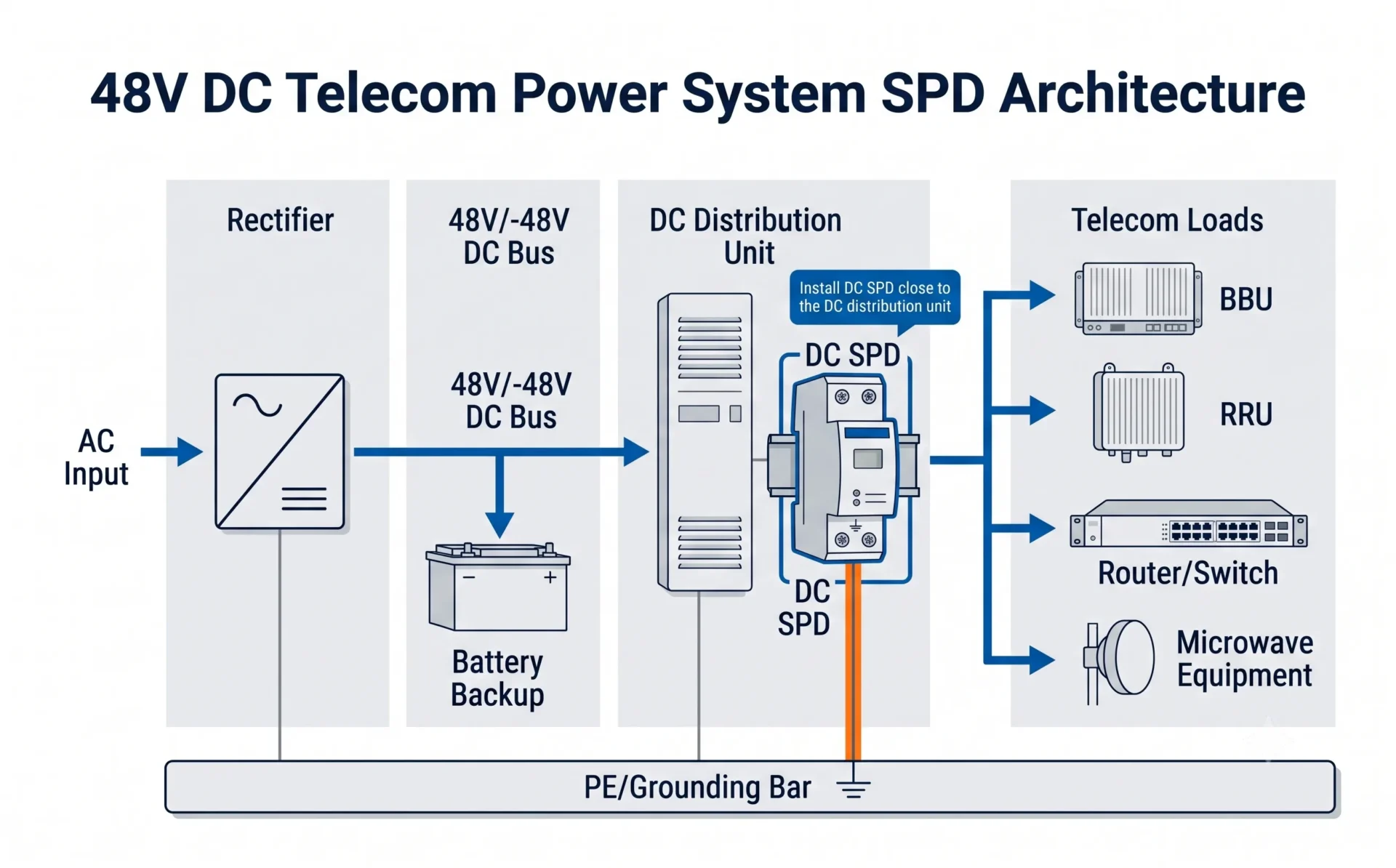
A telecom DC power system usually includes AC input power, rectifier modules, battery backup, a 48V / -48V DC bus, a DC distribution unit, fuses or DC breakers, and telecom loads such as BBU, RRU, router, switch, or microwave equipment.
The SPD discussed in this guide is mainly for the 48V / -48V DC power circuit. It is not the same as an AC input SPD, RJ45 signal SPD, RS485 signal SPD, coaxial antenna SPD, or PV 600V / 1000V / 1500V DC SPD.
Why Telecom Power Systems Often Use -48V DC
Many telecom power systems are described as -48V DC systems. In simple terms, this means the telecom equipment is powered by a negative DC supply architecture, usually combined with rectifier modules and battery backup.
For SPD selection, the important point is not the name alone. The buyer must confirm the actual DC+ / RTN, DC− / -48V, PE, bonding, and grounding arrangement of the cabinet. A 48V DC SPD and a -48V DC SPD may refer to the same telecom application, but the wiring and pole protection must match the real system design.
Where Should the 48V DC SPD Be Installed?
The most common position is near the DC distribution unit or at the DC power entry of the telecom cabinet. The purpose is simple: divert surge energy to PE before it reaches sensitive telecom equipment.
| Installation Point | When to Use | Notes for Buyers |
|---|---|---|
| DC distribution unit output | Standard telecom cabinet protection | Common position for cabinet-level DC power protection |
| Cabinet DC incoming side | Outdoor or remote cabinets | Protects the DC power entry before internal branch circuits |
| Equipment branch circuit | Sensitive or high-value telecom loads | Used as secondary protection close to protected equipment |
| Rectifier output side | Integrated telecom power systems | Confirm with rectifier or system supplier before layout |
| Battery / DC bus area | Site-specific power architecture | Requires careful coordination with cabinet grounding design |
The SPD is normally installed in parallel with the DC circuit. The PE conductor should be short, straight, and connected to a reliable grounding bar.
How to Choose the Rated Voltage for a 48V DC SPD
Do not select the SPD only by the name “48V”. A telecom power system may be called 48V, but the actual DC bus voltage can be higher during charging, float operation, battery management, or rectifier output adjustment.
The SPD continuous operating voltage must be high enough to withstand the real working voltage of the system. For procurement, confirm the nominal DC voltage, maximum continuous DC operating voltage, battery charging voltage range, rectifier output voltage range, system grounding method, and site exposure level.
| System Situation | What to Confirm | Buyer Direction |
|---|---|---|
| Standard 48V / -48V telecom cabinet | Rectifier output range and battery charging voltage | Select a low-voltage DC SPD with suitable continuous operating voltage margin |
| Outdoor base station power system | Maximum DC bus voltage, site exposure, grounding quality | Confirm both voltage rating and surge current capability |
| OEM telecom cabinet batch order | Whether all cabinets use the same voltage range and wiring design | Use one confirmed SPD model to reduce batch production risk |
| Non-standard DC power system | Actual maximum continuous operating voltage | Do not copy a standard 48V SPD model blindly |
48V DC SPD vs PV DC SPD vs AC SPD
One common purchasing mistake is choosing a familiar SPD type instead of the correct SPD for the actual circuit. A telecom 48V DC power circuit should not be treated like a PV string or an AC distribution board.
| SPD Type | Designed For | Why It Matters for Telecom Buyers |
|---|---|---|
| 48V / -48V DC telecom SPD | Low-voltage DC telecom power circuits, cabinets, and base station DC distribution | This is the correct direction for 48V telecom cabinet power protection |
| PV DC SPD | Solar PV strings with much higher DC voltage ranges | Not a direct replacement for 48V telecom power systems |
| AC SPD | AC distribution boards, AC input panels, and AC power circuits | Useful for the AC input side, but not for the 48V DC cabinet bus |
| Signal SPD | RJ45, RS485, control, monitoring, or communication lines | Needed for signal ports, but different from DC power protection |
Positive and Negative Pole Protection in -48V Telecom Systems
Telecom systems are often described as -48V DC systems. In many telecom power architectures, the return conductor and grounding arrangement are defined by the cabinet or site design. That is why SPD wiring must follow the actual system diagram, not only the product name.
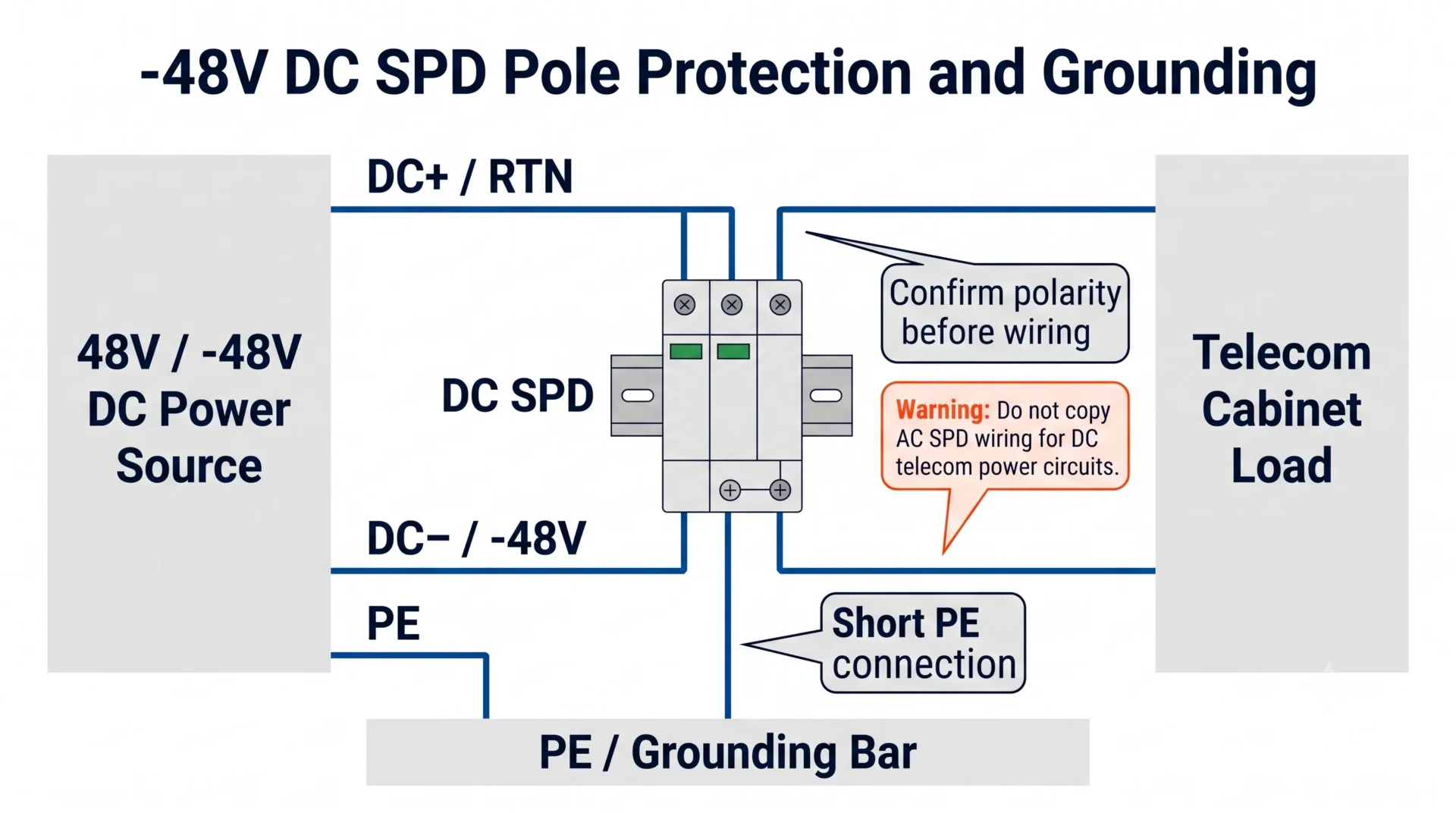
For OEM telecom cabinets, this point is very important. A model may fit mechanically, but the pole configuration may not match the actual electrical design.
- Confirm whether the system is marked 48V DC or -48V DC
- Confirm DC+ / RTN and DC− / -48V conductor arrangement
- Confirm which conductor is bonded to earth or cabinet ground
- Confirm whether the SPD module is polarity-sensitive
- Confirm the wiring diagram before batch cabinet production
Suggested Parameters to Confirm for 48V DC Telecom SPD
If you are comparing suppliers, do not ask only for “48V DC SPD price”. Ask each supplier to confirm the same technical parameters, otherwise the quotations may not be comparable.
| Parameter | What It Means | What Buyers Should Ask |
|---|---|---|
| Continuous operating voltage | The DC voltage the SPD can withstand continuously | Is it suitable for the real rectifier and battery voltage range? |
| In | Nominal discharge current | What is the tested nominal surge current rating? |
| Imax | Maximum discharge current for Type 2 SPD | Is it enough for the cabinet site exposure level? |
| Up | Voltage protection level | Is the residual voltage suitable for the protected telecom equipment? |
| Poles | DC+ / DC− / PE protection arrangement | Does the wiring match the -48V telecom cabinet design? |
| Remote alarm | Dry contact for failure monitoring | Does the project need NO, NC, or both? |
| Mounting | DIN rail or cabinet mounting | Will it fit the available cabinet space? |
| Certificate / test report | Document support for project approval | Can the supplier provide the required document package? |
Type 2 or Type 1+2: Which Is Better for Telecom 48V DC?
For many indoor telecom cabinets, a Type 2 DC SPD is used for induced surges and switching transients. For outdoor base stations, exposed telecom shelters, mountain sites, tower areas, or long cable routes, the protection design may require stronger upstream protection or coordinated Type 1+2 / Type 2 protection.
| Site Condition | Common SPD Direction | Buyer Note |
|---|---|---|
| Indoor telecom room | Type 2 DC SPD | Usually for secondary DC power protection |
| Outdoor telecom cabinet | Type 2 or higher surge capacity | Grounding quality becomes more important |
| Tower base station | Coordinated AC + DC + signal protection | 48V DC SPD alone is not enough for the whole site |
| High lightning area | Site-level surge protection design | Do not rely on only one SPD point |
| OEM telecom cabinet | Project specification based selection | Keep the same model and label for batch consistency |
Grounding Requirements for 48V DC Telecom SPD
A 48V DC SPD cannot work well without a proper surge discharge path. The PE connection should be short, straight, low impedance, and properly bonded to the cabinet grounding system.
A long PE cable can make the installed protection worse than the datasheet value suggests. The SPD may still discharge surge current, but the protected equipment may see a higher residual voltage because of conductor inductance.
- Keep the PE conductor short and straight
- Avoid looping the PE cable around other conductors
- Connect to a reliable grounding bar
- Check cabinet bonding and grounding continuity
- Avoid loose, corroded, or shared poor connections
- Follow the project grounding design and local requirements
Should a 48V DC Telecom SPD Have Remote Alarm?
For monitored telecom cabinets, remote alarm is highly recommended. A remote alarm contact does not protect against surges by itself. It tells the maintenance system when the SPD has failed or needs replacement.
| Application | Remote Alarm Needed? | Reason |
|---|---|---|
| Indoor cabinet with regular inspection | Optional | Visual indicator may be enough |
| Outdoor unmanned cabinet | Recommended | Maintenance team cannot check daily |
| Base station power system | Recommended | Helps reduce unnoticed SPD failure |
| OEM monitored cabinet | Strongly recommended | Adds value to the cabinet design |
| Small standalone cabinet | Optional | Depends on maintenance plan |
Typical remote alarm options include NO dry contact, NC dry contact, and a 3-pin terminal. Before ordering, confirm whether your monitoring system expects NO or NC logic. For wiring examples, see our guide on SPD remote alarm contact wiring.
Key Parameters to Confirm Before Ordering
For B2B orders, the buyer should not only ask for “48V DC SPD price”. A correct inquiry should include the real cabinet parameters, otherwise the supplier may recommend the wrong model.
| Parameter | What to Confirm | Why It Matters |
|---|---|---|
| Nominal voltage | 48V or -48V DC | Basic system match |
| Max continuous voltage | Actual maximum DC bus voltage | Prevents wrong voltage selection |
| SPD type | Type 2 or Type 1+2 | Matches site exposure and project design |
| In / Imax | Nominal and maximum discharge current | Determines surge handling capacity |
| Up | Voltage protection level | Lower Up helps protect sensitive equipment |
| Poles | DC+ / DC− / PE wiring | Prevents wrong wiring and wrong module selection |
| Mounting | 35mm DIN rail or cabinet mounting | Affects cabinet layout and installation space |
| Remote alarm | NO / NC dry contact | Needed for monitored telecom sites |
| Visual indicator | Green / red window | Helps maintenance teams identify failed modules |
| OEM label | Brand, model, label, packaging | Needed for private label and cabinet production |
Common Mistakes When Selecting 48V DC Telecom SPD
Mistake 1: Using a PV DC SPD for a 48V Telecom Cabinet
PV DC SPDs are usually designed for much higher DC voltages. They are not automatically suitable for 48V telecom power systems.
Mistake 2: Selecting by “48V” Only
The real maximum operating voltage matters more than the nominal name. Always check the rectifier and battery voltage range.
Mistake 3: Ignoring Grounding
A poor PE connection can make the SPD less effective. Short wiring is part of the protection system, not just an installation detail.
Mistake 4: Forgetting Remote Alarm
For unmanned telecom sites, visual indicators are not enough. Remote alarm helps the maintenance team know when a module has failed.
Mistake 5: Copying AC SPD Wiring
AC SPD wiring and DC SPD wiring are different. Do not copy an AC distribution board diagram for a 48V DC telecom cabinet.
Mistake 6: No Batch Parameter Confirmation
For OEM or cabinet batch orders, confirm voltage, pole configuration, width, label, alarm contact, and certificate before production.
Before Bulk Ordering 48V DC Telecom SPDs
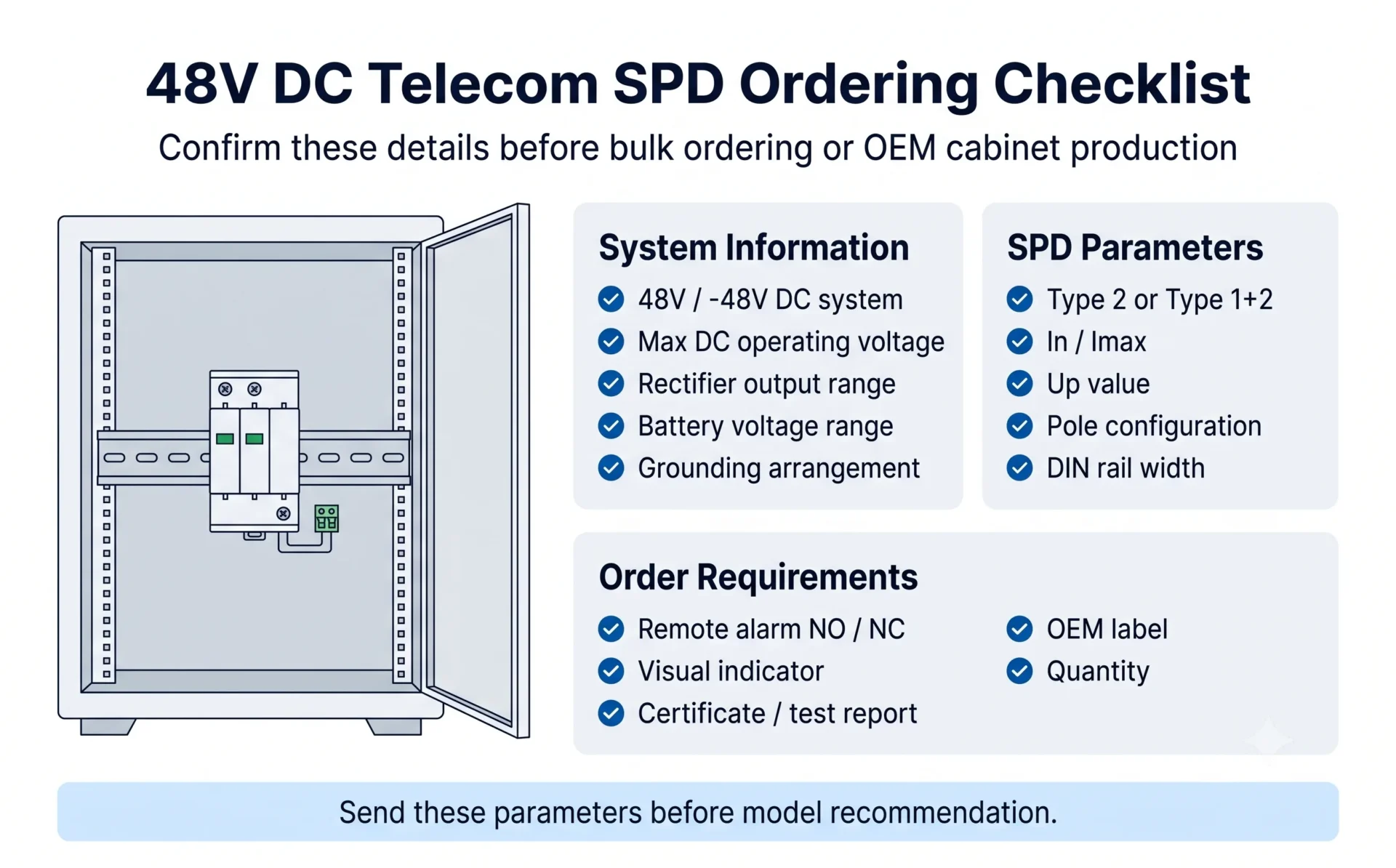
Send these details to the supplier before asking for a final model recommendation. This turns the inquiry from “send price” into a real technical selection request and reduces wrong-model orders.
- Application: telecom cabinet, base station power unit, or DC distribution unit
- Nominal system voltage: 48V or -48V DC
- Maximum DC operating voltage
- Rectifier output voltage range
- Battery backup voltage range
- Grounding arrangement
- Installation position
- Required SPD type: Type 2 or Type 1+2
- Required In / Imax
- Required Up value
- Pole configuration
- DIN rail space
- Remote alarm requirement: NO / NC / both
- Visual indicator requirement
- Required certificate or test report
- OEM label and packaging requirement
- Estimated order quantity
Send your 48V telecom power parameters
LEEYEE can help confirm a suitable DC SPD model for telecom cabinets, base station DC distribution units, outdoor cabinets, and OEM power system projects.
Related Reading
These pages can help buyers build a complete surge protection plan for telecom power systems and OEM cabinet projects.
FAQ: 48V DC SPD for Telecom Power Systems
What SPD should I use for a 48V DC telecom power system?
Use a low-voltage DC SPD designed for 48V / -48V telecom power circuits. It should match the real maximum DC operating voltage, installation position, grounding system, and remote monitoring requirement.
What is the difference between a 48V DC SPD and a -48V DC SPD?
In telecom applications, both terms often refer to surge protection for the same low-voltage DC power architecture. The key is to confirm the real DC+ / RTN, DC− / -48V, PE, and grounding arrangement before selecting the SPD.
Can I use a 65V DC SPD for a 48V telecom power system?
Only if the SPD continuous operating voltage, wiring design, discharge current rating, and test documents match the actual telecom power system. Do not choose by voltage number alone. Confirm the rectifier and battery voltage range first.
Is a 48V DC SPD the same as a PV DC SPD?
No. PV DC SPDs are usually designed for much higher DC voltages such as 600V, 1000V, or 1500V. A 48V telecom power system needs an SPD matched to low-voltage DC operation.
Should the SPD be installed before or after the rectifier?
In many telecom systems, the DC SPD is installed on the DC distribution side, downstream of the rectifier and close to the protected DC loads. The exact position should follow the cabinet design and power system supplier requirement.
Where is the best installation point for a 48V DC SPD in a base station cabinet?
A common position is near the DC distribution unit or the DC power entry of the cabinet. For sensitive branches, additional protection may be installed closer to the protected equipment.
Does a -48V DC system need special SPD wiring?
Yes. The SPD wiring should match the actual DC+ / DC− / PE arrangement and grounding method of the telecom system. Do not copy AC SPD wiring for DC telecom power circuits.
Is remote alarm necessary for a telecom DC SPD?
For outdoor or unmanned telecom cabinets, remote alarm is strongly recommended. It allows the monitoring system to detect SPD failure without opening the cabinet.
Should a telecom DC SPD have NO/NC remote alarm contact?
For monitored telecom cabinets, yes, it is usually useful. Confirm whether the monitoring system expects NO, NC, or both before ordering.
What Uc should I choose for a 48V DC SPD?
The SPD continuous operating voltage should be higher than the actual maximum continuous DC operating voltage of the system. Confirm the rectifier and battery charging voltage range before selecting the model.
Can one 48V DC SPD protect the whole telecom site?
No. A telecom site may also need AC input SPD, signal SPD, RJ45 SPD, coaxial SPD, and proper grounding. This page only covers the 48V DC power circuit.
What should I confirm before ordering 48V DC SPDs in bulk?
Confirm nominal voltage, maximum DC voltage, SPD type, In/Imax, Up, pole configuration, DIN rail width, remote alarm, certificate, label, packaging, and order quantity.